

|
시장보고서
상품코드
2118198
마케팅 데이터 관리 시장 : 시장 점유율 분석, 업계 동향 및 통계, 성장 예측(2026-2031년)Marketing Data Management - Market Share Analysis, Industry Trends & Statistics, Growth Forecasts (2026 - 2031) |
||||||
 Mordor Intelligence
Mordor Intelligence에 의하면, 마케팅 데이터 관리 시장 규모는 2025년 102억 8,000만 달러로 평가되었고, 2026년에는 112억 4,000만 달러로 추정되고, 2031년까지 201억 6,000만 달러에 이를 것으로 예상되며, 2026-2031년 CAGR 12.39%로 성장할 전망입니다.
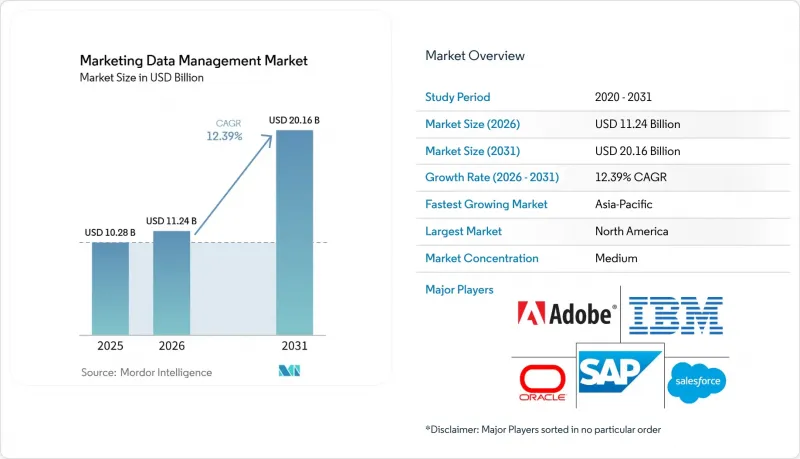
본 보고서는 솔루션별(데이터 관리 플랫폼, 고객 데이터 플랫폼, 데이터 통합 및 거버넌스 솔루션 등), 도입 형태별(클라우드, 온프레미스, 하이브리드), 조직 규모별(대기업, 중소기업), 최종 사용자 산업별(소매 및 전자상거래, BFSI 등), 그리고 지역별로 분류되어 있습니다. 시장 전망은 금액(달러) 기준으로 제시되어 있습니다.
세계의 마케팅 데이터 관리 시장 동향 및 인사이트
통합된 고객 데이터 거버넌스에 대한 수요 증가
고객 데이터는 오랫동안 CRM 시스템, 커머스 플랫폼, 광고 도구, 오프라인 기록 등에 분산되어 있어 각 사용자를 명확하게 파악하기 어려웠습니다. 현재 기업들은 규제 준수와 일상적인 캠페인 실행을 모두 지원할 수 있는 거버넌스가 철저히 갖춰진 데이터 환경을 필요로 하고 있어 마케팅 데이터 관리 시장이 그 혜택을 보고 있습니다. 유럽의 GDPR(EU 개인정보보호규정), 인도의 디지털 개인 데이터 보호법 및 기타 지역의 유사한 프레임워크로 인해 거버넌스는 플랫폼 설계의 핵심 요소가 되었습니다. 세일즈포스는 2025년 11월, 인포매티카(Informatica) 인수를 완료함으로써 통합, 데이터 품질, 개인정보 보호,메타데이터, 마스터 데이터 관리를 단일 플랫폼 스택으로 통합함으로써 이러한 방향성을 더욱 강화했습니다. 또한, 프랑스 CNIL은 2026년 1월, 마케팅 데이터 처리에 관한 동의 증명 기준에 대한 공식 협의를 시작했으며, 이로 인해 유럽 전역에서 감사 가능한 거버넌스 도구의 중요성이 높아졌습니다.
AI를 활용한 오디언스 세분화의 확산
AI 주도형 오디언스 세분화는 시험적 활용 단계에서 일상적인 마케팅 업무로 전환되고 있으며, 더 깨끗한 퍼스트파티 데이터에 대한 필요성이 높아지고 있습니다. HubSpot의 보고서에 따르면, 2026년에는 마케팅 담당자의 87%가 적어도 하나의 정기적인 워크플로우에서 생성형 AI를 활용하고 있으며, 40.8%는 오디언스 세분화에 이를 활용하고 있었습니다. 세분화 모델은 신원이 확인되고 동의 정보가 반영된 고객 레코드를 기반으로 할 때 더 높은 성과를 내기 때문에 마케팅 데이터 관리 시장은 이러한 변화의 혜택을 받고 있습니다. Salesforce는 2026년 3월 실적 발표 시점에서 Data Cloud의 엔터프라이즈 고객 수가 12,000개사에 달했다고 밝히며, 대기업들이 AI 이용 사례를 통합된 고객 데이터 환경과 얼마나 신속하게 연계하고 있는지를 부각시켰습니다. EU AI법은 2026년 8월 2일부터 단계적으로 요건을 적용하며, 프로파일링 및 타겟팅에 사용되는 AI 시스템에 대한 문서화, 투명성 및 감독 요건을 강화합니다.
레거시 마케팅 스택의 통합 복잡성
많은 기업이 어트리뷰션, 개인화, 캠페인 관리, 데이터 활용을 위해 개별 시스템을 운영하고 있어, 엔터프라이즈용 마케팅 스택의 관리가 점점 더 어려워지고 있습니다. 마케팅 데이터 관리 시장에서는 이 점이 과제로 대두되고 있습니다. 연결이 늘어날 때마다 소스 시스템이 변경될 때 스키마 드리프트, 모니터링 작업, 복구 작업이 증가할 가능성이 있기 때문입니다. IBM의 조사에 따르면, Salesforce를 외부 플랫폼에 연결한 조직은 매우 성공적인 비즈니스 성과를 보고할 가능성이 약 3배 더 높은 것으로 나타났으며, 이는 통합의 질이 실제 수익에 얼마나 큰 영향을 미치는지를 여실히 보여줍니다. 구식 ETL 환경은 API나 소스 필드가 변경될 때 작동하지 않게 되는 등 유연성이 부족한 데이터 로직에 의존하는 경우가 많기 때문에 특히 현대화가 어렵습니다. 따라서 데이터 통합성을 높이는 것의 가치와 마이그레이션에 소요되는 시간, 업무에 미치는 지장, 긴 도입 주기를 신중하게 고려해야 하므로 많은 구매자들이 신중한 태도를 취하고 있습니다.
부문 분석
2025년 시점에서 솔루션별로는 데이터 관리 플랫폼(DMP)이 28.41%로 가장 큰 점유율을 차지했으며, 솔루션 구성에서 마케팅 데이터 관리 시장을 주도하는 카테고리가 되었습니다. 이러한 지위는 프로그래매틱 광고 및 크로스사이트 타겟팅을 위한 익명 오디언스 부문 관리 분야에서 오랫동안 확립된 역할에서 비롯된 것입니다. 그러나 기업들이 DMP 주도 워크플로우에서 퍼스트 파티 고객 ID를 핵심으로 하는 시스템으로 전환함에 따라 DMP의 중심적인 지위는 점차 약화되고 있습니다. 고객 데이터 플랫폼(CDP)은 2031년까지 연평균 성장률(CAGR) 15.82%로 확대될 것으로 예상되며, 이는 새로운 수요가 어디로 향하고 있는지를 보여줍니다. 이러한 성장은 채널 전반에 걸친 개인화, 어트리뷰션, AI 주도형 활성화(activation)를 뒷받침할 수 있는 행동 데이터, 거래 데이터, CRM 데이터의 통합에 대한 수요와 밀접하게 관련되어 있습니다.
또한, 마케팅 데이터 관리 업계에서는 데이터 통합 및 거버넌스 도구에 대한 수요가 증가하고 있습니다. 이는 기업이 IT 주도형 운영 모델에 전적으로 의존하지 않으면서도 마케팅 팀이 더 깨끗하고 데이터 계보가 추적 가능한 데이터를 활용할 수 있도록 하기 위함입니다. 세일즈포스와 인포매티카의 통합은 마케팅 운영에서 거버넌스가 적용된 파이프라인 및 메타데이터 관리의 활용 사례를 확대함으로써 이러한 방향성을 더욱 강화했습니다. ID 해결 솔루션은 온라인,앱, 오프라인 행동을 단일하고 영구적인 고객 레코드에 연결하는 것이 필수적인 리테일 미디어 및 금융 서비스 분야에서 주목받고 있습니다. 캠페인 데이터 오케스트레이션은 현재 매출 규모상 여전히 가장 작은 부문이지만, 업스트림 데이터 투자가 측정 가능한 비즈니스 성과로 이어지는 계층이기 때문에 높은 전략적 가치를 지니고 있습니다. 2026년 7월 Treasure AI가 IDC MarketScape에서 평가받은 사실 또한, 솔루션 리더십이 퍼스트파티 신원, AI 기반 의사결정, 멀티채널 실행을 단일 아키텍처 내에서 통합하는 데 점점 더 의존하고 있음을 보여줍니다.
2025년 마케팅 데이터 관리 시장에서 클라우드 도입은 시장 점유율의 64.73%를 차지하며 주요 도입 형태로서의 우위를 유지했습니다. 이러한 우위는 확장성, 규정 준수 관리, Snowflake, BigQuery, Databricks 등의 플랫폼과의 신속한 통합과 같은 클라우드의 구조적 이점을 반영한 것입니다. 또한 기업들은 새로운 데이터 소스를 신속하게 추가해야 할 때 사내 엔지니어링 부담을 일부 줄일 수 있다는 점에서도 클라우드를 선호했습니다. 이로 인해 사내 프로세스를 모두 재구축하지 않고도 여러 채널에 걸쳐 고객 데이터 운영을 확대하려는 기업들에게 클라우드는 특히 매력적인 선택지가 되었습니다. 그 결과, 새로운 도입 활동의 상당 부분에서 클라우드는 여전히 기본 운영 모델로 자리 잡았습니다.
금융 서비스 및 헬스케어 분야에서는 데이터 저장 장소에 관한 규제, 보안 정책, 레거시 인프라가 완전한 전환을 방해했기 때문에 온프레미스 배포는 여전히 중요한 위치를 차지하고 있었습니다. 하이브리드 환경은 2031년까지 연평균 성장률(CAGR) 14.29%를 나타낼 것으로 예측되며, 많은 기업이 완전한 전환(컷오버)보다는 단계적인 전환을 선호하고 있음을 알 수 있습니다. 마케팅 데이터 관리 업계에서는 기업들이 레거시 시스템과의 연동을 유지하면서, 활성화 및 분석을 최신 클라우드 환경에 가깝게 하려는 움직임에 따라 하이브리드 솔루션의 중요성이 높아지고 있습니다. 어도비는 2026년 3월, Salesforce CRM, Microsoft Dynamics, Marketo Engage에 대한 변경 데이터 캡처(CDC) 지원을 확대하고, 혼합 환경의 운영 유지를 용이하게 함으로써 이 모델을 강화했습니다. 컴포저블 CDP 아키텍처는 핵심 고객 데이터를
지역별 분석
2025년, 북미는 36.82%라는 최대의 지역 점유율을 차지하며 마케팅 데이터 관리 시장을 주도하는 지역이 되었습니다. 그 수익의 대부분은 미국이 차지하고 있는데, 이는 높은 기업 소프트웨어 지출, 밀집된 벤더 기반, 그리고 성숙한 시스템 통합사업자 생태계가 결합된 결과입니다. 캐나다에서는 기업의 디지털 전환 활동을 통해 안정적인 수요가 나타났습니다. 한편, 멕시코는 규모는 작지만 국경을 넘는 전자상거래와 연동되어 성장을 지속하는 시장이 되었습니다. 또한, 미국의 주 차원 개인정보 보호 규제로 인해 거버넌스 및 동의 처리가 조달 과제로 계속해서 중요시되었습니다. 북미에서는 통합된 고객 데이터와 AI를 활용한 마케팅 시스템을 조기에 도입했기 때문에 마케팅 데이터 관리 시장은 해당 지역에서 가장 견조한 성장세를 보였습니다.
유럽은 GDPR(EU 개인정보보호규정)로 인해 고객 데이터 취급에 대한 거버넌스가 법적 및 운영상의 요건이 됨에 따라 중요한 2위 점유율을 차지했습니다. EU AI법은 프로파일링 및 오디언스 타겟팅에 사용되는 AI에 대해 단계적인 의무를 도입하고 2026년 8월 2일부터 시행됨에 따라, 규정 준수에 새로운 차원을 더했습니다. 독일과 영국은 계속해서 해당 지역 내 최대 시장 거점으로 자리매김했습니다. 또한 프랑스에서는 CNIL(프랑스 국가정보자유위원회)이 2026년 1월 동의 증명 기준에 관한 협의를 진행하면서 모멘텀이 강화되었고, 채널 전반에 걸친 감사 가능한 동의 추적에 대한 수요가 높아졌습니다. 남미는 여전히 규모는 작지만, 브라질에서는 소매, 금융 서비스, 미디어 플레이어들이 LGPD(브라질 개인정보 보호법)의 틀 아래에서 퍼스트 파티 데이터 인프라에 대한 투자를 지속함에 따라 계속해서 두드러진 존재감을 보였습니다.
아시아태평양은 2031년까지 14.81%라는 지역별 최고 연평균 성장률(CAGR)을 보일 것으로 예상되어, 마케팅 데이터 관리 시장의 주요 성장 동력이 되고 있습니다. 인도, 동남아시아, 한국, 일본에서는 전자상거래의 확대와 기업의 마케팅 기술 예산 증가에 따라 수요가 높아지고 있습니다. Treasure Data에 따르면, 일본의 국내 CDP 시장은 2020년 170억 엔(1억 1,300만 달러)에서 2025년에는 490억 엔(3억 2,450만 달러)로 성장할 것으로 보이며(2025년 IRS 평균 환율 기준), 2027년까지 750억 엔으로 성장이 지속될 것으로 예측됩니다. 또한 중국, 인도, 베트남, 싱가포르에서는 현지화, 데이터 이전 규정, 동의 아키텍처에 대해 서로 다른 기대가 형성되고 있어 지역별 규정 준수 복잡성도 증가하고 있습니다. 중동 및 아프리카는 여전히 규모가 가장 작은 지역 그룹이었으나, 디지털 전환 및 기업의 고객 참여 기반에 투자하고 있는 경제권에서는 도입이 순조롭게 진행되었습니다.
기타 혜택 :
- 엑셀 형식 시장 예측(ME) 시트
- 3개월간의 애널리스트 지원
자주 묻는 질문
목차
제1장 서론
제2장 조사 방법
제3장 개요
제4장 시장 구도
제5장 시장 규모 및 성장 예측
제6장 경쟁 구도
제7장 시장 기회 및 향후 전망
AJY 26.09.01According to Mordor Intelligence, the marketing data management market size is expected to increase from USD 10.28 billion in 2025 to USD 11.24 billion in 2026 and reach USD 20.16 billion by 2031, growing at a CAGR of 12.39% over 2026-2031.
This report is Segmented by Solutions (Data Management Platforms, Customer Data Platforms, Data Integration and Governance Solutions, and More), Deployment Mode (Cloud, On-Premises, and Hybrid), Organization Size (Large Enterprises, and Small and Medium Enterprises), End-User Industry (Retail and E-Commerce, BFSI, and More), and Geography. The Market Forecasts are Provided in Terms of Value (USD).
Global Marketing Data Management Market Trends and Insights
Growing Need for Unified Customer Data Governance
Customer data has long been scattered across CRM systems, commerce platforms, ad tools, and offline records, limiting a clear view of each user. The Marketing Data Management Market is benefiting because enterprises now need governed data environments that can support both regulatory compliance and daily campaign execution. GDPR in Europe, the Digital Personal Data Protection Act in India, and similar frameworks across other regions have pushed governance into the center of platform design. Salesforce reinforced this direction in November 2025 when it completed the acquisition of Informatica, bringing integration, data quality, privacy, metadata, and master data management into a single platform stack. France's CNIL also opened a formal consultation in January 2026 on consent proof standards for marketing data processing, which raised the importance of auditable governance tools across Europe.
Rising Adoption of AI-Driven Audience Segmentation
AI-led audience segmentation has moved from pilot use into regular marketing operations, increasing the need for cleaner first-party data. HubSpot reported that 87% of marketing professionals were using generative AI in at least 1 recurring workflow in 2026, while 40.8% were using it for audience segmentation. The Marketing Data Management Market is benefiting from this shift because segmentation models perform better when they rely on identity-resolved, consent-aware customer records. Salesforce said Data Cloud had 12,000 enterprise customers as of its March 2026 earnings call, highlighting how quickly large organizations were aligning AI use cases with unified customer data environments. The EU AI Act will apply phased requirements from August 2, 2026, increasing documentation, transparency, and supervision requirements for AI systems used for profiling and targeting.
Integration Complexity Across Legacy Marketing Stacks
Enterprise marketing stacks have become harder to manage because many companies run separate systems for attribution, personalization, campaign management, and data activation. The Marketing Data Management Market faces friction here because every extra connection can increase schema drift, monitoring work, and recovery effort when source systems change. IBM found that organizations connecting Salesforce to external platforms were nearly 3 times more likely to report highly successful business outcomes, underscoring how strongly integration quality shapes actual returns. Older ETL environments are especially difficult to modernize because they often depend on rigid data logic that breaks when APIs or source fields change. This makes many buyers cautious because the value of better data unification must still be weighed against migration time, operational disruption, and long implementation cycles.
Other drivers and restraints analyzed in the detailed report include:
- First-Party Data Monetization Pressure After Cookie Deprecation
- Expansion of Omnichannel Campaign Orchestration
- High Compliance Burden for Cross-Border Data Use
For complete list of drivers and restraints, kindly check the Table Of Contents.
Segment Analysis
Data management platforms held the largest share by solutions at 28.41% in 2025, making them the leading category within the Marketing Data Management Market by solution mix. Their position came from a long-established role in managing anonymous audience segments for programmatic advertising and cross-site targeting. Even so, their centrality is weakening as enterprises shift from DMP-led workflows to systems built around first-party customer identity. Customer data platforms are projected to expand at a 15.82% CAGR through 2031, which shows where new demand is moving. This growth is tied to the need for unified behavioral, transactional, and CRM data that can support personalization, attribution, and AI-led activation across channels.
The Marketing Data Management industry is also seeing rising demand for data integration and governance tools, as enterprises seek to enable marketing teams to work with cleaner, lineage-tracked data without relying entirely on IT-led operating models. The Salesforce and Informatica combination strengthened this direction by broadening the use case for governed pipelines and metadata management inside marketing operations. Identity resolution solutions are gaining traction in retail media and financial services, where linking online, app, and offline behavior into a single durable customer record is essential. Campaign data orchestration remains the smallest segment by current revenue, but it carries high strategic value because it is the layer where upstream data investments become measurable business outcomes. Treasure AI's July 2026 recognition in the IDC MarketScape also showed that solution leadership increasingly hinges on combining first-party identity, AI decisioning, and multi-channel execution within a single architecture.
Cloud deployments accounted for 64.73% of the Marketing Data Management Market share in 2025, maintaining their lead as the leading deployment mode. That lead reflected cloud's structural advantages in scalability, managed compliance support, and faster integration with platforms such as Snowflake, BigQuery, and Databricks. Enterprises also favored cloud because it reduced part of the in-house engineering burden when new data sources had to be added quickly. This made the cloud especially attractive for companies trying to scale customer data operations across several channels without rebuilding every internal process. As a result, cloud remained the default operating model for much of the new deployment activity.
On-premises deployment still mattered in financial services and healthcare, where data residency rules, security policies, and legacy infrastructure slowed full migration. Hybrid is projected to grow at a 14.29% CAGR through 2031, which shows that many enterprises prefer a staged transition rather than a full cutover. The Marketing Data Management industry is seeing hybrid solutions gain importance as companies seek to preserve links to legacy systems while moving activation and analytics closer to modern cloud environments. Adobe strengthened this model in March 2026 by expanding Change Data Capture support for Salesforce CRM, Microsoft Dynamics, and Marketo Engage, making mixed deployments easier to maintain. Composable CDP architectures further support hybrid adoption because they allow core customer data
Complete Report Scope:
- By Solutions
- Data Management Platforms
- Customer Data Platforms
- Data Integration and Governance Solutions
- Identity Resolution Solutions
- Campaign Data Orchestration Solutions
- By Deployment Mode
- Cloud
- On-Premises
- Hybrid
- By Organization Size
- Large Enterprises
- Small and Medium Enterprises
- By End-User Industry
- Retail and E-Commerce
- BFSI
- Healthcare and Life Sciences
- IT and Telecom
- Media and Entertainment
- Industrial Manufacturing
- Government and Public Administration
- Other End-User Industries
- By Geography
- North America
- United States
- Canada
- Mexico
- South America
- Brazil
- Argentina
- Rest of South America
- Europe
- Germany
- United Kingdom
- France
- Italy
- Spain
- Russia
- Rest of Europe
- Asia-Pacific
- China
- India
- Japan
- South Korea
- Australia
- Rest of Asia-Pacific
- Middle East and Africa
- Middle East
- Saudi Arabia
- United Arab Emirates
- Rest of Middle East
- Africa
- South Africa
- Nigeria
- Rest of Africa
- Middle East
- North America
Geography Analysis
North America held the largest regional share at 36.82% in 2025, making it the leading region in the Marketing Data Management Market. The United States accounted for most of that revenue because it combines high enterprise software spending, a dense vendor base, and a mature ecosystem of system integrators. Canada added steady demand through enterprise digital transformation activity, while Mexico remained a smaller but growing contributor linked to cross-border e-commerce. State-level privacy regulation in the United States also kept governance and consent handling high on procurement agendas. The Marketing Data Management Market remained strongest in North America because buyers there were earlier adopters of integrated customer data and AI-enabled marketing systems.
Europe held a significant secondary share because GDPR made governing customer data handling both a legal and an operational requirement. The EU AI Act added a second compliance layer by introducing phased obligations for AI used for profiling and audience targeting, effective from August 2, 2026. Germany and the United Kingdom remained the largest market centers in the region. France also added momentum through CNIL's January 2026 consultation on consent proof standards, which increased demand for auditable consent tracking across channels. South America remained smaller in scale, but Brazil continued to stand out as enterprises in retail, financial services, and media invested in first-party data infrastructure under the LGPD framework.
Asia-Pacific is projected to record the fastest regional CAGR of 14.81% through 2031, which makes it the main growth engine for the Marketing Data Management Market. Demand is rising across India, Southeast Asia, South Korea, and Japan as e-commerce expands and enterprise marketing technology budgets deepen. Treasure Data said Japan's domestic CDP market grew from JPY 17 billion, USD 113 million, in 2020 to JPY 49 billion, USD 324.5 million, in 2025, using the 2025 IRS average exchange rate, and growth was expected to continue toward JPY 75 billion by 2027. Regional compliance complexity is also increasing because China, India, Vietnam, and Singapore are shaping different expectations for localization, transfer rules, and consent architecture. Middle East and Africa remained the smallest regional cluster, but adoption responded well in economies that were investing in digital transformation and enterprise customer engagement infrastructure.
- Adobe Inc.
- Salesforce, Inc.
- Oracle Corporation
- SAP SE
- IBM Corporation
- SAS Institute Inc.
- Tealium, Inc.
- Treasure Data, Inc.
- mParticle, Inc.
- Acquia, Inc.
- Bloomreach, Inc.
- Insider, Inc.
- Teradata Corporation
- Informatica Inc.
- Braze, Inc
- Acoustic, L.P.
- ActionIQ, Inc.
- Snowflake Inc
- Amperity, Inc.
- Lotame Solutions, Inc.
Additional Benefits:
- The market estimate (ME) sheet in Excel format
- 3 months of analyst support
TABLE OF CONTENTS
1 INTRODUCTION
- 1.1 Study Assumptions and Market Definition
- 1.2 Scope of the Study
2 RESEARCH METHODOLOGY
3 EXECUTIVE SUMMARY
4 MARKET LANDSCAPE
- 4.1 Market Overview
- 4.2 Market Drivers
- 4.2.1 Growing Need for Unified Customer Data Governance
- 4.2.2 Rising Adoption of AI-Driven Audience Segmentation
- 4.2.3 Expansion of Omnichannel Campaign Orchestration
- 4.2.4 First-Party Data Monetization Pressure After Cookie Deprecation
- 4.2.5 Demand for Real-Time Personalization Across Digital Touchpoints
- 4.2.6 Brand Safety and Consent-Aware Data Activation
- 4.3 Market Restraints
- 4.3.1 Integration Complexity Across Legacy Marketing Stacks
- 4.3.2 High Compliance Burden for Cross-Border Data Use
- 4.3.3 Talent Gap in Data Engineering and MarTech Operations
- 4.3.4 Vendor Lock-In Risks in Closed Marketing Data Ecosystems
- 4.4 Impact of Macroeconomic Factors on the Market
- 4.5 Industry Value Chain Analysis
- 4.6 Technology Outlook
- 4.7 Regulatory Landscape
- 4.8 Porter's Five Forces Analysis
- 4.8.1 Threat of New Entrants
- 4.8.2 Bargaining Power of Suppliers
- 4.8.3 Bargaining Power of Buyers
- 4.8.4 Threat of Substitutes
- 4.8.5 Intensity of Competitive Rivalry
5 MARKET SIZE AND GROWTH FORECASTS (VALUE)
- 5.1 By Solutions
- 5.1.1 Data Management Platforms
- 5.1.2 Customer Data Platforms
- 5.1.3 Data Integration and Governance Solutions
- 5.1.4 Identity Resolution Solutions
- 5.1.5 Campaign Data Orchestration Solutions
- 5.2 By Deployment Mode
- 5.2.1 Cloud
- 5.2.2 On-Premises
- 5.2.3 Hybrid
- 5.3 By Organization Size
- 5.3.1 Large Enterprises
- 5.3.2 Small and Medium Enterprises
- 5.4 By End-User Industry
- 5.4.1 Retail and E-Commerce
- 5.4.2 BFSI
- 5.4.3 Healthcare and Life Sciences
- 5.4.4 IT and Telecom
- 5.4.5 Media and Entertainment
- 5.4.6 Industrial Manufacturing
- 5.4.7 Government and Public Administration
- 5.4.8 Other End-User Industries
- 5.5 By Geography
- 5.5.1 North America
- 5.5.1.1 United States
- 5.5.1.2 Canada
- 5.5.1.3 Mexico
- 5.5.2 South America
- 5.5.2.1 Brazil
- 5.5.2.2 Argentina
- 5.5.2.3 Rest of South America
- 5.5.3 Europe
- 5.5.3.1 Germany
- 5.5.3.2 United Kingdom
- 5.5.3.3 France
- 5.5.3.4 Italy
- 5.5.3.5 Spain
- 5.5.3.6 Russia
- 5.5.3.7 Rest of Europe
- 5.5.4 Asia-Pacific
- 5.5.4.1 China
- 5.5.4.2 India
- 5.5.4.3 Japan
- 5.5.4.4 South Korea
- 5.5.4.5 Australia
- 5.5.4.6 Rest of Asia-Pacific
- 5.5.5 Middle East and Africa
- 5.5.5.1 Middle East
- 5.5.5.1.1 Saudi Arabia
- 5.5.5.1.2 United Arab Emirates
- 5.5.5.1.3 Rest of Middle East
- 5.5.5.2 Africa
- 5.5.5.2.1 South Africa
- 5.5.5.2.2 Nigeria
- 5.5.5.2.3 Rest of Africa
- 5.5.5.1 Middle East
- 5.5.1 North America
6 COMPETITIVE LANDSCAPE
- 6.1 Market Concentration
- 6.2 Strategic Moves
- 6.3 Market Share Analysis
- 6.4 Company Profiles (includes Global Level Overview, Market Level Overview, Core Segments, Financials as available, Strategic Information, Market Rank/Share, Products and Services, Recent Developments)
- 6.4.1 Adobe Inc.
- 6.4.2 Salesforce, Inc.
- 6.4.3 Oracle Corporation
- 6.4.4 SAP SE
- 6.4.5 IBM Corporation
- 6.4.6 SAS Institute Inc.
- 6.4.7 Tealium, Inc.
- 6.4.8 Treasure Data, Inc.
- 6.4.9 mParticle, Inc.
- 6.4.10 Acquia, Inc.
- 6.4.11 Bloomreach, Inc.
- 6.4.12 Insider, Inc.
- 6.4.13 Teradata Corporation
- 6.4.14 Informatica Inc.
- 6.4.15 Braze, Inc
- 6.4.16 Acoustic, L.P.
- 6.4.17 ActionIQ, Inc.
- 6.4.18 Snowflake Inc
- 6.4.19 Amperity, Inc.
- 6.4.20 Lotame Solutions, Inc.
7 MARKET OPPORTUNITIES AND FUTURE OUTLOOK
- 7.1 White-Space and Unmet-Need Assessment


