

|
시장보고서
상품코드
2122946
미국의 마케팅 분석 시장 : 시장 점유율 분석, 업계 동향 및 통계, 성장 예측(2026-2031년)United States Marketing Analytics - Market Share Analysis, Industry Trends & Statistics, Growth Forecasts (2026 - 2031) |
||||||
 Mordor Intelligence
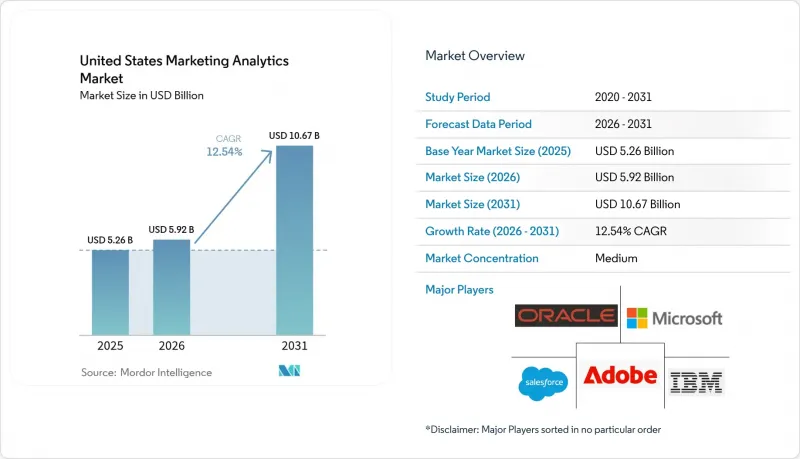
Mordor Intelligence에 의하면, 미국의 마케팅 분석 시장 규모는 2025년에 52억 6,000만 달러로 평가되었고, 2026년 59억 2,000만 달러로 추정되며, 2031년까지 106억 7,000만 달러에 이를 것으로 예측됩니다.
예측 기간(2026-2031년) 동안 연평균 성장률(CAGR)은 12.54%가 될 것으로 전망됩니다.

본 보고서는 도입 형태별(클라우드 및 온프레미스), 분석 유형별(기술적, 진단적, 예측적, 처방적), 용도별(온라인, 이메일, 컨텐츠, 소셜 미디어, 기타), 최종 사용자별(소매, 은행, 금융서비스 및 보험(BFSI), 교육, 의료, 제조, 여행 및 호스피탈리티, 기타)로 분류되어 있습니다. 시장 전망은 금액(달러) 기준으로 제시되어 있습니다.
미국의 마케팅 분석 시장 동향 및 인사이트
효과적인 ROI 달성을 위한 마케팅 예산 활용 수요 증가
이사회는 재량 지출을 엄격하게 검토하고 있으며, CMO(최고 마케팅 책임자)는 각 캠페인이 수익에 미치는 직접적인 기여도를 입증해야 합니다. 듀크 대학교의 CMO 조사에 따르면, 2024년 가을 시점에서도 마케팅 기술 활용률은 40% 미만에 그치고 있으며, 예산이 기업 수익의 9.1%로 정체되어 있음에도 불구하고 투자와 실현 가치 사이에 격차가 존재함이 드러났습니다. 광고, CRM, 커머스 플랫폼의 데이터를 통합하는 중앙 집중식 대시보드가 사일로화된 개별 솔루션을 대체하여 멀티 터치 어트리뷰션과 생애 가치(LTV) 모델링을 가능하게 하고 있습니다. 노코드 커넥터를 제공하는 벤더 덕분에 도입 기간이 분기 단위에서 몇 주 단위로 단축되어, 기술적 지식이 없는 팀도 고급 분석을 활용할 수 있게 되었습니다. 광고 비용 대비 효과(ROAS)가 가장 중요한 지표로 부상하는 가운데, 분석을 업무에 통합한 기업에서는 예산 승인 주기가 단축되고 캠페인 전개 속도가 향상되고 있습니다.
클라우드 기술과 빅데이터 도입
탄력적인 클라우드 인프라는 마케팅 기술 워크로드의 사실상의 표준이 되었습니다. 2024년에는 기업의 71%가 적어도 하나의 마케팅 분석 프로세스를 클라우드로 이전했으며, 이는 2023년의 58%에서 증가한 수치입니다. 클라우드 데이터 레이크는 웹, 모바일, POS(판매 시점 정보 관리)에서 발생하는 스트리밍 이벤트를 수집하고, 머신러닝 모델을 실행하여 실시간으로 마이크로 부문을 생성합니다. Snowflake와 Adobe Experience Platform의 연동과 같은 파트너십을 통해 스토리지 중복을 유발하지 않고 퍼스트파티 데이터를 활용할 수 있게 되어, 지연 시간 단축과 비용 절감이 가능해집니다. Apache Spark와 같은 오픈소스 엔진은 야간 배치 처리 대신, 수 초 이내에 프로파일을 업데이트하는 증분 처리를 실현하고 있습니다. 이러한 아키텍처상의 이점은 민첩한 실험과 피드백 루프의 가속화로 이어집니다.
높은 도입 비용과 시스템 통합 문제
풀스택 분석 솔루션을 도입하려면 라이선싱, 클라우드 리소스, 데이터 엔지니어링 및 변경 관리가 필요합니다. 중견 기업은 90개 이상의 마케팅 용도를 관리하는 경우가 많아, 그 결과 스키마가 파편화되거나 고객 식별자가 중복되어 통합에 필요한 노력이 증가하고 있습니다. 또한 데이터 양의 급증에 따라 클라우드 지출이 예상을 초과하는 경우도 있어, 재무 부서는 총 소유 비용(TCO)을 재검토해야 하는 상황에 직면해 있습니다. 현재 각 벤더들은 번들화된 관리형 서비스, 종량제 요금제, 사전 구축된 커넥터를 제공하여 이에 대응하고 있지만, 초기 도입 부담으로 인해 자원이 제한된 구매자의 경우 인사이트를 얻기까지의 시간이 여전히 지연되고 있습니다.
부문 분석
미국 마케팅 분석 시장의 클라우드 도입 규모는 2025년에 37억 3,000만 달러에 달했으며, 연평균 성장률(CAGR) 13.74%로 확대될 것으로 예측되어, 온프레미스형 솔루션에 대한 우위를 확고히 하고 있습니다. 2025년에는 클라우드가 미국 마케팅 분석 시장 점유율의 70.88%를 차지한 것으로 평가되었으며, 이는 기업들이 유연한 용량, 기능의 자동 릴리스, 사용량 기반 과금을 선호하고 있음을 반영합니다. 하드웨어 교체 주기 및 데이터센터 운영 비용을 절감할 수 있다는 점 때문에 투자는 IaaS(Infrastructure-as-a-Service) 쪽으로 더욱 기울고 있습니다.
주요 공급업체들은 현재 HIPAA 준수 환경, FedRAMP 인증 및 SOC 2 Type II 인증을 제공하고 있으며, 이를 통해 규정 준수 담당 팀은 규제 대상 워크로드를 안심하고 마이그레이션할 수 있게 되었습니다. 규제가 엄격한 업계조차도 기밀 데이터를 온프레미스에 보관하면서, 계산 부하가 높은 분석 처리를 클라우드로 오프로드하는 하이브리드 아키텍처의 시범 운영을 진행하고 있습니다. 동일한 환경에 통합된 머신러닝 서비스는 데이터 마이그레이션 비용을 절감하고 모델 배포를 가속화합니다. 이는 데이터 사이언스 인력이 부족한 중견 기업에게 큰 이점이 되고 있습니다.
2025년, 예측 분석은 미국 마케팅 분석 시장 규모에서 가장 큰 점유율을 유지하며 18억 1,000만 달러로 평가되었고, 시장 점유율 34.35%를 차지했습니다. 한편, 처방 분석은 연평균 성장률(CAGR) 13.28%로 확대되고 있으며, 이는 인사이트와 실행 간의 격차를 해소하는 자동화된 ‘차선책’ 권고에 대한 마케터들 수요를 반영한 것입니다. 처방 분석 엔진은 발송 시간, 제안의 가치, 크리에이티브 변형의 조합을 평가하여 가장 수익성이 높은 조치를 실시간으로 실행합니다.
클라우드 플랫폼에 통합된 AutoML 도구는 특징량 엔지니어링과 모델 튜닝을 자동화하여, 데이터 사이언스 리소스가 제한적인 팀도 쉽게 활용할 수 있게 되었습니다. 진단 분석과 서술적 분석은 경영진을 위한 보고서의 필수 요소로 남아 있지만, 사후 대응적인 특성으로 인해 전략적 영향력은 제한적입니다. 알고리즘 기반 의사결정이 일상 업무에 확산됨에 따라, 설명 가능성 및 편향 검증과 관련된 거버넌스 프로세스가 특히 금융 서비스 및 의료 분야의 이용 사례에서 표준화되고 있습니다.
기타 혜택 :
- 엑셀 형식 시장 예측(ME) 시트
- 3개월간의 애널리스트 지원
자주 묻는 질문
목차
제1장 서론
제2장 조사 방법
제3장 주요 요약
제4장 시장 구도
제5장 시장 규모 및 성장 예측
제6장 경쟁 구도
제7장 시장 기회 및 향후 전망
AJY 26.09.07According to Mordor Intelligence, the United States marketing analytics market size was valued at USD 5.26 billion in 2025 and estimated to grow from USD 5.92 billion in 2026 to reach USD 10.67 billion by 2031, at a CAGR of 12.54% during the forecast period (2026-2031).
This report is Segmented by Deployment (Cloud, and On-Premise), Analytics Type (Descriptive, Diagnostic, Predictive, and Prescriptive), Application (Online, E-Mail, Content, Social Media, and Other), End User (Retail, BFSI, Education, Healthcare, Manufacturing, Travel and Hospitality, and More). The Market Forecasts are Provided in Terms of Value (USD).
United States Marketing Analytics Market Trends and Insights
Increasing Need to Utilize Marketing Budgets for an Effective ROI
Boards are scrutinizing discretionary spending, prompting chief marketing officers to demonstrate the direct contribution of every campaign to revenue. The Duke CMO Survey showed that martech utilization remained below 40% in Fall 2024, even as budgets held steady at 9.1% of firm revenue, underscoring a gap between investment and realized value. Unified dashboards that consolidate data from advertising, CRM, and commerce platforms are replacing siloed point solutions, enabling multi-touch attribution and lifetime-value modeling. Vendors offering no-code connectors shorten implementation windows from quarters to weeks, making advanced analytics accessible to non-technical teams. As return-on-ad-spend becomes the North Star metric, enterprises that operationalize analytics experience faster budget approval cycles and higher campaign velocity.
Adoption of Cloud Technology and Big Data
Elastic cloud infrastructure has become the default for martech workloads, with 71% of enterprises migrating at least one marketing analytics process to the cloud in 2024, up from 58% in 2023. Cloud data lakes ingest streaming web, mobile, and point-of-sale events, then execute machine-learning models that create micro-segments in real time. Partnerships such as Snowflake's integration with Adobe Experience Platform allow activation of first-party data without duplicating storage, cutting latency and reducing cost. Open-source engines like Apache Spark now power incremental processing that updates profiles within seconds rather than overnight batches. These architectural gains translate into agile experimentation and faster feedback loops.
High Cost of Implementation and System Integration Issues
Deploying a full-stack analytics solution requires software licenses, cloud resources, data engineering, and change management. Mid-market firms often manage more than 90 marketing applications, which creates fragmented schemas and duplicate customer identifiers that inflate the labor needed for integration. Cloud spending can also exceed projections as data volumes surge, prompting finance teams to re-examine total cost of ownership. Vendors now respond with bundled managed services, consumption-based pricing, and pre-built connectors, yet the up-front lift still delays time-to-insight for resource-constrained buyers.
Other drivers and restraints analyzed in the detailed report include:
- Proliferation of Social Media Channels
- Growing Regulatory Focus on First-Party Data Strategies
- Increasing State-Level Consumer Data-Protection Statutes
For complete list of drivers and restraints, kindly check the Table Of Contents.
Segment Analysis
The United States marketing analytics market size for cloud deployment stood at USD 3.73 billion in 2025 and is forecast to rise at a 13.74% CAGR, cementing its dominance over on-premise alternatives. Cloud captured 70.88% of United States marketing analytics market share in 2025, reflecting enterprises' preference for elastic capacity, automatic feature releases, and usage-based billing. Cost avoidance from hardware refresh cycles and data-center overhead further tilts investment toward infrastructure-as-a-service.
Major providers now offer HIPAA-eligible environments, FedRAMP authorizations, and SOC 2 Type II attestations, giving compliance teams confidence to migrate regulated workloads. Even highly regulated sectors are piloting hybrid architectures that keep sensitive data on-premise while offloading compute-intensive analytics to the cloud. Machine-learning services embedded within the same environment reduce data-movement costs and speed model deployment, a benefit resonating with mid-market firms lacking data-science headcount.
Predictive analytics maintained the largest slice of the United States marketing analytics market size at USD 1.81 billion in 2025, equal to 34.35% share in 2025. Prescriptive analytics, however, is expanding at a 13.28% CAGR, reflecting marketer appetite for automated next-best-action recommendations that close the gap between insight and activation. Prescriptive engines evaluate permutations of send times, offer values, and creative variants, then trigger the highest-yield action in real time.
AutoML tooling embedded in cloud platforms automates feature engineering and model tuning, democratizing access for teams with limited data-science resources. Diagnostic and descriptive analytics remain table stakes for executive reporting, yet their reactive nature limits strategic impact. As algorithmic decision-making permeates daily operations, governance processes around explainability and bias review are becoming standard, particularly in financial-services and healthcare use cases.
Complete Report Scope:
- By Deployment
- Cloud
- On-Premise
- By Analytics Type
- Descriptive Analytics
- Diagnostic Analytics
- Predictive Analytics
- Prescriptive Analytics
- By Application
- Online Marketing
- E-Mail Marketing
- Content Marketing
- Social Media Marketing
- Other Applications
- By End User
- Retail
- Banking, Financial Services and Insurance
- Education
- Healthcare
- Manufacturing
- Travel and Hospitality
- Other End Users
List of Companies Covered in this Report:
- IBM Corporation
- Microsoft Corporation
- Oracle Corporation
- Salesforce Inc.
- Adobe Inc.
- SAS Institute Inc.
- Teradata Corporation
- Accenture plc
- Neustar Inc.
- Pegasystems Inc.
- Alphabet Inc.
- HubSpot Inc.
- Amplitude Inc.
- Mixpanel Inc.
- Sprinklr Inc.
- Hootsuite Inc.
- Klaviyo Inc.
- Nielsen Holdings plc
- Experian plc
- Similarweb Ltd.
Additional Benefits:
- The market estimate (ME) sheet in Excel format
- 3 months of analyst support
TABLE OF CONTENTS
1 INTRODUCTION
- 1.1 Study Assumptions and Market Definition
- 1.2 Scope of the Study
2 RESEARCH METHODOLOGY
3 EXECUTIVE SUMMARY
4 MARKET LANDSCAPE
- 4.1 Market Overview
- 4.2 Market Drivers
- 4.2.1 Increasing Need to Utilize Marketing Budgets for an Effective ROI
- 4.2.2 Adoption of Cloud Technology and Big Data
- 4.2.3 Proliferation of Social Media Channels
- 4.2.4 Growing Regulatory Focus on First-Party Data Strategies
- 4.2.5 Accelerated Shift to Real-Time Personalization Engines
- 4.2.6 Emergence of Privacy-Preserving Analytics Frameworks
- 4.3 Market Restraints
- 4.3.1 High Cost of Implementation and System Integration Issues
- 4.3.2 Availability of Feature-Rich Open-Source Tools
- 4.3.3 Increasing State-Level Consumer Data-Protection Statutes
- 4.3.4 Talent Shortage in Advanced Analytics and Data Engineering
- 4.4 Industry Value Chain Analysis
- 4.5 Impact of Macroeconomic Factors on the Market
- 4.6 Technological Outlook
- 4.7 Porter's Five Forces Analysis
- 4.7.1 Threat of New Entrants
- 4.7.2 Bargaining Power of Buyers
- 4.7.3 Bargaining Power of Suppliers
- 4.7.4 Threat of Substitute Products
- 4.7.5 Intensity of Competitive Rivalry
- 4.8 Regulatory Landscape
5 MARKET SIZE AND GROWTH FORECASTS (VALUE)
- 5.1 By Deployment
- 5.1.1 Cloud
- 5.1.2 On-Premise
- 5.2 By Analytics Type
- 5.2.1 Descriptive Analytics
- 5.2.2 Diagnostic Analytics
- 5.2.3 Predictive Analytics
- 5.2.4 Prescriptive Analytics
- 5.3 By Application
- 5.3.1 Online Marketing
- 5.3.2 E-Mail Marketing
- 5.3.3 Content Marketing
- 5.3.4 Social Media Marketing
- 5.3.5 Other Applications
- 5.4 By End User
- 5.4.1 Retail
- 5.4.2 Banking, Financial Services and Insurance
- 5.4.3 Education
- 5.4.4 Healthcare
- 5.4.5 Manufacturing
- 5.4.6 Travel and Hospitality
- 5.4.7 Other End Users
6 COMPETITIVE LANDSCAPE
- 6.1 Market Concentration
- 6.2 Strategic Moves
- 6.3 Market Share Analysis
- 6.4 Company Profiles (includes Global level Overview, Market level overview, Core Segments, Financials as available, Strategic Information, Market Rank/Share for key companies, Products and Services, and Recent Developments)
- 6.4.1 IBM Corporation
- 6.4.2 Microsoft Corporation
- 6.4.3 Oracle Corporation
- 6.4.4 Salesforce Inc.
- 6.4.5 Adobe Inc.
- 6.4.6 SAS Institute Inc.
- 6.4.7 Teradata Corporation
- 6.4.8 Accenture plc
- 6.4.9 Neustar Inc.
- 6.4.10 Pegasystems Inc.
- 6.4.11 Alphabet Inc.
- 6.4.12 HubSpot Inc.
- 6.4.13 Amplitude Inc.
- 6.4.14 Mixpanel Inc.
- 6.4.15 Sprinklr Inc.
- 6.4.16 Hootsuite Inc.
- 6.4.17 Klaviyo Inc.
- 6.4.18 Nielsen Holdings plc
- 6.4.19 Experian plc
- 6.4.20 Similarweb Ltd.
7 MARKET OPPORTUNITIES AND FUTURE OUTLOOK
- 7.1 White-Space and Unmet-Need Assessment


