|
시장보고서
상품코드
2124473
5G 기기 : 시장 점유율 분석, 업계 동향 및 통계, 성장 예측(2026-2031년)5G Devices - Market Share Analysis, Industry Trends & Statistics, Growth Forecasts (2026 - 2031) |
||||||
 Mordor Intelligence
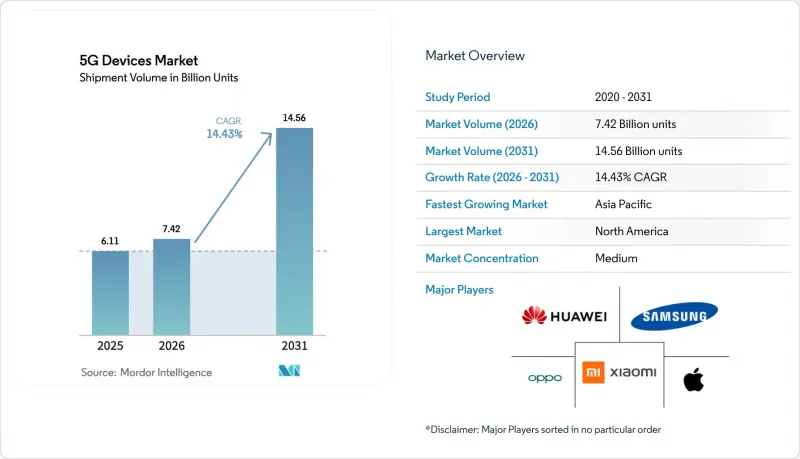
Mordor Intelligence에 의하면, 출하대수 기반 5G 기기 시장 규모는 2025년 61억 1,000만 대로 평가되었습니다. 2026년에는 74억 2,000만 대로 확대되어 2026년부터 2031년에 걸쳐 CAGR 14.43%로 성장을 지속하여, 2031년에는 145억 6,000만 대에 이를 것으로 예측됩니다.
본 보고서는 폼 팩터(스마트폰, CPE, 산업용 라우터, 모듈, 노트북·태블릿, 핫스팟, 웨어러블·XR), 지원 주파수 대역(서브 6GHz, mm파, 하이브리드), 최종 사용자(일반 소비자, 산업, 자동차, 의료, 에너지, 기업),용도(eMBB, URLLC, MMTC, FWA, V2X), 지역별로 분류되어 있습니다. 시장 예측은 수량(대수) 기준으로 제시되어 있습니다.
세계의 5G 기기 시장 동향 및 인사이트
신흥 경제국에서의 모바일 데이터 수요 폭발적 증가
인도의 사용자 1인당 월간 데이터 소비량은 2025년에 20기가바이트를 넘어섰습니다. 이는 클라우드 게임, 증강현실(AR) 필터, 100밀리초 미만의 지연 시간이 필요한 실시간 번역 도구 등이 주도한 결과입니다. 전 세계 5G 커버리지는 55%에 달했으나, 저소득 국가에서의 보급률은 고작 4%에 그쳤으며, 도입을 좌우한 요인은 인프라보다 저렴한 가격이었습니다. 이에 대응해 통신 사업자들은 단말기 초기 비용을 경감하는 할부 요금제를 도입했고, 각 제조업체들은 고급 기능을 제외한 150달러 미만의 스마트폰을 출시하기 시작했습니다. 이러한 움직임으로 인해 이익률은 압박을 받았지만, 5G 기기 시장은 얼리 어답터층을 넘어 확대되었습니다. 그 결과, 판매 대수가 늘어나 출하 대수의 두 자릿수 성장을 뒷받침하는 기반이 마련되었습니다.
5G 칩셋 및 RF 프런트엔드의 평균 판매 가격(ASP) 하락
퀄컴의 ‘Snapdragon 4’ 시리즈 평균 판매 가격은 2024 회계연도에 전년 대비 22% 하락했습니다. 이는 주로 미디어텍이 ‘Dimensity 6000’ 프로세서의 가격을 인하했기 때문입니다. Sub-6GHz 대역용 GaAs 파워 앰프는 2022년 개당 3.50달러에서 2025년에는 2달러 미만으로 떨어졌습니다. 그 결과, 5G가 4G에 비해 가지는 부품 원가 프리미엄이 15달러 미만으로 떨어지면서 대중 시장 보급의 가장 큰 장벽이 제거되었습니다. mm파(mmWave) 프런트엔드 모듈은 여전히 12-18달러의 비용이 들기 때문에 이 대역은 고급 기종에 한정되어 있습니다. 그럼에도 불구하고, 핵심 반도체의 가격 하락으로 인해 신흥국 시장에서도 보급형 모델이 합리적인 가격으로 제공되면서 5G 기기 시장은 확대되고 있습니다.
RF 반도체 공급망의 변동
갈륨 질화물 웨이퍼 공급 부족으로 인해 2024년 RF 프런트엔드의 리드타임은 30주로 늘어났습니다. 반면, 베이스밴드용 반도체의 리드타임은 14주였습니다. 전 세계에서 갈륨 질화물-실리콘 카바이드(GaN-on-SiC) 기판을 양산할 수 있는 팹은 3곳에 불과하기 때문에 하이엔드 mm파(mmWave) 기기는 매장에 진열되는 시기가 늦어지는 경우가 많습니다. 각 OEM 업체들은 6기가헤르츠 미만의 양산 모델과 수량 한정이 적용된 밀리파(mmWave) 모델, 이 두 가지 SKU를 출하함으로써 리스크를 완화하고 있습니다. 이러한 양극화로 인해 새로운 팹 생산 능력이 가동될 때까지는 5G 기기 시장 전체의 연평균 성장률(CAGR)이 둔화될 것입니다.
부문별 분석
2025년 출하 대수에서 스마트폰이 차지하는 비중은 64.96%에 달하고, 전 세계 45억 명 이상의 사용자에게 주요 접속 기기로서의 중심적인 역할을 부각시켰습니다. 그러나 2025년에는 교체 주기가 31개월로 연장되어 시장의 성숙화를 시사했습니다. 웨어러블 기기 및 증강현실(XR) 하드웨어는 보험사의 건강 증진 인센티브와 직장 내 안전 규제의 뒷받침을 받아 2031년까지 연평균 성장률(CAGR) 15.52%로 성장할 전망입니다. 애플의 보고서에 따르면, 2024년 해당 기업의 웨어러블 제품 구성에서 셀룰러 지원 애플 워치가 38%를 차지하며, 2022년의 22%에서 증가했습니다. 고정 무선용 고객 단말 장비(CPE)는 지방의 광대역 인프라 구축 노력에 따라 증가하고 있으며, 한편 500-1,200달러 상당의 산업용 라우터는 가혹한 환경에서의 도입 수요가 늘고 있습니다. 자동차와 계측 기기 간의 M2M(머신 투 머신) 통신에 필수적인 모듈은 IoT의 확장과 함께 규모를 키워가고 있습니다.
성장의 주도권이 어디에 있는지 살펴보면, 휴대용 기기에 집중된 수요가 정체된 반면, 웨어러블 및 환경형 엔드포인트가 급증하고 있는 이유를 알 수 있습니다. 증강현실(AR) 안경은 작업자의 시야에 지시를 중첩하여 표시함으로써, 공장에서의 유지보수 실수를 줄여줍니다. 그러나 사용자들은 손목 착용형이나 안경형 기기에서 며칠간의 배터리 지속 시간을 기대하고 있기 때문에 배터리 방전에 대한 불안감은 여전히 남아 있습니다. 따라서 전력 소비를 300밀리와트 미만으로 억제하는 지속적인 반도체 발전은 폼 팩터의 전환에 있어 여전히 결정적인 요소가 될 것입니다. 이러한 발전이 실현됨에 따라 5G 기기 시장은 향후 70억 대 규모로 확대되면서 휴대전화에 대한 의존도를 점차 낮춰 나갈 것입니다.
2025년에는 서브 6기가헤르츠 대역의 무선 기기가 58.22%의 점유율을 차지했습니다. 이는 1킬로미터 규모의 셀에서 초당 300-600메가비트의 통신 속도를 실현하며, 프런트엔드 비용이 6달러 미만이기 때문입니다. mm파(mmWave)의 출하 대수는 14.86%의 성장률을 보이고 있지만, 모듈 단가가 12-18달러로 높고, 현재 진행 중인 네트워크 고밀도화가 필요하기 때문에 그 성장세는 낮은 수준에서 시작되었습니다. 두 대역을 결합한 하이브리드 단말기는 2025년 스마트폰 시장의 18%를 차지하며, 최고 속도를 추구하는 얼리 어답터층의 요구에 부응했습니다. 통신 사업자는 신호의 도달 범위를 동등하게 만들기 위해 서브 6GHz 기지국에 비해 10-15배에 달하는 mmWave 스몰 셀을 설치해야 하며, 이러한 막대한 설비 투자 부담이 전 지역 커버리지 실현을 지연시키고 있습니다.
전국적인 보급 측면에서는 서브 6기가헤르츠가 우세하며, mm파는 경기장, 공항, 고밀도 도심부의 통로 등으로 제한될 전망입니다. 그 결과, 서브 6기가헤르츠 하드웨어는 5G 기기 시장의 주력 제품으로 대량 공급이 지속되는 한편, mm파는 프리미엄 계층을 타겟으로할 것입니다. 단말기 보급 밀도가 높아지고 프런트엔드 가격이 하락하면 2031년까지 밀리파의 점유율이 30%에 근접할 가능성은 있으나, 그 성장 여지는 인프라와 부품 공급 양쪽의 병목 현상을 해결할 수 있느냐에 달려 있습니다.
지역별 분석
2025년, 아시아태평양은 전 세계 출하 대수의 55.73%를 차지했습니다. 이는 중국의 4억 2,000만 대 생산과, 150억 달러 규모의 조립 투자를 유치한 인도의 생산 연계형 인센티브 프로그램에 힘입은 결과입니다. 일본과 한국은 1,000달러를 초과하는 프리미엄 부문의 40%를 차지하며, 출하 대수 기준 순위보다 더 큰 존재감을 보이고 있습니다. 동남아시아 시장은 300달러 미만의 단말기를 중심으로 급속히 확대되고 있는 반면, 호주 및 뉴질랜드에서는 36개월 주기의 교체 주기가 성장을 억제하고 있습니다. 지역에 뿌리내린 부품 생태계 덕분에 아시아태평양은 유럽이나 북미에 비해 최대 30%의 비용 우위를 점하고 있으며, 5G 기기 시장에서 주도적인 입지를 공고히 하고 있습니다.
중동은 가장 빠르게 성장하는 지역 중 하나로, 2031년까지 연평균 성장률(CAGR)은 16.01%를 나타낼 것으로 예측됩니다. 사우디아라비아는 ‘비전 2030’에 따라 5G 스마트 시티 프로젝트에 200억 달러를 배정하고 있으며, 아랍에미리트(UAE)는 2024년에 인구의 95%를 커버하는 수준에 이르렀습니다. 평균 판매 가격이 높은 수준을 유지하고 있어 단말기 보급은 네트워크 구축에 뒤처지고 있지만, 칩셋 비용 하락이 지속된다면 보급의 다음 단계가 열릴 것입니다.
북미와 유럽에서는 상반된 요인에 직면해 있습니다. 5G 보급이 성숙기에 접어든 반면, 규제 압력으로 인해 단말기 교체 속도가 둔화되고 있습니다. 유럽연합(EU)은 2023년에 전자폐기물 관련 규제를 강화하여 단말기 1대당 2-5달러의 폐기 처리 비용을 부과하기 시작했습니다. 미국에서는 ‘수리권’을 둘러싼 논의가 단말기의 장기 사용을 촉진하고 있어, 지역 전체의 연평균 성장률(CAGR)은 낮은 두 자릿수 수준에 머물고 있습니다. 남미와 아프리카를 합치면 출하 대수의 12%를 차지하지만, 서비스가 제대로 미치지 않는 농촌 지역에서는 고정 무선 통신이 중기적으로 비약적인 발전을 이끄는 계기가 될 것입니다.
기타 혜택 :
- 엑셀 형식 시장 예측(ME) 시트
- 3개월간의 애널리스트 지원
자주 묻는 질문
목차
제1장 서론
제2장 조사 방법
제3장 주요 요약
제4장 시장 구도
제5장 시장 규모 및 성장 예측
제6장 경쟁 구도
제7장 시장 기회 및 향후 전망
KTH 26.09.14According to Mordor Intelligence, the 5G devices market size in terms of shipment volume is expected to grow from 6.11 billion units in 2025 to 7.42 billion units in 2026 and is forecast to reach 14.56 billion units by 2031 at 14.43% CAGR over 2026-2031.
This report is Segmented by Form Factor (Smartphones, CPE, Industrial Routers, Modules, Laptops and Tablets, Hotspots, and Wearables and XR), Spectrum Support (Sub-6 GHz, Mmwave, and Hybrid), End-User (Consumer, Industrial, Automotive, Healthcare, Energy, and Enterprise), Application (eMBB, URLLC, MMTC, FWA, and V2X), and Geography. The Market Forecasts are Provided in Terms of Volume (Units).
Global 5G Devices Market Trends and Insights
Explosive Mobile-Data Demand in Emerging Economies
Monthly data consumption per user in India surpassed 20 gigabytes in 2025, driven by cloud gaming, augmented-reality filters, and real-time translation tools that require latency under 100 milliseconds. Although global 5G coverage reached 55%, penetration in low-income nations was only 4%, so affordability rather than infrastructure dictated adoption. Carriers responded with financing schemes that lowered upfront handset costs, prompting brands to release sub-USD 150 smartphones trimmed of high-end features. This dynamic expanded the 5G device market beyond early adopters, even as margins tightened. The result is a broadening unit base that underpins double-digit shipment growth.
Declining ASP of 5G Chipsets and RF Front-Ends
Qualcomm's Snapdragon 4-series average selling price dropped 22% year over year in fiscal 2024, mainly because MediaTek discounted Dimensity 6000 processors. GaAs power amplifiers for sub-6 gigahertz bands fell below USD 2 per unit in 2025, down from USD 3.50 in 2022. As a result, the bill-of-materials premium for 5G over 4G fell below USD 15, dismantling the largest barrier to mass-market adoption. MmWave front-end modules still cost USD 12-18, confining that band to premium devices. Even so, falling core silicon prices widen the 5G devices market by making entry-level models affordable in emerging economies.
Supply-Chain Volatility for RF Semiconductors
Gallium-nitride wafer shortages pushed RF front-end lead times to 30 weeks in 2024, compared with 14 weeks for baseband silicon. Only three fabs worldwide can mass-produce gallium-nitride-on-silicon-carbide substrates, so premium mmWave gear often reaches stores late. Original equipment manufacturers mitigate risk by shipping dual stock-keeping units: volume sub-6 gigahertz models and limited mmWave variants. The bifurcation blunts the overall 5G devices market CAGR until new fab capacity comes online.
Other drivers and restraints analyzed in the detailed report include:
- Aggressive Carrier Device-Subsidy Programs
- Enterprise Private-Network Rollouts
- Patchy mmWave Coverage Outside Dense Urban Zones
For complete list of drivers and restraints, kindly check the Table Of Contents.
Segment Analysis
Smartphones accounted for 64.96% of shipments in 2025, underscoring their central role as primary access devices for more than 4.5 billion users worldwide. Yet replacement intervals lengthened to 31 months in 2025, signaling maturation. Wearables and extended-reality hardware are on a 15.52% CAGR path to 2031, lifted by insurer wellness incentives and workplace safety mandates. Apple reported that cellular-enabled watches formed 38% of its wearable mix in 2024, up from 22% in 2022. Customer-premises equipment for fixed wireless has risen with rural broadband initiatives, while industrial routers priced at USD 500-1,200 thrive in harsh-environment deployments. Modules, critical for machine-to-machine automotive and metering links, scale in parallel with the Internet of Things.
Growth leadership shows why pocket-centric demand is plateauing while body-worn and ambient endpoints surge. Augmented-reality glasses lower maintenance errors in factories by overlaying instructions in workers' fields of view. However, battery anxiety persists because users expect multi-day endurance on wrist and eyewear devices. Continuous silicon advances that push power draw below 300 milliwatts therefore remain decisive for form-factor migration. As these advances materialize, the 5G devices market will rely less on handsets for its next 7 billion-unit expansion.
Sub-6 gigahertz radios captured 58.22% share in 2025 since they deliver 300-600 megabits per second across kilometer-scale cells at front-end costs below USD 6. MmWave shipments grow at 14.86% but start from a lower base because modules cost USD 12-18 and require network densification that is still underway. Hybrid devices that combine both bands represented 18% of 2025 smartphones, catering to early adopters keen on peak speeds. Carriers must install 10-15 times more mmWave small cells than sub-6 gigahertz sites to match signal reach, a heavy capital burden that delays ubiquitous coverage.
Momentum favors sub-6 gigahertz for nationwide availability, with mmWave reserved for stadiums, airports, and high-density downtown corridors. Consequently, sub-6 gigahertz hardware will stay the volume backbone of the 5G devices market while mmWave targets premium tiers. Once densities rise and front-end prices fall, the share of mmWave could approach 30% by 2031, but its upside hinges on solving both infrastructure and component supply bottlenecks.
Complete Report Scope:
- By Form Factor
- Smartphones
- Customer-Premises Equipment (Indoor / Outdoor)
- Industrial Grade Routers / Gateways
- Modules
- Laptops/Tablets
- Hotspots
- Wearables and XR Devices
- By Spectrum Support
- Sub-6 GHz
- mmWave
- Hybrid (Sub-6 GHz + mmWave)
- By End-User Industry
- Consumer Electronics
- Industrial and Manufacturing
- Automotive and Transportation
- Healthcare
- Energy and Utilities
- Enterprise/Commercial
- By Application
- Enhanced Mobile Broadband (eMBB)
- Ultra-Reliable Low-Latency Comms (URLLC)
- Massive Machine-Type Comms (mMTC)
- Fixed Wireless Access
- Vehicle-to-Everything (V2X)
- By Geography
- North America
- United States
- Canada
- Mexico
- South America
- Brazil
- Argentina
- Rest of South America
- Europe
- Germany
- United Kingdom
- France
- Italy
- Spain
- Rest of Europe
- Asia-Pacific
- China
- Japan
- India
- South Korea
- ASEAN
- Rest of Asia-Pacific
- Middle East
- Saudi Arabia
- United Arab Emirates
- Rest of Middle East
- Africa
- South Africa
- Nigeria
- Rest of Africa
- North America
Geography Analysis
Asia-Pacific shipped 55.73% of global units in 2025, buoyed by China's 420 million-device output and India's production-linked incentive program that drew USD 15 billion in assembly investments. Japan and South Korea punch above their volume-based rank by owning 40% of the premium tier above USD 1,000. Southeast Asian markets expand rapidly on sub-USD 300 handsets, whereas Australia and New Zealand see 36-month cycles that temper growth. Localized component ecosystems give Asia-Pacific up to 30% cost advantages versus Europe and North America, locking in its leadership of the 5G devices market.
The Middle East is one of the fastest risers, with a 16.01% CAGR to 2031. Saudi Arabia allocated USD 20 billion to 5G smart-city projects under Vision 2030, and the United Arab Emirates achieved 95% population coverage in 2024. Device uptake lags network rollout because average selling prices remain high; continued chipset cost erosion will unlock the next leg of adoption.
North America and Europe face countervailing forces: mature 5G footprints coexist with regulatory pressures that slow handset churn. The European Union tightened e-waste rules in 2023, adding end-of-life fees of USD 2-5 per phone. U.S. right-to-repair debates encourage longer use, holding region-wide CAGR to low double digits. South America and Africa together account for 12% of shipments, though fixed wireless presents a mid-term leapfrog path in underserved rural areas.
- Apple Inc.
- Samsung Electronics Co., Ltd.
- Huawei Technologies Co., Ltd.
- Xiaomi Corp.
- Guangdong OPPO Mobile Telecommunications Corp., Ltd.
- Vivo Mobile Communication Co., Ltd.
- Lenovo Group Ltd. (Motorola Mobility LLC)
- Nokia Corp.
- ZTE Corp.
- Cisco Systems, Inc.
- Ericsson AB
- Qualcomm Inc.
- MediaTek Inc.
- Quectel Wireless Solutions Co., Ltd.
- Fibocom Wireless Inc.
- Sierra Wireless, Inc. (Semtech)
- Telit Cinterion Ltd.
- Keysight Technologies, Inc.
- TCL Technology Group Corp.
- Honor Device Co., Ltd.
- Realme Mobile Telecommunications (Shenzhen) Co., Ltd.
- HMD Global Oy
- OnePlus Technology (Shenzhen) Co., Ltd.
- AsusTek Computer Inc.
Additional Benefits:
- The market estimate (ME) sheet in Excel format
- 3 months of analyst support
TABLE OF CONTENTS
1 INTRODUCTION
- 1.1 Study Assumptions and Market Definition
- 1.2 Scope of the Study
2 RESEARCH METHODOLOGY
3 EXECUTIVE SUMMARY
4 MARKET LANDSCAPE
- 4.1 Market Overview
- 4.2 Market Drivers
- 4.2.1 Explosive Mobile-Data Demand In Emerging Economies
- 4.2.2 Declining ASP of 5G Chipsets and RF Front-Ends
- 4.2.3 Aggressive Carrier Device-Subsidy Programs
- 4.2.4 Enterprise Private-Network Roll-Outs
- 4.2.5 Regulatory Spectrum-Sharing Models (CBRS, UK LSA) Catalysing Industrial Devices
- 4.2.6 Multi-Access Edge AI Chips Enabling Ultra-Low-Power 5G Wearables
- 4.3 Market Restraints
- 4.3.1 Supply-Chain Volatility For RF Semiconductors
- 4.3.2 Patchy Mmwave Coverage Outside Dense Urban Zones
- 4.3.3 E-Waste Regulations Restricting Rapid Handset Refresh
- 4.3.4 Cross-Border Security Certifications Delaying Industrial Routers
- 4.4 Industry Value Chain Analysis
- 4.5 Regulatory Landscape
- 4.6 Technological Outlook
- 4.7 Porter's Five Forces Analysis
- 4.7.1 Bargaining Power of Suppliers
- 4.7.2 Bargaining Power of Buyers
- 4.7.3 Threat of New Entrants
- 4.7.4 Threat of Substitutes
- 4.7.5 Intensity of Competitive Rivalry
5 MARKET SIZE AND GROWTH FORECASTS (VOLUME)
- 5.1 By Form Factor
- 5.1.1 Smartphones
- 5.1.2 Customer-Premises Equipment (Indoor / Outdoor)
- 5.1.3 Industrial Grade Routers / Gateways
- 5.1.4 Modules
- 5.1.5 Laptops/Tablets
- 5.1.6 Hotspots
- 5.1.7 Wearables and XR Devices
- 5.2 By Spectrum Support
- 5.2.1 Sub-6 GHz
- 5.2.2 mmWave
- 5.2.3 Hybrid (Sub-6 GHz + mmWave)
- 5.3 By End-User Industry
- 5.3.1 Consumer Electronics
- 5.3.2 Industrial and Manufacturing
- 5.3.3 Automotive and Transportation
- 5.3.4 Healthcare
- 5.3.5 Energy and Utilities
- 5.3.6 Enterprise/Commercial
- 5.4 By Application
- 5.4.1 Enhanced Mobile Broadband (eMBB)
- 5.4.2 Ultra-Reliable Low-Latency Comms (URLLC)
- 5.4.3 Massive Machine-Type Comms (mMTC)
- 5.4.4 Fixed Wireless Access
- 5.4.5 Vehicle-to-Everything (V2X)
- 5.5 By Geography
- 5.5.1 North America
- 5.5.1.1 United States
- 5.5.1.2 Canada
- 5.5.1.3 Mexico
- 5.5.2 South America
- 5.5.2.1 Brazil
- 5.5.2.2 Argentina
- 5.5.2.3 Rest of South America
- 5.5.3 Europe
- 5.5.3.1 Germany
- 5.5.3.2 United Kingdom
- 5.5.3.3 France
- 5.5.3.4 Italy
- 5.5.3.5 Spain
- 5.5.3.6 Rest of Europe
- 5.5.4 Asia-Pacific
- 5.5.4.1 China
- 5.5.4.2 Japan
- 5.5.4.3 India
- 5.5.4.4 South Korea
- 5.5.4.5 ASEAN
- 5.5.4.6 Rest of Asia-Pacific
- 5.5.5 Middle East
- 5.5.5.1 Saudi Arabia
- 5.5.5.2 United Arab Emirates
- 5.5.5.3 Rest of Middle East
- 5.5.6 Africa
- 5.5.6.1 South Africa
- 5.5.6.2 Nigeria
- 5.5.6.3 Rest of Africa
- 5.5.1 North America
6 COMPETITIVE LANDSCAPE
- 6.1 Market Concentration
- 6.2 Strategic Moves
- 6.3 Market Share Analysis
- 6.4 Company Profiles (includes Global level Overview, Market Level Overview, Core Segments, Financials as Available, Strategic Information, Market Rank/Share for Key Companies, Products and Services, and Recent Developments)
- 6.4.1 Apple Inc.
- 6.4.2 Samsung Electronics Co., Ltd.
- 6.4.3 Huawei Technologies Co., Ltd.
- 6.4.4 Xiaomi Corp.
- 6.4.5 Guangdong OPPO Mobile Telecommunications Corp., Ltd.
- 6.4.6 Vivo Mobile Communication Co., Ltd.
- 6.4.7 Lenovo Group Ltd. (Motorola Mobility LLC)
- 6.4.8 Nokia Corp.
- 6.4.9 ZTE Corp.
- 6.4.10 Cisco Systems, Inc.
- 6.4.11 Ericsson AB
- 6.4.12 Qualcomm Inc.
- 6.4.13 MediaTek Inc.
- 6.4.14 Quectel Wireless Solutions Co., Ltd.
- 6.4.15 Fibocom Wireless Inc.
- 6.4.16 Sierra Wireless, Inc. (Semtech)
- 6.4.17 Telit Cinterion Ltd.
- 6.4.18 Keysight Technologies, Inc.
- 6.4.19 TCL Technology Group Corp.
- 6.4.20 Honor Device Co., Ltd.
- 6.4.21 Realme Mobile Telecommunications (Shenzhen) Co., Ltd.
- 6.4.22 HMD Global Oy
- 6.4.23 OnePlus Technology (Shenzhen) Co., Ltd.
- 6.4.24 AsusTek Computer Inc.
7 MARKET OPPORTUNITIES AND FUTURE OUTLOOK
- 7.1 White-space and Unmet-Need Assessment