
|
시장보고서
상품코드
2119053
인도의 전자상거래 라스트 마일 배송 : 시장 점유율 분석, 산업 동향 및 통계 데이터, 성장 예측(2026-2031년)India E-Commerce Last-Mile Delivery - Market Share Analysis, Industry Trends & Statistics, Growth Forecasts (2026 - 2031) |
||||||
 Mordor Intelligence
Mordor Intelligence에 의하면, 인도의 전자상거래 라스트 마일 배송 시장 규모는 2025년에 31억 5,000만 달러로 평가되었습니다. 2026년 36억 6,000만 달러에서 2031년까지 75억 7,000만 달러에 이를 것으로 추정되고 2026년부터 2031년까지 예측 기간에서 CAGR은 15.63%를 나타낼 전망입니다.
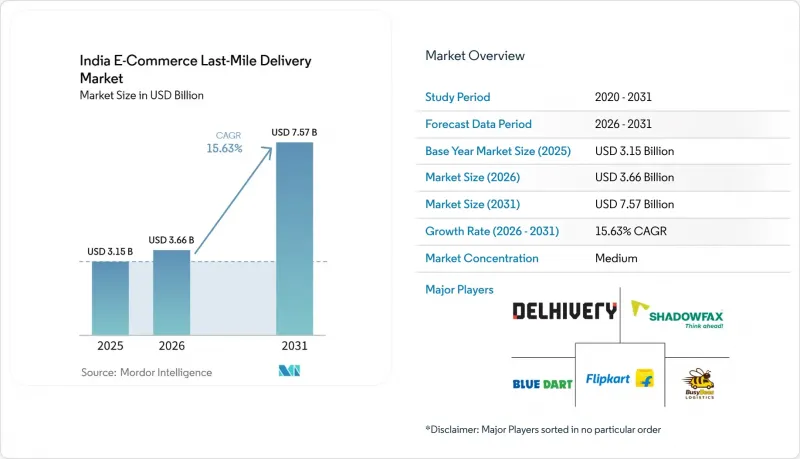
인도의 전자상거래용 라스트 마일 배송 시장은 주요 대도시권 이외 지역에서의 주문 밀도 증가를 배경으로 확대되고 있습니다. 배송 업체들은 중소 도시에서 서비스 지역을 확대하고, 배송 속도를 향상시키며, 보다 지속 가능한 배송 경로의 경제성을 구축하고 있습니다. 본 보고서는 배송 유형(표준, 당일, 익일 배송)별 분류, 배송 모델별(B2C, B2B, C2C),도시 등급별(Tier 1, Tier 2, Tier 3 이하), 제품 유형별(식품 및 음료, 퍼스널케어·가정용품, 패션·라이프스타일, 가구, 기타), 지역별(북부, 중부, 서부, 동부, 남부)로 분류되어 있습니다. 시장 전망은 금액(달러) 기준으로 제시되어 있습니다.
인도의 전자상거래 라스트 마일 배송 시장 동향 및 인사이트
Tier 2 및 Tier 3 도시에서의 전자상거래 주문 밀도 급증
인도의 전자상거래 라스트 마일 배송 시장에서 대도시권 이외 수요는 더 이상 부차적인 요소가 아닙니다. 이는 이러한 도시들이 현재 소포 처리량 성장의 다음 단계를 형성하고 있기 때문입니다. 26 회계연도에 Tier 2 및 Tier 3 도시는 신규 D2C 주문의 66%를 차지했으며, 25 회계연도 대비 GMV 증가분의 60%를 기여했습니다. 이는 신규 주문 창출이 성숙한 대도시권이 아닌 비대도시권 소비자에 의해 점점 더 주도되고 있음을 보여줍니다. 이는 배송 사업자의 운영 논리를 바꾸는 요소입니다. 수요가 소수의 밀집된 도심부가 아닌, 수많은 소규모 상권 전반에 걸쳐 증가하고 있다면, 네트워크의 깊이, 경로 계획, 그리고 지역 내 배송의 일관성이 더욱 중요해지기 때문입니다. 또한 이는 대상 고객층이 점점 더 분산되고 있음을 의미하며, 인구 밀도가 낮은 노선이 혼잡해지기 전에 그곳에서 서비스 신뢰성을 확립할 수 있는 배송 업체에 유리하게 작용합니다. 따라서 인도의 전자상거래 라스트 마일 배송 시장에서는 우편번호 대상 지역의 확대, 교외 지역의 배송 인력 확보, 그리고 소규모 도시에서의 라스트 마일 프로세스 표준화에 더 큰 가치가 부여되고 있습니다. 이러한 추세는 또한 미래의 경쟁 우위가 대도시권 노선에서의 입지를 지키는 것뿐만 아니라, 새로운 수요 클러스터에서 조기에 배송망의 밀도를 높이는 데서 비롯될 것임을 시사합니다.
대도시권 내 배송 속도에 대한 기대감 고조
인도의 전자상거래 라스트 마일 배송 시장에서 퀵커머스의 부상으로 인해 많은 도시 지역 쇼핑객들이 일상적인 구매에서 ‘용납할 수 있는’ 것으로 간주하는 기준이 변화함에 따라, 주요 대도시권에서의 배송에 대한 기대는 점점 더 높아지고 있습니다. Flipkart Minutes는 2026년 6월까지 이미 1,000곳의 마이크로 풀필먼트 센터로 규모를 확장하여 하루 82만 건의 주문을 처리하고 있으며, 2026년 말까지 1,500곳으로 늘릴 계획입니다. 이는 신속한 주문 처리 인프라가 얼마나 빠른 속도로 구축되고 있는지를 보여줍니다. 또한 아마존도 ‘Amazon Now’를 인도 내 300개 이상의 도시로 확대했으며, 해당 서비스의 주문 건수는 서비스 시작 이후 분기마다 두 배씩 증가하고 있다고 발표했습니다. 이로 인해 많은 도시 지역의 이용 사례에서 기대되는 배송 시간대가 더욱 재정의되었습니다. 그 결과, 플랫폼이 관리하는 특급 배송 사업이 배송 속도의 기준을 확립해 가고 있으며, 제3자 배송업체가 빈번하게 주문하는 도시 지역 고객을 유지하고자 한다면 이를 더 이상 무시할 수 없게 되었습니다. 배송 속도 향상은 더 이상 배달원 증원만으로는 실현할 수 없기 때문에 경로 밀도, 자동 분류 및 배차 정확도에 대한 투자가 더욱 시급해지고 있습니다. 실질적으로 인도의 전자상거래 라스트 마일 배송 시장은 대도시권에서 서비스 속도가 기본적인 경쟁 요건이 되는 모델로 전환되고 있습니다.
우편번호 지역 중 인구 밀도가 낮은 곳에서의 건당 배송 성공 비용 부담
인도의 전자상거래 라스트 마일 배송 시장은 인구 밀도가 낮은 우편번호 지역에서 여전히 심각한 비용 문제에 직면해 있습니다. 이는 배송 경로의 범위가 넓고, 배송지 밀도가 낮으며, 배송 성공을 예측하기 어렵기 때문입니다. 많은 노선에서 한 번의 운행으로 충분한 배송지 수를 확보하지 못할 경우, 신속한 배송의 수익성이 악화될 가능성이 있으므로 표준 배송이 유일한 현실적인 서비스 수준으로 머무르는 경우가 있습니다. 또한, 많은 교외 및 농촌 지역에서는 주소 정보의 정확도가 낮고, 배송지 간 거리가 멀며, 인프라 정비 현황도 고르지 않아 물리적인 배송 조건이 열악한 상황에서는 디지털 도구의 이점이 제한될 수밖에 없습니다. 이것이 소포 수요가 증가하고 있음에도 불구하고, 소규모 도시로의 서비스 확장이 반드시 건전한 이익률을 가져오지는 않는 이유입니다. 이러한 노선에서 충분한 배송 밀도를 확보하지 못하는 사업자는 하청이나 제휴 네트워크에 대한 의존도가 높아지는 경향이 있으며, 그 결과 배송 데이터나 향후 노선 최적화에 대한 직접적인 관리 능력이 저하됩니다. 따라서 인도의 전자상거래 라스트 마일 배송 시장에서는 밀도를 동반하지 않는 단순한 배송 범위 확대를 추구하기보다는 우편번호(핀코드) 커버리지 확대와 보다 효과적인 주문 클러스터링, 그리고 엄격한 비용 관리를 동시에 달성할 수 있는 배송 사업자가 앞으로도 우위를 점하게 될 것입니다.
부문별 분석
2025년, 인도의 전자상거래용 라스트 마일 배송 시장에서 표준 배송의 점유율은 58.19%를 차지했습니다. 이는 속도보다 합리적인 가격과 광범위한 지리적 커버리지가 중시되는 경우, 며칠이 소요되는 배송이 여전히 주류를 이루고 있음을 보여줍니다. 이 세부 내역은 중요합니다. 왜냐하면 고속 배송 형태가 소비자의 기대와 배송 업체의 투자 우선순위를 형성하고 있는 반면, 인도의 전자상거래 라스트 마일 배송 시장은 규모 확대에 있어 여전히 표준 네트워크에 의존하고 있음을 보여주기 때문입니다. Flipkart Minutes는 2026년 6월까지 1,000곳의 마이크로 풀필먼트 센터를 구축했으며, 이미 하루 82만 건의 주문을 처리하고 있어 당일 배송 및 거의 즉각적인 배송을 지원하기 위해 얼마나 고밀도 인프라가 구축되고 있는지를 여실히 보여줍니다. 아마존은 ‘Amazon Now’가 300개 이상의 도시로 확대되었으며, 서비스 개시 이후 주문 건수가 분기마다 두 배로 증가하고 있다고 발표했는데, 이는 신속한 배송을 요구하는 소비자 행동이 급속히 확산되고 있음을 시사합니다.
당일 배송은 가장 빠르게 성장하는 하위 부문으로, 2026년부터 2031년까지 연평균 성장률(CAGR) 19.08%가 예상됩니다. 이는 신속한 주문 처리 모델이 대도시권 중심의 제안에서 보다 광범위한 운영 기준으로 빠르게 전환되고 있음을 반영합니다. 익일 배송은 속도와 비용의 균형이 잘 잡혀 있으며, 하이퍼로컬 배송이 일반적으로 제공하는 범위보다 더 엄격한 관리가 필요한 카테고리에 적합하기 때문에 유용한 중간층으로 자리 잡고 있습니다. 전자기기나 가전제품은 주문 확인, 포장, 취급 과정에서 보다 체계적인 배송 시간대가 요구되는 경우가 많기 때문에 이 중간 단계에 특히 적합합니다. 당일 배송 네트워크가 확대됨에 따라 초고속 배송이 아직 경제적으로 실현 불가능한 지역에서도 고객의 기대가 높아지고 있으며, 이로 인해 표준 배송만 제공하는 사업자의 가격 결정력이 약화될 가능성이 있습니다. 즉, 인도의 전자상거래 라스트 마일 배송 시장에서는 단순히 고속 서비스 계층이 추가될 뿐만 아니라, 쇼핑객과 판매자 모두가 모든 배송 약속을 어떻게 평가하는지에 대한 관점도 재구성되고 있는 것입니다.
2025년, 인도의 전자상거래 라스트 마일 배송 시장 점유율의 69.88%를 B2C가 차지했으며, 인도의 조직화된 소포 배송 네트워크가 여전히 마켓플레이스 및 브랜드에서 소비자로의 배송 흐름에 의해 뒷받침되고 있음이 확인되었습니다. C2C는 2031년까지 연평균 성장률(CAGR) 21.75%를 나타낼 것으로 예측되며, 리셀 플랫폼, 소셜 커머스, P2P 거래가 널리 받아들여짐에 따라 가장 빠르게 확장되는 배송 모델이 될 전망입니다. 이러한 구성은 인도의 전자상거래 라스트 마일 배송 업계가 기존의 소매 배송의 틀을 넘어, 더욱 세분화되고 소비자 행동에 좌우되는 주문 흐름으로 확대되고 있음을 보여줍니다. B2B는 이 시장에서 여전히 규모가 작지만, 퀵커머스의 성장과 연동되어 다크 스토어 보충 및 조직적인 재고 이동의 혜택을 받고 있습니다. Delhivery의 보고서에 따르면, Ecom Express의 통합 이후 1분기 부분 적재 화물 운송량은 전년 동기 대비 15% 증가했는데, 이는 퀵커머스 사업자 전체의 다크 스토어 보충 수요가 일부 기여한 결과입니다.
C2C의 성장은 소포의 가치가 낮은 경우가 많고, 주소 표준화가 진행되지 않아 일반적인 B2C 흐름에 비해 주문 행태를 예측하기 어렵기 때문에 더 까다로운 사업 환경을 조성하고 있습니다. 또한, 이러한 배송에서는 사소한 실수만으로도 저가 소포의 이익률을 급격히 떨어뜨릴 가능성이 있으므로, 경로 분석 및 주소 검증의 중요성이 더욱 부각되고 있습니다. 그런 의미에서 인도의 전자상거래 라스트 마일 배송 업계는 더욱 데이터 중심의 운영 방식으로 전환되고 있습니다. 이는 C2C가 주류를 이루는 배송 환경에서 기존의 중량 기반 요금 책정이나 경로 계획의 효과가 떨어지고 있기 때문입니다. 이러한 변화에 조기에 적응한 운송업체는 2031년에 걸쳐 C2C 처리량이 국내 소포 유통에서 더 큰 비중을 차지하게 됨에 따라 혜택을 볼 가능성이 높습니다.
기타 혜택 :
- 엑셀 형식 시장 예측(ME) 시트
- 3개월간의 애널리스트 지원
자주 묻는 질문
목차
제1장 서론
제2장 분석 방법
제3장 주요 요약
제4장 시장 구도
제5장 시장 규모 및 성장률 예측(금액 기준, 2026-2031년)
제6장 경쟁 구도
제7장 시장 기회 및 향후 전망
KTH 26.09.04According to Mordor Intelligence, the India e-commerce last-mile delivery market size was valued at USD 3.15 billion in 2025 and is estimated to grow from USD 3.66 billion in 2026 to reach USD 7.57 billion by 2031, at a CAGR of 15.63% during the forecast period 2026-2031.
The India e-commerce last-mile delivery market is expanding on the back of stronger order density beyond the largest metros, where carriers are adding coverage, improving delivery speed, and building more viable route economics in smaller cities. This report is Segmented by Delivery Type (Standard, Same-Day, Next-Day), by Delivery Model (B2C, B2B, C2C), City Tier (Tier 1, Tier 2, Tier 3 and Below), by Product Type (Foods and Beverages, Personal and Household Care, Fashion and Lifestyle, Furniture, and More), and by Region (North, Central, West, East, South). The Market Forecasts are Provided in Terms of Value (USD).
India E-Commerce Last-Mile Delivery Market Trends and Insights
Rapid Expansion of E-Commerce Order Density in Tier 2 and Tier 3 Cities
Demand outside the largest metros is no longer a secondary layer for the India e-commerce last-mile delivery market, because these cities are now shaping the next phase of parcel volume growth. Tier II and Tier III cities accounted for 66% of new D2C orders in FY 26 and contributed 60% of incremental GMV over FY 25, indicating that new order creation is increasingly led by non-metro consumers rather than by mature urban clusters. This changes the operating logic for carriers because network depth, route planning, and local delivery consistency matter more when demand is rising across many smaller catchments rather than in a few dense city cores. It also means the addressable shopper base is becoming more distributed, which favors carriers that can build service reliability in lower-density lanes before those lanes become crowded. The India e-commerce last-mile delivery market is therefore seeing greater value in pincode expansion, staffing for semi-urban deliveries, and standardizing last-mile processes across smaller cities. That pattern also suggests that future competitive gains will come from building density early in new demand clusters rather than only defending positions on metro routes.
Shift Toward Faster Delivery Expectations in Metro Corridors
Delivery expectations in the largest metros are tightening because quick commerce has changed what many urban shoppers now consider acceptable for everyday purchases in the India e-commerce last-mile delivery market. Flipkart Minutes had already scaled to 1,000 micro-fulfillment centers by June 2026, was processing 820,000 daily orders, and planned to reach 1,500 centers by the end of 2026, which shows the pace at which fast-fulfillment infrastructure is being added. Amazon also expanded Amazon Now to more than 300 Indian cities and stated that orders on the service had doubled every quarter since launch, which further reset the expected delivery window for many urban use cases. The result is that platform-controlled express operations are setting a delivery speed benchmark that third-party carriers cannot ignore if they want to retain higher-frequency urban accounts. This is forcing more investment into route density, automated sortation, and dispatch precision, because delivery speed can no longer be improved only by adding riders. In practical terms, the India e-commerce last-mile delivery market is moving toward a model where service speed is becoming a basic competitive requirement in large metro corridors.
High Cost per Successful Delivery in Low-Density Pin Codes
The India e-commerce last-mile delivery market still faces a hard cost challenge in lower-density pin codes because route spreads are wider, drop density is lower, and successful delivery is less predictable. Standard delivery can remain the only viable service level in many of these lanes because the economics of faster delivery deteriorate when routes cannot support enough stops per run. Carriers also face weaker address quality, longer inter-stop distances, and more uneven infrastructure in many semi-urban and rural corridors, which limits the benefit of digital tools when physical delivery conditions remain difficult. This is why service expansion into smaller cities does not automatically yield healthy margins, even as parcel demand rises. Operators that lack adequate density in these lanes often rely more on subcontracting and partnership networks, reducing direct control over delivery data and future route optimization. The India e-commerce last-mile delivery market will therefore continue to reward carriers that can combine pincode expansion with better order clustering and cost discipline, rather than pursuing reach without density.
Other drivers and restraints analyzed in the detailed report include:
- Rising Platform-Led Control Over Captive Delivery Networks
- Parcel Route Optimization Through AI-Enabled Sortation and Dispatching
- Margin Pressure from Cash on Delivery, Returns, and Reattempts
For complete list of drivers and restraints, kindly check the Table Of Contents.
Segment Analysis
Standard delivery held 58.19% of the India e-commerce last-mile delivery market share in 2025, which shows that multi-day fulfillment still dominates when affordability and broad geographic reach matter more than speed. This split is important because it shows that the India e-commerce last-mile delivery market still depends on standard networks for scale, even while fast-delivery formats are shaping shopper expectations and carrier investment priorities. Flipkart Minutes had reached 1,000 micro-fulfillment centers by June 2026 and was already processing 820,000 daily orders, underscoring how dense the infrastructure is being built to support same-day and near-instant fulfillment. Amazon stated that Amazon Now had expanded to more than 300 cities and that orders had doubled every quarter since launch, suggesting the rapid spread of rapid-delivery behavior.
Same-day delivery is the fastest-growing sub-segment, with a projected 19.08% CAGR from 2026 to 2031, reflecting how rapidly rapid-fulfillment models are moving from a metro-led proposition toward a broader operational benchmark. Next-Day Delivery is becoming a useful middle layer because it balances speed with cost and fits categories that need more control than hyperlocal fulfillment usually provides. Electronics and home appliances are especially suited to that middle tier because order verification, packaging, and handling often require more structured delivery windows. As same-day networks scale, they are also tightening customer expectations in places where ultra-fast delivery is not yet economically viable, which can weaken pricing power for standard-only operators. That means the India e-commerce last mile delivery market is not simply adding a faster service tier, but is also reshaping how every delivery promise is valued by both shoppers and merchants.
B2C accounted for 69.88% of the India e-commerce last-mile delivery market share in 2025, which confirms that organized parcel networks in India are still anchored by marketplace and brand-to-consumer shipment flows. C2C is projected to grow at a 21.75% CAGR through 2031, making it the fastest-expanding delivery model as resale platforms, social commerce, and peer-to-peer transactions gain wider acceptance. That mix shows how the Indian e-commerce last-mile delivery industry is broadening beyond conventional retail delivery into more fragmented and behavior-driven order flows. B2B remains smaller in this market, but it is benefiting from dark-store replenishment and organized inventory movement, linked to the growth of quick commerce. Delhivery reported that its part-truckload freight tonnage grew 15% year on year in the first quarter, after integrating Ecom Express, partly supported by dark-store restocking demand across quick-commerce operators.
The growth of C2C creates a more difficult operating environment because parcel values are often lower, addresses are less standardized, and order behavior can be less predictable than in regular B2C flows. These shipments also underscore the importance of route intelligence and address verification, since small errors can quickly erode margins on low-value parcels. In that sense, the India e-commerce last mile delivery industry is being pushed toward more data-led execution because traditional weight-based pricing and route planning are less effective in C2C-heavy traffic. Carriers that adapt to this shift early are likely to benefit as C2C volume becomes a more visible contributor to national parcel flows through 2031.
Complete Report Scope:
- By Delivery Type
- Standard Delivery
- Same-Day Delivery
- Next-Day Delivery
- By Delivery Model
- Business-to-Consumer (B2C)
- Business-to-Business (B2B)
- Consumer-to-Consumer (C2C)
- By City Tier
- Tier 1
- Tier 2
- Tier 3 and Below
- By Product Type
- Foods and Beverages
- Personal and Household Care
- Fashion and Lifestyle (Accessories, Apparel, Footwear)
- Furniture
- Consumer Electronics and Household Appliances
- Other Products
- By Region
- North
- Central
- West
- East
- South
List of Companies Covered in this Report:
- Delhivery Limited
- TCI Express Limited
- Busybees Logistics Solutions Private Limited
- Shadowfax Technologies Private Limited
- Flipkart Online Services Private Limited
- Amazon, Inc.
- Blue Dart Express Limited
- DTDC Express Limited
- Allcargo Gati Limited
- India Post
- DHL Group
- FedEx
- LoadShare Networks Private Limited
- ElasticRun
- Porter
- Mahindra Logistics Limited
- Safexpress
- Aramex
- TVS Supply Chain Solutions Limited
- Borzo India Private Limited
Additional Benefits:
- The market estimate (ME) sheet in Excel format
- 3 months of analyst support
TABLE OF CONTENTS
1 Introduction
- 1.1 Study Assumptions and Market Definition
- 1.2 Scope of the Study
2 Research Methodology
3 Executive Summary
4 Market Landscape
- 4.1 Market Overview and Role of Last-Mile Delivery in E-Commerce Logistics
- 4.2 E-Commerce Spending Trends
- 4.3 Market Drivers
- 4.3.1 Rapid Expansion of E-Commerce Order Density in Tier 2 and Tier 3 Cities
- 4.3.2 Shift Toward Faster Delivery Expectations in Metro Corridors
- 4.3.3 Rising Platform-Led Control Over Captive Delivery Networks
- 4.3.4 Parcel Route Optimization Through AI-Enabled Sortation and Dispatching
- 4.3.5 Growing Use of EV Fleets for High-Frequency Urban Drop Density
- 4.3.6 Increasing Demand for Returns Handling and Reverse Logistics Visibility
- 4.4 Market Restraints
- 4.4.1 High Cost per Successful Delivery in Low-Density Pin Codes
- 4.4.2 Driver and Rider Attrition, Compliance, and Peak-Hour Capacity Gaps
- 4.4.3 Margin Pressure from Cash on Delivery, Returns, and Reattempts
- 4.4.4 Fragmented Infrastructure for Same-Day and Hyperlocal Service Beyond Top Cities
- 4.5 Regulatory Framework
- 4.6 Value Chain and Distribution Channel Architecture Analysis
- 4.7 Technology Innovations Outlook
- 4.8 Porter's Five Forces Analysis
- 4.8.1 Threat of New Entrants
- 4.8.2 Bargaining Power of Suppliers
- 4.8.3 Bargaining Power of Buyers
- 4.8.4 Threat of Substitutes
- 4.8.5 Rivalry Among Competitors
- 4.9 Evolution of E-Commerce Last-Mile Delivery Requirements
- 4.10 Pricing and Cost Structure Analysis
- 4.11 Consumer Behavior and Delivery Preferences Analysis
- 4.12 Sustainable Delivery Solutions and Green Logistics Initiatives
- 4.13 Impact of Geo-Political Events on Supply Chain Shifts
5 Market Size and Growth Forecasts (Value, 2026-2031)
- 5.1 By Delivery Type
- 5.1.1 Standard Delivery
- 5.1.2 Same-Day Delivery
- 5.1.3 Next-Day Delivery
- 5.2 By Delivery Model
- 5.2.1 Business-to-Consumer (B2C)
- 5.2.2 Business-to-Business (B2B)
- 5.2.3 Consumer-to-Consumer (C2C)
- 5.3 By City Tier
- 5.3.1 Tier 1
- 5.3.2 Tier 2
- 5.3.3 Tier 3 and Below
- 5.4 By Product Type
- 5.4.1 Foods and Beverages
- 5.4.2 Personal and Household Care
- 5.4.3 Fashion and Lifestyle (Accessories, Apparel, Footwear)
- 5.4.4 Furniture
- 5.4.5 Consumer Electronics and Household Appliances
- 5.4.6 Other Products
- 5.5 By Region
- 5.5.1 North
- 5.5.2 Central
- 5.5.3 West
- 5.5.4 East
- 5.5.5 South
6 Competitive Landscape
- 6.1 Market Concentration
- 6.2 Key Strategic Moves
- 6.3 Market Share Analysis
- 6.4 Company Profiles (includes Global Level Overview, Market Level Overview, Core Segments, Financials as Available, Strategic Information, Market Rank/Share for Key Companies, Products & Services, and Recent Developments)
- 6.4.1 Delhivery Limited
- 6.4.2 TCI Express Limited
- 6.4.3 Busybees Logistics Solutions Private Limited
- 6.4.4 Shadowfax Technologies Private Limited
- 6.4.5 Flipkart Online Services Private Limited
- 6.4.6 Amazon, Inc.
- 6.4.7 Blue Dart Express Limited
- 6.4.8 DTDC Express Limited
- 6.4.9 Allcargo Gati Limited
- 6.4.10 India Post
- 6.4.11 DHL Group
- 6.4.12 FedEx
- 6.4.13 LoadShare Networks Private Limited
- 6.4.14 ElasticRun
- 6.4.15 Porter
- 6.4.16 Mahindra Logistics Limited
- 6.4.17 Safexpress
- 6.4.18 Aramex
- 6.4.19 TVS Supply Chain Solutions Limited
- 6.4.20 Borzo India Private Limited
7 Market Opportunities and Future Outlook
- 7.1 White-space and Unmet-Need Assessment