
|
시장보고서
상품코드
2125492
독일의 라스트 마일 배송 시장 : 점유율 분석, 업계 동향과 통계, 성장 예측(2026-2031년)Germany Last Mile Delivery - Market Share Analysis, Industry Trends & Statistics, Growth Forecasts (2026 - 2031) |
||||||
 Mordor Intelligence
Mordor Intelligence에 의하면, 독일 라스트 마일 배송 시장 규모는 2025년에 300억 1,000만 달러로 평가되었고 2026년 314억 달러에서 2031년까지 393억 9,000만 달러에 이를 것으로 예측되며, 예측 기간(2026-2031년) CAGR은 4.64%를 나타낼 전망입니다.
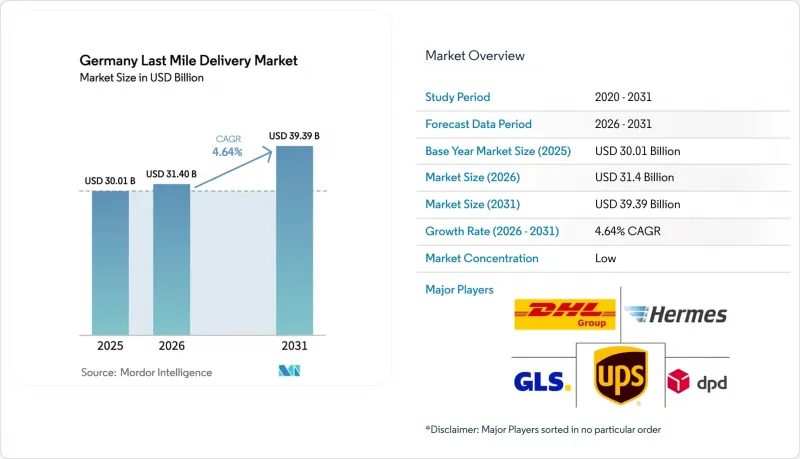
본 보고서는 서비스별(표준 배송, 당일 배송, 특급 배송), 비즈니스 모델별(기업 간 거래(B2B), 기업 대 소비자(B2C), 소비자 간 거래(C2C)), 최종 사용자 산업(전자상거래 소매, 패션·라이프스타일, 뷰티 등),연방주(바덴뷔르템베르크주, 베를린, 바이에른주 등)별로 분류되어 있습니다. 시장 전망은 금액(달러) 기준으로 제시되어 있습니다.
독일 라스트 마일 배송 시장 동향 및 인사이트
국내 전자상거래 소포 처리량의 급증
독일 소비자들의 온라인 쇼핑 이용이 확산됨에 따라, 국내 B2C 소포 유통량은 계속 증가하고 있으며, 연간 발송 건수는 사상 최고치를 기록하고 있습니다. Temu나 Shein과 같은 크로스보더 전자상거래 플랫폼이 대량의 소포를 수입하고 있어, 이로 인해 수입량이 확대되고 도시 지역의 분류 허브에 부담이 가중되고 있습니다. 소비자 조사에 따르면, 예측 가능한 배송 시간대에 대한 기대가 높아지고 있으며, 집배 거점 밀도가 높고 자동 분류 시스템을 갖춘 운송업체에 대한 수요가 집중되고 있습니다. 2025년에 체결된 패션 업계 주도의 Zalando와 About You간의 제휴는 통합된 물류 체계 하에서 주문 처리(fulfillment)를 통합함으로써 소포 밀도를 더욱 높이고 있습니다. 대형 사업자는 규모의 경제 효과로 인해 이익률을 유지할 수 있지만, 신규 진출기업은 서비스가 부족한 지역에서 1회당 배송 비용이 높아지는 부담을 안고 있습니다.
택배 보관함 및 PUDO 네트워크의 확대
2024년 10월 DPD와 GLS의 제휴를 통해 독일 최대 규모의 오픈 로커 시스템이 탄생했으며, 수천 개의 자동 로커 간 소포 수령의 상호 운용성을 실현했습니다. 독일포스트 DHL은 2030년까지 대부분의 도시 거주자가 도보 거리 내에서 Packstation을 이용할 수 있게 될 전망입니다. 2025년 myflexbox와 DPD의 제휴를 통해 도입된 건물 내 사물함은 첫 배송 성공률을 높이고 배송 체류 시간을 단축합니다. 소매점 결제 API에서는 사물함 위치가 실시간으로 표시되어 ‘클릭 앤 콜렉트’ 이용을 촉진하는 동시에, 배송 실패로 인한 비용을 절감하고 있습니다. 락커에 대한 막대한 초기 투자는 수년에 걸친 설치 장소 임대 계약을 감당할 수 있는 대규모 사업자에게 유리하게 작용합니다.
인건비 및 연료비 급등
2024년 단체 교섭을 통해 우편 및 소포 배송 직원들에게 대폭적인 임금 인상이 승인되면서, 이미 영업비의 절반 이상을 인건비로 지출하고 있는 운송업체의 비용 부담이 더욱 가중되었습니다. 운전기사 부족은 여전히 만성화되어 있어, 기업들은 초임이나 입사 보너스를 인상할 수밖에 없는 상황입니다. 또한 2024년에는 에너지 가격 변동과 고속도로 통행료 인상에 따라 연료비도 상승했으며, 계약상의 요금 조정 조항이 투입 비용의 인플레이션을 따라가지 못할 경우 이익률이 압박받고 있습니다. 분류 센터의 자동화 및 차량의 부분적인 전기화를 통해 이러한 압박은 일부 상쇄되었으나, 이를 위해서는 수년에 걸친 설비 투자가 필요합니다.
부문별 분석
2025년, 표준 배송 서비스는 독일 라스트 마일 배송 시장 점유율의 62.45%를 차지했습니다. 이는 배송비에 대한 소비자의 높은 가격 민감도와 서비스 대상인 지방 배송지가 광범위하게 분포되어 있다는 점이 뒷받침하고 있습니다. 당일 배송 옵션은 틈새 시장이지만, 도시 지역 쇼핑객들이 시간적 제약이 있는 구매 시 즉각성을 점점 더 중요시함에 따라 연평균 성장률(CAGR) 3.62%(2026-2031년)로 가장 강력한 성장세를 기록할 것으로 예측됩니다.
독일의 라스트 마일 배송 시장에서 당일 배송 서비스 시장 규모는 주문 마감 시간을 통일하는 소매업체와의 제휴 및 마이크로 허브를 활용한 중계 거점 운영에 힘입어 꾸준히 확대될 것으로 예측됩니다. 배송업체는 AI를 활용한 분류 시스템을 통해 자정까지 배송을 완료하는 야간 노선에 화물을 배정함으로써, 단위 이익률을 훼손하지 않으면서 서비스 차별화를 유지하고 있습니다. 일반 배송의 수익성은 여전히 높은 배송 거점 밀도와 통합된 간선 운송에 의존하고 있는 반면, 운송 시간 보장이 필요한 B2B 분야에서는 특급 배송 서비스에 대한 수요가 안정적입니다.
기타 혜택:
- 엑셀 형식 시장 예측(ME) 시트
- 3개월간 애널리스트 지원
자주 묻는 질문
목차
제1장 서론
제2장 조사 방법
제3장 주요 요약
제4장 시장 구도
제5장 시장 규모와 성장 예측
제6장 경쟁 구도
제7장 시장 기회와 향후 전망
JHSAccording to Mordor Intelligence, the Germany last mile delivery market size was valued at USD 30.01 billion in 2025 and estimated to grow from USD 31.4 billion in 2026 to reach USD 39.39 billion by 2031, at a CAGR of 4.64% during the forecast period (2026-2031).
This report is Segmented by Service (Standard Delivery, Same-Day, and Express Delivery), Business Model (Business-To-Business (B2B), Business-To-Consumer (B2C), and Customer-To-Consumer (C2C)), End-User Industry (E-Commerce Retail, Fashion & Lifestyle, Beauty, and More), Federal State (Baden-Wurttemberg, Berlin, Bavaria, and More). The Market Forecasts are Provided in Terms of Value (USD).
Germany Last Mile Delivery Market Trends and Insights
Surge in Domestic E-commerce Parcel Volumes
Domestic B2C parcel flows continue to rise as German consumers deepen online shopping penetration, sending annual shipment counts to record highs Cross-border platforms such as Temu and Shein import sizeable parcel quantities, amplifying inbound volumes and stretching urban sorting hubs. Consumer surveys reveal higher expectations for predictable delivery windows, consolidating demand around carriers with dense stop coverage and automated sortation. The fashion-led Zalando-About You tie-up, signed in 2025, further amplifies parcel density by pooling fulfillment under unified logistics leadership. Larger operators gain scale economies that shield margins, whereas newcomers shoulder a higher cost-per-stop in sparsely served corridors.
Expansion of Parcel-Locker & PUDO Networks
The October 2024 DPD-GLS alliance created Germany's largest open locker system, enabling parcel hand-off interoperability across thousands of automated boxes. Deutsche Post DHL is on track to install a Packstation within walking distance for most urban residents by 2030. Building-integrated lockers launched through the 2025 myflexbox-DPD cooperation improve first-attempt success and shrink delivery dwell time. Retail checkout APIs now surface locker locations in real time, encouraging click-and-collect and cutting failed delivery costs. High up-front locker investment favors scale players able to underwrite multi-year site leases.
Rising Labor & Fuel Costs
Collective bargaining rounds in 2024 granted postal and parcel employees meaningful wage increases, lifting the cost base for carriers that already spend more than half of their operating expenses on personnel. Driver shortages remain chronic, forcing firms to raise entry pay and sign-on bonuses. Fuel outlays also climbed during 2024 amid energy-price volatility and higher highway tolls, compressing margins where contractual rate-adjustment clauses lag input inflation. Automation in sort centers and partial fleet electrification offset some pressure but require multiyear capital commitments.
Other drivers and restraints analyzed in the detailed report include:
- Sustainability Regulations Driving EV Fleets
- AI-Enabled Zonal Logistics & Route Optimization
- Scarce Inner-city Logistics Real Estate
For complete list of drivers and restraints, kindly check the Table Of Contents.
Segment Analysis
Standard delivery services captured 62.45% of the Germany last mile delivery market share in 2025, sustained by consumer sensitivity to shipping fees and the breadth of rural destinations served. Same-day options, though niche, is expected to log the strongest forward pace at a 3.62% CAGR (2026-2031) as urban shoppers increasingly value immediacy for time-critical purchases.
The Germany last mile delivery market size for same-day services is expected to rise steadily, helped by retailer partnerships that pool order cut-off times and micro-hub staging. Carriers employ AI sorting to feed evening rounds that deliver before midnight, maintaining service differentiation without eroding unit margins. Standard delivery profitability remains tied to high stop density and consolidated line-haul, while express-service demand stabilizes in B2B verticals needing guaranteed transit.
Complete Report Scope:
- By Service
- Standard Delivery
- Same-day
- Express Delivery
- By Business Model
- Business-to-Business (B2B)
- Business-to-Consumer (B2C)
- Customer-to-Consumer (C2C)
- By End-user Industry
- E-commerce Retail
- Fashion & Lifestyle
- Beauty, Wellness & Personal Care
- Home & Furniture
- Consumer Electronics & Appliances
- Healthcare & Medical Supplies
- Others
- By German Federal State
- Baden-Wurttemberg
- Berlin
- Bavaria
- North Rhine-Westphalia
- Rest of German Federal State
List of Companies Covered in this Report:
- Deutsche Post DHL Group
- Hermes
- UPS
- DPD
- GLS
- FedEx Express
- DSV
- Rhenus Logistics
- CEVA Logistics
- Speedlink Transport
- Delivery Hero
- GO Express & Logistics
- Berlin Last Mile
- Courier Service Germany
- Cencora
- PTV Logistics GmbH
- Redwood Fulfillment
- Landmark Global
- Yusen Logistics
- AIT Worldwide Logistics, Inc.
Additional Benefits:
- The market estimate (ME) sheet in Excel format
- 3 months of analyst support
TABLE OF CONTENTS
1 Introduction
- 1.1 Study Assumptions & Market Definition
- 1.2 Scope of the Study
2 Research Methodology
3 Executive Summary
4 Market Landscape
- 4.1 Market Overview
- 4.2 Market Drivers
- 4.2.1 Surge in domestic e-commerce parcel volumes
- 4.2.2 Expansion of parcel-locker & PUDO networks
- 4.2.3 Sustainability regulations driving EV fleets
- 4.2.4 Micro-hub reuse of vacant retail & parking assets
- 4.2.5 AI-enabled zonal logistics & route optimisation
- 4.2.6 German Postal Law 2024 boosting infrastructure spend
- 4.3 Market Restraints
- 4.3.1 Rising labour & fuel costs
- 4.3.2 Package theft/damage & failed first-attempts
- 4.3.3 Wage-inflation from collective bargaining rounds
- 4.3.4 Scarce inner-city logistics real-estate
- 4.4 Value / Supply-Chain Analysis
- 4.5 Regulatory Landscape
- 4.6 Technological Outlook
- 4.7 Porter's Five Forces
- 4.7.1 Bargaining Power of Buyers
- 4.7.2 Bargaining Power of Suppliers
- 4.7.3 Threat of New Entrants
- 4.7.4 Threat of Substitutes
- 4.7.5 Intensity of Competitive Rivalry
- 4.8 Impact of COVID-19 and Geo-Political Events
5 Market Size & Growth Forecasts
- 5.1 By Service
- 5.1.1 Standard Delivery
- 5.1.2 Same-day
- 5.1.3 Express Delivery
- 5.2 By Business Model
- 5.2.1 Business-to-Business (B2B)
- 5.2.2 Business-to-Consumer (B2C)
- 5.2.3 Customer-to-Consumer (C2C)
- 5.3 By End-user Industry
- 5.3.1 E-commerce Retail
- 5.3.2 Fashion & Lifestyle
- 5.3.3 Beauty, Wellness & Personal Care
- 5.3.4 Home & Furniture
- 5.3.5 Consumer Electronics & Appliances
- 5.3.6 Healthcare & Medical Supplies
- 5.3.7 Others
- 5.4 By German Federal State
- 5.4.1 Baden-Wurttemberg
- 5.4.2 Berlin
- 5.4.3 Bavaria
- 5.4.4 North Rhine-Westphalia
- 5.4.5 Rest of German Federal State
6 Competitive Landscape
- 6.1 Market Concentration
- 6.2 Strategic Moves
- 6.3 Market Share Analysis
- 6.4 Company Profiles (includes Global level Overview, Market level overview, Core Segments, Financials as available, Strategic Information, Market Rank/Share for key companies, Products & Services, and Recent Developments)
- 6.4.1 Deutsche Post DHL Group
- 6.4.2 Hermes
- 6.4.3 UPS
- 6.4.4 DPD
- 6.4.5 GLS
- 6.4.6 FedEx Express
- 6.4.7 DSV
- 6.4.8 Rhenus Logistics
- 6.4.9 CEVA Logistics
- 6.4.10 Speedlink Transport
- 6.4.11 Delivery Hero
- 6.4.12 GO Express & Logistics
- 6.4.13 Berlin Last Mile
- 6.4.14 Courier Service Germany
- 6.4.15 Cencora
- 6.4.16 PTV Logistics GmbH
- 6.4.17 Redwood Fulfillment
- 6.4.18 Landmark Global
- 6.4.19 Yusen Logistics
- 6.4.20 AIT Worldwide Logistics, Inc.
7 Market Opportunities & Future Outlook
- 7.1 White-space & Unmet-need Assessment