
|
시장보고서
상품코드
2119146
유럽의 전자상거래 라스트 마일 배송 시장 : 시장 점유율 분석, 업계 동향 및 통계, 성장 예측(2026-2031년)Europe E-Commerce Last-Mile Delivery - Market Share Analysis, Industry Trends & Statistics, Growth Forecasts (2026 - 2031) |
||||||
 Mordor Intelligence
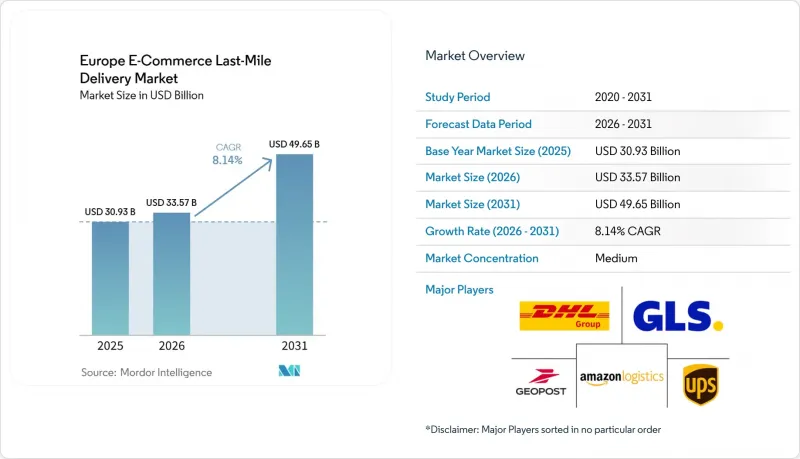
Mordor Intelligence에 의하면, 유럽의 전자상거래 라스트 마일 배송 시장 규모는 2025년에 309억 3,000만 달러로 평가되었고, 2026년에는 335억 7,000만 달러로 추정되고, 2031년까지 496억 5,000만 달러에 이를 것으로 예측되며, 2026-2031년 CAGR은 8.14%를 기록할 전망입니다.
유럽의 전자상거래 라스트마일 배송 시장은 현관 앞 배송 서비스와 택배 보관함, 수거 거점, 지역 배송 허브를 결합한 네트워크로 전환되고 있습니다. 본 보고서는 배송 유형별(표준, 당일, 익일 배송), 배송 모델별(B2C, B2B, C2C), 도시 계층(Tier 1, Tier 2, 기타), 제품 유형별(식품 및 음료, 가전제품, 기타 상품), 국가별(영국, 독일, 프랑스, 스페인, 이탈리아, 벨기에, 네덜란드, 북유럽 국가, 기타 유럽)로 분류되어 있습니다. 시장 전망은 금액(달러) 기준으로 제시되어 있습니다.
유럽의 전자상거래 라스트 마일 배송 시장 동향 및 인사이트
전자상거래 소포 밀도의 확대
소포 밀도가 향상됨에 따라 각 노선에서 더 많은 배송지를 처리할 수 있게 되어, 유럽 전자상거래 라스트 마일 배송 시장의 경제성이 개선되고 있습니다. 또한, 배송 실패나 지연은 고객의 전환율 및 재구매에 영향을 미칠 수 있으므로, 소매업체들도 배송 성과를 더욱 중요하게 여기고 있습니다. 유럽의 첫 배송 성공률은 2025년 1분기 82.1%에서 2분기에는 86.4%로 상승했습니다. 같은 기간 동안 정시 배송률은 98%를 상회하며 유지되었습니다. 밀집된 네트워크를 보유한 운송업체는 이러한 업무 효율 향상을 활용하여 인건비를 비례적으로 늘리지 않고도 서비스 신뢰성을 높일 수 있습니다. 이러한 이점으로 인해 대도시권 이외 지역의 집하 거점 및 보관함 네트워크에 대한 투자도 촉진되고 있습니다.
자택 외 수령 및 로커 네트워크 확대
집 밖 수령은 접근성이 좋은 수거 거점에서 배송을 통합할 수 있기 때문에 유럽 전자상거래의 라스트 마일 배송 시장에서 핵심 요소로 자리 잡고 있습니다. Geopost는 2025년 유럽 전역에서 5만 대의 보관함을 포함한 15만 곳 이상의 수거 거점을 운영했으며, 자택 외 수령 처리량은 31% 증가했습니다. InPost는 2025년에 14억 개의 소포를 배송하고, 자동 소포 수취기 1만 4,200대를 추가 설치함으로써 유럽 네트워크의 로커 수는 6만 1,196개에 달했습니다. GLS는 24개월 동안 네트워크를 7만 곳에서 13만 곳의 집 밖 수령 거점으로 확대했으며, 2030년까지 자사 소유의 락커를 3만 개로 늘리겠다는 목표를 세웠습니다. DPD Germany와 GLS는 2026년 3월에 ‘inbox’ 공유 네트워크를 출범시켰으며, 2027년 말까지 2만 곳의 공유 거점을 설치하는 것을 목표로 하고 있습니다. 공유 네트워크는 소비자의 편의성을 높이는 동시에 각 운송 사업자의 인프라 부담을 경감시킬 수 있습니다.
라스트 마일 분야의 인력 확보 및 기사 유지 과제
라스트 마일 서비스는 신뢰할 수 있는 운전기사의 배정에 의존하고 있기 때문에 인력 확보는 여전히 유럽 전자상거래 라스트 마일 배송 시장의 제약 요인으로 작용하고 있습니다. IRU 보고서에 따르면, 2025년 유럽 전체에서 50만 2,000개의 트럭 운전사 자리가 채워지지 않았으며, 이는 13%의 부족률에 해당합니다. 또한 2030년까지 66만 명의 운전자가 은퇴할 것으로 예측됩니다. 인력 부족은 배송 사업자의 채용, 교육 및 초과 근무 비용 증가로 이어집니다. 또한, 계절적 성수기에 운송 사업자가 서비스 용량을 확대하는 것도 어려워집니다. 락커, 경로 계획 도구, 유연한 배송 모델은 문 앞 배송 횟수를 줄일 수는 있지만, 훈련된 인력의 필요성을 없애지는 못합니다.
부문 분석
2025년, 유럽의 전자상거래 라스트 마일 배송 시장에서 표준 배송은 56%의 점유율을 차지했습니다. 이러한 상황은 더 빠른 배송 옵션이 이용 가능한 경우에도 소비자가 여전히 배송비를 중요하게 여긴다는 점을 반영합니다. 표준 서비스는 소매업체에게 일상적인 주문에 대한 저비용 대안이 되며, 운송업체에게는 배송 경로를 통합할 수 있게 해줍니다. 또한, 현관 앞 배송보다 사물함이나 수령 거점과의 연계가 점점 더 확대되고 있습니다. 이러한 변화로 인해 첫 배송 성공률이 향상되고, 배송 미달에 따른 비용을 절감할 가능성이 있습니다. 익일 배송은 가격과 긴급성 측면에서 표준 서비스와 당일 배송의 중간에 위치합니다.
당일 배송은 2031년까지 연평균 성장률(CAGR) 11.59%를 나타낼 것으로 예측되며, 유럽 전자상거래 라스트 마일 배송 시장에서 가장 빠르게 성장하는 배송 형태가 될 전망입니다. 이동 거리가 짧고 현지 재고가 빈번한 배송을 뒷받침하는 대도시권에서 실현 가능성이 가장 높다고 할 수 있습니다. 소매업체들은 식품, 생필품, 패션, 가전제품 등 긴급성이 높은 주문에 대해 이 서비스를 가장 빈번하게 이용하고 있습니다. 이 모델에서는 배송량이 효율적인 수준에 도달하기 전에 지역별 주문 처리 능력이 요구됩니다. 그 결과, 인구 밀도가 높은 도시 지역 이외에서는 당일 배송이 제한적으로만 이용될 가능성이 높다고 볼 수 있습니다. 사업자는 표준 배송을 널리 이용할 수 있도록 유지하면서 당일 배송을 유료 옵션으로 제공함으로써 이익률을 지킬 수 있습니다.
2025년, 유럽 전자상거래 라스트마일 배송 시장 규모 중 B2C가 47.96%를 차지했습니다. 소매 전자상거래, 식료품 주문 처리 및 D2C(소비자 직접 판매) 브랜드가 이 모델에서 계속해서 가장 큰 소포 물량을 차지하고 있습니다. Geopost사는 2025년 유럽의 주요 5개 시장에서 B2C 처리량이 9% 증가했다고 보고했습니다. B2C 배송에는 문 앞 배송, 사물함, 택배점 서비스에 더해 반품 서비스의 조합이 필요합니다. 소매업체는 배송업체가 결제 시 신뢰할 수 있는 배송 옵션을 제공함으로써 혜택을 얻습니다. 이에 따라 소비자 대상 배송은 국내 소포 네트워크의 핵심 취급량 기반으로 계속 자리 잡고 있습니다.
C2C는 2031년까지 연평균 성장률(CAGR) 14.26%를 나타낼 것으로 예측됩니다. 중고품 플랫폼과 피어 투 피어(P2P) 재판매 채널의 확산이 이 부문을 뒷받침하고 있습니다. 독일의 2026년 KEP 조사에 따르면, C2C가 장기적으로 가장 큰 잠재력을 지닌 부문으로 지목되었습니다. 이러한 소포는 크기가 비교적 작아 사물함이나 수령 지점에서의 배송에 적합합니다. 이러한 특징은 운송 사업자가 B2C 배송을 위해 구축하고 있는 네트워크와 부합합니다. InPost는 2025년에 영국의 Yodel과 스페인의 Sending을 인수하여, 사물함 네트워크에 더해 문 앞 배송 체계를 확충했습니다. 발송과 반품(리버스 플로우)을 모두 취급하는 운송 사업자는 재판매 플랫폼에 대해 보다 효과적으로 서비스를 제공할 수 있습니다.
기타 혜택 :
- 엑셀 형식 시장 예측(ME) 시트
- 3개월간의 애널리스트 지원
자주 묻는 질문
목차
제1장 서론
제2장 조사 방법
제3장 주요 요약
제4장 시장 구도
제5장 시장 규모 및 성장 예측(금액, 2026-2031년)
제6장 경쟁 구도
제7장 시장 기회 및 향후 전망
AJY 26.09.03According to Mordor Intelligence, the Europe e-commerce last-mile delivery market was valued at USD 30.93 billion in 2025 and is expected to reach USD 33.57 billion in 2026 and USD 49.65 billion by 2031, registering a CAGR of 8.14% between 2026 and 2031.
The Europe e-commerce last-mile delivery market is moving toward networks that combine doorstep services with parcel lockers, pickup points, and local delivery hubs. This report is Segmented by Delivery Type (Standard, Same-Day, Next-Day), by Delivery Model (B2C, B2B, C2C), by City Tier (Tier 1, Tier 2, and More), by Product Type (Foods and Beverages, Consumer Electronics, Other Products), and by Country (United Kingdom, Germany, France, Spain, Italy, Belgium, Netherlands, Nordics, Rest of Europe). The Market Forecasts are Provided in Terms of Value (USD).
Europe E-Commerce Last-Mile Delivery Market Trends and Insights
E-Commerce Parcel Density Expansion
Parcel density is improving the economics of the Europe e-commerce last-mile delivery market because carriers can serve more addresses on each route. Retailers are also placing greater value on delivery performance because failed or delayed deliveries can affect customer conversion and repeat orders. First-attempt delivery success in Europe rose from 82.1% in the first quarter of 2025 to 86.4% in the second quarter. On-time delivery remained above 98% during the same period. Carriers with dense networks can use these operating gains to improve service reliability without incurring proportional labor costs. The same advantage is encouraging investment in pickup and locker coverage outside the largest cities.
Out-of-Home Pickup and Locker Network Expansion
Out-of-home delivery is becoming a central part of the Europe e-commerce last-mile delivery market because it consolidates deliveries at accessible collection points. Geopost operated more than 150,000 pickup points, including 50,000 lockers, across Europe in 2025, and its out-of-home volumes rose 31%. InPost delivered 1.4 billion parcels in 2025 and added 14,200 automated parcel machines, bringing its European network to 61,196 lockers. GLS expanded its network from 70,000 to 130,000 out-of-home points in 24 months and set a target of 30,000 owned lockers by 2030. DPD Germany and GLS launched the inbox shared network in March 2026, aiming to reach 20,000 shared points by the end of 2027. Shared networks can widen consumer access while lowering the infrastructure burden on each carrier.
Last-Mile Labor Availability and Driver Retention Pressure
Labor availability remains a restraint on the Europe e-commerce last-mile delivery market because final-mile service depends on reliable driver coverage. The IRU reported 502,000 unfilled truck driver positions across Europe in 2025, equal to a 13% shortage rate. It also stated that 660,000 drivers are expected to retire by 2030. Shortages can increase recruitment, training, and overtime costs for delivery operators. They also make it harder for carriers to add service capacity during seasonal peaks. Lockers, route-planning tools, and flexible delivery models can reduce the number of doorstep stops, but they do not eliminate the need for trained personnel.
Other drivers and restraints analyzed in the detailed report include:
- Same-Day and Next-Day Service Penetration
- Electrification of Urban Delivery Fleets
- Urban Access Constraints and Low-Emission Zone Compliance Costs
For complete list of drivers and restraints, kindly check the Table Of Contents.
Segment Analysis
Standard delivery held 56% of the Europe e-commerce last-mile delivery market share in 2025. Its position reflects continued consumer attention to delivery charges, even where faster options are available. Standard services give retailers a lower-cost option for routine orders and allow carriers to consolidate routes. They are also increasingly linked to lockers and pickup points rather than doorstep delivery. This change can improve first-attempt delivery performance and reduce missed delivery costs. Next-day delivery sits between standard and same-day services in both price and urgency.
Same-day delivery is forecast to grow at an 11.59% CAGR through 2031, making it the fastest-growing delivery type in the Europe e-commerce last-mile delivery market. It is most viable in large cities, where short travel distances and local stock support frequent dispatches. Retailers use it most often for urgent orders for food, household, fashion, and electronics. The model requires local fulfillment capacity before volume can reach an efficient level. As a result, same-day delivery is likely to remain selective outside dense urban areas. Operators can protect margins by offering it as a paid option while keeping standard delivery broadly available.
B2C accounted for 47.96% of the Europe e-commerce last-mile delivery market size in 2025. Retail e-commerce, grocery fulfillment, and direct-to-consumer brands continue to create the largest parcel flows in this model. Geopost reported 9% B2C volume growth in 2025 across its 5 major European markets. B2C delivery requires a mix of doorstep, locker, and parcel-shop services, as well as return services. Retailers benefit when carriers provide reliable delivery choices at checkout. This keeps consumer delivery the core volume base for national parcel networks.
C2C is forecast to grow at a 14.26% CAGR through 2031. Second-hand platforms and the wider use of peer-to-peer resale channels support the segment. Germany's 2026 KEP study identified C2C as the segment with the greatest longer-term potential. These parcels are often smaller and well-suited to locker or pickup-point delivery. That profile fits the networks carriers are building for B2C delivery. InPost's 2025 acquisitions of Yodel in the United Kingdom and Sending in Spain expanded its doorstep capabilities alongside its locker base. Carriers that handle both outbound and reverse flows can serve resale platforms more effectively.
Complete Report Scope:
- By Delivery Type
- Standard Delivery
- Same-Day Delivery
- Next-Day Delivery
- By Delivery Model
- Business-to-Consumer (B2C)
- Business-to-Business (B2B)
- Consumer-to-Consumer (C2C)
- By City Tier
- Tier 1
- Tier 2
- Tier 3 and Below
- By Product Type
- Foods and Beverages
- Personal and Household Care
- Fashion and Lifestyle (accessories, apparel, footwear)
- Furniture
- Consumer Electronics and Household Appliances
- Other Products
- By Country
- United Kingdom
- Germany
- France
- Spain
- Italy
- Belgium
- Netherlands
- NORDICS (Denmark, Finland, Iceland, Norway, and Sweden)
- Rest of Europe
List of Companies Covered in this Report:
- DHL Group
- GLS Group
- Amazon Logistics
- United Parcel Service, Inc.
- FedEx
- InPost
- La Poste Group
- Correos Group
- PostNL
- Poste Italiane
- Geopost (DPDgroup Parent)
- Evri
- PostNord
- Bnode
- Bring
- Swiss Post Ltd.
- Cainiao
- Colis Prive
Additional Benefits:
- The market estimate (ME) sheet in Excel format
- 3 months of analyst support
TABLE OF CONTENTS
1 Introduction
- 1.1 Study Assumptions and Market Definition
- 1.2 Scope of the Study
2 Research Methodology
3 Executive Summary
4 Market Landscape
- 4.1 Market Overview and Role of Last-Mile Delivery in E-Commerce Logistics
- 4.2 E-Commerce Spending Trends
- 4.3 Market Drivers
- 4.3.1 E-Commerce Parcel Density Expansion
- 4.3.2 Out-of-Home Pickup and Locker Network Expansion
- 4.3.3 Same-Day and Next-Day Service Penetration
- 4.3.4 Electrification of Urban Delivery Fleets
- 4.3.5 Real-Time Route Optimization and Visibility Expectations
- 4.3.6 Cross-Border Marketplace Fulfillment Complexity
- 4.4 Market Restraints
- 4.4.1 Last-Mile Labor Availability and Driver Retention Pressure
- 4.4.2 Urban Access Constraints and Low-Emission Zone Compliance Costs
- 4.4.3 Rural Density Penalties for Zero-Emission Delivery Economics
- 4.4.4 Packaging, Returns, and Reverse-Logistics Cost Inflation
- 4.5 Regulatory Framework
- 4.6 Value Chain and Distribution Channel Architecture Analysis
- 4.7 Technology Innovations Outlook
- 4.8 Porter's Five Forces Analysis
- 4.8.1 Threat of New Entrants
- 4.8.2 Bargaining Power of Suppliers
- 4.8.3 Bargaining Power of Buyers
- 4.8.4 Threat of Substitutes
- 4.8.5 Rivalry Among Competitors
- 4.9 Evolution of E-Commerce Last-Mile Delivery Requirements
- 4.10 Pricing and Cost Structure Analysis
- 4.11 Consumer Behavior and Delivery Preferences Analysis
- 4.12 Sustainable Delivery Solutions and Green Logistics Initiatives
- 4.13 Impact of Geo-Political Events on Supply Chain Shifts
5 Market Size and Growth Forecasts (Value, 2026-2031)
- 5.1 By Delivery Type
- 5.1.1 Standard Delivery
- 5.1.2 Same-Day Delivery
- 5.1.3 Next-Day Delivery
- 5.2 By Delivery Model
- 5.2.1 Business-to-Consumer (B2C)
- 5.2.2 Business-to-Business (B2B)
- 5.2.3 Consumer-to-Consumer (C2C)
- 5.3 By City Tier
- 5.3.1 Tier 1
- 5.3.2 Tier 2
- 5.3.3 Tier 3 and Below
- 5.4 By Product Type
- 5.4.1 Foods and Beverages
- 5.4.2 Personal and Household Care
- 5.4.3 Fashion and Lifestyle (accessories, apparel, footwear)
- 5.4.4 Furniture
- 5.4.5 Consumer Electronics and Household Appliances
- 5.4.6 Other Products
- 5.5 By Country
- 5.5.1 United Kingdom
- 5.5.2 Germany
- 5.5.3 France
- 5.5.4 Spain
- 5.5.5 Italy
- 5.5.6 Belgium
- 5.5.7 Netherlands
- 5.5.8 NORDICS (Denmark, Finland, Iceland, Norway, and Sweden)
- 5.5.9 Rest of Europe
6 Competitive Landscape
- 6.1 Market Concentration
- 6.2 Key Strategic Moves
- 6.3 Market Share Analysis
- 6.4 Company Profiles (includes Global level Overview, Market level overview, Core Segments, Financials as available, Strategic Information, Market Rank/Share for key companies, Products & Services, and Recent Developments)
- 6.4.1 DHL Group
- 6.4.2 GLS Group
- 6.4.3 Amazon Logistics
- 6.4.4 United Parcel Service, Inc.
- 6.4.5 FedEx
- 6.4.6 InPost
- 6.4.7 La Poste Group
- 6.4.8 Correos Group
- 6.4.9 PostNL
- 6.4.10 Poste Italiane
- 6.4.11 Geopost (DPDgroup Parent)
- 6.4.12 Evri
- 6.4.13 PostNord
- 6.4.14 Bnode
- 6.4.15 Bring
- 6.4.16 Swiss Post Ltd.
- 6.4.17 Cainiao
- 6.4.18 Colis Prive
7 Market Opportunities and Future Outlook
- 7.1 White-space and Unmet-Need Assessment