
|
시장보고서
상품코드
2119575
아시아태평양의 반도체 디바이스 : 시장 점유율 분석, 업계 동향 및 통계, 성장 예측(2026-2031년)Asia-Pacific Semiconductor Device - Market Share Analysis, Industry Trends & Statistics, Growth Forecasts (2026 - 2031) |
||||||
 Mordor Intelligence
Mordor Intelligence에 의하면, 2026년 아시아태평양의 반도체 디바이스 시장 규모는 4,671억 5,000만 달러로 추정되고 2025년 4,321억 1,000만 달러에서 확대해, 2031년에는 6,899억 달러에 이를 것으로 예측됩니다.
2026년부터 2031년까지의 연평균 성장률(CAGR)은 8.11%가 될 것으로 전망됩니다.
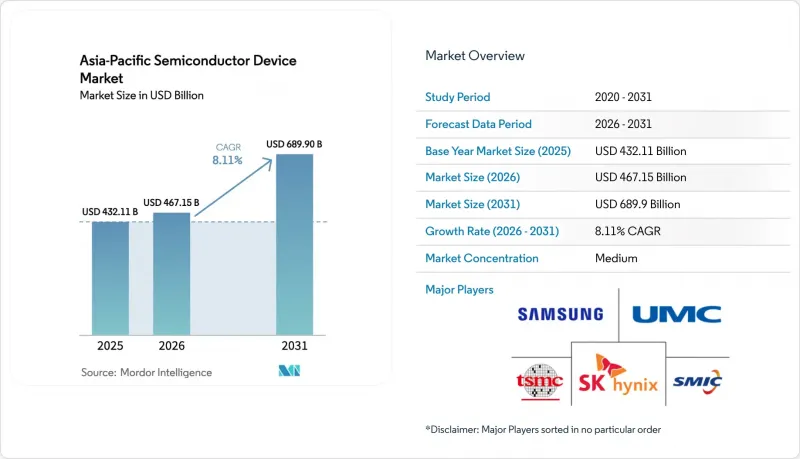
본 보고서는 디바이스 유형(디스크리트 반도체, 옵토일렉트로닉스, 센서 및 MEMS, 집적회로),비즈니스 모델(IDM 및 설계/팹리스 벤더), 최종 사용자 산업(자동차, 통신, 소비자용, 산업용, 컴퓨팅/데이터 스토리지, 데이터센터, 인공지능 등), 그리고 국가별로 분류되어 있습니다. 시장 예측은 금액(달러) 기준으로 제시되어 있습니다.
아시아태평양의 반도체 디바이스 시장 동향 및 인사이트
AI를 중심으로 한 컴퓨팅 수요의 급증
생성형 AI 및 엣지 추론 워크로드를 위한 AI 가속기는 파운드리 생산 능력에 지속적인 부담을 주고 있으며, TSMC의 첨단 공정(7nm 및 그보다 미세한 공정)은 2024년 해당 기업의 웨이퍼 매출의 74%를 차지했습니다. SK하이닉스는 고대역폭 메모리(HBM) 매출이 전년 동기 대비 4배 증가함에 따라 분기 영업이익을 사상 최고치인 8조 800억 원으로 끌어올렸습니다. 삼성은 AI 서버 수요에 대응하기 위해 HBM3E 및 3nm 게이트 올 어라운드(GAA) 로직에 초점을 맞춘 메모리 확장에 47조 5,000억 원을 배정했습니다. 파운드리 업체들은 2.5D 및 3D 칩렛 패키징 라인을 확대하고 있지만, 기판 공급 제약으로 인해 2026년까지도 리드타임이 길어질 전망입니다. 스파스 연산 및 인메모리 처리를 포함한 신경망 아키텍처의 지속적인 최적화로 인해 TOPS당 다이 크기는 축소될 것으로 예상되지만, AI가 PC, 스마트폰, 산업용 엣지 노드에 보급됨에 따라 웨이퍼 시작 총수는 증가할 것으로 전망됩니다.
자동차의 전기화 및 ADAS
중국은 수입 의존도를 억제하기 위해 2025년까지 30종 이상의 주요 자동차용 반도체에 대한 국내 규격을 제정하고, SiC 및 MCU의 현지 조달을 가속화했습니다. 지역 내 전기차(EV) 보급이 반도체 사용량 증가를 뒷받침하고 있으며, 동남아시아의 자동차 생산은 내연기관 차량에 비해 대당 최대 2.5배의 파워 디바이스가 필요한 배터리식 전기차 플랫폼으로 전환되고 있습니다. 삼성일렉트로메카닉스는 자동차용 MLCC 출하량이 연평균 11% 성장할 것으로 전망하며, 2025년에는 최초의 LiDAR 대응 커패시터 생산을 계획했습니다. ST마이크로일렉트로닉스는 전 세계 SiC 파워 시장에서 32.6%의 점유율을 유지하고 있으며, 2030년까지 두 자릿수 CAGR을 뒷받침하기 위해 카타니아와 우시에서 생산 능력을 확대되고 있습니다. ISO 26262 등 기능 안전에 관한 필수 규격으로 인해 추진, 센싱, 구역 제어 각 분야에서 고신뢰성 자동차용 IC에 대한 수요가 계속해서 주도되고 있습니다.
첨단 리소그래피 및 EDA에 대한 수출 규제
2022년 이후, 미국 산업안보국(BIS)의 일련의 결정에 따라 EUV 스캐너, 직접 라이트형 전자빔 장치 및 첨단 EDA 소프트웨어의 중국 내 팹에 대한 판매가 제한되고 있습니다. 네덜란드와 일본은 2024년에 정책을 조율하여 라이선싱 대상을 심자외선(DUV) 멀티패터닝 및 PECVD 장비까지 확대했습니다. 이에 대해 중국은 보복 조치로 특정 미국산 프로세서를 정부 조달 대상에서 제외하고, 총액 460억 달러에 달하는 국내 팹에 대한 인가를 확대했습니다. 다국적 IDM 기업들은 서로 다른 규정 준수 체제에 대응할 수밖에 없어 법무 및 물류 비용이 증가하고 있습니다. 그러나 지방 정부의 보조금과 2차 EDA 벤더의 지원 덕분에 28nm 및 성숙 노드의 확장이 지속되고 있어, 아시아태평양 전체 반도체 디바이스 시장에 미치는 단기적인 부정적 영향은 완화되고 있습니다.
부문 분석
집적회로(IC)는 2025년 아시아태평양의 반도체 디바이스 시장 매출의 84.62%를 차지했으며, 최첨단 로직, HBM, LPDDR6의 출하량이 확대됨에 따라 2031년까지 주도적인 위치를 유지할 것으로 예측됩니다. 3nm 노드로의 전환과 Rapidus사의 2nm 파일럿 라인 건설 계획은 이 지역에서 생산되는 로직 다이의 높은 가치 밀도를 더욱 강화하고 있습니다. AI 서버 수요에 힘입은 메모리 시장의 주기적인 회복으로 웨이퍼의 평균 판매 가격(ASP)은 상승하고 있는 반면, 자동차용 MCU의 경우 일본과 중국에서 28nm 공정을 활용한 임베디드 MRAM 기능에 대한 수요가 증가하고 있습니다.
센서 및 MEMS 분야는 자동차용 레이더, LiDAR 및 스마트 팩토리에서의 환경 센싱 채택 확대에 힘입어 연평균 성장률(CAGR) 9.54%를 기록하며, 아시아태평양 전체 반도체 소자 시장보다 높은 성장세를 보일 것으로 전망됩니다. AR/VR 헤드셋에 사용되는 MEMS 모션 센서의 아시아태평양의 반도체 소자 시장 규모는 2031년까지 43억 2,000만 달러를 넘어설 가능성이 있습니다. 광학 소자 및 디스크리트 파워 소자는 LED 마이크로 디스플레이 수요와 SiC 파워트레인의 도입 확대에 힘입어 한 자릿수 중반대의 성장률을 기록할 전망입니다.
기타 혜택 :
- 엑셀 형식 시장 예측(ME) 시트
- 3개월간의 애널리스트 지원
자주 묻는 질문
목차
제1장 서론
제2장 조사 방법
제3장 주요 요약
제4장 시장 구도
제5장 시장 규모 및 성장 예측
제6장 경쟁 구도
제7장 시장 기회 및 향후 전망
KTH 26.09.10According to Mordor Intelligence, Asia-Pacific semiconductor device market size in 2026 is estimated at USD 467.15 billion, growing from 2025 value of USD 432.11 billion with 2031 projections showing USD 689.9 billion, growing at 8.11% CAGR over 2026-2031.
This report is Segmented by Device Type (Discrete Semiconductors, Optoelectronics, Sensors and MEMS, and Integrated Circuits), Business Model (IDM and Design/Fabless Vendor), End-User Industry (Automotive, Communication, Consumer, Industrial, Computing/Data Storage, Data Centre, Artificial Intelligence, and More), and Country. The Market Forecasts are Provided in Terms of Value (USD).
Asia-Pacific Semiconductor Device Market Trends and Insights
AI-centric compute demand surge
AI accelerators for generative and edge inference workloads continue to strain foundry capacity, with TSMC's advanced nodes (7 nm and finer) representing 74% of the company's wafer revenue in 2024. SK hynix lifted quarterly operating profit to a record KRW 8.08 trillion on high-bandwidth memory (HBM) sales that quadrupled year over year. Samsung has earmarked KRW 47.5 trillion for memory expansion focused on HBM3E and 3-nm gate-all-around logic to meet AI server demand. Foundries are scaling 2.5-D and 3-D chiplet packaging lines, yet substrate constraints keep lead times elevated into 2026. Continuous optimization of neural network architectures, including sparse computation and in-memory processing, is expected to reduce die size per TOPS but raise total wafer starts as AI permeates PCs, smartphones, and industrial edge nodes.
Electrification and ADAS in vehicles
China established domestic standards for more than 30 critical automotive semiconductors by 2025 to curb import dependence, accelerating local SiC and MCU sourcing. Regional EV adoption fuels incremental silicon content, with Southeast Asian vehicle output shifting toward battery electric platforms that require up to 2.5 times more power devices per unit than internal-combustion equivalents. Samsung Electro-Mechanics forecasts 11% annual growth in automotive MLCC shipments and plans production of the first LiDAR-grade capacitors in 2025. STMicroelectronics retains 32.6% share of the global SiC power market and is adding capacity in Catania and Wuxi to support double-digit CAGR through 2030. Mandatory functional-safety standards such as ISO 26262 continue to drive demand for high-reliability, automotive-grade ICs across propulsion, sensing, and zonal control domains.
Export controls on advanced lithography and EDA
Successive U.S. Bureau of Industry and Security rulings since 2022 restrict EUV scanners, direct-write e-beam tools, and advanced EDA software sales to Chinese fabs. The Netherlands and Japan aligned policies in 2024, extending licensing to deep-UV multipatterning and PECVD equipment. China retaliated by excluding certain U.S. processors from government procurement and boosting domestic fab approvals worth USD 46 billion. Multinational IDMs must navigate divergent compliance frameworks, elevating legal and logistical expenses. Yet, provincial subsidies and tier-two EDA vendors support ongoing 28 nm and mature-node expansions, tempering the near-term drag on the broader Asia-Pacific semiconductor device market.
Other drivers and restraints analyzed in the detailed report include:
- 5G/6G network roll-outs
- Regional subsidies for sub-7 nm fabs
- Acute design-engineering talent shortage
For complete list of drivers and restraints, kindly check the Table Of Contents.
Segment Analysis
Integrated circuits generated 84.62% of the Asia-Pacific semiconductor device market revenue in 2025 and are projected to retain leadership through 2031 as leading-edge logic, HBM, and LPDDR6 volumes scale. Node transitions to 3 nm and the planned 2 nm pilot line at Rapidus reinforce the high value density of logic die produced in the region. Memory's cyclical rebound, anchored by AI server demand, lifts blended wafer ASPs, while automotive-grade MCUs call for embedded MRAM features on 28 nm processes in Japan and China.
The sensors and MEMS category is forecast to outpace the broader Asia-Pacific semiconductor device market at a 9.54% CAGR on rising automotive radar, lidar, and environmental sensing adoption in smart factories. The Asia-Pacific semiconductor device market size for MEMS motion sensors used in AR/VR headsets could exceed USD 4.32 billion by 2031. Optical and discrete power devices register mid-single-digit growth, buoyed by LED micro-display demand and SiC powertrain rollouts.
Complete Report Scope:
- By Device Type
- Discrete Semiconductors
- Diodes
- Transistors
- Power Transistors
- Rectifier and Thyristor
- Other Device Type
- Optoelectronics
- Light-Emitting Diodes (LEDs)
- Laser Diodes
- Image Sensors
- Optocouplers
- Other Optoelectronics
- Sensors and MEMS
- Pressure
- Magnetic Field
- Actuators
- Acceleration and Yaw Rate
- Temperature and Other Sensors and MEMS
- Integrated Circuits
- By IC Type
- Analog
- Micro
- Microprocessors (MPU)
- Microcontrollers (MCU)
- Digital Signal Processors
- Logic
- Memory
- By Technology Node
- less than 3 nm
- 3 nm
- 5 nm
- 7 nm
- 16 nm
- 28 nm
- Above 28 nm
- By IC Type
- Discrete Semiconductors
- By Business Model
- IDM
- Design/Fabless Vendor
- By End-user Industry
- Automotive
- Communication (Wired and Wireless)
- Consumer
- Industrial
- Computing/Data Storage
- Data Centre
- Artificial Intelligence
- Government (Aerospace and Defence)
- Other End-user Industry
- By Country
- China
- Japan
- South Korea
- Taiwan
- India
- Singapore
- Malaysia
- Australia
- Indonesia
- Rest of Asia-Pacific
List of Companies Covered in this Report:
- Taiwan Semiconductor Manufacturing Company Limited (TSMC)
- Samsung Electronics Co., Ltd.
- SK hynix Inc.
- Semiconductor Manufacturing International Corporation
- United Microelectronics Corporation
- Hua Hong Semiconductor Limited
- Powerchip Semiconductor Manufacturing Corp.
- Tower Semiconductor Ltd.
- Renesas Electronics Corporation
- Rohm Co., Ltd.
- MediaTek Inc.
- Novatek Microelectronics Corp.
- Realtek Semiconductor Corp.
- Nuvoton Technology Corporation
- Winbond Electronics Corporation
- GigaDevice Semiconductor Inc.
- Shanghai Fudan Microelectronics Group Co., Ltd. (Unisoc)
- Silicon Motion Technology Corp.
- JCET Group Co., Ltd.
- Advanced Semiconductor Engineering Inc.
- Magnachip Semiconductor Corp.
- Macronix International Co., Ltd.
Additional Benefits:
- The market estimate (ME) sheet in Excel format
- 3 months of analyst support
TABLE OF CONTENTS
1 INTRODUCTION
- 1.1 Study Assumptions and Market Definition
- 1.2 Scope of the Study
2 RESEARCH METHODOLOGY
3 EXECUTIVE SUMMARY
4 MARKET LANDSCAPE
- 4.1 Market Overview
- 4.2 Market Drivers
- 4.2.1 AI-Centric Compute Demand Surge
- 4.2.2 Electrification and ADAS in Vehicles
- 4.2.3 5G/6G Network Rollouts
- 4.2.4 Regional Subsidies for Sub-7 Nm Fabs
- 4.2.5 PV/ESS Boom Boosting Wide-Band-Gap Power Devices
- 4.2.6 In-House Silicon by Hyperscale Cloud Providers
- 4.3 Market Restraints
- 4.3.1 Export Controls on Advanced Lithography and EDA
- 4.3.2 Acute Design-Engineering Talent Shortage
- 4.3.3 Water-Energy Sustainability Constraints on Fabs
- 4.3.4 Memory Down-Cycles Throttling CAPEX
- 4.4 Industry Value Chain Analysis
- 4.5 Regulatory Landscape
- 4.6 Technological Outlook
- 4.7 Porter's Five Forces Analysis
- 4.7.1 Threat of New Entrants
- 4.7.2 Bargaining Power of Suppliers
- 4.7.3 Bargaining Power of Buyers
- 4.7.4 Threat of Substitutes
- 4.7.5 Intensity of Competitive Rivalry
- 4.8 Impact of Macroeconomic Factors on the Market
5 MARKET SIZE AND GROWTH FORECASTS (VALUE)
- 5.1 By Device Type
- 5.1.1 Discrete Semiconductors
- 5.1.1.1 Diodes
- 5.1.1.2 Transistors
- 5.1.1.3 Power Transistors
- 5.1.1.4 Rectifier and Thyristor
- 5.1.1.5 Other Device Type
- 5.1.2 Optoelectronics
- 5.1.2.1 Light-Emitting Diodes (LEDs)
- 5.1.2.2 Laser Diodes
- 5.1.2.3 Image Sensors
- 5.1.2.4 Optocouplers
- 5.1.2.5 Other Optoelectronics
- 5.1.3 Sensors and MEMS
- 5.1.3.1 Pressure
- 5.1.3.2 Magnetic Field
- 5.1.3.3 Actuators
- 5.1.3.4 Acceleration and Yaw Rate
- 5.1.3.5 Temperature and Other Sensors and MEMS
- 5.1.4 Integrated Circuits
- 5.1.4.1 By IC Type
- 5.1.4.1.1 Analog
- 5.1.4.1.2 Micro
- 5.1.4.1.2.1 Microprocessors (MPU)
- 5.1.4.1.2.2 Microcontrollers (MCU)
- 5.1.4.1.2.3 Digital Signal Processors
- 5.1.4.1.3 Logic
- 5.1.4.1.4 Memory
- 5.1.4.2 By Technology Node
- 5.1.4.2.1 less than 3 nm
- 5.1.4.2.2 3 nm
- 5.1.4.2.3 5 nm
- 5.1.4.2.4 7 nm
- 5.1.4.2.5 16 nm
- 5.1.4.2.6 28 nm
- 5.1.4.2.7 Above 28 nm
- 5.1.4.1 By IC Type
- 5.1.1 Discrete Semiconductors
- 5.2 By Business Model
- 5.2.1 IDM
- 5.2.2 Design/Fabless Vendor
- 5.3 By End-user Industry
- 5.3.1 Automotive
- 5.3.2 Communication (Wired and Wireless)
- 5.3.3 Consumer
- 5.3.4 Industrial
- 5.3.5 Computing/Data Storage
- 5.3.6 Data Centre
- 5.3.7 Artificial Intelligence
- 5.3.8 Government (Aerospace and Defence)
- 5.3.9 Other End-user Industry
- 5.4 By Country
- 5.4.1 China
- 5.4.2 Japan
- 5.4.3 South Korea
- 5.4.4 Taiwan
- 5.4.5 India
- 5.4.6 Singapore
- 5.4.7 Malaysia
- 5.4.8 Australia
- 5.4.9 Indonesia
- 5.4.10 Rest of Asia-Pacific
6 COMPETITIVE LANDSCAPE
- 6.1 Market Concentration
- 6.2 Strategic Moves
- 6.3 Market Share Analysis
- 6.4 Company Profiles (includes Global level Overview, Market level overview, Core Segments, Financials as available, Strategic Information, Market Rank/Share, Products and Services, and Recent Developments)
- 6.4.1 Taiwan Semiconductor Manufacturing Company Limited (TSMC)
- 6.4.2 Samsung Electronics Co., Ltd.
- 6.4.3 SK hynix Inc.
- 6.4.4 Semiconductor Manufacturing International Corporation
- 6.4.5 United Microelectronics Corporation
- 6.4.6 Hua Hong Semiconductor Limited
- 6.4.7 Powerchip Semiconductor Manufacturing Corp.
- 6.4.8 Tower Semiconductor Ltd.
- 6.4.9 Renesas Electronics Corporation
- 6.4.10 Rohm Co., Ltd.
- 6.4.11 MediaTek Inc.
- 6.4.12 Novatek Microelectronics Corp.
- 6.4.13 Realtek Semiconductor Corp.
- 6.4.14 Nuvoton Technology Corporation
- 6.4.15 Winbond Electronics Corporation
- 6.4.16 GigaDevice Semiconductor Inc.
- 6.4.17 Shanghai Fudan Microelectronics Group Co., Ltd. (Unisoc)
- 6.4.18 Silicon Motion Technology Corp.
- 6.4.19 JCET Group Co., Ltd.
- 6.4.20 Advanced Semiconductor Engineering Inc.
- 6.4.21 Magnachip Semiconductor Corp.
- 6.4.22 Macronix International Co., Ltd.
7 MARKET OPPORTUNITIES AND FUTURE OUTLOOK
- 7.1 White-space and Unmet-need Assessment