

|
시장보고서
상품코드
2119705
중동의 데이터센터 랙 시장 : 점유율 분석, 업계 동향과 통계, 성장 예측(2026-2031년)Middle East Data Center Rack - Market Share Analysis, Industry Trends & Statistics, Growth Forecasts (2026 - 2031) |
||||||
 Mordor Intelligence
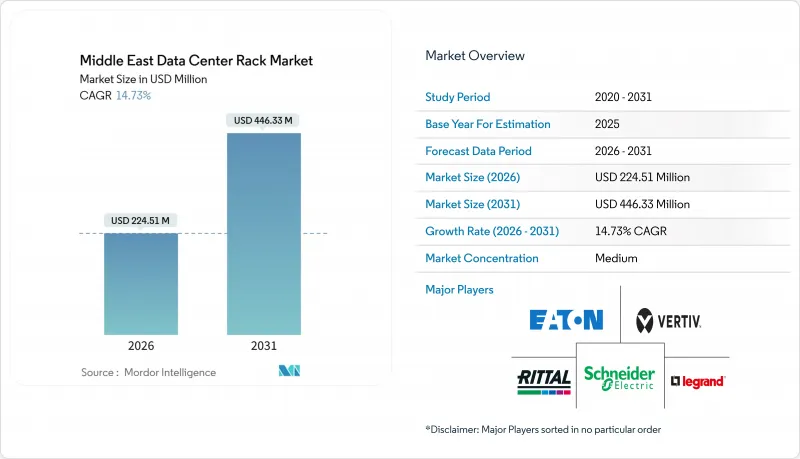
Mordor Intelligence에 의하면, 중동의 데이터센터 랙 시장 규모는 2026년에 2억 2,451만 달러로 추정되며, 예측 기간(2026-2031년)에서 CAGR 14.73%로 성장을 지속하여, 2031년에는 4억 4,633만 달러에 이를 전망입니다.
본 보고서는 랙 크기(쿼터 랙, 하프 랙, 풀 랙), 랙 유형(밀폐형 캐비닛, 오픈 프레임, 벽걸이형, 마이크로 엣지 인클로저), 티어 유형(Tier 1 및 2, Tier 3, 티어 4), 데이터센터 규모(소규모, 중규모,대규모, 하이퍼스케일), 데이터센터 유형(코로케이션, 하이퍼스케일러, 엔터프라이즈 및 엣지), 국가별로 분류되어 있습니다. 시장 전망은 금액(달러) 기준으로 제시되어 있습니다.
중동 데이터센터 랙 시장 동향 및 인사이트
사우디아라비아 및 UAE에서 주요 클라우드 기업들의 하이퍼스케일 확장
각 클라우드 플랫폼 기업들은 데이터 주권에 관한 규제를 충족하기 위해 페르시아만 연안 지역 내에서 멀티 리전 구축을 추진하고 있으며, 새로운 가용성 영역이 하나 추가될 때마다 20kW 이상의 부하를 처리하도록 설계된 고밀도 밀폐형 캐비닛 수천 대가 도입될 것입니다. AI 훈련 클러스터는 열 출력을 증가시키기 때문에 랙에는 케이블 배선, 후면 도어형 열교환기, 센서 제어식 기류 제어 기능이 통합되어야 합니다. 5메가와트에서 50메가와트까지 확장 가능한 모듈식 포드 레이아웃 덕분에 건설 기간이 단축되어, 사전 조립 키트를 제공하는 랙 공급업체에게 경쟁 우위를 제공합니다.
현지 조달 요건의 가속화가 국내 코로케이션 수요를 견인
사우디아라비아의 IKTVA 및 UAE의 ICV 체계에서는 기술 프로젝트에 대해 30%-40%의 국내 부가가치 기준이 부과되고 있기 때문에 세계 공급업체들은 현재 국내 최종 조립을 위해 노크다운 방식의 랙을 출하하거나 지역 철강 가공업체와 제휴하고 있습니다. 이러한 제도에 따른 인증은 가격 프리미엄을 수반하지만, 입찰 평가에서 우선순위가 보장됩니다. 요르단에서도 현지 규제의 적용이 확대됨에 따라, 공급망은 수입 중심 모델에서 제조, 분체 도장, 최종 조립을 걸프 지역 내 여러 공장으로 분산시키는 하이브리드 모델로 전환되고 있습니다.
부문 분석
2025년, 중동의 데이터센터 랙 시장에서 풀 랙이 74.32%의 점유율을 차지하며, 코로케이션 및 엔터프라이즈 홀에서 42U 크기의 역사적인 우위를 입증하고 있습니다. 그러나 소형 쉘터에 컴퓨팅 설비를 설치하는 5G 엣지 구축의 확산에 힘입어 하프 랙은 2031년까지 연평균 성장률(CAGR) 15.53%로 성장하고 있습니다. 아부다비에서 노키아가 2025년에 구축한 클라우드 RAN에서는 12U 및 18U 내후성 인클로저가 채택되어, 무선 액세스 네트워크가 집중형 홀에서 분산형 노드로 전환되고 있음을 입증했습니다. 쿼터 랙은 원격 사무실을 위한 틈새 수요가 나타나고 있지만, 대량 수요는 계속해서 이 두 가지 주요 크기에 집중될 전망입니다.
통신 사업자들은 수천 대의 동일한 사양의 42U 캐비닛을 수용하는 하이퍼스케일 홀용과, 전원, 냉각, 보안 기능이 완전히 통합된 상태로 출하되는 하프 하이트 인클로저용, 이 두 가지 포트폴리오를 병행하는 것을 선호합니다. 이러한 접근 방식은 조달 프로세스를 간소화하는 동시에 다양한 열 환경에 대응할 수 있게 해줍니다. 구체적으로, GPU 클러스터에는 20kW의 전력을 지원하는 풀 랙이 채택되고, 5kW 이하로 작동하는 엣지 용도용으로는 하프 랙이 채택되고 있습니다. 양극단을 모두 아우르는 벤더가 최대 시장 점유율을 확보하지만, 서로 다른 공급망과 가격 책정 모델을 동시에 운영해야 합니다.
2025년 현재, 밀폐형 캐비닛은 중동 데이터센터 랙 시장 점유율의 79.33%를 차지하고 있으며, 2031년까지 15.67%의 성장이 예상됩니다. 이러한 선호의 배경에는 방진 성능이 있습니다. IP54 규격을 준수하는 도어가 사막의 미세 입자로부터 서버를 보호하고, 양압 기류가 신뢰성을 향상시키기 때문입니다. 오픈 프레임형 랙은 여전히 테스트 실험실이나 Tier 1 홀 등에서 사용되고 있지만, 사업자들이 가동 시간 목표와 더욱 엄격한 환경 제어를 동시에 달성하고자 함에 따라 그 점유율은 감소하는 추세입니다.
열 관리 대책도 시장 동향에 영향을 미치고 있습니다. 후면 도어식 열교환기나 인로우형 칠러는 밀폐형 캐비닛에 후속 설치가 용이하여, 이를 통해 시설은 냉수 플랜트를 교체하지 않고도 전력 밀도를 높일 수 있습니다. 2025년에 완공된 두바이의 ‘Moro Hub’ 태양광 데이터센터에서는 수동적 에너지를 활용해 주간 열을 관리하기 위해 후면 도어형 열교환기를 갖춘 밀폐형 인클로저가 채택되었습니다. AI가 30-50kW의 부하를 발생시키는 가운데, 밀폐형 포맷은 그 우위를 확고히 하고 있으며, 하이퍼스케일러에 의한 가격 압박에도 불구하고 프리미엄 평균 판매 가격(ASP)을 유지하고 있습니다.
기타 혜택:
- 엑셀 형식 시장 예측(ME) 시트
- 3개월간의 애널리스트 지원
자주 묻는 질문
목차
제1장 서론
제2장 조사 방법
제3장 개요
제4장 시장 구도
제5장 시장 규모와 성장 예측
제6장 경쟁 구도
제7장 시장 기회와 향후 전망
JHS 26.09.03According to Mordor Intelligence, the Middle East data center rack market size is estimated at USD 224.51 million in 2026, and is expected to reach USD 446.33 million by 2031, at a CAGR of 14.73% during the forecast period (2026-2031).
This report is Segmented by Rack Size (Quarter Rack, Half Rack, and Full Rack), Rack Type (Enclosed Cabinet, Open-Frame, Wall-Mount and Micro-Edge Enclosure), Tier Type (Tier 1 and 2, Tier 3, and Tier 4), Data Center Size (Small, Medium, Large and Hyperscale), Data Center Type (Colocation, Hyperscalers, and Enterprise and Edge), and Country. Market Forecasts are Provided in Terms of Value (USD).
Middle East Data Center Rack Market Trends and Insights
Hyperscale Build-Outs by Cloud Majors in Saudi Arabia and UAE
Cloud platforms are rolling out multi-region footprints inside the Gulf to satisfy data-sovereignty rules, and every new availability zone translates into thousands of high-density, enclosed cabinets engineered for 20 kilowatt or higher loads. Racks must integrate cable-routing, rear-door heat exchangers, and sensor-driven airflow because AI training clusters intensify thermal output. Modular pod layouts that scale from 5 megawatts to 50 megawatts are shortening construction schedules, giving rack vendors that deliver pre-assembled kits an edge.
Accelerated Local-Content Requirements Driving On-Shore Colocation Demand
Saudi Arabia's IKTVA and the UAE's ICV frameworks impose 30%-40% domestic-value thresholds on technology projects, so global vendors now ship knock-down racks for final assembly in-country or partner with regional steel fabricators. Certification under these schemes commands price premiums yet ensures priority in bid evaluations. As local compliance expands to Jordan, the supply chain is moving from import-centric to hybrid models that split fabrication, powder coating, and final integration across multiple Gulf plants.
Other drivers and restraints analyzed in the detailed report include:
- 5G-Led Edge Sites Requiring Micro-Module Racks
- Sovereign-AI and HPC Investments in Gulf States
- High Import Tariffs on Steel Enclosures in Non-FTA Countries
- Water-Scarcity Regulations Limiting Liquid-Cooling Retrofits
For complete list of drivers and restraints, kindly check the Table Of Contents.
Segment Analysis
Full racks command 74.32% of Middle East data center rack market share in 2025, underscoring the historical dominance of 42U footprints for colocation and enterprise halls. Yet half racks expand at a 15.53% CAGR through 2031, propelled by 5G edge rollouts that install compute in small shelters. Nokia's 2025 Cloud RAN build in Abu Dhabi used 12U and 18U weatherized enclosures, proving how radio access networks shift away from centralized halls toward distributed nodes. Quarter racks see niche uptake for remote offices, but bulk demand will continue to cluster around the two leading sizes.
Operators favor dual portfolios, one for hyperscale halls that absorb thousands of identical 42U cabinets and another for half-height enclosures that ship fully integrated with power, cooling, and security. The approach simplifies procurement while meeting divergent thermals, with GPU clusters leaning on full racks that support 20 kilowatt power and half racks targeting edge applications running at 5 kilowatt or lower. Vendors that span both ends capture the widest wallet share, but must juggle distinct supply chains and pricing models.
Enclosed cabinets held 79.33% of Middle East data center rack market share in 2025 and are projected to grow 15.67% through 2031. Dust ingress protection drives the preference, as IP54-rated doors shield servers from desert particulates while positive-pressure airflow improves reliability. Open-frame racks linger in test labs or Tier 1 halls, yet their share is eroding because operators pair uptime targets with stricter environmental controls.
Thermal strategies also tilt the field. Rear-door heat exchangers and in-row chillers retrofit smoothly onto sealed cabinets, letting facilities step up power density without replacing chilled-water plants. The Moro Hub solar data center in Dubai completed in 2025 and adopted sealed enclosures with rear-door exchangers to manage daytime heat using passive energy. As AI drives 30-50 kilowatt loads, the enclosed format cements its edge, sustaining premium ASPs despite hyperscaler price pressure.
Complete Report Scope:
- By Rack Size
- Quarter Rack (Below 11U)
- Half Rack (12 to 22U)
- Full Rack (Above 42U)
- By Rack Type
- Enclosed Cabinet
- Open-Frame
- Wall-Mount and Micro-Edge Enclosure
- By Tier Type
- Tier 1 and 2
- Tier 3
- Tier 4
- By Data Center Size
- Small Data Center
- Medium Data Center
- Large Data Center
- Hyperscale Data Center
- By Data Center Type
- Colocation Data Center
- Hyperscalers Data Center/CSPs
- Enterprise and Edge Data Center
- By Country
- Saudi Arabia
- United Arab Emirates
- Oman
- Jordan
- Rest of Middle East
List of Companies Covered in this Report:
- Schneider Electric SE
- Vertiv Group Corp.
- Rittal GmbH & Co. KG
- Eaton Corporation plc
- Legrand SA
- nVent Electric plc
- Panduit Corp.
- Huawei Technologies Co., Ltd.
- Black Box Corporation
- Chatsworth Products, Inc.
- Middle East Fiber Cable Manufacturing Co.
- Great Lakes Data Racks & Cabinets Inc.
- Delta Electronics, Inc.
- ABB Ltd.
- Belden Inc.
- Canovate Group
Additional Benefits:
- The market estimate (ME) sheet in Excel format
- 3 months of analyst support
TABLE OF CONTENTS
1 INTRODUCTION
- 1.1 Study Assumptions and Market Definition
- 1.2 Scope of the Study
2 RESEARCH METHODOLOGY
3 EXECUTIVE SUMMARY
4 MARKET LANDSCAPE
- 4.1 Market Overview
- 4.2 Market Drivers
- 4.2.1 Hyperscale Build-Outs by Cloud Majors in Saudi Arabia and UAE
- 4.2.2 Accelerated Local-Content Requirements Driving On-Shore Colocation Demand
- 4.2.3 5G-Led Edge Sites Requiring Micro-Module Racks
- 4.2.4 Sovereign-AI and HPC Investments in Gulf States
- 4.2.5 Renewable-Energy PPA Incentives Lowering Opex for Rack Densification
- 4.2.6 Micro-Climate Resistant Enclosures for Desert Environments
- 4.3 Market Restraints
- 4.3.1 High Import Tariffs on Steel Enclosures in Non-FTA Countries
- 4.3.2 Limited Availability of Tier-IV Colocation Floor Space Outside GCC
- 4.3.3 Growing Preference for Blade and Sled Servers Reduces Rack Count
- 4.3.4 Water-Scarcity Regulations Limiting Liquid-Cooling Retrofits
- 4.4 Impact of Macroeconomic Factors on the Market
- 4.5 Industry Value Chain Analysis
- 4.6 Regulatory Landscape
- 4.7 Technological Outlook
- 4.8 Porter's Five Forces Analysis
- 4.8.1 Bargaining Power of Buyers
- 4.8.2 Bargaining Power of Suppliers
- 4.8.3 Threat of New Entrants
- 4.8.4 Threat of Substitute Products
- 4.8.5 Intensity of Competitive Rivalry
5 MARKET SIZE AND GROWTH FORECASTS (VALUE)
- 5.1 By Rack Size
- 5.1.1 Quarter Rack (Below 11U)
- 5.1.2 Half Rack (12 to 22U)
- 5.1.3 Full Rack (Above 42U)
- 5.2 By Rack Type
- 5.2.1 Enclosed Cabinet
- 5.2.2 Open-Frame
- 5.2.3 Wall-Mount and Micro-Edge Enclosure
- 5.3 By Tier Type
- 5.3.1 Tier 1 and 2
- 5.3.2 Tier 3
- 5.3.3 Tier 4
- 5.4 By Data Center Size
- 5.4.1 Small Data Center
- 5.4.2 Medium Data Center
- 5.4.3 Large Data Center
- 5.4.4 Hyperscale Data Center
- 5.5 By Data Center Type
- 5.5.1 Colocation Data Center
- 5.5.2 Hyperscalers Data Center/CSPs
- 5.5.3 Enterprise and Edge Data Center
- 5.6 By Country
- 5.6.1 Saudi Arabia
- 5.6.2 United Arab Emirates
- 5.6.3 Oman
- 5.6.4 Jordan
- 5.6.5 Rest of Middle East
6 COMPETITIVE LANDSCAPE
- 6.1 Market Concentration
- 6.2 Strategic Moves
- 6.3 Market Share Analysis
- 6.4 Company Profiles (includes Global Level Overview, Market Level Overview, Core Segments, Financials as available, Strategic Information, Market Rank/Share, Products and Services, Recent Developments)
- 6.4.1 Schneider Electric SE
- 6.4.2 Vertiv Group Corp.
- 6.4.3 Rittal GmbH & Co. KG
- 6.4.4 Eaton Corporation plc
- 6.4.5 Legrand SA
- 6.4.6 nVent Electric plc
- 6.4.7 Panduit Corp.
- 6.4.8 Huawei Technologies Co., Ltd.
- 6.4.9 Black Box Corporation
- 6.4.10 Chatsworth Products, Inc.
- 6.4.11 Middle East Fiber Cable Manufacturing Co.
- 6.4.12 Great Lakes Data Racks & Cabinets Inc.
- 6.4.13 Delta Electronics, Inc.
- 6.4.14 ABB Ltd.
- 6.4.15 Belden Inc.
- 6.4.16 Canovate Group
7 MARKET OPPORTUNITIES AND FUTURE OUTLOOK
- 7.1 White-Space and Unmet-Need Assessment


