|
시장보고서
상품코드
2120434
온도 센서 : 시장 점유율 분석, 업계 동향 및 통계, 성장 예측(2026-2031년)Temperature Sensors - Market Share Analysis, Industry Trends & Statistics, Growth Forecasts (2026 - 2031) |
||||||
 Mordor Intelligence
Mordor Intelligence에 의하면, 온도 센서 시장 규모는 2025년 93억 5,000만 달러로 평가되었습니다. 2026년에는 99억 3,000만 달러로 확대되어 2026년부터 2031년에 걸쳐 CAGR 6.2%로 성장을 지속하여, 2031년까지 134억 1,000만 달러에 이를 것으로 예측됩니다.
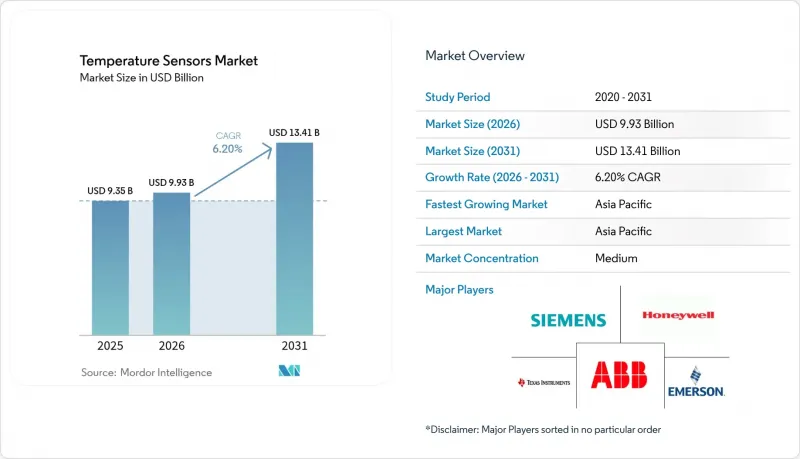
본 보고서는 유형(유선, 무선), 출력(아날로그, 디지털), 기술(접촉식 열전대 등), 최종 사용자 산업(화학제품 및 석유화학제품, 석유 및 가스 등) 및 지역별로 분류되어 있습니다. 시장 예측은 금액(달러) 기준으로 제시되어 있습니다.
세계의 온도 센서 시장 동향 및 인사이트
유럽 공정 산업에서의 스마트 IIoT 온도 네트워크 확대
유럽의 각 제조업체들은 에너지 효율 및 근로자 안전에 관한 ‘인더스트리 5.0’ 목표를 달성하기 위해 기존 제어 아키텍처에 무선 온도 노드를 통합하고 있습니다. 유지보수가 필요 없는 센서 설계로 인해 수명 주기 비용이 절감되고 개조 도입이 간소화되므로, 화학 및 섬유 플랜트와 HVAC 업그레이드에서 매력적입니다. AI를 활용한 제어 루프는 더 풍부한 데이터 스트림을 활용하여 기압 및 열 환경을 안정화시키고, 제품 수율을 향상시키는 동시에 가동 중단 시간을 줄입니다. 미국 소규모 공장을 대상으로 한 투자 수익률(ROI) 조사에서는 초기 IIoT 하드웨어 비용을 상회하는 운영 비용 절감이 확인되어, 유사한 프로젝트에 대한 자본 예산의 타당성이 입증되었습니다. 그 결과, 신뢰성이 극히 중요한 용도에서도 무선 노드의 도입이 가속화되고 있으며, 온도 센서 시장은 커넥티드 아키텍처로 빠르게 전환되고 있습니다.
GaN/SiC 파워 일렉트로닉스의 채택 확대가 정밀 냉각 센서 수요를 끌어올리고 있습니다.
질화갈륨(GaN) 및 실리콘카바이드(SiC) 소자는 더 높은 전력 밀도로 작동하기 때문에 1도 미만의 모니터링 정밀도가 필요한 국소적인 발열 구역이 발생합니다. 반도체 공급업체들은 GaN이 급속 충전기, AI 서버 및 전기차용 컨버터 분야에서 상업적 전환점에 도달할 것으로 예측했습니다. 자동차 제조업체들은 강한 전자기장 하에서도 보정을 유지할 수 있는 센서를 지정하고 있는 반면, 데이터센터 운영자들은 핫스팟 위험을 억제하기 위해 다점 열 분포 맵을 채택하고 있습니다. 알루미늄 질화물 박막 센서에 대한 조사 결과, 900°C까지 신뢰성 있는 작동이 확인되어 센서의 사용 범위가 가혹한 전력 전자 환경으로 확대되고 있습니다. 경쟁력 있는 비용으로 고정밀도와 EMI 내성을 제공하는 공급업체는 온도 센서 시장에서 점유율을 확대하는 데 유리한 입장에 있습니다.
중국의 저비용 공급업체에 의한 평균 판매 가격(ASP) 하락 압력
정부의 지원을 통한 규모의 경제 효과로 인해, 중국 공급업체들은 범용 열전대나 기본적인 RTD를 세계 경쟁사들보다 낮은 가격에 판매할 수 있게 되었으며, 이는 온도 센서 시장 전체의 이익률을 압박하고 있습니다. 유럽 기업들은 Sensirion사의 STS4L과 같이 비용 효율성이 뛰어나면서도 고정밀도를 갖춘 모델을 출시하여 대응하고 있습니다. 이 모델은 ±0.4°C의 정확도를 유지하면서도 소비 전력을 마이크로와트 단위로 억제하여, 직접적인 가격 경쟁에 휘말리지 않고 시장 점유율을 지키고 있습니다.
부문 분석
유선 센서는 2025년에도 매출의 84.35%를 차지하며 계속해서 시장을 독점했으며, 전자기 간섭이나 지연의 위험을 견뎌내야 하는 생산상 중요한 루프를 뒷받침하고 있습니다. 한편, 무선 노드는 그 격차를 좁혀가고 있으며, 공장이 기존 생산 라인을 개조하거나 건물 관리 기업이 배관 공사 없이 설치 가능한 배터리 구동 송신기를 도입하는 추세에 따라 2031년까지 연평균 성장률(CAGR) 11.2%로 확대되고 있습니다. 무선 기반 개조에서는 일반적으로 중복성 확보를 위한 추가 채널이 도입되기 때문에 온도 센서 시장이 그 혜택을 보고 있으며, 이는 판매 대수 및 서비스 수익 증가로 이어지고 있습니다. 이용 사례는 화학 반응기, HVAC 밸런스 조정, 원격 우물 입구 모니터링 등에 이르기까지 다양하며, 모두 안전한 프로토콜 스택과 수년에 걸친 배터리 수명이 요구됩니다.
프로토콜의 급속한 성숙으로 인해 구리선 케이블과의 신뢰성 차이는 줄어들고 있으며, 다중 노드 구축 프로젝트의 평균 투자 회수 기간은 2년 미만으로 단축되었습니다. 허니웰의 ISA100 준수 ‘SmartLine’ 트랜스미터는 암호화된 메시 아키텍처를 통해 패킷 손실을 0.01% 미만으로 억제하면서 1초 미만의 갱신 빈도를 실현하고 있는 좋은 예입니다(honeywell.com). 또한, 운영자는 라인을 중단하지 않고도 사이버 보안 패치를 배포할 수 있는 ‘FOTA(Firmware Over The Air)’를 통한 업그레이드를 높이 평가하고 있으며, 이 기능은 현재 온도 센서 시장 전반에서 보편화되고 있습니다. 따라서 온도 센서 업계 전반에서는 무선 기술을 틈새 시장용이 아닌, 기존 시설(브라운필드)에서의 장기적인 표준으로 인식하고 있습니다.
2025년에도 아날로그 장치가 매출의 70.65%를 계속 차지했습니다. 이는 정유시설나 제철소에서 4-20 mA 루프가 여전히 분산 제어 시스템(DCS) 입력의 기반을 이루고 있기 때문입니다. 그러나 엣지에서 클라우드에 이르는 아키텍처에서 산업용 이더넷, I2C, 1-Wire 버스가 보급됨에 따라 디지털 센서는 2031년까지 연평균 성장률(CAGR) 9.1%로 확대되고 있습니다. 디지털 노드에 EEPROM 기반의 보정 기능이 내장되면, 설치 업체는 플랜트 현장에서 미세 조정을 할 필요가 없어지므로 시운전 비용 절감과 가동 중단 시간 단축으로 이어집니다. 이러한 전환의 가속화를 반영하여, 디지털 기기용 온도 센서 시장 규모는 2031년까지 53억 8,000만 달러에 달할 것으로 예측됩니다.
텍사스 기기(Texas Instruments)의 ±0.08°C 정밀도를 자랑하는 TMP117은 FDA 감사를 위해 교정 데이터를 보관해야 하는 제약 공장에서 내장형 CRC 보호 레지스터가 어떻게 추적성을 향상시키는지 보여줍니다(ti.com). 또한, 데이터 양이 많은 패킷을 통해 이상 현상이 발생하기 전에 고장을 예측하는 자산 성능 관리 알고리즘이 가능해져, 펌프나 모터의 수명을 연장하고 배상 책임 위험을 줄입니다. 그 결과, 각 벤더들은 분석 대시보드를 부가가치가 높은 구독 서비스로 묶어 제공하고 있으며, 이를 통해 온도 센서 시장 전체의 수익 주기성이 완화되고 있습니다.
지역별 분석
아시아태평양은 2025년 매출의 44.72%를 차지했으며, 중국의 5G 매크로셀 구축과 인도의 GMP 준수 백신 제조 공장 건설에 힘입어 연평균 성장률(CAGR) 7.05%로 성장하고 있습니다. 전기차 배터리 생산 라인에 대한 정부의 보조금으로 차량 1대당 센서 밀도가 높아지는 한편, 국내 반도체 팹에서는 ±0.2°C의 RTD가 필요한 클린룸 루프가 채택되고 있습니다. 일본과 한국은 특히 1,400°C 센서가 필요한 SiC 웨이퍼용 로에서 정밀 제조 수요를 주도하고 있습니다.
북미에서는 제약 업계의 콜드체인 규정 준수 및 사이트당 150km가 넘는 광섬유 DTS가 도입되는 경우가 많은 하이퍼스케일 클라우드 캠퍼스가 시장을 주도하고 있습니다. FDA가 2025년부터 특정 임상용 체온계에 대해 적용 면제 조치를 시행함에 따라 기기 인증 주기가 가속화되는 한편, DOE가 자금을 지원하는 효율화 목표에 따라 데이터센터 운영자는 흡기 온도를 1°C 미만으로 제어해야 하는 압박을 받고 있습니다. 자동차 업계의 Tier 1 공급업체는 설계 주기가 긴 편이지만, 새로운 EV 플랫폼이 등장할 때마다 열 관리 노드가 확대되고 있어 온도 센서 시장은 디트로이트의 전동화 일정에 연동되고 있습니다.
유럽에서는 ‘인더스트리 5.0’으로의 전환이 우선시되고 있으며, 무선 센서 네트워크와 디지털 트윈을 융합한 스마트 공장 업그레이드를 위해 EU 차원의 보조금이 활용되고 있습니다. 마찬가지로, 전기차의 보급에 따라 차량당 배터리 열 관리 장치의 수도 증가하고 있습니다. 이 지역의 에너지 전환은 수소 전해조 및 해상 풍력 발전용 컨버터에서 내식성 프로브에 대한 수요를 촉진하고 있습니다. 전반적으로 유럽의 온도 센서 업계는 높은 평균 판매 가격(ASP)과 엄격한 측정 기준을 특징으로 하며, 이러한 요소들이 세계 경쟁 속에서 이익률을 지켜주고 있습니다.
기타 혜택 :
- 엑셀 형식 시장 예측(ME) 시트
- 3개월간의 애널리스트 지원
자주 묻는 질문
목차
제1장 서론
제2장 조사 방법
제3장 주요 요약
제4장 시장 구도
제5장 시장 규모 및 성장 예측
제6장 경쟁 구도
제7장 시장 기회 및 향후 전망
KTH 26.09.10According to Mordor Intelligence, the temperature sensor market size is expected to grow from USD 9.35 billion in 2025 to USD 9.93 billion in 2026 and is forecast to reach USD 13.41 billion by 2031 at 6.2% CAGR over 2026-2031.
This report is Segmented Into Type (Wired, Wireless), Output (Analog, Digital), Technology (Contact Thermocouple, and More), End-User Industry (Chemical and Petrochemical, Oil and Gas and More), and Geography. The Market Forecasts are Provided in Terms of Value (USD).
Global Temperature Sensors Market Trends and Insights
Expansion of Smart IIoT Temperature Networks in European Process Industries
European manufacturers are integrating wireless temperature nodes into existing control architectures to meet Industry 5.0 goals for energy efficiency and worker safety. Maintenance-free sensor designs lower lifecycle cost and simplify retrofit deployment, which is attractive in chemical-fiber plants and HVAC upgrades. AI-enabled control loops use the richer data stream to stabilize air-pressure and thermal conditions, improving product yield and reducing downtime. Return-on-investment studies in small US factories show operating savings that outweigh initial IIoT hardware spend, validating capital budgets for similar. As a result, wireless nodes gain momentum even in reliability-critical applications, accelerating the temperature sensor market toward connected architectures.
GaN/SiC Power Electronics Adoption Elevating Precision-Cooling Sensor Demand
Gallium-nitride and silicon-carbide devices operate at higher power densities, creating localized heat zones that require sub-degree monitoring accuracy. Semiconductor suppliers forecast GaN reaching commercial tipping points in fast chargers, AI servers, and electric-vehicle converters. Automotive OEMs specify sensors that maintain calibration under strong electromagnetic fields, while data-center operators adopt multi-point thermal maps to contain hotspot risk. Research into aluminum-nitride thin-film sensors shows reliable operation up to 900 °C, extending sensor use into extreme power-electronics environments . Suppliers that deliver precision and EMI immunity at competitive cost are well-positioned to gain share in the temperature sensor market.
Downward ASP Pressure from Chinese Low-Cost Suppliers
State-supported economies of scale allow Chinese vendors to undercut global peers on commodity thermocouples and basic RTDs, eroding margins across the temperature sensor market. European firms are countering by releasing cost-efficient yet accurate models such as Sensirion's STS4L, which draws micro-watts of power while holding +-0.4 °C accuracy, thereby defending share without direct price wars
Other drivers and restraints analyzed in the detailed report include:
- Mandatory Cold-Chain Traceability for Biologics & mRNA Vaccines
- 5G Base-Station Roll-outs Requiring On-Board Thermal Monitoring
- Supply Risk of High-Purity Platinum Wire for RTDs
For complete list of drivers and restraints, kindly check the Table Of Contents.
Segment Analysis
Wired sensors continued to dominate with 84.35 % revenue in 2025, anchoring production-critical loops that must resist electromagnetic interference and latency risks. Wireless nodes are closing the gap, expanding at 11.2 % CAGR to 2031 as factories retrofit legacy lines and building-management firms deploy battery-powered transmitters that install without conduit work. The temperature sensor market benefits because every wireless retrofit typically adds extra redundancy channels, lifting unit volumes and service revenues. Use cases span chemical reactors, HVAC balancing and remote well-head monitoring, each demanding secure protocol stacks and multi-year battery life.
Rapid protocol maturation is reducing the reliability delta versus copper cabling and bringing average project payback below two years for multi-node deployments. Honeywell's ISA100-compliant SmartLine transmitter illustrates how encrypted mesh architectures keep packet loss below 0.01 % while reporting sub-second updates [honeywell.com]. Operators also value firmware-over-the-air upgrades that let them roll out cyber-security patches without line shutdowns, a feature now common across the temperature sensor market. The overall temperature sensor industry therefore sees wireless not as a niche but as the long-term default for brown-field sites.
Analog devices retained 70.65 % revenue in 2025 because 4-20 mA loops still anchor distributed-control-system (DCS) inputs in refineries and steel mills. Digital sensors, however, are expanding 9.1 % CAGR to 2031 as industrial Ethernet, I2C and 1-Wire buses proliferate in edge-to-cloud architectures. When digital nodes embed EEPROM-based calibration, installers no longer need plant-floor trim, cutting commissioning cost and shortening downtime. The temperature sensor market size for digital devices is projected to reach USD 5.38 billion by 2031, reflecting this accelerating conversion.
Texas Instruments' +-0.08 °C TMP117 exemplifies how embedded CRC-protected registers improve traceability in pharmaceutical plants that must archive calibration data for FDA audits [ti.com]. Data-rich packets also enable asset-performance-management algorithms that predict failure before excursions occur, extending pump and motor life and lowering indemnity exposure. Vendors consequently bundle analytics dashboards as value-added subscriptions that smooth revenue cyclicality across the temperature sensor market.
Complete Report Scope:
- Type
- Wired
- Wireless
- Output
- Analog
- Digital
- Technology
- Contact Thermocouple
- Resistance Temperature Detector (RTD)
- Thermistor (NTC/PTC)
- Temperature IC
- Non-Contact Infrared
- Fiber-Optic
- End-User Industry
- Chemical and Petrochemical
- Oil and Gas
- Metals and Mining
- Power Generation
- Food and Beverage
- Automotive and E-Mobility
- Medical and Healthcare
- Aerospace and Defense
- Consumer Electronics and Wearables
- Other Industries
- By Geography
- North America
- United States
- Canada
- Mexico
- Europe
- United Kingdom
- Germany
- France
- Italy
- Rest of Europe
- Asia-Pacific
- China
- India
- Japan
- South Korea
- Australia
- Rest of Asia-Pacific
- South America
- Brazil
- Argentina
- Rest of South America
- Middle East
- United Arab Emirates
- Saudi Arabia
- Rest of Middle East
- Africa
- South Africa
- Nigeria
- Rest of Africa
- North America
Geography Analysis
Asia-Pacific generated 44.72 % of 2025 revenue and is advancing at a 7.05 % CAGR, supported by China's 5G macro-cell rollout and India's build-out of GMP-compliant vaccine plants. Government subsidies for EV battery lines amplify sensor density per vehicle, while domestic semiconductor fabs adopt clean-room loops that demand +-0.2 °C RTDs. Japan and South Korea add precision-manufacturing pull, especially for SiC wafer furnaces requiring 1,400 °C sensors.
North America follows with pharmaceutical cold-chain compliance and hyperscale cloud campuses that often deploy >150 km of fiber DTS per site. The FDA's 2025 waiver on certain clinical thermometers accelerates device qualification cycles, while DOE-funded efficiency targets push data-center operators to sub-1 °C inlet-air control. Automotive Tier-1 design cycles are longer, yet every new EV platform still expands thermal nodes, tying the temperature sensor market to Detroit's electrification timetable.
Europe prioritizes Industry 5.0 retrofits, leveraging EU-level grants for smart-factory upgrades that merge wireless sensor networks with digital twins. EV adoption likewise lifts battery thermal-management units per vehicle. The region's energy transition stimulates demand for corrosion-resistant probes in hydrogen electrolyzers and offshore wind converters. Overall the temperature sensor industry in Europe is characterised by premium ASPs and stringent metrology standards that shield margins against global price competition.
- Honeywell International Inc.
- Siemens AG
- Texas Instruments Inc.
- STMicroelectronics N.V.
- TE Connectivity Ltd.
- Panasonic Corporation
- ABB Ltd
- Emerson Electric Co.
- Analog Devices Inc.
- Denso Corporation
- Microchip Technology Inc.
- Amphenol Advanced Sensors
- Sensirion AG
- Endress+Hauser AG
- Robert Bosch GmbH
- Fluke Process Instruments
- FLIR Systems (Teledyne)
- Gnther GmbH Temperaturmesstechnik
- Kongsberg Gruppen
- Maxim Integrated Products
- Thermometris
Additional Benefits:
- The market estimate (ME) sheet in Excel format
- 3 months of analyst support
TABLE OF CONTENTS
1 INTRODUCTION
- 1.1 Study Assumptions and Market Definition
- 1.2 Scope of the Study
2 RESEARCH METHODOLOGY
3 EXECUTIVE SUMMARY
4 MARKET LANDSCAPE
- 4.1 Market Overview
- 4.2 Market Drivers
- 4.2.1 Expansion of Smart IIoT Temperature Networks in European Process Industries
- 4.2.2 GaN/SiC Power Electronics Adoption Elevating Precision-Cooling Sensor Demand (Asia)
- 4.2.3 Mandatory Cold-Chain Traceability for Biologics and mRNA Vaccines (North America)
- 4.2.4 5G Base-Station Roll-outs Requiring On-Board Thermal Monitoring (Asia)
- 4.2.5 Electrified-Mobility Thermal-Management Modules Adoption (Europe)
- 4.2.6 Hyperscale Data-Center Build-out Driving Fiber-Optic Distributed Sensing (Global)
- 4.3 Market Restraints
- 4.3.1 Downward ASP Pressure from Chinese Low-Cost Suppliers
- 4.3.2 Supply Risk of High-Purity Platinum Wire for RTDs
- 4.3.3 Calibration-Drift Liability Claims in Pharma Manufacturing (US/EU)
- 4.3.4 Long Design-in Freeze Cycles in Automotive Tier-1s
- 4.4 Value / Supply-Chain Analysis
- 4.5 Regulatory or Technological Outlook
- 4.6 Porter's Five Forces Analysis
- 4.6.1 Bargaining Power of Suppliers
- 4.6.2 Bargaining Power of Buyers
- 4.6.3 Threat of New Entrants
- 4.6.4 Intensity of Competitive Rivalry
- 4.6.5 Threat of Substitute Products
5 MARKET SIZE AND GROWTH FORECASTS (VALUE)
- 5.1 Type
- 5.1.1 Wired
- 5.1.2 Wireless
- 5.2 Output
- 5.2.1 Analog
- 5.2.2 Digital
- 5.3 Technology
- 5.3.1 Contact Thermocouple
- 5.3.2 Resistance Temperature Detector (RTD)
- 5.3.3 Thermistor (NTC/PTC)
- 5.3.4 Temperature IC
- 5.3.5 Non-Contact Infrared
- 5.3.6 Fiber-Optic
- 5.4 End-User Industry
- 5.4.1 Chemical and Petrochemical
- 5.4.2 Oil and Gas
- 5.4.3 Metals and Mining
- 5.4.4 Power Generation
- 5.4.5 Food and Beverage
- 5.4.6 Automotive and E-Mobility
- 5.4.7 Medical and Healthcare
- 5.4.8 Aerospace and Defense
- 5.4.9 Consumer Electronics and Wearables
- 5.4.10 Other Industries
- 5.5 By Geography
- 5.5.1 North America
- 5.5.1.1 United States
- 5.5.1.2 Canada
- 5.5.1.3 Mexico
- 5.5.2 Europe
- 5.5.2.1 United Kingdom
- 5.5.2.2 Germany
- 5.5.2.3 France
- 5.5.2.4 Italy
- 5.5.2.5 Rest of Europe
- 5.5.3 Asia-Pacific
- 5.5.3.1 China
- 5.5.3.2 India
- 5.5.3.3 Japan
- 5.5.3.4 South Korea
- 5.5.3.5 Australia
- 5.5.3.6 Rest of Asia-Pacific
- 5.5.4 South America
- 5.5.4.1 Brazil
- 5.5.4.2 Argentina
- 5.5.4.3 Rest of South America
- 5.5.5 Middle East
- 5.5.5.1 United Arab Emirates
- 5.5.5.2 Saudi Arabia
- 5.5.5.3 Rest of Middle East
- 5.5.6 Africa
- 5.5.6.1 South Africa
- 5.5.6.2 Nigeria
- 5.5.6.3 Rest of Africa
- 5.5.1 North America
6 COMPETITIVE LANDSCAPE
- 6.1 Market Concentration
- 6.2 Strategic Moves
- 6.3 Market Share Analysis
- 6.4 Company Profiles (includes Global level Overview, Market level overview, Core Segments, Financials as available, Strategic Information, Market Rank/Share for key companies, Products and Services, and Recent Developments)
- 6.4.1 Honeywell International Inc.
- 6.4.2 Siemens AG
- 6.4.3 Texas Instruments Inc.
- 6.4.4 STMicroelectronics N.V.
- 6.4.5 TE Connectivity Ltd.
- 6.4.6 Panasonic Corporation
- 6.4.7 ABB Ltd
- 6.4.8 Emerson Electric Co.
- 6.4.9 Analog Devices Inc.
- 6.4.10 Denso Corporation
- 6.4.11 Microchip Technology Inc.
- 6.4.12 Amphenol Advanced Sensors
- 6.4.13 Sensirion AG
- 6.4.14 Endress+Hauser AG
- 6.4.15 Robert Bosch GmbH
- 6.4.16 Fluke Process Instruments
- 6.4.17 FLIR Systems (Teledyne)
- 6.4.18 Gnther GmbH Temperaturmesstechnik
- 6.4.19 Kongsberg Gruppen
- 6.4.20 Maxim Integrated Products
- 6.4.21 Thermometris
7 MARKET OPPORTUNITIES AND FUTURE OUTLOOK
- 7.1 White-space and Unmet-Need Assessment