|
시장보고서
상품코드
2120549
서미스터 온도 센서 : 시장 점유율 분석, 업계 동향 및 통계, 성장 예측(2026-2031년)Thermistor Temperature Sensor - Market Share Analysis, Industry Trends & Statistics, Growth Forecasts (2026 - 2031) |
||||||
 Mordor Intelligence
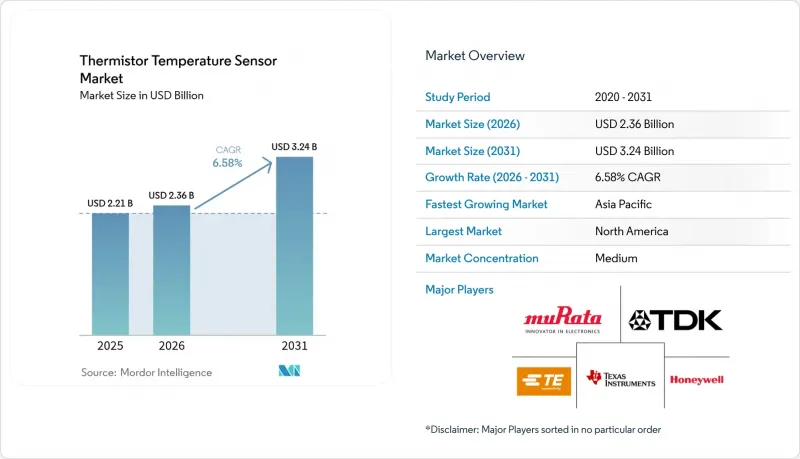
Mordor Intelligence에 의하면, 서미스터 온도 센서 시장 규모는 2025년 22억 1,000만 달러로 평가되었습니다. 2026년에는 23억 6,000만 달러로 확대되어 2026-2031년에 걸쳐 CAGR 6.58%로 성장을 지속하여, 2031년에는 32억 4,000만 달러에 이를 것으로 예측됩니다.
본 보고서는 유형별(양온도 계수(PTC), 음온도 계수(NTC)), 온도 범위별(저온(-40℃ 이하), 중온(-40℃-125℃), 기타),최종 이용 산업별(자동차·E-모빌리티, 가전·웨어러블 기기, 산업 자동화·IIoT, 의료 및 생명과학 기기, 에너지·발전, 항공우주 및 방위, HVAC·빌딩 자동화), 지역별로 분류되어 있습니다. 시장 예측은 금액(달러) 기준으로 제시되어 있습니다.
세계의 서미스터 온도 센서 시장 동향 및 인사이트
가전제품 분야에서 가성비가 뛰어나고 고정밀 센서에 대한 수요
칩 스케일의 0402 패키지는 기판상의 점유 면적을 최소화하면서 ±0.5°C의 정밀도를 실현하기 때문에 서미스터는 스마트폰, 노트북, 웨어러블 기기에서 점유율을 확대되고 있습니다. 현재, 기기 제조업체들은 배터리 및 시스템 온 칩(SoC)의 히트 스프레더 전체에 다점 서미스터 어레이를 내장하고, 예측적 스로틀링 알고리즘을 가동함으로써 부품의 수명을 연장하고 사용자의 안전성을 향상시키고 있습니다. 애플리케이션 프로세서의 지속적인 소형화로 인해 폐열 밀도가 높아지고 있어, 차세대 스마트폰이 출시될 때마다 열 관리 지점이 증가하고 있습니다. 그 결과, OEM 업체들이 디지털 IC 대체품보다 NTC 부품의 저렴한 비용과 성숙한 공급망을 선호함에 따라 서미스터 온도 센서 시장은 꾸준히 확대되고 있습니다. 초소형 다이와 저잡음 신호 체인을 결합한 공급업체들은 디스크리트 서미스터가 범용 제품이라는 평판에도 불구하고 프리미엄 평균 판매 가격(ASP)의 입지를 확립해 가고 있습니다.
EV용 배터리의 급속한 보급에 따른 고밀도 열 폭주 모니터링 필요성 증가
최신 배터리 팩에는 차량 1대당 수백 개의 센서 비드가 탑재되어 있습니다. 이는 셀 간의 온도 차이가 5℃만 있어도 연쇄적인 열 폭주 고장으로 이어질 수 있기 때문입니다. NTC 소재는 -40℃에서 125℃ 범위에서 100밀리초 이하의 응답 속도를 실현하여, 배터리 관리 장치(BMU)가 가스 발생 전에 과열된 모듈을 격리할 수 있게 해줍니다. 고니켈 NMC 등 2세대 화학계 배터리의 경우, 더욱 엄격한 온도 범위가 요구되므로 1kW시당 센서 수가 더욱 증가하고 있습니다. 그 결과, 자동차 제조업체는 서미스터 온도 센서 시장에서 최대 구매자가 되었습니다. 엄격한 AEC-Q200 신뢰성 검사를 충족하기 위해 각 공급업체는 진동, 습도, 전자기 간섭에 내성이 있는 에폭시 코팅 리드선을 도입하여 차량의 수명 기간 동안 장기적인 교정 안정성을 확보하고 있습니다.
RTD·IC 센서와 비교했을 때 좁은 온도 측정 범위
대부분의 NTC는 125°C 부근이 상한선이기 때문에 200°C를 초과하는 온도에서 작동하는 항공우주용 터빈, 석유화학용 반응기, 엔진 배기 시스템에는 사용할 수 없습니다. 이러한 분야의 최종 사용자들은 고온 영역에서도 안정성을 유지하며, 아날로그 신호 처리가 필요 없이 선형 출력을 제공하는 백금 RTD나 디지털 실리콘 IC를 선호하여 채택하고 있습니다. 그 결과, 극한의 고온 환경에서 시장 적용 범위가 제한되어 서미스터 온도 센서 시장 점유율 확보 기회가 좁아지고 있습니다. 부품 제조업체들은 고온용 유리 밀봉 비드를 개발하고 있지만, 생산 수율이 낮고 비용도 높기 때문에 단기적인 보급에는 한계가 있습니다.
부문별 분석
NTC 소자는 2025년 출하량의 69.62%를 차지하며, 의료, 배터리, 산업용 제어 루프에서 0.01°C의 변화를 감지할 수 있는 지수형 저항-온도 특성 덕분에 서미스터 온도 센서 시장 점유율에서 확실한 주도권을 확립하고 있습니다. NTC 부품이 서미스터 온도 센서 시장 규모에 기여하는 비중은 2025년 15억 4,000만 달러에서 2031년까지 22억 2,000만 달러로 확대될 것으로 예측됩니다. 이는 해당 부문이 칩 스케일, 프로브, 연성 기판과 같은 형태로 확장될 수 있는 능력을 반영한 것입니다. PTC 제품은 연평균 성장률(CAGR) 7.38%로 성장하고 있지만, 돌입 전류 제한 및 자가 발열 히터용 틈새 시장에 머물러 있습니다.
페로브스카이트가 도핑된 세라믹의 진화로 인해 베타 계수가 4,400K 이상으로 높아져, 복잡한 선형화 처리를 거치지 않아도 정확도가 더욱 향상되고 있습니다. 또한, 각 벤더들은 폴리이미드나 PET 위에 박막 NTC 층을 형성하고 있어, 설계자들에게는 e-텍스타일 의류용 신축성 센서가 제공되고 있습니다. 이러한 꾸준한 혁신의 속도는 디지털 IC가 기존 소켓 시장을 서서히 잠식하고 있는 상황에서도 NTC의 장기적인 우위를 뒷받침하고 있으며, 서미스터 온도 센서 시장이 고감도 디스크리트 부품을 중심으로 견고한 기반을 유지할 것임을 보장하고 있습니다.
지역별 분석
2025년에 아시아태평양이 46.08%의 점유율을 차지한 배경에는 중국, 일본, 한국에 집중된 수직 통합형 세라믹 가공 및 표면 실장 조립 거점이 있습니다. 1차 공급업체들은 부품 공장 근처에서 대규모 소성로를 가동하고 있으며, 이를 통해 물류 비용을 절감하고 리드 타임을 단축하고 있습니다. EV 도입을 위한 정부의 인센티브가 지역 수요를 뒷받침하는 한편, 이 지역의 주요 배터리 제조업체들은 엄격한 팩 수준의 열 설계 요건을 충족하기 위해 국내 공급업체로부터 센서를 조달하고 있습니다.
북미와 유럽을 합치면 2025년 매출의 약 34.75%를 차지했습니다. 이 지역들의 강점은 추적성 및 기능 안전 인증이 중시되는 고수익 의료, 항공우주, ADAS 시장에 있습니다. 독일과 미국의 자동차 1차 공급업체들은 800V 배터리 아키텍처 내 배선을 간소화하는 온도·전압 복합 프로브의 인증을 시작했으며, 이러한 추세로 인해 출하 대수가 정체되더라도 평균 판매 가격은 상승할 것으로 예측됩니다.
중동은 기가팩토리, 스마트 시티 계획, 에너지 집약적인 해수 담수화 플랜트가 시설당 수천 개의 센서를 필요로 하기 때문에 연평균 성장률(CAGR) 6.98%로 가장 높은 성장률을 기록하고 있습니다. 아프리카와 남미는 여전히 발전 단계에 있지만, 광업, 농업, 재생에너지 부문이 초기 발판을 마련하고 있습니다. 수출 지향적인 아시아 공급업체들은 현지 유통업체와 제휴하여 지원 체계의 부족을 보완하고, 이러한 개척 지역에서 시장 점유율을 확대함으로써 서미스터 온도 센서 시장을 더욱 넓히고 있습니다.
기타 혜택
- 엑셀 형식 시장 예측(ME) 시트
- 3개월간의 애널리스트 지원
자주 묻는 질문
목차
제1장 서론
제2장 조사 방법
제3장 주요 요약
제4장 시장 구도
제5장 시장 규모 및 성장 예측
제6장 경쟁 구도
제7장 시장 기회 및 향후 전망
KTH 26.09.04According to Mordor Intelligence, the thermistor temperature sensor market size is expected to grow from USD 2.21 billion in 2025 to USD 2.36 billion in 2026 and is forecast to reach USD 3.24 billion by 2031 at 6.58% CAGR over 2026-2031.
This report is Segmented by Type (Positive Temperature Coefficient (PTC), Negative Temperature Coefficient (NTC)), Temperature Range (Low Temperature (Below -40 C), Medium Temperature (-40 C To 125 C) and More), End-Use Industry (Automotive, Consumer Electronics, Industrial, Medical, Energy, Aerospace, HVAC), and Geography. The Market Forecasts are Provided in Terms of Value (USD).
Global Thermistor Temperature Sensor Market Trends and Insights
Demand for Cost-Effective, High-Accuracy Sensors in Consumer Electronics
Thermistors are winning socket share in smartphones, laptops, and wearables because chip-scale 0402 packages occupy minimal board real estate while still achieving +-0.5 °C accuracy. Device makers now embed multi-point thermistor arrays across batteries and system-on-chip heat spreaders to trigger predictive throttling algorithms that lengthen component life and improve user safety. Continuous shrinkage of application processors lifts waste-heat density, so every new smartphone generation adds incremental thermal nodes. The result is a steady rise in the thermistor temperature sensor market as OEMs favor the low cost and mature supply chains of NTC parts over digital IC alternatives. Suppliers that combine ultra-small die with low-noise signal chains are carving out premium ASP positions despite the commodity reputation of discrete thermistors.
Rapid EV-Battery Deployment Requiring Dense Thermal-Runaway Monitoring
Modern battery packs mount hundreds of sensing beads per vehicle because a 5 °C cell-to-cell gradient can cascade into runaway failures. NTC materials deliver sub-100 millisecond response across -40 °C to 125 °C ranges, allowing battery-management units to isolate overheating modules before venting occurs. Second-generation chemistries such as high-nickel NMC require even tighter temperature envelopes, enlarging sensor counts per kilowatt-hour. Automakers have therefore become the largest volume buyers in the thermistor temperature sensor market. To meet stringent AEC-Q200 reliability tests, vendors are introducing epoxy-coated leads that resist vibration, humidity, and electromagnetic interference, ensuring long-term calibration stability over the vehicle's service life.
Limited Temperature Span Versus RTDs and IC Sensors
Most NTC formulations top out near 125 °C, which rules them out for aerospace turbines, petrochemical reactors, and engine-exhaust systems that run beyond 200 °C. End users in these sectors prefer platinum RTDs or digital silicon ICs that remain stable at elevated ranges and provide linear outputs without analog conditioning. The resulting application ceiling trims the obtainable share of the thermistor temperature sensor market in extreme-temperature verticals. Component makers are pursuing high-temperature glass-encapsulated beads, but production yields remain low and costs high, limiting near-term adoption.
Other drivers and restraints analyzed in the detailed report include:
- Expansion of Industrial IoT and Smart Factories
- Regulatory Mandates on Food Safety and Cold-Chain Traceability
- Volatility in Manganese, Cobalt, and Nickel-Oxide Feedstock Prices
For complete list of drivers and restraints, kindly check the Table Of Contents.
Segment Analysis
NTC devices captured 69.62% of the 2025 volume, establishing clear leadership in the thermistor temperature sensor market share thanks to exponential resistance-temperature slopes that resolve 0.01 °C changes in medical, battery, and industrial control loops. The thermistor temperature sensor market size contribution from NTC parts is forecast to grow from USD 1.54 billion in 2025 to USD 2.22 billion by 2031, reflecting the segment's ability to scale into chip-scale, probe, and flexible-substrate formats. PTC products, while rising at a 7.38% CAGR, remain niche for inrush current limiting and self-heating heaters.
The evolution of perovskite-doped ceramics is amplifying beta coefficients above 4,400 K, further tightening accuracy without complex linearization. Vendors also deposit thin-film NTC layers on polyimide and PET, giving designers stretchable sensors for e-textile garments. This steady innovation cadence underpins long-term NTC dominance even as digital ICs nibble at legacy sockets, ensuring the thermistor temperature sensor market retains a robust core around high-sensitivity discrete components.
Complete Report Scope:
- By Type
- Positive Temperature Coefficient (PTC)
- Negative Temperature Coefficient (NTC)
- By Temperature Range
- Low Temperature (Below -40 C)
- Medium Temperature (-40 C to 125 C)
- High Temperature (Above 125 C)
- By End-Use Industry
- Automotive and E-Mobility
- Consumer Electronics and Wearables
- Industrial Automation and IIoT
- Medical and Life-Sciences Equipment
- Energy and Power Generation
- Aerospace and Defense
- HVAC and Building Automation
- By Geography
- North America
- United States
- Canada
- Mexico
- South America
- Brazil
- Argentina
- Chile
- Rest of South America
- Europe
- Germany
- United Kingdom
- France
- Italy
- Spain
- Rest of Europe
- Asia-Pacific
- China
- Japan
- India
- South Korea
- Australia
- Singapore
- Malaysia
- Rest of Asia-Pacific
- Middle East
- Saudi Arabia
- United Arab Emirates
- Turkey
- Rest of Middle East
- Africa
- South Africa
- Nigeria
- Rest of Africa
- North America
Geography Analysis
Asia-Pacific's 46.08% share in 2025 stems from its vertically integrated ceramic processing and surface-mount assembly hubs concentrated in China, Japan, and South Korea. Tier-one suppliers operate large-scale kilns near component plants, cutting logistics costs and shortening lead times. Government incentives for EV adoption amplify local demand, while regional giant battery makers source sensors from domestic vendors to comply with tight pack-level thermal budgets.
North America and Europe combine for roughly 34.75% of 2025 revenue. Their advantage lies in high-margin medical, aerospace, and ADAS markets that prize traceability and functional-safety certification. Automotive Tier-1s in Germany and the United States have begun qualifying combined temperature-voltage probes that simplify wiring inside 800-V battery architectures, a trend expected to lift average selling prices even if unit counts plateau.
The Middle East tops growth tables at 6.98% CAGR as giga-factories, smart-city programs, and energy-intensive desalination plants demand thousands of sensors per facility. Africa and South America remain nascent, but mining, agriculture, and renewables create early footholds. Export-oriented Asian vendors are partnering with local distributors to bridge support gaps and capture incremental share in these frontier regions, further broadening the thermistor temperature sensor market.
- Texas Instruments Inc.
- Murata Manufacturing Co. Ltd.
- TDK Corporation (EPCOS)
- TE Connectivity
- Honeywell International Inc.
- Panasonic Corp.
- Vishay Intertechnology Inc.
- Mitsubishi Materials Corp.
- Shibaura Electronics Co. Ltd.
- Littelfuse Inc. (Ametherm)
- SEMITEC Corp.
- KOA Corporation
- Ohizumi Manufacturing Co. Ltd.
- Molex LLC
- Analog Devices Inc.
- Amphenol Advanced Sensors
- Sensata Technologies
- Heraeus Nexensos
- Vishay BC Components
- AVX Corp. (KYOCERA)
Additional Benefits:
- The market estimate (ME) sheet in Excel format
- 3 months of analyst support
TABLE OF CONTENTS
1 INTRODUCTION
- 1.1 Study Assumptions and Market Definition
- 1.2 Scope of the Study
2 RESEARCH METHODOLOGY
3 EXECUTIVE SUMMARY
4 MARKET LANDSCAPE
- 4.1 Market Overview
- 4.2 Market Drivers
- 4.2.1 Demand for cost-effective, high-accuracy sensors in consumer electronics
- 4.2.2 Rapid EV-battery deployment requiring dense thermal-runaway monitoring
- 4.2.3 Expansion of industrial IoT and smart factories
- 4.2.4 Regulatory mandates on food-safety and cold-chain traceability
- 4.2.5 Solid-state battery early-warning chips integrating micro-NTC beads
- 4.2.6 Smart-textile wearables embedding flexible thermistor yarns
- 4.3 Market Restraints
- 4.3.1 Limited temperature span versus RTDs and IC sensors
- 4.3.2 Volatility in manganese, cobalt, and nickel-oxide feedstock prices
- 4.3.3 Shift toward fully-digital temperature-sensor ICs in automotive ADAS
- 4.3.4 Self-heating drift in ultra-low-power IoT nodes
- 4.4 Industry Value Chain Analysis
- 4.5 Regulatory Landscape
- 4.6 Technological Outlook
- 4.7 Porter's Five Forces Analysis
- 4.7.1 Threat of New Entrants
- 4.7.2 Bargaining Power of Buyers
- 4.7.3 Bargaining Power of Suppliers
- 4.7.4 Threat of Substitutes
- 4.7.5 Intensity of Rivalry
- 4.8 Impact of Macroeconomic Factors
5 MARKET SIZE AND GROWTH FORECASTS (VALUE)
- 5.1 By Type
- 5.1.1 Positive Temperature Coefficient (PTC)
- 5.1.2 Negative Temperature Coefficient (NTC)
- 5.2 By Temperature Range
- 5.2.1 Low Temperature (Below -40 C)
- 5.2.2 Medium Temperature (-40 C to 125 C)
- 5.2.3 High Temperature (Above 125 C)
- 5.3 By End-Use Industry
- 5.3.1 Automotive and E-Mobility
- 5.3.2 Consumer Electronics and Wearables
- 5.3.3 Industrial Automation and IIoT
- 5.3.4 Medical and Life-Sciences Equipment
- 5.3.5 Energy and Power Generation
- 5.3.6 Aerospace and Defense
- 5.3.7 HVAC and Building Automation
- 5.4 By Geography
- 5.4.1 North America
- 5.4.1.1 United States
- 5.4.1.2 Canada
- 5.4.1.3 Mexico
- 5.4.2 South America
- 5.4.2.1 Brazil
- 5.4.2.2 Argentina
- 5.4.2.3 Chile
- 5.4.2.4 Rest of South America
- 5.4.3 Europe
- 5.4.3.1 Germany
- 5.4.3.2 United Kingdom
- 5.4.3.3 France
- 5.4.3.4 Italy
- 5.4.3.5 Spain
- 5.4.3.6 Rest of Europe
- 5.4.4 Asia-Pacific
- 5.4.4.1 China
- 5.4.4.2 Japan
- 5.4.4.3 India
- 5.4.4.4 South Korea
- 5.4.4.5 Australia
- 5.4.4.6 Singapore
- 5.4.4.7 Malaysia
- 5.4.4.8 Rest of Asia-Pacific
- 5.4.5 Middle East
- 5.4.5.1 Saudi Arabia
- 5.4.5.2 United Arab Emirates
- 5.4.5.3 Turkey
- 5.4.5.4 Rest of Middle East
- 5.4.6 Africa
- 5.4.6.1 South Africa
- 5.4.6.2 Nigeria
- 5.4.6.3 Rest of Africa
- 5.4.1 North America
6 COMPETITIVE LANDSCAPE
- 6.1 Market Concentration
- 6.2 Strategic Moves
- 6.3 Market Share Analysis
- 6.4 Company Profiles (includes Global level Overview, Market level overview, Core Segments, Financials as available, Strategic Information, Market Rank/Share, Products and Services, Recent Developments)
- 6.4.1 Texas Instruments Inc.
- 6.4.2 Murata Manufacturing Co. Ltd.
- 6.4.3 TDK Corporation (EPCOS)
- 6.4.4 TE Connectivity
- 6.4.5 Honeywell International Inc.
- 6.4.6 Panasonic Corp.
- 6.4.7 Vishay Intertechnology Inc.
- 6.4.8 Mitsubishi Materials Corp.
- 6.4.9 Shibaura Electronics Co. Ltd.
- 6.4.10 Littelfuse Inc. (Ametherm)
- 6.4.11 SEMITEC Corp.
- 6.4.12 KOA Corporation
- 6.4.13 Ohizumi Manufacturing Co. Ltd.
- 6.4.14 Molex LLC
- 6.4.15 Analog Devices Inc.
- 6.4.16 Amphenol Advanced Sensors
- 6.4.17 Sensata Technologies
- 6.4.18 Heraeus Nexensos
- 6.4.19 Vishay BC Components
- 6.4.20 AVX Corp. (KYOCERA)
7 MARKET OPPORTUNITIES AND FUTURE OUTLOOK
- 7.1 White-space and Unmet-need Assessment