

|
시장보고서
상품코드
2120476
중동 및 아프리카의 플라스틱 병 및 용기 : 시장 점유율 분석, 업계 동향 및 통계, 성장 예측(2026-2031년)MEA Plastic Bottles And Containers - Market Share Analysis, Industry Trends & Statistics, Growth Forecasts (2026 - 2031) |
||||||
 Mordor Intelligence
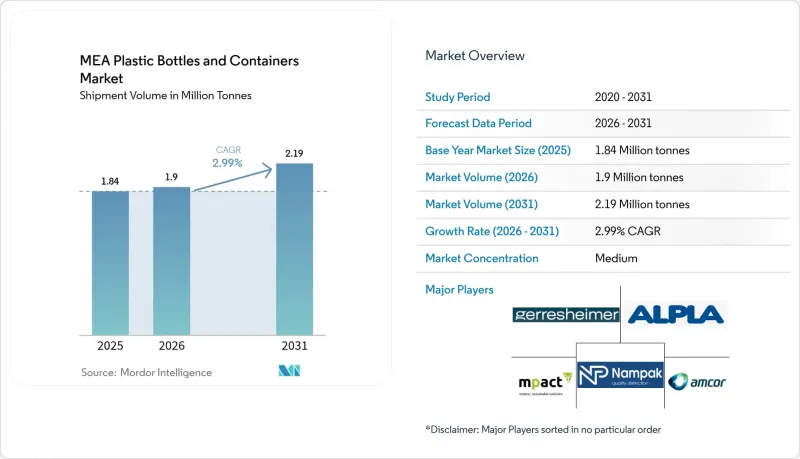
Mordor Intelligence에 의하면, 중동 및 아프리카의 플라스틱 병 및 용기 시장 규모는 2025년 184만 톤으로 평가되었습니다. 2026년에는 190만 톤으로 확대되어 2026-2031년에 걸쳐 CAGR 2.99%로 성장을 지속하여, 2031년까지 219만 톤에 이를 것으로 예측됩니다.

본 보고서는 소재별(PET, HDPE, PP, 기타), 포장 유형별(병, 항아리·캐니스터, 기타), 최종 사용자 산업별(음료, 식품, 기타), 제조 기술별(압출 블로우 성형, 사출 신장 블로우 성형, 기타)로 분류되어 있습니다. 시장 예측은 수량(톤)으로 표시되어 있습니다.
중동 및 아프리카의 플라스틱 병 및 용기 시장 동향 및 인사이트
경량 PET 병의 채택 확대
파라자일렌 가격 변동으로 인해 수지 비용이 불안정한 상황이 지속되는 가운데, 이익률 유지를 목표로 하는 가공업체들에게 경량 PET 제품은 매력적인 선택지가 되고 있습니다. 사우디아라비아 규제 당국은 화학적 비활성 특성을 이유로 민감한 용도에 PET 사용을 권장하고 있으며, GCC(걸프협력회의) 국가 전체에도 유사한 기준이 도입되도록 장려하고 있습니다. 아랍에미리트의 공장에 도입된 최신 스트레치 블로우 성형기는 균일한 두께를 실현하여 500ml 물병의 경우 20g 이하라는 목표를 꾸준히 달성하고 있으며, 사막을 횡단하는 장거리 운송 시 운임 비용을 절감하고 있습니다. 설계 개선을 통해 출하 100만 개당 팔레트 수가 감소하여, Scope 3 배출량이 직접적으로 감소하고 있습니다. 탄산 음료 생산 라인의 경우, 라인 속도가 빠르기 때문에 1g당 감축 효과가 커지므로 도입이 선도적으로 진행되고 있습니다. 한편, 레반트 시장의 소규모 유제품 제조업체들은 캡 장착 시 토크 제한이 있어 보다 신중한 태도를 취하고 있습니다. 브랜드 소유자가 여러 수명 주기에 걸쳐 견고한 병의 내구성을 중시하는 다운스트림 리필 프로그램을 통합함에 따라, 설비의 지속적인 업그레이드는 중기적인 성과를 가져올 것으로 예측됩니다.
GCC 전역에서 병입 생수 및 청량음료 수요의 급증
걸프 연안 국가들의 1인당 물 소비량은 하루 500리터를 넘는 경우가 많으며, 이 수치는 3자리 수에 달하는 더위 지수와 곳곳에서 공급되는 담수화 물과 관련이 있습니다. 아랍에미리트의 소매업체에 따르면, 여행 성수기 동안 관광객 수요를 충족시키기 위한 200ml PET 병 판매량은 두 자릿수 성장률을 보이고 있습니다. 각 청량음료 병입 업체들은 연중 널리 보급된 냉장 설비를 활용하여, 경제권 간을 이동하는 장거리 운전자가 자주 이용하는 주유소 매점에 1회분 용량의 탄산음료를 진열하고 있습니다. 상수도망 개선으로 인해 무수 손실은 4.6%까지 감소했으나, 맛의 안정성과 미네랄 첨가를 이유로 많은 소비자들은 여전히 브랜드 생수를 선호하고 있습니다. 식품 접촉용 플라스틱에 관한 걸프 연안 국가들의 통일된 기준에 따라 국경 검사가 완화되었으며, 제벨 알리 및 담맘에 위치한 공동 생산 거점을 활용한 GCC 전역에 걸친 공급망이 구축되었습니다.
플라스틱 규제 강화 및 소비자의 반발
아랍에미리트는 2026년에 종합적인 일회용 플라스틱 금지령을 시행할 예정이며, 이로 인해 음식점은 섬유 소재 컵이나 알루미늄 캔으로 전환할 수밖에 없게 됩니다. 오만과 에티오피아도 2025년에 유사한 조치를 시행할 예정이며, 수입 의존도가 높은 중소기업의 경우 규제 준수를 위한 유예 기간이 단축되었습니다. 조사에 따르면, 아랍에미리트 소비자의 92%가 친환경 포장을 위해 추가 비용을 지불할 의향이 있는 것으로 나타났으며, 이는 2023년 대비 4포인트 상승한 수치로, 대응이 늦어지고 있는 기업들에게는 브랜드 평판에 대한 위험이 커지고 있습니다. 지역 패스트푸드 체인들은 규제 확대를 예상하여 성형 펄프로 만든 냉음료 컵을 활용한 시범 프로그램을 서둘러 추진하고 있습니다. 여러 국가에 걸친 포트폴리오를 관리하는 유통업체들은 국가별로 다른 단계적 폐지 일정에 어려움을 겪고 있으며, 재고 관리와 원가 계산 모델이 복잡해지고 있습니다.
부문별 분석
2025년, 중동 및 아프리카의 플라스틱 병 및 용기 시장에서 PET는 50.90%의 점유율을 차지했으며, 이는 탄산음료의 압력 및 사막 기후의 기온 변동에 대한 내성을 입증합니다. 이 폴리머의 투명성과 높은 비용 효율성 덕분에 브랜드 생수,청량음료, 많은 식용유 용기에서 여전히 표준 소재로서의 위상을 유지하고 있습니다. 바이오플라스틱은 현재로서는 틈새 시장에 불과하지만, 제약 산업의 구매자들이 환자의 안전성과 탄소 발자국이라는 두 가지 지표를 모두 충족해 나감에 따라 4.78%의 성장이 예상됩니다. UPM이 볼미올리 파마(Bormioli Pharma)사와 공동으로 추진 중인 목재 유래 병 프로젝트는 생산 라인을 약간만 조정하면 도입 가능한 드롭인 솔루션으로서의 가능성을 보여주고 있습니다.
중동 및 아프리카의 플라스틱 병 및 용기 시장에서는 HDPE의 내화학성이 높이 평가되어, 윤활유나 세정액을 운반하는 제리캔에 필수적인 소재로 자리 잡고 있습니다. LDPE는 조미료 코너에서 볼 수 있는 스퀴즈 병에서 여전히 중요한 역할을 하고 있는 반면, 폴리프로필렌의 내열성은 오토클레이브 멸균되는 앰플에 적합합니다. PEN과 같은 특수 수지는 초고차단성 의료용 영양 제품에 사용되고 있습니다. 재활용 흐름이 성숙해짐에 따라, 가공업체들은 기계적 강도를 유지하면서 의무화된 함유율 기준을 충족하기 위해 rPET와 버진 수지를 혼합하게 될 것으로 보입니다. 이를 통해 브랜드 소유자는 원자재 가격의 급등으로부터 보호받을 수 있게 됩니다.
2025년에는 병이 전체 채택의 48.12%를 차지했으며, 소비자용 음료, 식용유, 퍼스널케어 제품 리필용 등 폭넓은 부문에서 높은 범용성을 보일 것으로 나타났습니다. 그 단순한 형태는 고속 충전 라인에 적합하며, 사업자는 금형을 대폭 변경하지 않고도 SKU를 전환할 수 있습니다. 대조적으로, 앰플과 바이알은 각국 정부가 면세 조치 및 수출 장려책을 통해 의약품 수탁 제조를 유치하고 있기 때문에 연평균 성장률(CAGR) 4.62%가 예상됩니다. 게레스하이머사가 이탈리아에서 확장한 바이알 생산 라인은 신흥 걸프 지역의 주사제 허브에 생산 능력을 공급하여 공급의 신뢰성을 강화할 것입니다.
중동 및 아프리카의 플라스틱 병 및 용기 시장에서는 고급 스킨케어 크림용 용기와 분말 영양 보충제용 캐니스터가 성장의 원동력이 되고 있습니다. 제리칸은 펌프보다 중력식 디스펜서가 선호되는 농촌 지역의 비료 유통에서 여전히 확고한 입지를 유지하고 있습니다. 맞춤형 드롭퍼 및 스프레이 용기는 생산량은 적지만, 유아용 안전 잠금 장치 및 위변조 방지 기능 요건으로 인해 상당한 이익률을 확보하고 있습니다.
기타 혜택
- 엑셀 형식 시장 예측(ME) 시트
- 3개월간의 애널리스트 지원
자주 묻는 질문
목차
제1장 서론
제2장 조사 방법
제3장 주요 요약
제4장 시장 구도
제5장 시장 규모 및 성장 예측
제6장 경쟁 구도
제7장 시장 기회 및 향후 전망
KTH 26.09.04According to Mordor Intelligence, the Middle East and Africa plastic bottles and containers market size is expected to grow from 1.84 million tonnes in 2025 to 1.9 million tonnes in 2026 and is forecast to reach 2.19 million tonnes by 2031 at 2.99% CAGR over 2026-2031.
This report is Segmented by Material (PET, HDPE, PP, and More), Packaging Type (Bottles, Jars and Canisters, and More), End-User Industry (Beverages, Food, and More), Manufacturing Technology (Extrusion Blow Moulding, Injection Stretch Blow Moulding, and More). The Market Forecasts are Provided in Terms of Volume (Tonnes).
MEA Plastic Bottles And Containers Market Trends and Insights
Increasing Adoption of Lightweight PET Bottles
Lightweight PET formats appeal to converters seeking margin protection as paraxylene price swings keep resin costs volatile. Saudi regulators endorse PET for sensitive applications because of its chemical inertness, encouraging similar standards across the rest of the GCC. Modern stretch-blow molding machines in UAE plants achieve even wall thickness and consistently hit sub-20-gram targets for 500-milliliter water bottles, cutting freight costs on long cross-desert hauls. Design refinements translate into fewer pallets per million units shipped, directly lowering scope 3 emissions. Carbonated soft-drink lines spearhead adoption because high line speeds amplify each gram saved, while smaller dairy producers in Levant markets move more cautiously due to cap-application torque constraints. Continued equipment upgrades suggest a medium-term payoff as brand owners integrate downstream refill programs that lean on robust bottle integrity over multiple life cycles.
Surge in Packaged-Water and Soft-Drink Demand Across GCC
Per-capita water consumption in the Gulf often exceeds 500 liters daily, a figure linked to triple-digit heat indices and desalinated supply ubiquity. UAE retailers report double-digit unit sales growth of 200-milliliter PET bottles catering to tourist demand during peak travel months. Soft-drink bottlers capitalize on year-round refrigeration penetration, positioning single-serve carbonated drinks at service-station forecourts frequented by long-haul drivers moving between economic zones. Despite network upgrades that cut non-revenue water losses to 4.6%, many consumers still favor branded bottles because of taste consistency and mineral add-backs. Harmonized Gulf standards for food-contact plastics reduce border checks, enabling pan-GCC supply chains that leverage shared production hubs in Jebel Ali and Dammam.
Intensifying Anti-Plastic Legislation and Consumer Backlash
UAE will enact a comprehensive single-use plastic ban in 2026, forcing restaurants to pivot toward fiber-based cups and aluminum cans. Oman and Ethiopia have similar measures scheduled for 2025, compressing the compliance horizon for import-heavy SMEs. Surveys show 92% of UAE shoppers are prepared to pay more for eco-friendly packaging, up four points from 2023, intensifying brand-reputation risks for laggards. Regional fast-food chains fast-track pilot programs with molded-pulp cold-drink cups in anticipation of rule extensions. Distributors managing multi-country portfolios struggle with differing phase-out calendars, complicating inventory management and costing models.
Other drivers and restraints analyzed in the detailed report include:
- Regulatory Push for Food-Grade rPET in Saudi Arabia and UAE
- Solar-Desalination Boom Driving Bulk-Water Container Uptake
- Volatile Crude-Linked Resin Pricing
For complete list of drivers and restraints, kindly check the Table Of Contents.
Segment Analysis
PET accounts for 50.90% of the Middle East and Africa plastic bottles and containers market share in 2025, underscoring its compatibility with beverage carbonation pressures and desert-climate temperature swings. The polymer's clarity and cost efficiency keep it the default for branded water, soft drinks, and many edible-oil formats. Bioplastics, though just a niche, are forecast to grow at 4.78% as pharmaceutical buyers respond to both patient-safety and carbon-footprint metrics. UPM's wood-based bottle project with Bormioli Pharma shows potential for drop-in solutions requiring only minor line adjustments.
The Middle East and Africa plastic bottles and containers market benefits from HDPE's chemical resilience, making it indispensable for jerrycans transporting lubricants and cleaning fluids. LDPE retains relevance for squeeze bottles found in condiment aisles, while polypropylene's thermal resistance suits autoclave-sterilized ampoules. Specialty resins such as PEN serve ultra-high-barrier medical nutrition products. As recycling streams mature, converters will likely blend rPET with virgin to meet mandatory content thresholds while retaining mechanical strength, protecting brand owners from feedstock price shocks.
Bottles captured 48.12% of adoption in 2025, illustrating the format's universality across consumer beverages, cooking oils, and personal-care refills. Their straightforward geometry aligns with high-speed filling lines, allowing operators to pivot SKUs without extensive tooling revisions. Ampoules and vials, by contrast, are poised for a 4.62% CAGR as governments court pharmaceutical contract manufacturing through tax holidays and export incentives. Gerresheimer's expanded vial lines in Italy will funnel capacity into emerging Gulf injectable-drug hubs, reinforcing supply reliability.
The Middle East and Africa plastic bottles and containers market finds growth levers in jars for premium skin-care creams and in canisters for powdered nutrition. Jerrycans keep a foothold in rural fertilizer distribution, where gravitational dispensing is favored over pumps. Custom dropper and spray formats, though low in tonnage, command notable margins due to child-resistance requirements and tamper-evident features.
Complete Report Scope:
- By Material
- Polyethylene Terephthalate (PET)
- High-Density Polyethylene (HDPE)
- Polypropylene (PP)
- Low-Density Polyethylene (LDPE)
- Bioplastics
- Other Plastics
- By Packaging Type
- Bottles
- Jars and Canisters
- Jerrycans
- Ampoules and Vials
- Other Packaging Types
- By End-user Industry
- Beverages
- Non-Alcoholic Beverages
- Bottled Water
- Carbonated Soft Drinks
- Dairy and Functional Drinks
- Other Non-Alcoholic Beverages
- Alcoholic Beverages
- Non-Alcoholic Beverages
- Food
- Pharmaceuticals
- Cosmetics and Personal Care
- Industrial Chemicals
- Other End-user Industries
- Beverages
- By Manufacturing Technology
- Extrusion Blow Moulding
- Injection Stretch Blow Moulding
- Injection Blow Moulding
- Compression Blow Moulding
- Other Manufacturing Technologies
- By Geography
- Middle East
- Saudi Arabia
- United Arab Emirates
- Turkey
- Rest of Middle East
- Africa
- South Africa
- Kenya
- Rest of Africa
- Middle East
List of Companies Covered in this Report:
- Amcor plc
- ALPLA Werke Alwin Lehner GmbH & Co KG
- Nampak Ltd
- Gerresheimer AG
- Mpact Ltd
- Plastipak Holdings, Inc.
- Silgan Holdings Inc.
- SABIC - Saudi Basic Industries Corporation
- Indorama Ventures Public Co. Ltd.
- Graham Packaging Company, L.P.
- Resilux NV
- Alpha Packaging Inc.
- Packnet SA
- Emirates Plastic Industries Factory LLC
- Takween Advanced Industries Co.
- Al Amana Plastic LLC
- Huhtamaki Oyj
- Sonoco Products Company
- Origin Materials, Inc.
- Sidel (Part of Tetra Laval)
Additional Benefits:
- The market estimate (ME) sheet in Excel format
- 3 months of analyst support
TABLE OF CONTENTS
1 INTRODUCTION
- 1.1 Study Assumptions and Market Definition
- 1.2 Scope of the Study
2 RESEARCH METHODOLOGY
3 EXECUTIVE SUMMARY
4 MARKET LANDSCAPE
- 4.1 Market Overview
- 4.2 Market Drivers
- 4.2.1 Increasing adoption of lightweight PET bottles
- 4.2.2 Surge in packaged-water and soft-drink demand across GCC
- 4.2.3 Regulatory push for food-grade rPET in Saudi Arabia and United Arab Emirates
- 4.2.4 Solar-desalination boom driving bulk-water container uptake
- 4.2.5 E-commerce refill-and-delivery models scaling returnable PET
- 4.3 Market Restraints
- 4.3.1 Intensifying anti-plastic legislation and consumer backlash
- 4.3.2 Volatile crude-linked resin pricing
- 4.3.3 rPET supply-quality gap throttling food-grade output
- 4.3.4 Water-scarcity policies discouraging single-use formats
- 4.4 Industry Value Chain Analysis
- 4.5 Regulatory Landscape
- 4.6 Technological Outlook
- 4.7 Porter's Five Forces Analysis
- 4.7.1 Bargaining Power of Suppliers
- 4.7.2 Bargaining Power of Buyers
- 4.7.3 Threat of New Entrants
- 4.7.4 Intensity of Competitive Rivalry
- 4.7.5 Threat of Substitutes
- 4.8 The Impact of Macroeconomic Factors on the Market
5 MARKET SIZE AND GROWTH FORECASTS (VOLUME)
- 5.1 By Material
- 5.1.1 Polyethylene Terephthalate (PET)
- 5.1.2 High-Density Polyethylene (HDPE)
- 5.1.3 Polypropylene (PP)
- 5.1.4 Low-Density Polyethylene (LDPE)
- 5.1.5 Bioplastics
- 5.1.6 Other Plastics
- 5.2 By Packaging Type
- 5.2.1 Bottles
- 5.2.2 Jars and Canisters
- 5.2.3 Jerrycans
- 5.2.4 Ampoules and Vials
- 5.2.5 Other Packaging Types
- 5.3 By End-user Industry
- 5.3.1 Beverages
- 5.3.1.1 Non-Alcoholic Beverages
- 5.3.1.1.1 Bottled Water
- 5.3.1.1.2 Carbonated Soft Drinks
- 5.3.1.1.3 Dairy and Functional Drinks
- 5.3.1.1.4 Other Non-Alcoholic Beverages
- 5.3.1.2 Alcoholic Beverages
- 5.3.1.1 Non-Alcoholic Beverages
- 5.3.2 Food
- 5.3.3 Pharmaceuticals
- 5.3.4 Cosmetics and Personal Care
- 5.3.5 Industrial Chemicals
- 5.3.6 Other End-user Industries
- 5.3.1 Beverages
- 5.4 By Manufacturing Technology
- 5.4.1 Extrusion Blow Moulding
- 5.4.2 Injection Stretch Blow Moulding
- 5.4.3 Injection Blow Moulding
- 5.4.4 Compression Blow Moulding
- 5.4.5 Other Manufacturing Technologies
- 5.5 By Geography
- 5.5.1 Middle East
- 5.5.1.1 Saudi Arabia
- 5.5.1.2 United Arab Emirates
- 5.5.1.3 Turkey
- 5.5.1.4 Rest of Middle East
- 5.5.2 Africa
- 5.5.2.1 South Africa
- 5.5.2.2 Kenya
- 5.5.2.3 Rest of Africa
- 5.5.1 Middle East
6 COMPETITIVE LANDSCAPE
- 6.1 Market Concentration
- 6.2 Strategic Moves
- 6.3 Market Share Analysis
- 6.4 Company Profiles (includes Global-Level Overview, Market-Level Overview, Core Segments, Financials, Strategic Information, Market Rank/Share, Products and Services, Recent Developments)
- 6.4.1 Amcor plc
- 6.4.2 ALPLA Werke Alwin Lehner GmbH & Co KG
- 6.4.3 Nampak Ltd
- 6.4.4 Gerresheimer AG
- 6.4.5 Mpact Ltd
- 6.4.6 Plastipak Holdings, Inc.
- 6.4.7 Silgan Holdings Inc.
- 6.4.8 SABIC - Saudi Basic Industries Corporation
- 6.4.9 Indorama Ventures Public Co. Ltd.
- 6.4.10 Graham Packaging Company, L.P.
- 6.4.11 Resilux NV
- 6.4.12 Alpha Packaging Inc.
- 6.4.13 Packnet SA
- 6.4.14 Emirates Plastic Industries Factory LLC
- 6.4.15 Takween Advanced Industries Co.
- 6.4.16 Al Amana Plastic LLC
- 6.4.17 Huhtamaki Oyj
- 6.4.18 Sonoco Products Company
- 6.4.19 Origin Materials, Inc.
- 6.4.20 Sidel (Part of Tetra Laval)
7 MARKET OPPORTUNITIES AND FUTURE OUTLOOK
- 7.1 White-space and Unmet-Need Assessment


