
|
시장보고서
상품코드
2120510
스페인의 병원 용품 : 시장 점유율 분석, 업계 동향 및 통계, 성장 예측(2026-2031년)Spain Hospital Supplies - Market Share Analysis, Industry Trends & Statistics, Growth Forecasts (2026 - 2031) |
||||||
 Mordor Intelligence
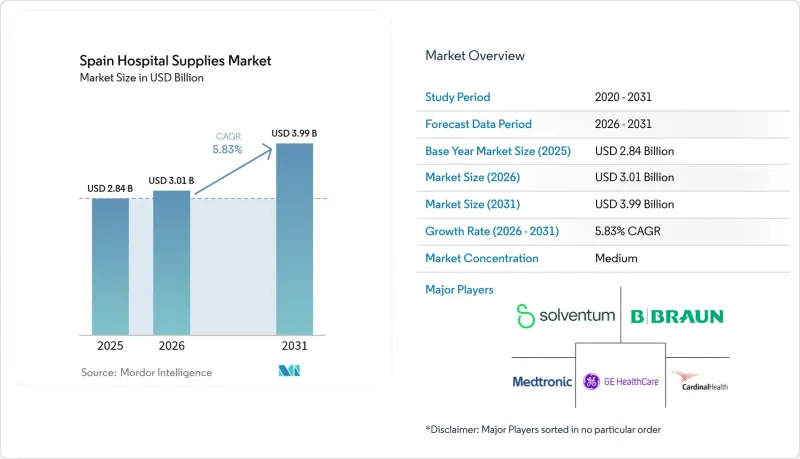
Mordor Intelligence에 의하면, 스페인의 병원 용품 시장 규모는 2025년 28억 4,000만 달러로 평가되었습니다. 2026년에는 30억 1,000만 달러로 확대되어 2026년부터 2031년에 걸쳐 CAGR 5.83%로 성장을 지속하여, 2031년에는 39억 9,000만 달러에 이를 것으로 예측됩니다.
본 보고서는 제품별(환자 검사 기기, 수술실용 기기, 이동 보조 기구 및 이송 기기, 멸균·소독 기기 등), 최종 사용자 시설별(공립 병원, 사립 병원 등), 유통 채널별(직접 공공 입찰, 온라인 B2B 플랫폼 등)로 분류되어 있습니다. 시장 예측은 금액(달러) 기준으로 제시되어 있습니다.
스페인의 병원 용품 시장 동향 및 인사이트
감염병 및 만성 질환 발생률 증가
모니터링 데이터에 따르면, EU 입원 환자의 7.1%가 의료 관련 감염을 경험하고 있으며, 그중 가장 많은 비중을 차지하는 것은 호흡기 질환입니다. 스페인의 국민건강보험 제도는 이러한 사례에 대한 치료를 보장하고 있으며, 그 결과 진단 키트, 멸균된 소모품, 호흡 보조 기기의 예측 가능한 대량 조달로 이어지고 있습니다. 2024년 국민건강보험법 개정으로 인해 단기 체류자 및 난민 신청자에게도 적용 범위가 확대되어 수혜자층이 넓어졌습니다. 병원이 만성 질환 관리와 감염 관리 과정을 통합함에 따라, 공급업체들은 일회용 제품과 자동 멸균 장치를 결합한 일괄 입찰의 혜택을 누리고 있으며, 또한 분석 기능을 갖춘 의료기기는 입원·외래를 불문하고 질환의 장기적인 관리를 지원하고 있습니다.
병원 내 감염에 대한 인식 제고
EU 전역에서는 연간 약 350만 건의 병원 내 감염(HAI)이 발생하며, 9만 명 이상이 이와 관련하여 사망하는 것으로 추산됩니다. 이 중 최대 절반은 보다 철저한 감염 관리 대책을 통해 예방할 수 있습니다. 이에 반해, 스페인의 병원에서는 MDR(의료기기 규정)의 시판 후 조사 규정에 부합하는 CE 마크가 부착된 일회용 의료기기 및 추적 가능한 멸균 시스템을 우선적으로 채택하고 있습니다. 입찰 사양서에서는 항균 표면이나 밀폐형 약제 이송 솔루션에 대한 언급이 증가하고 있으며, ISO 표준을 준수하는 클린룸 제조 인증을 받은 공급업체가 우대받고 있습니다. 조달 팀이 집단 감염 억제에 드는 비용과 제품 구매 시의 초기 비용을 정량적으로 비교 평가함에 따라, 감염 관리 관련 제품 포트폴리오는 전략적 중요성이 커지고 있습니다.
엄격한 규제 체계
MDR에서는 기존 의료기기에 대해 2024년 5월까지 업데이트된 품질 관리 기준을 준수할 것을 요구했으며, 이행 유예 기간은 늦어도 2028년 12월까지로 정해져 있습니다. 스페인의 AEMPS는 또한 모든 의료기기의 국내 등록을 의무화하고 있으며, 규정(EU) 2024/1860에 따라 공급 중단 통지를 의무화하고 있습니다. 중소 제조업체들은 위험 기반 분류, 의료기기 고유 식별자(UDI) 표시, 정기적인 안전성 업데이트 보고와 관련하여 높은 규정 준수 비용에 직면해 있습니다. 그 결과, 유통업체들은 MDR 승인을 받은 제품을 중심으로 포트폴리오를 통합하고 있으며, 이로 인해 브랜드 선택의 폭이 좁아지고 혁신적인 중소기업 시장 진입 기간이 길어질 가능성이 있습니다.
부문 분석
2025년, 스페인의 병원 용품 시장에서 일회용 병원 용품이 시장 점유율의 45.12%를 차지했습니다. 이는 일회용 제품에 대한 안전 프로토콜에 대한 지속적인 중시를 반영한 것입니다. 멸균 및 소독 장비는 2031년까지 연평균 성장률(CAGR) 7.56%로 성장을 지속하고, 있으며, 병원 내 감염(HAI)에 대한 인식 제고와 MDR의 추적성 규정 덕분에 성장세를 보이고 있습니다. 스페인 의료 소모품 시장에서 멸균 시스템 시장 규모는 병원들이 열에 취약한 의료기기를 보호하기 위해 저온 멸균 장치 및 과산화수소 멸균 장치로 교체를 추진함에 따라 꾸준히 확대될 것으로 전망됩니다.
수술실용 기기 및 진단 기기에는 계속해서 ‘부흥 계획’의 보조금과 연계된 예산 배분이 이루어지고 있는 반면, 실리콘 오일 미립자에 대한 안과 분야의 안전 경고에 따라 주사기 및 바늘의 사양은 계속 진화하고 있습니다. 잔류 용량이 제로인 CE 마크가 부착된 미량 주사기 공급업체들은 틈새 시장이지만 고부가가치 주문을 확보하고 있습니다.
기타 혜택 :
- 엑셀 형식 시장 예측(ME) 시트
- 3개월간의 애널리스트 지원
자주 묻는 질문
목차
제1장 서론
제2장 조사 방법
제3장 주요 요약
제4장 시장 구도
제5장 시장 규모 및 성장 예측
제6장 경쟁 구도
제7장 시장 기회 및 향후 전망
KTH 26.09.10According to Mordor Intelligence, the Spain hospital supplies market size is expected to grow from USD 2.84 billion in 2025 to USD 3.01 billion in 2026 and is forecast to reach USD 3.99 billion by 2031 at 5.83% CAGR over 2026-2031.

This report is Segmented by Product (Patient Examination Devices, Operating Room Equipment, Mobility Aids and Transportation Equipment, Sterilisation & Disinfection Equipment, and More), End-User Facility (Public Hospitals, Private Hospitals, and More), Distribution Channel (Direct Public Tenders, Online B2B Platforms, and More). The Market Forecasts are Provided in Terms of Value (USD).
Spain Hospital Supplies Market Trends and Insights
Rising Incidence of Infectious & Chronic Diseases
Surveillance data show that 7.1% of EU hospital patients experience healthcare-associated infections, with respiratory conditions at the forefront. Spain's universal health system guarantees treatment for those cases, translating into predictable bulk procurement of diagnostic kits, sterile consumables and respiratory support devices. The 2024 Universal Health-Care Bill extended coverage to temporary residents and asylum seekers, widening the beneficiary pool. As hospitals integrate chronic-care and infection-control pathways, suppliers benefit from bundled tenders that combine disposables with automated sterilisation units, while analytics-enabled devices support longitudinal disease management across inpatient and outpatient settings.
Growing Awareness of Hospital-Acquired Infections
An estimated 3.5 million HAI cases and more than 90,000 related deaths occur annually across the EU, up to half of which are preventable through stronger infection-control practices. Spanish hospitals respond by favouring CE-marked single-use devices and traceable sterilisation systems that comply with MDR post-market surveillance rules. Tender specifications increasingly reference antimicrobial surfaces and closed-system drug-transfer solutions, rewarding vendors that certify ISO-compliant clean-room manufacturing. As procurement teams quantify the cost of outbreak containment versus up-front product premiums, infection-control portfolios gain strategic weight.
Stringent Regulatory Framework
The MDR requires legacy devices to align with updated quality-management standards by May 2024, while transitional grace periods run no later than December 2028. Spain's AEMPS further obliges in-country registration of all medical devices and mandates supply-interruption notifications under Regulation (EU) 2024/1860. Smaller manufacturers face high compliance costs for risk-based classification, unique-device identification labelling and periodic safety-update reports. Consequently, distributors consolidate their portfolios around MDR-approved products, potentially narrowing brand choice and lengthening market-entry timelines for innovative SMEs.
Other drivers and restraints analyzed in the detailed report include:
- Rapidly Ageing Spanish Population
- Digitalised Public Procurement Accelerating Fulfilment
- Shift Toward Home-Care Services
For complete list of drivers and restraints, kindly check the Table Of Contents.
Segment Analysis
Disposable hospital supplies accounted for 45.12% of Spain hospital supplies market share in 2025, reflecting persistent emphasis on single-use safety protocols. Sterilisation and disinfection equipment, posting a 7.56% CAGR to 2031, benefits from rising HAI awareness and MDR traceability rules. The Spain hospital supplies market size for sterilisation systems is projected to expand steadily as hospitals upgrade to low-temperature and hydrogen-peroxide units that protect heat-sensitive devices.
Operating-room equipment and diagnostic instruments continue to receive budget allocations tied to Recovery Plan grants, while syringe and needle specifications evolve following ophthalmology safety alerts on silicone-oil droplets. Suppliers of CE-marked micro-volume syringes with zero residual volume capture niche but high-value orders.
Complete Report Scope:
- By Product
- Patient Examination Devices
- Operating-Room Equipment
- Mobility Aids & Transport Equipment
- Sterilisation & Disinfection Equipment
- Disposable Hospital Supplies
- Syringes & Needles
- Other Products
- By End-User Facility
- Public Hospitals
- Private Hospitals
- Specialised Clinics
- Diagnostic & Imaging Centres
- By Distribution Channel
- Direct Public Tenders
- Group-Purchasing Organisations (GPOs)
- Online B2B Platforms
- Retail & Community Pharmacies
List of Companies Covered in this Report:
- Solventum Corporation
- B. Braun
- Baxter
- Beckton Dickinson
- Cardinal Health
- Medtronic
- GE HealthCare Technologies Inc.
- Thermo Fisher Scientific
- Johnson & Johnson (Ethicon, DePuy)
- Fresenius
- Grifols
- Werfen
- Palex Medical
- Izasa Medical
- Smiths Group
- Stryker
- Dragerwerk
- Siemens Healthineers
- Olympus
- Terumo
Additional Benefits:
- The market estimate (ME) sheet in Excel format
- 3 months of analyst support
TABLE OF CONTENTS
1 Introduction
- 1.1 Study Assumptions & Market Definition
- 1.2 Scope of the Study
2 Research Methodology
3 Executive Summary
4 Market Landscape
- 4.1 Market Overview
- 4.2 Market Drivers
- 4.2.1 Rising Incidence Of Infectious & Chronic Diseases
- 4.2.2 Growing Awareness Of Hospital-Acquired Infections
- 4.2.3 Rapidly Ageing Spanish Population
- 4.2.4 Digitalised Public Procurement Accelerating Fulfilment
- 4.2.5 EU RRF Funds Modernising Hospital Infrastructure
- 4.2.6 Domestic Single-Use Plastics Capacity Expansions
- 4.3 Market Restraints
- 4.3.1 Stringent Regulatory Framework
- 4.3.2 Shift Toward Home-Care Services
- 4.3.3 EU Plastic-Tax Driven Input-Cost Volatility
- 4.3.4 Fragmented Regional-Budget Procurement Cycles
- 4.4 Supply-Chain Analysis
- 4.5 Regulatory Landscape
- 4.6 Porter's Five Forces
- 4.6.1 Threat of New Entrants
- 4.6.2 Bargaining Power of Buyers
- 4.6.3 Bargaining Power of Suppliers
- 4.6.4 Threat of Substitutes
- 4.6.5 Intensity of Competitive Rivalry
5 Market Size & Growth Forecasts (Value, USD)
- 5.1 By Product
- 5.1.1 Patient Examination Devices
- 5.1.2 Operating-Room Equipment
- 5.1.3 Mobility Aids & Transport Equipment
- 5.1.4 Sterilisation & Disinfection Equipment
- 5.1.5 Disposable Hospital Supplies
- 5.1.6 Syringes & Needles
- 5.1.7 Other Products
- 5.2 By End-User Facility
- 5.2.1 Public Hospitals
- 5.2.2 Private Hospitals
- 5.2.3 Specialised Clinics
- 5.2.4 Diagnostic & Imaging Centres
- 5.3 By Distribution Channel
- 5.3.1 Direct Public Tenders
- 5.3.2 Group-Purchasing Organisations (GPOs)
- 5.3.3 Online B2B Platforms
- 5.3.4 Retail & Community Pharmacies
6 Competitive Landscape
- 6.1 Market Concentration
- 6.2 Market Share Analysis
- 6.3 Company Profiles (includes Global level Overview, Market level overview, Core Segments, Financials as available, Strategic Information, Market Rank/Share for key companies, Products & Services, and Recent Developments)
- 6.3.1 Solventum Corporation
- 6.3.2 B. Braun SE
- 6.3.3 Baxter International Inc.
- 6.3.4 Becton, Dickinson and Company
- 6.3.5 Cardinal Health Inc.
- 6.3.6 Medtronic plc
- 6.3.7 GE HealthCare Technologies Inc.
- 6.3.8 Thermo Fisher Scientific Inc.
- 6.3.9 Johnson & Johnson (Ethicon, DePuy)
- 6.3.10 Fresenius Medical Care AG & Co. KGaA
- 6.3.11 Grifols S.A.
- 6.3.12 Werfen
- 6.3.13 Palex Medical
- 6.3.14 Izasa Medical
- 6.3.15 Smith & Nephew plc
- 6.3.16 Stryker Corporation
- 6.3.17 Dragerwerk AG & Co. KGaA
- 6.3.18 Siemens Healthineers AG
- 6.3.19 Olympus Corporation
- 6.3.20 Terumo Corporation
7 Market Opportunities & Future Outlook
- 7.1 White-space & Unmet-Need Assessment