|
시장보고서
상품코드
2120769
유럽의 농업기계 : 시장 점유율 분석, 업계 동향과 통계, 성장 예측(2026-2031년)Europe Agricultural Machinery - Market Share Analysis, Industry Trends & Statistics, Growth Forecasts (2026 - 2031) |
||||||
 Mordor Intelligence
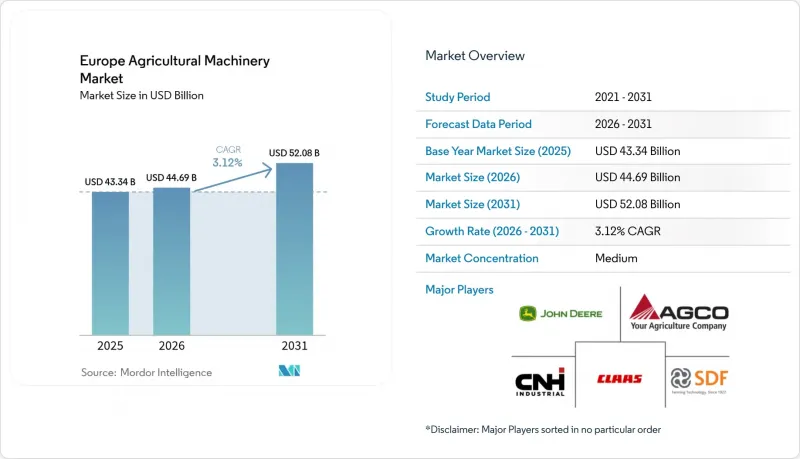
Mordor Intelligence에 의하면, 2026년 유럽의 농업기계 시장 규모는 446억 9,000만 달러로 추정되며, 2025년 433억 4,000만 달러에서 2031년에는 520억 8,000만 달러에 달할 것으로 예측됩니다.
또한 2026-2031년 연평균 성장률(CAGR) 3.12%를 기록할 전망입니다.
본 보고서는 유형별(트랙터, 경운·중경 기기, 관개 기계, 수확 기계 등) 및 지역별(독일, 프랑스, 영국, 이탈리아, 스페인, 러시아 및 기타 유럽)로 분류되어 있습니다. 시장 예측은 금액(미 달러)으로 표시되어 있습니다.
유럽 농업 기계 시장 동향 및 인사이트
유럽연합(EU) 및 각국의 보조금에 힘입어 농업의 기계화가 가속화되고 있습니다.
유럽투자은행(EIB)이 제공하는 10억 유로(10억 5,000만 달러) 규모의 지속가능성 연계형 농업 기술(AgTech) 대출 한도는 배출량이 검증된 구매 건에 대해 장비 정가의 최대 70%를 지원합니다. 이에 독일 연방 정부의 기계 구매에 대한 20% 보조금을 더하면, 스테이지 V 대응 트랙터의 순 취득 비용은 기존 티어 III 모델과 같은 수준으로 낮아져, 보수적인 구매자에게도 투자 회수 기간이 단축됩니다. 프랑스와 이탈리아도 유사한 추가 지원책을 도입하고 있으며, 2025년부터 2027년까지의 기간 동안 보조금 예산이 앞당겨 투입됨에 따라 선주문이 급증하고 있습니다. 각 OEM 업체들은 도입률을 극대화하기 위해 제품 출시 일정을 보조금 신청 마감일과 맞추고 있습니다. 리스 회사는 보조금 상환 기간에 맞추어 계약 기간을 7년으로 연장하고 있으며, 이를 통해 연간 현금 흐름 부담을 경감하는 동시에 40마력 미만 차량의 조기 폐차를 촉진하고 있습니다.
농업 기계 분야의 급속한 모델 업그레이드
배출가스 규제 개정 및 디지털 서브시스템 도입을 배경으로, 주류 트랙터 제품의 평균 출시 주기는 6년에서 2년 미만으로 단축되었습니다. 디어 앤 컴퍼니(Deere & Company)가 2025년에 발표한 자율 주행 트랙터에는 새로운 라이더(LiDAR) 어레이와 하드웨어 교체 없이 경로 계획을 최적화하는 OTA(무선) 펌웨어가 탑재되어 있습니다. 농가들은 이제 농기계를 지속적으로 진화하는 플랫폼으로 인식하고 있으며, 독일 설문 응답자의 47%는 농업적 이익을 극대화하기 위해 분기마다 소프트웨어를 업그레이드할 계획입니다. 이러한 빠른 업데이트 속도로 인해 딜러들은 첨단 서비스 도구에 대한 투자를 서둘러야 하는 상황에 놓여 있습니다. 유럽 농업 기계 시장의 각 제조업체들은 기능 잠금 해제를 위한 구독형 가격 책정으로 전환하며, 단품 판매 이외의 수익원을 다각화하고 있습니다.
높은 초기 비용과 유지비
수많은 센서가 탑재된 콤바인이나 자율형 살포기의 정가는 2024년부터 2025년에 걸쳐 18% 상승하여, 일부 사양의 경우 대당 100만 달러를 넘는 수준에 이르렀습니다. 200-400헥타르를 경작하는 중규모 농가들은 특히 평균 순이익률이 7% 전후에 머무르는 동유럽에서 농업 기계 구입과 토지 개량 프로젝트 중 어느 쪽에 투자할지 어려운 선택을 강요받고 있습니다. 또한, 독자 사양의 전자 기기에는 판매점의 개입이 필요하기 때문에 유지보수 비용도 상승하고 있습니다. 프랑스의 서비스 요금 시간당 단가는 2020년 68유로(71달러)였던 데 비해, 현재는 평균 105유로(110달러)입니다. 소규모 농가에서는 기계 공동 이용 그룹을 결성하여 비용을 절감하고 있지만, 조정에 드는 수고가 효율화의 이점을 상쇄할 가능성이 있습니다.
부문 분석
트랙터는 2025년에 48.85%의 점유율을 차지하며 압도적인 시장 리더십을 유지하고 있습니다. 이는 유럽 대부분의 농업 경영에서 주요 동력원으로서 트랙터가 수행하는 근본적인 역할을 반영한 것입니다. 트랙터 카테고리 내에서는 평균 65헥타르 규모의 유럽 농장에서 100-150 HP 부문이 가장 큰 점유율을 차지하고 있습니다. 한편, 150 HP를 초과하는 부문은 대규모 농가들이 더 높은 출력의 기계를 통해 효율성을 추구하고 있기 때문에 가장 빠른 성장세를 보이고 있습니다. 경운·경작 장비는 두 번째로 큰 카테고리를 차지하고 있으며, 특히 보전 경작법이 유럽 전역에 보급됨에 따라 컬티베이터와 경운기의 판매가 호조를 보이고 있습니다. 또한, 2023년에 고비용 투입 자재(쟁기 등의 농업 기계를 포함)를 선택한 농가에게 유럽집행위원회가 4억 3,000만 유로(4억 5,500만 달러)의 보조금을 지급한 것도 도입률을 높이는 주요 요인 중 하나입니다.
관개 기계는 강수 패턴의 변동이 심화되고 있으며, 효율 개선을 의무화하는 물 사용 규제를 배경으로 연평균 성장률(CAGR) 3.74%로 가장 빠르게 성장하는 부문으로 부상하고 있습니다. 점적 관개 시스템은 기존 스프링클러 시스템에 비해 40-60%의 절수 효과를 가져오는 동시에, 작물 수확량을 향상시키는 정밀한 영양분 공급을 가능하게 하여 이러한 성장을 주도하고 있습니다. 수확 기계의 경우, 콤바인이 시장을 주도하는 가운데 수요는 견조한 추세를 보이고 있으나, 중요한 수확기 노동력 부족이 심화됨에 따라 스마트하고 자율 주행형 수확기가 가장 높은 성장률을 보이는 하위 부문으로 부상하고 있습니다. 건초·사료용 기계는 유럽의 거대한 낙농 부문을 뒷받침하고 있으며, 농가들이 사료 생산 효율을 최적화하려는 가운데 특히 베일러에 대한 수요가 증가하고 있습니다. 드론과 정밀 파종기를 포함하는 ‘기타 유형’ 카테고리는 농가가 기존 방식에 비해 운영상의 이점을 약속하는 신기술을 시도함에 따라, 작은 기반에서 폭발적인 성장을 보이고 있습니다.
기타 혜택:
- 엑셀 형식 시장 예측(ME) 시트
- 3개월간의 애널리스트 지원
자주 묻는 질문
목차
제1장 서론
제2장 조사 방법
제3장 주요 요약
제4장 시장 구도
제5장 시장 규모와 성장 예측
제6장 경쟁 구도
제7장 시장 기회와 향후 전망
LSH 26.09.08According to Mordor Intelligence, the Europe agricultural machinery market size in 2026 is estimated at USD 44.69 billion, growing from 2025 value of USD 43.34 billion with 2031 projections showing USD 52.08 billion, growing at 3.12% CAGR over 2026-2031.
This report is Segmented by Type (Tractors, Plowing and Cultivating Equipment, Irrigation Machinery, Harvesting Machinery, and More), and by Geography (Germany, France, United Kingdom, Italy, Spain, Russia, and Rest of Europe). The Market Forecasts are Provided in Terms of Value (USD).
Europe Agricultural Machinery Market Trends and Insights
European Union and National Subsidies are Accelerating Mechanization
The European Investment Bank's EUR 1 billion (USD 1.05 billion) sustainability-linked agtech loan window covers up to 70% of equipment list prices for emissions-verified purchases. When stacked with Germany's federal 20% machinery grant, net acquisition costs for Stage V tractors drop to parity with legacy Tier III units, flattening payback curves for conservative buyers. France and Italy deploy similar top-up schemes, ensuring that subsidy budgets are front-loaded into the 2025-2027 window, which drives a spike in advance orders. OEMs are synchronizing product-launch calendars with grant-application deadlines to maximize uptake. Leasing companies are extending contracts to seven years to align with subsidy claw-back periods, lowering annual cash footprints and fostering premature retirement of sub-40-horsepower fleets.
Rapid Model Upgrades in Agricultural Machinery
Average release cycles for mainstream tractor lines have compressed from six years to fewer than two, propelled by emission revisions and the influx of digital subsystems. Deere & Company's 2025 autonomous tractors debuted new LiDAR arrays and over-the-air firmware that optimize path planning without hardware swaps. Farmers now view machinery as an evolving platform, with 47% of German survey respondents plan to upgrade software quarterly to capture agronomic gains. The speed of iteration pushes dealers to invest in advanced service tools. Manufacturers in the Europe agricultural machinery market are pivoting to subscription pricing for feature unlocks, diversifying revenue beyond unit sales.
High Upfront and Maintenance Costs
List prices for sensor-rich combines and autonomous sprayers jumped 18% between 2024 and 2025, pushing some configurations beyond USD 1 million per unit. Mid-sized growers operating 200-400 hectares face difficult trade-offs between machinery and land-improvement projects, especially in Eastern Europe where average net margins hover near 7%. Maintenance expenses have also climbed as proprietary electronics require dealer intervention. Hourly service rates in France now average EUR 105 (USD 110) compared with EUR 68 (USD 71) in 2020. Smaller farms mitigate costs by forming machinery rings, but coordination overhead can erode efficiency gains.
Other drivers and restraints analyzed in the detailed report include:
- High Adoption of Telematics and Predictive Maintenance
- Eco-Scheme Incentives for Low-Emission Machinery
- Cybersecurity Risks in Connected Equipment
For complete list of drivers and restraints, kindly check the Table Of Contents.
Segment Analysis
Tractors maintain commanding market leadership with a 48.85% share in 2025, reflecting their fundamental role as the primary power source for most European farming operations. Within the tractor category, the 100-150 HP segment captures the largest share among European farms that average 65 hectares, while the greater than 150 HP segment experiences the fastest growth as large-scale operations pursue efficiency through higher-capacity equipment. Plowing and cultivating equipment represents the second-largest category, with cultivators and tillers showing particular strength as conservation tillage practices gain adoption across the continent. The financial grant of Euro 430 million (USD 455 million) by the European Commission for the farmers opting for high-cost inputs in 2023, including agricultural equipment such as plows, is also one of the major factors increasing the adoption rates.
Irrigation machinery emerges as the fastest-growing segment at 3.74% CAGR, driven by increasingly erratic precipitation patterns and water usage regulations that mandate efficiency improvements. Drip irrigation systems lead this expansion as they deliver 40-60% water savings compared to traditional sprinkler systems while enabling precise nutrient delivery that enhances crop yields. Harvesting machinery maintains steady demand with combine harvesters dominating the category, though smart and autonomous harvesters represent the highest-growth subsegment as labor shortages intensify during critical harvest windows. Haying and forage machinery serves the substantial European dairy sector, with balers experiencing particular demand as farmers optimize feed production efficiency. The "Other Types" category, including drones and precision seeders, shows explosive growth from a small base as farmers experiment with emerging technologies that promise operational advantages over conventional approaches.
Complete Report Scope:
- By Type
- Tractor
- Less than 50 HP
- 50 to 100 HP
- 100 to 150 HP
- More than 150 HP
- Plowing and Cultivating Equipment
- Plows
- Harrows
- Cultivators and Tillers
- Other Equipment (Ridger, Rotary tillers, etc.)
- Irrigation Machinery
- Sprinkler
- Drip
- Other Irrigation Machinery (Micro-irrigation, Pivot irrigation, etc.)
- Harvesting Machinery
- Combine Harvesters
- Forage Harvesters
- Smart/Autonomous Harvesters
- Haying and Forage Machinery
- Mowers
- Balers
- Other Haying Equipment (Rakes, Tedders, etc.)
- Other Types (Drones, Precision Seeders)
- Tractor
- By Geography
- Germany
- France
- United Kingdom
- Italy
- Spain
- Russia
- Rest of Europe
List of Companies Covered in this Report:
- Deere & Company
- CNH Industrial N.V.
- AGCO Corporation
- Kubota Corporation
- CLAAS KGaA mbH
- SDF S.p.A
- Kuhn SAS (Bucher Industries AG)
- Yanmar Holdings Co., Ltd.
- GRIMME Landmaschinenfabrik GmbH & Co. KG
- Horsch Maschinen GmbH (HORSCH PIRK Forestry GmbH)
- Mahindra & Mahindra Ltd.
- Pottinger Landtechnik GmbH
- Tractors and Farm Equipment Limited (TAFE)
Additional Benefits:
- The market estimate (ME) sheet in Excel format
- 3 months of analyst support
TABLE OF CONTENTS
1 Introduction
- 1.1 Study Assumptions and Market Definition
- 1.2 Scope of the Study
2 Research Methodology
3 Executive Summary
4 Market Landscape
- 4.1 Market Overview
- 4.2 Market Drivers
- 4.2.1 Chronic farm-labor shortage
- 4.2.2 European Union and national subsidies are accelerating mechanization
- 4.2.3 Rapid model upgrades in agricultural machinery
- 4.2.4 High adoption of telematics and predictive maintenance
- 4.2.5 Eco-scheme incentives for low-emission machinery
- 4.2.6 OEM ag-software hardware-bundle financing
- 4.3 Market Restraints
- 4.3.1 High upfront and maintenance costs
- 4.3.2 Cybersecurity risks in connected equipment
- 4.3.3 Semiconductor supply constraints
- 4.3.4 Diesel-emission compliance cost escalation
- 4.4 Regulatory Landscape
- 4.5 Technological Outlook
- 4.6 Porter's Five Forces Analysis
- 4.6.1 Bargaining Power of Suppliers
- 4.6.2 Bargaining Power of Buyers
- 4.6.3 Threat of New Entrants
- 4.6.4 Threat of Substitute Products
- 4.6.5 Intensity of Competitive Rivalry
5 Market Size and Growth Forecasts (Value)
- 5.1 By Type
- 5.1.1 Tractor
- 5.1.1.1 Less than 50 HP
- 5.1.1.2 50 to 100 HP
- 5.1.1.3 100 to 150 HP
- 5.1.1.4 More than 150 HP
- 5.1.2 Plowing and Cultivating Equipment
- 5.1.2.1 Plows
- 5.1.2.2 Harrows
- 5.1.2.3 Cultivators and Tillers
- 5.1.2.4 Other Equipment (Ridger, Rotary tillers, etc.)
- 5.1.3 Irrigation Machinery
- 5.1.3.1 Sprinkler
- 5.1.3.2 Drip
- 5.1.3.3 Other Irrigation Machinery (Micro-irrigation, Pivot irrigation, etc.)
- 5.1.4 Harvesting Machinery
- 5.1.4.1 Combine Harvesters
- 5.1.4.2 Forage Harvesters
- 5.1.4.3 Smart/Autonomous Harvesters
- 5.1.5 Haying and Forage Machinery
- 5.1.5.1 Mowers
- 5.1.5.2 Balers
- 5.1.5.3 Other Haying Equipment (Rakes, Tedders, etc.)
- 5.1.6 Other Types (Drones, Precision Seeders)
- 5.1.1 Tractor
- 5.2 By Geography
- 5.2.1 Germany
- 5.2.2 France
- 5.2.3 United Kingdom
- 5.2.4 Italy
- 5.2.5 Spain
- 5.2.6 Russia
- 5.2.7 Rest of Europe
6 Competitive Landscape
- 6.1 Market Concentration
- 6.2 Strategic Moves
- 6.3 Market Share Analysis
- 6.4 Company Profiles (Includes Global Level Overview, Market Level Overview, Core Segments, Financials as Available, Strategic Information, Market Rank/Share for Key Companies, Products and Services, and Recent Developments)
- 6.4.1 Deere & Company
- 6.4.2 CNH Industrial N.V.
- 6.4.3 AGCO Corporation
- 6.4.4 Kubota Corporation
- 6.4.5 CLAAS KGaA mbH
- 6.4.6 SDF S.p.A
- 6.4.7 Kuhn SAS (Bucher Industries AG)
- 6.4.8 Yanmar Holdings Co., Ltd.
- 6.4.9 GRIMME Landmaschinenfabrik GmbH & Co. KG
- 6.4.10 Horsch Maschinen GmbH (HORSCH PIRK Forestry GmbH)
- 6.4.11 Mahindra & Mahindra Ltd.
- 6.4.12 Pottinger Landtechnik GmbH
- 6.4.13 Tractors and Farm Equipment Limited (TAFE)