|
시장보고서
상품코드
2120822
아시아태평양의 핵의학 : 시장 점유율 분석, 업계 동향과 통계, 성장 예측(2026-2031년)Asia-Pacific Nuclear Medicine - Market Share Analysis, Industry Trends & Statistics, Growth Forecasts (2026 - 2031) |
||||||
 Mordor Intelligence
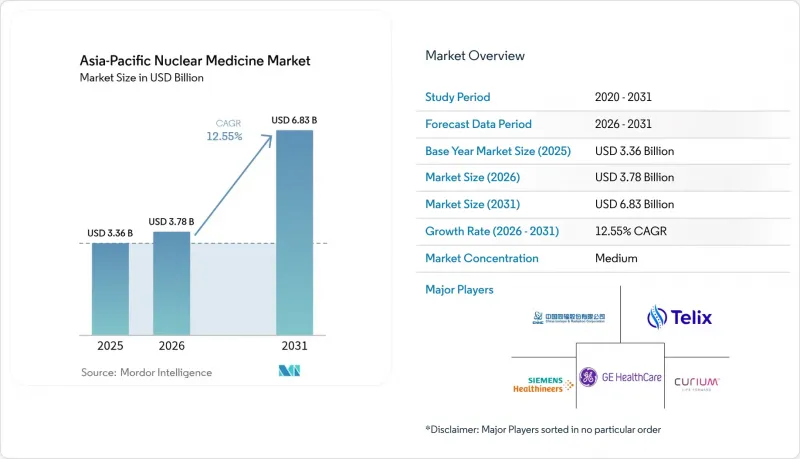
Mordor Intelligence에 의하면, 아시아태평양의 핵의학 시장 규모는 2025년에 33억 6,000만 달러로 평가되었고, 2026년 37억 8,000만 달러에서 2031년까지 68억 3,000만 달러에 이를 것으로 예측되며, 예측 기간(2026-2031년) CAGR은 12.55%를 기록할 전망입니다.
본 보고서는 제품 유형(진단용 (SPECT 및 PET), 치료용 (알파선 방출체 등)), 방사성 동위원소(테크네튬-99m, 플루오르-18 등),용도(순환기, 종양학 등), 최종 사용자(병원, 영상진단센터 등), 지역(중국, 일본, 인도, 호주, 한국 등)별로 분류되어 있습니다. 시장 전망은 금액(미 달러) 기준으로 제시되어 있습니다.
아시아태평양의 핵의학 시장 동향 및 인사이트
암 및 심혈관 질환의 부담 증가
아시아는 전 세계 암 환자 수의 49.2%, 암으로 인한 사망자 수의 56.1%를 차지하고 있으며, 중국이나 인도네시아 등 인구가 많은 국가에서는 폐암 발병률이 가장 높습니다. 또한, 이 지역에서는 심혈관 질환의 유병률도 두드러지는데, 동아시아에서는 인구 10만 명당 1,014.06명의 심부전 환자가 보고된 반면, 남아시아에서는 10만 명당 389.97명입니다. 이러한 역학적 경향으로 인해 종양학 및 순환기학 분야에서 SPECT 및 PET 검사에 대한 지속적인 수요가 발생하고 있습니다. 일본과 한국의 고령화 진행에 따라 핵의학 영상 진단을 통한 조기 발견이 필요한 암 환자 수가 증가하고 있습니다. 높은 흡연율(인도네시아 남성의 경우 54.4%, 중국 남성의 경우 41.5%)은 병기 분류 및 치료 경과 모니터링을 위해 분자 영상 진단이 필요한 폐암 환자가 앞으로도 지속적으로 발생할 것임을 시사합니다. 그 결과, 아시아태평양의 핵의학 시장은 지역 질병 관리 전략에서 매우 중요한 요소로 자리매김하고 있습니다.
하이브리드 영상 기술의 도입 확대
중산대학교 암 센터 등 의료 기관에 도입된 전신용 PET/CT 스캐너는 3년 동안 3만 건의 검사를 완료하며, 방사선 피폭량과 촬영 시간을 줄였습니다. 게이오기주쿠 대학 병원에 도입된 입식 CT 플랫폼은 고령 환자의 근골격계 및 호흡기계 평가에서 진단의 정확성을 높이고 있습니다. SPECT 시스템은 더 높은 공간 분해능과 짧은 스캔 시간을 실현하는 반도체 검출기로 전환되고 있습니다. 이러한 하이브리드 모달리티에 통합된 인공지능 알고리즘을 통해 병변의 자동 감지 및 정량 분석이 가능해졌으며, 이를 통해 보고 시간 단축과 의료 자원이 부족한 지역에서의 원격 판독이 지원됩니다. 중국, 일본, 호주의 조달 프로그램이 전신 스캐너를 중시하는 가운데, 아시아태평양의 핵의학 시장에서는 검사 건수와 진단 정확도를 높이는 기술 갱신 주기가 형성되고 있습니다.
사이클로트론 및 영상 진단 장비에 대한 고액의 설비 투자
신흥국에서는 200만-500만 달러에 달하는 비용이 드는 PET/CT 스캐너 도입에 더해, 연간 20만 달러에 육박하는 서비스 계약 비용도 발생하기 때문에 예산상의 제약에 직면해 있습니다. 예를 들어 필리핀에서는 사이클로트론이 3대밖에 가동되고 있지 않으며, 그 모두가 마닐라에 위치해 있어 지방 환자들의 이동비 부담이 커지고 있습니다. 인도에서는 PET 시스템에 대한 엄격한 품질 보증 기준으로 인해 조달 기간이 길어지고 규정 준수 비용이 증가하고 있습니다. 자본 수요는 방사선 차폐 핫셀, 우수 제조 기준(GMP)을 준수하는 시설, 그리고 인증된 직원까지 미치며, 많은 공립 병원에서 투자 회수 기간이 5년을 초과하게 됩니다. 제한된 보험 환급 제도로 인해 경제적 부담이 환자에게 전가되는 경우가 많아, 차세대 테라노스틱스의 도입이 지연될 가능성이 있습니다. 그 결과, 아시아태평양의 핵의학 시장은 인프라 장벽을 극복하기 위해 민관 파트너십이나 우대 대출에 의존할 수밖에 없습니다.
부문 분석
2025년, 아시아태평양의 핵의학 시장에서 진단 분야가 70.74%를 차지했습니다. 이는 심근 관류, 종양 병기 분류, 뇌 영상 진단 분야에서 SPECT 및 PET의 응용이 정착되어 있기 때문입니다. 멀티헤드 감마 카메라는 현재 더 높은 계수 감도를 실현하고 있어, 이를 통해 스캔 시간이 단축되고 환자 처리 능력이 향상되고 있습니다. 심장 부하 검사 프로토콜에서는 화질을 저하시키지 않으면서 방사선 피폭량을 줄여주는 새로운 고체 검출기가 활용되고 있습니다. 중국과 일본의 병원에서는 종양학 검사에서 PET/CT가 표준화되어 있어, 테크네튬-99m 및 플루오르-18의 투여량에 대한 안정적인 수요가 발생하고 있습니다. 검사 건수는 추적자와 스캐너 사용 시간 모두에 대해 비용을 상환하는 공적 보험 제도에 의해 뒷받침되고 있어, 서비스 제공업체의 수익을 안정적으로 유지하고 있습니다.
치료 분야는 현재 규모는 작지만 연평균 성장률(CAGR) 17.02%로 확대되고 있습니다. 루테튬-177 도타테이트는 신경내분비종양에 대한 승인을 획득했으며, ‘Pluvicto’의 도입을 통해 전립선암 치료 분야로 빠르게 확대되고 있습니다. 악티늄-225와 같은 알파선 방출체는 더 높은 선형 에너지 전달률(LET)이 기대되며, 미세 전이성 질환에서 세포 사멸을 촉진합니다. 한국이 2025년 중반까지 국내에서 악티늄-225 생산을 시작할 계획인 것은 공급 경로를 단축하고 투여 비용을 절감하는 결과를 가져올 것입니다. 임상 지침은 특히 전립선암과 갑상선암의 경우, 치료 알고리즘의 더 초기 단계에서 방사성 리간드 요법을 도입하는 방향으로 진화하고 있습니다. 지역 등록부를 통한 지속적인 데이터 생성은 보험사의 신뢰를 높이고, 보험 적용을 가속화하며, 아시아태평양의 핵의학 산업의 치료 분야에서의 입지를 확대되고 있습니다.
2025년, 테크네튬-99m은 아시아태평양의 핵의학 시장 규모에서 40.25%의 점유율을 유지했습니다. 반감기가 6시간이며, 유리한 광자 에너지를 가지고 있어 뼈, 신장, 심근 영상 진단 분야에서 광범위하게 활용되고 있습니다. 그러나 몰리브덴-99 생산에 노후화된 원자로에 의존하고 있어, 이 지역은 정기적인 공급 부족 위험에 노출되어 있으며, 호주와 일본 등 여러 국가에서 가속기를 활용한 공급 솔루션을 평가했습니다. 중국에서는 현재 디지털 물류 플랫폼을 통해 발생기의 출하 상황을 실시간으로 추적하여, 외딴 지역의 진료소에서 재고 부족 위험을 줄이고 있습니다.
루테튬-177은 연평균 성장률(CAGR) 11.95%로 성장을 지속하고, 있으며, 영상 진단과 치료 모두에 적합한 다목적 베타선 방출 특성을 통해 치료용 파이프라인의 핵심이 되고 있습니다. SHINE-Primo Biotech와의 계약을 통해 비캐리어 첨가형 루테튬-177에 대한 접근성이 대만, 일본, 싱가포르로 확대되었으며, 이 3개국에서 총 25건 이상의 임상시험이 진행되고 있습니다. 이 동위원소의 반감기는 6.7일이기 때문에 과도한 붕괴 손실 없이 지역 간 수송이 가능해져, 반감기가 짧은 약물의 주요 유통 문제를 해결하고 있습니다. 플루오린-18은 종양 영상 진단 분야에서 계속해서 확대되고 있는 반면, 갈륨-68 기반 추적자는 감염증 및 염증 매핑 분야에서 주목을 받고 있습니다. 테르븀-161 및 토륨-228에 대한 초기 연구 결과는 치료용 동위원소의 다양화가 임박했음을 시사하며, 이는 아시아태평양의 핵의학 시장에서 수익원의 확대로 이어질 것입니다.
기타 혜택:
- 엑셀 형식 시장 예측(ME) 시트
- 3개월간의 애널리스트 지원
자주 묻는 질문
목차
제1장 서론
제2장 조사 방법
제3장 주요 요약
제4장 시장 구도
제5장 시장 규모와 성장 예측
제6장 경쟁 구도
제7장 시장 기회와 향후 전망
LSH 26.09.08According to Mordor Intelligence, the Asia-Pacific nuclear medicine market size was valued at USD 3.36 billion in 2025 and estimated to grow from USD 3.78 billion in 2026 to reach USD 6.83 billion by 2031, at a CAGR of 12.55% during the forecast period (2026-2031).
This report is Segmented by Product Type (Diagnostics[SPECT and PET], Therapeutics[alpha Emitters and More]), Radioisotope (Technetium-99m, Fluorine-18 and More), Application (Cardiology, Oncology, and More), End User (Hospital, Diagnostic Imaging Centers and More) and Geography (China, Japan, India, Australia, South Korea and More). The Market Forecasts are Provided in Terms of Value (USD)
Asia-Pacific Nuclear Medicine Market Trends and Insights
Rising Burden of Cancer and Cardiovascular Diseases
Asia accounts for 49.2% of global cancer cases and 56.1% of cancer deaths, with lung malignancies topping incidence tables in large populations such as China and Indonesia. The region also records pronounced cardiovascular disease prevalence, as East Asia reports 1,014.06 heart-failure patients per 100,000 population versus 389.97 per 100,000 in South Asia. These epidemiological patterns create sustained demand for both SPECT and PET procedures in oncology and cardiology. Ageing demographics in Japan and South Korea are intensifying oncologic caseloads that require early detection through nuclear imaging. High smoking rates-54.4% among Indonesian men and 41.5% among Chinese men-suggest a continued pipeline of pulmonary cancers that will rely on molecular imaging for staging and therapy monitoring. Consequently, the Asia-Pacific nuclear medicine market is positioned as a critical component of regional disease-management strategies.
Rising Adoption of Hybrid Imaging Technologies
Total-body PET/CT scanners installed at institutions such as Sun Yat-sen University Cancer Center have completed 30,000 examinations in three years, cutting radiation exposure and acquisition times.Upright CT platforms launched at Keio University Hospital improve diagnostic confidence for musculoskeletal and respiratory assessments in elderly patients. SPECT systems are transitioning to semiconductor detectors that deliver higher spatial resolution and shorter scan windows. Artificial-intelligence algorithms embedded in these hybrid modalities enable automated lesion detection and quantitative analytics, which reduce reporting time and support remote reading in underserved locations. As procurement programs in China, Japan, and Australia emphasize whole-body scanners, the Asia-Pacific nuclear medicine market gains a technology refresh cycle that boosts procedure volumes and diagnostic accuracy.
High CAPEX for Cyclotrons and Imaging Equipment
Emerging economies face budget constraints when acquiring PET/CT scanners that can cost USD 2-5 million, plus annual service contracts approaching USD 200,000. The Philippines, for example, operates only three cyclotrons, all in Manila, which inflates travel expenses for provincial patients. In India, stringent quality-assurance standards for PET systems escalate procurement timelines and compliance costs. Capital needs extend to radiation-shielded hot cells, Good Manufacturing Practice suites, and certified staff, pushing payback periods beyond five years in many public hospitals. Limited reimbursement policies often shift financial burden to patients, potentially delaying adoption of next-generation theranostics. As a result, the Asia-Pacific nuclear medicine market must rely on public-private partnerships and concessional financing to overcome infrastructure barriers.
Other drivers and restraints analyzed in the detailed report include:
- Government Initiatives and Healthcare Infrastructure Development
- Expansion of Molecular Imaging Applications and Personalized Medicines
- Complex Multi-Agency Isotope Transport Regulations
For complete list of drivers and restraints, kindly check the Table Of Contents.
Segment Analysis
Diagnostics accounted for 70.74% of the Asia-Pacific nuclear medicine market in 2025, driven by well-established SPECT and PET applications in myocardial perfusion, tumor staging, and brain imaging. Multi-head gamma cameras now achieve higher count sensitivity, which shortens scan times and improves patient throughput. Cardiac stress protocols benefit from new solid-state detectors that lower radiation dose without compromising image quality. Hospitals across China and Japan have standardized PET/CT for oncology work-ups, creating consistent demand for technetium-99m and fluorine-18 doses. Procedure volumes are supported by public insurance schemes that reimburse both tracer and scanner time, stabilizing revenue for service providers.
Therapeutics, though smaller today, is rising at a 17.02% CAGR. Lutetium-177 dotatate gained approvals for neuroendocrine tumors and is rapidly expanding into prostate cancer therapy through Pluvicto roll-outs. Alpha emitters such as actinium-225 promise higher linear-energy transfer, enhancing cell kill in micro-metastatic disease. South Korea's plan to initiate domestic actinium-225 production by mid-2025 will shorten supply lines and lower dose costs. Clinical guidelines are evolving to include radioligand therapy earlier in treatment algorithms, especially for prostate and thyroid malignancies. Continuous data generation from regional registries strengthens payor confidence and accelerates reimbursement, expanding the Asia-Pacific nuclear medicine industry footprint in therapeutics.
Technetium-99m retained 40.25% share of the Asia-Pacific nuclear medicine market size in 2025. Its 6-hour half-life and favorable photon energy underpin its ubiquity in bone, renal, and myocardial imaging. Nevertheless, reliance on ageing reactors for molybdenum-99 production exposes the region to periodic shortages, prompting countries such as Australia and Japan to evaluate accelerator-based supply solutions. Digital logistics platforms in China now track generator shipments in real time, mitigating stock-out risk for remote clinics.
Lutetium-177, posting a 11.95% CAGR, anchors the therapeutic pipeline through versatile beta-emission profiles that are suitable for both imaging and therapy. SHINE-Primo Biotech agreements extend non-carrier-added lutetium-177 access to Taiwan, Japan, and Singapore, which collectively support more than 25 clinical trials. The isotope's 6.7-day half-life facilitates regional shipping without excessive decay loss, addressing a key distribution challenge for shorter-lived agents. Fluorine-18 continues to expand in oncology imaging, while gallium-68-based tracers gain traction in infection and inflammation mapping. Early research on terbium-161 and thorium-228 signals an impending diversification of therapeutic isotopes, broadening revenue streams for the Asia-Pacific nuclear medicine market.
Complete Report Scope:
- By Product
- Diagnostics
- SPECT
- PET
- Therapeutics
- Alpha Emitters
- Beta Emitters
- Brachytherapy Isotopes
- Diagnostics
- By Radioisotope
- Technetium-99m
- Iodine-131
- Fluorine-18
- Lutetium-177
- Others
- By Application
- Oncology
- Cardiology
- Neurology
- Endocrinology
- Other Applications
- By End User
- Hospitals
- Diagnostic Imaging Centers
- Academic & Research Institutes
- Specialty Clinics
- Geography
- China
- Japan
- India
- Australia
- South Korea
- Rest of Asia-Pacific
List of Companies Covered in this Report:
- GE Healthcare
- Siemens Healthineers
- Koninklijke Philips
- Canon
- Curium Pharma
- Telix Pharmaceuticals
- Bracco Imaging S.p.A.
- Nordion
- NTP Radioisotopes SOC Ltd.
- China Isotope & Radiation Corp. (CIRC)
- Advanced Accelerator Applications (Novartis)
- Jubilant Radiopharma
- AdvanCell (Australia)
- Shenzhen Mindray Bio-Medical
- Institute of Nuclear Energy Research (Taiwan)
- Jiangsu Huayi Technology
- Zhejiang Jiutai New Drug
- Cyclopharma Laboratories
Additional Benefits:
- The market estimate (ME) sheet in Excel format
- 3 months of analyst support
TABLE OF CONTENTS
1 Introduction
- 1.1 Study Assumptions and Market Definition
- 1.2 Scope of the Study
2 Research Methodology
3 Executive Summary
4 Market Landscape
- 4.1 Market Overview
- 4.2 Market Drivers
- 4.2.1 Rising Burden Of Cancer & Cardiovascular Diseases
- 4.2.2 Rising Adoption of Hybrid Imaging Technologies
- 4.2.3 Government Initiatives and Healthcare Infrastructure Development
- 4.2.4 Expansion of Molecular Imaging Applications and Personalized Medicines
- 4.2.5 Rising Awareness and Demand for Theranostics
- 4.2.6 Initiatives taken by Market Players and Launch of Products
- 4.3 Market Restraints
- 4.3.1 High CAPEX For Cyclotrons & Imaging Equipment
- 4.3.2 Complex Multi-Agency Isotope Transport Regulations
- 4.3.3 Short Half-Life Isotope Supply Chain Risk
- 4.3.4 Shortage Of Certified Nuclear-Medicine Pharmacists Outside Tier-1 Cities
- 4.4 Value / Supply-Chain Analysis
- 4.5 Regulatory Landscape
- 4.6 Technology Outlook
- 4.7 Porter's Five Forces Analysis
- 4.7.1 Bargaining Power of Suppliers
- 4.7.2 Bargaining Power of Buyers
- 4.7.3 Threat of New Entrants
- 4.7.4 Threat of Substitutes
- 4.7.5 Intensity of Competitive Rivalry
5 Market Size and Growth Forecasts (Value-USD)
- 5.1 By Product
- 5.1.1 Diagnostics
- 5.1.1.1 SPECT
- 5.1.1.2 PET
- 5.1.2 Therapeutics
- 5.1.2.1 Alpha Emitters
- 5.1.2.2 Beta Emitters
- 5.1.2.3 Brachytherapy Isotopes
- 5.1.1 Diagnostics
- 5.2 By Radioisotope
- 5.2.1 Technetium-99m
- 5.2.2 Iodine-131
- 5.2.3 Fluorine-18
- 5.2.4 Lutetium-177
- 5.2.5 Others
- 5.3 By Application
- 5.3.1 Oncology
- 5.3.2 Cardiology
- 5.3.3 Neurology
- 5.3.4 Endocrinology
- 5.3.5 Other Applications
- 5.4 By End User
- 5.4.1 Hospitals
- 5.4.2 Diagnostic Imaging Centers
- 5.4.3 Academic & Research Institutes
- 5.4.4 Specialty Clinics
- 5.5 Geography
- 5.5.1 China
- 5.5.2 Japan
- 5.5.3 India
- 5.5.4 Australia
- 5.5.5 South Korea
- 5.5.6 Rest of Asia-Pacific
6 Competitive Landscape
- 6.1 Market Concentration
- 6.2 Market Share Analysis
- 6.3 Company profiles (includes Global level Overview, Market level overview, Core Segments, Financials as available, Strategic Information, Market Rank/Share for key companies, Products and Services, and Recent Developments)
- 6.3.1 GE Healthcare
- 6.3.2 Siemens Healthineers AG
- 6.3.3 Philips Healthcare
- 6.3.4 Canon Medical Systems Corp.
- 6.3.5 Curium Pharma
- 6.3.6 Telix Pharmaceuticals
- 6.3.7 Bracco Imaging S.p.A.
- 6.3.8 Nordion Inc.
- 6.3.9 NTP Radioisotopes SOC Ltd.
- 6.3.10 China Isotope & Radiation Corp. (CIRC)
- 6.3.11 Advanced Accelerator Applications (Novartis)
- 6.3.12 Jubilant Radiopharma
- 6.3.13 AdvanCell (Australia)
- 6.3.14 Shenzhen Mindray Bio-Medical
- 6.3.15 Institute of Nuclear Energy Research (Taiwan)
- 6.3.16 Jiangsu Huayi Technology
- 6.3.17 Zhejiang Jiutai New Drug
- 6.3.18 Cyclopharma Laboratories
7 Market Opportunities and Future Outlook
- 7.1 White-Space and Unmet-Need Assessment