|
시장보고서
상품코드
2121393
핵의학 : 시장 점유율 분석, 업계 동향과 통계, 성장 예측(2026-2031년)Nuclear Medicine - Market Share Analysis, Industry Trends & Statistics, Growth Forecasts (2026 - 2031) |
||||||
 Mordor Intelligence
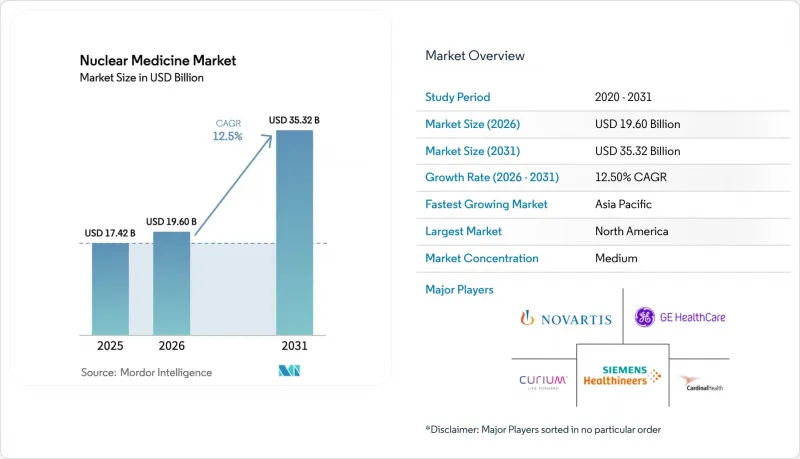
Mordor Intelligence에 따르면 핵의학 시장 규모는 2025년 174억 2,000만 달러에서 2026년에는 196억 달러로 확대하며, 2026-2031년에 CAGR 12.5%로 추이하며, 2031년까지 353억 2,000만 달러에 달할 것으로 예측됩니다.
이 보고서는 제품 유형(진단, 치료), 방사성동위원소(테크네튬-99m, 불소-18, 요오드-131, 루테튬-177, 기타),용도(종양, 심장병 등), 최종사용자(병원, 영상 진단센터, 연구기관 등), 지역(북미, 유럽, 아시아태평양, 중동 및 아프리카, 남미)별로 분류되어 있습니다. 시장 예측은 금액(달러)으로 표시되어 있습니다.
전 세계 핵의학 시장의 동향 및 인사이트
대상 질환의 부담 증가가 정밀진단을 촉진
2025년에는 미국내 암 신규 발병자 수가 200만 명에 달하는 반면,심혈관 질환은 여전히 전 세계 사망 원인 1위를 차지하고 있으며, 이에 따라 순환기과에서는 스트레스 부하 검사만을 수행하는 관류 검사 대신, 혈관 재건술의 지침이 되는 PET-CT 하이브리드 생체 기능 스캔으로의 전환이 진행되고 있습니다. 세계보건기구(WHO) 보고서에 따르면 신경계 질환은 전 세계 인구의 3명 중 1명이 앓고 있으며, 이에 따라 의료 시스템에서는 증가하는 증례에 대응하기 위해 사이클로트론 도입 및 핵의학 전문의 양성이 추진되고 있습니다. FDA·EMA에 의한 표적 항암제용 동반 진단 의무화로 인해 영상 진단이 치료 알고리즘에 통합되어 지속적인 검사 건수가 확보되고 있습니다. 따라서 이러한 질환들의 총 부담이 핵의학 시장의 장기적인 성장 기반이 되고 있습니다. 공공 선별 검사 프로그램에 대한 투자와 연구 보조금은 수요 전망을 더욱 공고히 하고 있습니다. 그 결과, 사이클로트론 공급업체와 방사성 의약품 조제업체는 주요 대도시권뿐만 아니라 지방 도시에서도 생산 능력을 확대하고 있습니다.
표적 방사선 치료의 도입이 치료 패러다임을 재구성
루테튬-177 DOTATATE를 이용한 펩티드 수용체 방사성동위원소 치료는 신경내분비 종양 임상 시험에서 79%의 질병 통제율을 달성하여 화학요법의 벤치마크를 상회함으로써, 미국 및 유럽의 진료 지침에 채택되는 계기가 되었습니다. 메디케어의 2025년 루테튬-177 PSMA-617 적용 범위 확대로 인해 전이성 전립선암의 전체 생존 기간이 4개월 연장되었으며, 이를 계기로 병원에서는 전용 치료실에 대한 투자가 진행되고 있습니다. 라듐-223 등의 알파선 방출체는 단거리에서 높은 선형 에너지 전달률을 발휘하므로 골수 독성을 줄여주어, 허약한 환자를 치료하는 종양 전문의들로부터 지지를 받고 있습니다. 갈륨-68을 이용한 영상 진단과 루테튬-177을 이용한 치료를 결합한 세라노스틱스(치료와 진단의 융합)를 통해 실시간 선량 측정이 가능해지며, 불필요한 치료 주기가 줄어들어 전체 의료비 절감으로 이어집니다. 독일과 프랑스에서 체외 방사선 치료와 방사성 의약품 치료의 보험 적용 조건이 동등해짐에 따라 오랫동안 존재해 온 장벽이 제거되어 유럽내 도입이 가속화되고 있습니다.
부문별 분석
2025년에는 SPECT 심근 관류 검사 및 PET 종양학 프로토콜의 보급에 힘입어 진단 분야가 매출의 76.12%를 차지했으나, 병원들이 루테튬-177·악티늄-225를 이용한 치료법을 채택함에 따라 치료 분야는 2031년까지 연평균 성장률(CAGR) 15.45%로 성장할 것으로 예측됩니다. 이러한 전환에 따라 치료 분야가 핵의학 시장 규모에서 차지하는 비중은 높아지는 한편, 진단 분야는 환자 선정 및 경과 관찰에서 계속해서 기초적인 역할을 수행하게 될 것입니다. SPECT는 스캐너 비용이 저렴하여 순환기·골 영상 진단 분야에서 점유율을 유지하고 있지만, PET는 뛰어난 해상도와 정량 정확도로 인해 종양학·신경학 분야의 검사 건수를 지속적으로 늘리고 있습니다. 알파선 방출체의 투여량은 베타선 방출체(8,000달러)에 비해 3만 달러라는 고가대로 거래되고 있으며, 이는 더 적은 치료 주기로 방사선 저항성 종양을 근절할 수 있는 능력을 반영합니다. 이트륨-90 및 루테튬-177과 같은 베타선 방출체는 확고한 안전성 데이터에 지원되어 간 및 신경내분비 종양 치료의 주류로 자리 잡고 있습니다. 요오드-125를 포함한 근접 치료용 동위원소는 로봇 수술 및 외부 조사법의 발전에 따라 성장세가 정체되어 있습니다.
치료 분야의 성장은 약국의 수익을 끌어올리고, 핫셀, 차폐된 주입실, 선량 측정 소프트웨어에 대한 설비 투자를 촉진할 것입니다. 진단용 추적자와 이에 적합한 치료법을 세트로 판매하는 공급업체는 더 높은 지갑 점유율을 확보하게 될 것입니다. 세라노스틱스가 성숙해짐에 따라 통합된 진료 경로를 통해 총 의료비가 절감되고, 지불자 측의 지원이 강화되어 핵의학 시장의 확대가 지속될 것입니다.
테크네튬-99m은 대량으로 시행되는 심장 및 뼈 스캔에 힘입어 2025년에도 43.28%의 점유율을 유지했습니다. 그러나 PSMA 요법이 종양학의 주류로 자리 잡아가면서 루테튬-177의 사용량은 연평균 성장률(CAGR) 14.31%로 증가하고 있으며, 치료용 동위원소 시장내 점유율을 확대하고 있습니다. 플루오르-18은 여전히 PET 영상의 핵심을 이루고 있지만, PSMA 및 섬유아세포 활성화 단백질을 표적으로 하는 새로운 추적자 덕분에 그 용도는 종양학을 넘어 염증 및 심근섬유증 분야로 확대되고 있습니다. 요오드-131은 갑상선 질환의 표준 치료법으로 자리 잡았으나, 수술 기술의 발전과 경구용 키나아제 억제제의 보급에 따라 그 사용량은 정체 상태에 있습니다.
갈륨-68이나 구리-64와 같은 신흥 동위원소는 조기 접근 프로그램을 시행하는 학술기관에서 그 기세가 커지고 있으며, 공급망이 성숙해지면 더 광범위한 채택의 길이 열릴 것입니다. 유연한 생산 라인 구성에 투자하는 공급업체는 동위원소 유형별 수요 변동에 대응하는 데 있으며, 가장 유리한 입장에 서게 될 것입니다.
지역별 분석
2025년에는 2,500대가 넘는 PET-CT 스캐너와 18유형의 PET 추적자에 대한 메디케어 적용을 배경으로, 북미가 매출 점유율 39.43%로 1위를 차지했습니다. 미국에는 루테튬-177 PSMA 치료를 제공하는 병원 120곳과 악티늄-225 임상 시험 거점 40곳이 있으며, 규제 당국의 승인이 가속화되고 연구의 시너지 효과가 촉진되고 있습니다. 캐나다에서는 원자로에 의존하지 않는 Mo-99 생산으로의 전환을 통해 기존의 공급 차질이 완화되고 있습니다. 한편, 멕시코에서는 민관 협력을 통한 스캐너 도입이 진행되어 1억 3,000만 명의 국민에게 접근성이 확대되고 있습니다.
유럽은 PET 보급률이 높으며, 독일에서는 180대의 사이클로트론을 가동하고 있으며, 주민의 95%에게 플루오르-18을 당일 중에 공급할 수 있습니다. 각국의 공적 의료제도가 아밀로이드 PET 및 갈륨-68 PSMA 검사의 비용을 보상하고 있으며, 이에 따라 검사 건수가 증가하고 있습니다. 이탈리아와 스페인은 진단과 치료를 한 곳에서 통합하는 세라노스틱 센터에 투자하고 있으며, 이를 통해 의료비 절감이 이루어지고 있습니다. 폴란드와 헝가리는 구형 감마 카메라를 현대화하고 있으며, 이에 따라 최신형 동위원소 및 소프트웨어에 대한 수요가 증가하고 있습니다.
아시아태평양은 연평균 성장률(CAGR) 14.56%로 가장 빠르게 성장하는 지역이며, 2025년에 중국에서 300대의 PET-CT 스캐너가 도입되고, 2027년까지 인도의 사이클로트론 설치 거점이 27곳으로 확대되는 것이 그 원동력이 되고 있습니다. 일본에서는 고령화에 따라 알츠하이머병 및 심근 생체 기능 영상 진단에 대한 수요가 증가하고 있으며, 2024년부터는 국민건강보험 적용 대상이 되었습니다. 한국에서는 지방 병원을 대상으로 PET-CT 장비에 대한 보조금을 지급하여 검사 대기 시간을 5일로 단축하고 있습니다. 호주에서는 구리-64·지르코늄-89 추적자의 규제 승인이 진행되면서, 해당국은 지역적 임상시험 거점으로서의 위상을 확립해 가고 있습니다. 한편, 아세안(ASEAN) 국가들은 규모상 과제를 극복하기 위해 공동 방사성 의약품 네트워크를 구축하고 있습니다.
기타 혜택:
- 엑셀 형식의 시장 예측(ME) 시트
- 3개월간의 애널리스트 지원
자주 묻는 질문
목차
제1장 서론
제2장 조사 방법
제3장 개요
제4장 시장 구도
제5장 시장 규모와 성장 예측
제6장 경쟁 구도
제7장 시장 기회와 향후 전망
KSA 26.09.04According to Mordor Intelligence, the nuclear medicine market size is expected to grow from USD 17.42 billion in 2025 to USD 19.60 billion in 2026 and is forecast to reach USD 35.32 billion by 2031 at 12.5% CAGR over 2026-2031.
This report is Segmented by Product Type (Diagnostics, Therapeutics), Radioisotope (Technetium-99m, Fluorine-18, Iodine-131, Lutetium-177, Others), Application (Oncology, Cardiology, and More), End User (Hospitals, Diagnostic Imaging Centers, Research Institutes and More), and Geography (North America, Europe, Asia-Pacific, Middle East and Africa, South America). Market Forecasts are in Value (USD).
Global Nuclear Medicine Market Trends and Insights
Rising Burden of Targeted Diseases Drives Precision Diagnostics
Cancer incidence reached 2 million new U.S. cases in 2025, while cardiovascular disease remained the principal cause of global mortality, pushing cardiology departments to replace stress-only perfusion studies with hybrid PET-CT viability scans that guide revascularization. The World Health Organization reports that neurological disorders affect 1 in 3 people worldwide, spurring health systems to install cyclotrons and train nuclear-medicine physicians to manage the rising caseload. FDA and EMA companion-diagnostic mandates for targeted oncology drugs embed imaging into treatment algorithms and secure recurring procedure volumes. The combined disease burden, therefore, anchors long-term growth of the nuclear medicine market. Investments in public screening programs and research grants further reinforce demand visibility. As a result, cyclotron vendors and radiopharmacy operators are expanding capacity in major metropolitan areas and secondary cities alike.
Targeted Radiotherapy Adoption Reshapes Treatment Paradigms
Peptide receptor radionuclide therapy using lutetium-177 DOTATATE achieved a 79% disease-control rate in neuroendocrine tumor trials, eclipsing chemotherapy benchmarks and prompting guideline inclusion in the United States and Europe. Medicare's 2025 coverage expansion for lutetium-177 PSMA-617 extended overall survival by 4 months in metastatic prostate cancer, triggering hospital investment in purpose-built therapy suites. Alpha-emitters such as radium-223 deliver high-linear-energy transfer over short ranges, reducing bone-marrow toxicity and appealing to oncologists treating frail patients. Theranostic pairs linking gallium-68 imaging to lutetium-177 therapy enable real-time dosimetry and limit unnecessary cycles, translating into lower overall care costs. Reimbursement parity between external-beam radiation and radiopharmaceutical therapy in Germany and France removes a historical barrier and accelerates European adoption.
Other drivers and restraints analyzed in the detailed report include:
- Imaging Modality Advances Enhance Diagnostic Precision
- Expansion of Non-Reactor Mo-99 Production Mitigates Supply Risk
- Complex Multi-Agency Regulatory Approval Delays Market Entry
- Short Half-Life Isotopes Impose Logistical Constraints
For complete list of drivers and restraints, kindly check the Table Of Contents.
Segment Analysis
Diagnostics controlled 76.12% of revenue in 2025, supported by widespread SPECT myocardial perfusion and PET oncology protocols, yet therapeutics are projected to grow at 15.45% CAGR through 2031 as hospitals embrace lutetium-177 and actinium-225 regimens. This pivot will lift therapeutics' contribution to the nuclear medicine market size, while diagnostics maintain a foundational role in patient selection and follow-up. SPECT preserves share in cardiology and bone imaging because of lower scanner costs, but PET continues to win oncology and neurology volumes due to superior resolution and quantification accuracy. Alpha-emitter doses command premium prices (USD 30,000 versus USD 8,000 for beta-emitters), reflecting their ability to eradicate radio-resistant tumors with fewer cycles. Beta-emitters such as yttrium-90 and lutetium-177 dominate liver and neuroendocrine tumor therapy, underpinned by robust safety data. Brachytherapy isotopes, including iodine-125, show flat growth as robotic surgery and external-beam modalities advance.
Therapeutic growth will lift pharmacy revenues and drive capital expenditure on hot cells, shielded infusion suites, and dosimetry software. Suppliers that bundle diagnostic tracers with matched therapies will capture higher wallet share. As theranostics mature, integrated pathways will lower total care costs, reinforcing payer support and sustaining nuclear medicine market expansion.
Technetium-99m retained a 43.28% share in 2025, driven by high-volume cardiology and bone scans. Yet lutetium-177 doses are rising at a 14.31% CAGR as PSMA therapy enters mainstream oncology practice, expanding the nuclear medicine market share of therapeutic isotopes. Fluorine-18 remains the backbone of PET imaging, but novel tracers targeting PSMA and fibroblast activation protein expand its utility beyond oncology into inflammation and cardiac fibrosis. Iodine-131 remains standard for thyroid disorders, though usage plateaus amid surgery advances and oral kinase inhibitors.
Emerging isotopes such as gallium-68 and copper-64 are gaining momentum at academic centers running early-access programs, paving the way for broader adoption once supply chains mature. Suppliers investing in flexible production line configurations will be best positioned to meet demand variance across isotope classes.
Complete Report Scope:
- By Product Type
- Diagnostics
- SPECT
- PET
- Therapeutics
- Alpha Emitters
- Beta Emitters
- Brachytherapy Isotopes
- Diagnostics
- By Radioisotope
- Technetium-99m
- Fluorine-18
- Iodine-131
- Lutetium-177
- Others
- By Application
- Oncology
- Cardiology
- Neurology
- Endocrinology
- Orthopedics & Pain Management
- Other Applications
- By End User
- Hospitals
- Diagnostic Imaging Centers
- Specialized Radiopharmacies
- Research Institutes
- Ambulatory Surgical Centers
- By Geography
- North America
- United States
- Canada
- Mexico
- Europe
- Germany
- United Kingdom
- France
- Italy
- Spain
- Rest of Europe
- Asia-Pacific
- China
- Japan
- India
- Australia
- South Korea
- Rest of Asia-Pacific
- Middle East and Africa
- GCC
- South Africa
- Rest of Middle East and Africa
- South America
- Brazil
- Argentina
- Rest of South America
- North America
Geography Analysis
North America led with 39.43% revenue share in 2025, supported by over 2,500 PET-CT scanners and Medicare coverage for 18 PET tracers. The United States hosts 120 hospitals offering lutetium-177 PSMA therapy and 40 actinium-225 clinical-trial sites, accelerating regulatory approvals and fostering research synergies. Canada's transition to non-reactor Mo-99 production mitigates prior supply disruptions, while Mexico's public-private scanner installations extend access to its 130 million population.
Europe boasts high PET penetration, with Germany operating 180 cyclotrons that enable same-day fluorine-18 deliveries to 95% of residents. National health systems reimburse amyloid PET and gallium-68 PSMA, reinforcing procedural volumes. Italy and Spain invest in theranostic centers that consolidate diagnostics and therapy under one roof, lowering care costs. Poland and Hungary modernize legacy gamma cameras, lifting demand for updated isotopes and software.
Asia-Pacific is the fastest-growing region at 14.56% CAGR, led by China's installation of 300 PET-CT scanners in 2025 and India's expansion of cyclotron sites to 27 by 2027. Japan's aging population drives Alzheimer's and cardiac viability imaging, with national insurance coverage since 2024. South Korea subsidizes PET-CT equipment for rural hospitals, cutting wait times to 5 days. Australia's regulatory approvals for copper-64 and zirconium-89 tracers position it as a regional clinical-trial hub, while ASEAN nations form shared radiopharmacy networks to overcome scale challenges.
- Actinium Pharmaceuticals
- Bayer
- Blue Earth Diagnostics
- Bracco Imaging S.p.A.
- BWXT Medical Ltd.
- Cardinal Health
- Cerveau Technologies
- Curium Pharma
- Eckert & Ziegler Radiopharma
- GE Healthcare
- IBA Molecular
- Isotopia Molecular Imaging
- Jubilant Radiopharma
- Lantheus
- NorthStar Medical Radioisotopes
- Novartis
- Siemens Healthineers
- SOFIE Biosciences
- Spectrum Dynamics Medical
- Telix Pharmaceuticals Ltd.
Additional Benefits:
- The market estimate (ME) sheet in Excel format
- 3 months of analyst support
TABLE OF CONTENTS
1 Introduction
- 1.1 Study Assumptions & Market Definition
- 1.2 Scope of the Study
2 Research Methodology
3 Executive Summary
4 Market Landscape
- 4.1 Market Overview
- 4.2 Market Drivers
- 4.2.1 Rising burden of targeted diseases (cardiovascular, cancer, neurological)
- 4.2.2 Growing adoption of targeted radiotherapy
- 4.2.3 Technological advancement in imaging modalities
- 4.2.4 Increasing focus of government & private players
- 4.2.5 Expansion of non-reactor Mo-99 production technologies
- 4.2.6 Integration of AI-enabled radiotracer quantification workflows
- 4.3 Market Restraints
- 4.3.1 Complex multi-agency regulatory approval
- 4.3.2 Short half-life isotope supply-chain risk
- 4.3.3 High cost of nuclear-medicine procedures & equipment
- 4.3.4 Scarcity of high-specific-activity isotope production infrastructure
- 4.4 Value Chain Analysis
- 4.5 Regulatory Landscape
- 4.6 Technological Outlook
- 4.7 Porter's Five Forces
- 4.7.1 Bargaining Power of Suppliers
- 4.7.2 Bargaining Power of Buyers
- 4.7.3 Threat of New Entrants
- 4.7.4 Threat of Substitutes
- 4.7.5 Intensity of Competitive Rivalry
5 Market Size & Growth Forecasts (Value - USD)
- 5.1 By Product Type
- 5.1.1 Diagnostics
- 5.1.1.1 SPECT
- 5.1.1.2 PET
- 5.1.2 Therapeutics
- 5.1.2.1 Alpha Emitters
- 5.1.2.2 Beta Emitters
- 5.1.2.3 Brachytherapy Isotopes
- 5.1.1 Diagnostics
- 5.2 By Radioisotope
- 5.2.1 Technetium-99m
- 5.2.2 Fluorine-18
- 5.2.3 Iodine-131
- 5.2.4 Lutetium-177
- 5.2.5 Others
- 5.3 By Application
- 5.3.1 Oncology
- 5.3.2 Cardiology
- 5.3.3 Neurology
- 5.3.4 Endocrinology
- 5.3.5 Orthopedics & Pain Management
- 5.3.6 Other Applications
- 5.4 By End User
- 5.4.1 Hospitals
- 5.4.2 Diagnostic Imaging Centers
- 5.4.3 Specialized Radiopharmacies
- 5.4.4 Research Institutes
- 5.4.5 Ambulatory Surgical Centers
- 5.5 By Geography
- 5.5.1 North America
- 5.5.1.1 United States
- 5.5.1.2 Canada
- 5.5.1.3 Mexico
- 5.5.2 Europe
- 5.5.2.1 Germany
- 5.5.2.2 United Kingdom
- 5.5.2.3 France
- 5.5.2.4 Italy
- 5.5.2.5 Spain
- 5.5.2.6 Rest of Europe
- 5.5.3 Asia-Pacific
- 5.5.3.1 China
- 5.5.3.2 Japan
- 5.5.3.3 India
- 5.5.3.4 Australia
- 5.5.3.5 South Korea
- 5.5.3.6 Rest of Asia-Pacific
- 5.5.4 Middle East and Africa
- 5.5.4.1 GCC
- 5.5.4.2 South Africa
- 5.5.4.3 Rest of Middle East and Africa
- 5.5.5 South America
- 5.5.5.1 Brazil
- 5.5.5.2 Argentina
- 5.5.5.3 Rest of South America
- 5.5.1 North America
6 Competitive Landscape
- 6.1 Market Concentration
- 6.2 Market Share Analysis
- 6.3 Company Profiles (includes Global level Overview, Market level overview, Core Segments, Financials as available, Strategic Information, Market Rank/Share for key companies, Products & Services, and Recent Developments)
- 6.3.1 Actinium Pharmaceuticals
- 6.3.2 Bayer AG
- 6.3.3 Blue Earth Diagnostics
- 6.3.4 Bracco Imaging S.p.A.
- 6.3.5 BWXT Medical Ltd.
- 6.3.6 Cardinal Health Inc.
- 6.3.7 Cerveau Technologies
- 6.3.8 Curium Pharma
- 6.3.9 Eckert & Ziegler Radiopharma
- 6.3.10 GE HealthCare
- 6.3.11 IBA Molecular
- 6.3.12 Isotopia Molecular Imaging
- 6.3.13 Jubilant Radiopharma
- 6.3.14 Lantheus Holdings Inc.
- 6.3.15 NorthStar Medical Radioisotopes
- 6.3.16 Novartis AG
- 6.3.17 Siemens Healthineers
- 6.3.18 SOFIE Biosciences
- 6.3.19 Spectrum Dynamics Medical
- 6.3.20 Telix Pharmaceuticals Ltd.
7 Market Opportunities & Future Outlook
- 7.1 White-Space & Unmet-Need Assessment