|
시장보고서
상품코드
2120842
태국의 석유 및 가스 Downstream 시장 : 시장 점유율 분석, 업계 동향과 통계, 성장 예측(2026-2031년)Thailand Oil And Gas Downstream - Market Share Analysis, Industry Trends & Statistics, Growth Forecasts (2026 - 2031) |
||||||
 Mordor Intelligence
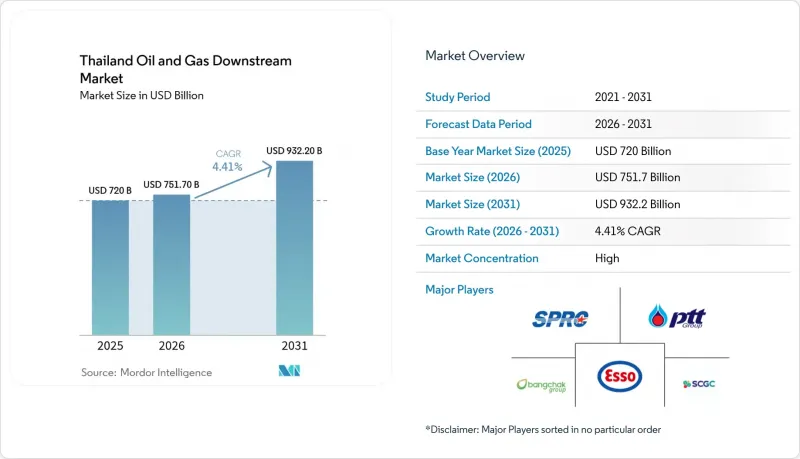
Mordor Intelligence에 의하면, 태국의 석유 및 가스 Downstream 시장 규모는 2025년 7억 2,000만 달러에서 2026년에는 7억 5,170만 달러에 이르고, 2026-2031년 CAGR 4.41%로 성장을 지속하여 2031년에는 9억 3,220만 달러에 달할 것으로 예측됩니다.
본 보고서는 유형별(정유시설 및 석유화학 플랜트), 제품 유형별(정제 석유 제품, 석유화학제품, 윤활유), 유통 채널별(직접 판매·도매, 유통업체·상업, 소매)로 분류되어 있습니다. 시장 규모 및 전망은 금액(달러)으로 제시되어 있습니다.
태국 석유 및 가스 다운스트림 시장 동향과 인사이트
관광업 회복이 정제 제품 수요 회복을 견인
국제 방문객 수가 4,000만 명 대를 향해 증가함에 따라 제트 연료 출하량은 팬데믹 이전 수준에 근접하고 있으며, 이에 따라 숙박 및 물류 서비스를 통해 휘발유와 디젤 수요가 회복되고 있습니다. 라스트 마일 전자상거래 배송 차량은 방콕 교외로의 도시 확산에 따라 장거리 운송에서의 디젤 수요를 증가시키고 있으며, 중간 수준의 복잡성을 지닌 정유시설의 가동 기간을 연장하고 있습니다. 팬데믹 기간 동안 처리량을 억제했던 사업자들은 2025년부터 2026년까지의 성수기 가동률을 극대화하기 위해 계획되었던 턴어라운드를 앞당겨 실시했습니다. 인바운드 여행 회복이 더딘 다른 국가들과 비교하여, 태국의 석유 및 가스 다운스트림 시장은 크랙 스프레드를 뒷받침하는 선제적인 수요 회복의 혜택을 누리고 있습니다. 태국의 현재 전기차 보급률 10%는 2027년 이전에 액체 연료의 총 수요 성장에 큰 영향을 미치기에는 너무 낮기 때문에 정유사들이 설비 갱신을 위한 자본 투자를 회수할 수 있는 몇 년간의 여유가 생겼습니다.
유로 5 기준이 마진 확대의 길을 열어주다.
2027년 1월부터 시행되는 유로 5 규격의 가솔린 및 디젤 연료 의무화로 인해, 규격 적합 제품과 비적합 제품의 가격 차이는 추정 5-15% 확대될 것으로 예측됩니다. 새로운 잔류유 개질 라인과 대용량 탈황 설비를 갖춘 복합 정유시설는 이러한 프리미엄을 누리는 동시에 탄소세 부담을 경감할 수 있습니다. 기준을 충족하지 못하는 아세안(ASEAN) 국가들로부터의 수입 중간 증류 분에 대한 수요는 추가적인 판로를 제공하며, 태국을 청정 연료의 수출 거점으로 자리매김하고 있습니다. 하루 40만 배럴 규모의 ‘청정 연료 프로젝트’ 등 여러 프로젝트의 일정은 규제 시행에 앞서 생산을 확대하도록 조정되어 있으며, 이를 통해 규모의 경제가 강화될 것입니다. 소규모 단독 플랜트는 설비 갱신에 어려움을 겪고 있어, 수소를 재활용하고 더 무거운 원유를 낮은 한계 비용으로 처리할 수 있는 통합형 정유·석유화학 슈퍼사이트로의 전환이 가속화되고 있습니다.
중국 석유화학 업계의 과잉 생산 능력이 지역 마진을 압박
2024년 이후 가동을 시작한 중국의 연간 3,000만 톤을 초과하는 신규 에틸렌 생산 능력으로 인해 현물 모노머 가격은 세계 원가 곡선의 하위 사분위수 수준으로 밀려났으며, 동남아시아의 크래커 마진은 톤당 150달러까지 축소되었습니다. 나프타를 원료로 사용하는 태국의 사업자들은 지방 자치단체의 우대 조치에 힘입어 저렴한 석탄 유래 올레핀이나 에탄 기반 공정을 채택하는 중국의 복합 시설로 인해 특히 큰 압박을 받고 있습니다. 마진 압박으로 인해 가격 탄력성이 낮고 수익성을 높일 수 있는 특수 화학제품, 엔지니어링 플라스틱 및 다운스트림 부문으로의 통합을 위한 전략적 전환이 가속화되고 있습니다. 일시적인 반덤핑 관세는 제한적인 숨 고르기가 될 수 있지만, 장기적인 경쟁력은 에너지 효율화를 위한 개조 및 원료 유연성 확보에 달려 있으며, 이는 이미 2023년부터 2027년까지의 국가 석유화학 로드맵에서 우선 과제로 자리 잡고 있습니다.
부문별 분석
2025년 태국의 석유 및 가스 하류 시장에서 정유시설가 65.25%의 점유율을 차지했습니다. 이는 일일 124만 배럴의 증류 설비 용량이 회복세를 보이는 모빌리티 연료 수요를 충족시켰기 때문입니다. 태국 석유 및 가스 다운스트림 시장에서 정유시설 시장 규모는 유로 5 규제를 준수하기 위한 프리미엄과 지역적인 제트 연료 공급 부족이 가동률을 뒷받침함에 따라, 2031년까지 연평균 성장률(CAGR) 3.68%로 확대될 것으로 예측됩니다. 연평균 성장률(CAGR) 4.85%로 성장하고 있는 석유화학 플랜트는 PTT 세계 케미칼의 44억 달러 규모 ‘3 Steps Plus’ 프로그램 등, 다운스트림 공정의 폴리우레탄 및 생분해성 PLA 생산 라인을 추가하는 투자에 힘입고 있습니다. 통합형 사이트에서는 공유 유틸리티 및 수소 네트워크를 활용하여 운영 비용을 5-7% 절감하고, 혼합 원료에 대한 대응 능력이라는 전략적 초점을 더욱 명확히 하고 있습니다. 중국의 과잉 생산 능력은 여전히 가장 큰 역풍이지만, 태국의 복합 시설은 바이오 에틸렌 및 고순도 ABS 등 견조한 프리미엄 가격을 유지할 수 있는 틈새 특수 제품으로 대응하고 있습니다.
이와 병행하여 탄소 강도를 둘러싼 차별화 움직임도 진행되고 있습니다. 가스 연소 열병합 발전 설비와 결합된 신설 수소화 분해 장치는 10년 전의 수소화 스키머에 비해 배럴당 CO2 배출량을 12-15% 줄여, 이를 통해 탄소세 부담을 경감시키고 있습니다. 폐열 회수와 배가스 탈염을 결합한 개보수 공사는 컴플라이언스 비용을 더욱 낮추고, LIBOR보다 낮은 스프레드로 그린 파이낸스 관련 자금을 유치하고 있습니다. 이러한 노력들이 종합적으로 어우러져, 석유화학 사업의 수익이 연료 판매를 상회하는 상황에서도 태국 석유 및 가스 하류 시장 내 정유 사업의 기반을 유지하는 데 기여하고 있습니다.
기타 혜택:
- 엑셀 형식 시장 예측(ME) 시트
- 3개월간의 애널리스트 지원
자주 묻는 질문
목차
제1장 서론
제2장 조사 방법
제3장 주요 요약
제4장 시장 구도
제5장 시장 규모와 성장 예측
제6장 경쟁 구도
제7장 시장 기회와 향후 전망
LSH 26.09.08According to Mordor Intelligence, the Thailand oil and gas downstream market size is expected to grow from USD 720 million in 2025 to USD 751.7 million in 2026 and is forecast to reach USD 932.2 million by 2031 at 4.41% CAGR over 2026-2031.
This report is Segmented by Type (Refineries and Petrochemical Plants), Product Type (Refined Petroleum Products, Petrochemicals, and Lubricants), and Distribution Channel (Direct Sales/Wholesale, Distributors/Commercial, and Retail). The Market Sizes and Forecasts are Provided in Terms of Value (USD).
Thailand Oil And Gas Downstream Market Trends and Insights
Tourism Recovery Drives Refined Product Demand Resurgence
Jet fuel liftings are nearing pre-pandemic run-rates as international arrivals climb toward the 40 million mark, reviving gasoline and diesel pull through hospitality and logistics services. Last-mile e-commerce fleets add incremental diesel line-haul demand across Bangkok's peri-urban sprawl, extending the utilization window for mid-complexity refineries. Operators that throttled throughput during the pandemic are now executing planned turnarounds early to maximize availability during the 2025-2026 high season. Compared with peers where inbound travel lags, the Thailand oil and gas downstream market enjoys a first-mover demand recovery that supports crack spreads. The country's current 10% EV penetration remains too low to significantly impact aggregate liquid-fuel growth before 2027, creating a multi-year cushion for refiners to recoup upgrade capital expenditures.
Euro-5 Standards Create Margin Expansion Pathway
Mandatory Euro-5 gasoline and diesel specifications, effective January 2027, will widen the pricing gap between compliant and non-compliant supplies by an estimated 5-15%. Complex refineries equipped with new resid-upgrading trains and high-capacity desulfurizers can capture this premium while also reducing carbon tax liabilities. Imported middle-distillate demand from non-compliant ASEAN peers offers an additional outlet, positioning Thailand as a clean-fuel export hub. Project timelines, such as the 400,000 barrels-per-day Clean Fuel Project, are aligned to ramp ahead of enforcement, thereby reinforcing economies of scale. Smaller standalone units face upgrade hurdles, accelerating the shift toward integrated refining and petrochemical super-sites that can recycle hydrogen and process heavier crudes at a lower marginal cost.
China's Petrochemical Overcapacity Pressures Regional Margins
More than 30 million tonnes per annum (mta) of new Chinese ethylene capacity commissioned since 2024 has pulled spot monomer prices toward the bottom quartile of the global cost curve, shrinking Southeast Asian cracker margins to USD 150 per tonne. Thai operators reliant on naphtha feedstock see disproportionate pressure because Chinese complexes run inexpensive coal-to-olefin or ethane-based routes backed by provincial incentives. Margin compression accelerates the strategic pivot toward specialty chemicals, engineering plastics, and downstream integration, where price elasticity is lower, thereby enhancing profitability. While temporary anti-dumping duties offer limited respite, long-run competitiveness hinges on energy-efficiency retrofits and feedstock flexibility-investments already prioritized under the 2023-2027 national petrochemical roadmap.
Other drivers and restraints analyzed in the detailed report include:
- State Oil Plan 2025 Accelerates Efficiency Investments
- Digital Transformation Enhances Retail Profitability
- Carbon Border Measures Threaten Export Competitiveness
For complete list of drivers and restraints, kindly check the Table Of Contents.
Segment Analysis
Refineries captured 65.25% of the Thai oil and gas downstream market share in 2025, as 1.24 million barrels per day of installed distillation capacity met resurging mobility fuel demand. The Thailand oil and gas downstream market size for refineries is projected to increase at a 3.68% CAGR through 2031, as Euro-5 compliance premiums and regional jet-fuel deficits support utilization. Petrochemical plants, growing at a 4.85% CAGR, are underpinned by investments such as PTT Global Chemical's USD 4.4 billion "3 Steps Plus" program that adds downstream polyurethane and biodegradable PLA lines. Integrated sites leverage shared utilities and hydrogen networks, trimming operating costs by 5-7% and sharpening their strategic focus toward mixed-feed flexibility. Chinese overcapacity remains the chief headwind; however, Thai complexes counter with specialty niches, including bio-ethylene and high-purity ABS, which command resilient premiums.
A parallel differentiation track is unfolding around carbon intensity. New-build hydrocrackers paired with gas-fired cogeneration units emit 12-15% less CO2 per barrel than decade-old hydroskimmers, thereby cushioning carbon-tax exposure. Retrofits bundling waste-heat recovery and flue-gas desalination further lower compliance costs, attracting green-finance-linked loans at sub-LIBOR spreads. Collectively, these moves help sustain the Thai oil and gas downstream market's refinery core, even as petrochemical earnings outgrow fuel sales.
Complete Report Scope:
- By Type
- Refineries
- Petrochemical Plants
- By Product Type
- Refined Petroleum Products
- Petrochemicals
- Lubricants
- By Distribution Channel
- Direct Sales/Wholesale
- Distributors/Commercial
- Retail
List of Companies Covered in this Report:
- PTT Public Company Limited
- Thai Oil Public Company Limited
- Bangchak Corporation PCL
- Esso (Thailand) Public Company Limited
- Star Petroleum Refining PCL
- IRPC Public Company Limited
- PTT Global Chemical PCL
- SCG Chemicals Co. Ltd
- Caltex (Chevron)
- Royal Dutch Shell PLC
- TotalEnergies Marketing (Thailand)
- PTG Energy PCL
- Indorama Ventures PCL
- BAFS PCL
- OR (PTT Oil & Retail Business)
Additional Benefits:
- The market estimate (ME) sheet in Excel format
- 3 months of analyst support
TABLE OF CONTENTS
1 Introduction
- 1.1 Study Assumptions & Market Definition
- 1.2 Scope of the Study
2 Research Methodology
3 Executive Summary
4 Market Landscape
- 4.1 Market Overview
- 4.2 Market Drivers
- 4.2.1 Gradual recovery in domestic refined-product demand as tourism returns and e-commerce logistics expand
- 4.2.2 Euro-5/clean-fuel upgrades unlocking higher margins post-2026
- 4.2.3 State Oil Plan 2025: carbon-tax phase-in accelerating refinery efficiency projects
- 4.2.4 Rapid service-station network digitalization (EV chargers & retail platforms) boosting downstream profitability
- 4.2.5 Petrochemical feedstock flexibility projects (propane/ethane) mitigating naphtha price shocks
- 4.2.6 Under-the-radar: Sustainable-aviation-fuel (SAF) investments creating a new high-value product pool
- 4.3 Market Restraints
- 4.3.1 China-led petrochemical over-capacity compressing cracker / polymer spreads
- 4.3.2 Rising Single-Pool-Gas feedstock costs squeezing LPG & GSP margins
- 4.3.3 Carbon-border measures (EU CBAM, CORSIA) threatening export economics for high-CO? fuels
- 4.3.4 Under-the-radar: Accelerating EV adoption eroding gasoline demand earlier than forecasts
- 4.4 Supply-Chain Analysis
- 4.5 Regulatory Landscape
- 4.6 Technological Outlook
- 4.7 Refining Capacity Analysis
- 4.8 Porter's Five Forces
- 4.8.1 Threat of New Entrants
- 4.8.2 Bargaining Power of Suppliers
- 4.8.3 Bargaining Power of Buyers
- 4.8.4 Threat of Substitutes
- 4.8.5 Competitive Rivalry
- 4.9 PESTLE Analysis
5 Market Size & Growth Forecasts
- 5.1 By Type
- 5.1.1 Refineries
- 5.1.2 Petrochemical Plants
- 5.2 By Product Type
- 5.2.1 Refined Petroleum Products
- 5.2.2 Petrochemicals
- 5.2.3 Lubricants
- 5.3 By Distribution Channel
- 5.3.1 Direct Sales/Wholesale
- 5.3.2 Distributors/Commercial
- 5.3.3 Retail
6 Competitive Landscape
- 6.1 Market Concentration
- 6.2 Strategic Moves (M&A, Partnerships, PPAs)
- 6.3 Market Share Analysis (Market Rank/Share for key companies)
- 6.4 Company Profiles (includes Global level Overview, Market level overview, Core Segments, Financials as available, Strategic Information, Products & Services, and Recent Developments)
- 6.4.1 PTT Public Company Limited
- 6.4.2 Thai Oil Public Company Limited
- 6.4.3 Bangchak Corporation PCL
- 6.4.4 Esso (Thailand) Public Company Limited
- 6.4.5 Star Petroleum Refining PCL
- 6.4.6 IRPC Public Company Limited
- 6.4.7 PTT Global Chemical PCL
- 6.4.8 SCG Chemicals Co. Ltd
- 6.4.9 Caltex (Chevron)
- 6.4.10 Royal Dutch Shell PLC
- 6.4.11 TotalEnergies Marketing (Thailand)
- 6.4.12 PTG Energy PCL
- 6.4.13 Indorama Ventures PCL
- 6.4.14 BAFS PCL
- 6.4.15 OR (PTT Oil & Retail Business)
7 Market Opportunities & Future Outlook
- 7.1 White-Space & Unmet-Need Assessment