|
시장보고서
상품코드
2121361
산업용 밸브 : 시장 점유율 분석, 업계 동향과 통계, 성장 예측(2026-2031년)Industrial Valves - Market Share Analysis, Industry Trends & Statistics, Growth Forecasts (2026 - 2031) |
||||||
 Mordor Intelligence
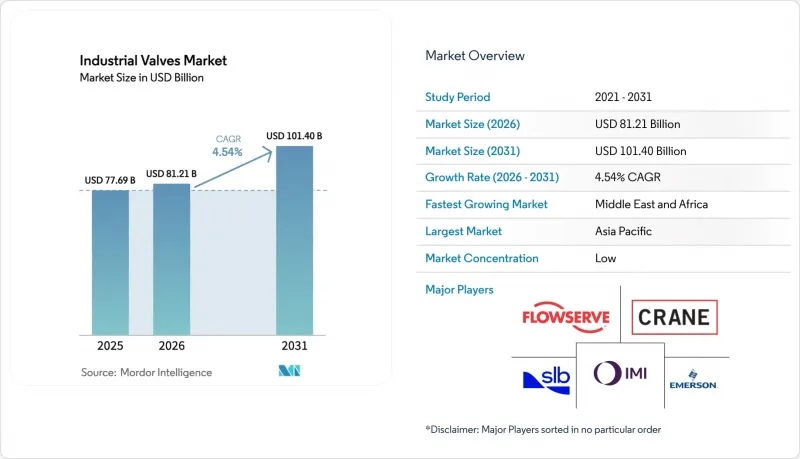
Mordor Intelligence에 따르면 산업용 밸브 시장 규모는 2025년 776억 9,000만 달러에서 2026년에는 812억 1,000만 달러로 확대되어 2031년까지 1,014억 달러에 달할 것으로 예상되며, 2026년부터 2031년까지 CAGR 4.54%로 성장할 것으로 전망됩니다.
본 보고서는 유형별(볼 밸브, 버터플라이 밸브, 게이트 밸브, 기타), 제품별(쿼터턴 밸브, 멀티턴 밸브, 기타), 밸브 기능별(차단 밸브, 조절 밸브, 기타), 본체 재질별(강, 합금계, 기타), 용도(석유·가스, 전력, 기타), 지역(아시아태평양, 북미, 유럽, 남미, 중동 및 아프리카)별로 분류되어 있습니다. 시장 전망은 금액(달러) 기준으로 제시되어 있습니다.
세계 산업용 밸브 시장의 동향 및 인사이트
아시아태평양의 LNG 터미널 건설 확대
싱가포르 에너지시장청은 2024년, 싱가포르 내 두 번째 LNG 터미널 계약을 체결했습니다. 이 계약에는 저장 용량 20만 입방미터, 연간 처리 능력 500만 톤의 부유식 저장·재기화 설비(FSRU)가 지정되어 있으며, 2020년대 말까지 가동을 시작할 예정입니다. 또한, 태국의 연간 750만 톤 처리 능력을 갖춘 논 파브(Non-Fab) 시설과 인도네시아의 연간 380만 톤 처리 능력을 갖춘 탕구 제3 트레인에서는 합쳐서 -162℃에서 사용 가능한 극저온용 볼 밸브와 버터플라이 밸브가 수천 개 필요하게 되었습니다. 니켈 합금의 공급 제약으로 인해 리드타임이 24주로 늘어남에 따라, 자사 주조 공장을 보유한 OEM 업체에게 유리한 상황이 전개되고 있습니다. ASME B16.34 규격에 부합하는 니켈 합금 본체로 사양 변경이 진행되고 있어 평균 판매 가격이 상승하고 있으며, 산업용 밸브 시장에서 통합형 공급업체의 이익률 향상 가능성이 높아지고 있습니다.
GCC 국가들의 해수 담수화 설비 투자 급증
2025년 초에 9억 2,000만 달러 규모의 EPC 계약이 체결된 아랍에미리트의 하시얀 해수 담수화 플랜트는 2027년까지 하루 1억 8,000만 임페리얼 갤런을 생산할 예정이며,2025년 2월 기준으로 공사의 55%가 완료되었습니다. 이 플랜트는 역삼투 기술을 채택하고 있으며, 고염분 농도의 염수 처리를 위해서는 내식성이 뛰어난 듀플렉스강 밸브가 필요합니다. 각 플랜트에서는 고염분 농도의 브라인을 처리하기 위해 2,000-3,000개의 듀플렉스강 게이트 밸브와 버터플라이 밸브가 필요합니다. 현지 주조 공장이 부족한 상황이라, 공익사업자는 유럽 및 북미의 공급업체를 사전 인증하도록 압박받고 있으며, 이로 인해 지역 내 지출 배분이 재검토되고 합작 투자 기회가 생겨나면서, 걸프 연안 지역의 산업용 밸브 시장 전망이 더욱 밝아지고 있습니다.
니켈 합금 주물 공급 부족으로 인한 리드타임 장기화
2020년에 도입되어 2024년과 2025년까지 연장된 인도네시아의 니켈 광석 수출 금지 조치와, 이와 병행하여 시행되고 있는 필리핀의 규제로 인해 전 세계 정제 니켈 생산량의 70%에서 80%가 중국에 집중되어 있으며,니켈 함량이 20%를 초과하는 듀플렉스 및 인코넬 밸브 주물의 공급에 병목 현상이 발생하고 있습니다. 니켈을 사전 구매할 만한 재무 기반이 충분하지 않은 중소 제조업체들은 특수 합금 부문에서 철수하고 있으며, 자체 주조 공장을 운영하거나 수년에 걸친 공급 계약을 체결한 플로우서브(Flow Serve)나 베란(Beran)과 같은 수직 통합형 기업들에게 시장 점유율을 양보하고 있습니다. 이러한 산업 재편 추세는 2027-2028년까지 인도네시아와 필리핀에서 새로운 니켈 제련 설비가 가동될 때까지 지속될 것으로 보입니다.
부문별 분석
볼 밸브는 2025년에 시장 점유율의 40.48%를 차지했습니다. 이는 석유·가스·화학 부문에서 1/4 회전 방식의 간편함과 확실한 차단 성능을 반영한 결과입니다. 한편, 체크 밸브는 2031년까지 연평균 성장률(CAGR) 7.18%로 확대되고 있으며, 이는 밸브 유형 중 가장 높은 성장률입니다. 이러한 성장 가속화는 수소 파이프라인 및 CCS 네트워크에서 역류 방지를 의무화하는 공정 안전 규제에 기인합니다. 이러한 네트워크에서는 역류가 발생하면 치명적인 압력 급상승을 초래할 우려가 있기 때문입니다. 버터플라이 밸브는 대구경·저압의 상수도 및 하수 처리 시스템에 사용되며, 공공 사업에서 게이트 밸브에 비해 비용 면에서 우위를 차지하고 있지만, 중요 구간의 차단 용도에서는 사업자가 볼 밸브를 우선적으로 선택하기 때문에 그 시장 점유율은 안정적입니다.
API 6D 규격의 화재 안전성 및 저배출 관련 요건이 강화됨에 따라, 현재는 볼 밸브 형태가 선호되는 추세입니다. 한편, 듀얼 플레이트식 역류방지밸브는 비상 정지 시 LNG 극저온 펌프를 보호하는 역할을 수행하고 있습니다. 버터플라이 밸브는 상수도 부문에서 중요성을 유지하고 있으며, 게이트 밸브는 고압 증기 용도로 계속 사용되고 있습니다. 플러그 밸브는 슬러리 처리의 틈새 시장을 확보하고 있으며, 이러한 요소들이 산업용 밸브 시장에서 유량 제어형 밸브의 시장 상황을 형성하고 있습니다.
2025년 시점에서 쿼터턴 밸브는 55.18%의 점유율을 차지하고 있으며, 그 우위는 개방에서 폐쇄까지 90도라는 신속한 작동에 기인합니다. 이를 통해 자동화된 배치 공정 및 비상 정지 시스템의 사이클 타임이 단축됩니다. 멀티턴 밸브는 수소 및 CCS 프로젝트에서 1,000바의 하중 하에서 밀봉을 위해 게이트 밸브나 글로브 밸브의 설계가 지정됨에 따라 연평균 성장률(CAGR) 5.81%로 성장할 것으로 예측됩니다.
전동 액추에이터로의 전환은 제품 구성의 경제성을 재편하고 있습니다. 에머슨의 2024년 3분기 실적 설명회에서는 멀티턴 밸브용 전동 액추에이터 장착 수가 전년 동기 대비 12% 증가했다는 점이 강조되었습니다. 이는 석유화학 복합 시설이 계기용 공기 압축기를 제거하고 에너지 소비를 15%에서 20% 절감하기 위해 공압 시스템을 교체하고 있기 때문입니다. ISO 5211 표준을 준수하는 설치의 범용성 덕분에 쿼터턴 밸브는 개조 공사에서 여전히 인기를 끌고 있지만, 반면 멀티턴 방식으로의 업그레이드에서는 맞춤형 키트가 비용 측면에서 복잡성을 가중시키고 있으며, 이것이 산업용 밸브 시장 전체의 제품 선택 동향을 형성하고 있습니다.
지역별 분석
2025년, 아시아태평양은 매출의 40.47%를 차지했으며, 각각 수천 개의 정밀 밸브가 필요한 LNG 터미널과 반도체 팹이 이를 주도했습니다. 중국, 대만, 한국이 팹 수요를 뒷받침하는 한편, 동남아시아에서는 석탄을 대체할 가스 인프라 확충이 진행되고 있습니다.
북미에서는 방대한 설치 기반을 바탕으로 애프터마켓 매출이 높은 수준을 유지하고 있습니다. ‘CHIPS 법’에 따른 390억 달러 규모의 인센티브 조치로 인해 애리조나주, 텍사스주, 오하이오주에서 인텔, 마이크론, 삼성의 팹 건설이 촉진되고 있으며, 엄격한 밸브 청정도 사양을 충족하는 초순수 루프가 도입되고 있습니다.
중동 및 아프리카는 GCC(걸프협력회의) 국가들의 해수 담수화 설비 투자와 사우디아라비아의 석유화학 산업 확대를 배경으로, 2031년까지 연평균 성장률(CAGR) 6.57%를 기록하며 세계에서 가장 빠른 성장이 예상됩니다. 유럽에서는 해상 풍력발전 및 CCS(이산화탄소 포집·저장) 거점이 화석 연료 발전소의 폐지를 일부 상쇄하는 한편, 라틴아메리카에서는 프레스솔트층 및 셰일 프로젝트가 지역의 밸브 수요를 뒷받침하고 있어, 산업용 밸브 시장의 지리적 확장을 엿볼 수 있습니다.
기타 혜택
- 엑셀 형식의 시장 예측(ME) 시트
- 3개월간의 애널리스트 지원
자주 묻는 질문
목차
제1장 소개
제2장 조사 방법
제3장 주요 요약
제4장 시장 구도
제5장 시장 규모와 성장 예측
제6장 경쟁 구도
제7장 시장 기회와 향후 전망
KSM 26.09.03According to Mordor Intelligence, the industrial valves market size is expected to increase from USD 77.69 billion in 2025 to USD 81.21 billion in 2026 and reach USD 101.40 billion by 2031, growing at a CAGR of 4.54% over 2026-2031.
This report is Segmented by Type (Ball, Butterfly, Gate, and More), Product (Quarter-Turn, Multi-Turn, and More), Valve Function (Isolation, Regulation, and More), Body Material (Steel, Alloy-Based, and More), Application (Oil and Gas, Power, and More), and Geography (Asia-Pacific, North America, Europe, South America, and Middle East and Africa). Market Forecasts are Provided in Terms of Value (USD).
Global Industrial Valves Market Trends and Insights
LNG-Terminal Build-Outs Across APAC
Singapore's Energy Market Authority awarded the country's second LNG terminal contract in 2024, specifying a floating storage and regasification unit with 200,000 cubic meters of storage and 5 million tonnes per annum throughput, operational by the end of the decade. Moreover, Thailand's 7.5 million tpa Nong Fab facility and Indonesia's 3.8 million tpa Tangguh Train 3 collectively require thousands of cryogenic ball and butterfly valves rated for -162°C service. Nickel-alloy supply constraints are stretching lead times to 24 weeks, favoring OEMs with captive foundries. Specification drift toward ASME B16.34-qualified nickel-alloy bodies is lifting average selling prices, bolstering margin potential for integrated suppliers in the industrial valves market.
Desalination CAPEX Surge in GCC States
The UAE's Hassyan desalination plant, awarded in early 2025 with a USD 920 million EPC contract, will produce 180 million imperial gallons per day by 2027 and stood 55% complete as of February 2025, employing reverse-osmosis technology that demands corrosion-resistant duplex-steel valves for high-salinity brine handling. Each plant needs 2,000-3,000 duplex-steel gate and butterfly valves to handle high-salinity brine. Local foundry shortages push utilities to pre-qualify European and North American vendors, reallocating regional spend and creating joint-venture openings that enhance Gulf prospects for the industrial valves market.
Nickel-Alloy Casting Shortages Extending Lead Times
Indonesia's 2020 nickel-ore export ban, extended through 2024 and 2025, and the Philippines' parallel restrictions have concentrated 70% to 80% of global refined-nickel output in China, creating a chokepoint for duplex and Inconel valve castings that require nickel content above 20%. Smaller fabricators lacking the balance-sheet strength to pre-purchase nickel are exiting specialty-alloy segments, ceding market share to vertically integrated players such as Flowserve and Velan that operate captive foundries or hold multi-year supply agreements. This consolidation dynamic is likely to persist until new nickel-refining capacity in Indonesia and the Philippines comes online in 2027 to 2028.
Other drivers and restraints analyzed in the detailed report include:
- Predictive-Maintenance-Driven Replacement Cycles in North American Chemicals
- Hydrogen & CCS Mega-Projects Demanding Ultra-High-Pressure Valves
- Stricter Fugitive-Emission Testing Costs for SMEs
For complete list of drivers and restraints, kindly check the Table Of Contents.
Segment Analysis
Ball valves captured 40.48% of market share in 2025, reflecting their quarter-turn simplicity and tight shut-off in oil, gas, and chemical applications, while check valves are expanding at 7.18% CAGR through 2031, the fastest rate among valve types. This acceleration stems from process-safety regulations mandating backflow prevention in hydrogen pipelines and CCS networks, where reverse flow can trigger catastrophic pressure excursions. Butterfly valves serve large-diameter, low-pressure water and wastewater systems, offering cost advantages over gate valves in municipal projects, yet their share remains stable as operators prioritize ball valves for critical isolation duties.
Steeper fire-safe and low-emission revisions to API 6D now favor ball-valve geometries, while dual-plate check valves protect LNG cryogenic pumps during emergency shutdowns. Butterfly valves retain water-sector relevance, and gate valves persist in high-pressure steam service. Plug valves capture slurry niches, rounding out the industrial valves market landscape for flow-control types.
Quarter-turn valves held 55.18% share in 2025, a dominance rooted in their rapid actuation-90 degrees from open to closed-that reduces cycle time in automated batch processes and emergency shutdown systems. Multi-turn valves are projected to grow at a 5.81% CAGR as hydrogen and CCS projects specify gate and globe designs for sealing under 1,000-bar loads.
The shift toward electric actuators is reshaping product-mix economics. Emerson's Q3 2024 earnings call highlighted a 12% year-over-year increase in electric-actuator attachments for multi-turn valves, driven by petrochemical complexes replacing pneumatic systems to eliminate instrument-air compressors and reduce energy consumption by 15% to 20%. ISO 5211 mounting versatility keeps quarter-turn devices popular in retrofit work, while custom kits add cost complexity to multi-turn upgrades, shaping product-choice dynamics across the industrial valves market.
Complete Report Scope:
- By Type
- Ball Valve
- Butterfly Valve
- Gate Valve
- Globe Valve
- Plug Valve
- Other Types
- By Product
- Quarter-Turn Valve
- Multi-Turn Valve
- Other Products
- By Valve Function
- Isolation Valves
- Regulation Valves
- Check and Safety Valves
- By Body Material
- Steel (Carbon and Stainless Steel)
- Alloy-Based (Duplex, Inconel, etc.)
- Cast/Ductile Iron
- Cryogenic Nickel Alloys
- Others
- By Application
- Oil and Gas
- Power
- Water and Wastewater Management
- Chemicals
- New Energy
- Other Applications (Includes Food Processing, Mining, and Marine)
- By Geography
- Asia-Pacific
- China
- India
- Japan
- South Korea
- Indonesia
- Vietnam
- Malaysia
- Thailand
- Rest of Asia-Pacific
- North America
- United States
- Canada
- Mexico
- Europe
- Germany
- United Kingdom
- Italy
- France
- NORDIC Countries
- Turkey
- Russia
- Spain
- Rest of Europe
- South America
- Brazil
- Argentina
- Colombia
- Rest of South America
- Middle East and Africa
- Saudi Arabia
- United Arab Emirates
- Qatar
- Egypt
- Nigeria
- South Africa
- Rest of Middle East and Africa
- Asia-Pacific
Geography Analysis
Asia-Pacific held 40.47% revenue in 2025, led by LNG terminals and semiconductor fabs that each require thousands of precision valves. China, Taiwan, and South Korea underpin fab demand, whereas Southeast Asia scales gas infrastructure to replace coal.
North America generates high aftermarket revenue from its vast installed base. The CHIPS Act's USD 39 billion incentives spurred Intel, Micron, and Samsung fabs in Arizona, Texas, and Ohio, incorporating ultrapure-water loops with stringent valve cleanliness specs.
The Middle East and Africa will post a 6.57% CAGR to 2031, fastest worldwide, on the back of GCC desalination CAPEX and Saudi petrochemical expansions. Europe's offshore wind and CCS hubs partially offset fossil-power retirements, while Latin America's pre-salt and shale projects sustain regional valve demand, illustrating geographic spread in the industrial valves market.
- Alfa Laval
- AVK Holding A/S
- Baker Hughes Company
- Circor International Inc.
- Crane Company
- Curtiss-Wright Corporation
- Danfoss A/S
- Emerson Electric Co.
- Engipro Solutions LLP,
- Flowserve Corporation
- Georg Fischer Ltd.
- Hitachi Ltd
- Honeywell International Inc.
- IMI Critical Engineering (IMI PLC)
- ITT Inc.
- KITZ Corporation
- KLINGER Holding
- Metso
- Mueller Co. LLC
- Nibco Inc.
- Okano Valve Mfg. Co. Ltd.
- SAMSON AKTIENGESELLSCHAFT
- SLB
- Technipfmc PLC
- The Weir Group PLC
- Valvitalia SpA
- Velan
- Xylem
Additional Benefits:
- The market estimate (ME) sheet in Excel format
- 3 months of analyst support
TABLE OF CONTENTS
1 Introduction
- 1.1 Study Assumptions & Market Definition
- 1.2 Scope of the Study
2 Research Methodology
3 Executive Summary
4 Market Landscape
- 4.1 Market Overview
- 4.2 Market Drivers
- 4.2.1 LNG-terminal build-outs across APAC
- 4.2.2 Desalination CAPEX surge in GCC states
- 4.2.3 Predictive-maintenance-driven replacement cycles in NA chemical sector
- 4.2.4 Hydrogen & CCS mega-projects demanding ultra-high-pressure valves
- 4.2.5 Semiconductor-fab ultrapure-valve boom
- 4.3 Market Restraints
- 4.3.1 Nickel-alloy casting shortages extending lead-times
- 4.3.2 Stricter fugitive-emission testing costs for SMEs
- 4.3.3 Rapid shift to electric actuators cannibalising manual-valve demand
- 4.4 Value Chain Analysis
- 4.5 Porter's Five Forces
- 4.5.1 Bargaining Power of Suppliers
- 4.5.2 Bargaining Power of Buyers
- 4.5.3 Threat of New Entrants
- 4.5.4 Threat of Substitutes
- 4.5.5 Degree of Competition
5 Market Size & Growth Forecasts (Value)
- 5.1 By Type
- 5.1.1 Ball Valve
- 5.1.2 Butterfly Valve
- 5.1.3 Gate Valve
- 5.1.4 Globe Valve
- 5.1.5 Plug Valve
- 5.1.6 Other Types
- 5.2 By Product
- 5.2.1 Quarter-Turn Valve
- 5.2.2 Multi-Turn Valve
- 5.2.3 Other Products
- 5.3 By Valve Function
- 5.3.1 Isolation Valves
- 5.3.2 Regulation Valves
- 5.3.3 Check and Safety Valves
- 5.4 By Body Material
- 5.4.1 Steel (Carbon and Stainless Steel)
- 5.4.2 Alloy-Based (Duplex, Inconel, etc.)
- 5.4.3 Cast/Ductile Iron
- 5.4.4 Cryogenic Nickel Alloys
- 5.4.5 Others
- 5.5 By Application
- 5.5.1 Oil and Gas
- 5.5.2 Power
- 5.5.3 Water and Wastewater Management
- 5.5.4 Chemicals
- 5.5.5 New Energy
- 5.5.6 Other Applications (Includes Food Processing, Mining, and Marine)
- 5.6 By Geography
- 5.6.1 Asia-Pacific
- 5.6.1.1 China
- 5.6.1.2 India
- 5.6.1.3 Japan
- 5.6.1.4 South Korea
- 5.6.1.5 Indonesia
- 5.6.1.6 Vietnam
- 5.6.1.7 Malaysia
- 5.6.1.8 Thailand
- 5.6.1.9 Rest of Asia-Pacific
- 5.6.2 North America
- 5.6.2.1 United States
- 5.6.2.2 Canada
- 5.6.2.3 Mexico
- 5.6.3 Europe
- 5.6.3.1 Germany
- 5.6.3.2 United Kingdom
- 5.6.3.3 Italy
- 5.6.3.4 France
- 5.6.3.5 NORDIC Countries
- 5.6.3.6 Turkey
- 5.6.3.7 Russia
- 5.6.3.8 Spain
- 5.6.3.9 Rest of Europe
- 5.6.4 South America
- 5.6.4.1 Brazil
- 5.6.4.2 Argentina
- 5.6.4.3 Colombia
- 5.6.4.4 Rest of South America
- 5.6.5 Middle East and Africa
- 5.6.5.1 Saudi Arabia
- 5.6.5.2 United Arab Emirates
- 5.6.5.3 Qatar
- 5.6.5.4 Egypt
- 5.6.5.5 Nigeria
- 5.6.5.6 South Africa
- 5.6.5.7 Rest of Middle East and Africa
- 5.6.1 Asia-Pacific
6 Competitive Landscape
- 6.1 Market Concentration
- 6.2 Strategic Moves
- 6.3 Market Share(%)/Ranking Analysis
- 6.4 Company Profiles (includes Global level Overview, Market level overview, Core Segments, Financials as available, Strategic Information, Market Rank/Share, Products & Services, Recent Developments)
- 6.4.1 Alfa Laval
- 6.4.2 AVK Holding A/S
- 6.4.3 Baker Hughes Company
- 6.4.4 Circor International Inc.
- 6.4.5 Crane Company
- 6.4.6 Curtiss-Wright Corporation
- 6.4.7 Danfoss A/S
- 6.4.8 Emerson Electric Co.
- 6.4.9 Engipro Solutions LLP,
- 6.4.10 Flowserve Corporation
- 6.4.11 Georg Fischer Ltd.
- 6.4.12 Hitachi Ltd
- 6.4.13 Honeywell International Inc.
- 6.4.14 IMI Critical Engineering (IMI PLC)
- 6.4.15 ITT Inc.
- 6.4.16 KITZ Corporation
- 6.4.17 KLINGER Holding
- 6.4.18 Metso
- 6.4.19 Mueller Co. LLC
- 6.4.20 Nibco Inc.
- 6.4.21 Okano Valve Mfg. Co. Ltd.
- 6.4.22 SAMSON AKTIENGESELLSCHAFT
- 6.4.23 SLB
- 6.4.24 Technipfmc PLC
- 6.4.25 The Weir Group PLC
- 6.4.26 Valvitalia SpA
- 6.4.27 Velan
- 6.4.28 Xylem
7 Market Opportunities & Future Outlook
- 7.1 White-Space & Unmet-Need Assessment
- 7.2 Increasing in demand from food processing industries