
|
시장보고서
상품코드
2121381
GaN 반도체 디바이스 : 시장 점유율 분석, 업계 동향과 통계, 성장 예측(2026-2031년)GaN Semiconductor Devices - Market Share Analysis, Industry Trends & Statistics, Growth Forecasts (2026 - 2031) |
||||||
 Mordor Intelligence
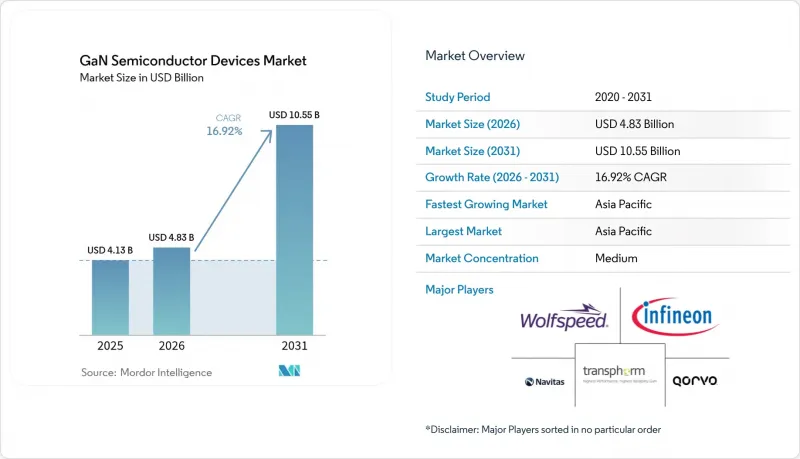
Mordor Intelligence에 따르면 2026년 GaN 반도체 디바이스 시장 규모는 48억 3,000만 달러로 추정되고 있으며, 2025년 41억 3,000만 달러에서 확대하며, 2031년에는 105억 5,000만 달러에 달할 것으로 예측됩니다.
2026-2031년까지 연평균 성장률(CAGR) 16.92%로 성장할 것으로 전망됩니다.
이 보고서는 소자 유형별(파워 반도체 등), 구성 요소(트랜지스터 등), 정격전압(100V 미만 등), 웨이퍼 크기(2인치 등), 기판 기술(GaN-On-SiC 등),패키징(표면 실장 등), 최종사용자 산업(자동차·모빌리티 등), 지역(북미, 남미, 유럽, 아시아태평양, 중동 및 아프리카)별로 분류되어 있습니다.
전 세계 GaN 반도체 디바이스 시장의 동향 및 인사이트
중국 OEM 업체들의 로드맵에 힘입어 65-240W USB-C PD 지원 GaN 충전기가 보급됨
중국의 가전 브랜드들이 초소형 USB PD(유니버설 시리얼 버스 파워 딜리버리) 충전기로의 급속한 전환을 주도했습니다. 2024년에 출시된 모델은 최대 240W의 출력을 실현하면서도 실리콘 제품 대비 부피를 40% 줄이고 소매 가격을 35% 낮췄습니다. Anker사의 ‘GaN Prime’ 시리즈는 1.8 W/cm³를 넘는 전력 밀도를 실현하여, 주머니에 들어갈 만한 크기의 케이스 안에서 노트북이나 스마트폰에 대한 멀티 프로토콜 충전을 가능하게 했습니다. 비용 절감을 통해 아시아태평양 및 북미 전역에서 주류 제품으로의 보급이 촉진되었으며, 그 판매량 증가가 GaN 반도체 디바이스 시장 전체로 파급되고 있습니다.
아시아 및 인도에서의 5G Massive-MIMO 매크로 셀 구축에는 200W를 초과하는 GaN-on-SiC PA가 필요
중국, 인도, 일본의 모바일 네트워크 사업자들은 2024년에 3.5GHz 이상의 GaN-on-SiC 파워 앰프를 채택한 매크로 기지국 15,000기 이상을 도입했습니다. 이러한 전환으로 전력 소비가 25% 감소하고 통신 범위가 18% 확대되었으며, 일본의 한 대형 통신 사업자의 경우 연간 1,800만 달러의 운영비 절감 효과를 거두었습니다. 이러한 경제적 효과는 GaN PA의 채택을 확고히 하고, GaN 반도체 소자 시장 전체의 잠재적 수익을 확대하고 있습니다.
200mm GaN-on-Si 에피택셜 웨이퍼의 제한된 공급망내 병목 현상
2024년 시점에 200mm GaN 에피택셜 웨이퍼를 제조하는 인증 공급업체는 10개 미만이었습니다. 수율은 실리콘 벤치마크보다 15-20% 낮아, 이로 인해 생산량이 제한되고 높은 가격대가 유지되고 있습니다. 한 유럽의 1차 자동차 부품 공급업체에서는 6개월간의 생산 지연이 발생하여 2,800만 유로(3,020만 달러) 상당의 전략적 재고 완충을 마련할 수밖에 없었습니다. 이러한 병목 현상은 GaN 반도체 소자 시장의 단기 공급량에 큰 부담을 주고 있습니다.
부문 분석
GaN 반도체 소자 시장의 파워 반도체 부문은 2025년에 54.78%의 점유율을 차지하며, 2031년까지 연평균 성장률(CAGR) 18.41%로 확대될 것으로 전망됩니다. 데이터센터 사업자들은 효율 98.2%에 달하는 GaN 서버용 전원 공급 장치로 업그레이드함으로써 시설당 230만 달러의 비용 절감을 실현했습니다. 5G 매시브 MIMO 인프라 및 방위용 레이더에 의한 견고한 수요에 힘입어 RF 소자 시장도 이에 뒤를 이었습니다. 시장의 성숙에 따라 전략적 분기점이 나타났습니다. 인피니온(Infineon)과 같은 실리콘 계열 기존 기업은 자동차 등급 GaN MOSFET 제품 라인을 확대한 반면, 울프스피드(Wolfspeed)와 같은 RF 전문 기업은 3.5GHz를 초과하는 매크로 셀을 위해 GaN-on-SiC의 열적 여유를 활용했습니다. 집적형 파워 스테이지 공급 기업은 디스크리트 제품 판매에 그치지 않고 더 높은 이익률을 달성했습니다. 따라서 GaN 반도체 소자 시장에서는 업계 재편과 수직 통합이 모두 진행되며 규모의 경제가 강화되고 있습니다.
2025년에는 고전자이동도 트랜지스터(HEMT)가 매출의 56.63%를 차지했으나, 모놀리식 파워 IC는 연평균 성장률(CAGR) 29.55%를 기록하며 다른 모든 카테고리를 앞질렀습니다. 한 중국 스마트폰 OEM(Original Equipment Manufacturer)는 디스크리트 스위치를 단일 GaN IC로 대체함으로써 충전기의 BOM(부품표) 비용을 18% 절감하고, 부품 수를 45% 줄여 생산량 확대를 가속화했습니다. 집적화를 통해 전자기 호환성이 향상되고 기생 성분이 감소합니다. 이러한 이점으로 인해 GaN 반도체 소자 시장은 시스템 인 패키지(SiP) 설계로 전환되고 있습니다. 모듈 공급업체들은 고출력 용도에 대응하고 있는 한편, 다이오드 판매는 보조 정류 용도에서 견고한 추세를 보이고 있습니다.
100-650V 전압 대역은 소비자용, 데이터센터, 48V 산업용 전원 레일에 대응하고 있으며, 2025년에도 69.72%의 점유율을 유지했습니다. 반면, 650V를 초과하는 대역은 800V 구동 아키텍처에 힘입어 연평균 성장률(CAGR) 39.67%로 급성장하고 있습니다. 한 고급 전기자동차 브랜드는 900V GaN 스테이지를 채택함으로써 10-80% 충전 시간을 28분으로 단축하고, SiC에 비해 충전기의 무게를 3.2kg 줄였습니다. 이러한 전환으로 인해 새로운 절연 및 시험 규격이 요구되고 있으며, 이는 순수 반도체 공급업체에게 과제가 되고 있습니다. 그럼에도 불구하고 GaN 반도체 디바이스 시장에서는 650V를 초과하는 신뢰성을 입증할 수 있는 기업에 보상이 주어지며, 수익성이 높은 자동차 분야의 가치 창출 기회를 개발할 수 있게 됩니다.
지역별 분석
아시아태평양은 2025년 매출의 37.85%를 차지하며, 연평균 성장률(CAGR) 28.35%로 가장 빠른 성장을 기록했습니다. 중국의 갈륨 조달 가능성과 정부 보조금 덕분에 Innoscience는 경쟁사보다 35% 낮은 비용으로 세계 최대 규모의 8인치 GaN-on-Si 공장을 운영할 수 있었습니다. 한국의 주요 가전 기업과 일본의 주요 자동차 기업은 대량 주문을 하는 주요 고객이 되어 수요와 생산 능력의 성장이라는 선순환을 지원했습니다. 북미는 계속해서 혁신의 온상이었습니다. 연방 정부의 CHIPS 보조금 3,500만 달러 덕분에 글로벌파운드리(GlobalFoundries)는 버몬트주에서 GaN 생산 능력을 확대할 수 있었습니다. 방위 관련 기업은 GaN 기반 위상 배열 레이더를 도입하여 탐지 범위를 42% 확대하는 동시에 전력 소비를 18% 절감했습니다. 이는 GaN 반도체 소자 시장에도 파급 효과를 미칠, 임무 수행에 필수적인 성과를 보여줍니다. 유럽에서는 고급 자동차 및 산업용 사례를 우선시했습니다. 캠브리지 GaN 디바이스(Cambridge GaN Devices)는 사업 확장을 위해 3,050만 유로(3,310만 달러)를 조달했는데, 이는 유럽의 고출력 틈새 시장에 대한 투자자들의 신뢰를 반영한 것입니다. 독일의 한 대형 OEM 기업은 충전기 효율 97.8%를 달성하고 부품 수를 30% 줄이는 데 성공하여 EU의 에코디자인 지침을 준수했습니다. 라틴아메리카, 중동 및 아프리카는 현재 시장 점유율이 작지만, 에너지 가격과 인프라 구축이 맞물려 통신 및 스마트 시티 프로젝트 분야에서 유망한 확산 조짐을 보이고 있습니다.
기타 혜택:
- 엑셀 형식의 시장 예측(ME) 시트
- 3개월간의 애널리스트 지원
자주 묻는 질문
목차
제1장 서론
제2장 조사 방법
제3장 개요
제4장 시장 구도
제5장 시장 규모와 성장 예측
제6장 경쟁 구도
제7장 시장 기회와 향후 전망
KSA 26.09.04According to Mordor Intelligence, the gallium nitride semiconductor devices market size in 2026 is estimated at USD 4.83 billion, growing from 2025 value of USD 4.13 billion with 2031 projections showing USD 10.55 billion, growing at 16.92% CAGR over 2026-2031.
This report is Segmented by Device Type (Power Semiconductors, and More), Component (Transistors, and More), Voltage Rating (<100 V, and More), Wafer Size (2-Inch, and More), Substrate Technology (GaN-On-SiC, and More), Packaging (Surface-Mount, and More), End-User Industry (Automotive and Mobility, and More), and Geography (North America, South America, Europe, Asia-Pacific, and Middle East and Africa).
Global GaN Semiconductor Devices Market Trends and Insights
Proliferation of 65-240 W USB-C PD GaN Chargers Led by Chinese OEM Road-maps
Chinese consumer-electronics brands propelled a rapid shift toward ultra-compact universal serial bus power-delivery chargers. Models released in 2024 delivered up to 240 W while shrinking volume by 40% relative to silicon equivalents and lowering retail prices by 35%. Anker's GaN Prime line exceeded 1.8 W/cm3 power density, enabling multiprotocol charging for laptops and phones within pocket-sized enclosures. Cost-downs stimulated mainstream uptake across Asia-Pacific and North America, lifting unit volumes that ripple across the gallium nitride semiconductor devices market.
5G Massive-MIMO Macro-Cell Roll-outs Requiring >200 W GaN-on-SiC PAs in Asia and India
Mobile network operators in China, India, and Japan deployed more than 15,000 macro base stations in 2024 using GaN-on-SiC power amplifiers above 3.5 GHz. The switch trimmed power consumption by 25% and stretched coverage by 18%, translating into USD 18 million annual operating expense savings for one leading Japanese carrier. Such economics cement GaN PA design wins and expand addressable revenue across the gallium nitride semiconductor devices market.
Limited 200 mm GaN-on-Si Epi Wafer Supply Chain Bottlenecks
Fewer than 10 qualified suppliers produced 200 mm GaN epitaxial wafers in 2024. Yields sat 15-20% below silicon benchmarks, constraining throughput and sustaining premium pricing. A European Tier-1 automotive supplier recorded a six-month production delay that forced strategic inventory buffers worth EUR 28 million (USD 30.2 million). Bottlenecks weigh on near-term volumes within the gallium nitride semiconductor devices market.
Other drivers and restraints analyzed in the detailed report include:
- Shift to 800 V EV Platforms Driving Bidirectional GaN OBC and DC-DC Adoption
- Weight-Critical More-Electric Aircraft and eVTOL Powertrains Selecting GaN Converters
- Gate Reliability Challenges >175 °C for Automotive Grade-0 Qualification
For complete list of drivers and restraints, kindly check the Table Of Contents.
Segment Analysis
The power-semiconductor slice of the gallium nitride semiconductor devices market held 54.78% share in 2025 and is projected to compound at 18.41% to 2031. Data-center operators saved USD 2.3 million per facility by upgrading to GaN server power supplies that reached 98.2% efficiency. RF devices followed as 5G massive-MIMO infrastructure and defense radar sustained premium demand. Maturity signaled a strategic fork. Silicon incumbents such as Infineon expanded automotive-grade GaN MOSFET lines, while RF specialists like Wolfspeed leveraged GaN-on-SiC thermal headroom for>3.5 GHz macro cells. Integrated power-stage providers captured a higher margin by moving beyond discrete sales. The gallium nitride semiconductor devices market, therefore, experiences both consolidation and vertical integration, reinforcing scale advantages.
High-electron-mobility transistors occupied 56.63% revenue in 2025, yet monolithic power ICs outpaced all other categories at 29.55% CAGR. A Chinese smartphone OEM cut the charger bill-of-materials by 18% by replacing discrete switches with a single GaN IC, shrinking part count by 45% and catalyzing volume ramps. Integration improves electromagnetic compatibility and trims parasitics, benefits that explain why the gallium nitride semiconductor devices market is tilting toward system-in-package designs. Module suppliers address high-power installations, while diode sales remain steady in auxiliary rectification roles.
The 100-650 V corridor kept a 69.72% share in 2025 as it aligns with consumer, data-center, and 48 V industrial rails. Meanwhile, the >650 V band races ahead at 39.67% CAGR, fueled by 800 V propulsion architectures. One premium EV brand slashed 10-80% charge time to 28 minutes using 900 V GaN stages and cut charger mass by 3.2 kg versus SiC. This transition prompts new isolation and test standards, challenging pure-play suppliers. Nevertheless, the gallium nitride semiconductor devices market rewards those able to validate reliability beyond 650 V, unlocking lucrative automotive value pools.
Complete Report Scope:
- By Device Type
- Power Semiconductors
- RF Semiconductors
- Opto-Semiconductors
- By Component
- Transistors (HEMT/FET)
- Diodes (Schottky, PiN)
- Rectifiers
- Power ICs (Monolithic, Multi-chip)
- Modules (Half-bridge, Full-bridge)
- By Voltage Rating
- < 100 V
- 100 - 650 V
- > 650 V
- By Wafer Size
- 2-inch
- 4-inch
- 6-inch and Above (incl. 8-inch Pilot)
- By Substrate Technology
- GaN-on-SiC
- GaN-on-Si
- GaN-on-Sapphire
- Bulk GaN
- 650 - 1200 V
- > 1200 V
- By Packaging
- Surface-Mount (QFN, DFN)
- Through-Hole (TO-220, TO-247)
- Chip-Scale Package (CSP)
- Bare Die
- By End-User Industry
- Automotive and Mobility
- Electric Vehicles
- Charging Infrastructure
- Consumer Electronics
- Smartphone Fast Chargers
- Laptop and Tablet Chargers
- Gaming Consoles and VR
- Telecom and Datacom
- 5G Base Stations
- Data Center Power
- Industrial and Energy
- Solar Inverters
- Motor Drives
- Power Supply Units (SMPS)
- Aerospace and Defense
- Radar Systems
- Electronic Warfare
- Satellite Payloads
- Medical
- MRI and CT
- Portable Medical Devices
- Automotive and Mobility
- By Geography
- North America
- United States
- Canada
- Mexico
- South America
- Brazil
- Argentina
- Rest of South America
- Europe
- Germany
- United Kingdom
- France
- Italy
- Spain
- Rest of Europe
- Asia-Pacific
- China
- Japan
- South Korea
- India
- Taiwan
- Rest of Asia-Pacific
- Middle East and Africa
- Middle East
- Saudi Arabia
- United Arab Emirates
- Turkey
- Rest of Middle East
- Africa
- South Africa
- Rest of Africa
- Middle East
- North America
Geography Analysis
Asia-Pacific commanded 37.85% of 2025 sales and remained the fastest riser at 28.35% CAGR. China's access to gallium, plus state subsidies, allowed Innoscience to operate the world's largest 8-inch GaN-on-Si plant at costs 35% below peers. South Korea's consumer-electronics titans and Japan's automotive majors seeded high-volume anchor customers, sustaining a virtuous cycle of demand and capacity growth. North America stayed an innovation hotbed. Federal CHIPS grants of USD 35 million helped GlobalFoundries broaden GaN capacity in Vermont. Defense contractors deployed GaN-based phased-array radars that boosted detection range by 42% while trimming power by 18%, showcasing mission-critical gains that flow into the gallium nitride semiconductor devices market. Europe prioritized premium automotive and industrial use cases. Cambridge GaN Devices raised EUR 30.5 million (USD 33.1 million) for expansion, reflecting investor belief in high-power European niches. A leading German OEM realized 97.8% charger efficiency and 30% component reduction, aligning with EU eco-design directives. Latin America, the Middle East, and Africa presently hold modest shares yet demonstrate promising uptake in telecom and smart-city projects as energy prices and infrastructure buildouts converge.
- Efficient Power Conversion Corporation
- Navitas Semiconductor
- Transphorm Inc.
- Innoscience Technology Co., Ltd.
- MACOM Technology Solutions Holdings, Inc.
- Tagore Technology Inc.
- VisIC Technologies Ltd.
- Cambridge GaN Devices Ltd.
- NexGen Power Systems, Inc.
- Qromis, Inc.
- EPC Space LLC
- Analog Devices, Inc.
- Power Integrations, Inc.
- Ommic SAS
- Wolfspeed GaN Solutions
- Ampleon Netherlands B.V.
- Integra Technologies, Inc.
- RFHIC Corporation
- Sumitomo Electric Device Innovations Inc.
- Infineon Technologies AG
- STMicroelectronics N.V.
- Qorvo Inc.
Additional Benefits:
- The market estimate (ME) sheet in Excel format
- 3 months of analyst support
TABLE OF CONTENTS
1 INTRODUCTION
- 1.1 Study Assumptions and Market Definition
- 1.2 Scope of the Study
2 RESEARCH METHODOLOGY
3 EXECUTIVE SUMMARY
4 MARKET LANDSCAPE
- 4.1 Market Overview
- 4.2 Market Drivers
- 4.2.1 Proliferation of 65-240 W USB-C PD GaN Chargers Led by Chinese OEM Road-maps
- 4.2.2 5G Massive-MIMO Macro-Cell Roll-outs Requiring >200 W GaN-on-SiC PAs in Asia and India
- 4.2.3 Shift to 800 V EV Platforms Driving Bidirectional GaN OBC and DC-DC Adoption
- 4.2.4 Weight-Critical More-Electric Aircraft and eVTOL Powertrains Selecting GaN Converters
- 4.2.5 LEO Constellation Satellites Migrating to GaN Ku/Ka-Band SSPAs
- 4.2.6 Japanese and EU Fab Incentives Accelerating GaN Capacity Expansion
- 4.3 Market Restraints
- 4.3.1 Limited 200 mm GaN-on-Si Epi Wafer Supply Chain Bottlenecks
- 4.3.2 Gate Reliability Challenges >175 °C for Automotive Grade-0 Qualification
- 4.3.3 Cost Delta vs. LDMOS in Sub-3.5 GHz Macro PAs in Emerging Markets
- 4.3.4 Fragmented Test/Packaging Ecosystem for E-mode GaN QFN/CSP Packages
- 4.4 Value Chain Analysis
- 4.5 Regulatory and Technological Outlook
- 4.6 Porter's Five Forces Analysis
- 4.6.1 Bargaining Power of Suppliers
- 4.6.2 Bargaining Power of Buyers
- 4.6.3 Threat of New Entrants
- 4.6.4 Threat of Substitutes
- 4.6.5 Intensity of Competitive Rivalry
- 4.7 Impact of Macroeconomic Factors on the market
5 MARKET SIZE AND GROWTH FORECASTS (VALUE)
- 5.1 By Device Type
- 5.1.1 Power Semiconductors
- 5.1.2 RF Semiconductors
- 5.1.3 Opto-Semiconductors
- 5.2 By Component
- 5.2.1 Transistors (HEMT/FET)
- 5.2.2 Diodes (Schottky, PiN)
- 5.2.3 Rectifiers
- 5.2.4 Power ICs (Monolithic, Multi-chip)
- 5.2.5 Modules (Half-bridge, Full-bridge)
- 5.3 By Voltage Rating
- 5.3.1 < 100 V
- 5.3.2 100 - 650 V
- 5.3.3 > 650 V
- 5.4 By Wafer Size
- 5.4.1 2-inch
- 5.4.2 4-inch
- 5.4.3 6-inch and Above (incl. 8-inch Pilot)
- 5.5 By Substrate Technology
- 5.5.1 GaN-on-SiC
- 5.5.2 GaN-on-Si
- 5.5.3 GaN-on-Sapphire
- 5.5.4 Bulk GaN
- 5.5.5 650 - 1200 V
- 5.5.6 > 1200 V
- 5.6 By Packaging
- 5.6.1 Surface-Mount (QFN, DFN)
- 5.6.2 Through-Hole (TO-220, TO-247)
- 5.6.3 Chip-Scale Package (CSP)
- 5.6.4 Bare Die
- 5.7 By End-User Industry
- 5.7.1 Automotive and Mobility
- 5.7.1.1 Electric Vehicles
- 5.7.1.2 Charging Infrastructure
- 5.7.2 Consumer Electronics
- 5.7.2.1 Smartphone Fast Chargers
- 5.7.2.2 Laptop and Tablet Chargers
- 5.7.2.3 Gaming Consoles and VR
- 5.7.3 Telecom and Datacom
- 5.7.3.1 5G Base Stations
- 5.7.3.2 Data Center Power
- 5.7.4 Industrial and Energy
- 5.7.4.1 Solar Inverters
- 5.7.4.2 Motor Drives
- 5.7.4.3 Power Supply Units (SMPS)
- 5.7.5 Aerospace and Defense
- 5.7.5.1 Radar Systems
- 5.7.5.2 Electronic Warfare
- 5.7.5.3 Satellite Payloads
- 5.7.6 Medical
- 5.7.6.1 MRI and CT
- 5.7.6.2 Portable Medical Devices
- 5.7.1 Automotive and Mobility
- 5.8 By Geography
- 5.8.1 North America
- 5.8.1.1 United States
- 5.8.1.2 Canada
- 5.8.1.3 Mexico
- 5.8.2 South America
- 5.8.2.1 Brazil
- 5.8.2.2 Argentina
- 5.8.2.3 Rest of South America
- 5.8.3 Europe
- 5.8.3.1 Germany
- 5.8.3.2 United Kingdom
- 5.8.3.3 France
- 5.8.3.4 Italy
- 5.8.3.5 Spain
- 5.8.3.6 Rest of Europe
- 5.8.4 Asia-Pacific
- 5.8.4.1 China
- 5.8.4.2 Japan
- 5.8.4.3 South Korea
- 5.8.4.4 India
- 5.8.4.5 Taiwan
- 5.8.4.6 Rest of Asia-Pacific
- 5.8.5 Middle East and Africa
- 5.8.5.1 Middle East
- 5.8.5.1.1 Saudi Arabia
- 5.8.5.1.2 United Arab Emirates
- 5.8.5.1.3 Turkey
- 5.8.5.1.4 Rest of Middle East
- 5.8.5.2 Africa
- 5.8.5.2.1 South Africa
- 5.8.5.2.2 Rest of Africa
- 5.8.5.1 Middle East
- 5.8.1 North America
6 COMPETITIVE LANDSCAPE
- 6.1 Market Concentration
- 6.2 Strategic Moves
- 6.3 Market Share Analysis
- 6.4 Company Profiles (includes Global level Overview, Market level overview, Core Segments, Financials as available, Strategic Information, Market Rank/Share for key companies, Products and Services, Recent Developments)
- 6.4.1 Efficient Power Conversion Corporation
- 6.4.2 Navitas Semiconductor
- 6.4.3 Transphorm Inc.
- 6.4.4 Innoscience Technology Co., Ltd.
- 6.4.5 MACOM Technology Solutions Holdings, Inc.
- 6.4.6 Tagore Technology Inc.
- 6.4.7 VisIC Technologies Ltd.
- 6.4.8 Cambridge GaN Devices Ltd.
- 6.4.9 NexGen Power Systems, Inc.
- 6.4.10 Qromis, Inc.
- 6.4.11 EPC Space LLC
- 6.4.12 Analog Devices, Inc.
- 6.4.13 Power Integrations, Inc.
- 6.4.14 Ommic SAS
- 6.4.15 Wolfspeed GaN Solutions
- 6.4.16 Ampleon Netherlands B.V.
- 6.4.17 Integra Technologies, Inc.
- 6.4.18 RFHIC Corporation
- 6.4.19 Sumitomo Electric Device Innovations Inc.
- 6.4.20 Infineon Technologies AG
- 6.4.21 STMicroelectronics N.V.
- 6.4.22 Qorvo Inc.
7 MARKET OPPORTUNITIES AND FUTURE OUTLOOK
- 7.1 White-Space and Unmet-Need Assessment