

|
시장보고서
상품코드
2121632
중동의 윤활유 : 시장 점유율 분석, 업계 동향과 통계, 성장 예측(2026-2031년)Middle East Lubricants - Market Share Analysis, Industry Trends & Statistics, Growth Forecasts (2026 - 2031) |
||||||
 Mordor Intelligence
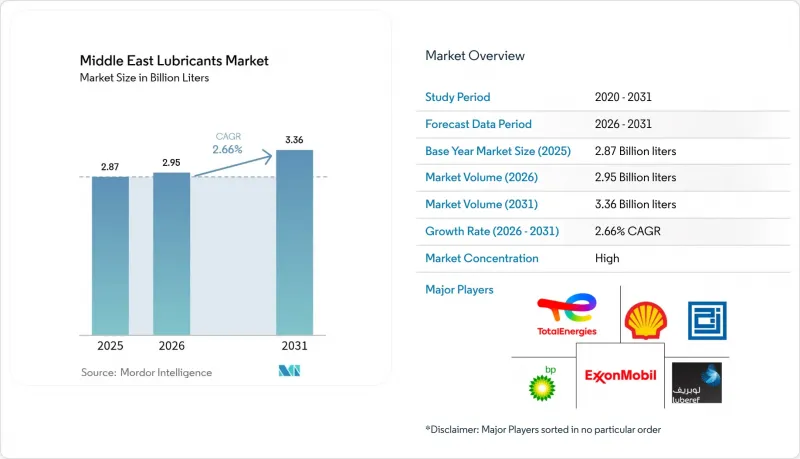
Mordor Intelligence에 의하면, 중동의 윤활유 시장 규모는 2025년에 28억 7,000만 리터로 평가되어 2026년 29억 5,000만 리터에서 2031년까지 33억 6,000만 리터에 이를 것으로 예측되며, 예측 기간(2026-2031년) CAGR은 2.66%를 기록할 전망입니다.
본 보고서는 그룹(그룹 I, 그룹 II, 그룹 III, 기타), 기유(바이오, 광물유, 합성, 반합성), 제품 유형(엔진 오일, 변속기 및 유압작동유, 금속 가공유 등), 최종 사용자 산업(발전, 자동차 및 기타 운송 장비, 중장비 등), 지역(사우디아라비아, 아랍에미리트, 이란 등)별로 분류되어 있습니다.
중동의 윤활유 시장 동향 및 인사이트
GCC 지역의 석유화학 및 제조 거점에서의 산업 확대
새로운 석유화학 단지, 금속 공장 및 하류 가공 업체의 등장으로 인해 압축기 오일, 열매체, 금속 가공용 윤활유에 대한 지역적 수요가 증가하고 있습니다. 110억 달러 규모의 ‘아미랄(Amiral)’ 프로젝트는 2024년에 가동을 시작하며, 배기 온도 200°C를 견딜 수 있는 합성 공정 오일이 필요한 165만 톤 규모의 에틸렌 크래커를 갖추고 있습니다. SABIC 주바이르 및 카타르의 라스 라판에서의 설비 확충도 이와 유사한 요구 사항을 확대시키고 있습니다. 통합형 생산자는 일반적으로 그룹 II 또는 그룹 III 기유를 지정합니다. 이는 점도 지수와 산화 안정성이 높을수록 예기치 못한 가동 중단을 줄일 수 있기 때문입니다. 이는 처리 능력이 높은 폴리머 자산에서 매우 중요한 지표가 됩니다. 또한, 산업 집적도가 높기 때문에 라스트 마일 물류 비용도 절감되어 유통업체은 벤더 관리 재고(VMI)를 도입할 수 있게 됩니다. 이를 통해 공장의 윤활유 보관실을 간소화하면서도 가동 시간을 확보할 수 있습니다. 이러한 선순환이 중동의 윤활유 시장 전체에서 프리미엄 등급 제품의 판매량이 지속적으로 증가하는 데 기여하고 있습니다.
자동차 보유 대수 증가와 애프터마켓 수요의 급증
소득 증가가 자동차 보유율을 끌어올리고, 전자상거래가 라스트 마일 트럭 운송을 가속화함에 따라 소형차의 신규 등록 대수는 계속 증가하고 있습니다. 사우디아라비아의 자동차 보유 대수는 2024년에 800만 대를 돌파할 전망이며, NEOM, 딜리야 및 기타 메가 프로젝트를 지원하기 위해 상용차 부문은 두 자릿수 성장률을 기록하며 확대되고 있습니다. UAE의 재수출 허브로서의 지위는 GCC 횡단 회랑에서 높은 연간 주행 거리를 기록하는 대형 트럭을 유치하여, API CK-4 및 저SAPs Euro VI 기준을 충족하는 고TBN 엔진 오일 수요를 견인하고 있습니다. 합성유 배합으로 오일 교환 주기는 75,000마일까지 연장되었지만, 단가 상승과 첨가제 사용량 증가로 인해 차량당 윤활유 비용은 실제로 증가하고 있습니다. API SN PLUS 및 ILSAC GF-6 등급에 대한 OEM의 보증 요건으로 인해 프리미엄 시장이 확대되고 있으며, 이는 중동의 윤활유 시장에서 교체량이 정체되어 있음에도 불구하고 이익률 유지에 기여하고 있습니다.
원유 가격 변동에 연동되는 기유 가격 변동
브렌트 원유 가격이 한 분기 내에 빈번하게 변동하기 때문에 Luberef와 같은 정유사는 그룹 I 및 그룹 II 연료의 공시 가격을 매월 조정할 수밖에 없습니다. 한편, 독립 블렌더는 배합 비용의 최대 75%를 기유가 차지하기 때문에 이익률 압박에 직면하고 있습니다. 게다가 고정된 서비스 패키지 메뉴를 제공하는 시장에서는 유연한 소매 가격 책정이 어려워지고 있습니다. 따라서 원유 가격이 상승하면 매출 총이익이 압박을 받게 되어 재고 관리의 엄격화나 헤지 전략이 필요해지며, 그 결과 자금 조달 비용이 증가합니다. 반대로 원유 가격이 급락하면 유통업체는 재고 가격을 인하할 수밖에 없어 평가 손실이 발생합니다. 이러한 가격 변동은 계획 수립에 불확실성을 야기하고, 생산 능력의 병목 현상 해소를 위한 설비 투자(CAPEX) 감축으로 이어져 중동의 윤활유 시장의 단기적 성장을 억제하고 있습니다.
부문별 분석
2025년, 그룹 I은 중동의 윤활유 시장 점유율의 46.62%를 차지했습니다. 이는 많은 산업용 구매자들이 스플래시 윤활식 컨베이어, 피스톤식 공기 압축기, 그리고 중간 수준의 열 부하에서 작동하는 발전기에서 여전히 그룹 I의 저렴한 비용을 선호하기 때문입니다. 이 부문의 도입 실적은 수십 년에 걸친 기존 정제 기술과 공급의 지속성을 보장하는 확립된 첨가제 배합에서 비롯된 것입니다. 그러나 2025년에 발표된 OEM 기술 지침에서는 신형 왕복동 압축기 모델에 그룹 II를 권장하고, 50°C의 환경 온도가 지속되는 조건에서 작동하는 터보차저 장착 및 충전 냉각식 엔진에는 그룹 III의 사용을 의무화하고 있어,이로 인해 최종 사용자는 더 고품질의 기유로 전환하도록 권장받고 있습니다.
성능 면에서의 장점은 설득력이 있습니다. 그룹 III 윤활유는 그룹 I에 비해 휘발성이 30% 낮고 점도 지수가 20% 높기 때문에 산화 수명이 연장되고 보충 빈도가 감소합니다. 사우디 아람코의 ‘Luberef Phase II’ 개조 계획에서는 이러한 전환을 구체적으로 염두에 둔 그룹 II 제품 라인이 추가되었습니다. 리야드와 제다 등지의 유통업체에서는 진화하는 SAE XW-30의 점도 요건을 충족하기 위해 이미 그룹 II를 40-60% 배합한 멀티그레이드 윤활유의 블렌딩이 이루어지고 있습니다. 단가는 상승하고 있지만, 차량군이 500시간의 오일 교환 주기를 채택함으로써 총 소유 비용이 낮아져 중동의 윤활유 시장에서의 도입이 가속화되고 있습니다.
광물유는 여전히 총 소비량의 69.58%를 차지하고 있으며, 이는 지역 내 풍부한 정제 능력, 비용 면에서의 우위, 그리고 광범위한 첨가제와의 호환성에 힘입은 것입니다. 그러나 주요 물류 사업자와 석유화학 제조업체가 서명한 지속가능성 헌장에서는 2030년까지 수명 주기 내 이산화탄소 배출량을 30% 감축하겠다고 약속하고 있습니다. 그 결과, 바이오 윤활유(주로 식물성 에스테르계 작동유 및 생분해성 금속 성형액)가 주목을 받으며 시장 전체를 상회하는 연평균 성장률(CAGR) 3.12%로 성장을 지속하고, 있습니다.
바이오 에스테르는 28일 이내에 90% 이상의 생분해성을 발휘하고, 뛰어난 경계 윤활성을 나타내므로 알루미늄 프레스 가공 라인에서 공구의 마모를 15% 저감합니다. 하지만 산화 안정성에는 한계가 있어 산화 방지제를 첨가해야 하므로 배합 비용이 증가합니다. 광물성 캐리어 오일에 20-30%의 바이오 성분을 배합한 반합성 블렌드는 ISO 11158의 성능을 유지하면서 환경에 미치는 부담을 줄이는 실용적인 타협점이 되고 있습니다. 이러한 혁신으로 인해 광물성 제품의 우위는 점차 약화되고 있으며, 중동의 윤활유 시장의 제품 라인업은 확대되는 추세를 보이고 있습니다.
기타 혜택:
- 엑셀 형식 시장 예측(ME) 시트
- 3개월간의 애널리스트 지원
자주 묻는 질문
목차
제1장 서론
제2장 조사 방법
제3장 주요 요약
제4장 시장 구도
제5장 시장 규모와 성장 예측
제6장 경쟁 구도
제7장 시장 기회와 향후 전망
LSH 26.09.09According to Mordor Intelligence, the Middle East lubricants market size was valued at 2.87 billion liters in 2025 and estimated to grow from 2.95 billion liters in 2026 to reach 3.36 billion liters by 2031, at a CAGR of 2.66% during the forecast period (2026-2031).
This report is Segmented by Group (Group I, Group II, Group III, and More), Base Stock (Bio-Based, Mineral Oil, Synthetic, Semi-Synthetic), Product Type (Engine Oil, Transmission and Hydraulic Fluid, Metalworking Fluid, and More), End-User Industry (Power Generation, Automotive and Other Transportation, Heavy Equipment, and More), and Geography (Saudi Arabia, United Arab Emirates, Iran, and More).
Middle East Lubricants Market Trends and Insights
Industrial Expansion Across GCC Petrochemical and Manufacturing Hubs
New petrochemical complexes, metals plants, and downstream converters are raising localized demand for compressor oils, heat-transfer fluids, and metalworking lubricants. The USD 11 billion Amiral project started up in 2024 with a 1.65 million ton ethylene cracker that relies on synthetic process oils able to tolerate 200 °C discharge temperatures. Additions at SABIC Jubail and Qatar's Ras Laffan extend the same requirement profile. Integrated producers typically specify Group II or Group III base stocks because higher viscosity index and oxidation stability reduce unplanned shutdowns, a critical metric in high-throughput polymer assets. Dense industrial clustering also lowers last-mile logistics costs, allowing distributors to implement vendor-managed inventories that keep plant lube rooms lean while guaranteeing uptime. This virtuous cycle underpins sustained uplift in premium-grade volumes across the Middle East lubricants market.
Automotive Fleet Growth and Aftermarket Demand Surge
Light-duty registrations continue to rise as income growth boosts vehicle ownership and e-commerce accelerates last-mile trucking. Saudi Arabia's vehicle parc crossed 8 million units in 2024, and commercial segments are expanding at double-digit rates to serve NEOM, Diriyah, and other megaprojects. The UAE's re-export hub status pulls in heavy-duty trucks that clock high annual mileage on trans-GCC corridors, driving demand for high-TBN engine oils meeting API CK-4 and low-SAPs Euro VI standards. Although synthetic formulations stretch change intervals to 75,000 miles, per-vehicle lube spend actually climbs because of higher unit prices and additive treat rates. OEM warranty requirements for API SN PLUS and ILSAC GF-6 classes are widening the premium tier, and this helps safeguard margins in the Middle East lubricants market despite plateauing drain volumes.
Base Oil Price Volatility Tied to Crude Fluctuations
Due to frequent fluctuations in Brent crude prices within a single quarter, refiners like Luberef are compelled to adjust their posted prices for Group I and Group II fuels every month. Meanwhile, independent blenders face squeezed margins, as base stocks account for as much as 75% of their formulation costs. Additionally, flexible retail pricing is challenging in markets that offer fixed service-package menus. Gross profit therefore compresses when crude rallies, prompting stocking discipline and hedging strategies that add financing costs. Conversely, rapid crude drops compel distributors to mark down inventories, triggering valuation losses. Such oscillations create planning uncertainty and trimmed CAPEX for capacity debottlenecks, restraining near-term growth within the Middle East lubricants market.
Other drivers and restraints analyzed in the detailed report include:
- Mega Infrastructure and Power Generation Projects Pipeline
- Local Content Mandates Spurring Domestic Blending
- Longer Drain Intervals Reducing Volumetric Demand
For complete list of drivers and restraints, kindly check the Table Of Contents.
Segment Analysis
Group I held a 46.62% slice of the Middle East lubricants market share in 2025 because many industrial buyers still favor its lower cost for splash-lubed conveyors, piston-type air compressors, and gensets operating under moderate thermal stress. The segment's installed base derives from decades of conventional refining and well-established additive treat recipes that assure supply continuity. However, OEM technical bulletins released in 2025 recommend Group II for new reciprocating compressor models and mandate Group III for turbocharged, charge-cooled engines running in sustained 50 °C ambient conditions, nudging end users toward higher-quality basestocks.
The performance narrative is compelling. Group III lubricants show 30% lower volatility and 20% higher viscosity index than Group I, extending oxidation life and reducing top-up rates. Saudi Aramco's Luberef Phase II revamp adds Group II lines specifically targeting this migration. Distributors across Riyadh and Jeddah are already blending multigrades with 40-60% Group II cut to meet evolving SAE XW-30 viscosity demands. Although unit prices climb, total cost of ownership sinks as fleets adopt 500-hour drain cycles, boosting adoption within the Middle East lubricants market.
Mineral oils still represent 69.58% of total consumption, underpinned by abundant regional refining capacity, cost advantage, and broad additive compatibility. Yet, sustainability charters signed by top logistics operators and petrochemicals producers commit to 30% life-cycle carbon reduction by 2030. Bio-based lubricants-mainly vegetable-ester hydraulic oils and biodegradable metal-forming fluids-therefore attract attention and record a 3.12% CAGR, outpacing the wider market.
Bio-esters deliver greater than 90% biodegradability within 28 days and exhibit superior boundary lubrication, reducing tool wear in aluminum stamping lines by 15%. Nonetheless, oxidative stability lags, necessitating anti-oxidant boosters that increase formulation cost. Semi-synthetic blends combining mineral carriers with 20-30% bio-base strike a practical compromise, retaining ISO 11158 performance while lowering environmental exposure. Such innovations slowly chip away at mineral dominance and broaden the offering landscape inside the Middle East lubricants market.
Complete Report Scope:
- By Group
- Group I
- Group II
- Group III
- Group IV (PAO)
- Naphthenics
- By Base Stock
- Bio-based Lubricant
- Mineral Oil Lubricant
- Synthetic Lubricant
- Semi-synthetic Lubricant
- By Product Type
- Engine Oil
- Transmission and Hydraulic Fluid
- Metalworking Fluid
- General Industrial Oil
- Gear Oil
- Greases
- Process Oils
- Other Types (Turbine, Refrigeration, Aviation, Marine, Transformer)
- By End-user Industry
- Power Generation
- Automotive and Other Transportation
- Heavy Equipment
- Food and Beverage
- Metallurgy and Metalworking
- Chemical Manufacturing
- Other Industries (Marine, Textiles, General Manufacturing, Oil and Gas)
- By Geography
- Saudi Arabia
- United Arab Emirates
- Iran
- Iraq
- Kuwait
- Qatar
- Oman
- Bahrain
- Rest of Middle-East
List of Companies Covered in this Report:
- Aljomaih and Shell Lubricating Oil Company Limited
- Behran Oil Co.
- BP p.l.c
- Chevron USA .Inc
- Emarat
- Exxon Mobil Corporation
- FUCHS
- GP Global MAG LLC
- Gulf Oil Middle East Limited (Gulf Oil International Ltd)
- Idemitsu Kosan Co., Ltd.
- IRANOL (LLP)
- Lubrex FZC
- Motul
- Pars Oil Company
- Petromin
- Saudi Aramco Base Oil Company - Luberef
- Sepahan Oil Company
- SK Lubricants
- TotalEnergies
Additional Benefits:
- The market estimate (ME) sheet in Excel format
- 3 months of analyst support
TABLE OF CONTENTS
1 Introduction
- 1.1 Study Assumptions and Market Definition
- 1.2 Scope of the Study
2 Research Methodology
3 Executive Summary
4 Market Landscape
- 4.1 Market Overview
- 4.2 Market Drivers
- 4.2.1 Industrial expansion across GCC petrochemical and manufacturing hubs
- 4.2.2 Automotive-fleet growth and aftermarket demand surge
- 4.2.3 Mega infrastructure and power-generation projects pipeline
- 4.2.4 Shift toward high-performance synthetics for harsh climates
- 4.2.5 Local-content mandates (e.g., Saudi Vision 2030) spurring domestic blending
- 4.3 Market Restraints
- 4.3.1 Base-oil price volatility tied to crude fluctuations
- 4.3.2 Longer drain-intervals reducing volumetric demand
- 4.3.3 Halal-certification limits on additive chemistries
- 4.4 Value Chain Analysis
- 4.5 Regulatory Landscape
- 4.6 Porter's Five Forces
- 4.6.1 Bargaining Power of Suppliers
- 4.6.2 Bargaining Power of Buyers
- 4.6.3 Threat of New Entrants
- 4.6.4 Threat of Substitutes
- 4.6.5 Degree of Competition
5 Market Size and Growth Forecasts (Volume)
- 5.1 By Group
- 5.1.1 Group I
- 5.1.2 Group II
- 5.1.3 Group III
- 5.1.4 Group IV (PAO)
- 5.1.5 Naphthenics
- 5.2 By Base Stock
- 5.2.1 Bio-based Lubricant
- 5.2.2 Mineral Oil Lubricant
- 5.2.3 Synthetic Lubricant
- 5.2.4 Semi-synthetic Lubricant
- 5.3 By Product Type
- 5.3.1 Engine Oil
- 5.3.2 Transmission and Hydraulic Fluid
- 5.3.3 Metalworking Fluid
- 5.3.4 General Industrial Oil
- 5.3.5 Gear Oil
- 5.3.6 Greases
- 5.3.7 Process Oils
- 5.3.8 Other Types (Turbine, Refrigeration, Aviation, Marine, Transformer)
- 5.4 By End-user Industry
- 5.4.1 Power Generation
- 5.4.2 Automotive and Other Transportation
- 5.4.3 Heavy Equipment
- 5.4.4 Food and Beverage
- 5.4.5 Metallurgy and Metalworking
- 5.4.6 Chemical Manufacturing
- 5.4.7 Other Industries (Marine, Textiles, General Manufacturing, Oil and Gas)
- 5.5 By Geography
- 5.5.1 Saudi Arabia
- 5.5.2 United Arab Emirates
- 5.5.3 Iran
- 5.5.4 Iraq
- 5.5.5 Kuwait
- 5.5.6 Qatar
- 5.5.7 Oman
- 5.5.8 Bahrain
- 5.5.9 Rest of Middle-East
6 Competitive Landscape
- 6.1 Market Concentration
- 6.2 Strategic Moves
- 6.3 Market Share**/Ranking Analysis
- 6.4 Company Profiles (includes Global level Overview, Market level overview, Core Segments, Financials as available, Strategic Information, Market Rank/Share for key companies, Products and Services, and Recent Developments)
- 6.4.1 Aljomaih and Shell Lubricating Oil Company Limited
- 6.4.2 Behran Oil Co.
- 6.4.3 BP p.l.c
- 6.4.4 Chevron USA .Inc
- 6.4.5 Emarat
- 6.4.6 Exxon Mobil Corporation
- 6.4.7 FUCHS
- 6.4.8 GP Global MAG LLC
- 6.4.9 Gulf Oil Middle East Limited (Gulf Oil International Ltd)
- 6.4.10 Idemitsu Kosan Co., Ltd.
- 6.4.11 IRANOL (LLP)
- 6.4.12 Lubrex FZC
- 6.4.13 Motul
- 6.4.14 Pars Oil Company
- 6.4.15 Petromin
- 6.4.16 Saudi Aramco Base Oil Company - Luberef
- 6.4.17 Sepahan Oil Company
- 6.4.18 SK Lubricants
- 6.4.19 TotalEnergies
7 Market Opportunities and Future Outlook
- 7.1 White-space and Unmet-need Assessment


