

|
시장보고서
상품코드
2116372
독일의 자동차 윤활유 시장 : 점유율 분석, 업계 동향과 통계, 성장 예측(2026-2031년)Germany Automotive Lubricants - Market Share Analysis, Industry Trends & Statistics, Growth Forecasts (2026 - 2031) |
||||||
 Mordor Intelligence
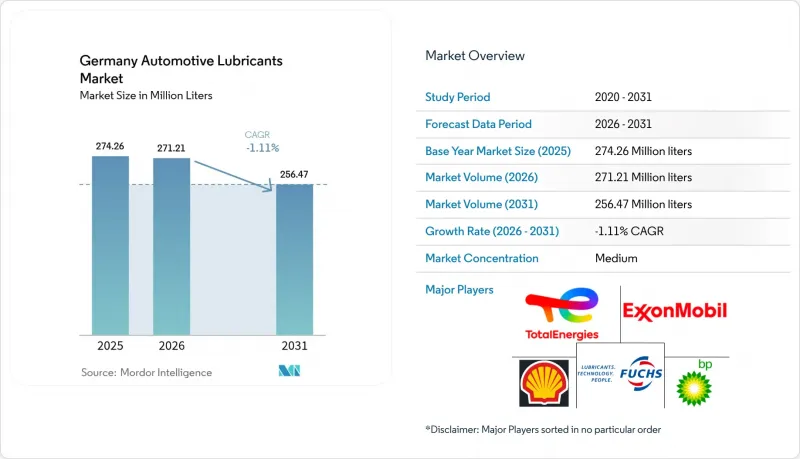
Mordor Intelligence에 의하면, 2026년 독일 자동차 윤활유 시장 규모는 2억 7,121만 리터로 추정되고 있어 2025년 2억 7,426만 리터에서 축소해, 2031년 예측은 2억 5,647만 리터가 되어, 2026년부터 2031년까지 CAGR-1.11%로 추이한다고 전망되고 있습니다.
본 보고서는 제품 유형(자동차 엔진오일, 수동 변속기 오일, 자동 변속기 오일, 브레이크 오일, 자동차 그리스, 기타 제품 유형) 및 차종(승용차, 상용차, 이륜차)별로 분류되어 있습니다. 시장 예측은 수량(리터) 기준으로 제시되어 있습니다.
독일 자동차 윤활유 시장 동향 및 인사이트
2024년 이후 독일 내 경차 생산 회복
2025년 9월, 국내 승용차 생산 대수가 회복되면서 공장 출고 시 주입 및 초기 정비 수요가 안정되었습니다. 생산 대수는 여전히 2019년 수준보다 낮지만, 2025년부터 2029년까지 3,200억 유로의 투자가 확정된 만큼 제조 활동은 지속될 것으로 예측됩니다. 전동화 모델은 이미 이 생산량에서 점유율을 확대하고 있으며, 차량당 윤활유 사용량은 감소하고 있지만, e-드라이브용 냉각수 분야에서 새로운 기회가 창출되고 있습니다. 엔진 공장의 가동률은 여전히 과거 평균보다 낮지만, 부품 공급 상황의 개선과 공급망 재편에 따라 조립 시설에서 사용되는 산업용 윤활유 수요가 단기적으로는 증가할 것으로 예측됩니다. 따라서 이러한 회복세는 독일 자동차 윤활유 시장 전체의 감소세를 완화하는 소소한 완충재 역할을 할 것입니다.
합성 저점도 엔진오일의 보급 확대
자동차 제조업체들이 연비 향상과 오일 교환 주기 연장이라는 이점을 추구하는 가운데, 0W-XX 및 5W-XX 등급에 대한 OEM 사양이 전국적으로 가속화되고 있습니다. 합성유는 터보차저가 장착된 차량이나 고열 부하 조건에서 휘발성 제어 및 슬러지 저항성이 뛰어납니다. ATIEL 행동 강령에 기반한 ACEA 인증에서는 엄격한 벤치 테스트 및 엔진 테스트가 규정되어 있으며, 이를 충족할 수 있는 소규모 블렌딩 업체는 거의 없어 경쟁이 제한되고 있습니다. 쉘(Shell)사가 그룹 III 제품으로의 전환을 추진함에 따라 그룹 I공급이 부족해져 원료 프리미엄은 상승했으나, 합성유에 필요한 고성능 기유에 대한 접근성은 개선되었습니다. 그 결과, 프리미엄 공급업체들은 브랜드 가치와 인증 시험소를 활용하여 시장 점유율을 확보하고 있으며, 독일의 자동차 윤활유 시장은 ‘양보다 질’을 중시하는 시장으로 자리 잡아가고 있습니다.
BEV 대수 증가가 엔진오일 수요량을 감소시킨다.
BEV 등록 대수가 증가한 결과, 연간 엔진오일 수요는 감소하고 있습니다. 충전소가 밀집한 도시 지역에서는 이미 퀵 루브(퀵 오일 교환) 이용 건수가 두 자릿수 감소세를 보이고 있습니다. OEM의 투자 방침은 배터리 어셈블리 및 전기 구동계에 중점을 두고 있어, 엔진 생산은 앞으로도 계속 축소될 것이 확실합니다. 따라서 윤활유 판매업체는 e-드라이브용 유체, 열갭 필러용 그리스, 그리고 실리콘 프리 소재와 호환되는 냉각수 블렌드로 제품 포트폴리오를 재구성해야 합니다. 이러한 변화에 대응하지 못한다면, 독일 자동차 윤활유 시장에서 장기적인 판매량 감소를 겪게 될 것입니다.
부문 분석
자동차 엔진오일은 독일 자동차 윤활유 시장의 62.68%를 차지하고 있습니다. 이 부문은 여전히 주류를 이루고 있는 내연기관 차량의 혜택을 받고 있으며, 오일 교환 주기가 짧은 구형 차량으로부터도 추가적인 지지를 얻고 있습니다. 합성 0W-20 및 0W-30 배합 제품은 OEM의 연비 향상 지침과 그룹 III 기유 확보 가능성 덕분에 프리미엄 상품 진열 공간을 차지하고 있습니다. 그러나 승용차 엔진 생산 대수의 감소와 BEV(배터리 전기자동차)에서 자동 변속기가 싱글 스피드 기어박스로 대체되는 현상이 장기적인 판매량을 끌어내리고 있습니다. 수동 변속기 오일 및 브레이크 오일은 수요의 극히 일부를 차지하고 있으며, 정기적인 정비 일정에 연동되어 비교적 안정적인 추세를 보이고 있습니다. 자동차 그리스는 휠 베어링이나 섀시의 각 부위에 사용되며, 전동화의 영향은 제한적이지만, 유압 작동유나 스티어링 작동유와 같은 틈새 제품은 전자 제어 브레이크 및 스티어링 시스템의 보급에 따라 감소하고 있습니다. 전반적으로, 제품 구성의 변화는 독일 자동차 윤활유 시장의 판매량 감소를 막는 것이 아니라, 단순히 그 속도를 늦추는 데 그칠 뿐입니다.
자동변속기 오일은 멀티 기어박스 사용이 급격히 감소하고 있는 점을 반영하여 연평균 성장률(CAGR)이 -0.94%로, 가장 급격한 축소가 예상됩니다. 기타 제품 카테고리에서는 추이에 편차가 나타납니다. 브레이크 오일은 운행 차량 대수의 추이와 연동되며, 그리스는 대형 차량 부문의 부품 수 추이와 연동됩니다. 또한, 새롭게 부상하고 있는 e-드라이브용 냉각수는 판매량이 서서히 증가하고 있어 기존의 감소분을 부분적으로 상쇄하고 있습니다. 예측 기간 동안 합성 윤활유 시장 점유율은 총 판매 리터수의 감소 속도를 상회하는 속도로 상승할 것으로 예상되므로, 독일 자동차 윤활유 시장 규모가 절대값으로 축소되더라도 시장 가치는 유지될 전망입니다.
기타 혜택:
- 엑셀 형식 시장 예측(ME) 시트
- 3개월간의 애널리스트 지원
자주 묻는 질문
목차
제1장 서론
제2장 조사 방법
제3장 주요 요약
제4장 시장 구도
제5장 시장 규모와 성장 예측
제6장 경쟁 구도
제7장 시장 기회와 향후 전망
제8장 CEO가 직면하는 중요 전략적 과제
JHS 26.08.28According to Mordor Intelligence, Germany automotive lubricants market size in 2026 is estimated at 271.21 million liters, growing from 2025 value of 274.26 million liters with 2031 projections showing 256.47 million liters, growing at -1.11% CAGR over 2026-2031.
This report is Segmented by Product Type (Automotive Engine Oil, Manual Transmission Fluids, Automatic Transmission Fluids, Brake Fluids, Automotive Greases, and Other Product Types) and Vehicle Type (Passenger Vehicles, Commercial Vehicles, and Two-Wheelers). The Market Forecasts are Provided in Terms of Volume (Litres).
Germany Automotive Lubricants Market Trends and Insights
Revival of German Light-Vehicle Production Post-2024
Domestic passenger-car output rebounded in September 2025, stabilizing factory fill and early-service demand. Although volumes remain below 2019 levels, committed investments of EUR 320 billion between 2025 and 2029 indicate sustained manufacturing activity. Electrified models already command a growing share of this output, trimming lubricant litres per vehicle yet opening new opportunities in e-drive coolants. Engine-plant utilization remains below historical norms; however, improved parts availability and reorganized supply chains are expected to support a near-term increase in industrial lubricants used within assembly facilities. The revival, therefore, offers a modest buffer that slows the overall decline of the German automotive lubricants market.
Rising Penetration of Synthetic Low-Viscosity Engine Oils
OEM specifications for 0W-XX and 5W-XX grades accelerate nationwide as automakers chase fuel economy and extended-drain benefits. Synthetics provide better volatility control and sludge resistance under turbocharged, high-thermal-load conditions. ACEA approvals governed by the ATIEL Code of Practice set rigorous bench and engine tests that few small blenders can meet, limiting competitive entry. Shell's shift to Group III output tightens Group I availability, raising feedstock premiums yet improving access to high-performance base oils required for synthetics. Premium suppliers consequently leverage brand equity and accredited labs to capture wallet share, cementing the German automotive lubricants market as a value-over-volume play.
Growing BEV Fleet Reducing Engine-Oil Volume
BEV registrations increased, resulting in a reduction in annual engine oil demand. Urban areas with dense charging hubs already show double-digit declines in quick-lube traffic. OEM spending commitments favor battery assembly and electric drivetrains, ensuring that engine manufacturing will continue to shrink. Lubricant marketers must therefore retool portfolios toward e-drive fluids, greases for thermal gap fillers, and coolant blends compatible with silicone-free materials. Failing to adapt will expose them to lasting volume loss in the German automotive lubricants market.
Other drivers and restraints analyzed in the detailed report include:
- Aging Car Parc Boosting After-Market Demand
- Demand for E-Motor and Reduction-Gearbox Fluids
- Base-Oil Price Volatility
For complete list of drivers and restraints, kindly check the Table Of Contents.
Segment Analysis
Automotive engine oil accounted for 62.68% of Germany's automotive lubricants market. The segment benefits from the still-dominant internal-combustion fleet and gains further support from older vehicles that require shorter drain intervals. Synthetic 0W-20 and 0W-30 formulations capture premium shelf space due to OEM fuel-economy directives and the availability of Group III base oils. Yet the decline in passenger-car engine builds and the replacement of automatic transmissions with single-speed gearboxes in BEVs undercut long-term volume. Manual transmission fluids and brake fluids account for a modest slice of demand, showing relatively stable trends tied to routine service schedules. Automotive greases serve wheel bearings and chassis points, with a limited impact on electrification, while niche products, such as hydraulic and steering fluids, decline in tandem with the adoption of electronic braking and steering systems. Altogether, the mix shift merely slows rather than stops the decline in volume in the German automotive lubricants market.
Automatic transmission fluids are expected to represent the steepest contraction, -0.94% CAGR, mirroring the rapid decline in the use of multi-gear boxes. Other product categories see uneven trajectories: brake fluids track the size of the rolling fleet, greases follow component counts in heavy-duty sectors, and emergent e-drive coolants acquire incremental litres that partially offset traditional losses. Over the forecast horizon, synthetic share rises faster than total litres decline, allowing value retention even as Germany's automotive lubricants market size contracts in absolute terms.
Complete Report Scope:
- By Product Type
- Automotive Engine Oil
- 0W-XX
- 5W-XX
- 10W-XX
- 15W-XX
- Monogrades
- Other Grades
- Manual Transmission Fluids (MTF)
- Automatic Transmission Fluids (ATF)
- Brake Fluids
- Automotive Greases
- Other Product Types (Power Steering Fluid etc.)
- Automotive Engine Oil
- By Vehicle Type
- Passenger Vehicles
- Commercial Vehicles
- Two-Wheelers
List of Companies Covered in this Report:
- ADDINOL
- AVISTA OIL
- BP Plc
- Chevron Corporation
- Exxon Mobil Corporation
- Finke Mineralolwerk
- FUCHS
- LIQUI MOLY
- Motul
- PETRONAS Lubricants International
- Ravensberger Schmierstoffvertrieb GmbH
- ROWE MINERALOLWERK GMBH
- Saudi Arbian Oil Co.
- SCT Lubricants
- Shell plc
- TotalEnergies
Additional Benefits:
- The market estimate (ME) sheet in Excel format
- 3 months of analyst support
TABLE OF CONTENTS
1 Introduction
- 1.1 Study Assumptions and Market Definition
- 1.2 Scope of the Study
2 Research Methodology
3 Executive Summary
4 Market Landscape
- 4.1 Market Overview
- 4.2 Market Drivers
- 4.2.1 Revival of German light-vehicle production post-2024
- 4.2.2 Rising penetration of synthetic low-viscosity engine oils
- 4.2.3 Aging car parc (more than 10 yrs) boosting after-market demand
- 4.2.4 Demand for e-motor and reduction-gearbox fluids
- 4.2.5 OEM Scope-3 targets driving CO2-neutral lubricants
- 4.3 Market Restraints
- 4.3.1 Growing BEV fleet reducing engine-oil volume
- 4.3.2 Base-oil price volatility
- 4.3.3 Stricter German packaging-waste rules
- 4.4 Value Chain and Distribution Channel Analysis
- 4.5 Porter's Five Forces
- 4.5.1 Threat of New Entrants
- 4.5.2 Bargaining Power of Suppliers
- 4.5.3 Bargaining Power of Buyers
- 4.5.4 Threat of Substitutes
- 4.5.5 Industry Rivalry
- 4.6 Regulatory Framework
- 4.7 Automotive Industry Trends
5 Market Size and Growth Forecasts (Volume)
- 5.1 By Product Type
- 5.1.1 Automotive Engine Oil
- 5.1.1.1 0W-XX
- 5.1.1.2 5W-XX
- 5.1.1.3 10W-XX
- 5.1.1.4 15W-XX
- 5.1.1.5 Monogrades
- 5.1.1.6 Other Grades
- 5.1.2 Manual Transmission Fluids (MTF)
- 5.1.3 Automatic Transmission Fluids (ATF)
- 5.1.4 Brake Fluids
- 5.1.5 Automotive Greases
- 5.1.6 Other Product Types (Power Steering Fluid etc.)
- 5.1.1 Automotive Engine Oil
- 5.2 By Vehicle Type
- 5.2.1 Passenger Vehicles
- 5.2.2 Commercial Vehicles
- 5.2.3 Two-Wheelers
6 Competitive Landscape
- 6.1 Market Concentration
- 6.2 Strategic Moves
- 6.3 Market Share (%)/Ranking Analysis
- 6.4 Company Profiles (includes Global level Overview, Market level overview, Core Segments, Financials as available, Production Capacity, Strategic Information, Market Rank/Share for key companies, Products and Services, and Recent Developments)
- 6.4.1 ADDINOL
- 6.4.2 AVISTA OIL
- 6.4.3 BP Plc
- 6.4.4 Chevron Corporation
- 6.4.5 Exxon Mobil Corporation
- 6.4.6 Finke Mineralolwerk
- 6.4.7 FUCHS
- 6.4.8 LIQUI MOLY
- 6.4.9 Motul
- 6.4.10 PETRONAS Lubricants International
- 6.4.11 Ravensberger Schmierstoffvertrieb GmbH
- 6.4.12 ROWE MINERALOLWERK GMBH
- 6.4.13 Saudi Arbian Oil Co.
- 6.4.14 SCT Lubricants
- 6.4.15 Shell plc
- 6.4.16 TotalEnergies
7 Market Opportunities and Future Outlook
- 7.1 White-space and Unmet-need Assessment


