|
시장보고서
상품코드
2121698
아프리카의 농업기계 : 시장 점유율 분석, 업계 동향과 통계, 성장 예측(2026-2031년)Africa Agricultural Machinery - Market Share Analysis, Industry Trends & Statistics, Growth Forecasts (2026 - 2031) |
||||||
 Mordor Intelligence
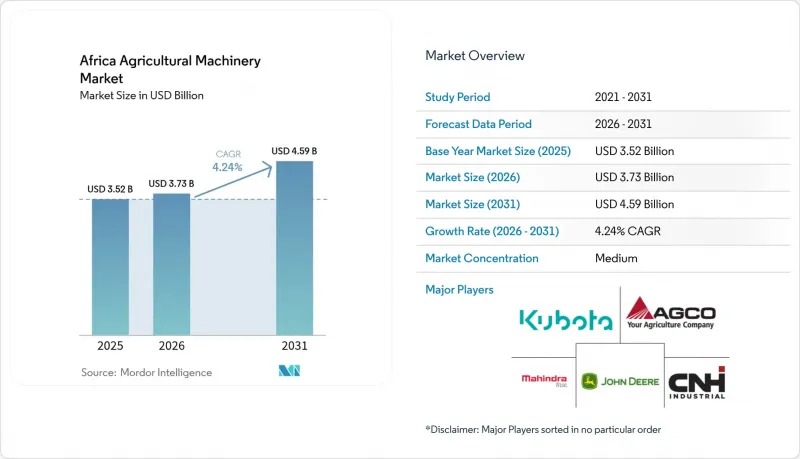
Mordor Intelligence에 의하면, 아프리카의 농업기계 시장 규모는 2025년 35억 2,000만 달러에서 2026년에는 37억 3,000만 달러에 이르고, 2026-2031년 CAGR 4.24%로 성장을 지속하여 2031년에는 45억 9,000만 달러에 달할 것으로 예측됩니다.
본 보고서는 제품 유형(트랙터, 경운 및 중경 기계, 파종 기계, 분무기, 관개 기계, 수확 기계, 건초·사료용 기계, 기타) 및 지역(남아프리카, 나이지리아 등)별로 분류되어 있습니다. 시장 예측은 금액(달러) 기준으로 제시되어 있습니다.
아프리카의 농업 기계 시장 동향 및 인사이트
농업 노동력 감소
농촌 지역의 젊은이들은 지속적으로 성장하는 도시 지역의 서비스업에 취업을 희망하고 있으며, 그 결과 토지 준비 및 수확에 종사할 수 있는 계절 근로자의 수가 감소하고 있습니다. 나이로비에서는 일반 근로자의 월급이 2018년 105.2달러에서 2024년 124.9달러로 상승했으며, 다른 지자체에서도 유사한 증가세가 나타나고 있어, 기존에는 가족 노동에 의존하던 2헥타르 미만 농장의 수익성이 압박받고 있습니다. 이에 대응하여 협동조합은 디지털 임대 플랫폼이나 고정 비용을 다수의 이용자에게 분산시키는 공유 소유 제도를 통해 트랙터 사용 시간을 확보하기 위해 자원을 공동으로 활용하고 있습니다. 세계은행에 따르면, 2023년 시점에서 나이지리아 농업 부문의 고용은 전체 고용의 34.3%를 차지했습니다. 2021년부터 2023년에 걸쳐 이 수치는 7.4% 감소했으나, 그 감소 추세는 일관되지 않고 불규칙적이었습니다. 따라서 심화되는 노동력 부족은 기계화에 소극적인 농가들 사이에서도 기계화를 향한 구조적인 추진력으로 작용하고 있습니다.
정부의 기계화 지원 정책과 보조금
현재 공공 프로그램을 통해 구매 비용에 대한 보조금이 지급되고, 투자 회수 기간이 단축되며, 운영자 교육도 포함되는 등 장비를 확보하기가 훨씬 수월해졌습니다. 이러한 프로그램은 소규모 농가를 포함한 더 폭넓은 농가가 기계화를 이용할 수 있도록 하는 것을 목표로 하고 있습니다. 나이지리아가 2026년 2월에 발표한 이니셔티브는 할인된 가격의 트랙터와 농기구를 제공함으로써, 2028년까지 국내 기계화율을 12%에서 25%로 높이는 것을 목표로 하고 있습니다. 이 이니셔티브는 농업 부문의 낮은 생산성과 노동력 부족과 같은 과제 해결에 기여할 것으로 기대됩니다. 2023년, 케냐 농업부는 농업 기계화를 촉진하기 위해 ‘국가 농업 기계화 정책’ 및 관련 조치를 도입하여 동력 이용률을 현재 30%에서 50%로 끌어올리는 것을 목표로 하고 있습니다. 이러한 노력은 농업의 효율성과 생산량을 향상시키는 것을 목적으로 합니다. 이러한 보조금을 통해 투자 회수 기간이 4년 미만으로 단축되어 소규모 농가라도 기계화를 도입하기 쉬워지며, 그 결과 농업 부문의 생산성 향상과 경제 성장이 촉진될 것입니다.
분산된 사후 서비스 네트워크
농촌 지역의 판매점 수가 제한적이기 때문에 트랙터 소유자는 공인 기술자나 순정 부품을 확보하기까지 오랜 기간 기다릴 수밖에 없습니다. 나이지리아의 트랙터 대부분은 공인 정비소에서 상당히 멀리 떨어져 있어, 소유자는 비공식 정비사에게 의존할 수밖에 없습니다. 이러한 정비사에 의한 수리는 보증이 무효화되는 경우가 많아 소유주에게 또 다른 과제가 되고 있습니다. 각 제조업체는 이러한 문제를 해결하기 위해 이동 서비스 차량이나 원격 진단 등의 방안을 도입하고 있습니다. 그러나 이러한 해결책은 신뢰할 수 있는 통신 환경과 충분한 기술자 교육에 크게 의존하고 있는데, 이 두 가지 모두 국내 각지에서 여전히 불안정한 상황입니다. 견고한 서비스 인프라가 갖춰지지 않아 트랙터의 이용률이 크게 떨어지고 있으며, 그 결과 기계화에 대한 투자 수익률이 낮아져 향후 구매 의욕을 저해하고 있습니다.
부문 분석
트랙터는 가장 큰 제품 유형으로, 2025년 아프리카의 농업 기계 시장 점유율의 42.6%를 차지하고 있습니다. 농지의 대부분이 2헥타르 미만이기 때문에 40마력 미만의 기종이 매출에서 큰 비중을 차지하고 있습니다. 소형 기계는 운송 차량이나 간단한 농기구의 동력원으로 겸용할 수 있어 케냐, 에티오피아, 가나에서 인기를 끌고 있습니다. 금융 지원 제도를 통해 협동조합이나 도급 서비스 사업자가 트랙터를 소유할 수 있게 됨에 따라, 아프리카의 농업 기계 시장 내 트랙터 시장 규모는 확대될 것으로 예측됩니다. 40-99마력의 중출력 트랙터는 농지를 공동으로 이용하는 농장들 사이에서 보급이 확대되고 있지만, 100마력을 초과하는 모델은 남아프리카공화국과 이집트에 집중되어 있습니다.
분무기는 2031년까지 연평균 성장률(CAGR) 5.1%로 확대되며, 모든 카테고리 중에서 가장 높은 성장률을 보이고 있습니다. 이는 수출 지향적인 원예 산업이 유럽연합(EU)의 안전 기준에 따라 잔류 농약 상한치 강화에 대응하고 있기 때문입니다. 케냐의 절화 생산 클러스터에서는 구입 비용의 절반을 지원하는 제도의 뒷받침으로, 농약 사용량을 줄이는 정밀 살포기가 보급되고 있습니다. 기온 상승에 따른 해충 피해 증가를 배경으로, 아프리카의 농업 기계 시장에서의 살포기 수요는 대폭 확대될 것으로 예측됩니다. 기반 규모는 작지만, 기후 변화에 강한 작물 관리가 정책상의 우선 과제로 부상함에 따라 그 성장률은 다른 어떤 부문보다도 높을 것으로 전망됩니다.
기타 혜택:
- 엑셀 형식 시장 예측(ME) 시트
- 3개월간의 애널리스트 지원
자주 묻는 질문
목차
제1장 서론
제2장 조사 방법
제3장 주요 요약
제4장 시장 구도
제5장 시장 규모와 성장 예측
제6장 경쟁 구도
제7장 시장 기회와 향후 전망
LSH 26.09.09According to Mordor Intelligence, the Africa agricultural machinery market size is projected to grow from USD 3.52 billion in 2025 to USD 3.73 billion in 2026 and is forecast to reach USD 4.59 billion by 2031 at a 4.24% CAGR over 2026-2031.
This report is Segmented by Product Type (Tractors, Plowing and Cultivating Machinery, Planting Machinery, Sprayers, Irrigation Machinery, Harvesting Machinery, Haying and Forage Machinery, and Other Types) and by Geography (South Africa, Nigeria, and More). The Market Forecasts are Provided in Terms of Value (USD).
Africa Agricultural Machinery Market Trends and Insights
Declining Agricultural Labor
Rural youth continue to migrate toward service jobs in growing urban centers, shrinking the seasonal workforce available for land preparation and harvest. In Nairobi, the monthly wage for a general laborer increased from USD 105.2 in 2018 to USD 124.9 in 2024, with similar increments observed in other municipalities, squeezing margins for farms under two hectares that traditionally relied on family labor. Cooperatives are countering by pooling resources to secure tractor hours through digital rental platforms and shared-ownership schemes that spread fixed costs across many users. According to the World Bank, in 2023, employment in the agricultural sector accounted for 34.3% of total employment in Nigeria . Between 2021 and 2023, this figure decreased by 7.4%, although the decline was irregular rather than consistent. Growing labor scarcity, therefore, acts as a structural push toward mechanization, even among conservative adopters.
Government Mechanization Schemes and Subsidies
Public programs are now subsidizing acquisition costs, reducing payback periods, and including operator training, significantly improving equipment affordability. These programs aim to make mechanization accessible to a broader range of farmers, including small-scale operators. Nigeria's February 2026 initiative aims to increase national mechanization levels from 12% to 25% by 2028 by providing discounted tractors and implements . This initiative is projected to address the challenges of low productivity and labor shortages in the agricultural sector. In 2023, the Kenyan Ministry of Agriculture introduced a National Agricultural Mechanization Policy and related initiatives to enhance farm mechanization, aiming to increase motorized power use from the current 30% to 50%. These efforts are designed to improve agricultural efficiency and output. These subsidies reduce break-even periods to less than four years, encouraging even small-scale operators to adopt mechanization, thereby fostering greater productivity and economic growth in the agricultural sector.
Fragmented After-Sales Service Networks
The limited presence of dealers in rural areas forces tractor owners to wait for extended periods to access certified technicians or genuine parts. A large portion of tractors in Nigeria are situated at considerable distances from authorized workshops, leaving operators with no choice but to rely on informal mechanics. These mechanics often perform repairs that void warranties, creating additional challenges for owners. Manufacturers have introduced initiatives such as mobile service vans and remote diagnostics to address these issues. However, these solutions are heavily dependent on reliable connectivity and adequate technician training, both of which remain inconsistent across the country. In the absence of a robust service infrastructure, tractor utilization rates decline significantly, resulting in lower returns on mechanization investments and discouraging future purchases.
Other drivers and restraints analyzed in the detailed report include:
- Pay-As-You-Go Equipment Financing Platforms
- Digitization and Telematics Integration
- Counterfeit and Gray-Market Imports
For complete list of drivers and restraints, kindly check the Table Of Contents.
Segment Analysis
Tractors are the largest product type, accounting for 42.6% of the Africa agricultural machinery market share in 2025, with units under 40 horsepower representing a significant share of sales, as the majority of farms remain below 2 hectares. Compact machines double as transport vehicles and power sources for simple implements, explaining their popularity in Kenya, Ethiopia, and Ghana. The Africa agricultural machinery market size for tractors is projected to grow as financing schemes make ownership viable for cooperatives and contract service providers. Medium-power tractors between 40 and 99 horsepower are gaining ground among estates pooling acreage, while models above 100 horsepower stay concentrated in South Africa and Egypt.
Sprayers expand at a 5.1% CAGR through 2031, the highest among all categories, as export-oriented horticulture faces tighter residue ceilings under European Union safety rules. Precision sprayers that cut chemical volumes are spreading in Kenyan floriculture clusters, aided by subsidies that reimburse half the purchase cost. The Africa agricultural machinery market for sprayers is anticipated to grow significantly, driven by rising pest pressure linked to warmer temperatures. Although starting from a smaller base, growth outpaces every other segment as climate-resilient crop management becomes a policy priority.
Complete Report Scope:
- By Product Type
- Tractors
- Less than 40 HP
- 40 - 99 HP
- 100 HP and Above
- Plowing and Cultivating Machinery
- Plows
- Harrows
- Rotovators and Cultivators
- Other Equipment
- Planting Machinery
- Seed Drills
- Planters
- Spreaders
- Other Planting Machinery
- Sprayers
- Handheld/Knapsack
- Tractor-Mounted
- Trailed/Pull-Type
- Self-Propelled
- UAV/Drone Sprayers
- Irrigation Machinery
- Drip Irrigation Systems
- Sprinkler Irrigation Systems
- Other Irrigation Machinery
- Harvesting Machinery
- Combine Harvesters
- Other Harvesting Machinery
- Haying and Forage Machinery
- Mowers and Conditioners
- Balers
- Other Haying and Forage Machinery
- Tractors
- By Geography
- Nigeria
- South Africa
- Kenya
- Egypt
- Ethiopia
- Rest of Africa
List of Companies Covered in this Report:
- Deere & Company
- CNH Industrial N.V.
- AGCO Corporation
- Mahindra & Mahindra Limited
- Kubota Corporation
- Tractors and Farm Equipment Limited (TAFE)
- Yanmar Holdings Co., Ltd.
- International Tractors Limited
- CLAAS KGaA mbH
- Weichai Lovol Intelligent Agricultural Technology Co., Ltd. (Weichai Power Co., Ltd.)
- SDF S.p.A (Same Deutz-Fahr)
- Agrimont Industrial Group
- Dongfeng Agricultural Machinery Group Co., Ltd.
- Zoomlion Heavy Industry Science and Technology Co., Ltd.
- Zetor Tractors a.s. (HTC Holding)
Additional Benefits:
- The market estimate (ME) sheet in Excel format
- 3 months of analyst support
TABLE OF CONTENTS
1 Introduction
- 1.1 Study Assumptions and Market Definition
- 1.2 Scope of the Study
2 Research Methodology
3 Executive Summary
4 Market Landscape
- 4.1 Market Overview
- 4.2 Market Drivers
- 4.2.1 Declining agricultural labor
- 4.2.2 Government mechanization schemes and subsidies
- 4.2.3 Pay-as-you-go equipment financing platforms
- 4.2.4 Digitization and telematics integration
- 4.2.5 Climate volatility accelerating mechanization
- 4.2.6 Carbon-credit-linked mechanization incentives
- 4.3 Market Restraints
- 4.3.1 Fragmented after-sales service networks
- 4.3.2 High up-front equipment costs
- 4.3.3 Counterfeit and gray-market imports
- 4.3.4 Persistent foreign-exchange volatility
- 4.4 Regulatory Landscape
- 4.5 Technological Outlook
- 4.6 Porter's Five Forces Analysis
- 4.6.1 Bargaining Power of Suppliers
- 4.6.2 Bargaining Power of Buyers
- 4.6.3 Threat of New Entrants
- 4.6.4 Threat of Substitutes
- 4.6.5 Intensity of Competitive Rivalry
5 Market Size and Growth Forecasts (Value)
- 5.1 By Product Type
- 5.1.1 Tractors
- 5.1.1.1 Less than 40 HP
- 5.1.1.2 40 - 99 HP
- 5.1.1.3 100 HP and Above
- 5.1.2 Plowing and Cultivating Machinery
- 5.1.2.1 Plows
- 5.1.2.2 Harrows
- 5.1.2.3 Rotovators and Cultivators
- 5.1.2.4 Other Equipment
- 5.1.3 Planting Machinery
- 5.1.3.1 Seed Drills
- 5.1.3.2 Planters
- 5.1.3.3 Spreaders
- 5.1.3.4 Other Planting Machinery
- 5.1.4 Sprayers
- 5.1.4.1 Handheld/Knapsack
- 5.1.4.2 Tractor-Mounted
- 5.1.4.3 Trailed/Pull-Type
- 5.1.4.4 Self-Propelled
- 5.1.4.5 UAV/Drone Sprayers
- 5.1.5 Irrigation Machinery
- 5.1.5.1 Drip Irrigation Systems
- 5.1.5.2 Sprinkler Irrigation Systems
- 5.1.5.3 Other Irrigation Machinery
- 5.1.6 Harvesting Machinery
- 5.1.6.1 Combine Harvesters
- 5.1.6.2 Other Harvesting Machinery
- 5.1.7 Haying and Forage Machinery
- 5.1.7.1 Mowers and Conditioners
- 5.1.7.2 Balers
- 5.1.7.3 Other Haying and Forage Machinery
- 5.1.1 Tractors
- 5.2 By Geography
- 5.2.1 Nigeria
- 5.2.2 South Africa
- 5.2.3 Kenya
- 5.2.4 Egypt
- 5.2.5 Ethiopia
- 5.2.6 Rest of Africa
6 Competitive Landscape
- 6.1 Market Concentration
- 6.2 Strategic Moves
- 6.3 Market Share Analysis
- 6.4 Company Profiles (Includes Global Level Overview, Market Level Overview, Core Segments, Financials as Available, Strategic Information, Market Rank/Share for Key Companies, Products and Services, and Recent Developments)
- 6.4.1 Deere & Company
- 6.4.2 CNH Industrial N.V.
- 6.4.3 AGCO Corporation
- 6.4.4 Mahindra & Mahindra Limited
- 6.4.5 Kubota Corporation
- 6.4.6 Tractors and Farm Equipment Limited (TAFE)
- 6.4.7 Yanmar Holdings Co., Ltd.
- 6.4.8 International Tractors Limited
- 6.4.9 CLAAS KGaA mbH
- 6.4.10 Weichai Lovol Intelligent Agricultural Technology Co., Ltd. (Weichai Power Co., Ltd.)
- 6.4.11 SDF S.p.A (Same Deutz-Fahr)
- 6.4.12 Agrimont Industrial Group
- 6.4.13 Dongfeng Agricultural Machinery Group Co., Ltd.
- 6.4.14 Zoomlion Heavy Industry Science and Technology Co., Ltd.
- 6.4.15 Zetor Tractors a.s. (HTC Holding)