

|
시장보고서
상품코드
2121928
배터리 관리 시스템(BMS) : 시장 점유율 분석, 업계 동향과 통계, 성장 예측(2026-2031년)Battery Management System - Market Share Analysis, Industry Trends & Statistics, Growth Forecasts (2026 - 2031) |
||||||
 Mordor Intelligence
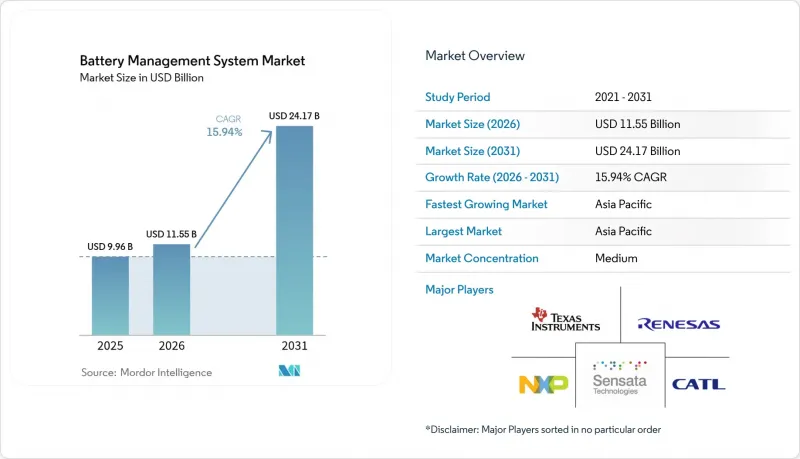
Mordor Intelligence에 의하면, 2026년 배터리 관리 시스템(BMS) 시장 규모는 115억 5,000만 달러로 추정되며, 2025년 99억 6,000만 달러에서 2031년에는 241억 7,000만 달러에 달할 것으로 예측됩니다.
또한 2026-2031년 연평균 성장률(CAGR)은 15.94%를 기록할 전망입니다.
본 보고서는 배터리 유형(리튬이온, 납산, 니켈계, 흐름전지 및 전고체), ‘토폴로지’(집중형, 분산형, 모듈형 및 하이브리드형),‘구성 요소’(하드웨어 및 소프트웨어), ‘전압 범위’(저, 중, 고), ‘용도’(자동차, 고정형 에너지 저장, 소비자 가전 등), 그리고 ‘지역’(북미, 유럽, 아시아태평양, 남미 등)별로 분류되어 있습니다.
전 세계 배터리 관리 시스템(BMS) 시장 동향 및 인사이트
전기차(EV) 생산 급증으로 고전압 BMS 수요 증가
2024년 전 세계 배터리 전기자동차(BEV) 판매 대수는 1,390만 대를 넘어, 2027년까지 3,000만 대를 넘어설 것으로 예측됩니다. 이에 따라 배터리 관리 시스템(BMS) 시장의 각 공급업체들은 상용차 배터리 팩에서 최대 360개의 셀을 모니터링하는 ASIL D 준수 솔루션 개발을 추진하고 있습니다. 제너럴 모터스(GM) 등 자동차 제조업체들은 무선 BMS 설계를 채택하여 하네스 배선을 90% 줄임으로써 중량과 조립 시간을 절감하고 있습니다. 800V 고전압 플랫폼에서는 첨단 열 관리 알고리즘과 실시간 진단이 요구되며, BMS는 수동적인 안전 장치라기보다는 급속 충전을 가능하게 하는 능동적인 요소로 재정의되고 있습니다. 현재 프리미엄 EV 부문에서 플랫폼 채택을 결정짓는 요인은 독자적인 통신 IC를 둘러싼 공급망상의 파트너십입니다.
리튬 이온 배터리 팩의 가격 하락이 대상 시장의 확대를 가져오고 있습니다.
2024년에는 특정 구성에서 리튬 이온 배터리의 비용이 1kWh당 100달러 아래로 떨어지면서, 지금까지 납축전지 팩에 의존하던 새로운 산업용 및 주거용 프로젝트가 가능해졌습니다. 이러한 저렴한 화학 배터리의 동향으로 인해 지게차, 통신용 UPS, 신흥 시장의 마이크로모빌리티 차량군 등에 배터리 관리 시스템(BMS) 시장 침투가 촉진되고 있습니다. 각 공급업체들은 필요한 안전성을 유지하면서 부품 원가를 절감한 간소화된 기판으로 이에 대응하고 있습니다. 모듈식 BMS 키트는 1kWh 규모의 가정용 태양광 발전 시스템부터 수 MWh 규모의 에너지 저장 시설에 이르기까지 폭넓게 대응하며, 신속한 도입과 유지보수를 통해 가동 중단 시간을 단축하는 데 기여합니다.
반도체 부족이 BMS 출하를 제약
파운드리 업체들이 수익성이 높은 스마트폰용 노드를 우선시하고 있어, 2026년까지도 자동차용 등급의 아날로그 및 파워 칩 공급 부족이 지속되고 있습니다. 배터리 관리 시스템(BMS) 시장공급업체들은 입수 가능한 핀 배열에 맞추어 기판을 재설계하고, 수년에 걸친 공급 계약을 협상하며, 심지어 할당량을 확보하기 위해 새로운 200mm 생산 라인에 투자하기까지 하고 있습니다. 리드타임이 52주를 초과함에 따라 자동차 제조업체들은 과잉 재고를 안을 수밖에 없어 운전 자금이 묶이고, 신모델 출시가 지연되고 있습니다.
부문 분석
2025년에는 리튬 이온 배터리가 매출의 52.74%를 차지했지만, 2028년경 상용화가 임박함에 따라 전고체 배터리는 연평균 성장률(CAGR) 41.38%로 급성장하고 있습니다. 도요타는 주행 거리 20% 향상과 10분 급속 충전을 목표로 하고 있으며, 모든 BMS에 완전히 새로운 임피던스 감지 로직을 통합할 것을 요구하고 있습니다. 리튬 이온 배터리의 배터리 관리 시스템(BMS) 시장 점유율은 LFP 및 고니켈 NMC의 가격이 점점 더 하락하고 있는 덕분에 여전히 큰 비중을 차지하고 있지만, 납산 배터리는 시동 배터리 분야에서 여전히 사용되고 있습니다. 흐름형 배터리 및 니켈계 배터리는 1시간 이상의 방전이나 극한 온도 환경에 대한 내성이 요구되는 틈새 산업용도에 대응하고 있습니다.
2025년에는 분산형 기판이 매출의 42.45%를 차지하며 연평균 성장률(CAGR) 22.96%로 혁신을 주도했습니다. 처리 능력이 각 모듈에 분산됨에 따라 하네스 길이가 단축되고 내결함성이 향상되었습니다. NXP의 초광대역 칩셋은 배선을 최대 90%까지 줄여, 설계자가 모든 형태의 스케이트보드형 배터리 팩을 설계할 수 있게 해줍니다. 저가형 스쿠터나 전동 공구에서는 집중형 설계가 주류를 이루는 반면, 실용적인 보관 용도에서는 모듈식 랙이 우수합니다. 하이브리드 레이아웃은 마스터 ECU와 무선 셀 노드를 결합함으로써 비용과 성능의 균형을 실현하고 있습니다.
지역별 분석
아시아태평양은 2025년에 매출의 60.92%를 차지할 것으로 예상되며, 2031년까지 연평균 19.08%의 성장률을 보일 것으로 전망됩니다. 중국의 거대한 규모는 동일한 산업 클러스터 내에서 원자재 정제, 셀 제조 및 최종 차량 조립을 촉진하고 있으며, 이를 통해 국내 BMS 보드의 입고 비용을 절감하고 있습니다. CATL 한 회사만으로도 2024년 1-3분기 전 세계 전기차용 배터리 용량 출하량의 36.7%를 차지하고 있으며, 차세대 컨트롤러가 필요한 셀-투-팩(Cell-to-Pack) 진단 기능에 투자하고 있습니다. 인도는 국내 전기차 보급을 촉진하기 위해 6,000만 달러를 배정하고 있으며, 이를 통해 지역 공급업체들에게 대규모 수주 기회가 열리고 있습니다. 일본과 한국은 고정밀 IC 및 자동차용 소프트웨어에 대한 전문 지식을 제공하여 생태계를 보완하고 있습니다.
북미는 ‘인플레이션 억제법’이 세액 공제를 현지 조달 배터리에 연계하고 있기 때문에 2위를 차지했습니다. 제너럴 모터스(GM)는 자체 개발한 ‘울티엄(Ultium)’ 무선 BMS를 활용해 배터리 팩 구성을 합리화하는 전기차 프로그램에 350억 달러를 예산으로 편성했습니다. 테슬라, 리비안 및 기존 자동차 제조업체들은 중서부 각지에서 기가팩토리 건설에 착수하여 고전압 기판 어셈블리 수요를 뒷받침하고 있습니다. 캘리포니아주와 텍사스주는 전력망용 에너지 저장 설비 도입을 주도하고 있으며, 2024년에는 각각 2GWh를 초과하는 용량이 추가되어 유틸리티 등급 BMS 수요를 견인하고 있습니다.
유럽에서는 엄격한 탄소 규제와 세컨드 라이프 배터리 혁신이 결합되고 있습니다. 각 자동차 제조업체는 더 빠른 충전과 경량 케이블을 추구하며 800V 구동계 개발을 추진하고 있습니다. EU의 배터리 규제는 소재의 추적 가능성과 재활용을 의무화하고 있으며, 제조업체들은 규정 준수를 위해 배터리 팩에 안전한 데이터 로거를 탑재해야 합니다. 남미, 중동 및 아프리카은 여전히 초기 단계이지만, 미래 성장이 기대되고 있습니다. 칠레의 풍부한 리튬 자원과 남아프리카공화국의 재생에너지 목표를 배경으로, 비용 최적화된 BMS 기판을 시험하는 에너지 저장 농장의 시범 사업이 추진되고 있으며, 향후 성장을 위한 기반이 마련되고 있습니다.
기타 혜택:
- 엑셀 형식 시장 예측(ME) 시트
- 3개월간의 애널리스트 지원
자주 묻는 질문
목차
제1장 서론
제2장 조사 방법
제3장 주요 요약
제4장 시장 구도
제5장 시장 규모와 성장 예측
제6장 경쟁 구도
제7장 시장 기회와 향후 전망
LSH 26.09.10According to Mordor Intelligence, battery management system market size in 2026 is estimated at USD 11.55 billion, growing from 2025 value of USD 9.96 billion with 2031 projections showing USD 24.17 billion, growing at 15.94% CAGR over 2026-2031.
This report is Segmented by Battery Type (Lithium-Ion, Lead-Acid, Nickel-Based, Flow Batteries, and Solid-State), Topology (Centralized, Distributed, Modular, and Hybrid), Component (Hardware and Software), Voltage Range (Low, Medium, and High), Application (Automotive, Stationary Energy Storage, Consumer Electronics, and More), and Geography (North America, Europe, Asia-Pacific, South America, and More).
Global Battery Management System Market Trends and Insights
EV production boom fuels demand for high-voltage BMS
Global battery-electric vehicle sales surpassed 13.9 million units in 2024 and are projected to exceed 30 million by 2027, prompting Battery Management System market vendors to engineer ASIL D-compliant solutions that monitor up to 360 cells in commercial vehicle packs. Automakers such as General Motors deploy wireless BMS designs that remove 90% of harness wiring, thus reducing mass and assembly time. High-voltage 800 V platforms demand advanced thermal algorithms and real-time diagnostics, repositioning the BMS as an active enabler of fast charging rather than a passive safeguard. Supply-chain partnerships around proprietary communication ICs now decide platform wins in premium EV segments.
Falling lithium-ion pack prices expand addressable markets
Lithium-ion costs dipped below USD 100 per kWh in select configurations in 2024, unlocking new industrial and residential projects that previously relied on lead-acid packs. The affordable chemistry trend fosters Battery Management System market penetration into forklifts, telecom UPS, and emerging-market micro-mobility fleets. Vendors respond with simplified boards that retain essential safety while trimming the bill of materials cost. Modular BMS kits scale from 1 kWh solar-home systems to multi-MWh storage farms, supporting quick deployment and reduced servicing downtime.
Semiconductor shortages constrain BMS shipments
Automotive-grade analog and power chips remain in short supply through 2026 as foundries prioritize higher-margin smartphone nodes. Battery Management System market suppliers redesign boards around available pin-outs, negotiate multi-year supply contracts, and even bankroll new 200 mm lines to protect allocations. Lead times exceeding 52 weeks compel vehicle manufacturers to hold excess inventory, tying up working capital and delaying the introduction of new models.
Other drivers and restraints analyzed in the detailed report include:
- Government safety & carbon mandates accelerate adoption
- Grid-scale storage build-out requires utility-grade BMS
- High integration & certification cost for advanced BMS
For complete list of drivers and restraints, kindly check the Table Of Contents.
Segment Analysis
Lithium-ion retained 52.74% revenue in 2025, yet solid-state boards sprint ahead at 41.38% CAGR as commercial launches near 2028. Toyota targets 20% range gains and 10-minute charges, demanding brand-new impedance-detection logic inside every BMS. The Battery Management System market share for lithium-ion remains sizable thanks to ever-cheaper LFP and high-nickel NMC, while lead-acid lingers in starter batteries. Flow and nickel chemistries address niche industrial operations requiring hour-long discharge or extreme temperature resilience.
Distributed boards controlled 42.45% revenue in 2025 and led innovation with a 22.96% CAGR. Processing power is spread across modules, trimming harness length, and elevating fault tolerance. NXP's ultra-wideband chipset eliminates up to 90% of wiring, allowing designers to craft skateboard packs of any shape. Centralized designs prevail in budget scooters and power tools, while modular racks excel in utility storage. Hybrid layouts combine a master ECU with wireless cell nodes to strike a balance between cost and performance.
Complete Report Scope:
- By Battery Type
- Lithium-ion
- Lead-acid
- Nickel-based
- Flow Batteries
- Solid-state
- By Topology
- Centralized
- Distributed
- Modular
- Hybrid
- By Component
- Hardware
- Software
- By Voltage Range
- Low (Up to 36 V)
- Medium (36 to 60 V)
- High (Above 60 V)
- By Application
- Automotive
- Stationary Energy Storage
- Consumer Electronics
- Industrial and Telecom UPS
- Medical Devices
- Aerospace and Marine
- By Geography
- North America
- United States
- Canada
- Mexico
- Europe
- Germany
- United Kingdom
- France
- Italy
- Spain
- Russia
- Rest of Europe
- Asia-Pacific
- China
- Japan
- India
- South Korea
- ASEAN Countries
- Australia and New Zealand
- Rest of Asia-Pacific
- South America
- Brazil
- Argentina
- Chile
- Rest of South America
- Middle East and Africa
- Saudi Arabia
- United Arab Emirates
- South Africa
- Egypt
- Rest of Middle East and Africa
- North America
Geography Analysis
The Asia-Pacific region accounted for 60.92% of the revenue in 2025 and is projected to grow at a 19.08% annual rate through 2031. China's scale drives raw-material refining, cell manufacturing, and final vehicle assembly in the same industrial clusters, thereby lowering the landed cost of domestic BMS boards. CATL alone shipped 36.7% of global EV battery capacity in the first three quarters of 2024 and invests in embedded cell-to-pack diagnostics that demand next-generation controllers. India allocates USD 60 million to boost local EV uptake, giving regional suppliers a path to volume contracts. Japan and South Korea contribute precision ICs and automotive software expertise, rounding out the ecosystem.
North America ranks second as the Inflation Reduction Act ties tax credits to locally sourced batteries. General Motors budgets USD 35 billion for EV programs that rely on in-house Ultium wireless BMS to streamline pack variants. Tesla, Rivian, and legacy automakers are breaking ground on giga-factories across the Midwest, anchoring demand for high-voltage board assemblies. California and Texas lead grid storage installations, each topping 2 GWh added in 2024, driving utility-grade BMS volume.
Europe combines stringent carbon rules with innovation in second-life batteries. Automakers are pursuing 800V drivetrains, seeking faster charging and lighter cables. The EU Battery Regulation mandates material traceability and recycling, prompting manufacturers to embed a secure on-pack data logger to ensure compliance. South America and the Middle East & Africa remain early-stage yet promising. Chile's lithium wealth and South Africa's renewable goals encourage pilot energy-storage farms that test cost-optimized BMS boards, laying the groundwork for future growth.
- Sensata Technologies
- Texas Instruments
- Renesas Electronics
- NXP Semiconductors
- Analog Devices
- Eberspaecher Vecture
- Elithion
- LION Smart
- Nuvation Energy
- CATL
- LG Energy Solution
- BYD Co.
- Panasonic Holdings
- Infineon Technologies
- Denso
- Mitsubishi Electric
- Johnson Matthey
- Lithium Balance
- Preh GmbH
- Ewert Energy
Additional Benefits:
- The market estimate (ME) sheet in Excel format
- 3 months of analyst support
TABLE OF CONTENTS
1 Introduction
- 1.1 Study Assumptions & Market Definition
- 1.2 Scope of the Study
2 Research Methodology
3 Executive Summary
4 Market Landscape
- 4.1 Market Overview
- 4.2 Market Drivers
- 4.2.1 EV production boom fuels demand for high-voltage BMS
- 4.2.2 Falling lithium-ion pack prices expand addressable markets
- 4.2.3 Government safety & carbon mandates accelerate adoption
- 4.2.4 Grid-scale storage build-out requires utility-grade BMS
- 4.2.5 800-V power-train shift creates need for next-gen HV BMS
- 4.2.6 Wireless BMS architectures enable flexible pack design
- 4.3 Market Restraints
- 4.3.1 High integration & certification cost for advanced BMS
- 4.3.2 Semiconductor shortages constrain BMS shipments
- 4.3.3 Growing cyber-attack surface of connected BMS platforms
- 4.3.4 Patchy global rules for 2nd-life batteries slow reuse
- 4.4 Supply-Chain Analysis
- 4.5 Regulatory Landscape
- 4.6 Technological Outlook
- 4.7 Porter's Five Forces
- 4.7.1 Bargaining Power of Suppliers
- 4.7.2 Bargaining Power of Buyers
- 4.7.3 Threat of New Entrants
- 4.7.4 Threat of Substitutes
- 4.7.5 Competitive Rivalry
5 Market Size & Growth Forecasts
- 5.1 By Battery Type
- 5.1.1 Lithium-ion
- 5.1.2 Lead-acid
- 5.1.3 Nickel-based
- 5.1.4 Flow Batteries
- 5.1.5 Solid-state
- 5.2 By Topology
- 5.2.1 Centralized
- 5.2.2 Distributed
- 5.2.3 Modular
- 5.2.4 Hybrid
- 5.3 By Component
- 5.3.1 Hardware
- 5.3.2 Software
- 5.4 By Voltage Range
- 5.4.1 Low (Up to 36 V)
- 5.4.2 Medium (36 to 60 V)
- 5.4.3 High (Above 60 V)
- 5.5 By Application
- 5.5.1 Automotive
- 5.5.2 Stationary Energy Storage
- 5.5.3 Consumer Electronics
- 5.5.4 Industrial and Telecom UPS
- 5.5.5 Medical Devices
- 5.5.6 Aerospace and Marine
- 5.6 By Geography
- 5.6.1 North America
- 5.6.1.1 United States
- 5.6.1.2 Canada
- 5.6.1.3 Mexico
- 5.6.2 Europe
- 5.6.2.1 Germany
- 5.6.2.2 United Kingdom
- 5.6.2.3 France
- 5.6.2.4 Italy
- 5.6.2.5 Spain
- 5.6.2.6 Russia
- 5.6.2.7 Rest of Europe
- 5.6.3 Asia-Pacific
- 5.6.3.1 China
- 5.6.3.2 Japan
- 5.6.3.3 India
- 5.6.3.4 South Korea
- 5.6.3.5 ASEAN Countries
- 5.6.3.6 Australia and New Zealand
- 5.6.3.7 Rest of Asia-Pacific
- 5.6.4 South America
- 5.6.4.1 Brazil
- 5.6.4.2 Argentina
- 5.6.4.3 Chile
- 5.6.4.4 Rest of South America
- 5.6.5 Middle East and Africa
- 5.6.5.1 Saudi Arabia
- 5.6.5.2 United Arab Emirates
- 5.6.5.3 South Africa
- 5.6.5.4 Egypt
- 5.6.5.5 Rest of Middle East and Africa
- 5.6.1 North America
6 Competitive Landscape
- 6.1 Market Concentration
- 6.2 Strategic Moves (M&A, Partnerships, PPAs)
- 6.3 Market Share Analysis (Market Rank/Share for key companies)
- 6.4 Company Profiles (includes Global level Overview, Market level overview, Core Segments, Financials as available, Strategic Information, Products & Services, and Recent Developments)
- 6.4.1 Sensata Technologies
- 6.4.2 Texas Instruments
- 6.4.3 Renesas Electronics
- 6.4.4 NXP Semiconductors
- 6.4.5 Analog Devices
- 6.4.6 Eberspaecher Vecture
- 6.4.7 Elithion
- 6.4.8 LION Smart
- 6.4.9 Nuvation Energy
- 6.4.10 CATL
- 6.4.11 LG Energy Solution
- 6.4.12 BYD Co.
- 6.4.13 Panasonic Holdings
- 6.4.14 Infineon Technologies
- 6.4.15 Denso
- 6.4.16 Mitsubishi Electric
- 6.4.17 Johnson Matthey
- 6.4.18 Lithium Balance
- 6.4.19 Preh GmbH
- 6.4.20 Ewert Energy
7 Market Opportunities & Future Outlook
- 7.1 White-space & Unmet-Need Assessment


