
|
시장보고서
상품코드
2122438
디스크리트 반도체 : 시장 점유율 분석, 업계 동향 및 통계, 성장 예측(2026-2031년)Discrete Semiconductor - Market Share Analysis, Industry Trends & Statistics, Growth Forecasts (2026 - 2031) |
||||||
 Mordor Intelligence
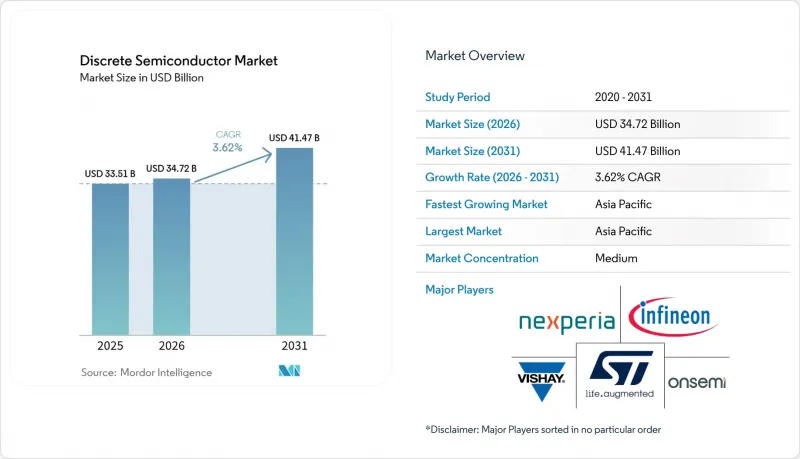
Mordor Intelligence에 의하면, 2026년 디스크리트 반도체 시장 규모는 347억 2,000만 달러로 추정되고 2025년 335억 1,000만 달러에서 확대해, 2031년에는 414억 7,000만 달러에 이를 것으로 예측됩니다.
2026-2031년 동안의 연평균 성장률(CAGR)은 3.62%를 나타낼 전망입니다.

본 보고서는 디바이스 유형별(다이오드, 소신호 트랜지스터, 기타), 최종 사용자 산업별(자동차, 가전, 기타), 소재별(실리콘, 실리콘 카바이드, 갈륨 나이탈리아드), 정격 출력별(저출력, 중출력, 고출력),지역별(북미, 남미, 유럽, 아시아태평양, 중동 및 아프리카)로 분류되어 있습니다. 시장 예측은 금액(달러)으로 표시되어 있습니다.
세계의 디스크리트 반도체 시장 동향 및 인사이트
자동차 전동화의 물결
배터리식 전기차와 플러그인 하이브리드 전기차에는 내연기관 차량에 비해 3-5배에 달하는 동력용 디스크리트 반도체가 탑재되어 있으며, 차량당 탑재량이 증가하고 있을 뿐만 아니라, 디스크리트 반도체 시장을 가전 시장의 경기 변동 영향으로부터 격리시키고 있습니다. 800V 고전압 구동 시스템에서는 인버터의 손실을 줄이고 배선 하네스의 경량화를 가능하게 하는 고속 스위칭 MOSFET 및 SiC 다이오드가 필수적입니다. 자동차 제조업체와 파운드리 파트너 간의 장기 조달 계약을 통해 AEC-Q101 인증 디바이스의 안정적인 공급이 확보되고 있습니다. 모터 및 액추에이터 공급업체에 의한 수직 통합형 인수는 드라이버 IC, 게이트 모듈, 열 인터페이스에 대한 보다 엄격한 관리를 뒷받침하고 있습니다. 충전 인프라가 350kW로 전환됨에 따라, 차량 탑재용 충전기는 효율성과 기판 공간 절약의 관점에서 와이드 밴드갭 디스크리트 소자를 선호하는 고주파 토폴로지로 전환되고 있습니다. 인증 주기와 무결점에 대한 기대가 높아짐에 따라 진입 장벽이 높아지고 있으며, 품질을 중시하는 공급업체들이 유리한 입지를 유지하고 있습니다.
SiC 소자의 비용 곡선과 IGBT의 비용 곡선의 교차점
150mm에서 200mm SiC 웨이퍼로의 전환, 기판의 얇아짐, 에피택셜 수율 향상에 따른 비용 절감으로 인해 1cm²당 비용이 낮아져, SiC MOSFET은 600-1,200V급에서 트렌치형 IGBT와 동등한 가격 수준에 근접하고 있습니다. 플라운호퍼 IISB의 ‘ThinSiCPower’와 같은 조사 프로그램에서는 설계된 기판과 후면 냉각을 통해 디바이스 수준의 비용을 25% 절감하는 데 성공했습니다. 중국의 기판 제조업체는 6인치 SiC 웨이퍼 가격을 400달러 이하로 낮춰, 2024년 초에 비해 30%의 가격 하락을 실현했습니다. 비용 곡선의 하락으로 인해 태양광 발전용 인버터, 산업용 드라이브, 데이터센터의 전원 셸프에 걸친 총 잠재 시장(TAM)이 확대되고 있습니다. 디바이스 공급업체들은 게이트 드라이버 ASIC 및 온도 센서를 하프 브리지 모듈에 통합하고 있으며, 이를 통해 시스템 설계자는 인증 기간을 단축하고 시장 출시 시간을 단축할 수 있게 되었습니다.
IC 수준의 집적화에 따른 디스크리트 부품의 침식
현재, 전력 관리 IC에는 저전압 MOSFET, 전류 감지 션트, 보호 회로가 통합되어 있어 스마트폰 및 노트북의 부품 비용이 절감되고 있습니다. 치플릿 아키텍처는 이러한 추세를 서버 마더보드 분야로까지 확대하고 있으며, 설계자는 단일 패키지에 질화갈륨(GaN) 드라이버 다이와 로직 클러스터를 통합할 수 있게 되었습니다. 저전력 소비자용 제품의 경우, 저가 제품군이 독립형 개별 부품에서 모노리식 레귤레이터로 전환되면서 판매량 증가세가 둔화되고 있습니다. 그러나 고출력 영역에서는 개별 부품의 중요성이 여전히 유지되고 있습니다. 고전압 스위치와 제어용 실리콘을 물리적으로 분리함으로써 열 마진과 전자기 호환성이 확보되기 때문입니다. 그 결과, 캐니발리제이션 효과는 비대칭적으로 나타납니다. 즉, 60V 이하의 저전류 디스크리트 부품에는 제약을 주는 반면, 650V 이상에서 작동하는 트랙션 인버터나 그리드 타이 컨버터에 미치는 영향은 제한적입니다.
부문별 분석
파워 MOSFET은 2025년 디스크리트 반도체 시장 규모에서 33.95%의 점유율을 차지했으며, 전동 운송 기기, 데이터센터의 전원 셸프, 재생에너지용 인버터에서 고속 스위칭 및 저손실 토폴로지가 요구됨에 따라 연평균 성장률(CAGR) 5.36%로 성장하고 있습니다. 디스크리트 반도체 시장은 낮은 RDS(on)과 애벌랜치 내성을 겸비한 트렌치 게이트 아키텍처의 이점을 누리고 있으며, 48V 서버 백플레인에서 소형 DC-DC 컨버터의 구현을 가능하게 하고 있습니다. 커퍼 클립과 탑사이드 냉각 패키징은 본딩 와이어 설계에 비해 열 저항을 최대 20K/W까지 감소시켜, 반복되는 전류 스파이크 하에서 수명을 연장합니다. 쇼트키 다이오드와 초고속 정류기는 여전히 PFC 단계에서 주류 솔루션이지만, SiC 하프 브리지 내에 여러 체크포인트가 집적됨에 따라 그 점유율은 서서히 확대되고 있습니다.
소신호 트랜지스터 수요는 비용과 기판 밀도가 순수한 효율보다 우선시되는 소비자용 IoT 용도를 중심으로 안정적입니다. 사이리스터의 출하량은 조명용 밸러스트 부문에서 감소하고 있지만, 특히 정적 스위치나 크로우바 보호 등 계통 측에서의 역할은 유지되고 있습니다. 이산 반도체 시장은 범용 저전압 부품과 가격 프리미엄이 붙는 성능 중심의 고전류 스위치 사이에서 양극화가 계속 진행되고 있습니다. 각 IDM 기업은 MOSFET 리드 프레임에 통합형 게이트 드라이버 및 전류 감지 증폭기를 결합하여 제품 라인을 다각화하고, 자동차용 트랙션 및 산업용 서보 드라이브의 설계 주기를 단축하고 있습니다.
2025년에는 자동차 용도가 디스크리트 반도체 시장 점유율의 25.55%를 차지했으며, 2031년까지 연평균 성장률(CAGR) 4.86%를 기록하며 다른 모든 부문을 능가하는 성장을 이뤘습니다. 배터리식 전기 구동의 보급으로 인해 트랙션 인버터, 자동차 충전기, 보조 펌프에 사용되는 파워 스위치의 수가 두 배로 증가하여, 전 세계 경차 판매 대수가 변동하는 상황에서도 지속적인 단위 수 증가를 뒷받침하고 있습니다. LiDAR에서 고해상도 레이더에 이르는 ADAS 부문에서는 감지 범위를 확대하기 위해 GaN 디스크리트 증폭기가 탑재되어 있으며, 이는 콘텐츠량의 점진적인 확대를 뒷받침하고 있습니다. 또한, 디스크리트 반도체 시장은 섀시 제어에서 SOC 통합보다 디스크리트 부품의 절연을 우선시하는 엄격한 기능 안전 규제의 혜택도 받고 있습니다.
가전제품은 출하량 기준 2위를 유지하고 있지만, 고도로 집적화된 PMIC가 디스크리트 부품 수요를 잠식하고 있어 성장률은 한 자릿수 초반에 머물고 있습니다. 통신 인프라에 대한 투자로 인해 5G 원격 라디오 헤드용 고전압 정류기 및 GaN RF 트랜지스터 수요가 뒷받침되고 있습니다. 산업용 자동화 부문에서는 가변 주파수 드라이브 및 무정전 전원 장치(UPS)용으로 IGBT와 SiC 다이오드의 채택이 계속해서 견조한 추세를 보이고 있습니다.
지역별 분석
아시아태평양은 2025년에 43.05%의 점유율로 디스크리트 반도체 시장을 독점하며, 2031년까지 연평균 성장률(CAGR) 5.23%로 가장 빠르게 성장하는 지역으로 남아 있습니다. 중국의 정부 주도 파운드리 지원 정책과 일본의 소재 및 패키징 부문에서의 주도적인 역할이 지속적인 투자를 뒷받침하고 있습니다. 아시아의 OSAT 기업들은 국내 전기차(EV) 및 전원 공급 장치 OEM의 파이프라인에 대응하기 위해 구리 클립과 성형 SiC 모듈의 생산 규모를 확대되고 있습니다. 정부의 탄소 중립을 향한 로드맵에 따라, 공공 자금이 첨단 인버터 및 충전기 프로그램에 투입되면서 현지 수요는 견조한 추세를 보이고 있습니다.
북미에서는 520억 달러 규모의 ‘CHIPS and Science Act(칩스 앤 사이언스 법)’를 활용하여 성숙 노드 및 와이드 밴드갭 생산 라인을 국내로 복귀시키고 있지만, 비용 구조는 여전히 아시아의 팹보다 약 35% 높은 수준입니다. 그 결과, 디스크리트 반도체 공급업체들은 ‘트윈 팹’ 전략을 채택하여 주요 용도의 생산을 미국과 말레이시아 거점으로 분산함으로써 지정학적 요인과 경제적 요인의 균형을 맞추고 있습니다. 미국의 자동차 Tier 1 공급업체와 방위용 전자기기 공급업체는 ITAR(국제무기거래규정) 및 사이버 보안 규정 준수를 위해 국내 조달을 중시하고 있으며, 이로 인해 지역 팹에는 보호된 틈새 시장이 확보되고 있습니다.
유럽은 ‘EU 칩 법’을 통해 2030년까지 전 세계 반도체 생산 능력의 20%를 차지하는 것을 목표로 하고 있으며, 그린딜의 우선 과제인 에너지 효율이 높은 파워 디바이스에 중점을 두고 있습니다. 현지 IDM 기업들은 자동차 제조업체와의 지리적 근접성과 SiC를 활용한 고효율 컨버터를 뒷받침하는 전력망 현대화 이니셔티브를 활용하여 사업을 전개하고 있습니다.
한편, 중동 및 아프리카와 남미는 디스크리트 반도체 시장 전체에서 차지하는 비중이 한 자릿수에 그치고 있지만, 인프라 정비와 재생에너지 도입을 통해 고성장 마이크로 클러스터가 형성되고 있으며, 세계 기업들은 유통망 및 설계 지원 허브를 통해 이에 대응하고 있습니다.
기타 혜택
- 엑셀 형식 시장 예측(ME) 시트
- 3개월간의 애널리스트 지원
자주 묻는 질문
목차
제1장 서론
제2장 조사 방법
제3장 주요 요약
제4장 시장 구도
제5장 시장 규모 및 성장 예측
제6장 경쟁 구도
제7장 시장 기회 및 향후 전망
KTH 26.09.08According to Mordor Intelligence, discrete semiconductor market size in 2026 is estimated at USD 34.72 billion, growing from 2025 value of USD 33.51 billion with 2031 projections showing USD 41.47 billion, growing at 3.62% CAGR over 2026-2031.
This report is Segmented by Device Type (Diode, Small-Signal Transistor, and More), End-User Vertical (Automotive, Consumer Electronics, and More), Material (Silicon, Silicon-Carbide, Gallium-Nitride), Power Rating (Low-Power, Mid-Power, High-Power), and Geography (North America, South America, Europe, Asia-Pacific, Middle East, and Africa). The Market Forecasts are Provided in Terms of Value (USD).
Global Discrete Semiconductor Market Trends and Insights
Automotive Electrification Wave
Battery-electric and plug-in hybrid vehicles embed 3-5 times more power discretes than internal-combustion models, lifting content per car and insulating the discrete semiconductor market from consumer-electronics cyclicality. High-voltage 800 V drivetrains rely on fast-switching MOSFETs and SiC diodes that cut inverter losses and enable lighter wiring looms. Long-term sourcing agreements between automakers and foundry partners ensure supply continuity for AEC-Q101-qualified devices. Vertical acquisitions by motor and actuator suppliers underpin tighter control over driver ICs, gate modules, and thermal interfaces. As charging infrastructure migrates to 350 kW rates, vehicle onboard chargers shift toward higher-frequency topologies that favor wide-bandgap discretes for efficiency and board-space savings. Certification cycles and zero-defect expectations raise entry barriers, keeping quality-focused vendors in a favorable position.
SiC Device Cost Curve Crossing IGBT
Cost reductions from 150 mm to 200 mm SiC wafer transition, substrate-thinning, and higher epitaxial yields lower USD/cm2 and move SiC MOSFETs toward parity with trench IGBTs in 600-1,200 V classes. Research programs such as Fraunhofer IISB's ThinSiCPower demonstrate 25% device-level cost cuts through engineered substrates and backside cooling. Chinese substrate houses have pushed 6-inch SiC wafer pricing below USD 400, a 30% drop versus early 2024. The falling cost curve broadens the total addressable market across photovoltaic inverters, industrial drives, and data-center power shelves. Device vendors are integrating gate-driver ASICs and temperature sensors into half-bridge modules, enabling system designers to shorten qualification timelines and accelerate time-to-market.
IC-Level Integration Cannibalising Discretes
Power-management ICs now embed low-voltage MOSFETs, current-sense shunts, and protection circuitry, shrinking the bill of materials in smartphones and laptops. Chiplet architectures extend this trend to server motherboards, letting designers integrate gallium-nitride driver die alongside logic clusters within a single package. For low-power consumer products, the value line migrates from stand-alone discretes toward monolithic regulators, tempering volume growth. Yet high-power zones maintain discrete relevance. Physical separation of high-voltage switches from control silicon safeguards thermal margins and electromagnetic compliance. Consequently, the cannibalization effect is asymmetric: it constrains sub-60 V low-current discretes but has limited reach into traction inverters or grid-tie converters that operate above 650 V.
Other drivers and restraints analyzed in the detailed report include:
- 5G Radio PA Module Proliferation
- Renewable-Energy Inverters Demand
- Cyclical Cap-Ex Over-Supply Risk
For complete list of drivers and restraints, kindly check the Table Of Contents.
Segment Analysis
Power MOSFETs held a 33.95% share of the discrete semiconductor market size in 2025 and are growing at a 5.36% CAGR as electrified transport, data-center power shelves, and renewable inverters demand fast-switching, low-loss topologies. The discrete semiconductor market benefits from trench-gate architectures that combine lower RDS(on) with avalanche ruggedness, enabling compact DC-DC converters in 48 V server backplanes. Copper-clip and top-side-cooling packages lower thermal resistance by as much as 20 K/W versus bond-wire designs, lengthening lifetime under repetitive current spikes. Schottky diodes and ultrafast rectifiers remain workhorse solutions in PFC stages, though their share grows modestly as integration packs multiple checkpoints inside SiC half-bridges.
Demand for small-signal transistors stabilizes around consumer IoT applications where cost and board density trump raw efficiency. Thyristor volumes fall in lighting ballasts yet sustain grid-side roles, particularly static switches and crowbar protection. The discrete semiconductor market continues to bifurcate between commodity low-voltage parts and performance-critical high-current switches that command price premiums. IDMs diversify by pairing MOSFET lead frames with integrated gate drivers and current-sense amplifiers, shortening design cycles for vehicle traction and industrial servo drives.
Automotive applications accounted for 25.55% of the discrete semiconductor market share in 2025, outpacing all other verticals with a 4.86% CAGR through 2031. Battery-electric propulsion multiplies the count of power switches in traction inverters, on-board chargers, and auxiliary pumps, supporting persistent unit growth even as global light-vehicle sales fluctuate. ADAS domains, from LiDAR to high-definition radar, integrate discrete GaN amplifiers to extend detection range, feeding incremental content growth. The discrete semiconductor market also benefits from stringent functional-safety regulations that favor discrete component isolation over SOC integration in chassis control.
Consumer electronics retain second-place volume but sit at low-single-digit growth because highly integrated PMICs cannibalize discrete sockets. Communication-infrastructure expenditure reinforces demand for high-voltage rectifiers and GaN RF transistors in 5G remote radio heads. Industrial automation remains a steady adopter of IGBTs and SiC diodes for variable-frequency drives and uninterruptible power supply systems.
Complete Report Scope:
- By Device Type
- Diode
- Small-Signal Transistor
- Power Transistor
- MOSFET Power Transistor
- IGBT Power Transistor
- Other Power Transistor
- Rectifier
- Thyristor
- By End-user Vertical
- Automotive
- Consumer Electronics
- Communication Infrastructure
- Industrial
- Other End-user Verticals
- By Material
- Silicon
- Silicon-Carbide (SiC)
- Gallium-Nitride (GaN)
- By Power Rating
- Low-power (<20 V)
- Mid-power (20 - 600 V)
- High-power (>600 V)
- By Geography
- North America
- United States
- Canada
- Mexico
- South America
- Brazil
- Argentina
- Rest of South America
- Europe
- Germany
- United Kingdom
- France
- Russia
- Rest of Europe
- Asia-Pacific
- China
- Japan
- India
- South Korea
- South-East Asia
- Rest of Asia-Pacific
- Middle East and Africa
- Middle East
- Saudi Arabia
- United Arab Emirates
- Rest of Middle East
- Africa
- South Africa
- Egypt
- Rest of Africa
- Middle East
- North America
Geography Analysis
Asia-Pacific dominated the discrete semiconductor market in 2025 with a 43.05% share and remains the fastest-growing region at a 5.23% CAGR through 2031. State-backed foundry incentives in China and Japan's stewardship in materials and packaging underpin sustained investment. Asian OSATs scale copper-clip and molded SiC modules that cater to domestic EV and power-supply OEM pipelines. Government carbon-neutrality roadmaps channel public funding toward advanced inverter and charger programs, keeping local demand robust.
North America leverages the USD 52 billion CHIPS and Science Act to reshore mature-node and wide-bandgap lines, yet cost structures remain about 35% higher than Asian fabs. Consequently, discrete semiconductor vendors adopt a "twin-fab" strategy, splitting critical-application output between U.S. and Malaysian sites to balance geopolitics and economics. Automotive Tier-1 and defense electronics suppliers in the United States value domestic sourcing for ITAR and cybersecurity compliance, giving regional fabs a protected niche.
Europe targets a 20% global semiconductor capacity share by 2030 through the EU Chips Act, emphasizing energy-efficient power devices for green-deal priorities. Local IDMs capitalize on automotive customer proximity and grid modernization initiatives that favor SiC-enabled high-efficiency converters.
Meanwhile, the Middle East and Africa, plus South America, together represent a single-digit percentage of the discrete semiconductor market, yet infrastructure roll-outs and renewable adoption generate high-growth micro-clusters that global players address through distributor networks and design-in support hubs.
- Infineon Technologies AG
- ON Semiconductor Corporation
- Vishay Intertechnology Inc.
- STMicroelectronics N.V.
- Nexperia B.V.
- Rohm Co., Ltd.
- Diodes Incorporated
- Mitsubishi Electric Corporation
- Fuji Electric Co., Ltd.
- Littelfuse Inc.
- Texas Instruments Incorporated
- Toshiba Electronic Devices & Storage Corporation
- ABB Ltd.
- Hitachi Energy Ltd.
- Eaton Corporation plc
- NXP Semiconductors N.V.
- Semikron Danfoss GmbH & Co. KG
- Renesas Electronics Corporation
- Microchip Technology Inc.
- Wolfspeed Inc.
- Qorvo Inc.
- WeEn Semiconductors Co., Ltd.
- Analog Devices Inc.
- Power Integrations Inc.
- Skyworks Solutions Inc.
- Alpha & Omega Semiconductor Ltd.
Additional Benefits:
- The market estimate (ME) sheet in Excel format
- 3 months of analyst support
TABLE OF CONTENTS
1 INTRODUCTION
- 1.1 Study Assumptions and Market Definition
- 1.2 Scope of the Study
2 RESEARCH METHODOLOGY
3 EXECUTIVE SUMMARY
4 MARKET LANDSCAPE
- 4.1 Market Overview
- 4.2 Market Drivers
- 4.2.1 Automotive electrification wave
- 4.2.2 Renewable-energy inverters demand
- 4.2.3 5 G radio PA module proliferation
- 4.2.4 SiC device cost curve crossing IGBT
- 4.2.5 Regionalization of power-module supply chains
- 4.2.6 Adoption of advanced copper clip packages
- 4.3 Market Restraints
- 4.3.1 IC-level integration cannibalising discretes
- 4.3.2 Cyclical cap-ex over-supply risk
- 4.3.3 Thermal-runaway reliability concerns in SiC diodes
- 4.3.4 Tight EU eco-design rules on standby losses
- 4.4 Impact of Macroeconomic Factors on the Market
- 4.5 Industry Value Chain Analysis
- 4.6 Regulatory Landscape
- 4.7 Technological Outlook
- 4.8 Porter's Five Forces Analysis
- 4.8.1 Bargaining Power of Suppliers
- 4.8.2 Bargaining Power of Buyers
- 4.8.3 Threat of New Entrants
- 4.8.4 Threat of Substitute Products
- 4.8.5 Intensity of Competitive Rivalry
- 4.9 Investment Analysis
5 MARKET SIZE AND GROWTH FORECASTS (VALUE)
- 5.1 By Device Type
- 5.1.1 Diode
- 5.1.2 Small-Signal Transistor
- 5.1.3 Power Transistor
- 5.1.3.1 MOSFET Power Transistor
- 5.1.3.2 IGBT Power Transistor
- 5.1.3.3 Other Power Transistor
- 5.1.4 Rectifier
- 5.1.5 Thyristor
- 5.2 By End-user Vertical
- 5.2.1 Automotive
- 5.2.2 Consumer Electronics
- 5.2.3 Communication Infrastructure
- 5.2.4 Industrial
- 5.2.5 Other End-user Verticals
- 5.3 By Material
- 5.3.1 Silicon
- 5.3.2 Silicon-Carbide (SiC)
- 5.3.3 Gallium-Nitride (GaN)
- 5.4 By Power Rating
- 5.4.1 Low-power (< 20 V)
- 5.4.2 Mid-power (20 - 600 V)
- 5.4.3 High-power (> 600 V)
- 5.5 By Geography
- 5.5.1 North America
- 5.5.1.1 United States
- 5.5.1.2 Canada
- 5.5.1.3 Mexico
- 5.5.2 South America
- 5.5.2.1 Brazil
- 5.5.2.2 Argentina
- 5.5.2.3 Rest of South America
- 5.5.3 Europe
- 5.5.3.1 Germany
- 5.5.3.2 United Kingdom
- 5.5.3.3 France
- 5.5.3.4 Russia
- 5.5.3.5 Rest of Europe
- 5.5.4 Asia-Pacific
- 5.5.4.1 China
- 5.5.4.2 Japan
- 5.5.4.3 India
- 5.5.4.4 South Korea
- 5.5.4.5 South-East Asia
- 5.5.4.6 Rest of Asia-Pacific
- 5.5.5 Middle East and Africa
- 5.5.5.1 Middle East
- 5.5.5.1.1 Saudi Arabia
- 5.5.5.1.2 United Arab Emirates
- 5.5.5.1.3 Rest of Middle East
- 5.5.5.2 Africa
- 5.5.5.2.1 South Africa
- 5.5.5.2.2 Egypt
- 5.5.5.2.3 Rest of Africa
- 5.5.5.1 Middle East
- 5.5.1 North America
6 COMPETITIVE LANDSCAPE
- 6.1 Market Concentration
- 6.2 Strategic Moves
- 6.3 Market Share Analysis
- 6.4 Company Profiles {(includes Global level Overview, Market level overview, Core Segments, Financials as available, Strategic Information, Market Rank/Share for key companies, Products and Services, and Recent Developments)}
- 6.4.1 Infineon Technologies AG
- 6.4.2 ON Semiconductor Corporation
- 6.4.3 Vishay Intertechnology Inc.
- 6.4.4 STMicroelectronics N.V.
- 6.4.5 Nexperia B.V.
- 6.4.6 Rohm Co., Ltd.
- 6.4.7 Diodes Incorporated
- 6.4.8 Mitsubishi Electric Corporation
- 6.4.9 Fuji Electric Co., Ltd.
- 6.4.10 Littelfuse Inc.
- 6.4.11 Texas Instruments Incorporated
- 6.4.12 Toshiba Electronic Devices & Storage Corporation
- 6.4.13 ABB Ltd.
- 6.4.14 Hitachi Energy Ltd.
- 6.4.15 Eaton Corporation plc
- 6.4.16 NXP Semiconductors N.V.
- 6.4.17 Semikron Danfoss GmbH & Co. KG
- 6.4.18 Renesas Electronics Corporation
- 6.4.19 Microchip Technology Inc.
- 6.4.20 Wolfspeed Inc.
- 6.4.21 Qorvo Inc.
- 6.4.22 WeEn Semiconductors Co., Ltd.
- 6.4.23 Analog Devices Inc.
- 6.4.24 Power Integrations Inc.
- 6.4.25 Skyworks Solutions Inc.
- 6.4.26 Alpha & Omega Semiconductor Ltd.
7 MARKET OPPORTUNITIES AND FUTURE OUTLOOK
- 7.1 White-space and Unmet-Need Assessment