

|
시장보고서
상품코드
2123468
인도의 수탁 제조 기관(CMO) 시장 : 점유율 분석, 업계 동향과 통계, 성장 예측(2026-2031년)India Contract Manufacturing Organization (CMO) - Market Share Analysis, Industry Trends & Statistics, Growth Forecasts (2026 - 2031) |
||||||
 Mordor Intelligence
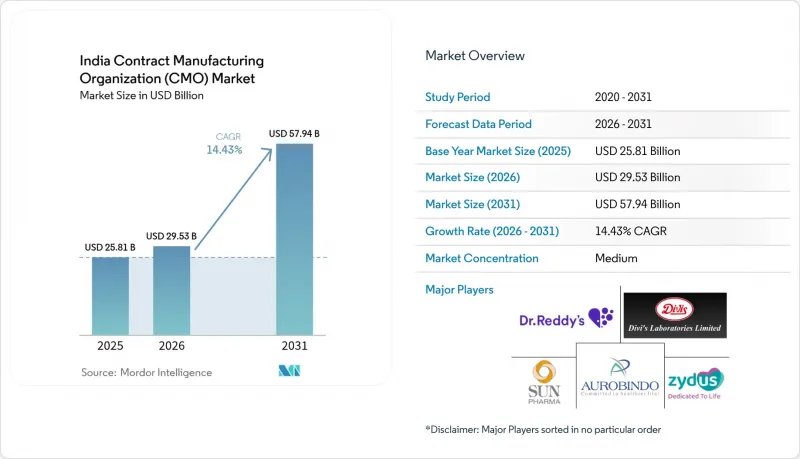
Mordor Intelligence에 의하면, 인도 수탁 제조 기관(CMO) 시장 규모는 2025년에 258억 1,000만 달러로 평가되었고 2026년 295억 3,000만 달러에서 2031년까지 579억 4,000만 달러에 이를 것으로 예측되며, 예측 기간(2026-2031년) CAGR은 14.43%를 나타낼 전망입니다.
본 보고서는 서비스 유형(API 및 중간체, 완제), 분자 유형(저분자, 고분자/바이오의약품), 최종 사용자(대형 제약사, 중견 제약사, 가상 제약사/스타트업), 치료 분야(종양학, 심혈관, 기타), 제조 규모(전임상, 임상, 상업 생산)별로 분류되어 있습니다. 시장 전망은 금액(달러) 기준으로 제시됩니다.
인도 수탁 제조 기관(CMO) 시장 동향 및 인사이트
확대되는 바이오의약품 아웃소싱 프로젝트
각 스폰서 기업이 품질을 저해하지 않으면서 저비용 입지를 추구하는 가운데, 인도는 전 세계 바이오의약품 수탁 제조 계약에서 점유율을 확대되고 있습니다. 2025년, 오리진(Origen)은 유전체 밸리에 70,000제곱피트 규모의 단일클론 항체 제조 공장을 개설했는데, 이는 업계가 포유류 세포 배양 전문 기술로 무게 중심을 옮기고 있음을 보여줍니다. 진입 장벽이 여전히 높기 때문에 전문 시설은 프리미엄 가격을 책정할 수 있지만, 그럼에도 인도는 유럽과 미국의 비용 구조보다 낮습니다. CDSCO의 ‘스케줄 M’으로의 등급 상향 조정으로 미국 FDA 및 EMA 기준과의 부합성이 확보되어, 다국적 기업에게 중요한 조달 장벽이 제거되었습니다. 그 결과, 바이오의약품 프로젝트의 계약 규모가 확대되고 재수주도 증가하고 있습니다. 따라서 이 분야에서는 2030년까지 지속적인 두 자릿수 성장이 예상됩니다.
복잡한 주사제에 대한 활발한 수요
무균 제조의 복잡성과 전 세계 생산 능력의 제약으로 인해 주사제 수주는 인도의 CDMO로 집중되고 있습니다. 사노피가 하이데라바드에서 추진 중인 4억 3,700만 달러 규모의 확장 계획은 프리필드 주사기 및 동결건조 항암제에 초점을 맞추고 있어, 현지 전문 지식에 대한 높은 신뢰를 입증하고 있습니다. 한편, 국내 기업들도 고활성 중간체를 위한 발효 설비를 동시에 확충하고 있습니다. 안전 규제로 인해 엄격한 환경 관리가 의무화되어 있고, 다른 아시아 거점에서의 리드타임이 여전히 길기 때문에 프리미엄 가격 책정이 지속되고 있습니다. 이 부문은 복잡한 전달 시스템이 필수적인 맞춤형 의료로 향하는 세계적 흐름과 부합합니다. 이러한 상황으로 인해 향후 2년간 높은 이익률 전망이 유지될 것으로 보입니다.
중국 공급에 연동되는 원자재 가격 변동
인도의 주요 원료 중 70% 이상을 중국이 공급하고 있으며, 2024년 환경 규제 강화로 인해 중간체의 비용이 20-30% 상승했습니다. 이익률 압박으로 인해 CDMO 각사는 장기 계약 재협상을 피할 수 없게 되어, 고객과의 관계에 균열이 생기고 있습니다. PLI 파크에서는 국내산 원료 공급이 보장되어 있지만, 생산 규모 확대에는 수년이 소요됩니다. 헤지 전략이나 이중 조달로 인해 간접비가 증가하여 단기적인 수익성을 압박하고 있습니다. 또한, 스폰서 측은 가격 전망이 개선될 때까지 수년에 걸친 계약 체결을 보류할 가능성이 있습니다.
기타 혜택:
- 엑셀 형식 시장 예측(ME) 시트
- 3개월간의 애널리스트 지원
자주 묻는 질문
목차
제1장 서론
제2장 조사 방법
제3장 주요 요약
제4장 시장 구도
제5장 시장 규모와 성장 예측
제6장 경쟁 구도
제7장 시장 기회와 향후 전망
JHS 26.09.09According to Mordor Intelligence, the India contract manufacturing organization market size was valued at USD 25.81 billion in 2025 and estimated to grow from USD 29.53 billion in 2026 to reach USD 57.94 billion by 2031, at a CAGR of 14.43% during the forecast period (2026-2031).
This report is Segmented by Service Type (API and Intermediates, Finished Dose), Molecule Type (Small Molecules, and Large Molecules/Biologics), End-User (Big Pharma, Mid-Size Pharma, and Virtual/Start-ups), Therapeutic Area (Oncology, Cardiovascular, and More), and Manufacturing Scale (Pre-Clinical, Clinical, Commercial). The Market Forecasts are Provided in Terms of Value (USD).
India Contract Manufacturing Organization (CMO) Market Trends and Insights
Growing Biologics Outsourcing Pipeline
India is securing a rising share of global biologics contracts as sponsors pursue lower cost locations without compromising quality. Aurigene opened a 70,000-square-foot monoclonal antibody plant in Genome Valley in 2025, illustrating the industry's pivot toward mammalian cell culture expertise. Specialized facilities command premium pricing because barriers to entry remain high, yet India still undercuts Western cost structures. CDSCO Schedule M upgrades ensure alignment with U.S. FDA and EMA standards, removing a key procurement hurdle for multinational firms. As a result, contract values for biologics projects are lengthening, and repeat orders are climbing. Sustained double-digit growth is therefore expected for this capability set through 2030.
Strong Demand for Complex Injectables
Sterile manufacturing complexity and limited global capacity are funneling injectable assignments toward Indian CDMOs. Sanofi's USD 437 million Hyderabad expansion focuses on pre-filled syringes and lyophilized oncology products, underscoring confidence in local expertise. Domestic players are simultaneously scaling fermentation suites for high-potency intermediates. Premium pricing persists because safety regulations mandate rigorous environmental controls, while lead times from alternate Asian hubs remain long. The segment meshes with global moves toward personalized medicine, where complex delivery systems are essential. These conditions maintain a high-margin outlook over the next two years.
Volatile Raw-Material Prices Linked to China Supply
China supplies more than 70% of India's key starting materials, and 2024 environmental clampdowns raised intermediate costs by 20-30%. Margin compression forces CDMOs to renegotiate long-term contracts, straining client relationships. Although PLI parks promise domestic feedstock, scale-up will take multiple years. Hedging strategies and dual sourcing add overheads, weighing on near-term profitability. Sponsors may also withhold multi-year awards until price visibility improves.
Other drivers and restraints analyzed in the detailed report include:
- Capacity Expansions by Global Big-Pharma in India
- AI-Enabled Process-Development Efficiencies
- Rising FDA Warning Letters to Indian Sites
For complete list of drivers and restraints, kindly check the Table Of Contents.
List of Companies Covered in this Report:
- Divi's Laboratories Limited
- Dr. Reddy's Laboratories Limited
- Sun Pharmaceutical Industries Limited
- Aurobindo Pharma Limited
- Zydus Lifesciences Limited (Cadila Healthcare)
- Cipla Limited
- Lupin Limited
- Jubilant Pharmova Limited
- Biocon Limited
- MSN Laboratories Private Limited
- Viatris Inc. (Mylan Laboratories Ltd.)
- Akums Drugs and Pharmaceuticals Limited
- Wockhardt Limited
- Theon Pharmaceuticals Limited
- BDR Pharmaceuticals International Private Limited
- Ciron Drugs & Pharmaceuticals Private Limited
- Medipaams India Private Limited
- Bharat Biotech International Limited
- Strides Pharma Science Limited
- Alkem Laboratories Limited
Additional Benefits:
- The market estimate (ME) sheet in Excel format
- 3 months of analyst support
TABLE OF CONTENTS
1 INTRODUCTION
- 1.1 Study Assumptions and Market Definition
- 1.2 Scope of the Study
2 RESEARCH METHODOLOGY
3 EXECUTIVE SUMMARY
4 MARKET LANDSCAPE
- 4.1 Market Overview
- 4.2 Market Drivers
- 4.2.1 Growing biologics outsourcing pipeline
- 4.2.2 Strong demand for complex injectables
- 4.2.3 Capacity expansions by global big-pharma in India
- 4.2.4 Government PLI (Production-Linked Incentive) schemes for APIs
- 4.2.5 Venture funding in CDMO start-ups
- 4.2.6 AI-enabled process-development efficiencies
- 4.3 Market Restraints
- 4.3.1 Volatile raw-material prices linked to China supply
- 4.3.2 Rising FDA warning letters to Indian sites
- 4.3.3 Skilled-talent attrition in key clusters
- 4.3.4 Emerging capacity glut in oral-solid dosages
- 4.4 Industry Value Chain Analysis
- 4.5 Regulatory Landscape
- 4.6 Technological Outlook
- 4.7 Porter's Five Forces Analysis
- 4.7.1 Bargaining Power of Suppliers
- 4.7.2 Bargaining Power of Buyers
- 4.7.3 Threat of New Entrants
- 4.7.4 Threat of Substitutes
- 4.7.5 Intensity of Competitive Rivalry
- 4.8 Impact of Macroeconomic Factors on the Market
5 MARKET SIZE AND GROWTH FORECASTS (VALUE)
- 5.1 By Service Type
- 5.1.1 API and Intermediates
- 5.1.2 Finished Dose
- 5.1.2.1 Solids
- 5.1.2.2 Liquids
- 5.1.2.3 Semi-solids and Injectables
- 5.2 By Molecule Type
- 5.2.1 Small Molecules
- 5.2.2 Large Molecules / Biologics
- 5.3 By End-user
- 5.3.1 Big Pharma
- 5.3.2 Mid-Size Pharma
- 5.3.3 Virtual / Start-ups
- 5.4 By Therapeutic Area
- 5.4.1 Oncology
- 5.4.2 Cardiovascular
- 5.4.3 Anti-infectives
- 5.4.4 Central Nervous System (CNS)
- 5.4.5 Other Therapeutic Areas
- 5.5 By Manufacturing Scale
- 5.5.1 Pre-clinical
- 5.5.2 Clinical
- 5.5.3 Commercial
6 COMPETITIVE LANDSCAPE
- 6.1 Market Concentration
- 6.2 Strategic Moves
- 6.3 Market Share Analysis
- 6.4 Company Profiles (includes Global level Overview, Market level overview, Core Segments, Financials as available, Strategic Information, Market Rank/Share for key companies, Products and Services, and Recent Developments)
- 6.4.1 Divi's Laboratories Limited
- 6.4.2 Dr. Reddy's Laboratories Limited
- 6.4.3 Sun Pharmaceutical Industries Limited
- 6.4.4 Aurobindo Pharma Limited
- 6.4.5 Zydus Lifesciences Limited (Cadila Healthcare)
- 6.4.6 Cipla Limited
- 6.4.7 Lupin Limited
- 6.4.8 Jubilant Pharmova Limited
- 6.4.9 Biocon Limited
- 6.4.10 MSN Laboratories Private Limited
- 6.4.11 Viatris Inc. (Mylan Laboratories Ltd.)
- 6.4.12 Akums Drugs and Pharmaceuticals Limited
- 6.4.13 Wockhardt Limited
- 6.4.14 Theon Pharmaceuticals Limited
- 6.4.15 BDR Pharmaceuticals International Private Limited
- 6.4.16 Ciron Drugs & Pharmaceuticals Private Limited
- 6.4.17 Medipaams India Private Limited
- 6.4.18 Bharat Biotech International Limited
- 6.4.19 Strides Pharma Science Limited
- 6.4.20 Alkem Laboratories Limited
7 MARKET OPPORTUNITIES AND FUTURE OUTLOOK
- 7.1 White-Space and Unmet-Need Assessment


