

|
시장보고서
상품코드
2124742
북미의 골판지 포장 시장 : 시장 점유율 분석, 업계 동향 및 통계, 성장 예측(2026-2031년)North America Corrugated Packaging - Market Share Analysis, Industry Trends & Statistics, Growth Forecasts (2026 - 2031) |
||||||
 Mordor Intelligence
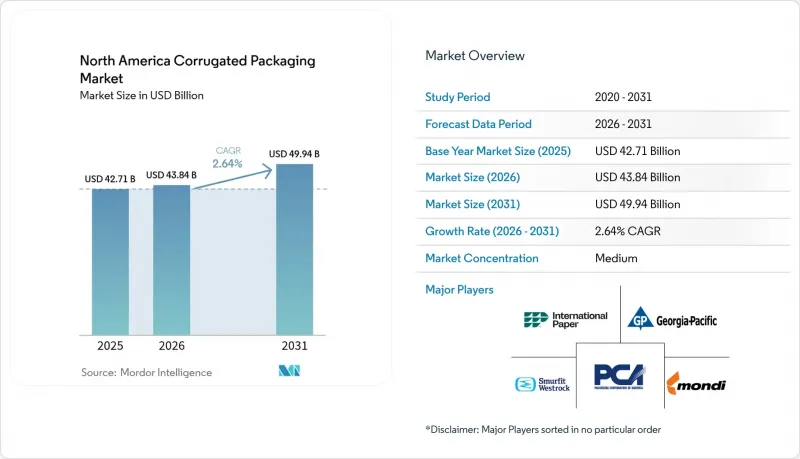
Mordor Intelligence에 의하면, 북미의 골판지 포장 시장 규모는 2025년 427억 1,000만 달러로 평가되었고, 2026년 438억 4,000만 달러에서 2031년까지 499억 4,000만 달러로 확대될 것으로 예측되며, 2026-2031년 연평균 복합 성장률(CAGR)은 2.64%를 나타낼 전망입니다.
본 보고서는 보드 등급별(재활용 컨테이너보드, 버진 크라프트 라이너보드 등), 벽 구조별(싱글월, 트리플월 등), 플루트 유형별(A-플루트, B-플루트 등), 제품 유형별(리지드 박스 등), 최종 사용자 산업별(음료, 종이 제품 등), 인쇄 기술별(디지털 인쇄 등) 및 국가별로 분류되어 있습니다. 시장 예측은 금액(달러) 기준으로 제시되어 있습니다.
북미의 골판지 포장 시장 동향 및 인사이트
전자상거래 소포 처리량의 급증
2025년, 북미의 전자상거래 배송량은 200억 개를 넘어섰으며, 그 중 92%가 골판지 용기로 운송됨에 따라 상자 수요 증가로 직결되었습니다. 미국 우정공사(USPS) 보고서에 따르면, 2025년 상반기 소포 처리량은 전년 동기 대비 7.2% 증가한 반면, 민간 운송업체들은 같은 해 B2C(기업에서 소비자로) 배송에서 12%의 추가 급증을 기록했습니다. 아마존은 2025년 중반까지 지역 네트워크 전체에 200곳 이상의 온디맨드 포장 스테이션을 설치하고, 26유형의 고정 크기 상자 재고를 폐지하는 동시에 소포 1개당 자재 폐기량을 18% 감축했습니다. 전미소매협회(NRF)는 2027년까지 온라인 판매가 미국 소매 총액의 28%를 나타낼 것으로 예측하고 있으며, 오프라인 매장 채널이 정체되더라도 골판지 시장의 지속적인 성장이 예상됩니다. 따라서 풀필먼트 센터에서는 라인 속도가 빠른 무지 크라프트지 슬롯형 컨테이너를 우선적으로 채택하고 있으며, 골판지는 운송용 포장재의 표준으로서 확고한 위치를 차지하고 있습니다.
재활용 가능한 포장으로의 규제 전환 및 플라스틱 금지 조치
2024년 6월에 시행되는 캐나다의 연방 플라스틱 등록 제도에서는 제조업체에 대해 플라스틱 사용량과 재생 소재 함유율 보고를 의무화하고 있지만, 이러한 규정 준수 부담에서 섬유계 포장재는 면제되고 있습니다. 또한 캘리포니아주와 뉴욕주를 포함한 미국 8개 주에서는 2024-2025년 확대 생산자 책임법이 제정되어 재활용이 불가능한 형태의 제품에 대해 톤당 수수료가 부과되고 있으나, 회수율이 89%에 달하는 골판지 상자는 대상에서 제외되어 있습니다. 멕시코시티가 2024년에 발효한 발포 폴리스티렌 식품 용기 금지 조치로 인해, 추정 35,000 쇼트톤 수요가 골판지 클램쉘 용기 및 피자 상자로 이동했습니다. Sustainable Packaging Coalition의 2025년 조사에 따르면, 북미 브랜드 소유자의 73%가 1차 포장을 지정할 때 경량화보다 재활용성을 우선시하는 것으로 나타났습니다. 이러한 정책들의 시너지 효과로 인해 플라스틱에 대한 골판지의 경쟁력이 전반적으로 높아지면서, 외식 산업, 소매점의 테이크아웃 용기, 그리고 소비자 직접 판매 채널에서 소재 전환이 가속화되고 있습니다.
폐골판지(OCC) 및 버진 펄프 가격 변동
재활용 골판지(OCC) 가격은 2025년 2월 1쇼트톤 당 50달러에서 같은 해 9월 90달러로 변동하여 80%에 달하는 변동폭이 발생함으로써 가공업체의 이익률이 압박을 받았습니다. 중국의 재생 섬유 수요 감소로 인해 210만 쇼트톤의 수출 물량이 북미 시장으로 되돌아오면서 국내 시장에 공급이 과잉되어 현물 가격을 하락시켰습니다. 한편, 제지 제조업체들은 2025년 초 골판지용 중심지 생산 능력의 12%를 가동 중단했습니다. 버진 크라프트 라이너 보드 가격은 톤당 620-650달러 전후로 추이하여, 통합형 생산자에게는 유리하지만 제지 자산을 보유하지 않은 무역회사에는 타격을 주는 큰 비용 격차가 발생했습니다. 연간 계약 대신 분기별 가격 재협상이 이루어지게 되면서 불확실성이 높아짐에 따라, 가공 공장의 자본 프로젝트가 지연될 가능성이 있습니다. 수출 경로가 회복되거나 국내에서 새로운 생산 능력이 가동되지 않는 한, 섬유 가격 변동에 따른 이익률 압박은 지속될 것입니다.
부문별 분석
2025년, 재활용 골판지는 북미 골판지 포장 시장 점유율의 68.34%를 차지했으며, 해당 지역의 성숙한 재생 섬유 네트워크의 유효성이 입증되었습니다. 이 등급의 비용 우위와 89%의 회수율 덕분에, 총 도착 비용을 중요시하는 식료품, 음료, 전자상거래 사업자들 사이에서는 여전히 기본 선택지로 자리 잡고 있습니다. 한편, 화장품, 밀키트, 가전 브랜드들이 더 밝은 인쇄면과 내유성 코팅을 요구함에 따라, 세미케미컬 및 특수 기질은 2031년까지 3.31%라는 가장 높은 연평균 성장률(CAGR)을 나타낼 전망입니다. 이러한 고품질 표면으로의 전환에 따라 통합 제지 제조업체들은 특수 기계의 병목 현상 해소를 추진하고 있으며, D2C(소비자 직접 판매) 채널을 위한 컨버터와의 장기 계약 확보에 나서고 있습니다.
북미 골판지 포장 시장에서 재활용 등급에 대한 수요는 여전히 완만하게 확대될 전망입니다. 이는 가공식품 취급량 증가가 프리미엄 원자재로 유출되는 시장 점유율을 상회하기 때문입니다. 버진 크라프트 라이너 보드는 적재 강도로 인해 긴 운송 시간을 보완해야 하는 수출용 목재 상자나 중공업용 화물에 여전히 필수적이지만, 비용이 40% 더 비싸다는 점이 더 광범위한 사용을 제한하고 있습니다. 재활용 등급에서도 경량화가 진행되고 있으며, 특히 의류 제품 운송에서 라이너의 평량(tso)이 47파운드에서 42파운드로 변경됨에 따라 그 매력이 더욱 확대되고 있습니다. 전반적으로, 기판 전략을 좌우하는 것은 더 이상 원료의 총 톤수가 아니라 브랜드별 세분화이며, 동일한 기계로 브라운 등급과 화이트 탑 등급을 전환할 수 있는 제지 제조업체는 생산 일정의 유연성을 높일 수 있습니다.
2025년에는 출하된 품목의 68%가 20파운드 미만이었기 때문에 싱글월 구조의 제품이 지역 매출의 59.76%를 차지했습니다. 이 제품들은 32 ECT의 강도로 충분하며, 고속 자동화로 인해 얇은 두께가 선호되는 소포, 소매용 및 경공업용 케이스에서 여전히 주력 제품으로 자리 잡고 있습니다. 3중 벽 구조는 2026년부터 2031년까지 3.28%라는 가장 높은 연평균 성장률(CAGR)을 보일 것으로 예측됩니다. 이는 니어쇼어화된 자동차 및 기계 생산에서 엔진 블록이나 무거운 주물 제품에 275파운드의 ECT 강도가 요구되기 때문입니다. 멕시코 북부와 미국 남부 국경 지역에서는 새로운 조립 공장이 해상 운송 및 복합 운송을 위해 더 두꺼운 상자를 지정하고 있어, 이 구조의 채택 확대가 두드러지게 나타나고 있습니다.
더블월 구조는 양극단 사이의 중간에 위치하며, 싱글월로는 너무 무겁지만 트리플월의 비용 대비 효율이 떨어지는 가전제품, 벌크 식품, 콜드체인 화물을 보호합니다. 월마트의 48-ECT 팔레트 의무화는 이미 일부 식료품 부문에서 싱글월에서 더블월로의 전환을 촉진하고 있습니다. 한편, 풀필먼트 센터가 부피 중량을 줄여나가는 가운데, 마이크로 플루트 기술의 혁신으로 인해 싱글월의 저가 시장이 잠식되고 있어, 주류 카테고리 내에서도 시장 점유율의 변동이 나타나고 있습니다. 동일한 골판지 성형기 라인에서 여러 가지 두께 유형을 생산할 수 있는 제조업체는 설비 가동률을 높이고, 리드 타임을 연장하지 않으면서도 변화하는 고객의 강도 사양에 대응할 수 있습니다.
기타 혜택 :
- 엑셀 형식 시장 예측(ME) 시트
- 3개월간의 애널리스트 지원
자주 묻는 질문
목차
제1장 서론
제2장 조사 방법
제3장 주요 요약
제4장 시장 구도
제5장 시장 규모 및 성장 예측
제6장 경쟁 구도
제7장 시장 기회 및 향후 전망
AJY 26.09.15According to Mordor Intelligence, the North America corrugated packaging market size is projected to expand from USD 42.71 billion in 2025 and USD 43.84 billion in 2026 to USD 49.94 billion by 2031, registering a CAGR of 2.64% between 2026 to 2031.

This report is Segmented by Board Grade (Virgin Kraft Linerboard, and More), Wall Type (Single Wall, Triple Wall, and More), Flute Type (A-Flute, B-Flute, and More), Product Type (Rigid Boxes, and More), End-User Industry (Beverages, Paper Products, and More), Printing Technology (Digital Printing, and More), and Country. The Market Forecasts are Provided in Terms of Value (USD).
North America Corrugated Packaging Market Trends and Insights
Surge in E-commerce Parcel Volumes
E-commerce shipments in North America topped 20 billion parcels in 2025, and 92% moved in corrugated containers, directly translating into higher box demand. The United States Postal Service reported a 7.2% year-over-year rise in package volume during the first half of 2025, while private carriers absorbed an additional 12% jump in business-to-consumer deliveries the same year. Amazon installed more than 200 on-demand packaging stations across its regional network by mid-2025, eliminating inventory of 26 fixed box sizes and cutting material waste by 18% per parcel. The National Retail Federation projects online sales will reach 28% of total United States retail by 2027, ensuring sustained corrugated growth even if brick-and-mortar channels stabilize. Fulfillment centers are therefore prioritizing plain kraft slotted containers that run at higher line speeds, reinforcing corrugated's position as the default transport medium.
Regulatory Shift Toward Recyclable Packaging and Plastic Bans
Canada's Federal Plastics Registry, effective June 2024, requires producers to report plastic volumes and recycled content, a compliance burden that fiber packaging is exempt from. Eight United States states, including California and New York, enacted extended producer responsibility laws during 2024-2025 that levy per-ton fees on non-recyclable formats, but spare corrugated boxes, which have an 89% recovery rate. Mexico City's 2024 ban on expanded polystyrene foodservice ware redirected an estimated 35,000 short tons of demand to corrugated clamshells and pizza boxes. The Sustainable Packaging Coalition found in 2025 that 73% of North American brand owners now rank recyclability above lightweighting when specifying primary packs. These converging policies collectively lift corrugated's competitive edge versus plastics and accelerate substrate switching in foodservice, retail carry-out, and direct-to-consumer channels.
Volatility in OCC and Virgin Pulp Prices
Old corrugated container prices fluctuated from USD 50 per short ton in February 2025 to USD 90 in September 2025, an 80% swing that eroded converter margins. China's reduced appetite for recovered fiber redirected 2.1 million short tons of exports back into North America, flooding the domestic stream and depressing spot values while mills idled 12% of corrugating-medium capacity in early 2025. Virgin Kraft linerboard held near USD 620-650 per ton, creating a wide cost gap that favored integrated producers but punished merchants lacking mill assets. Quarterly price renegotiations have replaced annual contracts, adding uncertainty that can delay capital projects in converting plants. Unless export channels recover or new domestic capacity starts, margin pressure from fiber price volatility will persist.
Other drivers and restraints analyzed in the detailed report include:
- Lightweight High-Strength Microflutes and Material Savings
- Cold-Chain Expansion for Meal-Kit and Pharma Logistics
- Substitution Threat from Flexible and Rigid Plastics
For complete list of drivers and restraints, kindly check the Table Of Contents.
Segment Analysis
Recycled containerboard captured 68.34% of the North America corrugated packaging market share in 2025, validating the region's mature recovered-fiber network. The grade's cost advantage and 89% recovery rate keep it the default choice for grocery, beverage, and e-commerce shippers that prize low total landed cost. Semi-chemical and specialty substrates, however, are forecast to record the fastest 3.31% CAGR through 2031 as cosmetics, meal-kit, and consumer-electronics brands demand brighter print surfaces and grease-resistant coatings. This migration toward premium surfaces is prompting integrated mills to debottleneck specialty machines and secure long-term contracts with converters serving direct-to-consumer channels.
The North America corrugated packaging market for recycled grades will still expand modestly, as volume gains in processed foods outweigh share drift to premium substrates. Virgin Kraft linerboard remains essential for export crates and heavy industrial loads, where stacking strength must offset long transit times, yet its 40% cost premium limits wider use. Recycled grades are also adopting lightweight grammages, notably a switch from 47-pound to 42-pound liner in apparel shipping, widening their appeal. Overall, brand segmentation rather than raw tonnage now guides substrate strategy, and mills that can toggle between brown and white-top grades on the same machine gain scheduling flexibility.
Single-wall formats accounted for 59.76% of regional revenue in 2025, as 68% of shipped items weighed under 20 pounds. They remain the workhorse in parcel, retail-ready, and light industrial cases where 32 ECT strength is sufficient and high-speed automation favors thin caliper. Triple-wall constructions are projected to notch the highest 3.28% CAGR over 2026-2031 as nearshored automotive and machinery output demands 275-pound ECT durability for engine blocks and heavy castings. Rising adoption is visible in northern Mexico and southern United States border corridors, where new assembly plants are specifying heavier boxes for ocean and intermodal transit.
Double-wall sits between the extremes, protecting appliances, bulk foods, and cold-chain payloads that are too heavy for single-wall yet do not justify triple-wall cost. Walmart's 48-ECT pallet mandate has already spurred upgrades from single-wall to double-wall in selected grocery lanes. Meanwhile, microflute innovation is eroding the lower end of single-wall as fulfillment centers trim dimensional weight, indicating share churn even within the dominant class. Producers that can run multiple wall types on the same corrugator window improve asset utilization and meet shifting customer strength specifications without lengthening lead times.
Complete Report Scope:
- By Board Grade
- Recycled Containerboard
- Virgin Kraft Linerboard
- Semi-chemical and Specialty Grades
- By Wall Type
- Single Wall
- Double Wall
- Triple Wall
- By Flute Type
- A-flute
- B-flute
- C-flute
- E-flute
- F/N Microflute
- By Product Type
- Slotted Boxes
- Rigid Boxes
- Telescope Boxes
- Folder Boxes
- Bulk Bins and Octabins
- By End-user Industry
- Processed Foods
- Fresh Foods
- Beverages
- Paper Products
- Electrical and Electronics
- Personal Care and Cosmetics
- Other End-user Industries
- By Printing Technology
- Flexographic Printing
- Digital Printing
- Litho-lamination
- Other Printing Technologies
- By Country
- United States
- Canada
- Mexico
List of Companies Covered in this Report:
- International Paper Company
- Smurfit Westrock plc
- Packaging Corporation of America
- Georgia-Pacific LLC
- Mondi plc
- Pratt Industries, Inc.
- Cascades Inc.
- Sonoco Products Company
- Nine Dragons Paper (Holdings) Limited
- Oji Holdings Corporation
- Graphic Packaging Holding Company
- Stora Enso Oyj
- Nippon Paper Industries Co., Ltd.
- Orora Limited
- Rengo Co., Ltd.
- Viking Packaging, LLC
- Sealed Air Corporation
- Menasha Corporation
- Hood Packaging Corporation
- Green Bay Packaging Inc.
- Clearwater Paper Corporation
Additional Benefits:
- The market estimate (ME) sheet in Excel format
- 3 months of analyst support
TABLE OF CONTENTS
1 INTRODUCTION
- 1.1 Study Assumptions and Market Definition
- 1.2 Scope of the Study
2 RESEARCH METHODOLOGY
3 EXECUTIVE SUMMARY
4 MARKET LANDSCAPE
- 4.1 Market Overview
- 4.2 Market Drivers
- 4.2.1 Surge in E-commerce Parcel Volumes
- 4.2.2 Regulatory Shift toward Recyclable Packaging and Plastic Bans
- 4.2.3 Lightweight High-Strength Micro-flutes and Material Savings
- 4.2.4 Cold-chain Expansion for Meal-kit and Pharma Logistics
- 4.2.5 AI-enabled Right-sizing and On-demand Box Production
- 4.2.6 Nearshoring of Manufacturing Boosting Domestic Box Demand
- 4.3 Market Restraints
- 4.3.1 Volatility in OCC and Virgin Pulp Prices
- 4.3.2 Substitution Threat from Flexible and Rigid Plastics
- 4.3.3 Labor Shortages Driving Automation Capex Burden
- 4.3.4 Rising Energy and Transportation Costs
- 4.4 Porter's Five Forces Analysis
- 4.4.1 Bargaining Power of Buyers
- 4.4.2 Bargaining Power of Suppliers
- 4.4.3 Threat of Substitutes
- 4.4.4 Threat of New Entrants
- 4.4.5 Intensity of Competitive Rivalry
- 4.5 Impact of Macroeconomic Factors on the Market
- 4.6 Industry Value Chain Analysis
- 4.7 Technological Outlook
5 MARKET SIZE AND GROWTH FORECASTS (VALUE)
- 5.1 By Board Grade
- 5.1.1 Recycled Containerboard
- 5.1.2 Virgin Kraft Linerboard
- 5.1.3 Semi-chemical and Specialty Grades
- 5.2 By Wall Type
- 5.2.1 Single Wall
- 5.2.2 Double Wall
- 5.2.3 Triple Wall
- 5.3 By Flute Type
- 5.3.1 A-flute
- 5.3.2 B-flute
- 5.3.3 C-flute
- 5.3.4 E-flute
- 5.3.5 F/N Microflute
- 5.4 By Product Type
- 5.4.1 Slotted Boxes
- 5.4.2 Rigid Boxes
- 5.4.3 Telescope Boxes
- 5.4.4 Folder Boxes
- 5.4.5 Bulk Bins and Octabins
- 5.5 By End-user Industry
- 5.5.1 Processed Foods
- 5.5.2 Fresh Foods
- 5.5.3 Beverages
- 5.5.4 Paper Products
- 5.5.5 Electrical and Electronics
- 5.5.6 Personal Care and Cosmetics
- 5.5.7 Other End-user Industries
- 5.6 By Printing Technology
- 5.6.1 Flexographic Printing
- 5.6.2 Digital Printing
- 5.6.3 Litho-lamination
- 5.6.4 Other Printing Technologies
- 5.7 By Country
- 5.7.1 United States
- 5.7.2 Canada
- 5.7.3 Mexico
6 COMPETITIVE LANDSCAPE
- 6.1 Market Concentration
- 6.2 Strategic Moves
- 6.3 Market Share Analysis
- 6.4 Company Profiles (includes Global Level Overview, Market Level Overview, Core Segments, Financials as available, Strategic Information, Market Rank/Share, Products and Services, Recent Developments)
- 6.4.1 International Paper Company
- 6.4.2 Smurfit Westrock plc
- 6.4.3 Packaging Corporation of America
- 6.4.4 Georgia-Pacific LLC
- 6.4.5 Mondi plc
- 6.4.6 Pratt Industries, Inc.
- 6.4.7 Cascades Inc.
- 6.4.8 Sonoco Products Company
- 6.4.9 Nine Dragons Paper (Holdings) Limited
- 6.4.10 Oji Holdings Corporation
- 6.4.11 Graphic Packaging Holding Company
- 6.4.12 Stora Enso Oyj
- 6.4.13 Nippon Paper Industries Co., Ltd.
- 6.4.14 Orora Limited
- 6.4.15 Rengo Co., Ltd.
- 6.4.16 Viking Packaging, LLC
- 6.4.17 Sealed Air Corporation
- 6.4.18 Menasha Corporation
- 6.4.19 Hood Packaging Corporation
- 6.4.20 Green Bay Packaging Inc.
- 6.4.21 Clearwater Paper Corporation
7 MARKET OPPORTUNITIES AND FUTURE OUTLOOK
- 7.1 White-space and Unmet-need Assessment


