

|
시장보고서
상품코드
2125688
중동의 골판지 포장 시장 : 시장 점유율 분석, 업계 동향 및 통계, 성장 예측(2026-2031년)Middle East Corrugated Packaging - Market Share Analysis, Industry Trends & Statistics, Growth Forecasts (2026 - 2031) |
||||||
 Mordor Intelligence
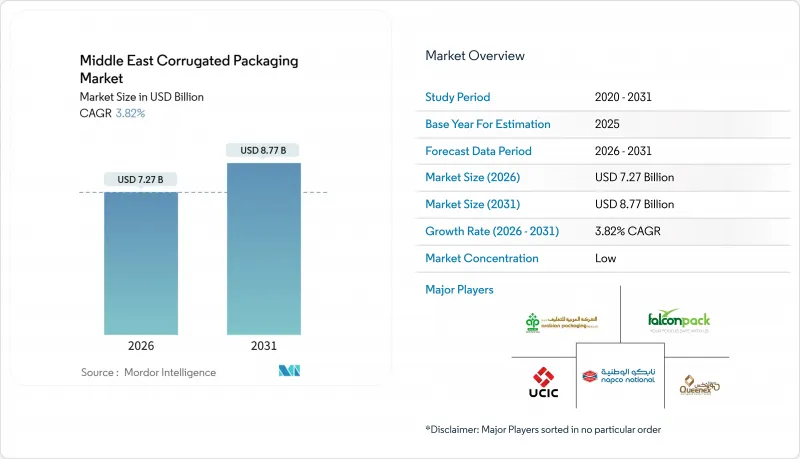
Mordor Intelligence 데이터에 의하면, 중동의 골판지 포장 시장 규모는 2026년에 72억 7,000만 달러로 추정되고, 2031년까지 87억 7,000만 달러에 이를 전망이며, CAGR 3.82%로 확대될 것으로 예측됩니다.
본 보고서는 제품 유형별(슬롯이 있는 상자, 텔레스코픽·멀티피스 상자, 기타), 보드 유형별(단층, 2층, 3층), 플루트 프로파일별(A 플루트, B 플루트, 기타), 최종 사용자 산업별(식품, 음료, 의약품, 산업, 기타), 인쇄 기술별(플렉소그래피, 디지털, 기타), 국가별로 분류되어 있습니다. 시장 전망은 금액(달러) 기준으로 제시되어 있습니다.
중동의 골판지 포장 시장 동향 및 인사이트
전자상거래의 급속한 성장에 따른 골판지 수요 증가
걸프협력회의(GCC)의 온라인 매출액은 2025년에 500억 달러에 달하여 전년 대비 30% 증가했습니다. 배송되는 소포가 1개 늘어날 때마다 최소 1개의 골판지 제품이 소비됩니다. 브랜드 소유주들은 맞춤형 그래픽, 반품용 절취 스트립, 운송 비용을 절감하는 ‘팩투핏(Pack-to-Fit)’ 알고리즘을 요구하고 있으며, 이로 인해 각 변환 업체들은 불과 500개 정도의 소량 주문이라도 인쇄가 가능한 디지털 인쇄기로의 전환을 강요받고 있습니다. 사우디아라비아의 ‘국가 산업 개발 및 물류 프로그램’에서는 배송 허브와 자동 분류 센터에 4,270억 달러가 배정되었으며, 각각은 부피 중량에 최적화된 상자 형태를 기준으로 표준화되어 있습니다. 여전히 대량 생산용 플렉소 인쇄 라인에 의존하고 있는 현지 컨버터들은 48시간 내 납품 및 가변 데이터 인쇄를 제공하는 기동력 있는 공장들에게 시장 점유율을 빼앗길 위험에 처해 있습니다. 중국과 인도의 크로스보더 판매업체들은 이미 가볍고 그래픽이 뛰어난 포장의 기준을 확립하여 지역 고객들의 기대치를 높이고 있습니다.
GCC의 음식 배달 시장 성장
GCC 지역의 음식 배달 시장은 2028년까지 300억 달러 규모에 달할 것으로 예상되며, 사우디아라비아와 아랍에미리트가 주문의 70%를 차지하여 내습성이 있는 단층 골판지 상자에 대한 수요를 견인하고 있습니다. 2025년 말 현재 이 지역에 1,200곳 이상 존재하는 클라우드 키친과 다크 스토어에서는 결로를 견디면서 최소 45분 동안 온도를 유지할 수 있는 포장이 요구되고 있습니다. 변환 업체는 판지에 폴리에틸렌이나 왁스 에멀젼을 코팅하고 있으며, 이로 인해 재료비는 8-12% 상승하지만, 레스토랑 체인은 다소 높은 배달료를 책정할 수 있게 됩니다. 정기 구독형 식사 키트 제공업체들은 통기성이 있는 트레이를 사용하고 있으며, 이를 통해 신선 식품의 유통 기한을 최대 3일까지 연장하여 식품 폐기물 감축으로 이어지고 있습니다. 지금까지 GCC 규제 당국은 음식 배달용 포장에 관한 구속력 있는 규정을 거의 제정하지 않았으며, 성능 기준은 규정 준수가 아니라 경쟁상의 차별화 요소로 취급되고 있습니다.
크래프트지 가격 변동
NBSK(Northern Bleached Softwood Kraft) 펄프 가격은 2022년 톤당 1,400달러에서 2024년에는 800-900달러로 하락했으나, 컨테이너보드 가격은 고작 15-20%만 하락하여,컨버터의 이익률은 최대 300베이시스포인트 축소되었습니다. 중동 국가들은 크라프트 라이너의 60%를 수입에 의존하고 있기 때문에 홍해에서의 항해 장애나 달러 강세 국면에서 컨버터는 운임 할증의 영향을 받기 쉽습니다. 국내 제지 제조업체들은 가격을 세계 벤치마크에 연동하고 있기 때문에 관세에 의한 보호 효과는 제한적입니다. Obeikan Industrial Investment Group과 같은 후방 통합형 기업들은 150-200 베이시스 포인트의 여유를 가지고 생산 능력에 대한 투자를 지속하고 있는 반면, 중소규모 기업들은 자동화 도입을 미루고 있습니다.
부문별 분석
슬롯이 있는 상자는 2025년 매출의 42.43%를 차지했으며, 벌크 물류 및 일반 상품의 출하를 뒷받침하고 있습니다. 반면, 트레이, 폴더, 시트는 클럽 스토어에서의 상품 전개와 오픈 탑형 및 셀프 디스플레이 형태를 선호하는 직접 소비자 판매(DTC) 모델에 힘입어 2031년까지 연평균 성장률(CAGR) 5.66%를 기록할 전망입니다. 중동의 골판지 포장 시장은 슈퍼마켓 운영자들이 2차 취급을 피할 수 있는 ‘선반에 직접 진열 가능한’ 디자인을 요구함에 따라 혜택을 보고 있으며, 인건비를 최대 30% 절감하고 있습니다. 디지털 인쇄 기능 덕분에 계절 한정 프로모션용 아트워크를 신속하게 변경할 수 있게 되었으며, 각 변환업체들은 범용 일반 슬롯 컨테이너에 비해 특수 트레이를 사용할 경우 15%의 이익률 향상을 보고하고 있습니다. 텔레스코프 박스와 멀티피스 박스는 산업기계 등 높은 내구성이 요구되는 틈새 시장을 차지하고 있으며, 2피스 설계를 통해 모서리 파손으로 인한 결함을 줄이고 있습니다. 골판지 팔레트와 다이컷 형태는 의약품 및 전자기기 부문에서 활용되며, 컴팩트한 크기임에도 불구하고 뛰어난 보호 성능을 발휘합니다.
트레이와 폴더는 콜드체인의 확대에도 대응하고 있으며, 통기성이 있는 농산물을 소매점의 냉장 진열대로 더 신속하게 운반함으로써 부패 기간을 2-3일 단축합니다. 밀키트 제공업체들은 표준 택배 보관함에 들어가는 접이식 메일러를 선호하며, 이러한 형태는 음식 배달 시장의 성장에 따라 수요가 증가하고 있습니다. 그 결과, 중동의 골판지 포장 시장에서 트레이나 폴더에 할당되는 시장 규모는 꾸준히 확대될 전망입니다. 신속한 금형 교체가 가능한 다이컷 가공 기술과 고해상도 그래픽 기술을 확보한 컨버터들은 이러한 증가분을 선점할 준비가 되어 있는 것으로 보입니다. 특히 아랍에미리트(UAE)에서는 온라인 식료품 배송 건수가 이미 주당 100만 건을 넘어섰기 때문에 이러한 경향이 두드러집니다.
2025년에는 단층 골판지가 38.32%의 점유율을 차지했으며, 단가가 사양을 좌우하는 전자상거래, 패스트푸드, 경공업 분야에서 주류를 이루고 있습니다. 이중층 골판지는 중량급 가전제품 및 소비자용 전자기기 수요를 충족시키며, 높은 재료비를 들이지 않고도 적재 효율을 높이고 있습니다. 3중 골판지는 1,000파운드를 초과하는 내압성이 필요한 사우디아라비아와 아랍에미리트의 중장비 수출을 배경으로, 2031년까지 연평균 성장률(CAGR) 4.32%로 성장할 전망입니다. 킹 살만 에너지 파크 등의 산업단지에서는 해상 운송 중 부식을 방지하기 위해 폴리에틸렌 방습층이 적용된 3중 골판지 상자에 가스 터빈을 포장하여 출하하고 있습니다.
지역 내 골판지 제조업체들은 한 번의 공정으로 3개의 중간층을 라미네이팅할 수 있는 중량용 골판지 생산 라인을 확충하고 있으며, 이를 통해 생산 시간을 30-40% 단축하고 있습니다. ISO 9001 품질 경영 시스템 인증을 취득한 3중 골판지 제조업체는 다국적 바이어들이 세계 기준을 요구함에 따라 가격 프리미엄을 확보하고 있습니다. 장기적으로 중동의 3중 골판지 포장 시장 점유율은 자본재 수출 성장과 밀접하게 연동되어 있습니다. 원자재 비용은 높지만, 전문적인 설계 비용과 부가가치가 높은 완충재를 통해 단위당 수익성은 확보되고 있습니다.
기타 혜택
- 엑셀 형식 시장 예측(ME) 시트
- 3개월간의 애널리스트 지원
자주 묻는 질문
목차
제1장 서론
제2장 조사 방법
제3장 주요 요약
제4장 시장 구도
제5장 시장 규모 및 성장 예측
제6장 경쟁 구도
제7장 시장 기회 및 향후 전망
AJY 26.09.15According to Mordor Intelligence, the Middle East corrugated packaging market size stands at USD 7.27 billion in 2026 and is projected to reach USD 8.77 billion by 2031, expanding at a 3.82% CAGR, according to Mordor Intelligence data.

This report is Segmented by Product Type (Slotted Box, Telescope/Multi-Piece Boxes, and More), Board Type (Single Wall, Double Wall, and Triple Wall), Flute Profile (A Flute, B Flute, and More), End-User Industry (Food, Beverages, Pharmaceuticals, Industrial, and More), Print Technology (Flexography, Digital, and More), and Country. The Market Forecasts are Provided in Terms of Value (USD).
Middle East Corrugated Packaging Market Trends and Insights
E-Commerce Boom Accelerating Corrugated Demand
Gulf Cooperation Council (GCC) online sales reached USD 50 billion in 2025, up 30% year-over-year, and every additional parcel shipped translates into at least one corrugated unit consumed. Brand owners demand custom graphics, return-ready tear strips, and pack-to-fit algorithms that reduce freight costs, pushing converters toward digital presses capable of printing lots as small as 500 units. Saudi Arabia's National Industrial Development and Logistics Program earmarked USD 427 billion for delivery hubs and automated sortation centers, each standardized around dimensional-weight optimized box footprints. Local converters that still rely on long-run flexographic lines risk losing share to agile plants that offer 48-hour turnaround and variable-data printing. Cross-border sellers from China and India have already set the benchmark for lightweight, high-graphic packaging, raising regional customer expectations.
Food Delivery Growth in GCC Nations
The GCC food-delivery channel is projected to generate USD 30 billion by 2028, with Saudi Arabia and the UAE accounting for 70% of orders and driving corrugated demand toward moisture-resistant single-wall boxes. Cloud kitchens and dark stores, which numbered over 1,200 in the region by end-2025, insist on packaging that maintains temperature for at least 45 minutes while surviving condensation. Converters coat boards with polyethylene or wax emulsions, raising material cost 8-12% but enabling restaurant chains to charge premium delivery fees. Subscription meal-kit providers use vented trays that extend the shelf life of fresh produce by up to 3 days, thereby reducing food waste. So far, GCC regulators have issued few binding rules on food-delivery packaging, leaving performance standards to competitive differentiation rather than compliance.
Kraft Paper Price Volatility
Northern Bleached Softwood Kraft (NBSK) pulp prices fell from USD 1,400 per ton in 2022 to USD 800-900 in 2024, yet containerboard prices slipped only 15-20%, compressing converter margins by up to 300 basis points. The Middle East imports 60% of its kraft liner, leaving converters exposed to freight surcharges during Red Sea disruptions and dollar strength cycles. Domestic mills tie prices to global benchmarks, so tariffs give limited shelter. Backward-integrated players, such as Obeikan Industrial Investment Group, enjoy a 150-200 basis-point cushion, and they continue to invest in capacity while smaller firms defer automation.
Other drivers and restraints analyzed in the detailed report include:
- Government-Led Industrial Diversification Projects
- Shift Toward Lightweight High-Strength Boards
- Water Scarcity Impact on Paper Mills
For complete list of drivers and restraints, kindly check the Table Of Contents.
Segment Analysis
Slotted boxes maintained 42.43% of 2025 revenue, anchoring shipments in bulk logistics and general merchandise. Trays, folders, and sheets, however, show a 5.66% CAGR through 2031, propelled by club-store merchandising and direct-to-consumer (DTC) models that prefer open-top or self-display formats. The Middle East corrugated packaging market benefits when supermarket operators demand shelf-ready designs that avoid secondary handling, reducing labor cost up to 30%. Digital print capability allows rapid artwork changes for seasonal promotions, and converters report margin uplifts of 15% on specialty trays versus commodity regular slotted containers. Telescope and multi-piece boxes occupy heavy-duty niches, such as industrial machinery, where two-piece designs reduce corner-crush failures. Corrugated pallets and die-cut shapes serve pharmaceuticals and electronics, delivering high protective performance in compact footprints.
Trays and folders also align with cold-chain expansion, carrying vented produce that reaches retail coolers faster, cutting spoilage by 2-3 days. Meal-kit providers prefer folded mailers that fit standard courier lockers, a format boosted by food-delivery growth. As a result, the Middle East corrugated packaging market size allocated to trays and folders will rise steadily. Converters that master quick-change die-cutting and high-resolution graphics look set to capture this incremental volume, especially in the UAE, where e-grocery shipments already exceed 1 million orders per week.
Single-wall accounted for 38.32% share in 2025, dominating e-commerce, fast food, and light industrial uses where unit cost drives specification. Double-wall satisfies mid-weight appliances and consumer electronics, offering improved stacking without high material expense. Triple-wall grows 4.32% CAGR through 2031 on the back of Saudi and UAE heavy machinery exports, which require crush resistances above 1,000 pounds. Industrial estates such as King Salman Energy Park ship gas turbines in triple-wall cartons fitted with polyethylene vapor barriers, preventing corrosion during sea voyages.
Regional converters expand heavy-duty corrugator lines capable of laminating three mediums in a single pass, cutting production time by 30-40%. Triple-wall producers that certify ISO 9001 quality systems command price premiums, because multinational buyers stipulate global standards. Over time, the Middle East corrugated packaging market share for triple-wall aligns closely with capital-goods export growth. Although raw material costs are higher, unit economics are protected by specialized design fees and value-added cushioning inserts.
Complete Report Scope:
- By Product Type
- Slotted Box
- Telescope/Multi-Piece Boxes
- Trays, Folder and Sheets
- Other Product Types
- By Board Type
- Single Wall
- Double Wall
- Triple Wall
- By Flute Profile
- A Flute
- B Flute
- C Flute
- E Flute
- F Flute
- Other Flute Profiles
- By End-user Industry
- Food
- Beverages
- Pharmaceuticals
- Personal Care and Household
- Industrial
- Electrical and Electronics
- Other End-user Industries
- By Print Technology
- Flexography
- Digital
- Lithography
- Other Print Technology
- By Country
- Saudi Arabia
- United Arab Emirates
- Qatar
- Jordan
- Rest of Middle East
List of Companies Covered in this Report:
- Arabian Packaging Co. LLC
- Queenex Corrugated Carton Factory LLC
- United Carton Industries Company JSC
- Napco National
- Falcon Pack Industries LLC
- Cepack Group DMCC
- World Pack Industries LLC
- Universal Carton Industries Group LLC
- Green Packaging Boxes Ind LLC
- Tarboosh Packaging Co. LLC
- Unipack Containers and Carton Products LLC
- Al Rumanah Packaging LLC
- Arabian Paper Products Co. Ltd
- Saudi Paper Manufacturing Co.
- Middle East Packaging LLC
- Obeikan Industrial Investment Group
- Al-Jazira Printing Inks LLC
- United Printing and Publishing LLC
- Majan Printing and Packaging SAOG
- Delta Printing Press LLC
Additional Benefits:
- The market estimate (ME) sheet in Excel format
- 3 months of analyst support
TABLE OF CONTENTS
1 INTRODUCTION
- 1.1 Study Assumptions and Market Definition
- 1.2 Scope of the Study
2 RESEARCH METHODOLOGY
3 EXECUTIVE SUMMARY
4 MARKET LANDSCAPE
- 4.1 Market Overview
- 4.2 Market Drivers
- 4.2.1 E-commerce Boom Accelerating Corrugated Demand
- 4.2.2 Food Delivery Growth in GCC Nations
- 4.2.3 Government-Led Industrial Diversification Projects
- 4.2.4 Shift Toward Lightweight High-Strength Boards
- 4.2.5 Digital Printing Adoption for Short-Run Packaging
- 4.2.6 Temperature-Controlled Date Export Packaging
- 4.3 Market Restraints
- 4.3.1 Kraft Paper Price Volatility
- 4.3.2 Water Scarcity Impact on Paper Mills
- 4.3.3 Import Tariffs on Recovered Paper
- 4.3.4 Rise of Reusable Plastic Crates in Produce Sector
- 4.4 Industry Value Chain Analysis
- 4.5 Regulatory Landscape
- 4.6 Technological Outlook
- 4.7 Impact of Macroeconomic Factors on the Market
- 4.8 Porter's Five Forces Analysis
- 4.8.1 Bargaining Power of Suppliers
- 4.8.2 Bargaining Power of Buyers
- 4.8.3 Threat of New Entrants
- 4.8.4 Threat of Substitute Products
- 4.8.5 Intensity of Competitive Rivalry
5 MARKET SIZE AND GROWTH FORECASTS (VALUE)
- 5.1 By Product Type
- 5.1.1 Slotted Box
- 5.1.2 Telescope/Multi-Piece Boxes
- 5.1.3 Trays, Folder and Sheets
- 5.1.4 Other Product Types
- 5.2 By Board Type
- 5.2.1 Single Wall
- 5.2.2 Double Wall
- 5.2.3 Triple Wall
- 5.3 By Flute Profile
- 5.3.1 A Flute
- 5.3.2 B Flute
- 5.3.3 C Flute
- 5.3.4 E Flute
- 5.3.5 F Flute
- 5.3.6 Other Flute Profiles
- 5.4 By End-user Industry
- 5.4.1 Food
- 5.4.2 Beverages
- 5.4.3 Pharmaceuticals
- 5.4.4 Personal Care and Household
- 5.4.5 Industrial
- 5.4.6 Electrical and Electronics
- 5.4.7 Other End-user Industries
- 5.5 By Print Technology
- 5.5.1 Flexography
- 5.5.2 Digital
- 5.5.3 Lithography
- 5.5.4 Other Print Technology
- 5.6 By Country
- 5.6.1 Saudi Arabia
- 5.6.2 United Arab Emirates
- 5.6.3 Qatar
- 5.6.4 Jordan
- 5.6.5 Rest of Middle East
6 COMPETITIVE LANDSCAPE
- 6.1 Market Concentration
- 6.2 Strategic Moves
- 6.3 Market Share Analysis
- 6.4 Company Profiles (includes Global Level Overview, Market Level Overview, Core Segments, Financials as Available, Strategic Information, Market Rank/Share for Key Companies, Products and Services, and Recent Developments)
- 6.4.1 Arabian Packaging Co. LLC
- 6.4.2 Queenex Corrugated Carton Factory LLC
- 6.4.3 United Carton Industries Company JSC
- 6.4.4 Napco National
- 6.4.5 Falcon Pack Industries LLC
- 6.4.6 Cepack Group DMCC
- 6.4.7 World Pack Industries LLC
- 6.4.8 Universal Carton Industries Group LLC
- 6.4.9 Green Packaging Boxes Ind LLC
- 6.4.10 Tarboosh Packaging Co. LLC
- 6.4.11 Unipack Containers and Carton Products LLC
- 6.4.12 Al Rumanah Packaging LLC
- 6.4.13 Arabian Paper Products Co. Ltd
- 6.4.14 Saudi Paper Manufacturing Co.
- 6.4.15 Middle East Packaging LLC
- 6.4.16 Obeikan Industrial Investment Group
- 6.4.17 Al-Jazira Printing Inks LLC
- 6.4.18 United Printing and Publishing LLC
- 6.4.19 Majan Printing and Packaging SAOG
- 6.4.20 Delta Printing Press LLC
7 MARKET OPPORTUNITIES AND FUTURE OUTLOOK
- 7.1 White-Space and Unmet-Need Assessment


