|
시장보고서
상품코드
2125459
영국의 사이버 보안 시장 : 점유율 분석, 업계 동향과 통계, 성장 예측(2026-2031년)UK Cybersecurity - Market Share Analysis, Industry Trends & Statistics, Growth Forecasts (2026 - 2031) |
||||||
 Mordor Intelligence
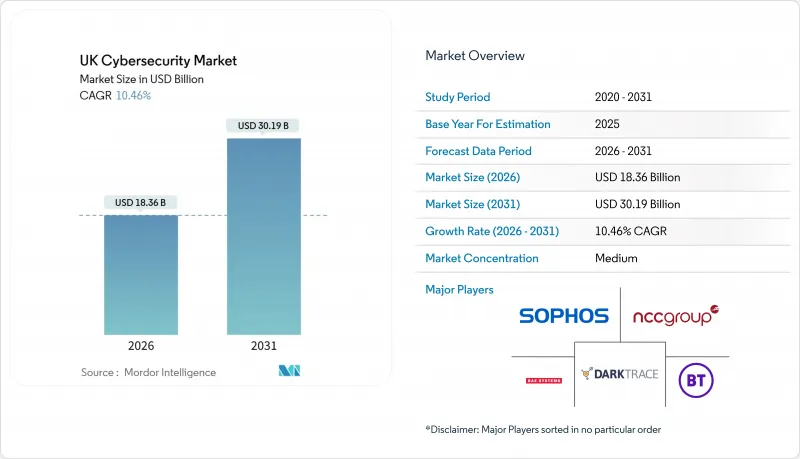
Mordor Intelligence에 의하면, 영국 사이버 보안 시장은 2026년에 183억 6,000만 달러에 이르고, 2031년까지 301억 9,000만 달러에 이를 것으로 예측되며, 이것은 CAGR 10.46%를 나타내고 있습니다.
본 보고서는 제공 형태(솔루션(용도 보안, 클라우드 보안, 데이터 보안, 네트워크 보안, 엔드포인트 보안 등) 및 서비스), 도입 형태(클라우드 및 On-Premise), 최종 사용자 산업(은행, 금융서비스 및 보험(BFSI), 정부·공공 부문 등), 최종 사용자 기업 규모(대기업 및 중소기업)별로 분류되어 있습니다. 시장 전망은 달러 기준 금액으로 제시되어 있습니다.
영국 사이버 보안 시장 동향 및 인사이트
디지털화의 가속화와 하이브리드 근무로 인한 공격 표면의 확대
하이브리드 근무의 보급으로 인해 기존의 경계 방어는 더 이상 기능하지 않게 되었습니다. 따라서 조직은 현재 패치 적용 상태가 고르지 않은 가정용 광대역에 연결된 수천 개의 엔드포인트를 방어해야 합니다. 각국의 지침에서는 방화벽, 보안 웹 게이트웨이, 제로 트러스트 네트워크 액세스를 단일 클라우드 스택으로 통합한 ‘보안 액세스 서비스 엣지(SASE)’의 도입을 권장하고 있으며, 이를 통해 사용자의 위치에 관계없이 통일된 정책을 적용할 수 있게 됩니다. 규제 대상 기업은 지속적인 인증과 마이크로 세분화을 유지해야 하며, 이러한 요구 사항이 금융 및 기술 허브 전반에 걸쳐 클라우드 네이티브 도입을 사실상 촉진하고 있습니다. 대기업의 73%가 유연한 근무 형태를 유지할 의향을 나타내고 있어, 이로 인해 ID 중심의 보안이 장기적인 필요성으로 자리 잡고 있습니다. 그 결과, 클라우드 도입이 On-Premise형 솔루션을 앞지르는 속도로 진행되고 있으며, 각 벤더들은 원격 네트워크와 캠퍼스 네트워크를 모두 아우르는 정책 엔진을 강력하게 추진하고 있습니다.
랜섬웨어 및 국가 주도의 위협 급증
영국 국립사이버보안센터(NCSC)의 기록에 따르면, 2025년 랜섬웨어 사고는 전년 대비 68% 증가했습니다. 이러한 급증은 초보 수준의 협력자라도 고도의 공격을 실행할 수 있게 해주는 ‘랜섬웨어-어-서비스(RaaS)’ 키트 때문인 것으로 분석됩니다. 의료 시스템은 장기간의 서비스 중단을 겪는 한편, 에너지 사업자들은 러시아 및 이란 그룹에 의한 것으로 확인된 공급망 침입에 직면했습니다. 정부 조사에 따르면, 2025년에는 기업의 32%가 정보 유출 피해를 입었으며, 이에 따른 복구 비용은 평균 1만 5,300파운드(20,534.97달러)에 달했습니다. 위협이 가중되는 가운데, 기업들은 연중무휴 24시간 대응을 보장하고 사고 대응 팀에 직접 에스컬레이션할 수 있는 MDR(Managed Detection and Response) 계약 도입을 서두르고 있습니다.
심각한 사이버 보안 인력 부족
정부 추산에 따르면, 2025년에는 전국적으로 1만 4,100건의 사이버 보안 관련 인력 부족이 예상되며, 런던의 시니어 클라우드 보안 엔지니어의 급여 중앙값은 8만 5,000파운드(114,083.18달러)에 달할 전망입니다. 인력 부족으로 인해 인건비가 상승하고 도입 일정이 장기화됨에 따라, 기업들은 보안 운영을 전문 제공업체에 위탁하고 있습니다. 수습 제도나 대학에 대한 투자를 통한 인력 부족 해소 효과는 중기적으로는 제한적이기 때문에 매니지드 서비스가 여전히 주요한 임시 해결책으로 자리 잡고 있으며, 두 자릿수 성장세가 더욱 가속화되고 있습니다.
부문 분석
2025년, 서비스 부문은 영국 사이버 보안 시장 점유율의 62.73%를 차지하며, 이 점유율은 연평균 성장률(CAGR) 12.22%로 확대될 것으로 전망됩니다. 매니지드 감지 및 대응(MDR)은 가장 빠르게 성장하는 서비스 항목으로 부상하고 있습니다. 이는 기업이 며칠 이내에 클라우드 센서를 가동하고, 정기 요금을 지불하여 24시간 위협 감지 서비스를 받을 수 있으며, 사내 보안 운영 센터(SOC)에 인력을 배치하는 것보다 예산 관리가 용이하기 때문입니다. 규정 준수 요건 증가와 이사회 차원의 격차 분석, 침투 테스트, 복원력 훈련 실시 요청에 따라 전문 서비스에 대한 수요도 증가하고 있습니다. 반면, 솔루션 분야는 여전히 필수적이지만 성장률은 저조한 임베디드니다. 구매자들은 방화벽, 제로 트러스트 네트워크 액세스, 보안 웹 게이트웨이 기능을 단일 구독으로 통합한 클라우드 네이티브 도구를 선호하는 경향이 있습니다. 제로 트러스트 설계는 강력한 인증과 최소 권한 원칙에 기반을 두고 있기 때문에 ID 및 액세스 관리는 가장 안정적으로 구매되고 있는 솔루션입니다. 용도 보안 도구 분야에서는 정적 분석, 동적 분석 및 소프트웨어 구성 분석을 지속적 통합(CI) 파이프라인에 통합하는 SaaS 공급업체들이 주목받고 있습니다. 엔드포인트, 네트워크, 데이터 보안 제품에 대한 관심은 꾸준하지만, 지출은 이러한 기술에 전문가의 모니터링을 결합한 서비스 계약으로 이동하고 있습니다.
영국의 사이버 보안 서비스 시장 규모는 공공 기관이 주요 공급업체에 24시간 보안 모니터링 인증 취득을 의무화함에 따라 더욱 가속화될 것으로 예측됩니다. 한편, 여러 지역에 보안 운영 센터를 운영하는 벤더들은 지연 위험을 헤지하고, 데이터 상주 요건을 충족하며, 국지적인 장애 발생 시 비즈니스 연속성을 보장하고 있습니다. 따라서 규제가 엄격한 산업, 과거에는 상황에 따라 사후 대응형 아웃소싱에 의존하던 중견 기업에서 다년간의 아웃소싱 보급률이 더욱 높아질 것으로 전망됩니다.
2025년에는 클라우드가 영국 사이버 보안 시장 규모의 63.84%를 차지하며 연평균 성장률(CAGR) 12.32%로 성장하는 반면, On-Premise 배포는 한 자릿수 중반의 성장률로 확대될 것으로 전망됩니다. 원격 및 하이브리드 인력에 신원 중심의 아키텍처가 요구됨에 따라, 조직들은 어디서나 일관된 정책을 적용하는 보안 서비스 엣지 플랫폼을 채택하고 있습니다. 정부 및 금융 규제 당국은 통합된 ID 페더레이션과 결합된 멀티 클라우드 전략을 권장하고 있으며, 이는 ‘클라우드 우선’ 통제를 중심으로 구축된 벤더의 로드맵 타당성을 더욱 뒷받침하고 있습니다. 기업들은 클라우드 보호를 활성화하는 데 며칠이 걸릴 수 있는 반면, 조달, 랙 설치, 유지보수 주기가 On-Premise 플랫폼의 발목을 잡고 있다는 사실을 깨닫고 있습니다. 엄격한 데이터 현지화 규정이 있는 산업 분야에서도 기밀 기록을 온사이트에 보관하면서 분석 처리는 탄력적인 클라우드 노드로 이전하는 하이브리드 설계를 채택하고 있습니다.
제조, 에너지, 공공 서비스 등 레거시 운영 기술(OT)을 운영하는 분야에서는 여전히 On-Premise 환경이 남아 있습니다. 에어 갭이 적용된 프로그래머블 로직 컨트롤러(PLC)는 외부 플랫폼과 연동할 수 없기 때문에 자산 소유자는 텔레메트리 데이터를 수집하기 위해 중개 센서나 네트워크 탭을 도입하고 있습니다. 벤더들은 이러한 도입 환경을 클라우드 호스팅형 관리 콘솔과 통합하고 있으며, 이는 유연한 이용 모델로의 광범위한 추세를 보여줍니다. 그러나 마이그레이션에는 설정 오류의 위험이 따르며, 현재는 Center for Internet Security의 벤치마크에 따라 규정 준수를 자동으로 확인하기 위해 클라우드 보안 태세 관리가 대부분의 기업 계약에 포함되어 있습니다.
기타 혜택:
- 엑셀 형식 시장 예측(ME) 시트
- 3개월간 애널리스트 지원
자주 묻는 질문
목차
제1장 서론
제2장 조사 방법
제3장 주요 요약
제4장 시장 구도
제5장 시장 규모와 성장 예측
제6장 경쟁 구도
제7장 시장 기회와 향후 전망
JHS 26.09.11According to Mordor Intelligence, the UK cybersecurity market reached USD 18.36 billion in 2026 and is projected to attain USD 30.19 billion by 2031, reflecting a 10.46% CAGR.
This report is Segmented by Offering (Solutions [Application Security, Cloud Security, Data Security, Network Security, Endpoint Security, and More], and Services), Deployment Mode (Cloud, and On-Premise), End-User Industry (BFSI, Government and Public Sector, and More), End-User Enterprise Size (Large Enterprises, and Small and Medium Enterprises). The Market Forecasts are Provided in Terms of Value in USD.
UK Cybersecurity Market Trends and Insights
Escalating Digitalization And Hybrid-Work Attack Surface
Hybrid work dismantled the traditional perimeter, so organizations now defend thousands of endpoints that sit on domestic broadband with inconsistent patch regimes. National guidance urges secure access service edge rollouts that blend firewall, secure web gateway, and zero-trust network access in a single cloud stack, enabling uniform policies regardless of user location. Regulated firms must also maintain continuous authentication and micro-segmentation, a requirement that effectively pushes cloud-native adoption across finance and technology hubs. Seventy-three percent of large employers intend to keep flexible work patterns, which cements identity-centric security as a long-term necessity. As a result, cloud deployments outpace on-premise alternatives, and vendors heavily promote policy engines that span both remote and campus networks.
Surge In Ransomware And Nation-State Threats
The National Cyber Security Centre recorded a 68% year-on-year jump in ransomware incidents during 2025, linking the spike to ransomware-as-a-service kits that allow entry-level affiliates to execute sophisticated attacks. Healthcare systems suffered prolonged outages, while energy utilities confronted supply-chain intrusions traced to Russian and Iranian groups. A government survey found that 32% of businesses endured breaches in 2025, with remediation costs averaging GBP 15,300 (USD 20534.97). Heightened threat pressure pushes enterprises toward managed detection and response contracts that guarantee 24 x 7 coverage and direct escalation to incident-response teams.
Acute Cyber-Skills Deficit
Government estimates indicate 14,100 cybersecurity vacancies nationwide in 2025, with senior cloud security engineers in London commanding median salaries of GBP 85,000 (USD 114083.18). Supply shortages inflate labor costs and prolong implementation schedules, prompting enterprises to outsource security operations to specialist providers. Apprenticeship schemes and university investment will ease shortages only in the medium term, so managed services remain the primary stopgap, reinforcing their double-digit growth trajectory.
Other drivers and restraints analyzed in the detailed report include:
- Growing UK Compliance Mandates Under Telecom Security Act And DORA
- Rapid Adoption Of AI-Driven Security Analytics
- High Total Cost Of Ownership For Advanced Platforms
For complete list of drivers and restraints, kindly check the Table Of Contents.
Segment Analysis
Services captured 62.73% of UK cybersecurity market share in 2025, and this slice is projected to widen at a 12.22% CAGR. Managed detection and response has become the fastest-growing line item because enterprises can activate cloud sensors within days and receive round-the-clock threat hunting for a recurring fee that is simpler to budget than staffing an internal security operations center. Professional services demand also rises as compliance mandates proliferate and boards commission gap analyses, penetration tests, and resilience rehearsals. In contrast, the solutions segment remains essential but lags in percentage growth, with buyers favoring cloud-native tools that bundle firewall, zero-trust network access, and secure web gateway features into a single subscription. Identity and access management ranks as the most consistently purchased solution because zero-trust designs rest on strong authentication and least-privilege authorizations. Application security tooling attracts software-as-a-service vendors that integrate static, dynamic, and software composition analysis into continuous-integration pipelines. Despite steady interest in endpoint, network, and data security products, spending tilts toward service engagements that wrap expert oversight around these technologies.
The UK cybersecurity market size for services is forecast to accelerate further as public entities mandate that critical suppliers hold round-the-clock security monitoring certifications. Meanwhile, vendors that operate multiple regional security operations centers hedge latency risks, meet data-residency clauses, and guarantee continuity in the event of localized outages. Multiyear outsourcing is therefore likely to reach a higher penetration rate among both highly regulated industries and mid-market firms that once relied on reactive outsourcing on an ad hoc basis.
Cloud captured 63.84% of UK cybersecurity market size in 2025, growing at a 12.32% CAGR, while on-premises deployments expand at mid-single-digit rates. Remote and hybrid workforces require identity-centric architectures, so organizations adopt security service edge platforms that enforce consistent policies across any location. Government and financial regulators endorse multi-cloud strategies paired with centralized identity federation, which further validates vendor roadmaps built around cloud-first controls. Enterprises note that activating cloud protection can take days, whereas procurement, racking, and maintenance cycles slow on-premises platforms. Even industries with strict data localization rules embrace hybrid designs that keep sensitive records onsite but shift analytics to elastic cloud nodes.
On-premises estates persist in segments that run legacy operational technology, such as manufacturing, energy, and utilities. Air-gapped programmable logic controllers cannot interface with external platforms, so asset owners deploy intermediary sensors and network taps to gain telemetry. Vendors blend these deployments with cloud-hosted management consoles, which illustrates the broader trend toward flexible consumption models. However, migration introduces misconfiguration risks, and cloud security posture management is now bundled into most enterprise contracts to check compliance against Center for Internet Security benchmarks automatically.
Complete Report Scope:
- By Offering
- Solutions
- Application Security
- Cloud Security
- Data Security
- Network Security
- Endpoint Security
- Infrastructure Protection
- Integrated Risk Management
- Identity and Access Management (IAM)
- Services
- Professional Services
- Managed Services
- Solutions
- By Deployment Mode
- Cloud
- On-Premise
- By End-user Industry
- BFSI
- Government and Public Sector
- Oil and Gas
- IT and Telecom
- Retail, E-commerce and Consumers
- Manufacturing and Industrial
- Energy and Utilities
- Healthcare
- Other End-user Industries (Transport, Logistics, Education, Hospitality)
- By End-user Enterprise Size
- Large Enterprises
- Small and Medium Enterprises (SMEs)
List of Companies Covered in this Report:
- Darktrace plc
- Sophos Group plc
- NCC Group plc
- BAE Systems Digital Intelligence
- BT Group plc (BT Security)
- Clearswift Ltd (Fortra LLC)
- Gen Digital UK Ltd (Avast)
- Becrypt Ltd
- LRQA Nettitude Ltd
- Reliance Cyber Science Ltd
- Quorum Cyber Ltd
- Adarma Ltd
- CybSafe Ltd
- Orpheus Cyber Ltd
- Titania Ltd
- Sophos Rapid Response Ltd
- Bridewell Consulting Ltd
- Integrity360 UK Ltd
- Trustwave SpiderLabs UK Ltd
- Thales UK Ltd (e-Security Division)
- XM Cyber UK Ltd
- Immersive Labs Ltd
- Censornet Ltd
- Bulletproof Cyber Security Services Ltd
- SureCloud Ltd
Additional Benefits:
- The market estimate (ME) sheet in Excel format
- 3 months of analyst support
TABLE OF CONTENTS
1 INTRODUCTION
- 1.1 Study Assumptions and Market Definition
- 1.2 Scope of the Study
2 RESEARCH METHODOLOGY
3 EXECUTIVE SUMMARY
4 MARKET LANDSCAPE
- 4.1 Market Overview
- 4.2 Market Drivers
- 4.2.1 Escalating Digitalisation and Hybrid-Work Attack Surface
- 4.2.2 Surge in Ransomware and Nation-State Threats
- 4.2.3 Growing UK Compliance Mandates (Telecom Security Act, DORA)
- 4.2.4 Rapid Adoption of AI-Driven Security Analytics
- 4.2.5 Government Zero-Trust Procurement Requirements
- 4.2.6 Cyber-Insurance Underwriting Pressures Shaping Controls
- 4.3 Market Restraints
- 4.3.1 Acute Cyber-Skills Deficit
- 4.3.2 High Total Cost of Ownership for Advanced Platforms
- 4.3.3 Legacy OT and Critical-Infrastructure Systems Hard to Secure
- 4.3.4 SME Under-Investment Given Unclear ROI
- 4.4 Industry Value Chain Analysis
- 4.5 Regulatory Landscape
- 4.6 Technological Outlook
- 4.7 Porter's Five Forces Analysis
- 4.7.1 Bargaining Power of Buyers
- 4.7.2 Bargaining Power of Suppliers
- 4.7.3 Threat of New Entrants
- 4.7.4 Threat of Substitutes
- 4.7.5 Intensity of Competitive Rivalry
- 4.8 Pricing Analysis
- 4.9 Impact of Macroeconomic Factors on the Market
- 4.10 Emerging Market Trends (AI, SASE, MDR)
5 MARKET SIZE AND GROWTH FORECASTS (VALUE)
- 5.1 By Offering
- 5.1.1 Solutions
- 5.1.1.1 Application Security
- 5.1.1.2 Cloud Security
- 5.1.1.3 Data Security
- 5.1.1.4 Network Security
- 5.1.1.5 Endpoint Security
- 5.1.1.6 Infrastructure Protection
- 5.1.1.7 Integrated Risk Management
- 5.1.1.8 Identity and Access Management (IAM)
- 5.1.2 Services
- 5.1.2.1 Professional Services
- 5.1.2.2 Managed Services
- 5.1.1 Solutions
- 5.2 By Deployment Mode
- 5.2.1 Cloud
- 5.2.2 On-Premise
- 5.3 By End-user Industry
- 5.3.1 BFSI
- 5.3.2 Government and Public Sector
- 5.3.3 Oil and Gas
- 5.3.4 IT and Telecom
- 5.3.5 Retail, E-commerce and Consumers
- 5.3.6 Manufacturing and Industrial
- 5.3.7 Energy and Utilities
- 5.3.8 Healthcare
- 5.3.9 Other End-user Industries (Transport, Logistics, Education, Hospitality)
- 5.4 By End-user Enterprise Size
- 5.4.1 Large Enterprises
- 5.4.2 Small and Medium Enterprises (SMEs)
6 COMPETITIVE LANDSCAPE
- 6.1 Market Concentration
- 6.2 Strategic Moves
- 6.3 Market Share Analysis
- 6.4 Company Profiles (includes Global level Overview, Market level overview, Core Segments, Financials as available, Strategic Information, Market Rank/Share for key companies, Products and Services, and Recent Developments)
- 6.4.1 Darktrace plc
- 6.4.2 Sophos Group plc
- 6.4.3 NCC Group plc
- 6.4.4 BAE Systems Digital Intelligence
- 6.4.5 BT Group plc (BT Security)
- 6.4.6 Clearswift Ltd (Fortra LLC)
- 6.4.7 Gen Digital UK Ltd (Avast)
- 6.4.8 Becrypt Ltd
- 6.4.9 LRQA Nettitude Ltd
- 6.4.10 Reliance Cyber Science Ltd
- 6.4.11 Quorum Cyber Ltd
- 6.4.12 Adarma Ltd
- 6.4.13 CybSafe Ltd
- 6.4.14 Orpheus Cyber Ltd
- 6.4.15 Titania Ltd
- 6.4.16 Sophos Rapid Response Ltd
- 6.4.17 Bridewell Consulting Ltd
- 6.4.18 Integrity360 UK Ltd
- 6.4.19 Trustwave SpiderLabs UK Ltd
- 6.4.20 Thales UK Ltd (e-Security Division)
- 6.4.21 XM Cyber UK Ltd
- 6.4.22 Immersive Labs Ltd
- 6.4.23 Censornet Ltd
- 6.4.24 Bulletproof Cyber Security Services Ltd
- 6.4.25 SureCloud Ltd
7 MARKET OPPORTUNITIES AND FUTURE OUTLOOK
- 7.1 White-Space and Unmet-Need Assessment