

|
시장보고서
상품코드
2125556
버스 시장 : 점유율 분석, 업계 동향과 통계, 성장 예측(2026-2031년)Bus - Market Share Analysis, Industry Trends & Statistics, Growth Forecasts (2026 - 2031) |
||||||
 Mordor Intelligence
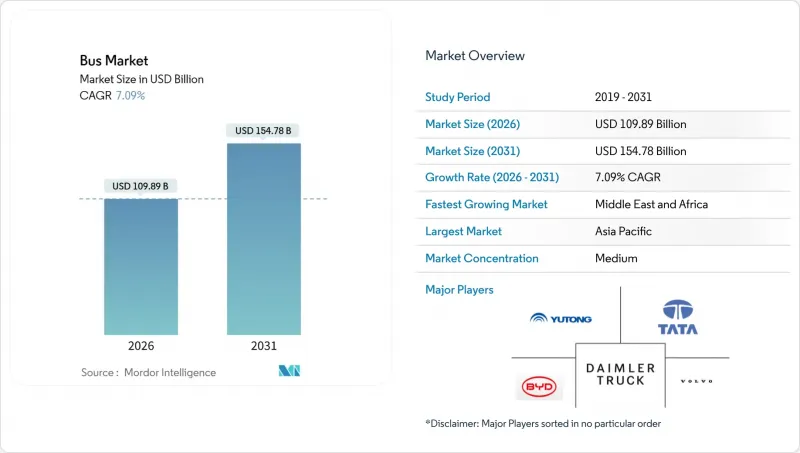
Mordor Intelligence에 의하면, 세계의 버스 시장 규모는 2026년에 1,098억 9,000만 달러에 이르고, 2031년까지 1,547억 8,000만 달러로 확대한다고 예측되고 있어 예측 기간 중 연평균 복합 성장률(CAGR)은 7.09%가 됩니다.
본 보고서는 구동 방식(하이브리드차·전기차 및 내연기관), 데크 유형(싱글 및 더블), 용도(노선버스, 시외버스/장거리버스,스쿨버스, 기타), 좌석 수(30석 이하 및 그 이상), 버스 전장(9m 이하 및 그 이상), 그리고 지역별로 분류되어 있습니다. 시장 예측은 금액(달러) 및 수량(대수)으로 제시되어 있습니다.
전 세계 버스 시장 동향 및 인사이트
배터리 비용의 급격한 하락으로 TCO 패리티 달성
2024년에는 배터리 팩의 평균 가격이 하락하여, 연료 가격과 전력 가격 조건이 양호할 경우 디젤 연료와의 총 소유 비용(TCO) 패리티가 실현되었습니다. 이러한 패리티는 세계 최대의 대중교통 시장 대부분에서 뚜렷하게 나타나고 있습니다. 산티아고의 경우, 시내 버스 차량군의 1킬로미터당 비용이 대폭 감소한 것으로 보고되었습니다. 또한, 가동 부품이 감소함에 따라 유지보수 필요성이 줄어들었고, 브레이크 패드의 수명이 대폭 연장되었습니다. 보조금 없이 수익성을 달성하기까지의 기간은 앞당겨졌지만, 소규모 사업자에게는 여전히 높은 초기 비용이 과제로 남아 있습니다.
ZEB 조달에 관한 국가의 의무화 조치
제로 에미션 버스 도입 의무화로 인해 공공 차량의 교체 주기가 가속화되고 있습니다. 캘리포니아주에서는 향후 몇년내에 디젤 차량 구매를 금지할 계획입니다. 한편, 유럽연합(EU)은 제로 에미션 차량에 대해 야심찬 목표를 설정하고 있으며, 중국도 도시 지역 차량의 전동화를 향해 급속히 나아가고 있습니다. 인도에서는 FAME-II 프로그램이 전기 버스 보급을 주도하고 있어, 여러 주에 걸친 대규모 입찰로 이어지고 있습니다. 그 결과, 사업자들은 현재 차량 발주와 더불어 충전 인프라 확보가 요구되고 있습니다. 이러한 변화는 단기적인 자본 수요를 증가시킬 뿐만 아니라, OEM(자동차 제조업체)에게 더 명확한 장기적인 판매 전망을 가져다주고 있습니다.
전기버스와 디젤버스의 초기 비용 차이
브라질과 남아프리카공화국에서는 관세 장벽과 현지 배터리 생산 체계의 부재로 인해 전기 버스 가격이 여전히 상당히 높은 수준을 유지하고 있으며, 그 결과 구매 비용에 상당한 추가 비용이 발생하고 있습니다. 이러한 높은 비용은 버스 시장에 여전히 큰 과제로 남아 있으며, 투자 회수 기간을 길게 만들어 많은 사업자에게 전기 버스 도입을 경제적으로 어렵게 만들고 있습니다. 게다가, 대부분의 경우 제한된 자금에 제약을 받는 지방자치단체 운영 사업자들은 기존 디젤 차량에 비해 전기버스의 계약금 요건이 높기 때문에 그 지불에 어려움을 겪고 있으며, 이는 더욱 친환경적인 교통 솔루션으로의 전환을 더욱 방해하고 있습니다.
부문 분석
내연기관 플랫폼은 2025년 매출의 71.23%를 차지했으나, ZEB(제로 에미션 버스) 의무화로 인해 신규 입찰에서 디젤 차량이 배제됨에 따라 배터리식 전기 버스는 연평균 성장률(CAGR) 11.82%로 확대되고 있습니다. 배터리 전기 버스 시장은 향후 몇 년 동안 상당한 성장이 예상되며, 버스 업계 전체에서 가장 수익성이 높은 부문이 될 것으로 전망됩니다. 각 OEM 기업들은 효율성 향상과 비용 절감을 위해 배터리 공급망 통합에 주력하고 있습니다. Yutong이나 BYD와 같은 기업들은 원자재 가격 변동에 따른 영향을 완화하기 위해 통합 생산 전략을 채택하고 있습니다. 이러한 접근 방식을 통해 유럽의 경쟁사들에 비해 큰 비용 우위를 확보하고 있습니다. 배터리 기술의 발전과 실제 주행 거리 향상으로 인해 하이브리드 차량 및 플러그인 하이브리드 차량의 존재감은 급속히 약화되고 있습니다. 한편, 연료전지 버스는 여전히 틈새 시장에 머물러 있으며, 그린 수소의 높은 비용이 보급의 걸림돌이 되고 있습니다. 장기적으로는 디젤 버스의 판매 대수가 감소할 것으로 예상되는데, 이는 단순한 점진적인 다각화가 아니라 시장의 구조적 변화를 반영한 것입니다.
‘전기차 우선’ 전략은 애프터서비스 사업의 경제성을 변화시키고 있습니다. 유럽의 각 제조업체들은 현재 차량 가동 중단 시간을 대폭 줄여주는 첨단 예측 유지보수 시스템을 기반으로 배터리 연장 보증을 제공합니다. 이러한 시스템은 데이터 분석을 활용하여 정비 일정을 최적화하는 동시에 운영 효율을 높이고 있습니다. 또한, ‘Battery-as-a-Service(BaaS)’ 계약의 도입으로 인해 배터리의 잔존 가치에 대한 위험이 소비자로부터 OEM 제조업체로 이전되고 있습니다. 그러나 이러한 변화는 과제도 안고 있습니다. 중고 배터리의 성숙한 유통 시장이 아직 제대로 구축되지 않았기 때문에 가까운 시일 내에 대책을 마련하지 않으면 이익률에 압박을 줄 우려가 있기 때문입니다.
2025년에는 도시 지역 및 도시 간 노선에서의 범용성을 바탕으로 싱글 데크형이 매출의 79.16%를 차지했습니다. 한편, 관광 수요의 회복과 프리미엄 급행 서비스 덕분에 더블 데크형 버스는 연평균 성장률(CAGR) 8.43%로 부활의 조짐을 보이고 있으며, 런던의 500대 규모 전기 버스 발주와 홍콩의 BYD제 버스 200대 납품이 그 대표적인 예입니다. 배터리 기술의 발전에 따라 유럽의 관광용 차량 시장에서 2층 버스의 인기가 점점 더 높아지고 있습니다. 터미널에서 팬터그래프를 이용한 기회 충전을 통해 주행 거리 제한이 해소되고, 각 도시의 관심이 높아짐에 따라 2층 버스의 매력은 기존의 주력 지역을 넘어 확산되고 있습니다.
그러나 기술적 과제가 여전히 보급을 가로막고 있습니다. 배터리의 무게로 인해 차량의 무게 중심이 높아지는 한편, 높이 제한으로 인해 특정 다리 아래를 통과할 수 없는 등 운행 경로의 선택지가 제한됩니다. 그 결과, 차량 기획 담당자는 승객 수용 능력 증가와 운행의 유연성(노선 적응성 및 차고지 인프라 등 포함) 간의 상충 관계를 신중하게 평가해야 합니다. 이러한 요인들로 인해 예측 기간 동안 단층 버스가 버스 시장의 주축으로 남을 것으로 확실시되고 있습니다.
지역별 분석
아시아태평양은 2025년 매출의 41.73%를 차지했습니다. 중국은 대규모 전기 버스 차량군을 보유하며 선두를 달리고 있는 반면, 인도의 FAME-II 계획은 마하라슈트라주, 카르나타카주, 델리 등 주요 주에서 버스 도입을 지원하고 있습니다. 중국의 각 OEM 기업들은 리튬 조달부터 최종 조립까지를 아우르는 수직 통합형 공급망을 활용하여 경쟁력 있는 가격의 12미터급 전기 버스를 제공합니다. 일본과 한국에서는 도시 간 노선이 전기 버스로 전환되고 있으며, 국내 제조업체들이 두드러진 기여를 하고 있습니다. 한편, 자카르타, 방콕, 하노이 등 아세안(ASEAN) 국가들의 도시에서는 전력망의 신뢰성이나 디젤 연료 보조금과 관련된 과제에 직면해 있으며, 이로 인해 총소유비용(TCO)의 균형 달성이 지연될 가능성이 있습니다. 중국의 차량 교체 주기가 진행됨에 따라, 인도의 입찰 프로젝트와 아세안(ASEAN)의 개발 프로그램이 해당 지역의 성장 궤도를 유지할 것으로 예측됩니다.
중동 및 아프리카은 9.73%라는 지역별 최고 수준의 연평균 성장률(CAGR)을 보일 것으로 예측됩니다. 사우디아라비아의 ‘비전 2030’, UAE의 전기 버스 도입, 카이로의 첫 BYD 차량 도입, 그리고 남아프리카공화국의 세계은행 양허 조건에 따른 가우트레인(Gautrain) 입찰 수주는 모두 이 대륙의 전기화 의지를 뒷받침하고 있습니다. 석유 수입을 재원으로 하는 이러한 노력에는 송전망 정비라는 과제가 있습니다. 피크 시간대 수요 대응 문제를 완화하기 위해 많은 기관이 버스 구매와 태양광 발전 및 마이크로그리드에 대한 투자를 전략적으로 결합하고 있습니다.
유럽에서는 막대한 보조금과 정책 조치의 뒷받침을 받아 전기차 도입에서 현저한 진전이 나타나고 있습니다. 노르웨이, 네덜란드, 영국 등 국가들의 디젤차 단계적 폐지는 향후 10년 이내에 완전한 전기화를 달성하겠다는 확고한 의지를 뒷받침하고 있습니다. ‘청정 차량 지침’은 명확한 틀을 제공하며, 회원국들에게 제로 배출 버스(ZEB) 조달을 우선시하도록 촉구함으로써 OEM(자동차 제조업체)의 투자를 위한 안정적인 환경을 조성하고 있습니다. 반면, 북미에서는 그 진전 속도가 완만합니다. 청정 스쿨버스에 대한 막대한 자금 지원이 있음에도 불구하고, 전력 회사들은 계통 연계 완료까지 장기간이 소요되는 상황에 직면해 있습니다. 게다가 프로테라(Proterra)의 파산 등 최근 시장 혼란으로 인해 각 기관은 계약 재입찰을 할 수밖에 없는 상황이며, 그 결과 NFI나 블루버드(Blue Bird)와 같은 유서 깊은 기업들이 유리한 입지를 차지하는 경우가 늘고 있습니다. 남미에서는 상황이 제각각입니다. 산티아고나 보고타와 같은 도시에서는 중국을 제외한 지역 중 최대 규모의 전기 버스 차량이 운행되고 있지만, 아르헨티나의 경제 불안으로 인해 입찰이 중단되면서 해당 지역의 전기 모빌리티 확대를 위한 진전이 지연되고 있습니다.
기타 혜택:
- 엑셀 형식 시장 예측(ME) 시트
- 3개월간의 애널리스트 지원
자주 묻는 질문
목차
제1장 서론
제2장 조사 방법
제3장 주요 요약
제4장 업계 주요 동향
제5장 시장 구도
제6장 시장 규모와 성장 예측
제7장 경쟁 구도
제8장 시장 기회와 향후 전망
제9장 CEO을 위한 중요 전략적 물음
제10장 부록
JHS 26.09.11According to Mordor Intelligence, the global bus market size reached USD 109.89 billion in 2026 and is projected to expand to USD 154.78 billion by 2031, reflecting a 7.09% CAGR over the forecast period.
This report is Segmented by Propulsion Type (Hybrid and Electric Vehicles and Internal Combustion Engine), Deck Type (Single and Double), Application (Transit Bus, Intercity Bus/Motorcoach, School Bus, and Other Applications), Seating Capacity (Up To 30 Seats, and More), Bus Length (Up To 9m, and More), and Geography. The Market Forecasts are Provided in Terms of Value (USD) and Volume (Units).
Global Bus Market Trends and Insights
Rapid Battery-Cost Decline Enabling TCO Parity
In 2024, average pack prices declined, enabling total cost of ownership (TCO) parity with diesel fuel under favorable fuel and electricity price conditions. This parity is evident in many of the world's largest transit markets. In Santiago, the city's fleet has reported significantly lower per-kilometer costs. Additionally, reduced maintenance requirements due to fewer moving parts have significantly extended the lifespan of brake pads. While the timeline for subsidy-free viability has advanced, smaller operators still face challenges with the initial cost premium.
National ZEB Procurement Mandates
Public fleets are accelerating their replacement cycles due to mandates for zero-emission buses. California plans to prohibit diesel purchases in the coming years. Meanwhile, the European Union has set ambitious targets for zero-emission vehicles, and China is advancing rapidly toward electrifying its urban fleets . In India, the FAME-II program is driving widespread adoption of electric buses, leading to significant multi-state tenders. As a result, operators are now required to secure charging infrastructure in conjunction with their vehicle orders. This shift not only increases short-term capital demands but also provides OEMs with a clearer, long-term sales outlook.
High Upfront Price of E-Buses vs Diesel
In Brazil and South Africa, the prices of electric buses remain significantly higher due to tariff barriers and the absence of local cell production, resulting in substantial purchase premiums. These elevated costs remain a key challenge for the Bus Market, extending the payback periods and making the adoption of electric buses less financially viable for many operators. Additionally, municipal operators, often constrained by limited capital, face difficulties in meeting the higher down-payment requirements for electric buses compared to traditional diesel assets, further hindering the transition to cleaner transportation solutions.
Other drivers and restraints analyzed in the detailed report include:
- Urban Air-Quality Regulations in Mega-Cities
- Battery-as-a-Service Financing Uptake
- Slow Depot and Public Charging Roll-Out
For complete list of drivers and restraints, kindly check the Table Of Contents.
Segment Analysis
Internal-combustion platforms retained 71.23% of 2025 revenue, yet battery-electric buses are expanding at an 11.82% CAGR as ZEB mandates lock diesel out of new tenders. The battery-electric bus market is expected to experience significant growth in the coming years, becoming the most lucrative segment within the broader bus industry. Original Equipment Manufacturers (OEMs) are focusing on consolidating their cell supply chains to enhance efficiency and reduce costs. Companies like Yutong and BYD are adopting integrated production strategies to mitigate the impact of raw material price volatility. This approach provides them with a substantial cost advantage over their European competitors. As battery technology advances and real-world ranges improve, hybrids and plug-in hybrids are rapidly losing relevance. At the same time, fuel-cell buses remain a niche segment, with adoption constrained by the high costs of green hydrogen. Over the long term, diesel bus volumes are anticipated to decline, reflecting a structural shift in the market rather than a gradual diversification.
Electric-first strategies are transforming the economics of after-sales services. European manufacturers are now offering extended battery warranties, supported by advanced predictive maintenance systems that significantly reduce vehicle downtime. These systems leverage data analytics to optimize maintenance schedules and improve operational efficiency. Additionally, the adoption of Battery-as-a-Service (BaaS) contracts is transferring the risk of residual battery value from consumers to OEMs. However, this shift introduces challenges, as the lack of a mature secondary market for used batteries could pressure profit margins if not addressed in the near future.
Single-deck models accounted for 79.16% of revenue in 2025, driven by their universal fit across urban and intercity routes. Double-deck buses, however, are reviving with an 8.43% CAGR on tourism rebounds and premium express services, exemplified by London's 500-unit electric order and Hong Kong's 200 BYD deliveries. With advancements in battery technology, double-decker buses are increasingly gaining traction in the European tourist fleet market. Pantograph opportunity charging at terminals is addressing range limitations and generating interest among cities, expanding the appeal of double-deckers beyond their traditional areas of dominance.
However, technical challenges continue to hinder widespread adoption. The weight of the battery raises the vehicle's center of gravity, while height restrictions limit route options under certain bridges. Consequently, fleet planners must carefully evaluate the trade-offs between increased passenger capacity and operational flexibility, including considerations like route adaptability and depot infrastructure. These factors ensure that single-decker buses remain the cornerstone of the bus market throughout the forecast period.
Complete Report Scope:
- By Propulsion Type
- Hybrid and Electric Vehicles
- By Fuel Category
- Battery Electric Vehicle
- Fuel Cell Electric Vehicle
- Hybrid Electric Vehicle
- Plug-in Hybrid Electric Vehicle
- By Fuel Category
- Internal Combustion Engine
- By Fuel Category
- Diesel
- Others
- By Fuel Category
- Hybrid and Electric Vehicles
- By Deck Type
- Single
- Double
- By Application
- Transit Bus
- Intercity Bus / Motorcoach
- School Bus
- Other Applications
- By Seating Capacity
- Up to 30 seats
- 31 - 50 seats
- More than 50 seats
- By Bus Length
- Up to 9 m
- 9 - 12 m
- More than 12 m
- By Region
- North America
- United States
- Canada
- Rest of North America
- South America
- Brazil
- Argentina
- Rest of South America
- Europe
- Germany
- United Kingdom
- France
- Italy
- Spain
- Rest of Europe
- Asia-Pacific
- China
- India
- Japan
- South Korea
- Rest of Asia-Pacific
- Middle East and Africa
- United Arab Emirates
- Saudi Arabia
- South Africa
- Turkey
- Rest of Middle East and Africa
- North America
Geography Analysis
The Asia-Pacific region contributed 41.73% of the 2025 revenue. China leads with a significant electric fleet, while India's FAME-II scheme supports the deployment of buses in key states, including Maharashtra, Karnataka, and Delhi. Chinese OEMs offer competitively priced 12-meter electric buses due to their vertically integrated supply chains, covering everything from lithium sourcing to final assembly. In Japan and South Korea, intercity corridors are transitioning to electric, with notable contributions from domestic manufacturers. Meanwhile, ASEAN cities like Jakarta, Bangkok, and Hanoi face challenges related to grid reliability and diesel subsidies, which could delay achieving total cost of ownership (TCO) parity. As China's replacement cycle progresses, India's tender pipeline and ASEAN's development programs are expected to sustain the region's growth trajectory .
The Middle East and Africa are expected to post the highest regional CAGR at 9.73%, Saudi Arabia's Vision 2030, the UAE's rollout of electric buses, Cairo's introduction of its first BYD units, and South Africa's award of a Gautrain tender under World Bank concessional terms, all underscore the continent's electric ambitions. Funded by oil revenues, these initiatives face a hurdle: grid upgrades. To mitigate peak demand challenges, many agencies are strategically coupling bus purchases with investments in solar generation and microgrids.
Europe has made significant progress in the adoption of electric vehicles, supported by substantial grants and policy measures. Diesel phase-outs in countries such as Norway, the Netherlands, and the UK underscore a strong commitment to achieving full electrification within the decade. The Clean Vehicles Directive provides a clear framework, encouraging member states to prioritize the procurement of zero-emission buses (ZEBs), thereby fostering a stable environment for OEM investments. North America, however, is advancing at a slower pace. Despite substantial funding for clean school buses, utilities face prolonged timelines for interconnections. Additionally, recent market disruptions, such as Proterra's bankruptcy, have forced agencies to re-bid contracts, often favoring established players like NFI and Blue Bird. South America presents a mixed scenario: while cities like Santiago and Bogota operate some of the largest electric fleets outside China, economic instability in Argentina has led to tender cancellations, delaying the region's progress in scaling up electric mobility.
- Yutong Bus Co., Ltd.
- BYD Company Ltd.
- Volvo AB
- Daimler Truck Holding AG
- Tata Motors Limited
- NFI Group Inc.
- Proterra Inc.
- Anhui Ankai Automobile Co., Ltd.
- Ashok Leyland Ltd.
- King Long United Automotive
- Zhongtong Bus Holding Co., Ltd.
- Scania AB
- MAN Truck and Bus SE
- Solaris Bus and Coach Sp. z o.o.
- Alexander Dennis Ltd.
- Blue Bird Corp.
- Gillig LLC
- Marcopolo S.A.
- VDL Bus and Coach
Additional Benefits:
- The market estimate (ME) sheet in Excel format
- 3 months of analyst support
TABLE OF CONTENTS
1 Introduction
- 1.1 Study Assumptions and Market Definition
- 1.2 Scope of the Study
2 Research Methodology
3 Executive Summary
4 Key Industry Trend
- 4.1 Urbanization, Population and Vehicle/Transit Demand
- 4.2 Car Ownership and Motorization Rate
- 4.3 EV Penetration in Car Market
- 4.4 Fuel vs Electricity Price Spread (Per km, ICE vs EV)
- 4.5 EV vs ICE Total Cost of Ownership (TCO) Gap
- 4.6 Financing and Ownership Models (Loans, Leasing, Subscription)
- 4.7 Battery Chemistry Mix and Pack Energy Density
- 4.8 Home, Workplace and Public Charger Access / Density
- 4.9 Fast-Charging Network Coverage and Power Bands
- 4.10 Alternative Fuels Infrastructure (Hydrogen for FCEVs)
- 4.11 Subsidy and Consumer Incentive Value
- 4.12 OEM EV Line-up and Model Pipeline
- 4.13 Value-Chain and Distribution-Channel Analysis
- 4.14 Regulatory, Fiscal and Industrial Policy Framework
5 Market Landscape
- 5.1 Market Overview
- 5.2 Market Drivers
- 5.2.1 National ZEB procurement mandates
- 5.2.2 Rapid battery-cost decline enabling TCO parity
- 5.2.3 Urban air-quality regulations in mega-cities
- 5.2.4 OEM electrification race and model proliferation
- 5.2.5 Battery-as-a-Service financing uptake
- 5.2.6 Hydrogen corridor pilots for long-haul coaches
- 5.3 Market Restraints
- 5.3.1 High upfront price of e-buses vs diesel
- 5.3.2 Slow depot and public charging roll-out
- 5.3.3 Grid-capacity upgrades at large depots
- 5.3.4 Cathode raw-material supply volatility
- 5.4 Value / Supply-Chain Analysis
- 5.5 Regulatory Landscape
- 5.6 Technological Outlook
- 5.7 Porter's Five Forces
- 5.7.1 Threat of New Entrants
- 5.7.2 Bargaining Power of Suppliers
- 5.7.3 Bargaining Power of Buyers
- 5.7.4 Threat of Substitutes
- 5.7.5 Industry Rivalry
6 Market Size and Growth Forecasts (Value and Volume)
- 6.1 By Propulsion Type
- 6.1.1 Hybrid and Electric Vehicles
- 6.1.1.1 By Fuel Category
- 6.1.1.1.1 Battery Electric Vehicle
- 6.1.1.1.2 Fuel Cell Electric Vehicle
- 6.1.1.1.3 Hybrid Electric Vehicle
- 6.1.1.1.4 Plug-in Hybrid Electric Vehicle
- 6.1.1.1 By Fuel Category
- 6.1.2 Internal Combustion Engine
- 6.1.2.1 By Fuel Category
- 6.1.2.1.1 Diesel
- 6.1.2.1.2 Others
- 6.1.2.1 By Fuel Category
- 6.1.1 Hybrid and Electric Vehicles
- 6.2 By Deck Type
- 6.2.1 Single
- 6.2.2 Double
- 6.3 By Application
- 6.3.1 Transit Bus
- 6.3.2 Intercity Bus / Motorcoach
- 6.3.3 School Bus
- 6.3.4 Other Applications
- 6.4 By Seating Capacity
- 6.4.1 Up to 30 seats
- 6.4.2 31 - 50 seats
- 6.4.3 More than 50 seats
- 6.5 By Bus Length
- 6.5.1 Up to 9 m
- 6.5.2 9 - 12 m
- 6.5.3 More than 12 m
- 6.6 By Region
- 6.6.1 North America
- 6.6.1.1 United States
- 6.6.1.2 Canada
- 6.6.1.3 Rest of North America
- 6.6.2 South America
- 6.6.2.1 Brazil
- 6.6.2.2 Argentina
- 6.6.2.3 Rest of South America
- 6.6.3 Europe
- 6.6.3.1 Germany
- 6.6.3.2 United Kingdom
- 6.6.3.3 France
- 6.6.3.4 Italy
- 6.6.3.5 Spain
- 6.6.3.6 Rest of Europe
- 6.6.4 Asia-Pacific
- 6.6.4.1 China
- 6.6.4.2 India
- 6.6.4.3 Japan
- 6.6.4.4 South Korea
- 6.6.4.5 Rest of Asia-Pacific
- 6.6.5 Middle East and Africa
- 6.6.5.1 United Arab Emirates
- 6.6.5.2 Saudi Arabia
- 6.6.5.3 South Africa
- 6.6.5.4 Turkey
- 6.6.5.5 Rest of Middle East and Africa
- 6.6.1 North America
7 Competitive Landscape
- 7.1 Market Concentration
- 7.2 Strategic Moves
- 7.3 Market Share Analysis
- 7.4 Company Profiles (Includes Global level Overview, Market level overview, Core Segments, Financials as available, Strategic Information, Market Rank/Share, Products and Services, Recent Developments)
- 7.4.1 Yutong Bus Co., Ltd.
- 7.4.2 BYD Company Ltd.
- 7.4.3 Volvo AB
- 7.4.4 Daimler Truck Holding AG
- 7.4.5 Tata Motors Limited
- 7.4.6 NFI Group Inc.
- 7.4.7 Proterra Inc.
- 7.4.8 Anhui Ankai Automobile Co., Ltd.
- 7.4.9 Ashok Leyland Ltd.
- 7.4.10 King Long United Automotive
- 7.4.11 Zhongtong Bus Holding Co., Ltd.
- 7.4.12 Scania AB
- 7.4.13 MAN Truck and Bus SE
- 7.4.14 Solaris Bus and Coach Sp. z o.o.
- 7.4.15 Alexander Dennis Ltd.
- 7.4.16 Blue Bird Corp.
- 7.4.17 Gillig LLC
- 7.4.18 Marcopolo S.A.
- 7.4.19 VDL Bus and Coach
8 Market Opportunities and Future Outlook
- 8.1 White-space and Unmet-Need Assessment
9 Key Strategic Questions for CEOs
10 Appendix
- 10.1 Global Overview
- 10.2 Porter's Five Forces Framework
- 10.3 Global Value Chain Analysis
- 10.4 Market Dynamics (DROs)
- 10.5 Sources and References
- 10.6 List of Tables and Figures
- 10.7 Primary Insights
- 10.8 Data Pack
- 10.9 Glossary of Terms


