

|
시장보고서
상품코드
2116800
연료전지 전기 버스 시장 : 점유율 분석, 업계 동향과 통계, 성장 예측(2026-2031년)Fuel Cell Electric Bus - Market Share Analysis, Industry Trends & Statistics, Growth Forecasts (2026 - 2031) |
||||||
 Mordor Intelligence
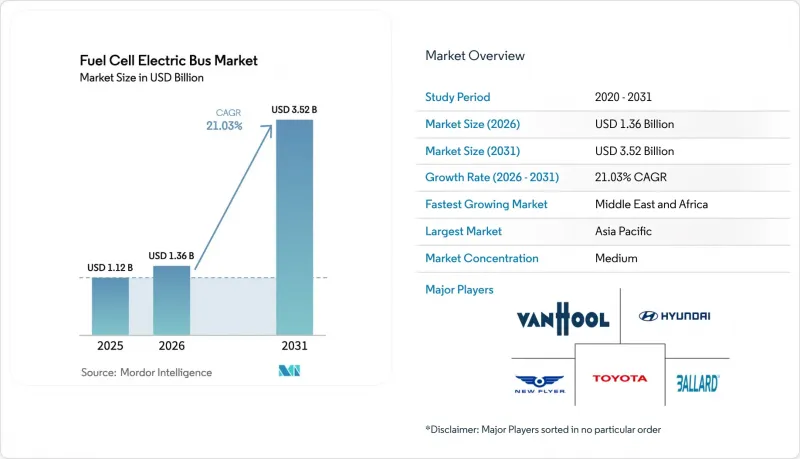
연료전지 전기 버스 시장 규모는 2025년에 11억 2,000만 달러로 평가되었고 2026년 13억 6,000만 달러에서 2031년까지 35억 2,000만 달러에 이를 것으로 예측되며, 예측 기간(2026-2031년) CAGR은 21.03%를 나타낼 전망입니다.
본 보고서는 용도별(도시 간 및 시내), 버스 유형별(신규 수소 버스 및 개조 수소 버스), 연료전지 유형별(양자 교환막형(PEMFC) 등), 정격 출력별(150kW 미만 및 150kW 이상),버스 전장별(9-12 m 및 12 m 초과), 주행 거리(300 km 미만 및 300 km 이상), 그리고 지역별로 분류되어 있습니다. 시장 예측은 금액(미 달러) 및 수량(대)으로 제시되어 있습니다.
전 세계 연료전지 전기 버스 시장 동향 및 인사이트
대중교통 차량에 대한 제로 배출 규제 강화
현재 많은 대중교통 기관이 디젤 차량 폐지를 위한 법적 기한에 직면해 있으며, 수소 버스에 관한 다년간의 기본 계약 체결이 진행되고 있습니다. 캘리포니아주에서는 2040년까지 모든 차량을 무공해 차량으로 전환해야 할 의무가 있으며, ‘혁신적 청정 교통(Innovative Clean Transit)’ 규정에 따라 단기 발주가 잇따르고 있습니다. 유럽연합(EU)의 ‘청정 차량 지침’에 따라 2024년에는 신규 납품 차량의 49%를 제로 배출 버스로할 것이라는 목표가 제시되었으며, 그중 연료전지 모델은 이미 전체의 3%를 차지하고 있습니다. 신흥 시장도 비슷한 길을 걷고 있습니다. 아부다비는 2030년까지 친환경 차량 비율을 20%로 늘리겠다는 목표를 제시하며, 각 OEM 업체에 명확한 조달 전망을 제공합니다. 따라서 법적 구속력이 있는 규제가 연료전지 전기 버스 시장의 장기적인 수요 곡선을 뒷받침하고 있습니다.
2025년 이후 그린 수소 가격의 급락
전해조 규모 확대와 재생에너지 비용 절감에 힘입어 2050년까지 평균 생산 비용은 1kg당 2.7유로까지 하락할 것으로 예상되며, 아시아에서는 1kg당 1.8유로에 달할 것으로 전망됩니다. 이로 인해 디젤과의 운영 비용 패리티에 변화가 생길 것입니다. 중국의 수소 부문은 2023년에 매출을 거의 두 배로 늘려 39억 3,000만 위안(RMB)에 달했으며, 이는 설비 및 공급망에서 가격 하락 추세를 보여주고 있습니다. 미국의 ‘퍼시픽 노스웨스트 수소 허브’ 등 새로 자금을 조달받은 허브들은 지역적 비용 우위를 제공하여 대중교통 차량의 연료비를 절감할 것입니다.
급속 충전식 배터리 전기 버스로부터의 경쟁
2024년, 배터리 전기 버스는 배터리 비용 하락과 차고 내 충전기의 보급에 힘입어 EU 도시 부문에서 처음으로 디젤 버스를 판매 대수에서 앞질렀습니다. 국제에너지기구(IEA)의 집계에 따르면, 2024년 전 세계 신규 전기 버스 도입 대수는 7만 대를 넘어 전년 대비 30% 증가했습니다. 일일 주행 거리가 200km 미만인 노선에서는 총 소유 비용(TCO) 산정에서 여전히 배터리 방식이 유리하기 때문에 수소 추진 지지자들은 장거리 주행이나 가동률이 높은 틈새 시장을 강조할 수밖에 없는 상황입니다.
부문 분석
시내 노선은 집중형 연료 보급과 예측 가능한 운행 주기가 적합하기 때문에 2025년 매출의 63.10%를 차지하며, 연료전지 전기버스 시장 규모로는 7억 1,000만 달러에 해당합니다. 도시 간 노선은 아직 발전 단계에 있지만, 사업자가 수소의 300-500km라는 ‘스위트 스팟’을 활용하여 도중 충전을 피할 수 있기 때문에 24.74%라는 가장 급격한 연평균 성장률(CAGR)이 예상됩니다. 수소 연료전지 버스 시장은 차고 부지가 제한적이고, 메가와트급 충전기를 지원하기 위한 송전망 업그레이드에 막대한 비용이 소요되는 경우 이점을 얻습니다. 칠레의 주행 거리 600km 차량군과 같은 실증 사례는 장거리 노선에서 수소의 적합성을 입증하고 있습니다.
도시 교통 기관 역시 운행 일정 지연을 최소화할 수 있는 10분 충전 시간을 높이 평가했습니다. 도시 간 네트워크에서는 배터리 팩이 승객 정원을 압박하는 야간 급행 노선에 수소가 동력원으로 기대를 모으고 있습니다. 자율주행 셔틀 실증 사업에서는 가동 중단 시간 없이 하루 20시간 운행을 지원하기 위해 연료전지 채택이 점점 더 요구되고 있으며, 이로 인해 연료전지 전기 버스 시장의 성능 면에서의 우위가 더욱 두드러지고 있습니다.
2025년 인도 대수의 71.10%를 신형 버스가 차지하며, 이는 각 OEM 업체들이 탱크를 루프 라인 내에 통합하여 바닥 면적을 효율적으로 활용할 수 있는 최적화된 섀시에 주력하고 있음을 반영합니다. 개조 차량은 규모는 작지만, 키트 공급업체가 운행 사업자에게 비교적 새로운 디젤 차량을 조기에 폐차하지 않고 개조할 수 있도록 함으로써 연평균 성장률(CAGR) 31.97%라는 급속한 성장을 이루고 있습니다. 자본 예산에 상한선이 있는 교통 당국은 특히 구매 보조금이 제공되는 지역에서 개조를 2030년 배출 목표 달성을 위한 과도기적 수단으로 간주하고 있습니다.
그럼에도 불구하고 솔라리스(Solaris)나 현대(Hyundai)와 같은 제조업체들은 스택, 인버터, 냉각 루프를 새로운 프레임에 직접 통합하여 차량 총중량을 줄이고 유지보수를 간소화하고 있습니다. 규모의 경제가 더욱 확대됨에 따라, 연료전지 전기 버스 시장은 신규 제조로 전환될 것으로 예측됩니다. 이는 운행 개시 후 5년이 경과하면, 수명 주기 총비용 측면에서 공장에서 통합된 시스템이 더 유리해지기 때문입니다.
지역별 분석
2025년, 아시아태평양은 전 세계 매출의 43.26%를 차지했으며, 연료전지 전기 버스 시장 규모는 4억 8,000만 달러에 달했습니다. 이는 중국의 인프라 구축이 급속히 진행되고, 한국으로부터의 대량 발주가 이루어졌기 때문입니다. 2031년까지 해당 지역의 연평균 성장률(CAGR) 30.12%는 1,200곳의 신규 수소 충전소 구축, 전국적인 통행료 면제, 그리고 에너지, 차량, 부품의 밸류체인을 통합한 산업 전략에 힘입은 결과입니다. 이어 북미는 6억 2,300만 달러의 연방 자금과 2035년까지 차량 교체를 의무화하는 주 정부의 규제를 호재로 삼아 연평균 성장률(CAGR) 27.26%로 확대되고 있습니다. ‘퍼시픽 노스웨스트 수소 허브’와 같은 프로젝트는 업스트림 공급망에 10억 달러를 창출하며, 주간 고속도로 연선 지자체에 대한 연료 공급 가격을 낮추고 있습니다. 캐나다의 ‘제로 배출 교통 기금’도 지자체의 시범 사업을 지원하고 있으며, 미시사가시의 첫 수소 차량 도입이 그 한 예입니다. 유럽은 ‘청정 차량 지침’과 지역 내 제조업의 우위를 원동력으로 연평균 성장률(CAGR) 23.42%를 기록할 전망입니다. 독일만 해도 2030년까지 3,800대의 수소연료전지 버스를 도입하는 것을 목표로 하고 있으며, 수소 충전소에 대한 대규모 공동 투자가 이루어지고 있습니다. 중동 및 아프리카은 기반은 낮지만 30.64%의 연평균 성장률(CAGR)로 가장 빠르게 성장하고 있는 지역입니다. 이는 UAE와 사우디아라비아의 지속가능성 프로그램이 주요 탄화수소 기업들을 수소 모빌리티 분야로 전환시키고 있는 것이 원동력이 되고 있습니다. 아부다비와 리야드에서의 시범 도입을 통해 기후 조건 하에서의 성능이 입증되고, 현지 공급망이 구축되면서 연료전지 전기 버스 시장의 지리적 범위가 확대되고 있습니다.
기타 혜택:
- 엑셀 형식 시장 예측(ME) 시트
- 3개월간의 애널리스트 지원
자주 묻는 질문
목차
제1장 서론
제2장 조사 방법
제3장 개요
제4장 시장 구도
제5장 시장 규모와 성장 예측(금액[달러]및 수량[단위])
제6장 경쟁 구도
제7장 시장 기회와 향후 전망
JHS 26.09.01According to Mordor Intelligence, the fuel cell electric bus market size was valued at USD 1.12 billion in 2025 and estimated to grow from USD 1.36 billion in 2026 to reach USD 3.52 billion by 2031, at a CAGR of 21.03% during the forecast period (2026-2031).
This report is Segmented by Application (Intercity and Intracity), Bus Type (New Hydrogen Buses and Retrofitted Hydrogen Buses), Fuel-Cell Type (Proton-Exchange Membrane (PEMFC) and More), Power Rating ( Less Than 150 KW and More), Bus Length (9 - 12 M and Over 12 M), Driving Range (Less Than 300 Km and More), and Geography. The Market Forecasts are Provided in Terms of Value (USD) and Volume (Units).
Global Fuel Cell Electric Bus Market Trends and Insights
Growing Zero-Emission Mandates for Public Transit Fleets
Many transit agencies now face statutory deadlines to eliminate diesel, prompting multi-year framework agreements for hydrogen buses. California requires full zero-emission fleets by 2040, triggering near-term orders under its Innovative Clean Transit rule. European Union's Clean Vehicles Directive pushed zero-emission buses to 49% of new deliveries in 2024, with fuel-cell models already taking 3% of the total. Emerging markets follow a similar path-Abu Dhabi targets a 20% green fleet share by 2030, providing clear procurement visibility for OEMs. Binding mandates, therefore, underpin the long-term demand curve of the fuel cell electric bus market.
Sharp Decline in Green Hydrogen Prices Post-2025
Electrolyzer scale-up and cheaper renewables are expected to cut average production costs to EUR 2.7 per kg by 2050, with Asia projected to hit EUR 1.8 per kg, altering the operating-cost parity versus diesel. China's hydrogen sector nearly doubled revenue to CNY 3.93 billion in 2023, demonstrating the deflationary trajectory of equipment and supply chains. Newly funded hubs such as the Pacific Northwest Hydrogen Hub in the United States add regional cost advantages that lower fuel bills for transit fleets.
Competition From Fast-Charging Battery-Electric Buses
Battery-electric buses outsold diesel in EU city segments for the first time in 2024, buoyed by falling battery costs and abundant depot chargers. The International Energy Agency counted over 70,000 new e-buses worldwide in 2024, a 30% jump from the year. On routes below 200 km daily, TCO modelling still favors batteries, forcing hydrogen proponents to emphasise longer-range and high-utilisation niches.
Other drivers and restraints analyzed in the detailed report include:
- Government-Backed Bulk Procurement Programmes
- Rapid Expansion of Liquid-Hydrogen Refuelling Corridors
- Grey-Hydrogen Supply Still Cheaper Than Green
For complete list of drivers and restraints, kindly check the Table Of Contents.
Segment Analysis
Intracity services generated 63.10% of 2025 revenue, equal to USD 0.71 billion of fuel cell electric bus market size, because city routes favour centralized refueling and predictable duty cycles. Intercity lines, while nascent, promise the steepest 24.74% CAGR as operators exploit hydrogen's 300-500 km sweet spot to avoid en-route charging. The fuel cell electric bus market benefits when depot footprints are tight and grid upgrades for megawatt-scale chargers prove costly. Demonstrations such as Chile's 600 km-range fleet underscore hydrogen's suitability for long-haul corridors.
Urban agencies also appreciate 10-minute refueling that keeps schedule recovery buffers thin. Intercity networks look to hydrogen to power overnight express links where battery packs would erode passenger capacity. Autonomous shuttle pilots increasingly specify fuel cells to support 20-hour daily duty without downtime, sharpening the performance edge for the fuel cell electric bus market.
New bus models represented 71.10% of 2025 deliveries, reflecting OEM focus on optimized chassis that integrate tanks within the roofline and free floor space. Retrofits, although smaller, are sprinting at a 31.97% CAGR as kit providers enable agencies to convert younger diesel stock instead of scrapping it early. Transit authorities with capped capital budgets view conversions as a bridge to 2030 emission targets, especially where policy offers purchase vouchers.
Still, builders like Solaris and Hyundai embed stacks, inverters, and cooling loops directly into new frames, delivering lower curb weight and simpler maintenance. As economies of scale sharpen, the fuel cell electric bus market is expected to pivot toward fresh builds because total lifecycle cost favors factory-integrated systems beyond year five of operation.
Complete Report Scope:
- By Application
- Intercity
- Intracity
- By Bus Type
- New Hydrogen Buses
- Retrofitted Hydrogen Buses
- By Fuel-cell Type
- Proton-Exchange Membrane (PEMFC)
- Phosphoric-Acid (PAFC)
- Solid-Oxide (SOFC)
- Others
- By Power Rating
- Less than 150 kW
- 150 - 250 kW
- Above 250 kW
- By Bus Length
- 9 - 12 metres
- Over 12 metres (articulated)
- By Driving Range
- Less than 300 km
- 300 - 500 km
- Above 500 km
- By Geography
- North America
- United States
- Canada
- Rest of North America
- South America
- Brazil
- Argentina
- Rest of South America
- Europe
- Germany
- United Kingdom
- France
- Italy
- Spain
- Russia
- Rest of Europe
- Asia-Pacific
- China
- Japan
- India
- South Korea
- Australia
- Rest of Asia-Pacific
- Middle East & Africa
- Saudi Arabia
- United Arab Emirates
- Turkey
- South Africa
- Rest of Middle East & Africa
- North America
Geography Analysis
Asia-Pacific commanded 43.26% of global revenue in 2025, equal to USD 0.48 billion of fuel cell electric bus market size, owing to China's infrastructure blitz and Korean bulk orders. The region's 30.12% CAGR to 2031 rests on 1,200 new hydrogen stations, national toll exemptions, and integrated industrial strategies that align energy, vehicle, and component value chains. North America follows, expanding at a 27.26% CAGR on the strength of USD 623 million federal funding and state mandates that force fleet turnovers by 2035. Projects like the Pacific Northwest Hydrogen Hub bring USD 1 billion into the upstream supply, lowering delivered fuel prices for agencies along Interstate corridors. Canada's Zero Emission Transit Fund also kick-starts municipal pilots, evidenced by Mississauga's first hydrogen fleet. Europe shows a 23.42% CAGR outlook, powered by the Clean Vehicles Directive and local manufacturing dominance. Germany alone targets 3,800 fuel-cell buses by 2030 with heavy co-investment in stations. The Middle East & Africa represents the fastest-growing territory at 30.64% CAGR, even if it starts from a lower base, spurred by UAE and Saudi sustainability programs that reposition hydrocarbons majors into hydrogen mobility. Pilot deployments in Abu Dhabi and Riyadh validate climatic performance and seed local supply chains, broadening the geographic reach of the fuel cell electric bus market.
- Ballard Power Systems Inc.
- New Flyer Industries
- Toyota Motor Corporation
- Hyundai Motor Company
- Tata Motors Ltd.
- Van Hool NV
- IVECO Group
- SAFRA
- Wrightbus (Bamford Bus Company Holdings Limited)
- CaetanoBus
- Foton International
- Yutong Bus Co., Ltd.
- ZhongTong Bus Holding Co., Ltd.
- CRRC Zhuzhou Electric Co., Ltd.
- Nuvera Fuel Cells LLC
- Nikola Corporation
Additional Benefits:
- The market estimate (ME) sheet in Excel format
- 3 months of analyst support
TABLE OF CONTENTS
1 Introduction
- 1.1 Study Assumptions & Market Definition
- 1.2 Scope of the Study
2 Research Methodology
3 Executive Summary
4 Market Landscape
- 4.1 Market Overview
- 4.2 Market Drivers
- 4.2.1 Growing Zero-Emission Mandates for Public Transit Fleets
- 4.2.2 Sharp Decline in Green Hydrogen Prices Post-2025
- 4.2.3 Government-Backed Bulk Procurement Programmes
- 4.2.4 Rapid Expansion of Liquid-Hydrogen Refuelling Corridors
- 4.2.5 OEM Platform Standardisation Lowering Total Cost of Ownership
- 4.2.6 Autonomous Shuttle Pilots Selecting FCEBs for Extended Duty Cycles
- 4.3 Market Restraints
- 4.3.1 Competition From Fast-Charging Battery-Electric Buses
- 4.3.2 Grey-Hydrogen Supply Still Cheaper Than Green
- 4.3.3 Under-Developed Maintenance Workforce
- 4.3.4 High Capex for Cryogenic Onboard Storage Systems
- 4.4 Value / Supply-Chain Analysis
- 4.5 Regulatory Landscape
- 4.6 Technological Outlook
- 4.7 Porter's Five Forces Analysis
- 4.7.1 Threat of New Entrants
- 4.7.2 Bargaining Power of Buyers
- 4.7.3 Bargaining Power of Suppliers
- 4.7.4 Threat of Substitutes
- 4.7.5 Intensity of Competitive Rivalry
5 Market Size & Growth Forecasts (Value [USD] and Volume [Units])
- 5.1 By Application
- 5.1.1 Intercity
- 5.1.2 Intracity
- 5.2 By Bus Type
- 5.2.1 New Hydrogen Buses
- 5.2.2 Retrofitted Hydrogen Buses
- 5.3 By Fuel-cell Type
- 5.3.1 Proton-Exchange Membrane (PEMFC)
- 5.3.2 Phosphoric-Acid (PAFC)
- 5.3.3 Solid-Oxide (SOFC)
- 5.3.4 Others
- 5.4 By Power Rating
- 5.4.1 Less than 150 kW
- 5.4.2 150 - 250 kW
- 5.4.3 Above 250 kW
- 5.5 By Bus Length
- 5.5.1 9 - 12 metres
- 5.5.2 Over 12 metres (articulated)
- 5.6 By Driving Range
- 5.6.1 Less than 300 km
- 5.6.2 300 - 500 km
- 5.6.3 Above 500 km
- 5.7 By Geography
- 5.7.1 North America
- 5.7.1.1 United States
- 5.7.1.2 Canada
- 5.7.1.3 Rest of North America
- 5.7.2 South America
- 5.7.2.1 Brazil
- 5.7.2.2 Argentina
- 5.7.2.3 Rest of South America
- 5.7.3 Europe
- 5.7.3.1 Germany
- 5.7.3.2 United Kingdom
- 5.7.3.3 France
- 5.7.3.4 Italy
- 5.7.3.5 Spain
- 5.7.3.6 Russia
- 5.7.3.7 Rest of Europe
- 5.7.4 Asia-Pacific
- 5.7.4.1 China
- 5.7.4.2 Japan
- 5.7.4.3 India
- 5.7.4.4 South Korea
- 5.7.4.5 Australia
- 5.7.4.6 Rest of Asia-Pacific
- 5.7.5 Middle East & Africa
- 5.7.5.1 Saudi Arabia
- 5.7.5.2 United Arab Emirates
- 5.7.5.3 Turkey
- 5.7.5.4 South Africa
- 5.7.5.5 Rest of Middle East & Africa
- 5.7.1 North America
6 Competitive Landscape
- 6.1 Market Concentration
- 6.2 Strategic Moves
- 6.3 Market Share Analysis
- 6.4 Company Profiles (Includes Global Level Overview, Market Level Overview, Core Segments, Financials as Available, Strategic Information, Market Rank/Share for Key Companies, Products & Services, and Recent Developments)
- 6.4.1 Ballard Power Systems Inc.
- 6.4.2 New Flyer Industries
- 6.4.3 Toyota Motor Corporation
- 6.4.4 Hyundai Motor Company
- 6.4.5 Tata Motors Ltd.
- 6.4.6 Van Hool NV
- 6.4.7 IVECO Group
- 6.4.8 SAFRA
- 6.4.9 Wrightbus (Bamford Bus Company Holdings Limited)
- 6.4.10 CaetanoBus
- 6.4.11 Foton International
- 6.4.12 Yutong Bus Co., Ltd.
- 6.4.13 ZhongTong Bus Holding Co., Ltd.
- 6.4.14 CRRC Zhuzhou Electric Co., Ltd.
- 6.4.15 Nuvera Fuel Cells LLC
- 6.4.16 Nikola Corporation


