

|
시장보고서
상품코드
2125625
블로어 시장 : 시장 점유율 분석, 산업 동향 및 통계 데이터, 성장 예측(2026-2031년)Blowers - Market Share Analysis, Industry Trends & Statistics, Growth Forecasts (2026 - 2031) |
||||||
 Mordor Intelligence
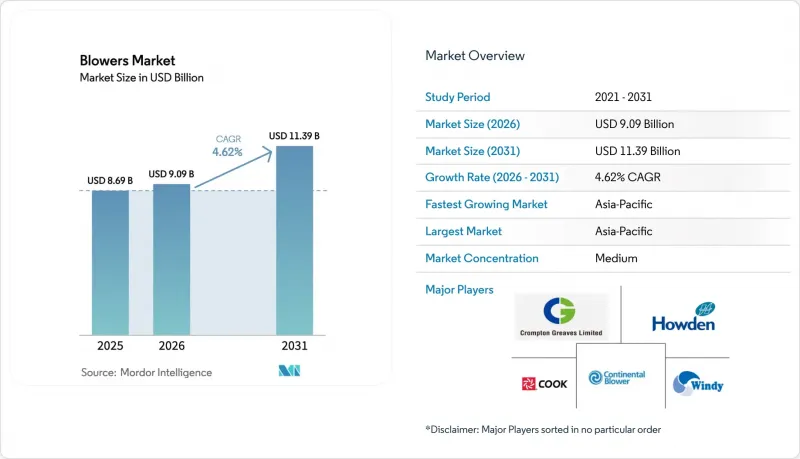
Mordor Intelligence에 의하면, 블로어 시장 규모는 2025년 86억 9,000만 달러로 평가되었고, 2026년에는 90억 9,000만 달러로 추정되고, 2026-2031년 CAGR 4.62%로 성장을 지속할 전망이며, 2031년에는 113억 9,000만 달러에 이를 것으로 예측됩니다.
본 보고서는 기술별(원심식, 축류식, 용적식, 고속 터보식, 와류식), 압력 범위별(저압, 중압, 고압), 최종 이용 산업별(발전, 석유 및 가스, 철강, 화학제품 및 석유화학제품, 광업 및 금속, 식품 및 음료, HVAC·클린룸 등) 및 지역별(북미, 유럽, 아시아태평양, 남미, 중동 및 아프리카)로 분류되어 있습니다.
세계의 블로어 시장 동향 및 인사이트
폐수 처리 인프라의 급속한 확대
지자체 및 산업용 폐수 처리 시설에서는 일반적으로 플랜트 전력 예산의 40-60%를 차지하는 폭기 능력 증강이 진행되고 있으며, 그 결과 블로어에 대한 수요가 지속되고 있습니다. 캔자스주의 수자원 회수 시설에서는 고속 일체형 기어식 블로어로 전환하는 개조를 통해 연간 에너지 비용을 3만 5,000달러 절감했습니다. 아시아태평양의 각국 정부는 물 부족에 대한 우려와 더욱 엄격해진 방류 규제를 연계하여, 용존 산소를 정밀하게 제어할 수 있는 원심식 및 자기 베어링식 터보 모델의 도입을 촉진하고 있습니다. 모듈식 처리 패키지는 소규모 지자체가 조달을 표준화하는 데 도움이 되며, 입증된 신뢰성을 갖춘 브랜드를 우선시함으로써 간접적으로 블로어 시장을 활성화하고 있습니다. 유틸리티자들이 전체 수명 주기에 걸친 운영 비용 절감을 목표로 하는 가운데, 디지털 모니터링 및 예측 유지보수 소프트웨어를 제공할 수 있는 공급업체는 더욱 큰 경쟁 우위를 확보하고 있습니다.
산업용 대기 배출 규제의 강화
화학, 전력, 식품 가공 플랜트 전반에 걸쳐 미세먼지 및 가스 배출 기준이 강화됨에 따라, 사업자들은 변동하는 조건에서도 일정한 유량을 유지할 수 있는 블로어 도입을 서두르고 있습니다. 미국에서는 2025-2029년 875GW의 신규 발전 용량 건설이 계획되어 있으며, 각 프로젝트에는 고효율 블로어에 의존하는 배가스 처리 시스템이 통합될 예정입니다. 유럽의 개정된 ‘산업 배출 지침’에는 연속 배출 모니터링이 포함되어 있으며, 이러한 사양은 오일 프리 방식이 제공하는 높은 신뢰성 덕분에 자기 베어링식 터보 설계를 유리하게 만들고 있습니다. 제약 제조업체와 클린룸에서는 현재 클래스 100 이상의 기류가 요구되고 있으며, 이로 인해 블로어 시장에 대한 규제 수요가 확대되고 있습니다. 전반적으로 규정 준수 비용으로 인해 검증 가능한 에너지 효율 및 가동률 지표를 갖춘 고품질 기계에 대한 조달이 진행되고 있으며, 가격에 민감한 산업임에도 불구하고 공급업체는 더 높은 이익률을 확보할 수 있게 되었습니다.
철강·구리 가격 변동
원자재 가격 변동은 최종 사용자에게 예산상의 불확실성을 야기하고, 제조업체에게는 이익률에 대한 압박을 가합니다. 특히 원심식 블로어 하우징에 사용되는 강재의 비중이나 모터 권선에서 구리가 차지하는 역할을 고려할 때, 그 영향은 현저합니다. 제조업체는 이에 대응하기 위해 금속 조달처를 다각화하거나 재고를 늘리고 있지만, 이로 인해 운전 자금 수요가 증가하고 있습니다. 비용에 민감한 분야의 프로젝트에서는 가격 동향이 안정될 때까지 발주를 미루는 경우가 많아, 이로 인해 블로어 시장 수요가 일시적으로 둔화되고 있습니다. EPC 도급업체들은 현재 계약에 가격 상승 조항을 포함시켜 원자재 리스크의 일부를 고객에게 전가하고 있습니다. 헤지 수단을 통해 부분적인 완화는 도모되고 있지만, 변동이 장기화될 경우 2026-2027년 예정된 대규모 하수처리장 입찰이 지연될 가능성이 있습니다.
부문 분석
2025년 블로어 시장 규모에서 원심식 기술은 44.25%의 점유율을 차지했으며, 이는 도시 하수 처리 및 일반 산업 용도에서 수십 년에 걸쳐 입증된 신뢰성을 반영한 것입니다. 반면, 구매자들이 수명 주기 전반에 걸친 에너지 절약을 우선시하는 경향이 있어, 고속 터보 설계 시장 규모는 2031년까지 연평균 성장률(CAGR) 5.86%를 나타낼 것으로 예측됩니다. 원심식 모델은 초기 비용이 저렴하고 유지보수가 간편하여 효율성상의 이점을 상쇄하는 경우, 특히 기술자 확보가 어려운 개발도상 지역에서 여전히 수요가 있습니다. 각 공급업체는 자체 개발한 원심식 제품 라인과 인수한 자기 베어링 제품을 결합한 하이브리드 제품 포트폴리오를 전개하여 시장 점유율을 유지하고자 하고 있습니다. 터보식 장비에는 상태 모니터링 센서가 점점 더 많이 탑재되고 있으며, 운영자에게 실시간 데이터를 제공함으로써 그 가치 인식을 더욱 높이고 있습니다. 용적식 루츠 블로어는 벌크 고체의 공기 이송 등 유량이 일정한 용도에서 여전히 중요성을 유지하고 있지만, 그 시장 점유율은 감소 추세에 있습니다. 축류식 기계는 대용량·저압 냉각탑에서 틈새 시장을 점유하고 있는 반면, 와류식 유닛은 내습성 기류가 필수적인 농장 규모의 바이오가스 소화조에서 성장하고 있습니다.
2세대 터보 블로어는 40,000rpm을 초과하는 회전 속도로 작동하며, 분진이 많은 환경에서도 베어링 수명을 연장하는 첨단 마이크로 메쉬 필터에 의해 지원됩니다. 현재 여러 제조업체가 부하 변동 상황에서도 효율을 유지하기 위해 임펠러 피치를 자동으로 조정하는 소프트웨어를 함께 제공하고 있으며, 이는 가변 토크형 폐수 폭기 분야에서 중요한 차별화 요소로 작용하고 있습니다. 자석 공급 리스크가 여전히 남아 있는 가운데, 일부 운영자는 하이브리드 세라믹 베어링 기술에 관심을 보이고 있으나, 이러한 프로토타입은 아직 산업 규모에서의 실증 단계에는 이르지 못했습니다. 전반적으로 원심식 장비는 대수 기준으로는 우위를 유지할 것으로 예상되지만, 고부가가치 부문에서는 터보식 유닛에 매출 성장세를 점차 내주게 될 것으로 전망됩니다.
지역별 분석
아시아태평양은 2025년에 37억 5,000만 달러 상당의 블로어 매출을 기록하며 전 세계 시장의 43.10%를 차지했습니다. 중국의 ‘제로 배출’ 규제로 인해 도시 하수 처리 시설의 개보수가 가속화되고 있는 한편, 인도의 ‘잘 지반 미션(Jal Jivan Mission)’은 새로운 처리 시설에 자금을 지원하고 있어, 이로 인해 원심식 및 터보식 블로어의 도입이 전반적으로 촉진되고 있습니다. 베트남과 말레이시아에 위치한 아세안(ASEAN)의 전자 산업 거점에서는 급증하는 반도체 조립품 수출을 뒷받침하기 위해 클린룸 사양의 HVAC용 블로어 도입이 진행되고 있습니다. 이 지역의 연평균 성장률(CAGR) 5.02% 전망치는 그린필드 인프라 구축과 에너지 집약도 감소를 목적으로 한 기존 설비 개보수 두 가지를 모두 반영한 것입니다.
북미에서는 시장이 성숙기에 접어들었음에도 불구하고 수익성이 높은 교체 수요가 예상됩니다. 유틸리티자들은 주 정부의 에너지 효율 향상 인센티브를 준수하기 위해 노후화된 폭기 설비를 VFD 연동형 터보 블로어로 교체하고 있습니다. 미국 전역에서 데이터센터 건설이 확대됨에 따라 고압 액체 냉각 시스템의 수주가 증가하고 있으며, 공급업체에게는 수익성이 높은 프로젝트 기회가 제공되고 있습니다. 연방 정부의 배출 감축 목표에 따라 멕시코만 연안의 석유화학 클러스터에서 자기 베어링 기술의 조기 도입이 가속화되고 있습니다. 캐나다에서 확대되고 있는 바이오가스 사업으로 인해, 혐기성 소화조를 위한 내습성·와류식 유닛의 판매가 증가하고 있습니다.
유럽에서는 산업 배출 지침을 배경으로 프리미엄 가격이 유지되고 있어, 시설 측에서는 클래스 제로 공기 청정도를 보장하는 오일 프리 기계의 구매가 권장되고 있습니다. 독일의 화학·제약 복합 시설에서는 탄소 배출료 급등에 따라 에너지 비용을 절감하기 위해 가변 속도 원심 블로어에 대한 투자가 진행되고 있습니다. 이 지역의 선진적인 애프터마켓 환경은 구독형 유지보수 서비스를 뒷받침하고 있으며, 지속적인 수익원을 확대되고 있습니다. 남미 및 중동 및 아프리카(MEA) 지역은 2025년 총 판매량에서 10% 미만에 그치고 있지만, 해수 담수화 플랜트 및 광업 프로젝트와 관련된 성장 조짐이 보입니다. 환율 리스크와 정치적 리스크가 단기적인 도입을 억제하고 있지만, 국제 금융 기관들이 MEA 지역의 물 안보에 주력하고 있다는 점은 블로어 시장의 장기적인 성장을 뒷받침하고 있습니다.
기타 혜택 :
- Excel 형식 시장 예측(ME) 시트
- 3개월간 애널리스트 지원
자주 묻는 질문
목차
제1장 서론
제2장 분석 방법
제3장 주요 요약
제4장 시장 구도
제5장 시장 규모 및 성장률 예측
제6장 경쟁 구도
제7장 시장 기회 및 향후 전망
AJY 26.09.15According to Mordor Intelligence, the blowers market size is expected to grow from USD 8.69 billion in 2025 to USD 9.09 billion in 2026 and is forecast to reach USD 11.39 billion by 2031 at 4.62% CAGR over 2026-2031.
This report is Segmented by Technology (Centrifugal, Axial, Positive-Displacement, High-Speed Turbo, and Regenerative), Pressure Range (Low, Medium, and High), End-Use Industry (Power Generation, Oil and Gas, Iron and Steel, Chemical and Petrochemical, Mining and Metals, Food and Beverage, HVAC and Cleanrooms, and More), and Geography (North America, Europe, Asia-Pacific, South America, and Middle East and Africa).
Global Blowers Market Trends and Insights
Rapid Expansion of Wastewater-Treatment Infrastructure
Municipal and industrial wastewater facilities are increasing their aeration capacity, which typically accounts for 40-60% of a plant's electricity budget, resulting in sustained demand for blowers. A retrofit at the Kansas Water Resource Recovery Facility cut annual energy costs by USD 35,000 after switching to high-speed integrally geared blowers. Asia-Pacific governments are coupling water-scarcity concerns with stricter discharge rules, spurring the uptake of centrifugal and magnetic-bearing turbo models that provide precise dissolved-oxygen control. Modular treatment packages help smaller municipalities standardize procurement, indirectly boosting the blower market by favoring brands with proven reliability. Vendors able to supply digital monitoring and predictive-maintenance software gain further advantage as utilities target whole-of-life operating savings.
Stricter Industrial Air-Emission Regulations
Tightening particulate and gas limits across chemical, power, and food-processing plants are pushing operators to acquire blowers that sustain constant flow under variable conditions.The United States plans 875 GW of new generating capacity between 2025-2029, each project integrating flue-gas treatment systems reliant on high-efficiency blowers. Europe's revised Industrial Emissions Directive incorporates continuous emissions monitoring, a specification that favors magnetic-bearing turbo designs due to their oil-free reliability. Pharmaceutical producers and cleanrooms now require class 100 or better airflow, broadening the regulatory pull on the blower market. Overall, compliance costs steer procurement toward premium machines with verifiable energy and uptime metrics, enabling suppliers to secure higher margins despite price-sensitive sectors.
Steel & Copper Price Volatility
Commodity swings create budget uncertainty for end users and margin pressure for manufacturers, especially given steel's weight in centrifugal-blower housings and copper's role in motor windings. Producers respond by dual-sourcing metals and carrying higher inventories, which raises working-capital needs. Projects in cost-sensitive sectors often defer purchase orders until price signals stabilize, temporarily damping blower market demand. EPC contractors now insert price-escalation clauses into contracts, transferring part of the raw-material risk back to clients. Although hedging instruments offer partial relief, sustained volatility could delay large wastewater plant tenders scheduled for 2026-2027.
Other drivers and restraints analyzed in the detailed report include:
- Power-Generation Additions in Emerging Economies
- Industrial Energy-Efficiency Retrofits
- Magnetic-Levitation Turbo Blowers Cannibalising Legacy Units
For complete list of drivers and restraints, kindly check the Table Of Contents.
Segment Analysis
The blower market size for centrifugal technology accounts for a 44.25% share in 2025, reflecting decades of proven reliability in municipal wastewater and general industrial applications. High-speed turbo designs, however, are projected to register a 5.86% CAGR through 2031, as buyers prioritize lifetime energy savings. Centrifugal models still appeal where lower upfront cost and simpler maintenance outweigh efficiency benefits, especially in developing regions with limited technical skill availability. Suppliers position hybrid portfolios that combine in-house centrifugal lines with acquired magnetic-bearing offerings to defend their market share. Turbo machines are increasingly integrating condition-monitoring sensors, providing operators with real-time data that further enhances their perceived value. Positive-displacement roots blowers retain relevance in flow-constant applications, such as the pneumatic conveying of bulk solids, although their share is declining. Axial machines occupy a niche in high-volume, low-pressure cooling towers, while regenerative units are growing in farm-scale biogas digesters, where moisture-tolerant airflows are crucial.
Second-generation turbo blowers operate at rotational speeds exceeding 40,000 rpm, supported by advanced micro-mesh filters that enhance bearing life in dusty environments. Several manufacturers now bundle software that automatically tunes impeller pitch to maintain efficiency across fluctuating loads, a key differentiator in variable-torque wastewater aeration. As magnet supply risks persist, a subset of operators signals interest in hybrid ceramic-bearing technology, although these prototypes remain unproven at an industrial scale. Overall, centrifugal equipment is expected to keep numerical leadership but cede incremental revenue gains to turbo units in high-value segments.
Complete Report Scope:
- By Technology
- Centrifugal
- Axial
- Positive-Displacement (Roots)
- High-Speed Turbo
- Regenerative
- By Pressure Range
- Low (Below 15 kPa)
- Medium (15 to 70 kPa)
- High (Above 70 kPa)
- By End-use Industry
- Power Generation
- Oil and Gas
- Iron and Steel
- Chemical and Petrochemical
- Mining and Metals
- Construction and Cement
- Food and Beverage
- Waste-Water Treatment
- HVAC & Cleanrooms
- Others
- By Geography
- North America
- United States
- Canada
- Mexico
- Europe
- Germany
- United Kingdom
- France
- Italy
- Spain
- NORDIC Countries
- Russia
- Rest of Europe
- Asia-Pacific
- China
- India
- Japan
- South Korea
- ASEAN Countries
- Rest of Asia-Pacific
- South America
- Brazil
- Argentina
- Rest of South America
- Middle East and Africa
- Saudi Arabia
- United Arab Emirates
- South Africa
- Rest of Middle East and Africa
- North America
Geography Analysis
The Asia-Pacific region underpinned USD 3.75 billion worth of blower sales in 2025, accounting for 43.10% of the global value. China's "Zero Discharge" mandates accelerate municipal wastewater upgrades, while India's Jal Jeevan Mission funds new treatment plants that collectively boost the adoption of centrifugal and turbo blowers. ASEAN electronics hubs in Vietnam and Malaysia are installing cleanroom-grade HVAC blowers to support the fast-rising chip-assembly exports. The region's 5.02% CAGR outlook reflects both greenfield infrastructure and retrofits aimed at lowering energy intensity.
North America follows with mature but lucrative replacement demand. Utilities retrofit aged aeration equipment with VFD-linked turbo blowers to comply with state energy-efficiency incentives. The build-out of data centres across the United States generates high-pressure liquid-cooling orders, providing suppliers with margin-rich project opportunities. Federal emission-reduction targets are accelerating the early adoption of magnetic-bearing technologies in petrochemical clusters along the Gulf Coast. Canada's expanding biogas programs enhance sales of moisture-resistant regenerative units for anaerobic digesters.
Europe sustains premium pricing on the back of the Industrial Emissions Directive, encouraging facilities to buy oil-free machines that guarantee class-zero air purity. Germany's chemical and pharmaceutical complexes are investing in variable-speed centrifugal blowers to reduce energy bills amid rising carbon charges. The region's advanced aftermarket environment favors subscription-based maintenance services, expanding recurring revenue streams. South America and the Middle East & Africa collectively contributed less than 10% of the 2025 volume, but signal upside linked to desalination plants and mining projects. Currency and political risks temper short-term adoption; however, international financiers' focus on water security in the MEA supports long-term growth in the blower market.
- Acme Engineering & Manufacturing Corp.
- Airmaster Fan Company Inc.
- Atlas Copco AB
- Continental Blower LLC
- CG Power & Industrial Solutions Ltd.
- DongKun Industrial Co. Ltd.
- Flakt Woods Group SA
- Gardner Denver Holdings Inc.
- Greenheck Fan Corp.
- Howden Group Ltd.
- Loren Cook Company
- Pollrich GmbH
- Ingersoll Rand Inc.
- Chicago Blower Corporation
- Twin City Fan & Blower
- Spencer Turbine Company
- New York Blower Company
- AirPro Fan & Blower Co.
- Atlantic Blowers
- Shandong Zhangqiu Blower Co. Ltd.
- Zhejiang Shangfeng Industrial Holdings
- Hitachi Industrial Equipment Systems Co. Ltd.
Additional Benefits:
- The market estimate (ME) sheet in Excel format
- 3 months of analyst support
TABLE OF CONTENTS
1 Introduction
- 1.1 Study Assumptions & Market Definition
- 1.2 Scope of the Study
2 Research Methodology
3 Executive Summary
4 Market Landscape
- 4.1 Market Overview
- 4.2 Market Drivers
- 4.2.1 Rapid expansion of wastewater-treatment infrastructure
- 4.2.2 Stricter industrial air-emission regulations
- 4.2.3 Power-generation additions in emerging economies
- 4.2.4 Industrial energy-efficiency retrofits
- 4.2.5 Data-centre liquid-cooling demand for high-pressure blowers
- 4.2.6 Farm-scale biogas digesters boosting regenerative blowers
- 4.3 Market Restraints
- 4.3.1 Steel & copper price volatility
- 4.3.2 High energy consumption and noise versus alternative tech
- 4.3.3 Magnetic-levitation turbo blowers cannibalising legacy units
- 4.3.4 Rare-earth magnet supply-chain exposure
- 4.4 Supply-Chain Analysis
- 4.5 Regulatory Landscape
- 4.6 Technological Outlook
- 4.7 Porter's Five Forces
- 4.7.1 Bargaining Power of Suppliers
- 4.7.2 Bargaining Power of Buyers
- 4.7.3 Threat of New Entrants
- 4.7.4 Threat of Substitutes
- 4.7.5 Competitive Rivalry
5 Market Size & Growth Forecasts
- 5.1 By Technology
- 5.1.1 Centrifugal
- 5.1.2 Axial
- 5.1.3 Positive-Displacement (Roots)
- 5.1.4 High-Speed Turbo
- 5.1.5 Regenerative
- 5.2 By Pressure Range
- 5.2.1 Low (Below 15 kPa)
- 5.2.2 Medium (15 to 70 kPa)
- 5.2.3 High (Above 70 kPa)
- 5.3 By End-use Industry
- 5.3.1 Power Generation
- 5.3.2 Oil and Gas
- 5.3.3 Iron and Steel
- 5.3.4 Chemical and Petrochemical
- 5.3.5 Mining and Metals
- 5.3.6 Construction and Cement
- 5.3.7 Food and Beverage
- 5.3.8 Waste-Water Treatment
- 5.3.9 HVAC & Cleanrooms
- 5.3.10 Others
- 5.4 By Geography
- 5.4.1 North America
- 5.4.1.1 United States
- 5.4.1.2 Canada
- 5.4.1.3 Mexico
- 5.4.2 Europe
- 5.4.2.1 Germany
- 5.4.2.2 United Kingdom
- 5.4.2.3 France
- 5.4.2.4 Italy
- 5.4.2.5 Spain
- 5.4.2.6 NORDIC Countries
- 5.4.2.7 Russia
- 5.4.2.8 Rest of Europe
- 5.4.3 Asia-Pacific
- 5.4.3.1 China
- 5.4.3.2 India
- 5.4.3.3 Japan
- 5.4.3.4 South Korea
- 5.4.3.5 ASEAN Countries
- 5.4.3.6 Rest of Asia-Pacific
- 5.4.4 South America
- 5.4.4.1 Brazil
- 5.4.4.2 Argentina
- 5.4.4.3 Rest of South America
- 5.4.5 Middle East and Africa
- 5.4.5.1 Saudi Arabia
- 5.4.5.2 United Arab Emirates
- 5.4.5.3 South Africa
- 5.4.5.4 Rest of Middle East and Africa
- 5.4.1 North America
6 Competitive Landscape
- 6.1 Market Concentration
- 6.2 Strategic Moves (M&A, Partnerships, PPAs)
- 6.3 Market Share Analysis (Market Rank/Share for key companies)
- 6.4 Company Profiles (includes Global level Overview, Market level overview, Core Segments, Financials as available, Strategic Information, Products & Services, and Recent Developments)
- 6.4.1 Acme Engineering & Manufacturing Corp.
- 6.4.2 Airmaster Fan Company Inc.
- 6.4.3 Atlas Copco AB
- 6.4.4 Continental Blower LLC
- 6.4.5 CG Power & Industrial Solutions Ltd.
- 6.4.6 DongKun Industrial Co. Ltd.
- 6.4.7 Flakt Woods Group SA
- 6.4.8 Gardner Denver Holdings Inc.
- 6.4.9 Greenheck Fan Corp.
- 6.4.10 Howden Group Ltd.
- 6.4.11 Loren Cook Company
- 6.4.12 Pollrich GmbH
- 6.4.13 Ingersoll Rand Inc.
- 6.4.14 Chicago Blower Corporation
- 6.4.15 Twin City Fan & Blower
- 6.4.16 Spencer Turbine Company
- 6.4.17 New York Blower Company
- 6.4.18 AirPro Fan & Blower Co.
- 6.4.19 Atlantic Blowers
- 6.4.20 Shandong Zhangqiu Blower Co. Ltd.
- 6.4.21 Zhejiang Shangfeng Industrial Holdings
- 6.4.22 Hitachi Industrial Equipment Systems Co. Ltd.
7 Market Opportunities & Future Outlook
- 7.1 White-Space & Unmet-Need Assessment


