
|
시장보고서
상품코드
2125640
중국의 반도체 디바이스 시장 : 점유율 분석, 업계 동향과 통계, 성장 예측(2026-2031년)China Semiconductor Device - Market Share Analysis, Industry Trends & Statistics, Growth Forecasts (2026 - 2031) |
||||||
 Mordor Intelligence
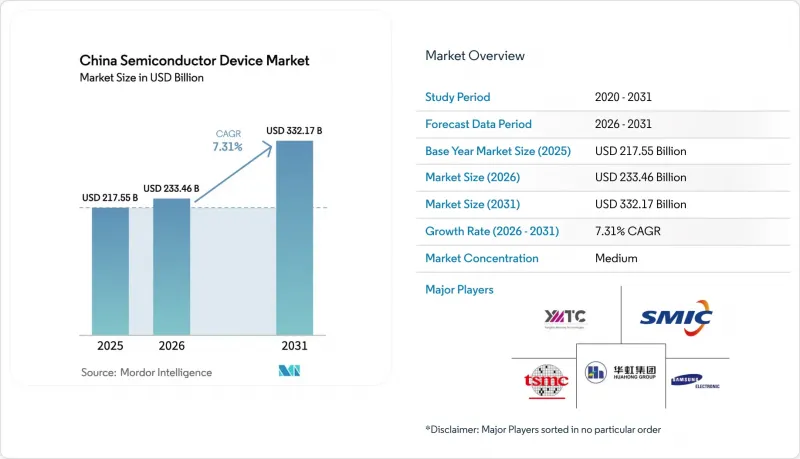
중국 반도체 디바이스 시장 규모는 2025년에 2,175억 5,000만 달러로 평가되었고 2026년 2,334억 6,000만 달러에서 2031년까지 3,321억 7,000만 달러에 이를 것으로 예측되며, 예측 기간(2026-2031년) CAGR은 7.31%를 나타낼 전망입니다.
본 보고서는 디바이스 유형(디스크리트 반도체(다이오드, 트랜지스터 등), 광전자(LED, 레이저 다이오드 등), 센서 및 MEMS(압력, 액추에이터 등), 집적 회로), 비즈니스 모델(IDM, 설계/팹리스 벤더),및 최종 이용 산업(자동차, 통신, 소비자용, 산업용, 컴퓨팅/데이터 스토리지, 데이터센터, AI, 정부)별로 분류되어 있습니다.
중국 반도체 디바이스 시장 동향 및 인사이트
‘중국 제조 2025’에 기반한 IC 생산 능력 확대 계획 가속화
중국은 2024년에 파운드리 생산 능력을 15% 확대하고, SMIC, 화홍(Huahong), Nexchip이 성숙 노드의 생산 라인을 본격 가동함에 따라 2025년에는 추가로 14%의 증강이 예정되어 있습니다. 현지화 움직임은 현재 제조 공정을 넘어 포토레지스트 박리 및 습식 세정 장비까지 확대되고 있으며, 이러한 분야에서는 국내 공급업체들이 높은 채택률을 달성하고 있습니다. 2027년까지 중국은 전 세계 28nm 생산 능력의 31%를 차지할 것으로 예측되며, 이는 성숙 노드의 가격 형성에 변화를 가져올 전망입니다. 이 계획의 성패는 안정적인 전력 공급, 공정 엔지니어링 인력, 그리고 수출 규제의 영향을 완화할 수 있는 대체 공급원(세컨드 소스) 장비 라인에 달려 있습니다. 이 모든 요소를 종합해 볼 때, 이러한 전개로 인해 소비자용, 산업용, 자동차용 전자제품을 위한 국내 공급 체계가 공고해져, 생태계 전반에 걸쳐 가동률과 이익률 향상으로 이어질 것입니다.
중국의 Tier 1 클라우드 제공업체에 의한 AI 중심 엣지 컴퓨팅 수요
알리바바는 2025년부터 2027년까지 AI 지원 클라우드 인프라 구축에 3,800억 위안(529억 달러)을 투자하겠다고 약속했으며, 텐센트와 바이두도 비슷한 규모의 투자를 발표했습니다. 수요는 GPU, 고대역폭 메모리, 네트워크 스위치용 ASIC에 이르기까지 다양하며, 이러한 주문은 현지 반도체 팹과 메모리 제조업체로 유입되고 있습니다. DeepSeek의 기반 모델은 소프트웨어와 하드웨어를 통합하는 중국의 역량을 입증하고 있으며, 해외 가속기에 대한 의존도를 줄이고 있습니다. 엣지 AI 워크로드는 저지연 On-Premise 컴퓨팅을 선호하기 때문에 구매자들은 국가의 데이터 주권 규정을 준수하는 국산 설계 SoC를 선택하고 있습니다. 따라서 하이퍼스케일러의 설비 투자와 칩 수준의 혁신 사이의 선순환은 중기적 성장의 주요 원동력이 될 것입니다.
미국 수출관리 대상 기업 목록에 따른 EUV 및 EDA 툴에 대한 규제
2024년 10월 및 12월에 미국 정부가 제정한 규정에 따라, EUV 스캐너, 첨단 증착 장비 및 하이엔드 EDA 라이선스의 중국 내 반도체 제조 공장으로의 출하가 금지되었습니다. 국내 제조업체들은 양산에서 여전히 28nm에 제한되어 있어, ASML사의 EUV를 사용하지 않고 7nm 개념 증명(PoC) 웨이퍼에 대한 기술 혁신을 도모해야 합니다. 대안으로는 게이트 길이 1nm로 시험 운용 중인 2차원 소재 트랜지스터나 첨단 DUV 멀티패터닝 등이 거론되지만, 상업적인 수율을 달성하기까지는 아직 수년이 소요될 전망입니다. 장비 납기 지연, 소프트웨어 라이선스의 불확실성, 그리고 규정 준수 감사가 공정 노드 전환 속도를 늦추고 있습니다.
부문 분석
2025년에는 집적 회로가 매출의 86.02%를 차지하며, AI, 5G, 서버 수요로 인해 더 큰 다이 크기와 적층형 V-캐시 솔루션이 요구됨에 따라 그 점유율은 소폭 더 상승할 것으로 예측됩니다. 중국 반도체 시장에서 집적 회로는 연평균 성장률(CAGR) 8.02%로 확대될 것이며, 2031년까지 692억 달러 이상의 신규 생산량이 추가될 것으로 예측됩니다. YMTC의 232층 3D NAND와 CXMT의 DDR5 수율 80%는 메모리 분야의 성장세를 뒷받침하고 있는 반면, SMIC의 12인치 생산 라인은 견조한 소비자용 및 산업용 수요를 바탕으로 가동률 89.6%로 가동되고 있습니다.
디스크리트 파워 디바이스, 옵토일렉트로닉스, 센서는 합쳐서 나머지 13.98%의 점유율을 차지하고 있지만, NEV의 전동화와 5G용 광학 부품 수요 증가의 혜택을 받고 있습니다. 국내 SiC 다이오드 생산 능력은 18개월마다 두 배로 증가하고 있으며, 스마트폰용 3D 센싱 VCSEL 출하량은 국내 팹으로 전환되고 있습니다. 금액 기준으로는 소규모이지만, 이러한 카테고리는 자동차 안전성, 스마트 공장 도입, AR/VR 하드웨어 분야에서 중요한 차별화 요소가 되어 다방면에 걸친 회복력을 뒷받침하고 있습니다.
기타 혜택:
- 엑셀 형식 시장 예측(ME) 시트
- 3개월간의 애널리스트 지원
자주 묻는 질문
목차
제1장 서론
제2장 조사 방법
제3장 주요 요약
제4장 시장 구도
제5장 시장 규모와 성장 예측
제6장 경쟁 구도
제7장 시장 기회와 향후 전망
JHSAccording to Mordor Intelligence, the China semiconductor device market size was valued at USD 217.55 billion in 2025 and estimated to grow from USD 233.46 billion in 2026 to reach USD 332.17 billion by 2031, at a CAGR of 7.31% during the forecast period (2026-2031).
This report is Segmented by Device Type (Discrete Semiconductors [Diodes, Transistors, and More], Optoelectronics [LEDs, Laser Diodes, and More], Sensors and MEMS [Pressure, Actuators, and More], and Integrated Circuits), Business Model (IDM, and Design/ Fabless Vendor), and End-Use Industry (Automotive, Communication, Consumer, Industrial, Computing/Data Storage, Data Center, AI, and Government).
China Semiconductor Device Market Trends and Insights
Accelerated "Made-in-China 2025" IC Capacity Expansion Programs
China expanded foundry capacity by 15% in 2024 and is scheduled to add another 14% in 2025 as SMIC, Huahong, and Nexchip ramp mature-node lines. Localization now stretches beyond fabrication to photoresist stripping and wet-clean tools, where domestic suppliers have achieved high usage rates. By 2027, China is projected to hold 31% of global 28 nm capacity, reshaping pricing at mature nodes. The program's success hinges on stable power, process-engineering talent, and second-source equipment lines that mitigate export-control exposure. Taken together, the rollout cements domestic supply for consumer, industrial, and automotive electronics, lifting utilization rates and margins across the ecosystem.
AI-Centric Edge-Computing Demand from Tier-1 Chinese Cloud Providers
Alibaba pledged CNY 380 billion (USD 52.9 billion) over 2025-2027 for AI-ready cloud infrastructure, while Tencent and Baidu announced comparable outlays. Demand spans GPUs, high-bandwidth memory, and network switch ASICs, channeling orders to local fabs and memory houses. DeepSeek's foundation model showcases China's ability to align software and hardware, easing reliance on foreign accelerators. Edge-AI workloads favor low-latency, on-premise compute, steering buyers toward domestically designed SOCs that comply with national data-sovereignty rules. The virtuous loop between hyperscaler capex and chip-level innovation is therefore a prime mid-term growth catalyst.
US Export-Control Entity-List Restrictions on EUV and EDA Tools
Washington's October 2024 and December 2024 rules bar shipment of EUV scanners, advanced deposition gear, and high-end EDA licenses to Chinese fabs. Domestic producers remain confined to 28 nm for mass production and must innovate around 7 nm proof-of-concept wafers without ASML EUV. Work-arounds include 2D-material transistors piloted at 1 nm gate length and advanced DUV multiple-patterning, but commercial yields are years away. Longer equipment lead-times, software license uncertainty, and compliance audits dampen the pace of node migration.
Other drivers and restraints analyzed in the detailed report include:
- Automotive-Grade SiC/GaN Adoption in NEV Powertrains
- National 5G Base-Station Build-Out Driving RF Front-End IC Uptake
- Talent Drain to Overseas Design Houses
For complete list of drivers and restraints, kindly check the Table Of Contents.
Segment Analysis
Integrated circuits accounted for 86.02% revenue in 2025, and their share is forecast to edge higher as AI, 5G, and server demand require larger die sizes and stacked V-cache solutions. Within the Chinese semiconductor market, integrated circuits are expected to expand at an 8.02% CAGR, adding more than USD 69.2 billion in new output by 2031. YMTC's 232-layer 3D NAND and CXMT's 80% DDR5 yield underscore momentum in memory, while SMIC's 12-inch lines run at 89.6% utilization on robust consumer and industrial demand.
Discrete power devices, optoelectronics, and sensors together occupy the remaining 13.98% share but are benefiting from NEV electrification and 5G optical-component pull. Domestic SiC diode capacity is doubling every 18 months, and VCSEL shipments for 3D sensing in smartphones are moving to local fabs. Although smaller in value, these categories contribute critical differentiation in automotive safety, smart-factory deployments, and AR/VR hardware, sustaining multi-segment resilience.
Complete Report Scope:
- By Device Type (Shipment Volume for Device Type is Complementary)
- Discrete Semiconductors
- Diodes
- Transistors
- Power Transistors
- Rectifier and Thyristor
- Other Discrete Devices
- Optoelectronics
- Light-Emitting Diodes (LEDs)
- Laser Diodes
- Image Sensors
- Optocouplers
- Other Device Types
- Sensors and MEMS
- Pressure
- Magnetic Field
- Actuators
- Acceleration and Yaw Rate
- Temperature and Others
- Integrated Circuits
- By Integrated Circuit Type
- Analog
- Micro
- Microprocessors (MPU)
- Microcontrollers (MCU)
- Digital Signal Processors
- Logic
- Memory
- By Technology Node (Shipment Volume Not Applicable)
- < 3nm
- 3nm
- 5nm
- 7nm
- 16nm
- 28nm
- > 28nm
- By Integrated Circuit Type
- Discrete Semiconductors
- By Business Model
- IDM
- Design/ Fabless Vendor
- By End-user Industry
- Automotive
- Communication (Wired and Wireless)
- Consumer
- Industrial
- Computing/Data Storage
- Data Center
- AI
List of Companies Covered in this Report:
- Semiconductor Manufacturing International Corp (SMIC)
- Taiwan Semiconductor Manufacturing Co (TSMC)
- Hua Hong Group
- Intel Corp
- Samsung Electronics Co Ltd
- SK Hynix Inc
- Micron Technology Inc
- Yangtze Memory Technologies Co (YMTC)
- JCET Group Co Ltd
- Advanced Micro Devices Inc
- Qualcomm Inc
- Broadcom Inc
- Nvidia Corp
- NXP Semiconductors NV
- Infineon Technologies AG
- STMicroelectronics NV
- Texas Instruments Inc
- Will Semiconductor Co Ltd
- Goodix Technology
- ASE Technology Holding Co
- Renesas Electronics Corp
- Rohm Co Ltd
Additional Benefits:
- The market estimate (ME) sheet in Excel format
- 3 months of analyst support
TABLE OF CONTENTS
1 INTRODUCTION
- 1.1 Study Assumptions and Market Definition
- 1.2 Scope of the Study
2 RESEARCH METHODOLOGY
3 EXECUTIVE SUMMARY
4 MARKET LANDSCAPE
- 4.1 Market Overview
- 4.2 Market Drivers
- 4.2.1 Accelerated "Made-in-China 2025" IC Asia-Pacificity Expansion Programs
- 4.2.2 AI-centric Edge-Computing Demand from Tier-1 Chinese Cloud Providers
- 4.2.3 Automotive-grade SiC/GaN Adoption in NEV Powertrains
- 4.2.4 National 5G Base-station Build-out Driving RF-Front-End IC Uptake
- 4.2.5 Industrial Upgrade to "Industry 4.0" Smart-Factories
- 4.2.6 Post-pandemic rebound of AIoT-enabled consumer devices (smart wearables, AR/VR)
- 4.3 Market Restraints
- 4.3.1 US Export-control Entity-List Restrictions on EUV and EDA Tools
- 4.3.2 Talent Drain to Overseas Design Houses
- 4.3.3 Electricity-Intensive Fabs Facing Provincial Carbon-Quota Caps
- 4.3.4 Persistent Price Volatility of 300 mm Prime Wafers
- 4.4 Industry Value Chain Analysis
- 4.5 Regulatory Outlook
- 4.6 Technological Trends
- 4.7 Porter's Five Forces Analysis
- 4.7.1 Threat of New Entrants
- 4.7.2 Bargaining Power of Buyers
- 4.7.3 Bargaining Power of Suppliers
- 4.7.4 Threat of Substitutes
- 4.7.5 Intensity of Rivalry
- 4.8 Impact Assessment of Macroeconomic Factors
- 4.9 Semiconductor Foundry Landscape
- 4.9.1 Foundry Revenue and Share by Players
- 4.9.2 IDM vs Fabless Sales
- 4.9.3 Installed Wafer Asia-Pacificity (by Fab Location)
5 MARKET SIZE AND GROWTH FORECASTS (VALUE)
- 5.1 By Device Type (Shipment Volume for Device Type is Complementary)
- 5.1.1 Discrete Semiconductors
- 5.1.1.1 Diodes
- 5.1.1.2 Transistors
- 5.1.1.3 Power Transistors
- 5.1.1.4 Rectifier and Thyristor
- 5.1.1.5 Other Discrete Devices
- 5.1.2 Optoelectronics
- 5.1.2.1 Light-Emitting Diodes (LEDs)
- 5.1.2.2 Laser Diodes
- 5.1.2.3 Image Sensors
- 5.1.2.4 Optocouplers
- 5.1.2.5 Other Device Types
- 5.1.3 Sensors and MEMS
- 5.1.3.1 Pressure
- 5.1.3.2 Magnetic Field
- 5.1.3.3 Actuators
- 5.1.3.4 Acceleration and Yaw Rate
- 5.1.3.5 Temperature and Others
- 5.1.4 Integrated Circuits
- 5.1.4.1 By Integrated Circuit Type
- 5.1.4.1.1 Analog
- 5.1.4.1.2 Micro
- 5.1.4.1.2.1 Microprocessors (MPU)
- 5.1.4.1.2.2 Microcontrollers (MCU)
- 5.1.4.1.2.3 Digital Signal Processors
- 5.1.4.1.3 Logic
- 5.1.4.1.4 Memory
- 5.1.4.2 By Technology Node (Shipment Volume Not Applicable)
- 5.1.4.2.1 < 3nm
- 5.1.4.2.2 3nm
- 5.1.4.2.3 5nm
- 5.1.4.2.4 7nm
- 5.1.4.2.5 16nm
- 5.1.4.2.6 28nm
- 5.1.4.2.7 > 28nm
- 5.1.4.1 By Integrated Circuit Type
- 5.1.1 Discrete Semiconductors
- 5.2 By Business Model
- 5.2.1 IDM
- 5.2.2 Design/ Fabless Vendor
- 5.3 By End-user Industry
- 5.3.1 Automotive
- 5.3.2 Communication (Wired and Wireless)
- 5.3.3 Consumer
- 5.3.4 Industrial
- 5.3.5 Computing/Data Storage
- 5.3.6 Data Center
- 5.3.7 AI
6 COMPETITIVE LANDSCAPE
- 6.1 Market Concentration
- 6.2 Strategic Moves
- 6.3 Market Share Analysis
- 6.4 Company Profiles (includes Global level Overview, Market level overview, Core Segments, Financials as available, Strategic Information, Market Rank/Share for key companies, Products and Services, and Recent Developments)
- 6.4.1 Semiconductor Manufacturing International Corp (SMIC)
- 6.4.2 Taiwan Semiconductor Manufacturing Co (TSMC)
- 6.4.3 Hua Hong Group
- 6.4.4 Intel Corp
- 6.4.5 Samsung Electronics Co Ltd
- 6.4.6 SK Hynix Inc
- 6.4.7 Micron Technology Inc
- 6.4.8 Yangtze Memory Technologies Co (YMTC)
- 6.4.9 JCET Group Co Ltd
- 6.4.10 Advanced Micro Devices Inc
- 6.4.11 Qualcomm Inc
- 6.4.12 Broadcom Inc
- 6.4.13 Nvidia Corp
- 6.4.14 NXP Semiconductors NV
- 6.4.15 Infineon Technologies AG
- 6.4.16 STMicroelectronics NV
- 6.4.17 Texas Instruments Inc
- 6.4.18 Will Semiconductor Co Ltd
- 6.4.19 Goodix Technology
- 6.4.20 ASE Technology Holding Co
- 6.4.21 Renesas Electronics Corp
- 6.4.22 Rohm Co Ltd
7 MARKET OPPORTUNITIES AND FUTURE OUTLOOK
- 7.1 White-space and Unmet-Need Assessment