|
시장보고서
상품코드
2125668
동남아시아의 텔레매틱스 시장 : 점유율 분석, 업계 동향과 통계, 성장 예측(2026-2031년) |
||||||
 Mordor Intelligence
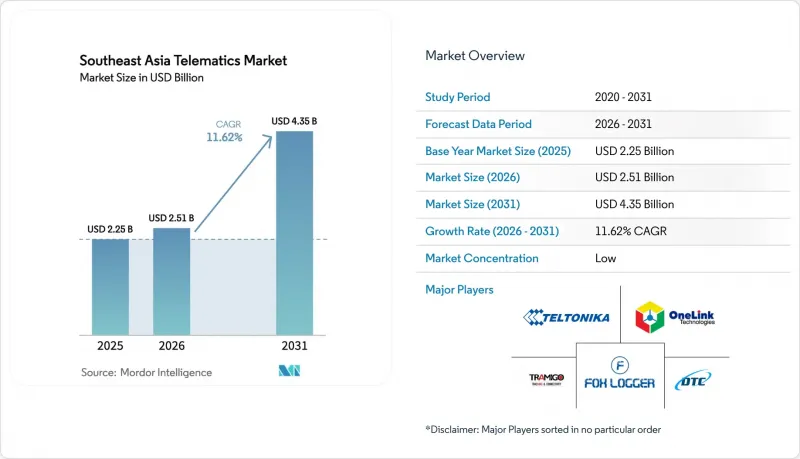
Mordor Intelligence에 의하면, 동남아시아 텔레매틱스 시장 규모는 2025년에 22억 5,000만 달러로 평가되었고 2026년 25억 1,000만 달러에서 2031년까지 43억 5,000만 달러에 이를 것으로 예측되며, 예측 기간(2026-2031년) CAGR은 11.62%를 나타낼 전망입니다.
본 보고서는 차량 유형(소형 상용차(LCV), 중형 상용차(MCV) 등), 솔루션(차량 함대/차량 관리, 위치 정보 서비스 등), 최종 사용자 산업(운송 및 물류, 전자상거래 라스트 마일 배송 등),연결 기술(휴대전화(2G/3G), 4G LTE 등), 그리고 국가별로 분류되어 있습니다. 시장 전망은 금액(달러) 기준으로 제시되어 있습니다.
동남아시아 텔레매틱스 시장 동향 및 인사이트
4단계 안전 및 배기가스 규제가 도입을 촉진
동남아시아 각국 정부는 연비 목표, CO2 기반 세제, 현지 조달률 규제, 그리고 제로 배출 공약을 다층적으로 도입하고 있으며, 텔레매틱스는 단순한 효율화 수단에서 규제상의 요건으로 변화하고 있습니다. 아세안 연비 로드맵은 2025년까지 차량의 평균 연료 소비량을 26% 감축할 것을 의무화하고 있으며, 사업자는 차량의 사용 현황을 실시간으로 모니터링해야 합니다. 태국의 소비세 제도는 CO2 감축을 장려하는 한편, 인도네시아의 현지 조달률 기준은 구매자들을 국내에서 통합된 텔레매틱스 모듈로 유도하고 있습니다. 또한 ‘아시아 제로 에미션 커뮤니티’의 일환으로 진행되고 있는 수소 및 바이오연료 시범 사업에서도 규제 준수를 위해 상세한 운영 데이터가 필요하며, 이로 인해 텔레매틱스는 차량 관리 업무 프로세스에 더욱 깊이 통합되고 있습니다. 그 결과, 도입 여부는 더 이상 ROI(투자 수익률)에만 의존하는 것이 아니며, 차량 운영 사업자는 시스템을 연결하지 않을 경우 규제 위반에 따른 처벌을 받게 되므로, 동남아시아의 텔레매틱스 시장은 두 자릿수 성장을 유지하고 있습니다.
이커머스의 라스트 마일 붐이 LCV 텔레매틱스를 견인
온라인 소매 플랫폼은 창고에서 집 앞까지의 포인트 투 포인트 가시성을 필요로 하는 배송 속도 기준을 계속해서 설정하고 있습니다. 800개 이상의 도시에서 운영되는 Grab의 슈퍼앱 서비스는 1시간 이내 배송 시간대를 달성하기 위해 커넥티드 LCV 및 이륜차 차량에 의존하고 있습니다. 말레이시아의 디지털 경제는 2020년 이미 GDP의 22.6%를 차지했으며, 연간 8.5%의 속도로 성장하고 있어 물류 사업자들은 추적 시스템을 업그레이드해야 할 필요에 직면해 있습니다. 베트남의 전기 이륜차는 2024년에 시장 점유율 9%를 돌파할 전망이며, 차량 대시보드에는 배터리 상태 및 주행 거리 관리에 관한 데이터 세트가 추가되고 있습니다. 이러한 동향은 실시간 경로 계획, 운전자 행동 평가, 충전 주기 분석에 대한 지속적인 수요를 뒷받침하고 있으며, 이 모든 것이 동남아시아 텔레매틱스 시장의 확대로 이어지고 있습니다.
초기 하드웨어 및 통합 비용의 높은 부담
세계적인 반도체 부족 현상은 여전히 지속되고 있으며, 자동차용 반도체의 리드타임은 50주에 달하는 상황입니다. 이로 인해 장치 가격이 상승하고 SKU 공급이 제한되고 있습니다. 차량 운영 사업자들은 자본 비용 격차의 확대에 직면해 있습니다. 대기업은 수년에 걸친 공급 계약을 체결하고 있는 반면, 중소기업은 도입을 연기하거나 기능을 제한한 솔루션을 선택하고 있습니다. 2021년 생산 부족량은 820만 대에 달했으며, 그 영향은 2025년 수주 상황에도 계속해서 파급되고 있어, 하드웨어의 평균 판매 가격(ASP)은 높은 수준을 유지하고 있으며, 동남아시아 텔레매틱스 시장의 단기 성장 궤도를 둔화시키고 있습니다.
부문 분석
2025년, 동남아시아 텔레매틱스 시장 규모의 36.92%를 소형 상용차가 차지했습니다. 이는 세밀한 경로 분석이 요구되는 소포 및 식료품 배송 업무에 힘입은 결과입니다. 사업자들은 엄격한 서비스 수준 계약(SLA)을 달성하기 위해 카메라 기반 운전자 평가, 콜드체인용 온도 센서, ePOD(전자 수령증) 연동 기능을 도입하고 있습니다. 이륜차 부문은 베트남과 인도네시아에서 차량 공유 및 택배 차량이 전기화됨에 따라 배터리 충전 상태 알림 및 배터리 교환 스테이션 매핑 기능이 추가되어, 2031년까지 연평균 성장률(CAGR)이 12.05%로 가장 높은 성장세를 보이고 있습니다.
태국에 위치한 Zapp사의 마이크로 팩토리에서는 연간 2만 1,500대의 전기 오토바이를 생산할 수 있으며, 각 차량에는 파워트레인의 실시간 데이터 수집을 위한 CAN 버스 포트가 탑재되어 있습니다. 광업 및 건설 업계의 중형 상용차의 경우, 가동 시간 대시보드와 지오펜싱 기능을 통해 현장에서 장비의 규정 준수가 보장되고 있습니다. 승용차 분야에서는 보험사가 커넥티드 보험 할인을 패키지로 제공하거나, 라이드셰어 플랫폼이 애프터마켓 OBD 동글을 지원하는 등 수요를 더욱 부추기고 있습니다. 이러한 동향들이 맞물려 동남아시아 텔레매틱스 업계의 다중 부문성을 강화하고 있으며, 솔루션 제공업체들은 적재량 등급에 관계없이 민첩하게 대응하고 있습니다.
2025년, 동남아시아 텔레매틱스 시장 규모의 41.55%를 ‘차량 및 차량 관리’가 차지하며, 핵심 기능인 GPS 추적, 정비 일정 관리, 운전자용 알림 기능을 제공합니다. 차량 1대당 3%-5%의 연료 소비 감축을 목표로 하는 장거리 및 지역 운송 사업자들 사이에서는 이 시스템의 도입이 거의 보편화되어 있습니다. 연평균 성장률(CAGR) 13.14%로 성장하고 있는 ‘텔레매틱스 보험’은 보험료를 운전 행동 점수나 주행 거리와 연동함으로써 위험 가격 책정의 방식을 재정의하고 있습니다. 이러한 변화는 NTUC Income이 Carro와 공동으로 출시한 ‘주행 거리에 따른 보험료(Pay-as-you-drive)’ 서비스를 통해 뚜렷하게 드러납니다. MS&AD의 185만 건에 달하는 커넥티드 보험 계약은 보험 수리 데이터 세트를 확대하고, AI를 통한 위험 코리도 벤치마킹을 가능하게 하고 있습니다. 이러한 이용 사례는 동남아시아 텔레매틱스 업계에서 하드웨어뿐만 아니라 분석 기능의 확장이야말로 벤더 간의 차별화 요소가 되고 있음을 여실히 보여줍니다.
위치 정보 서비스는 지도 및 차량 배차 플랫폼과 연동되는 한편, 예측 유지보수는 엣지 AI를 통한 고장 감지를 통해 그 입지를 다지고 있습니다. 사용 현황, 진동, 유체 온도 데이터를 클라우드상의 머신러닝 모델에 반영하는 벤더들은 예기치 못한 가동 중단 시간을 줄이고 잔존 가치 산정 정확도를 높이고 있습니다. 현재 경쟁 우위는 API 개방성, 무선 기반 기능 업그레이드, 그리고 타사 TMS 및 ERP 제품군과의 통합 속도에 있습니다.
기타 혜택:
- 엑셀 형식 시장 예측(ME) 시트
- 3개월간의 애널리스트 지원
자주 묻는 질문
목차
제1장 서론
제2장 조사 방법
제3장 주요 요약
제4장 시장 구도
제5장 시장 규모와 성장 예측
제6장 경쟁 구도
제7장 시장 기회와 향후 전망
JHSAccording to Mordor Intelligence, the Southeast Asia telematics market size was valued at USD 2.25 billion in 2025 and estimated to grow from USD 2.51 billion in 2026 to reach USD 4.35 billion by 2031, at a CAGR of 11.62% during the forecast period (2026-2031).
This report is Segmented by Vehicle Type (Light Commercial Vehicle (LCV), Medium Commercial Vehicle (MCV), and More), Solution (Fleet/Vehicle Management, Location-Based Services, and More), End-User Industry (Transport and Logistics, E-Commerce Last-Mile, and More), Connectivity Technology (Cellular (2G/3G), 4G LTE, and More), by Country. The Market Forecasts are Provided in Terms of Value (USD).
Southeast Asia Telematics Market Trends and Insights
Four-tier Safety and Emissions Mandates Drive Adoption
Governments across Southeast Asia are layering fuel-economy targets, CO2-based taxes, local-content rules, and zero-emission commitments, turning telematics from an efficiency option into a regulatory requirement. The ASEAN Fuel Economy Roadmap insists on a 26% reduction in average fleet fuel consumption by 2025, obliging operators to monitor vehicle usage in real time.Thailand's excise system rewards CO2 cuts, while Indonesia's local-content thresholds steer buyers toward domestically integrated telematics modules. Emerging hydrogen and biofuel pilots under the Asia Zero Emission Community also require granular operating data for compliance, further embedding telematics in fleet workflows. As a result, adoption no longer hinges on ROI alone; fleets must connect or face non-compliance penalties, sustaining double-digit growth for the Southeast Asia telematics market.
E-commerce Last-mile Boom Fuels LCV Telematics
Online retail platforms continue to set delivery-speed benchmarks that require point-to-point visibility from warehouse to doorstep. Grab's super-app services in 800+ cities rely on connected LCV and two-wheeler fleets to hit sub-one-hour delivery windows. Malaysia's digital economy already contributed 22.6% of GDP in 2020 and is expanding 8.5% per year, pressuring logistics providers to upgrade tracking systems.Vietnam's electric two-wheelers crossed 9% market share in 2024, adding battery-health and range-management datasets to fleet dashboards. These dynamics underpin sustained demand for real-time routing, driver-behavior scoring, and charge-cycle analytics, all of which expand the Southeast Asia telematics market.
High Upfront Hardware and Integration Cost
Global chip shortages linger, with automotive semiconductor lead times stretching to 50 weeks, inflating device prices and limiting SKU availability. Fleet operators face a widening cost-of-capital gap: larger firms lock multi-year supply contracts, while SMEs postpone deployments or opt for stripped-down feature sets. Production shortfalls hit 8.2 million vehicles in 2021 and still ripple through 2025 order books, keeping average hardware ASPs elevated and dampening the Southeast Asia telematics market's near-term growth trajectory.
Other drivers and restraints analyzed in the detailed report include:
- 4G/5G Rollout Enables Real-time Data Services
- Fleet Cost-reduction Amid Diesel Volatility and Carbon Tax
- Data-sovereignty Bottlenecks on Telemetry Export
For complete list of drivers and restraints, kindly check the Table Of Contents.
Segment Analysis
Light Commercial Vehicles commanded 36.92% of the Southeast Asia telematics market size in 2025, anchored in parcel and grocery delivery runs that demand granular route analytics. Operators deploy camera-based driver scoring, cold-chain temperature probes, and ePOD integrations to hit tight service-level agreements. Two-Wheelers are registering the fastest 12.05% CAGR to 2031 as Vietnam and Indonesia electrify ride-hailing and courier fleets, adding battery state-of-charge alerts and swap-station mapping features.
Zapp's micro-factory in Thailand can build 21,500 electric motorcycles per year, each shipping with CAN-bus ports for real-time power-train data. For Medium Commercial Vehicles in mining and construction, uptime dashboards and geofencing ensure equipment-site compliance. Passenger Cars round out demand as insurers bundle connected-policy discounts and ride-sharing platforms fit aftermarket OBD dongles. Collectively these dynamics reinforce the Southeast Asia telematics industry's multi-segment nature, keeping solution providers agile across payload classes.
Fleet and Vehicle Management accounted for 41.55% of the Southeast Asia telematics market size in 2025, offering core GPS tracking, maintenance scheduling, and driver alerts. Adoption is nearly universal among long-haul and regional haul operators seeking 3%-5% fuel-burn cuts per vehicle. Telematics Insurance, growing at 13.14% CAGR, is redefining risk pricing by aligning premiums with behavioral scores and mileage, a shift highlighted by NTUC Income's pay-as-you-drive launch with Carro. MS&AD's 1.85 million connected policies expand the actuarial dataset, enabling AI to benchmark risk corridors. These use cases underscore how analytics extensions not hardware alone differentiate vendors in the Southeast Asia telematics industry.
Location-Based Services tie into mapping and dispatch platforms, while Predictive Maintenance gains momentum through edge-AI fault detection. Vendors that pull usage, vibration, and fluid-temperature data into cloud ML models reduce unplanned downtime and enhance residual-value calculations. Competitive advantage now lies in API openness, over-the-air feature upgrades, and integration speed with third-party TMS or ERP suites.
Complete Report Scope:
- By Vehicle Type
- Light Commercial Vehicle (LCV)
- Medium Commercial Vehicle (MCV)
- Passenger Cars
- Others
- By Solution
- Fleet/Vehicle Management
- Location-Based Services
- Telematics Insurance
- Predictive Maintenance
- Others
- By End-user Industry
- Transport and Logistics
- E-commerce Last-Mile
- Public Transportation
- Construction and Mining
- Oil and Gas
- Others
- By Connectivity Technology
- Cellular (2G/3G)
- 4G LTE
- 5G
- Satellite
- Others
- By Country
- Thailand
- Indonesia
- Malaysia
- Singapore
- Vietnam
- Rest of Southeast Asia
List of Companies Covered in this Report:
- DTC Enterprise
- GPSiam
- Forth Tracking System
- Thai GPS Tracker
- Guarantee GPS
- Onelink Technology
- Thai Global Technologies
- East Innovation (EyeFleet)
- Xsense Information Service
- PT Navindo Technologies
- Foxlogger
- Maxxfleet
- IntelliTrac
- TransTrack
- UTrack
- Gigabyte Indonesia
- i-Tracking (S) Pte Ltd
- Tramigo Singapore
- Evo Systems SDN BHD
- Omnicomm Vietnam
- i-Fleet (CelcomDigi)
- EUPFIN Technology
- FindMyCar Philippines
- Manila GPS Trackers
- SkyFy Technology
- Vectras Inc.
- Teltonika Asia
- Explosoft International
- Get Prepared SDN BHD
Additional Benefits:
- The market estimate (ME) sheet in Excel format
- 3 months of analyst support
TABLE OF CONTENTS
1 INTRODUCTION
- 1.1 Study Assumptions and Market Definition
- 1.2 Scope of the Study
2 RESEARCH METHODOLOGY
3 EXECUTIVE SUMMARY
4 MARKET LANDSCAPE
- 4.1 Market Overview
- 4.2 Market Drivers
- 4.2.1 Four-tier safety and emissions mandates drive adoption
- 4.2.2 E-commerce last-mile boom fuels LCV telematics
- 4.2.3 4G/5G rollout enables real-time data services
- 4.2.4 Fleet cost-reduction amid diesel volatility and carbon tax
- 4.2.5 Mileage-based road-tax pilots (Indonesia)
- 4.2.6 Vietnam PAYD insurance-telco alliances
- 4.3 Market Restraints
- 4.3.1 High upfront hardware and integration cost
- 4.3.2 Patchy cross-border network roaming
- 4.3.3 Data-sovereignty bottlenecks on telemetry export
- 4.3.4 Shortage of certified installers outside tier-1 cities
- 4.4 Supply-Chain Analysis
- 4.5 Regulatory Landscape
- 4.6 Technological Outlook
- 4.7 Porter's Five Force Analysis
- 4.7.1 Bargaining Power of Suppliers
- 4.7.2 Bargaining Power of Buyers
- 4.7.3 Threat of New Entrants
- 4.7.4 Threat of Substitutes
- 4.7.5 Intensity of Competitive Rivalry
- 4.8 Assesment of Macroeconomic Trends on Market
5 MARKET SIZE AND GROWTH FORECASTS (VALUE)
- 5.1 By Vehicle Type
- 5.1.1 Light Commercial Vehicle (LCV)
- 5.1.2 Medium Commercial Vehicle (MCV)
- 5.1.3 Passenger Cars
- 5.1.4 Others
- 5.2 By Solution
- 5.2.1 Fleet/Vehicle Management
- 5.2.2 Location-Based Services
- 5.2.3 Telematics Insurance
- 5.2.4 Predictive Maintenance
- 5.2.5 Others
- 5.3 By End-user Industry
- 5.3.1 Transport and Logistics
- 5.3.2 E-commerce Last-Mile
- 5.3.3 Public Transportation
- 5.3.4 Construction and Mining
- 5.3.5 Oil and Gas
- 5.3.6 Others
- 5.4 By Connectivity Technology
- 5.4.1 Cellular (2G/3G)
- 5.4.2 4G LTE
- 5.4.3 5G
- 5.4.4 Satellite
- 5.4.5 Others
- 5.5 By Country
- 5.5.1 Thailand
- 5.5.2 Indonesia
- 5.5.3 Malaysia
- 5.5.4 Singapore
- 5.5.5 Vietnam
- 5.5.6 Rest of Southeast Asia
6 COMPETITIVE LANDSCAPE
- 6.1 Market Concentration
- 6.2 Strategic Moves
- 6.3 Market Share Analysis
- 6.4 Company Profiles (includes Global level Overview, Market level Overview, Core Segments, Financials as available, Strategic Information, Market Rank/Share for key companies, Products and Services, Recent Developments)
- 6.4.1 DTC Enterprise
- 6.4.2 GPSiam
- 6.4.3 Forth Tracking System
- 6.4.4 Thai GPS Tracker
- 6.4.5 Guarantee GPS
- 6.4.6 Onelink Technology
- 6.4.7 Thai Global Technologies
- 6.4.8 East Innovation (EyeFleet)
- 6.4.9 Xsense Information Service
- 6.4.10 PT Navindo Technologies
- 6.4.11 Foxlogger
- 6.4.12 Maxxfleet
- 6.4.13 IntelliTrac
- 6.4.14 TransTrack
- 6.4.15 UTrack
- 6.4.16 Gigabyte Indonesia
- 6.4.17 i-Tracking (S) Pte Ltd
- 6.4.18 Tramigo Singapore
- 6.4.19 Evo Systems SDN BHD
- 6.4.20 Omnicomm Vietnam
- 6.4.21 i-Fleet (CelcomDigi)
- 6.4.22 EUPFIN Technology
- 6.4.23 FindMyCar Philippines
- 6.4.24 Manila GPS Trackers
- 6.4.25 SkyFy Technology
- 6.4.26 Vectras Inc.
- 6.4.27 Teltonika Asia
- 6.4.28 Explosoft International
- 6.4.29 Get Prepared SDN BHD
7 MARKET OPPORTUNITIES AND FUTURE OUTLOOK
- 7.1 White-space and Unmet-need Assessment