

|
시장보고서
상품코드
2154451
XR용 촉각 피드백 및 감각 시뮬레이션 : 시장 점유율 분석, 업계 동향과 통계, 성장 예측(2026-2031년)Haptic Feedback and Sensorial Simulation For XR - Market Share Analysis, Industry Trends & Statistics, Growth Forecasts (2026 - 2031) |
||||||
 Mordor Intelligence
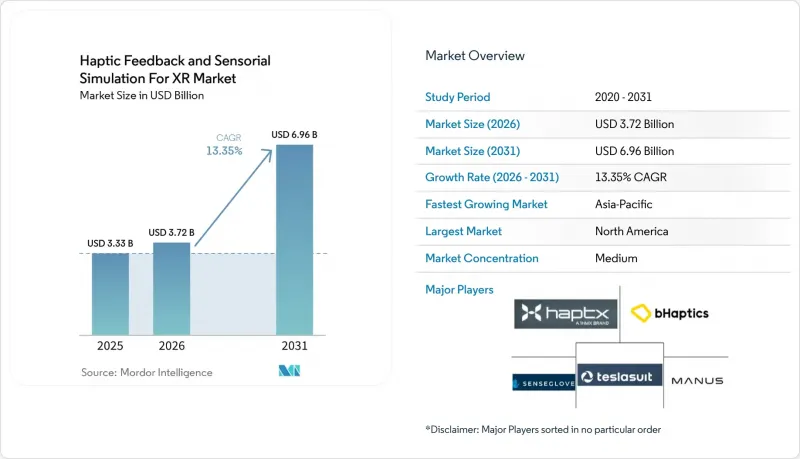
에 따르면 XR용 햅틱 피드백 및 감각 시뮬레이션 시장 규모는 2025년 33억 3,000만 달러, 2026년 37억 2,000만 달러에서 2031년까지 69억 6,000만 달러로 확대할 것으로 예측되고 있으며, 2026-2031년까지 연평균 성장률(CAGR)은 13.35%에 달할 전망입니다.
XR용 햅틱 피드백 및 감각 시뮬레이션의 글로벌 시장 동향 및 인사이트
XR 하드웨어의 보급과 공간 컴퓨팅의 도입
퀄컴의 ‘Snapdragon XR2+Gen 2’는 고해상도 혼합현실(MR) 기기를 지원하며, 새로운 헤드셋 설계를 위한 처리 기반을 제공합니다. 저비용으로 대량 생산되는 헤드셋은 호환 가능한 컨트롤러, 장갑, 조끼의 잠재적 고객 기반을 확대합니다. 2026년 소비자 시장을 염두에 둔 삼성, 구글, 퀄컴의 혼합현실(MR) 분야 공동 프로젝트 역시 헤드셋 판매량 증가를 지원하고 있습니다. 헤드셋 사용자가 별도의 설정 없이 햅틱 액세서리를 추가할 수 있게 되면, XR 시장에서 햅틱 피드백 및 감각 시뮬레이션에 대한 수요가 높아질 것입니다. 또한 보급 기반이 확대되면 소프트웨어 개발자들에게 새로운 XR 타이틀에 전용 햅틱 기능을 통합할 동기를 부여하게 될 것입니다. 퀄컴은 2026년 6월 ‘Snapdragon Reality Elite’ 및 ‘Scalable Turnkey AI-Ready Toolkit’을 발표하며, 햅틱 솔루션 제공업체가 AR 하드웨어를 구축할 때 활용할 수 있는 개발 툴을 추가했습니다.
고충실도 시뮬레이션 및 훈련에 대한 기업의 수요
기업의 구매 담당자는 시각적 시뮬레이션만으로는 물리적 저항감, 질감 또는 접촉감을 재현할 수 없는 경우 햅틱 시스템을 도입합니다. 외과수술 훈련, 항공기 정비, 불발탄 처리, 그리고 복잡한 제조 공정에서는 모두 작업자가 세부적인 절차를 연습해야 합니다. 2025년 3월 EU가 자금을 지원하는 MasterXR 프레임워크 하에 출범한 HEART 프로젝트에서는 SenseGlove사의 ‘Rembrandt’ 힘 피드백 장갑과 Aeon Robotics사의 ‘HandEffector’ 로봇 시스템을 결합했습니다. 이 프로젝트는 훈련을 받지 않은 운영자라도 VR과 힘 피드백 인터페이스를 통해 1시간 이내에 복잡한 로봇 작업을 습득할 수 있도록 하는 것을 목표로 했습니다. 이 모델로 인해 구매자의 관심은 기기 사양에서 도입 기간, 사고 감소, 그리고 훈련 성과로 옮겨가고 있습니다. 또한 하드웨어와 함께 SDK, 컨텐츠 라이브러리, 시스템 지원을 제공할 수 있는 공급업체가 우대받고 있습니다.
높은 시스템 비용과 복잡한 통합 요건
생체인식 기능을 갖춘 전신 햅틱 시스템은 소규모 교육 업체나 교육 기관에 여전히 고가입니다. 테슬라수트(Teslasuit)사는 CES 2026에서 전문가 및 연구용 ‘XR5’를 제조사 권장 소매가 9,900달러에 출시했습니다. 이러한 시스템의 경우, 학습 관리 플랫폼, 게임 엔진, 기업 소프트웨어와의 연동이 필요할 수 있습니다. 그 결과 발생하는 통합 작업으로 인해 총 소유 비용은 명시된 기기 가격을 초과하게 됩니다. 또한 높은 가격은 AI 기반 햅틱 렌더링을 개선하는 데 활용할 수 있는 상호작용 데이터의 양을 제한하고 있습니다. 400달러 미만의 무선 소비자용 장갑이 등장함에 따라 엔트리 레벨 기기에 대한 기대치는 낮아지고 있지만, 규제가 엄격한 시뮬레이션 환경에서는 앞으로도 프리미엄 멀티센서 시스템이 필요할 것입니다.
부문 분석
햅틱 컨트롤러는 주요 XR 헤드셋에 기본으로 포함되는 핵심 햅틱 인터페이스 역할을 계속하고 있으며, 2025년 전 세계 매출의 28.32%를 차지했습니다. XR 시장의 햅틱 피드백과 감각 시뮬레이션은 폭넓은 게임 엔진 지원과 풍부한 타이틀 라이브러리에 힘입어 성장하고 있습니다. 햅틱 장갑은 기업용 훈련, 외과수술 시뮬레이션, 원격 조작 등에 사용되며, HaptX, SenseGlove, Manus VR은 각각 서로 다른 힘 피드백 설계를 채택하고 있습니다. 햅틱 조끼와 벨트는 주로 게임 및 위치 기반 엔터테인먼트용으로 제공되지만, 햅틱 슈트는 기업 및 국방 분야에서의 활용에 있으며, 단가가 높은 편입니다. 햅틱 신발 및 신발, 햅틱 헤드셋 및 헤드마운트형 기기는 여전히 규모가 작은 카테고리이지만, 전신에 걸친 촉각 적용 범위를 확대하고 있습니다.
공중 햅틱 시스템은 핸드헬드형 액세서리 없이도 상호작용이 가능하므로 2031년까지 연평균 성장률(CAGR)이 13.56%에 달하며 가장 빠르게 성장하는 제품 카테고리입니다. SIM IP는 2025년에 Ultraleap사의 햅틱 및 XR 관련 특허 포트폴리오를 인수했습니다. 이 포트폴리오는 500건 이상의 자산을 포괄하며, 상업적 라이선싱 전략을 지원하고 있습니다. 이러한 자산들이 컨트롤러가 필요 없는 상호작용의 보다 광범위한 상용 개발을 지원할 수 있다면, 햅틱 피드백 XR 시장은 그 혜택을 누리게 될 것입니다. CVPR 2026에서 발표된 연구에서는 3D 장면의 형태, 사용자의 동작, 그리고 촉각 반응을 연결하는 ‘햅틱 뉴럴 필드(Haptic Neural Fields)’가 소개되었습니다. 이 기법을 통해 소재 고유의 효과에 대한 수작업 제작 과정을 줄일 수 있으며, 틈새 설치 환경 이외의 공간에서 공중 시스템의 실용성을 향상시킬 수 있습니다. 또한 비접촉식 상호작용을 통해 착용형 컨트롤러에 수반되는 청소 및 유지보수 부담을 경감할 수도 있습니다.
2025년에는 진동 햅틱 피드백이 38.42%의 점유율을 차지하며 매출 1위를 기록했습니다. 이는 성숙한 저비용 액추에이터를 사용하고, 폭넓은 게임 하드웨어에 대응하기 때문입니다. Haptics사는 100개 이상의 게임 타이틀에 대응하는 39,000개 이상의 동적 패턴을 보고하고 있습니다. 이러한 컨텐츠 기반을 바탕으로, 햅틱 피드백 XR 시장에서 진동 촉각 피드백은 가장 활용하기 쉬운 모달리티로서의 지위를 유지하고 있습니다. 그 다음으로는 저항이나 방향성 단서가 필수적인 ‘힘 감각 및 운동 감각 피드백’이 자리 잡고 있습니다. ‘피부 신장 피드백’, ‘전기 촉각 피드백’ 및 ‘열 피드백’은 온도 변화가 치료나 평가에 도움이 되는 재활 현장 등, 보다 소규모의 전문적인 용도로 사용되고 있습니다.
다중 모달 피드백은 여러 단서를 결합하여 물리적 접촉을 보다 정확하게 재현할 수 있으므로 2031년까지 연평균 성장률(CAGR) 13.68%로 확대될 것으로 예측됩니다. 이 모달리티에서 XR 시장 규모를 지원하는 햅틱 피드백 및 감각 시뮬레이션은 진동, 힘, 열 신호를 결합한 시스템을 통해 구현됩니다. HAPhy사는 언어 모델과 시각적 입력을 활용하여 물체의 묘사나 3D 이미지로부터 멀티모달 햅틱 매개변수를 생성했습니다. 이 회사의 맹검 테스트에서 사용자들은 생성된 경험을 수작업으로 제작된 자극과 동등한 수준으로 평가했습니다. 전기 촉각 및 열 장치에 대한 안전성 평가와 CE 마킹 요건은, 특히 제품이 장시간 신체 접촉을 목적으로 하거나 감독 하의 케어 환경에서 사용될 것으로 예상되는 경우, 규정 준수 대응 능력이 없는 공급업체에게 있으며, 소비자용 제품의 출시를 지연시키고 시장 진입 장벽을 높일 가능성이 있습니다.
지역별 분석
2025년, 북미는 XR 개발자, 기업용 교육 구매자 및 햅틱 기업에 대한 투자에 힘입어 전 세계 매출의 36.40%를 차지했습니다. XR 시장을 위한 햅틱 피드백 및 감각 시뮬레이션은 의료, 국방, 항공 및 첨단 제조 분야의 지역적 수요에 힘입어 성장하고 있습니다. 미국은 여전히 고충실도 기업 시스템을 위한 중요한 시장으로 남아 있지만, HaptX사는 ‘European Robotics Forum 2026’에서 장갑을 이용한 정교한 로봇 손의 원격 조작을 시연했습니다. 유럽 역시 국경을 초월한 프로젝트, 산업용 로봇 및 전문적인 시뮬레이션 활동을 통해 상당한 수익 기반을 구축하고 있습니다. EU가 자금을 지원하는 ‘MasterXR’ 프레임워크는 햅틱 기술의 연구개발을 지원하고 있으며, 독일과 영국은 산업용 로봇, 의료 시뮬레이션 및 국방 분야의 수요에 기여하고 있습니다.
아시아태평양은 2031년까지 연평균 성장률(CAGR) 14.19%로 확대될 것으로 예측됩니다. 이 지역의 XR용 햅틱 피드백 및 감각 시뮬레이션 시장 점유율은 하드웨어 제조 능력, 각국의 XR 프로그램, 그리고 확대되는 게임 사용자층에 의해 지원되고 있습니다. 일본의 NTT 도코모와 게이오기주쿠 대학이 실시한 실증 실험에서는 상용 5G가 고충실도 햅틱 원격 조작을 지원할 수 있음이 입증되었습니다. 한국의 2026년 지원 프로그램은 해외 진출을 목표로 하는 XR 및 AI 컨텐츠 기업에 로드맵을 제공하고 있는 반면, 중국의 액추에이터 생태계는 하드웨어 단가를 낮출 수 있습니다. 인도와 호주는 소비자용 및 산업용 햅틱 기기 시장에서 여전히 보급률이 낮은 편입니다.
중동은 공공 XR 프로그램이 경제 다각화를 지원하고 있으며, 높은 성장이 기대되는 하위 지역으로 부상하고 있습니다. 카타르 통신·정보기술부는 2025년 2월에 개최된 ‘Web Summit Qatar’에서 AI 및 XR 샌드박스를 출범시켰습니다. 사우디아라비아의 ‘비전 2030’ 프레임워크는 의료 및 국방 분야용 VR 시뮬레이터를 지원하고 있습니다. 아프리카는 여전히 초기 단계의 시장이며, 남아프리카공화국, 이집트, 나이지리아를 중심으로 선정된 대학 연구 거점 및 고급 게임 시설이 초기 상용화를 주도할 가능성이 있습니다.
기타 혜택:
- 엑셀 형식의 시장 예측(ME) 시트
- 3개월간의 애널리스트 지원
자주 묻는 질문
목차
제1장 서론
- 조사 전제조건과 시장 정의
- 조사 범위
제2장 조사 방법
제3장 개요
제4장 시장 구도
- 시장 개요
- 거시경제 요인이 시장에 미치는 영향
- 시장 성장 촉진요인
- 시장 성장 억제요인
- 업계 밸류체인 분석
- 규제 상황
- 기술 전망
- Porter's Five Forces 분석
제5장 시장 규모와 성장 예측
- 제품 유형별
- 피드백 방식별
- 폼팩터별
- 용도별
- 최종사용자별
- 유통 채널별
- 지역별
- 북미
- 미국
- 캐나다
- 멕시코
- 남미
- 브라질
- 아르헨티나
- 콜롬비아
- 기타 남미 국가
- 유럽
- 독일
- 영국
- 프랑스
- 이탈리아
- 러시아
- 기타 유럽 국가
- 아시아태평양
- 중국
- 일본
- 한국
- 인도
- 대만
- 호주
- 기타 아시아태평양 국가
- 중동
- 사우디아라비아
- 아랍에미리트
- 이스라엘
- 카타르
- 튀르키예
- 기타 중동 국가
- 아프리카
- 남아프리카공화국
- 이집트
- 나이지리아
- 기타 아프리카 국가
- 북미
제6장 경쟁 구도
- 시장 집중도
- 전략적 동향
- 시장 점유율 분석
- 기업 개요
- HaptX Inc.
- Manus VR B.V.
- SenseGlove B.V.
- CyberGlove Systems LLC
- VRgluv Inc.
- Dexta Robotics Inc.
- BeBop Sensors Inc.
- Contact CI
- NeuroDigital Technologies S.L.
- Noitom Ltd.
- Teslasuit Inc.
- bHaptics Inc.
- Virtuix Inc.
- Straythink
- ExoGeniX
- GestureTek Inc.
- Tactai Inc.
- AxonVR Inc.
- Actronika SAS
- Woojer Ltd.
- SUBPAC Inc.
- FundamentalVR
제7장 시장 기회와 향후 전망
KSA 26.10.23According to Mordor Intelligence, the haptic feedback and sensorial simulation for XR market size is projected to expand from USD 3.33 billion in 2025 and USD 3.72 billion in 2026 to USD 6.96 billion by 2031, registering a CAGR of 13.35% between 2026 to 2031.
Global Haptic Feedback and Sensorial Simulation For XR Market Trends and Insights
XR Hardware Proliferation and Spatial Computing Adoption
Qualcomm's Snapdragon XR2+ Gen 2 supports high-resolution mixed-reality devices and provides the processing base for new headset designs. Lower-cost and higher-volume headsets widen the potential customer base for compatible controllers, gloves, and vests. Samsung's joint mixed-reality work with Google and Qualcomm, aimed at consumer channels in 2026, also supports higher headset volumes. The haptic feedback and sensorial simulation for XR market gains when headset users can add tactile accessories without a specialized setup. A larger installed base also gives software developers a reason to include dedicated haptic functions in new XR titles. Qualcomm introduced Snapdragon Reality Elite and its Scalable Turnkey AI-Ready Toolkit in June 2026, adding development tools that haptic solution providers can use when building AR hardware.
Enterprise Demand for High-Fidelity Simulation and Training
Enterprise buyers use haptic systems when visual simulation alone cannot reproduce physical resistance, texture, or contact. Surgical training, aircraft maintenance, explosive ordnance disposal, and complex manufacturing all require workers to practice detailed procedures. The HEART Project, launched under the EU-funded MasterXR framework in March 2025, combined SenseGlove's Rembrandt force-feedback gloves with Aeon Robotics' HandEffector robotic system. The project aimed to let untrained operators teach complex robot tasks within 1 hour through a VR and force-feedback interface. This model shifts buyer attention from device specifications toward onboarding time, incident reduction, and training outcomes. It also favors suppliers that can provide SDKs, content libraries, and system support with the hardware.
High System Cost and Complex Integration Requirements
Full-body haptic systems with biometric sensing remain costly for small training operators and educational institutions. Teslasuit launched the XR5 at CES 2026 with an MSRP of USD 9,900 for professional and research settings. These systems can require links to learning-management platforms, game engines, and enterprise software. The resulting integration work increases total ownership costs beyond the listed device price. High prices also limit the volume of interaction data available for improving AI-driven haptic rendering. Wireless consumer gloves priced below USD 400 are reducing expectations for entry-level devices, but regulated simulation environments will continue to require premium multi-sensor systems.
Other drivers and restraints analyzed in the detailed report include:
- Rising Use of Haptic Wearables in Gaming and Fitness
- Expansion of Force Feedback in Remote Robotics and Teleoperation
- Limited Cross-Platform Haptic Interoperability
For complete list of drivers and restraints, kindly check the Table Of Contents.
Segment Analysis
Haptic Controllers accounted for 28.32% of global revenue in 2025 because they remain the primary haptic interface bundled with major XR headsets. The haptic feedback and sensorial simulation for the XR market rely on their broad game engine support and large title library. Haptic Gloves are used for enterprise training, surgical simulation, and teleoperation, with HaptX, SenseGlove, and Manus VR employing different force-feedback designs. Haptic Vests and Belts primarily serve gaming and location-based entertainment, while Haptic Suits have high unit values in enterprise and defense use. Haptic Shoes and Footwear, and Haptic Headsets and Head-Mounted Devices remain smaller categories that extend tactile coverage across the body.
Mid-Air Haptic Systems are the fastest-growing product category, with a CAGR of 13.56% through 2031, as they enable interaction without a handheld accessory. SIM IP acquired Ultraleap's haptics and XR patent portfolio in 2025, covering more than 500 assets and supporting a commercial licensing strategy. The haptic feedback XR market can benefit if those assets support broader commercial development of controller-free interaction. Research presented at CVPR 2026 described Haptic Neural Fields, which link scene geometry, user actions, and tactile responses in 3D scenes. The method can reduce manual authoring work for material-specific effects and improve the practicality of mid-air systems outside niche installations, where touchless interaction can also reduce the cleaning and maintenance requirements associated with worn controllers.
Vibrotactile Feedback led revenue with a share of 38.42% in 2025 because it uses mature, lower-cost actuators and works with a broad range of gaming hardware. Haptics reported more than 39,000 dynamic patterns compatible with over 100 game titles. This content base helps the haptic-feedback XR market maintain vibrotactile feedback as its most accessible modality. Force and Kinesthetic Feedback follows, where resistance and directional cues are essential. Skin-Stretch Feedback, Electro-Tactile Feedback, and Thermal Feedback serve smaller, specialized uses, including rehabilitation settings where temperature variation can support treatment and assessment.
Multimodal Feedback is projected to expand at a 13.68% CAGR through 2031 because combined cues can better represent physical contact. The haptic feedback and sensorial simulation for the XR market size for this modality is supported by systems that combine vibration, force, and thermal signals. HAPhy used language models and visual inputs to generate multimodal haptic parameters from object descriptions and 3D images. Users in its blinded study rated the generated experiences comparably to manually authored stimuli. Safety assessment and CE marking requirements for electro-tactile and thermal devices may slow consumer launches and raise barriers for suppliers without compliance capabilities, particularly when products are intended for prolonged body contact or for use in supervised care environments.
Complete Report Scope:
- By Product Type
- Haptic Controllers
- Haptic Gloves
- Haptic Vests and Belts
- Haptic Suits
- Haptic Shoes and Footwear
- Haptic Headsets and Head-Mounted Devices
- Mid-Air Haptic Systems
- Other Product Types
- By Feedback Modality
- Vibrotactile Feedback
- Force and Kinesthetic Feedback
- Skin-Stretch Feedback
- Electro-Tactile Feedback
- Thermal Feedback
- Multimodal Feedback
- By Form Factor
- Wired Devices
- Wireless Devices
- Soft Wearable Devices
- Rigid Exoskeleton Devices
- Modular Devices
- Full-Body Systems
- Partial-Body Systems
- By Application
- Gaming and Entertainment
- Industrial Training and Simulation
- Healthcare and Rehabilitation
- Defense and Public-Safety Training
- Remote Robotics and Teleoperation
- Education and Research
- Fitness and Sports Training
- Design, Engineering, and Prototyping
- By End User
- Consumers
- Enterprise and Commercial Organizations
- Healthcare Providers
- Defense and Government Organizations
- Academic and Research Institutions
- XR Content and Platform Developers
- By Distribution Channel
- Direct Sales
- System Integrators and Resellers
- Online Channels
- Specialty Retail
- Subscription and Haptic-Software Bundles
- By Geography
- North America
- United States
- Canada
- Mexico
- South America
- Brazil
- Argentina
- Colombia
- Rest of South America
- Europe
- Germany
- United Kingdom
- France
- Italy
- Russia
- Rest of Europe
- Asia-Pacific
- China
- Japan
- South Korea
- India
- Taiwan
- Australia
- Rest of Asia-Pacific
- Middle East
- Saudi Arabia
- United Arab Emirates
- Israel
- Qatar
- Turkey
- Rest of Middle East
- Africa
- South Africa
- Egypt
- Nigeria
- Rest of Africa
- North America
Geography Analysis
North America held 36.40% of global revenue in 2025, supported by XR developers, enterprise training buyers, and investment in haptic companies. The haptic feedback and sensorial simulation for XR market benefits from regional demand in healthcare, defense, aviation, and advanced manufacturing. The United States remains an important destination for high-fidelity enterprise systems, while HaptX demonstrated glove-based teleoperation of dexterous robot hands at European Robotics Forum 2026. Europe also has a significant revenue position through cross-border projects, industrial robotics, and specialized simulation activity. The EU-funded MasterXR framework supports haptic research and development, while Germany and the United Kingdom contribute industrial robotics, medical simulation, and defense demand.
Asia-Pacific is projected to expand at a 14.19% CAGR through 2031. The haptic feedback and sensorial simulation for XR market share of the region is supported by hardware manufacturing capacity, national XR programs, and a growing gaming base. Japan's NTT DOCOMO and Keio University demonstration showed that commercial 5G can support high-fidelity haptic teleoperation. South Korea's 2026 support program provides a route for XR and AI content companies seeking overseas expansion, while China's actuator ecosystem can reduce hardware unit costs. India and Australia remain underpenetrated markets for consumer and industrial haptic devices.
The Middle East is emerging as a high-growth subregion because public XR programs support economic diversification. Qatar's Ministry of Communications and Information Technology launched AI and XR Sandboxes at Web Summit Qatar in February 2025. Saudi Arabia's Vision 2030 framework supports VR medical and defense simulators. Africa remains an early-stage opportunity centered on South Africa, Egypt, and Nigeria, where selected university centers and premium gaming facilities may lead initial commercial adoption.
- HaptX Inc.
- Manus VR B.V.
- SenseGlove B.V.
- CyberGlove Systems LLC
- VRgluv Inc.
- Dexta Robotics Inc.
- BeBop Sensors Inc.
- Contact CI
- NeuroDigital Technologies S.L.
- Noitom Ltd.
- Teslasuit Inc.
- bHaptics Inc.
- Virtuix Inc.
- Straythink
- ExoGeniX
- GestureTek Inc.
- Tactai Inc.
- AxonVR Inc.
- Actronika SAS
- Woojer Ltd.
- SUBPAC Inc.
- FundamentalVR
Additional Benefits:
- The market estimate (ME) sheet in Excel format
- 3 months of analyst support
TABLE OF CONTENTS
1 INTRODUCTION
- 1.1 Study Assumptions and Market Definition
- 1.2 Scope of the Study
2 RESEARCH METHODOLOGY
3 EXECUTIVE SUMMARY
4 MARKET LANDSCAPE
- 4.1 Market Overview
- 4.2 Impact of Macroeconomic Factors on the Market
- 4.3 Market Drivers
- 4.3.1 XR Hardware Proliferation and Spatial Computing Adoption
- 4.3.2 Enterprise Demand for High-Fidelity Simulation and Training
- 4.3.3 Rising Use of Haptic Wearables in Gaming and Fitness
- 4.3.4 Expansion of Force Feedback in Remote Robotics and Teleoperation
- 4.3.5 AI-Enabled Adaptive and Multisensory Haptic Rendering
- 4.3.6 Regional XR Investment Programs in Asia-Pacific and the Middle East
- 4.4 Market Restraints
- 4.4.1 High System Cost and Complex Integration Requirements
- 4.4.2 Limited Cross-Platform Haptic Interoperability
- 4.4.3 Power, Weight, Thermal, and Wearability Constraints
- 4.4.4 Difficulty Translating Real-World Texture and Force Into Portable Devices
- 4.5 Industry Value Chain Analysis
- 4.6 Regulatory Landscape
- 4.7 Technological Outlook
- 4.8 Porter's Five Forces Analysis
- 4.8.1 Bargaining Power of Suppliers
- 4.8.2 Bargaining Power of Buyers
- 4.8.3 Threat of New Entrants
- 4.8.4 Threat of Substitutes
- 4.8.5 Competitive Rivalry
5 MARKET SIZE AND GROWTH FORECASTS (VALUE)
- 5.1 By Product Type
- 5.1.1 Haptic Controllers
- 5.1.2 Haptic Gloves
- 5.1.3 Haptic Vests and Belts
- 5.1.4 Haptic Suits
- 5.1.5 Haptic Shoes and Footwear
- 5.1.6 Haptic Headsets and Head-Mounted Devices
- 5.1.7 Mid-Air Haptic Systems
- 5.1.8 Other Product Types
- 5.2 By Feedback Modality
- 5.2.1 Vibrotactile Feedback
- 5.2.2 Force and Kinesthetic Feedback
- 5.2.3 Skin-Stretch Feedback
- 5.2.4 Electro-Tactile Feedback
- 5.2.5 Thermal Feedback
- 5.2.6 Multimodal Feedback
- 5.3 By Form Factor
- 5.3.1 Wired Devices
- 5.3.2 Wireless Devices
- 5.3.3 Soft Wearable Devices
- 5.3.4 Rigid Exoskeleton Devices
- 5.3.5 Modular Devices
- 5.3.6 Full-Body Systems
- 5.3.7 Partial-Body Systems
- 5.4 By Application
- 5.4.1 Gaming and Entertainment
- 5.4.2 Industrial Training and Simulation
- 5.4.3 Healthcare and Rehabilitation
- 5.4.4 Defense and Public-Safety Training
- 5.4.5 Remote Robotics and Teleoperation
- 5.4.6 Education and Research
- 5.4.7 Fitness and Sports Training
- 5.4.8 Design, Engineering, and Prototyping
- 5.5 By End User
- 5.5.1 Consumers
- 5.5.2 Enterprise and Commercial Organizations
- 5.5.3 Healthcare Providers
- 5.5.4 Defense and Government Organizations
- 5.5.5 Academic and Research Institutions
- 5.5.6 XR Content and Platform Developers
- 5.6 By Distribution Channel
- 5.6.1 Direct Sales
- 5.6.2 System Integrators and Resellers
- 5.6.3 Online Channels
- 5.6.4 Specialty Retail
- 5.6.5 Subscription and Haptic-Software Bundles
- 5.7 By Geography
- 5.7.1 North America
- 5.7.1.1 United States
- 5.7.1.2 Canada
- 5.7.1.3 Mexico
- 5.7.2 South America
- 5.7.2.1 Brazil
- 5.7.2.2 Argentina
- 5.7.2.3 Colombia
- 5.7.2.4 Rest of South America
- 5.7.3 Europe
- 5.7.3.1 Germany
- 5.7.3.2 United Kingdom
- 5.7.3.3 France
- 5.7.3.4 Italy
- 5.7.3.5 Russia
- 5.7.3.6 Rest of Europe
- 5.7.4 Asia-Pacific
- 5.7.4.1 China
- 5.7.4.2 Japan
- 5.7.4.3 South Korea
- 5.7.4.4 India
- 5.7.4.5 Taiwan
- 5.7.4.6 Australia
- 5.7.4.7 Rest of Asia-Pacific
- 5.7.5 Middle East
- 5.7.5.1 Saudi Arabia
- 5.7.5.2 United Arab Emirates
- 5.7.5.3 Israel
- 5.7.5.4 Qatar
- 5.7.5.5 Turkey
- 5.7.5.6 Rest of Middle East
- 5.7.6 Africa
- 5.7.6.1 South Africa
- 5.7.6.2 Egypt
- 5.7.6.3 Nigeria
- 5.7.6.4 Rest of Africa
- 5.7.1 North America
6 COMPETITIVE LANDSCAPE
- 6.1 Market Concentration
- 6.2 Strategic Moves
- 6.3 Market Share Analysis
- 6.4 Company Profiles (includes Global Level Overview, Market Level Overview, Core Segments, Financials as available, Strategic Information, Market Rank/Share, Products and Services, Recent Developments)
- 6.4.1 HaptX Inc.
- 6.4.2 Manus VR B.V.
- 6.4.3 SenseGlove B.V.
- 6.4.4 CyberGlove Systems LLC
- 6.4.5 VRgluv Inc.
- 6.4.6 Dexta Robotics Inc.
- 6.4.7 BeBop Sensors Inc.
- 6.4.8 Contact CI
- 6.4.9 NeuroDigital Technologies S.L.
- 6.4.10 Noitom Ltd.
- 6.4.11 Teslasuit Inc.
- 6.4.12 bHaptics Inc.
- 6.4.13 Virtuix Inc.
- 6.4.14 Straythink
- 6.4.15 ExoGeniX
- 6.4.16 GestureTek Inc.
- 6.4.17 Tactai Inc.
- 6.4.18 AxonVR Inc.
- 6.4.19 Actronika SAS
- 6.4.20 Woojer Ltd.
- 6.4.21 SUBPAC Inc.
- 6.4.22 FundamentalVR
7 MARKET OPPORTUNITIES AND FUTURE OUTLOOK
- 7.1 White-Space and Unmet-Need Assessment


