
|
시장보고서
상품코드
2081123
특수 비료 시장 예측(-2031년) : 예측 기술(완효성 비료, 미량영양소, 수용성 비료), 형태(건조, 액체), 시용 방법, 유형, 작물, 지역별Specialty Fertilizer Market by Technology (Controlled-Release Fertilizers, Micronutrients, Water-soluble Fertilizers, and Micronutrients), Form (Dry and Liquid), Application Method, Type, Crop Type, and Region - Global Forecast to 2031 |
||||||

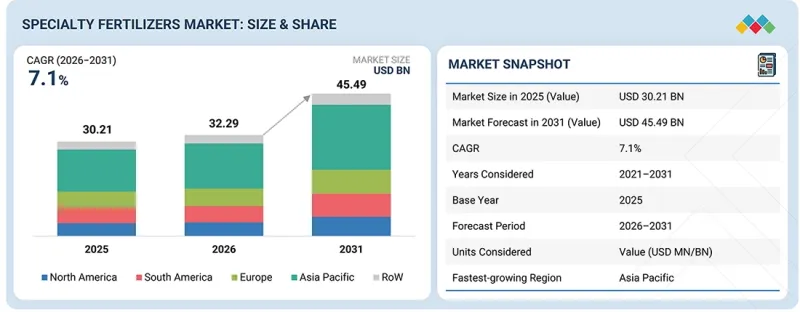
특수 비료 시장 규모는 2026년 322억 9,000만 달러에서 2031년에는 454억 9,000만 달러에 달할 것으로 예측되고 있으며, 2026-2031년까지 CAGR은 7.1%에 달할 전망입니다.
| 조사 범위 | |
|---|---|
| 조사 대상 기간 | 2021-2031년 |
| 기준연도 | 2025년 |
| 예측 기간 | 2026-2031년 |
| 단위 | 금액(달러)·톤 |
| 부문 | 기술, 유형, 형태, 용도, 작물, 지역별 |
| 대상 지역 | 북미, 유럽, 아시아태평양, 남미, 기타 지역 |
농업 생산량 증대와 보다 효율적인 양분 관리에 대한 수요가 높아지는 가운데, 농가는 경작 가능 면적의 감소, 토양 양분의 고갈, 작물 수확량 증대의 지속적인 필요성 등 다양한 과제에 직면해 있습니다. 그 결과, 광범위하게 살포하는 기존 방식보다 영양분을 보다 정확하고 정밀하게 공급할 수 있는 특수 비료의 사용이 늘어나고 있습니다. 여기에는 수용성 비료, 서방형 비료, 미량영양소 혼합 비료, 시비 관개용 비료가 포함되며, 이들은 영양소 이용 효율 향상, 작물 품질 개선, 영양분 손실 저감에 기여하고 있습니다. 정밀농업, 보호 재배, 첨단 관개 시스템의 보급 확대 역시 이 분야의 성장에 더욱 기여하고 있습니다.
'시용 방법별로는 엽면 살포 부문이 가장 큰 점유율을 차지하고 있습니다.'
이 방법은 과일, 채소, 원예 작물 등 고부가가치 작물이나 플랜테이션에서 일반적으로 사용되며, 최적의 수확량과 품질을 달성하기 위해서는 적절한 시기에 영양분을 공급하는 것이 매우 중요합니다. 엽면 시비는 영양분 이용 효율을 높이고, 토양에서의 침출이나 고착으로 인한 영양분 손실을 줄여주며, 생산자가 영양 관리 일정을 보다 유연하게 계획할 수 있게 해줍니다.
정밀농업 기술과 더불어 미량영양소나 수용성 비료를 사용하는 생산자가 늘어나고 있습니다. 이러한 조합이 엽면 살포에 대한 수요를 끌어올리고 있습니다. 또한 균형 잡힌 작물 영양의 중요성, 비생물적 스트레스 조건에 대처할 필요성, 집약형 농업 시스템으로의 지속적인 추세에 대한 인식이 높아지고 있습니다.
'곡물·곡류 부문은 예측 기간 중 상당한 성장률을 보일 것으로 전망됩니다.'
곡물·곡류는 특수 비료 시장에서 큰 점유율을 차지하고 있습니다. 이는 주로 밀, 쌀, 옥수수, 보리 등 주곡 작물의 광대한 재배 면적에 더해, 전 세계 식량 수요 증가에 대응하기 위해 생산성을 극대화해야 할 필요성이 커지고 있기 때문입니다. 농가에서는 영양소 이용 효율을 높이고, 작물의 생육을 촉진하며, 더 높은 수확량을 달성하기 위해 서방형 비료, 수용성 비료, 미량영양소 비료 등의 특수 비료 사용이 점점 더 확대되고 있습니다. 이러한 비료는 중요한 생육 단계를 거치는 동안 균형 잡힌 영양 공급을 보장하는 동시에, 영양분의 손실을 최소화하여 비료의 전반적인 효능을 향상시킵니다.
또한 이 부문은 투입 비용의 최적화와 농장의 수익성 향상을 목표로 한 정밀농업의 실천과 최신 영양 관리 프로그램의 도입 확대로부터도 혜택을 보고 있습니다. 또한 토양 비옥도에 대한 우려, 지속가능한 농업 실천의 필요성, 비료의 효율적 이용을 촉진하기 위한 정부의 노력 역시 곡물 재배 분야에서 특수 비료에 대한 꾸준한 수요를 지원하고 있습니다.
'남미는 특수 비료 시장에서 높은 성장률을 보이며 확대될 것으로 예상됩니다.'
남미는 대두, 옥수수, 사탕수수, 커피, 각종 과일 등의 주요 수출 지역인 만큼, 특수 비료 시장에서 상당한 성장이 예상됩니다. 이 지역의 많은 농가는 수용성 비료, 서방형 비료, 미량영양소 제품, 나아가 시비 및 관개 솔루션을 포함한 특수 비료를 점점 더 많이 도입하고 있습니다. 이 제품들은 작물의 생산성을 높이고, 양분 이용 효율을 개선하며, 작물의 품질을 향상시키는 것을 목적으로 합니다.
고부가가치 및 수출 지향형 작물 재배가 확대됨에 따라 더 높은 수확량을 달성하고 지속가능한 농업 관행을 촉진하기 위한 첨단 작물 영양 솔루션에 대한 수요가 증가하고 있습니다. 또한 정밀농업 툴의 도입, 토양내 영양분 부족에 대한 의식의 향상, 혁신적인 농업 기술에 대한 투자가 특수 비료의 사용을 가속화하고 있습니다.
또한 생산자들은 환경에 미치는 영향을 최소화하면서 기존 농지의 생산량을 극대화해야 한다는 압박도 커지고 있습니다. 이러한 추세는 세계 특수 비료 시장에서 남미의 중요성을 더욱 공고히 하고 있습니다.
이 보고서에서는 전 세계 특수 비료 시장을 조사하여, 시장 개요, 시장 성장에 영향을 미치는 다양한 요인에 대한 분석, 기술 및 특허 동향, 법규제 환경, 사례 연구, 시장 규모 추이 및 전망, 각종 분류·지역/주요 국가별 상세 분석, 경쟁 현황, 주요 기업 개요 등을 정리하여 전해드립니다.
자주 묻는 질문
목차
제1장 서론
제2장 개요
제3장 주요 인사이트
제4장 시장 개요
제5장 업계 동향
제6장 기술의 진보, AI의 영향, 특허, 혁신, 향후 응용
제7장 규제 상황과 지속가능성 구상
제8장 고객 상황과 구매 행동
제9장 특수 비료 시장 : 유형별
제10장 특수 비료 시장 : 기술별
제11장 특수 비료 시장 : 형태별
제12장 특수 비료 시장 : 시용 방법별
제13장 특수 비료 시장 : 작물 유형별
제14장 특수 비료 시장 : 지역별
제15장 경쟁 구도
제16장 기업 개요
제17장 조사 방법
제18장 인접 시장 및 관련 시장
제19장 부록
KSA 26.07.14The specialty fertilizers market is projected to reach USD 45.49 billion by 2031 from USD 32.29 billion in 2026, at a CAGR of 7.1% from 2026 to 2031.
| Scope of the Report | |
|---|---|
| Years Considered for the Study | 2021-2031 |
| Base Year | 2025 |
| Forecast Period | 2026-2031 |
| Units Considered | Value (USD Million/Billion) and Volume (KT) |
| Segments | By Technology, Type, Form, Application, Crop Type, and Region |
| Regions covered | North America, Europe, Asia Pacific, South America, and RoW |
The global market for specialty fertilizers is estimated at USD 32.29 billion in 2026 and is projected to reach USD 45.49 billion by 2031, growing at a CAGR of 7.1% from 2026 to 2031. The increasing demand for higher farming output and more efficient nutrient management has led to various challenges for farmers, including diminishing arable land, soil nutrient depletion, and the ongoing need to enhance crop yields. As a result, specialty fertilizers are being used more frequently because they can deliver nutrients in a more targeted and precise manner than broad application methods. These include water-soluble fertilizers, controlled-release fertilizers, micronutrient mixes, and fertigation fertilizers, which improve nutrient use efficiency, enhance crop quality, and reduce nutrient losses. The greater adoption of precision agriculture, protected cultivation, and advanced irrigation systems is further contributing to the growth of this sector.
"By application, the foliar treatment segment holds the largest share of the specialty fertilizers market."
By application, foliar treatment accounts for the largest share of the specialty fertilizers market. This method is commonly used for high-value crops such as fruits, vegetables, and horticultural crops, as well as plantations, where providing nutrients at the right time is crucial to achieving optimal yield and quality. Foliar application enhances nutrient use efficiency, reduces nutrient losses from leaching or fixation in the soil, and offers growers greater flexibility in planning nutrient schedules.
An increasing number of growers are adopting micronutrients and water-soluble fertilizers, along with precision agriculture techniques. This combination is driving up the demand for foliar applications. Additionally, there is growing awareness of the importance of balanced crop nutrition, the need to address abiotic stress conditions, and the ongoing trend towards intensive farming systems.
"The cereals & grains segment is projected to grow at a significant rate during the forecast period."
Cereals & grains occupy a significant share of the specialty fertilizers market. This is primarily due to the extensive cultivation areas devoted to staple crops such as wheat, rice, maize, and barley, along with the growing need to maximize productivity to meet rising global food demand. Farmers are increasingly adopting specialty fertilizers, such as controlled-release, water-soluble, and micronutrient fertilizers, to enhance nutrient use efficiency, improve crop performance, and achieve higher yields. These fertilizers ensure a balanced nutrient supply throughout critical growth stages while minimizing nutrient losses and improving overall fertilizer effectiveness.
The segment also benefits from the rising adoption of precision farming practices and modern nutrient management programs that aim to optimize input costs and enhance farm profitability. Additionally, concerns about soil fertility, the need for sustainable agricultural practices, and government initiatives promoting efficient fertilizer use continue to drive strong demand for specialty fertilizers in the cultivation of cereals & grains.
South America is expected to grow at a significant rate in the specialty fertilizers market.
South America is poised for significant growth in the specialty fertilizers market, largely due to its status as a major exporter of crops such as soybeans, corn, sugarcane, coffee, and various fruits. Many farmers in the region are increasingly adopting specialty fertilizers, including water-soluble, controlled-release, and micronutrient products, as well as fertigation solutions. These products aim to enhance crop productivity, improve nutrient use efficiency, and elevate crop quality.
The cultivation of high-value, export-driven crops is driving demand for advanced crop nutrition solutions to achieve higher yields and promote sustainable farming practices. Additionally, the adoption of precision agriculture tools, greater awareness of soil nutrient deficiencies, and investments in innovative farming techniques are accelerating the use of specialty fertilizers.
There is also a growing pressure on growers to maximize output from existing farmland while minimizing environmental impact. This trend further solidifies South America's importance in the global specialty fertilizers market.
In-depth interviews have been conducted with chief executive officers (CEOs), Directors, and other executives from various key organizations operating in the specialty fertilizers market:
- By Company Type: Tier 1 (25%), Tier 2 (45%), and Tier 3 (30%)
- By Designation: Directors (20%), Managers (50%), and Others (30%)
- By Region: North America (25%), Europe (30%), Asia Pacific (20%), South America (15%), and the Rest of the World (10%)
Prominent companies in the market include Nutrien Ltd. (Canada), Yara International ASA (Norway), ICL Group Ltd. (Israel), K+S Aktiengesellschaft (Germany), SQM S.A. (Chile), EuroChem Group (Switzerland), CF Industries Holdings, Inc. (US), Nufarm Limited (Australia), The Mosaic Company (US), OCI Global (Netherlands), OCP Group (Morocco), Kingenta Ecological Engineering Group Co., Ltd. (China), Coromandel International Limited (India), Deepak Fertilisers and Petrochemicals Corporation Limited (India), and Zuari Agro Chemicals Limited (India).
Other players include Kugler Company (US), Haifa Group (Israel), COMPO EXPERT GmbH (Germany), Wilbur-Ellis Holdings, Inc. (US), Valagro S.p.A. (Italy), BRANDT, Inc. (US), and AgroLiquid (US).
Research Coverage:
This research report categorizes the specialty fertilizers market by technology (controlled-release fertilizers, water-soluble fertilizers, micronutrients, and other specialty fertilizers), type [urea-ammonium nitrate (UAN), calcium ammonium nitrate (CAN), monoammonium phosphate (MAP), sulfate of potash (SOP), potassium nitrate, urea derivatives (Urea-formaldehyde, Urea-isobutyraldehyde, Urea-acetaldehyde), blends of NPK, and other types], form (dry, liquid), application (fertigation, foliar, soil, and other applications), crop type (cereals & grains, oilseeds & pulses, fruits & vegetables, and other crop types), region (North America, Europe, Asia Pacific, South America, and the Rest of the World).
The scope of the report covers detailed information regarding the major factors, such as drivers, restraints, challenges, and opportunities, influencing the growth of the specialty fertilizers market. A detailed analysis of the key industry players has been conducted to provide insights into their business overviews, services, key strategies, contracts, partnerships, agreements, new service launches, mergers & acquisitions, and recent developments in the Specialty Fertilizer market. This report covers competitive analysis of upcoming startups in the specialty fertilizers market ecosystem. Furthermore, industry-specific trends such as technology analysis, ecosystem & market mapping, patents, and the regulatory landscape are also covered in the study.
Reasons to buy this report:
The report will help market leaders and new entrants by providing the closest approximations of revenue numbers for the overall specialty fertilizers market and its subsegments. This report will help stakeholders understand the competitive landscape and gain deeper insights to better position their businesses and plan suitable go-to-market strategies. The report also helps stakeholders understand the market pulse and provides information on key drivers, restraints, challenges, and opportunities.
The report provides insights on the following pointers:
- Analysis of key drivers (rise in need for sustainable agriculture), restraints (commercialization of low-quality biostimulant products), opportunities (technological innovations), and challenges (uncertainty in global specialty fertilizer regulatory framework) influencing the growth of the specialty fertilizers market.
- New Product Launches/Innovations: Detailed insights on research & development activities and new product launches in the specialty fertilizers market.
- Market Development: Comprehensive information about lucrative markets. The report analyzes the specialty fertilizers market across varied regions.
- Market Diversification: Exhaustive information about new services, untapped geographies, recent developments, and investments in the specialty fertilizers market.
- Competitive Assessment: In-depth assessment of market shares, growth strategies, product offerings, brand/product comparison, and product footprints of leading players such as Nutrien Ltd. (Canada), Yara International ASA (Norway), ICL Group Ltd. (Israel), K+S Aktiengesellschaft (Germany), SQM S.A. (Chile), EuroChem Group (Switzerland), and other players in the specialty fertilizers market.
TABLE OF CONTENTS
1 INTRODUCTION
- 1.1 STUDY OBJECTIVES
- 1.2 MARKET DEFINITION
- 1.2.1 INCLUSIONS AND EXCLUSIONS
- 1.3 STUDY SCOPE
- 1.3.1 YEARS CONSIDERED
- 1.4 CURRENCY CONSIDERED
- 1.5 UNITS CONSIDERED
- 1.6 STAKEHOLDERS
- 1.7 SUMMARY OF CHANGES
2 EXECUTIVE SUMMARY
- 2.1 MARKET HIGHLIGHTS AND KEY INSIGHTS
- 2.2 KEY MARKET PARTICIPANTS: MAPPING OF STRATEGIC DEVELOPMENTS
- 2.3 DISRUPTIVE TRENDS IN SPECIALTY FERTILIZERS MARKET
- 2.4 HIGH-GROWTH SEGMENTS AND EMERGING FRONTIERS
- 2.5 REGIONAL SNAPSHOT: MARKET SIZE, GROWTH RATE, AND FORECAST
3 PREMIUM INSIGHTS
- 3.1 ATTRACTIVE OPPORTUNITIES FOR PLAYERS IN SPECIALTY FERTILIZERS MARKET
- 3.2 SPECIALTY FERTILIZERS MARKET, BY TECHNOLOGY AND REGION
- 3.3 SPECIALTY FERTILIZERS MARKET, BY MODE OF APPLICATION
- 3.4 SPECIALTY FERTILIZERS MARKET, BY CROP TYPE
- 3.5 SPECIALTY FERTILIZERS MARKET, BY TYPE
- 3.6 SPECIALTY FERTILIZERS MARKET, BY FORM
4 MARKET OVERVIEW
- 4.1 INTRODUCTION
- 4.2 MARKET DYNAMICS
- 4.2.1 DRIVERS
- 4.2.1.1 Growing need to address environmental concerns
- 4.2.1.2 Favorable government policies supporting efficient nutrient management
- 4.2.1.3 Ease of application and improved nutrient utilization
- 4.2.1.4 Expansion of protected cultivation
- 4.2.2 RESTRAINTS
- 4.2.2.1 High research and development costs
- 4.2.2.2 Improper management of controlled-release fertilizers
- 4.2.2.3 High handling, storage, and transportation costs of liquid fertilizers
- 4.2.2.4 Complex regulatory approval and compliance requirements
- 4.2.3 OPPORTUNITIES
- 4.2.3.1 Product innovations and technological advancements
- 4.2.3.2 Rising adoption of sustainable farming practices
- 4.2.3.3 Expansion of high-value crop cultivation
- 4.2.4 CHALLENGES
- 4.2.4.1 Rising prices of specialty fertilizers
- 4.2.4.2 Limited domestic manufacturing infrastructure in emerging markets
- 4.2.4.3 Low awareness and technical knowledge gaps among farmers
- 4.2.1 DRIVERS
- 4.3 UNMET NEEDS AND WHITE SPACES
- 4.3.1 UNMET NEEDS IN SPECIALTY FERTILIZERS MARKET
- 4.3.2 WHITE SPACE OPPORTUNITIES
- 4.4 INTERCONNECTED MARKETS AND CROSS-SECTOR OPPORTUNITIES
- 4.4.1 INTERCONNECTED MARKETS
- 4.4.2 CROSS-SECTOR OPPORTUNITIES
- 4.5 EMERGING BUSINESS MODELS AND ECOSYSTEM SHIFTS
- 4.5.1 EMERGING BUSINESS MODELS
- 4.5.2 ECOSYSTEM SHIFTS
- 4.6 STRATEGIC MOVES BY TIER-1/2/3 PLAYERS
- 4.6.1 KEY MOVES AND STRATEGIC FOCUS
5 INDUSTRY TRENDS
- 5.1 PORTER'S FIVE FORCES ANALYSIS
- 5.1.1 THREAT OF NEW ENTRANTS
- 5.1.2 THREAT OF SUBSTITUTES
- 5.1.3 BARGAINING POWER OF SUPPLIERS
- 5.1.4 BARGAINING POWER OF BUYERS
- 5.1.5 INTENSITY OF COMPETITIVE RIVALRY
- 5.2 MACROECONOMIC INDICATORS
- 5.2.1 GROWTH IN GLOBAL AGRICULTURAL PRODUCTION SUPPORTS SPECIALTY FERTILIZERS DEMAND
- 5.2.2 RISING GLOBAL NITROGEN DEMAND DRIVES SPECIALTY FERTILIZERS ADOPTION
- 5.3 VALUE CHAIN ANALYSIS
- 5.3.1 RAW MATERIAL SUPPLIERS
- 5.3.2 INTERMEDIATE PROCESSING & STRAIN DEVELOPMENT
- 5.3.3 FORMULATION & PRODUCT MANUFACTURING
- 5.3.4 CUSTOMIZATION & BRANDING & PRIVATE LABELING
- 5.3.5 DISTRIBUTION & SUPPLY NETWORK
- 5.3.6 END USERS & POST-SALES SUPPORT
- 5.4 ECOSYSTEM ANALYSIS
- 5.4.1 DEMAND SIDE
- 5.4.2 SUPPLY SIDE
- 5.5 PRICING ANALYSIS
- 5.5.1 AVERAGE SELLING PRICE OF KEY PLAYERS, BY TECHNOLOGY
- 5.5.2 AVERAGE SELLING PRICE TREND, BY REGION
- 5.5.3 AVERAGE SELLING PRICE TREND, BY TECHNOLOGY
- 5.6 TRADE ANALYSIS
- 5.6.1 EXPORT SCENARIO OF HS CODE 3101
- 5.6.2 IMPORT SCENARIO OF HS CODE 3101
- 5.7 KEY CONFERENCES AND EVENTS, 2026
- 5.8 TRENDS/DISRUPTIONS IMPACTING CUSTOMER BUSINESS
- 5.9 INVESTMENT AND FUNDING SCENARIO
- 5.10 CASE STUDY ANALYSIS
- 5.10.1 AI-ENABLED PREDICTIVE AGRONOMY FOR INTEGRATED CROP INPUT OPTIMIZATION
- 5.10.2 DIGITAL AGRONOMY SCALING THROUGH AI-DRIVEN PRECISION INPUT RECOMMENDATION SYSTEMS
- 5.10.3 AI-LED NUTRIENT MANAGEMENT PLATFORMS DRIVING NITROGEN EFFICIENCY AND FIELD-LEVEL OPTIMIZATION
- 5.11 IMPACT OF 2025 US TARIFF - SPECIALTY FERTILIZERS MARKET
- 5.11.1 INTRODUCTION
- 5.11.2 KEY TARIFF RATES
- 5.11.3 PRICE IMPACT ANALYSIS
- 5.11.4 IMPACT ON COUNTRIES/REGIONS
- 5.11.4.1 China (Asia Pacific)
- 5.11.4.2 India
- 5.11.4.3 European Union
- 5.11.4.4 Brazil
- 5.11.5 IMPACT ON END-USE INDUSTRIES
6 TECHNOLOGICAL ADVANCEMENTS, AI-DRIVEN IMPACT, PATENTS, INNOVATIONS, AND FUTURE APPLICATIONS
- 6.1 KEY EMERGING TECHNOLOGIES
- 6.1.1 AI-ENABLED PRECISION NUTRIENT MANAGEMENT PLATFORMS
- 6.1.2 CONTROLLED-RELEASE AND BIO-BASED COATING TECHNOLOGIES
- 6.1.3 MICROBIAL ENGINEERING AND BIOLOGICAL NITROGEN FIXATION PLATFORMS
- 6.2 COMPLEMENTARY TECHNOLOGIES
- 6.2.1 DIGITAL AGRONOMY PLATFORMS AND DECISION SUPPORT SYSTEMS (DSS)
- 6.2.2 REMOTE SENSING, SATELLITE IMAGING, AND DRONE-BASED CROP MONITORING
- 6.2.3 SOIL AND PLANT SENSOR NETWORKS (IOT-BASED NUTRIENT MONITORING)
- 6.3 ADJACENT TECHNOLOGIES
- 6.3.1 CLIMATE INTELLIGENCE AND AGRI-WEATHER ANALYTICS SYSTEMS
- 6.3.2 BLOCKCHAIN-BASED TRACEABILITY AND INPUT AUTHENTICATION SYSTEMS
- 6.3.3 DIGITAL FARM MANAGEMENT AND FARM MANAGEMENT INFORMATION SYSTEMS (FMIS)
- 6.4 TECHNOLOGY/PRODUCT ROADMAP
- 6.4.1 SHORT-TERM (2025-2027) | FOUNDATION & EARLY COMMERCIALIZATION
- 6.4.2 MID-TERM (2027-2030) | EXPANSION & STANDARDIZATION
- 6.4.3 LONG-TERM (2030-2035+) | MASS COMMERCIALIZATION & DISRUPTION
- 6.5 PATENT ANALYSIS
- 6.6 FUTURE APPLICATIONS
- 6.6.1 BIO-ENGINEERED SPECIALTY FERTILIZERS
- 6.6.2 AI-DRIVEN PRECISION FERTILIZATION
- 6.6.3 ADVANCED ENCAPSULATION & CONTROLLED-RELEASE FORMULATIONS
- 6.6.4 MULTIFUNCTIONAL SPECIALTY FERTILIZERS SYSTEMS
- 6.6.5 SUSTAINABLE & CIRCULAR SPECIALTY FERTILIZERS
- 6.7 IMPACT OF GENERATIVE AI ON SPECIALTY FERTILIZERS MARKET
- 6.7.1 INTRODUCTION
- 6.7.2 USE OF GENERATIVE AI ON SPECIALTY FERTILIZERS MARKET
- 6.7.3 TOP USE CASES AND MARKET POTENTIAL
- 6.7.4 BEST PRACTICES IN SPECIALTY FERTILIZERS MARKET
- 6.7.5 CASE STUDIES OF AI IMPLEMENTATION IN SPECIALTY FERTILIZERS MARKET
- 6.7.6 INTERCONNECTED ADJACENT ECOSYSTEM AND IMPACT ON MARKET PLAYERS
- 6.7.7 CLIENTS' READINESS TO ADOPT GENERATIVE AI IN SPECIALTY FERTILIZERS MARKET
- 6.7.8 SUCCESS STORIES AND REAL-WORLD APPLICATIONS
7 REGULATORY LANDSCAPE AND SUSTAINABILITY INITIATIVES
- 7.1 REGIONAL REGULATIONS AND COMPLIANCE
- 7.1.1 INDUSTRY STANDARDS
- 7.2 SUSTAINABILITY INITIATIVES
- 7.3 IMPACT OF REGULATORY POLICIES ON SUSTAINABILITY INITIATIVES
- 7.4 CERTIFICATIONS, LABELING, ECO-STANDARDS
8 CUSTOMER LANDSCAPE AND BUYER BEHAVIOR
- 8.1 DECISION-MAKING PROCESS
- 8.2 KEY STAKEHOLDERS INVOLVED IN BUYING PROCESS AND THEIR EVALUATION CRITERIA
- 8.2.1 KEY STAKEHOLDERS IN BUYING PROCESS
- 8.2.2 BUYING CRITERIA
- 8.3 ADOPTION BARRIER AND INTERNAL CHALLENGES
- 8.4 UNMET NEEDS OF VARIOUS END-USER/END-USE INDUSTRIES
- 8.4.1 COMMERCIAL FARMERS
- 8.4.2 FRUIT, VEGETABLE, AND HORTICULTURE GROWERS
- 8.4.3 ORGANIC FARMING
- 8.4.4 GREENHOUSE AND CONTROLLED ENVIRONMENT AGRICULTURE (CEA) OPERATORS
- 8.4.5 AGRICULTURAL INPUT DISTRIBUTORS AND RETAILERS
- 8.4.6 CROP ADVISORS AND AGRONOMISTS
- 8.5 MARKET PROFITABILITY
9 SPECIALTY FERTILIZERS MARKET, BY TYPE
- 9.1 INTRODUCTION
- 9.2 UREA-AMMONIUM NITRATE
- 9.2.1 REDUCTION IN RESIDUAL AMOUNT OF SOIL NITROGEN DUE TO UAN APPLICATION
- 9.3 CALCIUM AMMONIUM NITRATE
- 9.3.1 CAN PROTECTS PLANTS, PREVENTS LEAF AND BUD DEFORMATION, AND PROMOTES SOIL HEALTH
- 9.4 MONOAMMONIUM PHOSPHATE
- 9.4.1 USAGE OF MONOAMMONIUM PHOSPHATE FOR NEUTRAL AND HIGH-PH SOIL
- 9.5 SULFATE OF POTASH
- 9.5.1 SOP PROVIDES BEST POTASSIUM AND SULFUR SOURCE IN CROPS
- 9.6 POTASSIUM NITRATE
- 9.6.1 WIDESPREAD USE OF POTASSIUM NITRATE IN HIGH-VALUE CASH CROPS
- 9.7 UREA DERIVATIVES
- 9.7.1 WIDE USAGE OF UREA DERIVATIVES ATTRIBUTED TO HIGH NITROGEN AVAILABILITY
- 9.8 BLENDS OF NPK
- 9.8.1 BLENDS OF NPK USED TO PROVIDE BALANCED NUTRIENT FEED TO PLANTS
- 9.9 OTHER TYPES
10 SPECIALTY FERTILIZERS MARKET, BY TECHNOLOGY
- 10.1 INTRODUCTION
- 10.2 CONTROLLED-RELEASE FERTILIZERS
- 10.2.1 PRECISION NUTRIENT DELIVERY ENABLING SUSTAINABLE AGRICULTURAL INTENSIFICATION
- 10.3 WATER-SOLUBLE FERTILIZERS
- 10.3.1 HIGH-EFFICIENCY NUTRIENT SYSTEMS ENABLING PRECISION AND INTENSIVE CROP NUTRITION
- 10.4 MICRONUTRIENTS
- 10.4.1 ENHANCING CROP QUALITY, YIELD STABILITY, AND SOIL HEALTH
- 10.5 OTHER TECHNOLOGIES
11 SPECIALTY FERTILIZERS MARKET, BY FORM
- 11.1 INTRODUCTION
- 11.2 DRY
- 11.2.1 EASY STORAGE AND HIGH EFFICIENCY
- 11.3 LIQUID
- 11.3.1 EASE OF APPLICATION AND COMPATIBILITY WITH AUTOMATED IRRIGATION SYSTEMS
12 SPECIALTY FERTILIZERS MARKET, BY MODE OF APPLICATION
- 12.1 INTRODUCTION
- 12.2 FERTIGATION
- 12.2.1 REDUCING LEACHING OF FERTILIZERS AND INCREASING ABSORPTION OF NUTRIENTS
- 12.3 FOLIAR
- 12.3.1 BYPASSING SOIL-RELATED CONSTRAINTS AND REDUCING STRESS
- 12.4 SOIL
- 12.4.1 COMPATIBILITY WITH CONVENTIONAL FARMING PRACTICES AND MECHANIZED AGRICULTURE
- 12.5 OTHERS
13 SPECIALTY FERTILIZERS MARKET, BY CROP TYPE
- 13.1 INTRODUCTION
- 13.2 CEREALS & GRAINS
- 13.2.1 EASIER PENETRATION OF ACTIVE INGREDIENTS AND OTHER ADVANTAGES TO DRIVE DEMAND FOR SPECIALTY FERTILIZERS IN CEREALS & GRAINS
- 13.3 OILSEEDS & PULSES
- 13.3.1 RISING DEMAND FOR HIGH-YIELD AND DISEASE-RESISTANT SOYBEAN SEEDS TO BOOST ADOPTION OF SPECIALTY FERTILIZERS
- 13.4 FRUITS & VEGETABLES
- 13.4.1 STRONG LINKAGE TO NUTRITIONAL QUALITY, VISUAL APPEAL, AND MARKET PRICE REALIZATION TO DRIVE SEGMENT
- 13.5 OTHER CROP TYPES
14 SPECIALTY FERTILIZERS MARKET, BY REGION
- 14.1 INTRODUCTION
- 14.2 NORTH AMERICA
- 14.2.1 US
- 14.2.1.1 Sustainable agriculture systems and stringent environmental regulations to drive demand for micronutrient-based specialty fertilizers
- 14.2.2 CANADA
- 14.2.2.1 Rising demand for cereals & grains from food processing industry to drive market
- 14.2.3 MEXICO
- 14.2.3.1 Government focus on sustainable agriculture to drive demand for micronutrient-based specialty fertilizers
- 14.2.1 US
- 14.3 EUROPE
- 14.3.1 GERMANY
- 14.3.1.1 Support for switching from conventional to specialty fertilizers to drive market
- 14.3.2 FRANCE
- 14.3.2.1 Growing demand for high-value crops to boost market
- 14.3.3 UK
- 14.3.3.1 Adoption of agronomic bio-fortification to boost demand for micronutrients
- 14.3.4 ITALY
- 14.3.4.1 Rising demand for cereals and grains to drive market
- 14.3.5 SPAIN
- 14.3.5.1 Expansion of horticulture and export-oriented crops to drive specialty fertilizer demand
- 14.3.6 REST OF EUROPE
- 14.3.1 GERMANY
- 14.4 ASIA PACIFIC
- 14.4.1 CHINA
- 14.4.1.1 Rising consumption of ammonium and phosphorus-based specialty fertilizers to drive market
- 14.4.2 INDIA
- 14.4.2.1 Growing demand for micronutrients for fertilization to drive adoption of innovative specialty fertilizers
- 14.4.3 JAPAN
- 14.4.3.1 Focus on advanced agricultural practices to drive market
- 14.4.4 AUSTRALIA & NEW ZEALAND
- 14.4.4.1 Increasing consumption of specialty fertilizers and decreasing arable land to drive market
- 14.4.5 REST OF ASIA PACIFIC
- 14.4.1 CHINA
- 14.5 SOUTH AMERICA
- 14.5.1 BRAZIL
- 14.5.1.1 Brazil to dominate specialty fertilizers market in Latin America
- 14.5.2 ARGENTINA
- 14.5.2.1 Growing use of agrochemicals and advancements in farming techniques contribute to market growth
- 14.5.3 REST OF SOUTH AMERICA
- 14.5.1 BRAZIL
- 14.6 REST OF THE WORLD
- 14.6.1 MIDDLE EAST
- 14.6.1.1 Wide availability of controlled-release fertilizers due to presence of established market players
- 14.6.2 AFRICA
- 14.6.2.1 Growing need for liquid fertilizers and micronutrients to combat nutrition deficiency to support market growth
- 14.6.1 MIDDLE EAST
15 COMPETITIVE LANDSCAPE
- 15.1 OVERVIEW
- 15.2 KEY PLAYER COMPETITIVE STRATEGIES/RIGHT TO WIN, 2020-2025
- 15.3 REVENUE ANALYSIS, 2021-2025
- 15.4 MARKET SHARE ANALYSIS, 2025
- 15.5 BRAND/PRODUCT/SERVICE COMPARISON
- 15.6 COMPANY EVALUATION MATRIX: KEY PLAYERS, 2023
- 15.6.1 STARS
- 15.6.2 EMERGING LEADERS
- 15.6.3 PERVASIVE PLAYERS
- 15.6.4 PARTICIPANTS
- 15.6.5 COMPANY FOOTPRINT: KEY PLAYERS, 2025
- 15.6.5.1 Company footprint
- 15.6.5.2 Region footprint
- 15.6.5.3 Type footprint
- 15.6.5.4 Mode of application footprint
- 15.6.5.5 Form footprint
- 15.6.5.6 Technology footprint
- 15.7 COMPANY EVALUATION MATRIX: STARTUPS/SMES, 2023
- 15.7.1 PROGRESSIVE COMPANIES
- 15.7.2 RESPONSIVE COMPANIES
- 15.7.3 DYNAMIC COMPANIES
- 15.7.4 STARTING BLOCKS
- 15.7.5 COMPETITIVE BENCHMARKING: STARTUPS/SMES, 2025
- 15.7.5.1 Detailed list of key startups/SMEs
- 15.7.5.2 Competitive benchmarking of key startups/SMEs
- 15.8 COMPANY VALUATION AND FINANCIAL METRICS
- 15.9 COMPETITIVE SCENARIO
- 15.9.1 PRODUCT LAUNCHES
- 15.9.2 DEALS
- 15.9.3 EXPANSIONS
16 COMPANY PROFILES
- 16.1 KEY PLAYERS
- 16.1.1 NUTRIEN
- 16.1.1.1 Business overview
- 16.1.1.2 Products offered
- 16.1.1.3 Recent developments
- 16.1.1.3.1 Product launches/enhancements
- 16.1.1.3.2 Deals
- 16.1.1.4 MnM view
- 16.1.1.4.1 Right to win
- 16.1.1.4.2 Strategic choices
- 16.1.1.4.3 Weaknesses and competitive threats
- 16.1.2 YARA INTERNATIONAL
- 16.1.2.1 Business overview
- 16.1.2.2 Products offered
- 16.1.2.3 Recent developments
- 16.1.2.3.1 Deals
- 16.1.2.4 MnM view
- 16.1.2.4.1 Right to win
- 16.1.2.4.2 Strategic choices
- 16.1.2.4.3 Weaknesses and competitive threats
- 16.1.3 THE MOSAIC COMPANY
- 16.1.3.1 Business overview
- 16.1.3.2 Products offered
- 16.1.3.3 Recent developments
- 16.1.3.3.1 Product launches/enhancements
- 16.1.3.3.2 Deals
- 16.1.3.3.3 Other developments
- 16.1.3.4 MnM view
- 16.1.3.4.1 Right to win
- 16.1.3.4.2 Strategic choices
- 16.1.3.4.3 Weaknesses and competitive threats
- 16.1.4 ICL
- 16.1.4.1 Business overview
- 16.1.4.2 Products offered
- 16.1.4.3 Recent developments
- 16.1.4.3.1 Product launches/enhancements
- 16.1.4.3.2 Deals
- 16.1.4.4 MnM view
- 16.1.4.4.1 Right to win
- 16.1.4.4.2 Strategic choices
- 16.1.4.4.3 Weaknesses and competitive threats
- 16.1.5 K+S AKTIENGESELLSCHAFT
- 16.1.5.1 Business overview
- 16.1.5.2 Products offered
- 16.1.5.3 Recent developments
- 16.1.5.3.1 Product launches/enhancements
- 16.1.5.3.2 Deals
- 16.1.5.3.3 Expansions
- 16.1.5.4 MnM view
- 16.1.5.4.1 Right to win
- 16.1.5.4.2 Strategic choices
- 16.1.5.4.3 Weaknesses and competitive threats
- 16.1.6 SOCIEDAD QUIMICA Y MINERA DE CHILE (SQM)
- 16.1.6.1 Business overview
- 16.1.6.2 Products offered
- 16.1.6.3 Recent developments
- 16.1.6.3.1 Product launches/enhancements
- 16.1.6.4 MnM view
- 16.1.7 EUROCHEM GROUP
- 16.1.7.1 Business overview
- 16.1.7.2 Products offered
- 16.1.7.3 Recent developments
- 16.1.7.3.1 Product launches/enhancements
- 16.1.7.3.2 Deals
- 16.1.7.3.3 Expansions
- 16.1.7.4 MnM view
- 16.1.8 OCP GROUP
- 16.1.8.1 Business overview
- 16.1.8.2 Products offered
- 16.1.8.3 Recent developments
- 16.1.8.3.1 Product launches/enhancements
- 16.1.8.3.2 Deals
- 16.1.8.3.3 Expansions
- 16.1.8.4 MnM view
- 16.1.9 CF INDUSTRIES HOLDINGS, INC.
- 16.1.9.1 Business overview
- 16.1.9.2 Products offered
- 16.1.9.3 Recent developments
- 16.1.9.3.1 Product launches/enhancements
- 16.1.9.3.2 Deals
- 16.1.9.4 MnM view
- 16.1.10 NUFARM
- 16.1.10.1 Business overview
- 16.1.10.2 Products offered
- 16.1.10.3 Recent developments
- 16.1.10.3.1 Product launches/enhancements
- 16.1.10.4 MnM view
- 16.1.11 OCI GLOBAL
- 16.1.11.1 Business overview
- 16.1.11.2 Products offered
- 16.1.11.3 Recent developments
- 16.1.11.3.1 Product launches/enhancements
- 16.1.11.3.2 Deals
- 16.1.11.3.3 Other developments
- 16.1.11.4 MnM view
- 16.1.12 COROMANDEL INTERNATIONAL LIMITED
- 16.1.12.1 Business overview
- 16.1.12.2 Products offered
- 16.1.12.3 Recent developments
- 16.1.12.3.1 Product launches/enhancements
- 16.1.12.3.2 Expansions
- 16.1.12.4 MnM view
- 16.1.13 KINGENTA
- 16.1.13.1 Business overview
- 16.1.13.2 Products offered
- 16.1.13.3 Recent developments
- 16.1.13.3.1 Product launches/enhancements
- 16.1.13.3.2 Deals
- 16.1.13.3.3 Expansions
- 16.1.13.4 MnM view
- 16.1.14 DFPCL
- 16.1.14.1 Business overview
- 16.1.14.2 Products offered
- 16.1.14.3 Recent developments
- 16.1.14.3.1 Product launches/enhancements
- 16.1.14.3.2 Deals
- 16.1.14.4 MnM view
- 16.1.15 ZUARI AGRO CHEMICALS LTD.
- 16.1.15.1 Business overview
- 16.1.15.2 Products offered
- 16.1.15.3 MnM view
- 16.1.1 NUTRIEN
- 16.2 STARTUPS/SMES/OTHER PLAYERS
- 16.2.1 KUGLER COMPANY
- 16.2.1.1 Business overview
- 16.2.1.2 Products offered
- 16.2.1.3 MnM view
- 16.2.2 HAIFA GROUP
- 16.2.2.1 Business overview
- 16.2.2.2 Products offered
- 16.2.2.3 Recent developments
- 16.2.2.3.1 Product launches/enhancements
- 16.2.2.3.2 Expansions
- 16.2.2.4 MnM view
- 16.2.3 GRUPA AZOTY
- 16.2.3.1 Business overview
- 16.2.3.2 Products offered
- 16.2.3.3 Recent developments
- 16.2.3.3.1 Expansions
- 16.2.3.3.2 Other developments
- 16.2.3.4 MnM view
- 16.2.4 JCAM AGRI CO., LTD.
- 16.2.4.1 Business overview
- 16.2.4.2 Products offered
- 16.2.4.3 Recent developments
- 16.2.4.3.1 Product launches/enhancements
- 16.2.4.3.2 Deals
- 16.2.4.4 MnM view
- 16.2.5 PLANTIN
- 16.2.5.1 Business overview
- 16.2.5.2 Products offered
- 16.2.5.3 MnM view
- 16.2.6 BRANDT
- 16.2.7 AGROLIQUID
- 16.2.8 PLANT FOOD COMPANY, INC.
- 16.2.9 KOCH INDUSTRIES, INC.
- 16.2.10 AGZON AGRO
- 16.2.1 KUGLER COMPANY
17 RESEARCH METHODOLOGY
- 17.1 RESEARCH DATA
- 17.1.1 SECONDARY DATA
- 17.1.1.1 Key data from secondary sources
- 17.1.2 PRIMARY DATA
- 17.1.2.1 Key data from primary sources
- 17.1.2.2 Key industry insights
- 17.1.2.3 Breakdown of primaries
- 17.1.1 SECONDARY DATA
- 17.2 MARKET SIZE ESTIMATION
- 17.2.1 BOTTOM-UP APPROACH
- 17.2.2 TOP-DOWN APPROACH
- 17.2.2.1 Approach to estimate market size using top-down analysis
- 17.3 DATA TRIANGULATION
- 17.4 RESEARCH ASSUMPTIONS
- 17.5 RESEARCH LIMITATIONS AND RISK ASSESSMENT
18 ADJACENT AND RELATED MARKETS
- 18.1 INTRODUCTION
- 18.2 LIMITATIONS
- 18.3 CONTROLLED-RELEASE FERTILIZERS MARKET
- 18.3.1 MARKET DEFINITION
- 18.3.2 MARKET OVERVIEW
19 APPENDIX
- 19.1 DISCUSSION GUIDE
- 19.2 KNOWLEDGESTORE: MARKETSANDMARKETS' SUBSCRIPTION PORTAL
- 19.3 CUSTOMIZATION OPTIONS
- 19.4 RELATED REPORTS
- 19.5 AUTHOR DETAILS


