|
시장보고서
상품코드
2086829
데이터센터용 액체 냉각 매니폴드 시장 : 매니폴드 유형별, 냉각 유형별, 재료 유형별, 디자인 유형별, 데이터센터 유형별, 설치 유형별, 지역별 - 세계 예측(-2033년)Data Center Liquid Cooling Manifolds Market by Type (In-rack, RoW-based, Facility-level), Cooling Technology Type (Immersion, Direct to Chip, Hybrid), Data Center Type, Material Type, Design Type, Installation Type, and Region - Global Forecast to 2033 |
||||||

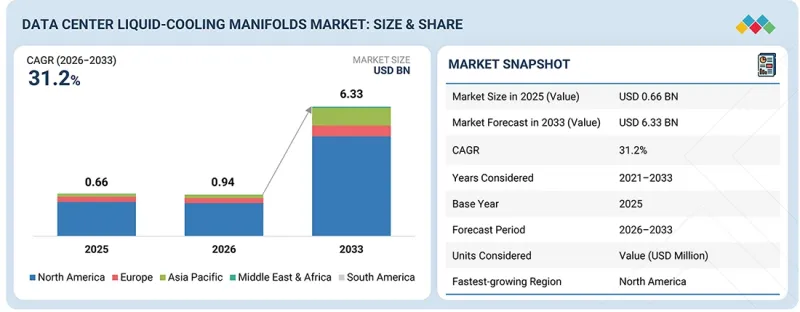
데이터센터용 액체 냉각 매니폴드 시장 규모는 2026년 9억 4,000만 달러에서 2033년까지 63억 3,000만 달러로 성장할 것으로 예상되며, CAGR은 31.2%에 달할 것으로 예측됩니다.
세계 데이터센터용 액체 냉각 매니폴드 시장이 확대되고 있는 주요 요인은, 첨단 열 관리 솔루션이 필요한 인공지능(AI), 기계 학습(ML) 및 고성능 컴퓨팅(HPC) 워크로드가 급속히 증가하고 있기 때문입니다. 랙의 전력 밀도가 높아짐에 따라 기존 공랭식 시스템의 효율성이 떨어지고 있으며, 액체 냉각 아키텍처의 도입이 가속화되고 있습니다.
| 조사 범위 | |
|---|---|
| 조사 대상 기간 | 2021-2033년 |
| 기준 연도 | 2025년 |
| 예측 기간 | 2026-2033년 |
| 산정 단위 | 금액(10억/100만 달러) |
| 부문 | 매니폴드 유형별, 냉각 유형별, 재료 유형별, 디자인 유형별, 데이터센터 유형별, 설치 유형별, 지역별 |
| 대상 지역 | 아시아태평양, 북미, 유럽, 중동 및 아프리카, 남미 |
다이렉트 투 칩(DTC) 및 침지 냉각 기술의 도입이 확대됨에 따라, 냉각액을 효율적으로 분배하는 매니폴드에 대한 수요가 꾸준히 증가하고 있습니다. 하이퍼스케일 및 코로케이션형 데이터센터 운영업체들은 AI 기반 애플리케이션을 지원하기 위해 고밀도 인프라에 대규모 투자를 진행하고 있습니다. 에너지 효율 향상과 운영 비용 절감이 점점 더 중요시되는 가운데, 액체 냉각 시스템으로의 전환이 더욱 가속화되고 있습니다. 또한, 지속가능성을 위한 노력과 탄소 배출 감축 목표 역시 보다 효율적인 냉각 기술의 도입을 뒷받침하고 있습니다. 클라우드 컴퓨팅, 디지털 서비스, 데이터 생성량의 지속적인 증가로 인해 첨단 냉각 인프라에 대한 수요가 확대되고 있습니다. 그 결과, 매니폴드는 차세대 데이터센터의 냉각 생태계에서 필수적인 구성요소로 자리매김하고 있습니다.
"매니폴드 유형별로는 인랙형 매니폴드 부문이 예측 기간 동안 가장 큰 시장 점유율을 차지할 것으로 추정됩니다."
랙 내 매니폴드 부문은 랙 수준에서 정밀한 냉각수 분배가 필요한 고밀도 AI 및 GPU 서버의 도입이 증가함에 따라, 전 세계 데이터센터용 액체 냉각 매니폴드 시장에서 급속히 성장하고 있습니다. 이러한 매니폴드는 여러 콜드 플레이트와 컴퓨팅 노드 간의 효율적인 유량 균형을 실현하여, 열 성능과 시스템 신뢰성을 향상시킵니다. 이 컴팩트한 설계는 차세대 데이터센터에서 선호되는 솔루션으로 자리 잡고 있는 '다이렉트 투 칩(DTC)' 냉각 아키텍처를 지원합니다. 또한, 인락 매니폴드는 집중형 분배 시스템에 비해 설치, 유지보수 및 확장성을 간소화합니다. 모듈형 데이터센터 설계의 도입 확대는 랙 통합형 냉각 인프라에 대한 수요를 더욱 가속화하고 있습니다. 하이퍼스케일 사업자들이 인랙 매니폴드를 선호하는 이유는 향후 용량 확장을 위한 유연성을 제공하기 때문입니다. 랙당 전력 밀도가 높아지는 추세에 따라, 국소적인 냉각수 관리의 필요성이 커지고 있습니다. 그 결과, 인락 매니폴드는 첨단 액체 냉각 시스템 도입에 있어 필수적인 구성요소로 자리매김하고 있습니다.
"냉각 기술 유형별로는 다이렉트 투 칩(Direct-to-Chip) 냉각 부문이 예측 기간 동안 가장 큰 시장 점유율을 차지할 것으로 추정됩니다."
AI, 기계 학습, HPC 애플리케이션에 사용되는 고성능 CPU 및 GPU를 효율적으로 냉각할 수 있기 때문에 전 세계 데이터센터용 액체 냉각 매니폴드 시장에서 다이렉트-투-칩(Direct-to-Chip) 냉각 기술 시장은 급속히 성장하고 있습니다. 이 기술은 중요한 구성요소에서 직접 열을 제거하기 때문에 기존의 공랭식 솔루션에 비해 뛰어난 열 성능을 발휘합니다. 또한, 신규 및 기존 데이터센터 환경 모두를 지원하므로 도입이 용이하고 비용 대비 효과도 높습니다. 고밀도 서버 랙의 도입이 확대됨에 따라 냉각액의 정밀한 분배에 대한 수요가 증가하고 있으며, 이것이 매니폴드 시스템의 수요를 견인하고 있습니다. 또한, 다이렉트 투 칩 냉각은 에너지 소비 절감과 데이터센터의 효율 향상에도 기여합니다. 주요 기술 기업과 서버 OEM 업체들은 차세대 AI 인프라를 위해 이러한 접근 방식의 표준화를 가속화하고 있습니다. 이 기술을 통해 신뢰성이나 성능을 저하시키지 않으면서 더 높은 연산 밀도를 실현할 수 있습니다. 그 결과, 다이렉트 투 칩(Direct-to-Chip) 냉각은 하이퍼스케일 및 엔터프라이즈 데이터센터에서 선호되는 액체 냉각 아키텍처로 자리 잡고 있습니다.
"데이터센터 유형별로 보면 하이퍼스케일 데이터센터 부문은 예측 기간 동안 가장 큰 시장 점유율을 차지할 것으로 추정됩니다."
하이퍼스케일 데이터센터 부문은 클라우드 컴퓨팅, 인공지능 및 대규모 디지털 서비스의 급속한 확장에 힘입어, 예측 기간 동안 가장 큰 시장 점유율을 차지할 것으로 예상됩니다. 대형 기술 기업들은 방대한 데이터 처리 및 저장 요구 사항을 충족하기 위해 하이퍼스케일 시설에 지속적으로 투자하고 있습니다. 이러한 데이터센터들은 매우 높은 IT 부하와 랙 밀도로 운영되고 있으며, 이로 인해 첨단 냉각 인프라에 대한 수요가 크게 증가하고 있습니다. 그 결과, 하이퍼스케일 시설에서는 효율적인 열 관리를 유지하기 위해 액체 냉각 기술을 대규모로 도입해야 합니다. 또한, 하이퍼스케일 사업자는 일반적으로 서로 다른 지역에 여러 개의 대규모 캠퍼스를 건설하기 때문에 인프라에 대한 투자는 더욱 증가합니다. 따라서 전 세계적으로 하이퍼스케일 데이터센터의 도입 건수가 증가하고 있는 점이 예측 기간 동안 액체 냉각 시장의 최대 점유율을 이끌어낼 것으로 예상됩니다.
CoolIT Systems(Ecolab)(캐나다), Vertiv(미국), Parker Hannifin(미국), nVent Electric(영국) 및 GF Industry &Infrastructure(스위스)는 데이터센터용 액체 냉각 매니폴드 시장의 주요 기업들입니다. 이 기업들은 시장 점유율과 사업 수익을 확대하기 위해 제휴, 합작 투자, 사업 확장 등 다양한 전략을 채택하고 있습니다.
조사 범위:
본 보고서에서는 부문을 정의하고, 매니폴드 유형, 냉각 기술 유형, 데이터센터 유형, 재질, 설계 유형, 설치 유형 및 지역을 기준으로 데이터센터용 액체 냉각 매니폴드 시장의 규모를 예측하고 있습니다. 주요 기업 개요을 작성하고, 해당 기업의 시장 점유율과 핵심 경쟁력을 종합적으로 분석하고 있습니다. 또한, 시장 내 각 기업의 사업 확장, 제휴, 인수 등 경쟁 동향을 추적·분석하고 있습니다.
이 보고서를 구매해야 하는 이유:
본 보고서는 데이터센터용 액체 냉각 매니폴드 시장 및 각 부문의 매출액에 대해 가장 정확한 추정치를 제공함으로써, 시장 선도 기업과 신규 진입 기업에 도움이 될 것으로 기대됩니다. 또한, 본 보고서는 이해관계자들이 시장의 경쟁 구도를 보다 깊이 이해하고, 비즈니스상의 입지를 강화하기 위한 귀중한 인사이트를 얻어, 효과적인 시장 진입 전략을 수립하는 데 도움이 될 것으로 기대됩니다. 또한, 이해관계자들이 시장 동향을 파악할 수 있도록 지원하고, 주요 시장 촉진요인, 제약요인, 과제 및 기회에 관한 정보를 제공합니다.
본 보고서에서는 다음 사항에 대한 인사이트를 제공합니다:
- 주요 촉진요인(하이퍼스케일 또는 코로케이션형 데이터센터의 급속한 확대, 고밀도 서버 랙 도입 증가, 에너지 효율이 뛰어나고 지속가능한 냉각 솔루션에 대한 수요 증가, 다이렉트 투 칩(DTC) 액체 냉각 아키텍처의 채택 확대) 및 제약요인(높은 초기 설비 투자 및 도입 비용, 냉각액 누출에 대한 우려, 시스템 신뢰성, 유지보수의 복잡성)에 대한 분석, 기회(AI 지원 데이터센터 및 고밀도 랙 스케일 인프라의 확대, 액체 냉각 데이터센터 환경에서의 열 기반 매니폴드 시스템 채택 확대), 그리고 과제(전체 냉각 인프라에 걸친 업계 표준화 및 상호 운용성 부족) 등, 데이터센터용 액체 냉각 매니폴드 시장의 성장에 영향을 미치는 요인들에 대해 분석하고 있습니다
- 제품 개발/혁신 : 데이터센터용 액체 냉각 매니폴드 시장의 향후 기술 동향 및 연구개발 활동에 대한 상세한 분석
- 시장 개발 : 다양한 지역의 데이터센터용 액체 냉각 매니폴드 시장 분석을 통한 수익성 높은 시장에 대한 종합적인 정보
- 시장의 다양화 : 데이터센터용 액체 냉각 매니폴드 시장에 대한 신제품, 다양한 유형, 미개척 지역, 최근 동향 및 투자에 관한 종합적인 정보.
- 경쟁사 분석 : CoolIT Systems(Ecolab)(캐나다), Vertiv(미국), Parker Hannifin(미국), nVent Electric(영국), GF Industry &Infrastructure(스위스) 등, 데이터센터용 액체 냉각 매니폴드 시장의 주요 참여 기업별 시장 점유율, 성장 전략, 제품 라인업에 대한 상세한 평가.
자주 묻는 질문
목차
제1장 소개
제2장 주요 요약
제3장 주요 인사이트
제4장 시장 개요
제5장 업계 동향
제6장 기술의 진보, AI에 의한 영향, 그리고 향후 응용
제7장 지속가능성과 규제 상황
제8장 고객 상황과 구매 행동
제9장 데이터센터용 액체 냉각 매니폴드 시장(매니폴드 유형별)
제10장 데이터센터용 액체 냉각 매니폴드 시장(냉각 유형별)
제11장 데이터센터용 액랭 매니폴드 시장(재료 유형별)
제12장 데이터센터용 액체 냉각 매니폴드 시장(디자인 유형별)
제13장 데이터센터용 액체 냉각 매니폴드 시장(데이터센터 유형별)
제14장 데이터센터용 액체 냉각 매니폴드 시장(설치 유형별)
제15장 데이터센터용 액랭 매니폴드 시장(지역별)
제16장 경쟁 구도
제17장 기업 개요
제18장 조사 방법
제19장 부록
KSM 26.07.20The data center liquid-cooling manifolds market is projected to grow from USD 0.94 billion in 2026 to USD 6.33 billion by 2033, at a CAGR of 31.2%. The global data center liquid-cooling manifolds market is expanding primarily due to the rapid expansion of artificial intelligence (AI), machine learning (ML), and high-performance computing (HPC) workloads that require advanced thermal management solutions. Increasing rack power densities are making traditional air-cooling systems less effective, accelerating the adoption of liquid-cooling architectures.
| Scope of the Report | |
|---|---|
| Years Considered for the Study | 2021-2033 |
| Base Year | 2025 |
| Forecast Period | 2026-2033 |
| Units Considered | Value (USD Billion / Million) |
| Segments | Type, Cooling Technology Type, Data Center Type, Material Type, Design Type, Installation Type and Region |
| Regions covered | Asia Pacific, North America, Europe, Middle East & Africa, and South America |
Growing deployment of direct-to-chip and immersion cooling technologies is creating strong demand for manifolds that ensure efficient coolant distribution. Hyperscale and colocation data center operators are investing heavily in high-density infrastructure to support AI-driven applications. Rising emphasis on energy efficiency and lower operating costs is further encouraging the transition to liquid-cooling systems. Sustainability initiatives and carbon reduction targets are also driving the adoption of more efficient cooling technologies. Continuous growth in cloud computing, digital services, and data generation is expanding the need for advanced cooling infrastructure. As a result, manifolds are becoming critical components in next-generation data center cooling ecosystems.
"By manifold type, the in-rack manifolds segment is estimated to hold the largest market share throughout the forecast period."
The in-rack manifolds segment is growing rapidly in the global data center liquid-cooling manifolds market due to increasing deployment of high-density AI and GPU servers that require precise coolant distribution at the rack level. These manifolds enable efficient flow balancing between multiple cold plates and compute nodes, improving thermal performance and system reliability. Their compact design supports direct-to-chip cooling architectures, which are becoming the preferred solution for next-generation data centers. In-rack manifolds also simplify installation, maintenance, and scalability compared with centralized distribution systems. Growing adoption of modular data center designs is further accelerating demand for rack-integrated cooling infrastructure. Hyperscale operators favor in-rack manifolds because they provide flexibility for future capacity expansion. The shift toward higher rack power densities is increasing the need for localized coolant management. As a result, in-rack manifolds are becoming a critical component of advanced liquid-cooling deployments.
"By cooling technology type, the direct-to-chip cooling segment is estimated to hold the largest market share throughout the forecast period."
The market for direct-to-chip cooling technology is growing rapidly in the global data center liquid-cooling manifolds market due to its ability to efficiently cool high-power CPUs and GPUs used in AI, machine learning, and HPC applications. Technology removes heat directly from critical components, delivering superior thermal performance compared to conventional air cooling solutions. Its compatibility with both new and existing data center environments makes deployment easier and more cost-effective. Growing adoption of high-density server racks is increasing the need for precise coolant distribution, driving demand for manifold systems. Direct-to-chip cooling also supports lower energy consumption and improved data center efficiency. Major technology companies and server OEMs are increasingly standardizing this approach for next-generation AI infrastructure. The technology enables higher computing density without compromising reliability or performance. As a result, direct-to-chip cooling is becoming the preferred liquid-cooling architecture across hyperscale and enterprise data centers.
"By data center type, the hyperscale data center segment is estimated to hold the largest market share throughout the forecast period."
The hyperscale data center segment is expected to hold the largest market share during the forecast period due to the rapid expansion of cloud computing, artificial intelligence, and large-scale digital services. Major technology companies are continuously investing in hyperscale facilities to support massive data processing and storage requirements. These data centers operate with extremely high IT loads and rack densities, which significantly increase the demand for advanced cooling infrastructure. As a result, hyperscale facilities require large-scale deployment of liquid-cooling technologies to maintain efficient thermal management. Additionally, hyperscale operators typically build multiple large campuses across different regions, further increasing infrastructure investments. Therefore, the growing number of hyperscale data center deployments globally is expected to drive the largest share of the liquid-cooling market during the forecast period.
Profile break-up of primary participants for the report:
- By Company Type: Tier 1 - 65%, Tier 2 - 20%, and Tier 3 - 15%
- By Designation: C-Level Executives - 25%, Directors - 30%, and Others - 45%
- By Region: North America - 30%, Asia Pacific - 40%, Europe - 20%, Middle East & Africa - 7%, and South America - 3%
CoolIT Systems (Ecolab) (Canada), Vertiv (US), Parker Hannifin (US), nVent Electric (UK), and GF Industry & Infrastructure (Switzerland) are among the key players in the data center liquid-cooling manifolds market. These players have adopted various strategies, including agreements, joint ventures, and expansions, to increase their market share and business revenue.
Research Coverage:
The report defines segments and projects the size of the data center liquid-cooling manifolds market based on manifold types, cooling technology types, data center types, material types, design types, installation types, and region. It strategically profiles the key players and comprehensively analyzes their market share and core competencies. It also tracks and analyzes competitive developments, such as expansions, agreements, and acquisitions undertaken by them in the market.
Reasons to Buy the Report:
The report is expected to help the market leaders/new entrants by providing them with the closest approximations of revenue numbers of the data center liquid-cooling manifolds market and its segments. This report is also expected to help stakeholders gain a deeper understanding of the market's competitive landscape, acquire valuable insights to enhance their business positions, and develop effective go-to-market strategies. It also enables stakeholders to understand the market's pulse and provides information on key market drivers, restraints, challenges, and opportunities.
The report provides insights into the following pointers:
- Analysis of critical drivers (rapid expansion of hyperscale or colocation data centers, increasing deployment of high-density server racks, rising demand for energy-efficient and sustainable cooling solutions, growing adoption of direct-to-chip liquid-cooling architectures), restraints (high initial capital investment and deployment costs, concerns regarding coolant leakage, system reliability, and maintenance complexity), opportunities (expansion of AI-ready data centers and high-density rack-scale infrastructure, increasing adoption of row-based manifold systems in liquid-cooled data center environments), and challenges (lack of industry-wide standardization and interoperability across cooling infrastructures) influencing the growth of the Data center liquid-cooling manifolds market
- Product Development/Innovation: Detailed insights on upcoming technologies, research & development activities in the data center liquid-cooling manifolds market
- Market Development: Comprehensive information about lucrative markets by analyzing the data center liquid-cooling manifolds market across varied regions
- Market Diversification: Exhaustive information about new products, various types, untapped geographies, recent developments, and investments in the data center liquid-cooling manifolds market.
- Competitive Assessment: In-depth assessment of market shares, growth strategies, and product offerings of leading players such as CoolIT Systems (Ecolab) (Canada), Vertiv (US), Parker Hannifin (US), nVent Electric (UK), and GF Industry & Infrastructure (Switzerland), among others, are the key players in the data center liquid-cooling manifolds market.
TABLE OF CONTENTS
1 INTRODUCTION
- 1.1 STUDY OBJECTIVES
- 1.2 MARKET DEFINITION
- 1.3 STUDY SCOPE
- 1.3.1 MARKET SEGMENTATION AND REGIONAL SCOPE
- 1.3.2 INCLUSIONS AND EXCLUSIONS
- 1.3.3 YEARS CONSIDERED
- 1.4 CURRENCY CONSIDERED
- 1.5 LIMITATIONS
- 1.6 STAKEHOLDERS
2 EXECUTIVE SUMMARY
- 2.1 KEY INSIGHTS AND MARKET HIGHLIGHTS
- 2.2 KEY MARKET PARTICIPANTS: SHARE INSIGHTS AND STRATEGIC DEVELOPMENTS
- 2.3 DISRUPTIVE TRENDS IN DATA CENTER LIQUID COOLING MANIFOLDS MARKET
- 2.4 HIGH-GROWTH SEGMENTS
- 2.5 REGIONAL SNAPSHOT: MARKET SIZE, GROWTH RATE, AND FORECAST
3 PREMIUM INSIGHTS
- 3.1 ATTRACTIVE OPPORTUNITIES FOR PLAYERS IN DATA CENTER LIQUID COOLING MANIFOLDS MARKET
- 3.2 DATA CENTER LIQUID COOLING MANIFOLDS MARKET, BY DATA CENTER TYPE
- 3.3 DATA CENTER LIQUID COOLING MANIFOLDS MARKET, BY COOLING TECHNOLOGY TYPE
- 3.4 DATA CENTER LIQUID COOLING MANIFOLDS MARKET, BY MANIFOLD TYPE
- 3.5 DATA CENTER LIQUID COOLING MANIFOLDS MARKET, BY MATERIAL TYPE
- 3.6 DATA CENTER LIQUID COOLING MANIFOLDS MARKET, BY REGION
- 3.7 DATA CENTER LIQUID COOLING MANIFOLDS MARKET, BY COUNTRY
4 MARKET OVERVIEW
- 4.1 INTRODUCTION
- 4.2 MARKET DYNAMICS
- 4.2.1 DRIVERS
- 4.2.1.1 Growth in data center market
- 4.2.1.2 Increase in server rack density
- 4.2.1.3 Growing demand for energy-efficient cooling solutions
- 4.2.1.4 Growing adoption of direct-to-chip liquid cooling architectures
- 4.2.2 RESTRAINTS
- 4.2.2.1 High capital expenditure and implementation costs
- 4.2.2.2 Concerns regarding coolant leakage and operational reliability
- 4.2.3 OPPORTUNITIES
- 4.2.3.1 Expansion of AI-ready data centers and rack-scale infrastructure
- 4.2.3.2 Increasing adoption of row-based manifold systems in high-density liquid-cooled data centers
- 4.2.4 CHALLENGES
- 4.2.4.1 Lack of standardization and interoperability
- 4.2.1 DRIVERS
- 4.3 UNMET NEEDS AND WHITE SPACES
- 4.3.1 UNMET NEEDS IN DATA CENTER LIQUID COOLING MANIFOLDS MARKET
- 4.3.2 WHITE SPACE OPPORTUNITIES
- 4.4 INTERCONNECTED MARKETS AND CROSS-SECTOR OPPORTUNITIES
- 4.4.1 INTERCONNECTED MARKETS
- 4.4.2 CROSS SECTOR OPPORTUNITIES
- 4.5 EMERGING BUSINESS MODELS AND ECOSYSTEM SHIFTS
- 4.5.1 EMERGING BUSINESS MODELS
- 4.5.2 ECOSYSTEM SHIFTS
- 4.6 STRATEGIC MOVES BY TIER 1/2/3 PLAYERS
- 4.6.1 KEY MOVES AND STRATEGIC FOCUS
5 INDUSTRY TRENDS
- 5.1 PORTER'S FIVE FORCES ANALYSIS
- 5.1.1 BARGAINING POWER OF SUPPLIERS
- 5.1.2 BARGAINING POWER OF BUYERS
- 5.1.3 THREAT OF SUBSTITUTES
- 5.1.4 THREAT OF NEW ENTRANTS
- 5.1.5 DEGREE OF COMPETITION
- 5.2 MACROECONOMICS INDICATORS
- 5.2.1 INTRODUCTION
- 5.2.2 GDP TRENDS AND FORECAST
- 5.2.3 DATA CENTER INDUSTRY
- 5.2.4 TRENDS IN GLOBAL DATA CENTER COOLING INDUSTRY
- 5.2.5 MANUFACTURING INDUSTRY
- 5.2.6 TRENDS IN GLOBAL HYPERSCALE AND AI DATA CENTER INDUSTRY
- 5.3 VALUE CHAIN ANALYSIS
- 5.3.1 PROMINENT COMPANIES
- 5.4 ECOSYSTEM ANALYSIS
- 5.5 KEY CONFERENCES & EVENTS IN 2026 - 2027
- 5.6 TRENDS/DISRUPTIONS IMPACTING CUSTOMERS' BUSINESSES
- 5.7 INVESTMENT AND FUNDING SCENARIO
- 5.8 CASE STUDY ANALYSIS
- 5.8.1 CASE STUDY 1: LG U+ AI DATA CENTER TESTBED - POLYMER MANIFOLD DEPLOYMENT (GF PIPING SYSTEMS)
- 5.8.2 CASE STUDY 2: NETMOUNTAINS CO-LOCATION DATA CENTER, VELBERT, GERMANY (GF PIPING SYSTEMS & RITTAL)
- 5.9 IMPACT OF 2025 US TARIFF - DATA CENTER LIQUID COOLING MANIFOLDS MARKET
- 5.9.1 INTRODUCTION
- 5.9.2 KEY TARIFF RATES IMPACTING MARKET
- 5.9.3 PRICE IMPACT ANALYSIS
- 5.9.4 KEY IMPACT ON VARIOUS REGIONS
- 5.9.4.1 US
- 5.9.4.2 Europe
- 5.9.4.3 Asia Pacific
- 5.9.5 IMPACT ON DATA CENTER INDUSTRY
6 TECHNOLOGICAL ADVANCEMENTS, AI-DRIVEN IMPACT, AND FUTURE APPLICATIONS
- 6.1 OVERVIEW
- 6.2 KEY TECHNOLOGIES
- 6.2.1 RACK-BASED MANIFOLD TECHNOLOGY
- 6.2.2 ROW-BASED MANIFOLD TECHNOLOGY
- 6.2.3 POLYMER-BASED MANIFOLD TECHNOLOGY
- 6.3 ADJACENT TECHNOLOGIES
- 6.3.1 DIRECT-TO-CHIP (DTC) COOLING TECHNOLOGY
- 6.3.2 COLD PLATE TECHNOLOGY
- 6.4 COMPLEMENTARY TECHNOLOGY ANALYSIS
- 6.4.1 TECHNOLOGY COOLING SYSTEM (TCS) TECHNOLOGY
- 6.5 FUTURE APPLICATIONS
- 6.5.1 INTELLIGENT FLOW BALANCING MANIFOLDS: SENSOR INTEGRATED MANIFOLDS THAT DYNAMICALLY OPTIMIZE COOLANT DISTRIBUTION ACROSS HIGH DENSITY AI AND GPU COOLING LOOPS
- 6.5.2 SMART MONITORING AND DIAGNOSTICS MANIFOLDS: MANIFOLDS EQUIPPED WITH INTEGRATED SENSORS THAT PROVIDE REAL-TIME VISIBILITY INTO COOLANT FLOW, PRESSURE, AND TEMPERATURE CONDITIONS
- 6.5.3 PREDICTIVE MAINTENANCE AND LEAK DETECTION MANIFOLDS: CONDITION AWARE MANIFOLD SYSTEMS THAT IDENTIFY FLOW ABNORMALITIES AND POTENTIAL COOLANT LEAKS BEFORE OPERATIONAL FAILURES OCCUR
- 6.5.4 SCALABLE MODULAR COOLANT DISTRIBUTION MANIFOLDS: STANDARDIZED MANIFOLD PLATFORMS THAT ENABLE RAPID DEPLOYMENT AND EXPANSION OF LIQUID COOLING INFRASTRUCTURE IN AI AND HYPERSCALE DATA CENTERS
- 6.6 IMPACT OF AI/GEN AI ON DATA CENTER LIQUID COOLING MANIFOLDS MARKET
- 6.6.1 INTRODUCTION
- 6.6.2 TOP USE CASES AND MARKET POTENTIAL
- 6.6.3 BEST PRACTICES: COMPANIES/INSTITUTIONS USE CASES
- 6.6.4 CASE STUDIES OF DATA CENTER LIQUID COOLING MANIFOLDS MARKET
- 6.6.5 INTERCONNECTED ADJACENT ECOSYSTEM AND IMPACT ON MARKET PLAYERS
- 6.6.6 CLIENTS' READINESS TO ADOPT GENERATIVE AI IN DATA CENTER LIQUID COOLING MANIFOLDS MARKET
- 6.6.6.1 Vertiv: Row-based manifold infrastructure for AI data centers
- 6.6.6.2 Supermicro: Rack-level coolant distribution manifolds for generative Ai supercomputers
7 SUSTAINABILITY AND REGULATORY LANDSCAPE
- 7.1 REGIONAL REGULATIONS AND COMPLIANCE
- 7.1.1 REGULATORY BODIES, GOVERNMENT AGENCIES, AND OTHER ORGANIZATIONS
- 7.1.2 INDUSTRY STANDARDS
- 7.2 SUSTAINABILITY INITIATIVES
- 7.2.1 CARBON IMPACT AND ECO APPLICATIONS OF DATA CENTER LIQUID COOLING MANIFOLDS MARKET
- 7.3 SUSTAINABILITY IMPACT AND REGULATORY POLICY INITIATIVES
- 7.4 CERTIFICATIONS, LABELLING AND ECO STANDARDS
8 CUSTOMER LANDSCAPE & BUYER BEHAVIOR
- 8.1 DECISION-MAKING PROCESS
- 8.2 KEY STAKEHOLDERS IN BUYING PROCESS
- 8.2.1 KEY STAKEHOLDERS IN BUYING PROCESS
- 8.2.2 BUYING CRITERIA
- 8.3 ADOPTION BARRIERS & INTERNAL CHALLENGES
- 8.4 UNMET NEEDS IN VARIOUS END USE INDUSTRIES
- 8.5 MARKET PROFITABILITY
- 8.5.1 REVENUE POTENTIAL
- 8.5.2 COST DYNAMICS
- 8.5.3 MARGIN OPPORTUNITIES IN KEY APPLICATIONS
9 DATA CENTER LIQUID COOLING MANIFOLDS MARKET, BY MANIFOLD TYPE
- 9.1 INTRODUCTION
- 9.2 IN-RACK MANIFOLDS
- 9.2.1 RISING RACK POWER DENSITIES AND DIRECT-TO-CHIP COOLING ADOPTION DRIVE DEMAND FOR IN-RACK MANIFOLDS
- 9.3 ROW-BASED MANIFOLDS
- 9.3.1 GROWING DEPLOYMENT OF HIGH-DENSITY AI CLUSTERS ACCELERATES ADOPTION OF IN-ROW MANIFOLDS
- 9.4 FACILITY DISTRIBUTION UNIT (FDU) MANIFOLDS
- 9.4.1 EXPANSION OF LARGE-SCALE LIQUID COOLING INFRASTRUCTURE SUPPORTS GROWTH OF FDU MANIFOLDS
10 DATA CENTER LIQUID COOLING MANIFOLDS MARKET, BY COOLING TYPE
- 10.1 INTRODUCTION
- 10.2 DIRECT-TO-CHIP COOLING
- 10.2.1 GROWING COOLANT DISTRIBUTION COMPLEXITY IN HIGH-DENSITY AI RACKS
- 10.3 IMMERSION COOLING
- 10.3.1 EXPANSION OF TANK-LEVEL THERMAL MANAGEMENT INFRASTRUCTURE CREATES DEMAND FOR SPECIALIZED FLUID DISTRIBUTION SYSTEMS
- 10.4 HYBRID COOLING
- 10.4.1 MODERNIZATION OF EXISTING DATA CENTERS STRENGTHENS DEMAND FOR HYBRID COOLING DEPLOYMENTS
11 DATA CENTER LIQUID COOLING MANIFOLDS MARKET, BY MATERIAL TYPE
- 11.1 INTRODUCTION
- 11.2 STAINLESS STEEL MANIFOLDS
- 11.2.1 CORROSION RESISTANCE AND LONG SERVICE LIFE SUPPORT ADOPTION OF STAINLESS STEEL MANIFOLDS
- 11.3 ALUMINUM MANIFOLDS
- 11.3.1 LIGHTWEIGHT CONSTRUCTION AND IMPROVED THERMAL PERFORMANCE DRIVE ALUMINIUM MANIFOLD ADOPTION
- 11.4 POLYMER-BASED MANIFOLDS
- 11.4.1 GROWING FOCUS ON LIGHTWEIGHT AND CORROSION-RESISTANT DESIGNS ACCELERATES POLYMER-BASED MANIFOLD ADOPTION
- 11.5 COMPOSITE MATERIAL
- 11.5.1 ADVANCED COMPOSITE STRUCTURES SUPPORT NEXT GENERATION LIQUID COOLING INFRASTRUCTURE
- 11.6 OTHERS
- 11.6.1 SPECIALIZED THERMAL AND CORROSION-RESISTANT MATERIALS SUSTAIN DEMAND IN NICHE APPLICATIONS
12 DATA CENTER LIQUID COOLING MANIFOLDS MARKET, BY DESIGN TYPE
- 12.1 INTRODUCTION
- 12.2 AISLE MOUNTED
- 12.2.1 CENTRALIZED COOLANT ACCESS AND SIMPLIFIED SERVICEABILITY DRIVE ADOPTION OF AISLE-MOUNTED DESIGNS
- 12.3 CEILING SUPPORTED
- 12.3.1 GROWING PREFERENCE FOR OVERHEAD UTILITY DISTRIBUTION SUPPORTS CEILING-SUPPORTED MANIFOLD ARCHITECTURES
- 12.4 FLOOR MOUNTED
- 12.4.1 INCREASING DEPLOYMENT OF HIGH-CAPACITY COOLING NETWORKS STRENGTHENS DEMAND FOR FLOOR-MOUNTED MANIFOLDS
- 12.5 UNDERFLOOR
- 12.5.1 MODERNIZATION OF RAISED-FLOOR DATA CENTERS SUSTAINS ADOPTION OF UNDERFLOOR MANIFOLD DESIGNS
13 DATA CENTER LIQUID COOLING MANIFOLDS MARKET, BY DATA CENTER TYPE
- 13.1 INTRODUCTION
- 13.2 HYPERSCALE
- 13.2.1 EXPANSION OF AI INFRASTRUCTURE AND HIGH-DENSITY COMPUTING ACCELERATES LIQUID COOLING ADOPTION IN HYPERSCALE DATA CENTERS
- 13.3 COLOCATION PROVIDERS
- 13.3.1 INCREASING CUSTOMER DEMAND FOR AI-READY INFRASTRUCTURE DRIVES MANIFOLD DEPLOYMENT IN COLOCATION FACILITIES
- 13.4 ENTERPRISES
- 13.4.1 MODERNIZATION OF LEGACY INFRASTRUCTURE SUPPORTS ADOPTION OF LIQUID COOLING IN ENTERPRISES
14 DATA CENTER LIQUID COOLING MANIFOLDS MARKET, BY INSTALLATION TYPE
- 14.1 INTRODUCTION
- 14.2 NEW INSTALLATION
- 14.2.1 AI INSTALLATIONS: PURPOSE-BUILT AI DATA CENTERS DRIVE DEMAND FOR ADVANCED COOLANT DISTRIBUTION NETWORKS
- 14.2.2 NON-AI INSTALLATIONS: GROWING DEMAND FOR EFFICIENT DIGITAL INFRASTRUCTURE SUPPORTS LIQUID COOLING ADOPTION IN NEW FACILITIES
- 14.3 RETROFIT
- 14.3.1 AI INSTALLATIONS: EXPANSION OF AI WORKLOADS DRIVES LIQUID COOLING RETROFITS ACROSS EXISTING DATA CENTER INFRASTRUCTURE
- 14.3.2 NON AI INSTALLATIONS: INFRASTRUCTURE MODERNIZATION AND EFFICIENCY IMPROVEMENTS SUPPORT NON-AI LIQUID COOLING RETROFITS
15 DATA CENTER LIQUID COOLING MANIFOLDS MARKET, BY REGION
- 15.1 INTRODUCTION
- 15.2 NORTH AMERICA
- 15.2.1 US
- 15.2.1.1 Rapid deployment of AI infrastructure and high-density GPU clusters by hyperscale operators, requiring advanced liquid cooling architectures to manage increasing thermal loads and improve energy efficiency
- 15.2.2 CANADA
- 15.2.2.1 Expansion of AI-ready hyperscale and colocation data centers powered by low-cost renewable energy to drive market
- 15.2.3 MEXICO
- 15.2.3.1 Rising rack power densities that require advanced liquid cooling infrastructure to ensure energy-efficient thermal management
- 15.2.1 US
- 15.3 EUROPE
- 15.3.1 GERMANY
- 15.3.1.1 Strict energy-efficiency regulations and rising rack power densities
- 15.3.2 UK
- 15.3.2.1 Expansion of financial services, computing infrastructure, and data sovereignty-driven investments in domestic digital infrastructure
- 15.3.3 FRANCE
- 15.3.3.1 Low-carbon nuclear energy availability, sovereign cloud initiatives, and strategic investments in AI infrastructure
- 15.3.4 ITALY
- 15.3.4.1 Increasing enterprise digitalization and growing investments in cloud infrastructure
- 15.3.5 SPAIN
- 15.3.5.1 Massive hyperscale investments in Aragon and Madrid, supported by abundant renewable energy resources and growing role as an international connectivity hub
- 15.3.6 REST OF EUROPE
- 15.3.1 GERMANY
- 15.4 ASIA PACIFIC
- 15.4.1 CHINA
- 15.4.1.1 Large-scale deployment of high-density computing environments, accelerating demand for liquid cooling manifolds and advanced thermal management systems
- 15.4.2 JAPAN
- 15.4.2.1 AI and high-performance computing infrastructure, is accelerating the adoption of liquid cooling manifold systems across the country's data center ecosystem
- 15.4.3 INDIA
- 15.4.3.1 Rapid expansion of AI-ready data centers and GPU infrastructure is accelerating the adoption of liquid cooling manifolds across India's data center industry
- 15.4.4 SOUTH KOREA
- 15.4.4.1 Expansion of AI, 5G services, and high-density digital infrastructure
- 15.4.5 MALAYSIA
- 15.4.5.1 Need for energy-efficient cooling in tropical climate
- 15.4.6 AUSTRALIA
- 15.4.6.1 Regional cloud hub and strong investment in renewable-powered digital infrastructure, is accelerating the adoption of liquid cooling manifolds across the country's data center ecosystem
- 15.4.7 REST OF ASIA PACIFIC
- 15.4.1 CHINA
- 15.5 MIDDLE EAST & AFRICA
- 15.5.1 GCC COUNTRIES
- 15.5.1.1 Saudi Arabia
- 15.5.1.1.1 Massive investments in AI and cloud infrastructure under Vision 2030, combined with large-scale projects
- 15.5.1.2 UAE
- 15.5.1.2.1 Need for efficient cooling in extreme temperatures
- 15.5.1.3 Rest of GCC Countries
- 15.5.1.3.1 Growing digital infrastructure development and rising need for energy-efficient cooling in harsh climate conditions
- 15.5.1.1 Saudi Arabia
- 15.5.2 SOUTH AFRICA
- 15.5.2.1 Expansion of cloud infrastructure combined with large-scale investments
- 15.5.3 REST OF MIDDLE EAST & AFRICA
- 15.5.1 GCC COUNTRIES
- 15.6 SOUTH AMERICA
- 15.6.1 BRAZIL
- 15.6.1.1 Large-scale cloud and AI infrastructure investments
- 15.6.2 ARGENTINA
- 15.6.2.1 Rapid expansion of digital economy, led by technology-driven companies, alongside increasing enterprise cloud adoption and investments in local data infrastructure
- 15.6.3 REST OF SOUTH AMERICA
- 15.6.1 BRAZIL
16 COMPETITIVE LANDSCAPE
- 16.1 INTRODUCTION
- 16.2 KEY PLAYERS' STRATEGIES/RIGHT TO WIN
- 16.3 REVENUE ANALYSIS, 2025
- 16.3.1 TOP PLAYERS' REVENUE ANALYSIS
- 16.4 MARKET SHARE ANALYSIS, 2025
- 16.4.1 RANKING OF KEY MARKET PLAYERS, 2025
- 16.4.2 MARKET SHARE ANALYSIS, 2025
- 16.4.2.1 Vertiv Group Corp. (US)
- 16.4.2.2 CoolIT Systems (Canada)
- 16.4.2.3 Motivair Corporation (US)
- 16.4.2.4 Eaton Corporation plc (Ireland)
- 16.4.2.5 Delta Electronics, Inc. (Taiwan)
- 16.5 BRAND/PRODUCT COMPARISON
- 16.5.1 COOLIT SYSTEMS
- 16.5.2 VERTIV
- 16.5.3 MOTIVAIR
- 16.5.4 CHILLDYNE
- 16.5.5 ACCELSIUS
- 16.6 COMPANY VALUATION AND FINANCIAL METRICS
- 16.7 COMPANY EVALUATION MATRIX: KEY PLAYERS, 2025
- 16.7.1 STARS
- 16.7.2 EMERGING LEADERS
- 16.7.3 PERVASIVE PLAYERS
- 16.7.4 PARTICIPANTS
- 16.8 COMPANY FOOTPRINT: KEY PLAYERS, 2025
- 16.8.1 COMPANY FOOTPRINT
- 16.8.2 REGION FOOTPRINT
- 16.8.3 MANIFOLD TYPE FOOTPRINT
- 16.8.4 COOLING TECHNOLOGY TYPE FOOTPRINT
- 16.8.5 MATERIAL TYPE FOOTPRINT
- 16.8.6 DATA CENTER TYPE FOOTPRINT
- 16.9 COMPANY EVALUATION MATRIX: STARTUPS/SMES, 2024
- 16.9.1 PROGRESSIVE COMPANIES
- 16.9.2 RESPONSIVE COMPANIES
- 16.9.3 DYNAMIC COMPANIES
- 16.9.4 STARTING BLOCKS
- 16.9.5 COMPETITIVE BENCHMARKING: STARTUPS/SMES, 2025
- 16.9.6 DETAILED LIST OF KEY STARTUPS/SMES
- 16.9.7 COMPETITIVE BENCHMARKING OF KEY STARTUPS/SMES
- 16.10 COMPETITIVE SCENARIO
- 16.10.1 PRODUCT LAUNCHES
- 16.10.2 DEALS
17 COMPANY PROFILES
- 17.1 MAJOR PLAYERS
- 17.1.1 TATE GLOBAL SOLUTIONS LTD.
- 17.1.1.1 Business overview
- 17.1.1.2 Products/Solutions/Services offered
- 17.1.1.3 MnM view
- 17.1.1.3.1 Key strengths
- 17.1.1.3.2 Strategic choices
- 17.1.1.3.3 Weaknesses and competitive threats
- 17.1.2 COOLIT SYSTEMS
- 17.1.2.1 Business overview
- 17.1.2.2 Products/Solutions/Services offered
- 17.1.2.3 Recent developments
- 17.1.2.3.1 Deals
- 17.1.2.4 MnM view
- 17.1.2.4.1 Key strengths
- 17.1.2.4.2 Strategic choices
- 17.1.2.4.3 Weaknesses and competitive threats
- 17.1.3 VERTIV GROUP CORP.
- 17.1.3.1 Business overview
- 17.1.3.2 Products/Solutions/Services offered
- 17.1.3.3 MnM view
- 17.1.3.3.1 Key strengths
- 17.1.3.3.2 Strategic choices
- 17.1.3.3.3 Weaknesses and competitive threats
- 17.1.4 EATON CORPORATION PLC
- 17.1.4.1 Business overview
- 17.1.4.2 Products/Solutions/Services offered
- 17.1.4.3 MnM view
- 17.1.4.3.1 Key strengths
- 17.1.4.3.2 Strategic choices
- 17.1.4.3.3 Weaknesses and competitive threats
- 17.1.5 MOTIVAIR CORPORATION
- 17.1.5.1 Business overview
- 17.1.5.2 Products/Solutions/Services offered
- 17.1.5.3 Recent developments
- 17.1.5.3.1 Deals
- 17.1.5.4 MnM view
- 17.1.5.4.1 Key strengths
- 17.1.5.4.2 Strategic choices
- 17.1.5.4.3 Weaknesses and competitive threats
- 17.1.6 CHILLDYNE, INC.
- 17.1.6.1 Business overview
- 17.1.6.2 Products/Solutions/Services offered
- 17.1.7 ACCELSIUS LLC
- 17.1.7.1 Business overview
- 17.1.7.2 Products/Solutions/Services offered
- 17.1.7.3 Recent developments
- 17.1.7.3.1 Product launches
- 17.1.8 STEEL & O'BRIEN MANUFACTURING
- 17.1.8.1 Business overview
- 17.1.8.2 Products/Solutions/Services offered
- 17.1.9 NVENT
- 17.1.9.1 Business overview
- 17.1.9.2 Products/Solutions/Services offered
- 17.1.10 ENVICOOL
- 17.1.10.1 Business overview
- 17.1.10.2 Products/Solutions/Services offered
- 17.1.11 JETCOOL TECHNOLOGIES INC (A FLEX COMPANY)
- 17.1.11.1 Business overview
- 17.1.11.2 Products/Solutions/Services offered
- 17.1.11.3 Recent developments
- 17.1.11.3.1 Deals
- 17.1.12 VALEX
- 17.1.12.1 Business overview
- 17.1.12.2 Products/Solutions/Services offered
- 17.1.13 DOCKWEILER
- 17.1.13.1 Business overview
- 17.1.13.2 Products/Solutions/Services offered
- 17.1.14 PARKER HANNIFIN CORP
- 17.1.14.1 Business overview
- 17.1.14.2 Products/Solutions/Services offered
- 17.1.15 GF INDUSTRY AND INFRASTRUCTURE FLOW SOLUTIONS
- 17.1.15.1 Business overview
- 17.1.15.2 Products/Solutions/Services offered
- 17.1.16 HANLEY CONTROLS (CLONMEL) LTD
- 17.1.16.1 Business overview
- 17.1.16.2 Products/Solutions/Services offered
- 17.1.17 DCX LIQUID COOLING SYSTEMS
- 17.1.17.1 Business overview
- 17.1.17.2 Products/Solutions/Services offered
- 17.1.18 DELTA ELECTRONICS, INC.
- 17.1.18.1 Business overview
- 17.1.18.2 Products/Solutions/Services offered
- 17.1.19 KRES POWER SYSTEMS ONTARIO CORPORATION
- 17.1.19.1 Business overview
- 17.1.19.2 Products/Solutions/Services offered
- 17.1.20 FILSONFILTERS
- 17.1.20.1 Business overview
- 17.1.20.2 Products/Solutions/Services offered
- 17.1.21 SHENZHEN LORI TECHNOLOGY CO., LTD
- 17.1.21.1 Business overview
- 17.1.21.2 Products/Solutions/Services offered
- 17.1.1 TATE GLOBAL SOLUTIONS LTD.
- 17.2 OTHER PLAYERS
- 17.2.1 TERACULE
- 17.2.2 VAV INTERNATIONAL
- 17.2.3 GLOBAL TEK FABRICATION CO., LTD.
- 17.2.4 MIAO TIEH PRECISION INDUSTRIAL CO., LTD.
18 RESEARCH METHODOLOGY
- 18.1 RESEARCH DATA
- 18.1.1 SECONDARY DATA
- 18.1.1.1 List of key secondary sources
- 18.1.1.2 Key data from secondary sources
- 18.1.2 PRIMARY DATA
- 18.1.2.1 Key data from primary sources
- 18.1.2.2 Key industry insights
- 18.1.2.3 List of primary participants
- 18.1.2.4 Breakdown of primary interviews
- 18.1.1 SECONDARY DATA
- 18.2 MARKET SIZE ESTIMATION
- 18.2.1 BOTTOM-UP APPROACH
- 18.2.2 TOP-DOWN APPROACH
- 18.3 MARKET FORECAST APPROACH
- 18.3.1 DEMAND-SIDE ANALYSIS
- 18.3.2 SUPPLY-SIDE ANALYSIS
- 18.3.3 CALCULATIONS FOR SUPPLY-SIDE ANALYSIS
- 18.4 GROWTH FORECAST
- 18.5 DATA TRIANGULATION
- 18.6 RESEARCH ASSUMPTIONS
- 18.7 RESEARCH LIMITATIONS
- 18.8 RISK ASSESSMENT
- 18.9 FACTOR ANALYSIS
19 APPENDIX
- 19.1 DISCUSSION GUIDE
- 19.2 KNOWLEDGESTORE: MARKETSANDMARKETS' SUBSCRIPTION PORTAL
- 19.3 CUSTOMIZATION OPTIONS
- 19.4 RELATED REPORTS
- 19.5 AUTHOR DETAILS