

|
시장보고서
상품코드
2099942
GPU 액체 냉각 시장 : 점유율 분석, 업계 동향 및 통계, 성장 예측(2026-2031년)GPU Liquid Cooling - Market Share Analysis, Industry Trends & Statistics, Growth Forecasts (2026 - 2031) |
||||||
 Mordor Intelligence
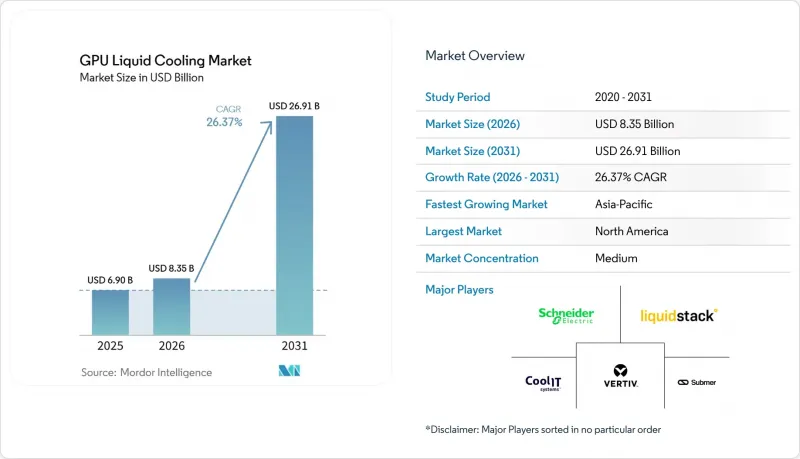
Mordor Intelligence에 의하면, GPU 액체 냉각 시장 규모는 2025년 69억 달러에서 2026년에는 83억 5,000만 달러로 확대되어 2031년까지 269억 1,000만 달러에 이를 것으로 예상되고 있어 2026년부터 2031년까지 CAGR 26.37%로 성장할 전망입니다.
본 보고서는 냉각 방식(단상 액체 냉각 및 2상 액체 냉각), 냉각 수준(컴포넌트 수준 냉각 및 서버 랙 수준 냉각), 도입 분야(하이퍼스케일 클라우드, 엔터프라이즈, 정부·연구용 HPC, 엣지 AI), GPU 전력 밀도(300W 미만, 300W-700W, 700W 이상), 지역별로 분류되어 있습니다. 시장 예측은 금액(달러) 기준으로 제시되어 있습니다.
전 세계 GPU 액체 냉각 시장 동향 및 인사이트
하이퍼스케일 랙 밀도 향상으로 액체 냉각이 주류로 부상
랙 수준의 전력 밀도는 2024년 27 kW에서 2026년에는 100 kW를 크게 상회하는 수준으로 급증하고 있으며, 주요 캠퍼스에서는 이미 250 kW 랙에 대한 시험이 진행되고 있습니다. 이러한 열 부하 조건에서는 기류 속도를 확보하는 것이 현실적으로 불가능하며, 소음상의 제약으로 인해 팬 회전 속도를 더 이상 높일 수도 없습니다. 따라서 사업자들은 기존 홀에 45°C공급 온도를 견딜 수 있는 냉각액 분배 장치를 후속 설치하여, 칠러를 연중 내내 이코노마이저 모드로 가동할 수 있도록 하고 있습니다. 조기 도입 기업에 따르면, 건물의 설치 면적이 35% 축소되어 콘크리트 및 철강 비용을 1억 8,000만 달러 이상 절감할 수 있었습니다고 합니다. 그 결과, 운영비로 미루어지는 것이 아니라 하이퍼스케일 설비 투자 계획에 직접 계상되는 형태로 명확한 전환 효과가 나타나고 있습니다.
OEM 플랫폼이 통합의 장벽을 제거
각 서버 제조업체들은 액체 냉각을 특수 옵션에서 고성능 GPU 노드의 표준 사양으로 전환했습니다. NVIDIA GB200, AMD MI325X 및 Supermicro X14 시스템에는 출고 시 콜드 플레이트, 퀵 디스커넥트, 누수 감지 루프가 기본으로 장착되어 있습니다. 이러한 턴키 방식 덕분에 랙 수준의 설치 시간이 16시간에서 3시간 미만으로 단축되었으며, 시운전에 소요되는 노력도 80% 감소했습니다. 액체 냉각 모델은 동일한 전력 범위 내에서 최대 18% 더 높은 클럭 주파수를 유지할 수 있으므로, 최종 사용자는 즉시 성능 여유를 확보할 수 있습니다. 액체 냉각은 더 이상 드문 기술이 아니며, 플래그십 AI 하드웨어의 표준 구성이라는 메시지는 분명합니다.
높은 초기 투자 비용이 액체 냉각의 보급을 저해하고 있습니다.
침지 탱크는 공랭식 솔루션에 비해 30%-50% 더 비싸며, 단상 콜드 플레이트와 비교해도 15%의 비용 증가가 지속되고 있어, 초기 투자가 많은 구매자에게 큰 장벽이 되고 있습니다. 절연액 사용은 도입 비용을 더욱 끌어올려 랙당 15,000-3만 달러의 추가 비용이 발생합니다. 또한 운영자는 총 액체량의 10%에 달할 수 있는 연간 보충 비용도 예산에 반영해야 합니다. 일반적으로 3년마다 하드웨어를 갱신하거나 교체하는 기업의 경우, 이러한 추가 비용은 투자 회수 기간을 허용 가능한 투자 기간을 넘어 연장시켜 도입 속도를 둔화시키고 광범위한 확산을 지연시키는 요인이 되고 있습니다. 각 벤더사는 현재 범용 유체 채택, 시스템 설계 간소화, 탱크 치수 표준화를 통해 비용 절감을 도모하며, 제조 규모 확대와 설치 효율 향상을 목표로 하고 있습니다. 그러나 많은 관측통들은 액체 냉각이 경쟁 솔루션과 가격 면에서 동등해지는 시점은 2028년 이후가 될 것으로 예상하고 있습니다.
부문 분석
2025년에는 단상 시스템이 매출의 73%를 차지했습니다. 이는 10년에 걸친 실제 운영에서의 성숙도와 기존 칠러와의 원활한 통합을 반영한 것입니다. 이러한 시스템은 30°C에서 45°C의 물-글리콜 혼합액을 순환시켜 칩 열의 최대 85%를 흡수하며, 기존 건물의 냉수 루프에 직접 통합할 수 있습니다. 단상 솔루션을 위한 GPU 액체 냉각 시장은 하이퍼스케일러 기업들이 Open Compute Project 하에서 매니폴드 설계를 표준화함에 따라 혜택을 입어, 통합에 소요되는 노력을 5분의 1 가까이 줄였습니다. Lenovo Neptune, Dell PowerEdge XE9680L 및 HPE Cray EX 서버의 출하가 지속됨에 따라, 특히 700와트 가속기가 여전히 주류를 이루는 워크로드에서 도입 기반이 유지되고 있습니다.
2상 플랫폼은 연평균 성장률(CAGR) 27.80%를 나타낼 것으로 예측되며, GPU 액체 냉각 시장에서 가장 두드러진 성장을 보일 것으로 전망됩니다. 증발형 콜드 플레이트는 1,000와트를 초과하는 열 부하의 거의 전부를 실리콘 위에서 직접 포착하고, 액체를 고온 상태로 냉각기로 되돌려 보내줌으로써 연중 대부분 기간 동안 거의 프리 쿨링을 실현합니다. Vertiv사의 Liebert PCW 및 ZutaCore사의 HyperCool을 통한 현장 테스트에서는 칩 수준의 열 흡수율이 98%에 달하여 냉각 에너지 소비량을 절반으로 줄이는 동시에, 전력 변환 장비를 위한 랙 공간을 확보할 수 있음이 입증되었습니다. 유전체 관리로 인해 재료 호환성에 관한 더 엄격한 규정이 적용되지만, 하이퍼스케일러 기업들은 미래의 Blackwell Ultra 클러스터를 수용하기 위해 완전히 새로운 홀을 건설하는 선택지와 비교하여 이러한 비용을 신중하게 검토하고 있습니다.
컴포넌트 수준의 콜드 플레이트는 서버 OEM의 출하량에 힘입어 2025년에도 56%의 점유율을 유지했습니다. 직접 투 칩(Direct-to-Chip) 플레이트는 새로운 서버 섀시가 필요하지 않고 표준화된 퀵 디스커넥트(Quick Disconnect)를 활용할 수 있어, 단계적인 개조를 진행하는 기업에게 매력적인 선택지가 되고 있습니다. 또한, 콜드 플레이트 루프는 유체 재고를 최소화하여 환경적 위험을 줄이고, 최소한의 행정 절차만으로 보험사의 지침을 충족할 수 있습니다. 다만, 노드별 배관 작업이 필요하며, 배기 열 온도가 50°C 미만이므로 열 재이용 체계를 충분히 활용할 수는 없습니다.
랙 수준의 액체 냉각은 연평균 28.10%의 성장률을 보일 것으로 예측됩니다. Submer, GRC 및 LiquidStack의 탱크를 통해 기존 플로어 그리드 내에서 200kW 랙을 구현하고, 설치 기간을 반나절 이내로 단축할 수 있을 뿐만 아니라, 가동 중에도 유지보수가 가능하여 유지보수 작업이 간소화됩니다. ByteDance가 PUE 1.08 및 85%의 폐열 회수율을 달성했다고 발표한 데 따라, GPU 액체 냉각 시장 점유율이 급등하며 중국 본토 전체의 조달 전략에 영향을 미치고 있습니다. 재무 모델에 따르면, 전기 요금이 kW시당 0.10달러를 초과할 경우, 액체 냉각을 통한 운영 비용 절감 효과가 3년 이내에 초기 투자 비용의 차액을 상쇄하여 총 소유 비용(TCO) 계산에서 결정적인 우위를 가져다주는 것으로 나타났습니다.
지역별 분석
2025년에는 아시아태평양이 매출의 68%를 차지하며, 2031년까지 연평균 29.10%의 성장률이 전망됩니다. 중국에서는 국가 주도의 AI 프로그램을 통해 국가 규모의 GPU 클러스터에 수십억 미달러가 투입되고 있는 반면, 동남아시아에서는 세제 혜택 조치를 활용하여 CDU 및 퀵 디스커넥트의 현지 생산을 추진하고 있습니다. ByteDance는 톈진 캠퍼스에서 PUE 1.08을 달성했다고 발표하고, 국내 클라우드 사업자들과 설계도를 공유했습니다. 이를 통해 해당 지역의 코로케이션 시장 전체에 파급되는 모범적인 효과가 나타나고 있습니다. 이와 병행하여 일본과 한국은 액체 냉각식 팹(제조 공장)에 국가 보조금을 투입함으로써, 수출 규제의 불확실성에 대비해 지역 내 공급 안정성을 확보하고 있습니다.
북미는 규모 면에서는 아시아태평양에 뒤처져 있지만, 기술 도입과 규제 측면에서의 추진력에서는 앞서고 있습니다. 캘리포니아주의 ‘타이틀 24’와 미국 연방 정부의 지역 에너지 협력 추진에 따라, 신규 건설 시설은 향후 10년 이내에 PUE를 1.18 미만으로 유지해야 할 의무가 부과되었습니다. 하이퍼스케일 사업자들은 버지니아주와 애리조나주에서 적극적인 2단계 시범 사업을 전개하며, 규정 준수 리스크를 사전에 방지하고 있습니다. 캐나다의 추운 기후는 서버 배열 활용이라는 구상을 더욱 매력적으로 만들고 있으며, 퀘벡주의 전력 회사는 폐열 회수 설비 연결에 대해 요금 할인을 제공하고 있어, 일부 도시 지역에서는 투자 회수 기간을 24개월로 단축하고 있습니다.
유럽에서는 독일이 법정 PUE 상한선을 시행하고, 프랑스가 송전망 이용료를 효율 점수에 연동시키며, 북유럽 국가들이 확립된 지역 열 공급 네트워크 내에서 열 재사용을 수익화하는 등 다양한 촉진요인이 나타나고 있습니다. 이러한 정책들이 맞물려 도입 일정을 가속화하고, 열 판매를 통한 매력적인 부수적 수익을 창출하고 있습니다. 그러나 유럽의 사업자들은 동시에 GWP(지구 온난화 지수)가 높은 냉매로부터의 전환도 요구받고 있으며, 공급업체는 시설 가동 개시 기한까지 탄화수소계 또는 에스테르계 배합에 대한 인증을 취득해야 합니다. 이러한 이중적인 압박으로 인해 변압기유 전문 업체, 대형 화학 제조업체, 그리고 새로 설립된 유체 재활용 업체로 구성된 활기찬 공급업체 구도가 형성되고 있습니다.
기타 혜택:
- 엑셀 형식 시장 예측(ME) 시트
- 3개월간의 애널리스트 지원
자주 묻는 질문
목차
제1장 서론
제2장 조사 방법
제3장 주요 요약
제4장 시장 구도
제5장 시장 규모와 성장 예측
제6장 경쟁 구도
제7장 시장 기회와 향후 전망
JHS 26.08.11According to Mordor Intelligence, the GPU liquid cooling market size is expected to increase from USD 6.90 billion in 2025 to USD 8.35 billion in 2026 and reach USD 26.91 billion by 2031, growing at a CAGR of 26.37% over 2026-2031.
This report is Segmented by Cooling Type (Single-Phase Liquid Cooling, and Two-Phase Liquid Cooling), Cooling Level (Component-Level Cooling, and Server Rack-Level Cooling), Deployment (Hyperscale Cloud, Enterprise, Government and Research HPC, and Edge AI), GPU Power Density (Below 300 W, 300 W-700 W, and Above 700 W), and Geography. The Market Forecasts are Provided in Terms of Value (USD).
Global GPU Liquid Cooling Market Trends and Insights
Hyperscale Rack Density Pushes Liquid Cooling Into the Mainstream
Rack-level power density ballooned from 27 kW in 2024 to well above 100 kW in 2026, and leading campuses already test 250 kW racks. At these thermal loads, airflow velocity becomes impractical, and acoustic limits prohibit further fan speed increases. Operators therefore retrofit existing halls with coolant distribution units that tolerate 45 °C supply temperatures, allowing chillers to run in economizer mode all year. Early adopters documented 35% smaller building footprints, saving more than USD 180 million in avoided concrete and steel. The outcome is a visible migration budgeted directly into hyperscale capital-expenditure plans rather than deferred operational spending.
OEM Platforms Remove Integration Barriers
Server manufacturers moved liquid cooling from a specialized option to a default for high-performance GPU nodes. Factory-installed cold plates, quick disconnects, and leak-detection loops now ship on NVIDIA GB200, AMD MI325X, and Supermicro X14 systems. The turnkey approach cuts rack-level installation time from 16 hours to less than three, reducing commissioning labor by 80%. End users gain immediate performance headroom, as liquid-cooled variants sustain up to 18% higher clock frequencies under the same power envelope. The commercial message is clear that liquid cooling is no longer exotic; it is the shipping configuration for flagship AI hardware.
Capital Cost Premium Slows Immersion Uptake
Immersion tanks cost 30%-50% more than air-based cooling solutions and continue to carry a 15% cost uplift over single-phase cold plates, making upfront capital expenditure a key barrier for many buyers. Dielectric fluids further increase deployment costs, adding USD 15,000-30,000 per rack, and operators must budget for yearly top-offs that can approach 10% of total fluid volume. For enterprises that typically refresh or renew hardware every three years, these added costs extend the payback period beyond acceptable investment horizons, slowing adoption and delaying broader rollouts. Vendors are now pursuing cost reductions by using commodity fluids, simplifying system designs, and standardizing tank dimensions to improve manufacturing scale and installation efficiency. However, most observers expect immersion cooling to reach price parity with competing solutions only after 2028.
Other drivers and restraints analyzed in the detailed report include:
- Two-Phase Technology Answers 1 kW-Plus Chips
- Regulation Turns Efficiency From Nice-to-Have Into Legal Requirement
- Environmental Rules Complicate Coolant Choice
For complete list of drivers and restraints, kindly check the Table Of Contents.
Segment Analysis
Single-phase systems accounted for 73% of revenue in 2025, reflecting a decade-long field maturity and seamless integration with legacy chillers. These installations circulate water-glycol mixtures between 30 °C and 45 °C, capture up to 85% of chip heat, and slot directly into existing building chilled-water loops. The GPU liquid-cooling market for single-phase solutions benefited from hyperscalers standardizing on manifold designs under the Open Compute Project, trimming integration labor by nearly one-fifth. Continued shipments of Lenovo Neptune, Dell PowerEdge XE9680L, and HPE Cray EX servers sustain the installed base, especially for workloads where 700-watt accelerators remain dominant.
Two-phase platforms are projected to grow at a 27.80% CAGR, making them the fastest-growing segment of the GPU liquid cooling market. Evaporative cold plates capture almost the entire 1,000-watt-plus heat load directly on silicon, returning liquid to chillers at elevated temperatures that support near-free cooling for much of the year. Vertiv Liebert PCW and ZutaCore HyperCool field trials demonstrate 98% chip-level heat capture, halving cooling energy use and freeing rack space for power-conversion gear. Though dielectric management imposes stricter material compatibility rules, hyperscalers weigh those costs against the alternative of building entirely new halls to house future Blackwell Ultra clusters.
Component-level cold plates retained 56% share in 2025, underpinned by ship-through volumes from server OEMs. Direct-to-chip plates require no new server enclosures and leverage standardized quick disconnects, making them attractive for enterprises performing gradual retrofits. Cold-plate loops also minimize fluid inventory, reducing environmental risk and meeting insurance-carrier guidelines with minimal paperwork. However, they still demand per-node plumbing labor and cannot fully exploit heat-re-use schemes because exhaust temperatures sit below 50 °C.
Rack-level immersion is forecast to expand at 28.10% per year. Submer, GRC, and LiquidStack tanks enable 200 kW racks within existing floor grids, shrink installation windows to a single afternoon, and simplify maintenance with live-service capabilities. The GPU liquid cooling market share for immersion rose sharply after ByteDance documented PUE 1.08 and 85% waste-heat recovery, influencing procurement strategies across mainland China. Financial models show that once electricity exceeds USD 0.10 per kilowatt-hour, immersion's operational savings eclipse its capital premium in under three years, tilting total-cost-of-ownership calculations decisively.
Complete Report Scope:
- By Cooling Type
- Single-Phase Liquid Cooling
- Two-Phase Liquid Cooling
- By Cooling Level
- Component-Level Cooling
- Server Rack-Level Cooling
- By Deployment
- Hyperscale Cloud
- Enterprise
- Government and Research HPC
- Edge AI
- By GPU Power Density
- Below 300 W
- 300 W - 700 W
- Above 700 W
- By Geography
- North America
- United States
- Canada
- Mexico
- Europe
- Germany
- United Kingdom
- France
- Italy
- Rest of Europe
- Asia-Pacific
- China
- Japan
- South Korea
- India
- Southeast Asia
- Rest of Asia-Pacific
- South America
- Brazil
- Rest of South America
- Middle East and Africa
- North America
Geography Analysis
Asia-Pacific accounted for 68% revenue in 2025 and is forecast to grow 29.10% annually through 2031. Sovereign AI programs in China inject billions of dollars into national GPU clusters, while Southeast Asia leverages tax incentives to localize production of CDUs and quick disconnects. ByteDance documented a PUE of 1.08 at its Tianjin campus and shared blueprints with domestic cloud peers, creating a demonstration effect that ripples through the region's colocation market. In parallel, Japan and South Korea channel state grants toward liquid-ready fabs, ensuring regional supply security against export-control uncertainty.
North America trails Asia-Pacific in volume but leads in technology adoption and regulatory impetus. California's Title 24 and the United States federal push for district-energy coupling obligate new builds to meet PUE below 1.18 within the decade. Hyperscale operators pre-empt compliance risk through aggressive two-phase pilots in Virginia and Arizona. Canada's colder climate further sweetens the server heat-export narrative, with Quebec utilities offering tariff rebates for waste-heat recovery connections, compressing payback to 24 months in some metro sites.
Europe presents a mosaic of drivers that Germany enforces statutory PUE caps, France ties grid fees to efficiency scores, and the Nordics monetize heat reuse within well-established district networks. Combined, these policies accelerate adoption schedules and generate attractive secondary revenue from heat sales. However, European operators must simultaneously pivot away from high-GWP coolants, compelling suppliers to certify hydrocarbon or ester formulations before facility-commissioning deadlines. This dual pressure fosters a vibrant vendor landscape comprising transformer oil specialists, chemical majors, and newly formed fluid recyclers.
- Vertiv Group Corporation
- Schneider Electric SE
- CoolIT Systems Inc.
- LiquidStack Holdings Inc.
- Submer Technologies SL
- Green Revolution Cooling Inc.
- Asetek AS
- Iceotope Technologies Ltd.
- Fujitsu Ltd.
- Dell Technologies Inc.
- Hewlett Packard Enterprise Company
- Lenovo Group Ltd.
- Super Micro Computer Inc.
- BOYD Corporation
- Delta Electronics Inc.
- Parker Hannifin Corporation
- CPC Colder Products Company
- Danfoss AS
- Staubli International AG
- Zutacore Ltd.
- LiquidCool Solutions Inc.
- Asperitas BV
Additional Benefits:
- The market estimate (ME) sheet in Excel format
- 3 months of analyst support
TABLE OF CONTENTS
1 INTRODUCTION
- 1.1 Study Assumptions and Market Definition
- 1.2 Scope of the Study
2 RESEARCH METHODOLOGY
3 EXECUTIVE SUMMARY
4 MARKET LANDSCAPE
- 4.1 Market Overview
- 4.2 Market Drivers
- 4.2.1 Hyperscale GPU Rack Densities Exceeding 120 kW Accelerate Liquid Cooling Adoption
- 4.2.2 OEM Launch of Liquid-Cooled GPU Platforms NVIDIA AMD Supermicro
- 4.2.3 Stricter Data-Centre PUE Mandates in North America and Europe
- 4.2.4 Heat Re-use Incentives in District Energy Networks
- 4.2.5 Next-Generation AI ASICs Above 1 kW TDP Require Two-Phase Solutions
- 4.2.6 Supply-Chain Localisation of CDUs and Quick Disconnects in Southeast Asia
- 4.3 Market Restraints
- 4.3.1 High CAPEX Premium for Immersion Systems
- 4.3.2 Fluorinated Coolant Environmental Regulations
- 4.3.3 Limited Field Expertise for Edge AI Retrofits
- 4.3.4 Long Qualification Cycles for Government HPC Facilities
- 4.4 Industry Value Chain Analysis
- 4.5 Regulatory Landscape
- 4.6 Technological Outlook
- 4.7 Impact of Macroeconomic Factors on the Market
- 4.8 Porter's Five Forces Analysis
- 4.8.1 Threat of New Entrants
- 4.8.2 Bargaining Power of Buyers
- 4.8.3 Bargaining Power of Suppliers
- 4.8.4 Threat of Substitutes
- 4.8.5 Competitive Rivalry
5 MARKET SIZE AND GROWTH FORECASTS (VALUE)
- 5.1 By Cooling Type
- 5.1.1 Single-Phase Liquid Cooling
- 5.1.2 Two-Phase Liquid Cooling
- 5.2 By Cooling Level
- 5.2.1 Component-Level Cooling
- 5.2.2 Server Rack-Level Cooling
- 5.3 By Deployment
- 5.3.1 Hyperscale Cloud
- 5.3.2 Enterprise
- 5.3.3 Government and Research HPC
- 5.3.4 Edge AI
- 5.4 By GPU Power Density
- 5.4.1 Below 300 W
- 5.4.2 300 W - 700 W
- 5.4.3 Above 700 W
- 5.5 By Geography
- 5.5.1 North America
- 5.5.1.1 United States
- 5.5.1.2 Canada
- 5.5.1.3 Mexico
- 5.5.2 Europe
- 5.5.2.1 Germany
- 5.5.2.2 United Kingdom
- 5.5.2.3 France
- 5.5.2.4 Italy
- 5.5.2.5 Rest of Europe
- 5.5.3 Asia-Pacific
- 5.5.3.1 China
- 5.5.3.2 Japan
- 5.5.3.3 South Korea
- 5.5.3.4 India
- 5.5.3.5 Southeast Asia
- 5.5.3.6 Rest of Asia-Pacific
- 5.5.4 South America
- 5.5.4.1 Brazil
- 5.5.4.2 Rest of South America
- 5.5.5 Middle East and Africa
- 5.5.1 North America
6 COMPETITIVE LANDSCAPE
- 6.1 Market Concentration
- 6.2 Strategic Moves
- 6.3 Market Share Analysis
- 6.4 Company Profiles
- 6.4.1 Vertiv Group Corporation
- 6.4.2 Schneider Electric SE
- 6.4.3 CoolIT Systems Inc.
- 6.4.4 LiquidStack Holdings Inc.
- 6.4.5 Submer Technologies SL
- 6.4.6 Green Revolution Cooling Inc.
- 6.4.7 Asetek AS
- 6.4.8 Iceotope Technologies Ltd.
- 6.4.9 Fujitsu Ltd.
- 6.4.10 Dell Technologies Inc.
- 6.4.11 Hewlett Packard Enterprise Company
- 6.4.12 Lenovo Group Ltd.
- 6.4.13 Super Micro Computer Inc.
- 6.4.14 BOYD Corporation
- 6.4.15 Delta Electronics Inc.
- 6.4.16 Parker Hannifin Corporation
- 6.4.17 CPC Colder Products Company
- 6.4.18 Danfoss AS
- 6.4.19 Staubli International AG
- 6.4.20 Zutacore Ltd.
- 6.4.21 LiquidCool Solutions Inc.
- 6.4.22 Asperitas BV
7 MARKET OPPORTUNITIES AND FUTURE OUTLOOK
- 7.1 White-Space and Unmet-Need Assessment


