

|
시장보고서
상품코드
2099793
북미의 GPU 액체 냉각 시장 : 시장 점유율 분석, 업계 동향 및 통계, 성장 예측(2026-2031년)North America GPU Liquid Cooling - Market Share Analysis, Industry Trends & Statistics, Growth Forecasts (2026 - 2031) |
||||||
 Mordor Intelligence
Mordor Intelligence에 의하면, 북미의 GPU 액체 냉각 시장 규모는 2025년 15억 9,000만 달러로 평가되었고, 2026년 19억 달러에서 2031년까지 59억 달러로 확대될 것으로 예측되며, 2026-2031년 연평균 복합 성장률(CAGR)은 25.37%를 나타낼 전망입니다.
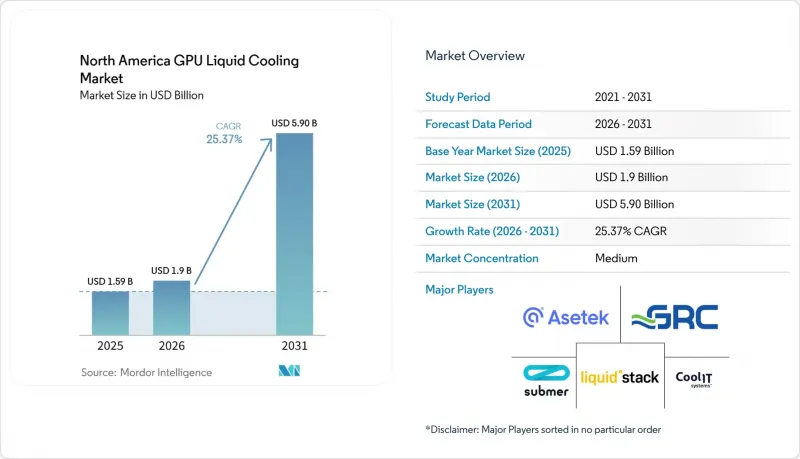
본 보고서는 냉각 방식별(단상, 2상), 냉각 수준별(컴포넌트 수준, 서버/랙 수준), 도입 형태별(하이퍼스케일 및 클라우드, 엔터프라이즈, 정부 및 연구기관(HPC), 엣지 AI), GPU 전력 밀도별(300W 미만, 300W-700W, 700W 이상), 지역별(미국, 캐나다, 멕시코)로 분류되어 있습니다. 시장 전망은 금액(달러) 기준으로 제시되어 있습니다.
북미의 GPU 액체 냉각 시장 동향 및 인사이트
데이터센터에서의 고밀도 GPU 채택 확대
GPU의 열 설계 전력(TDP)은 북미 GPU 액체 냉각 시장에서 액체 냉각이 더 이상 프리미엄 기능이 아닌, 구조적 요건이 되는 수준에 도달했습니다. NVIDIA는 H100 SXM5가 700W로 작동한다고 발표했으며, 이로 인해 고밀도 AI 노드는 많은 시설에서 공랭식의 실질적인 상한선에 이미 근접하고 있습니다. 마이크로소프트는 2026년 4월, GB200 NVL72 랙 스케일 시스템이 최대 부하 시 약 120kW를 소비하며, Vera Rubin NVL72 플랫폼에는 공랭식 구성이 존재하지 않는다는 사실을 밝혔습니다. 이는 향후 하이엔드 GPU 시스템이 처음부터 액체 냉각을 전제로 설계되고 있음을 뒷받침하는 것입니다. 또한 NVIDIA는 기존 공랭 설계에 비해 비용 절감과 효율 향상을 목표로 하는 미국 에너지부(DOE)가 지원하는 ‘COOLERCHIPS’ 프로젝트에 대해서도 언급했습니다. 이는 공공 부문의 검증 방향이 벤더의 로드맵과 일치하고 있음을 보여줍니다. 즉, 이전 세대 GPU를 위해 이미 액체 냉각 지원 시설을 구축해 둔 운영 사업자는 Blackwell 및 Blackwell 이후 시스템을 도입하는 데 유리한 입장에 있으며, 이러한 우위가 2026년 북미 GPU 액체 냉각 시장의 조달을 가속화하고 있습니다.
고도의 열 관리가 필요한 AI 훈련 가속화
대규모 AI 훈련 클러스터에서는 GPU가 장기간에 걸쳐 지속적인 풀 부하 상태에 놓이기 때문에 북미 GPU 액체 냉각 시장에서 열적 안정성은 에너지 문제와 마찬가지로 신뢰성 문제로 대두되고 있습니다. 아마존은 2025년, 자사 독자적인 직접-투-칩(Direct-to-Chip) 방식의 폐쇄형 루프 액체 냉각 시스템이 프로토타입에서 양산까지 11개월 만에 전환되었으며, 기존 공랭식 설계에 비해 연산 성능을 12% 향상시키고 에너지 소비를 최대 46% 절감했다고 발표했습니다. 또한, 이 시스템은 순수 소비량을 늘리지 않고 밀폐 루프 내에서 냉각액을 순환시키기 때문에 미국 내 많은 지역에서 우려되는 수자원 부담 문제를 직접적으로 해결한다고 밝혔습니다. 마이크로소프트는 2026년 4월, Azure 전체에 수십만 대의 액체 냉각식 NVIDIA Grace Blackwell GPU를 1년도 채 되지 않아 도입했으며, NVIDIA Vera Rubin NVL72 시스템을 채택한 최초의 하이퍼스케일 제공업체가 되었다고 발표했습니다. 슈퍼마이크로는 2025년 5월, 자사의 DLC-2 플랫폼을 통해 데이터센터의 전력 소비를 최대 40% 절감하고 총 소유 비용을 최대 20% 낮출 수 있다고 발표했습니다. 이는 공급망이 현재 하이퍼스케일 수요에 대응할 수 있는 상용 시스템을 제공할 수 있게 되었음을 보여줍니다.
액체 냉각 인프라에 수반되는 고액의 초기 설비 투자
프로젝트의 초기 비용이 여전히 북미 GPU 액체 냉각 시장의 일부를 위축시키고 있습니다. 특히, 처음부터 액체 냉각을 전제로 설계하는 것이 아니라 기존 건물을 개조해야 하는 사업자의 경우, 이러한 경향이 두드러집니다. 액체 냉각에는 냉각액 분배 장치, 매니폴드, 배관, 콜드 플레이트, 제어 시스템 등의 추가 설비가 필요하며, 이러한 요소들로 인해 초기 예산은 동등한 공랭식 시스템에 비해 고액이 됩니다. 모듈형 열 제어 시스템에 관한 Open Compute Project의 지침에 따르면, CDU 설계에는 중복성과 향후 밀도 증가를 고려한 용량 여유가 필요하며, 이로 인해 사업자가 완전 가동 단계에 도달하기도 전에 인프라 규모가 확대될 가능성이 있습니다. 슈나이더 일렉트릭은 2026년 1월, NVIDIA GB300 NVL72 시스템의 참조 설계가 이미 랙당 최대 142kW를 지원한다고 발표했으며, 이는 하이엔드 AI 도입에 있어 현재 계획되고 있는 열 인프라의 규모를 여실히 보여줍니다. 각 벤더사는 모듈식이며 확장성이 뛰어난 CDU 플랫폼으로 이에 대응하고 있지만, 조기에 자본을 투입해야 하기 때문에 기업 및 공공 부문 구매자들의 도입은 여전히 더딘 상태이며, 이로 인해 하이퍼스케일 환경 이외의 북미 GPU 액체 냉각 시장의 확대 속도가 둔화되고 있습니다.
부문 분석
2025년, 하이퍼스케일 및 클라우드 구축은 북미 GPU 액체 냉각 시장의 64.19%를 차지했습니다. 이는 최대 규모의 클라우드 사업자의 구매력과 구축 속도를 반영한 것입니다. 아마존은 2025년, 맞춤형 설계의 직접-투-칩(Direct-to-Chip)형 폐쇄 루프 액체 냉각 시스템을 개발하여, 이를 통해 연산 성능을 12% 향상시키고 에너지 소비를 최대 46% 절감했다고 발표했습니다. 이는 하이퍼스케일 사업자들이 액체 냉각 시스템을 실험적인 것으로 취급하지 않고 표준화를 추진하고 있는 이유를 보여줍니다. 마이크로소프트는 2026년 4월, Azure 전체에 이미 수십만 대의 액체 냉각식 Grace Blackwell GPU를 도입했다고 발표했습니다. 이는 클라우드 규모에서의 도입이 현재 상업적인 속도로 진행되고 있음을 뒷받침합니다. 공급업체의 로드맵, 검증 작업, 시설 설계 선택은 많은 경우 우선 하이퍼스케일 수요를 따르기 때문에 이러한 도입 동향은 북미 전체의 GPU 액체 냉각 시장을 형성하고 있습니다. 따라서 북미 GPU 액체 냉각 업계는 여전히 전체 인프라를 ‘액체 냉각 우선’ 표준으로 전환할 수 있는 구매자들에 의해 주도되고 있습니다.
엔터프라이즈 시장은 조달 장벽이 완화되고 있는 만큼, 2031년까지 연평균 성장률(CAGR) 27.89%를 나타낼 것으로 예측되며, 가장 빠르게 성장하는 도입 부문이 될 전망입니다. 주요 변화로는 클라우드 도입을 통해 입증된 성능 데이터 덕분에 민간 사업자들의 실행 위험에 대한 인식이 점차 낮아지고 있어, 액체 냉각이 더 이상 하이퍼스케일 전용 솔루션으로만 간주되지 않는다는 점을 들 수 있습니다. 정부 및 연구 기관의 구매자들도 미국 에너지부(DOE)가 주도하는 냉각 이니셔티브를 통해 차세대 모듈형 열 관리 시스템을 지원하며, 기존 공랭식 설비보다 뛰어난 효율성을 실현하고 있다는 점에서 더 명확한 신호를 받고 있습니다. 엣지 AI는 여전히 가장 규모가 작은 도입 그룹이지만, GRC는 2025년 11월 자사의 ‘ICEraQ Nano’ 시스템이 소규모 데이터룸 및 통신 클로젯을 위해 특별히 설계되었다고 발표했습니다. 이는 북미 GPU 액체 냉각 시장이 핵심 캠퍼스에서 분산형 추론 거점으로 확대되기 시작했음을 보여줍니다.
컴포넌트 수준 냉각은 2025년에 56.27%의 점유율을 차지했으며, 북미 GPU 액체 냉각 시장에서 여전히 가장 큰 냉각 수준을 유지했습니다. 이는 콜드플레이트를 활용한 직접-투-칩(Direct-to-Chip) 설계가 전체 실의 기류 관리보다 훨씬 높은 정밀도로 최신 GPU 및 CPU의 열 프로파일에 부합하기 때문입니다. 이러한 접근 방식을 통해 냉각은 열의 대부분을 발생시키는 장치에 집중되어, 전체 실을 고비용의 냉각 모델로 강제하지 않으면서도 열 제어가 향상됩니다. Frore Systems는 2026년 5월, GPU 온도를 열 한계보다 8°C 낮게 유지함으로써 연산 처리량을 유지할 수 있다고 밝혔습니다. 이는 칩 수준의 열적 안정성이 성능 가치와 직결되는 이유를 설명해 줍니다. 온도와 실제 성능 간의 이러한 직접적인 연관성 덕분에, 랙의 전력 소비가 지속적으로 증가하는 상황에서도 구성 요소 수준의 솔루션이 주도적인 위치를 유지하고 있습니다. 북미의 GPU 액체 냉각 시장은 신규 도입 및 개조 프로젝트 모두에서 가장 명확한 로드맵을 제공하기 때문에 여전히 이러한 콜드플레이트 아키텍처에 크게 의존하고 있습니다.
서버 및 랙 수준의 냉각 시장은 연평균 성장률(CAGR) 28.23%로 확대될 것으로 예측되며, AI 시스템이 더욱 고밀도인 랙 규모 통합으로 전환됨에 따라 가장 빠르게 성장하는 냉각 수준이 되고 있습니다. 마이크로소프트는 2026년 4월, NVIDIA Vera Rubin NVL72가 공랭식 옵션이 없는 완전한 액체 냉각 플랫폼으로 설계되었다고 발표했습니다. 이는 개별 구성 요소 선정에서 더 대규모의 랙 수준 열 설계 선택으로의 전환을 촉진하는 것입니다. LiquidStack사는 2026년 5월, 자사의 GigaModular CDU 플랫폼이 최대 14MW 규모의 도입을 지원한다고 발표했습니다. 이는 각 벤더들이 단일 노드의 최적화뿐만 아니라 시스템 전체 및 멀티 랙 규모의 열 관리를 염두에 두고 제품 개발을 진행하고 있음을 반영합니다. CoolIT Systems는 2026년 2월, 자사의 제조 및 엔지니어링 역량이 4,000W를 초과하는 AI 칩과 500kW를 초과하는 서버 랙을 지원한다고 발표했습니다. 이는 대용량 유체 관리가 제품 설계의 핵심으로 자리 잡고 있음을 시사합니다. Open Compute Project의 지침에서는 CDU 시스템에 확장성과 이중화가 필요하다고 강조하고 있으며, 북미 GPU 액체 냉각 시장 전체에서 랙 수준의 조달이 더욱 전략적인 요소로 자리 잡고 있습니다.
기타 혜택 :
- 엑셀 형식 시장 예측(ME) 시트
- 3개월간의 애널리스트 지원
자주 묻는 질문
목차
제1장 서론
제2장 조사 방법
제3장 주요 요약
제4장 시장 구도
제5장 시장 규모 및 성장 예측
제6장 경쟁 구도
제7장 시장 기회 및 향후 전망
AJY 26.08.07According to Mordor Intelligence, the North America GPU liquid cooling market size is projected to expand from USD 1.59 billion in 2025 and USD 1.90 billion in 2026 to USD 5.90 billion by 2031, registering a CAGR of 25.37% between 2026 to 2031.
This report is Segmented by Cooling Type (Single-Phase, and Two-Phase), Cooling Level (Component-Level, and Server/Rack-Level), Deployment (Hyperscale/Cloud, Enterprise, Government and Research (HPC), and Edge AI), GPU Power Density (Below 300W, 300W-700W, and Above 700W), and Geography (United States, Canada, and Mexico). The Market Forecasts are Provided in Terms of Value (USD).
North America GPU Liquid Cooling Market Trends and Insights
Growing Adoption Of High-Density GPUs In Data Centers
GPU thermal design power has moved into a range where liquid cooling is now a structural requirement for the North America GPU liquid cooling market, not a premium feature. NVIDIA stated that the H100 SXM5 operated at 700W, which already placed dense AI nodes near the practical ceiling for air cooling in many facilities. Microsoft stated in April 2026 that the GB200 NVL72 rack-scale system draws around 120kW at full load and that the Vera Rubin NVL72 platform has no air-cooled configuration, which confirms that future high-end GPU systems are being designed around liquid cooling from the outset. NVIDIA also highlighted DOE-backed COOLERCHIPS work aimed at lowering cost and improving efficiency versus traditional air-cooled designs, which shows that public-sector validation is moving in the same direction as vendor roadmaps. This means operators that already built liquid-ready facilities for earlier GPU generations are now in a better position to absorb Blackwell and post-Blackwell systems, and that advantage is accelerating procurement across the North America GPU liquid cooling market in 2026.
Acceleration Of AI Training Requiring Advanced Thermal Management
Large AI training clusters place GPUs under sustained full-load conditions for long periods, and that makes thermal stability a reliability issue as much as an energy issue for the North America GPU liquid cooling market. Amazon stated in 2025 that its custom direct-to-chip closed-loop liquid cooling system moved from prototype to production in 11 months, raised compute power by 12%, and cut energy use by up to 46% against earlier air-cooled designs.Amazon also stated that the system circulates coolant in a sealed loop without increasing net water consumption, which directly addresses water sensitivity in many U.S. locations. Microsoft stated in April 2026 that it had deployed hundreds of thousands of liquid-cooled NVIDIA Grace Blackwell GPUs across Azure in under one year and had become the first hyperscale provider to power NVIDIA Vera Rubin NVL72 systems. Supermicro stated in May 2025 that its DLC-2 platform can reduce data center power use by up to 40% and lower the total cost of ownership by up to 20%, which shows the supply chain is now matching hyperscale demand with deployable commercial systems.
High Initial Capital Expenditure For Liquid Cooling Infrastructure
Upfront project cost still slows parts of the North America GPU liquid cooling market, especially where operators must retrofit older buildings instead of designing for liquid from the start. Liquid cooling requires added equipment such as coolant distribution units, manifolds, piping, cold plates, and control systems, and those layers make first-pass budgets heavier than comparable air-cooled programs. Open Compute Project guidance for modular thermal control systems also shows that CDU design needs a capacity margin for redundancy and future density growth, which can increase infrastructure scope before operators even reach full utilization. Schneider Electric stated in January 2026 that reference designs for NVIDIA GB300 NVL72 systems already support up to 142kW per rack, which illustrates the scale of thermal infrastructure now being planned into high-end AI deployments. Vendors are responding with modular and scalable CDU platforms, but the need to commit capital early still slows adoption among enterprises and public-sector buyers, which tempers the pace of the North America GPU liquid cooling market outside hyperscale environments.
Other drivers and restraints analyzed in the detailed report include:
- Energy-Efficiency Mandates Driving Liquid Cooling Adoption
- Rising Carbon-Neutral Commitments By Hyperscalers
- Limited Industry Standards For Two-Phase Coolants
For complete list of drivers and restraints, kindly check the Table Of Contents.
Segment Analysis
Hyperscale and cloud deployments captured 64.19% of the North America GPU liquid cooling market share in 2025, which reflects the spending power and build pace of the largest cloud operators. Amazon stated in 2025 that it developed a custom direct-to-chip closed-loop liquid cooling design that increased compute power by 12% and cut energy use by up to 46%, which shows why hyperscale operators are standardizing around liquid systems instead of treating them as experimental. Microsoft stated in April 2026 that it had already deployed hundreds of thousands of liquid-cooled Grace Blackwell GPUs across Azure, which confirms that cloud-scale implementation is now happening at commercial speed. These deployments shape the wider North America GPU liquid cooling market because supplier roadmaps, validation work, and facility design choices often follow hyperscale demand first. The North America GPU liquid cooling industry is therefore still being led by buyers that can move entire fleets toward a liquid-first standard.
Enterprise is projected to grow at a 27.89% CAGR through 2031, making it the fastest-growing deployment segment as procurement barriers begin to ease. The main shift is that liquid cooling is no longer viewed only as a hyperscale solution, because proven performance data from cloud deployments has started to reduce perceived execution risk for private operators. Government and research buyers are also getting clearer signals from DOE-backed cooling efforts that support next-generation modular thermal systems and better efficiency than legacy air-cooled setups. Edge AI remains the smallest deployment group, but GRC stated in November 2025 that its ICEraQ Nano system was built specifically for smaller data rooms and communications closets, which shows that the North America GPU liquid cooling market is beginning to extend beyond core campuses into distributed inference locations.
Component-level cooling held 56.27% share in 2025 and remained the largest cooling level in the North America GPU liquid cooling market because cold-plate direct-to-chip designs match the heat profile of modern GPUs and CPUs with far greater precision than room-level airflow management. This approach keeps cooling focused on the devices that generate most of the heat, which improves thermal control without forcing the entire room into a higher-cost cooling model. Frore Systems stated in May 2026 that lowering GPU temperature by 8°C below the thermal limit can help sustain compute throughput, which explains why chip-level thermal stability is directly tied to performance value. That direct link between temperature and usable performance has helped component-level solutions retain leadership even as rack power keeps climbing. The North America GPU liquid cooling market still depends heavily on these cold-plate architectures because they offer the clearest path for both greenfield and retrofit programs.
Server and rack-level cooling is projected to expand at a 28.23% CAGR, which makes it the fastest-growing cooling level as AI systems move toward denser rack-scale integration. Microsoft stated in April 2026 that NVIDIA Vera Rubin NVL72 is designed as a fully liquid-cooled platform with no air-cooled option, which supports the shift from individual component decisions to larger rack-level thermal design choices. LiquidStack stated in May 2026 that its GigaModular CDU platform supports deployments up to 14MW, which reflects how vendors are building for whole-system and multi-rack thermal management rather than single-node optimization alone. CoolIT Systems stated in February 2026 that its manufacturing and engineering work supports AI chips above 4,000W and server racks above 500kW, which signals that higher-capacity fluid management is moving to the center of product design. Open Compute Project guidance reinforces that CDU systems need scalability and redundancy, so rack-level procurement is becoming more strategic across the North America GPU liquid cooling market.
Complete Report Scope:
- By Cooling Type
- Single-Phase Liquid Cooling
- Two-Phase Liquid Cooling
- By Cooling Level
- Component-Level Cooling
- Server / Rack-Level Cooling
- By Deployment
- Hyperscale / Cloud
- Enterprise
- Government & Research (HPC)
- Edge AI
- By GPU Power Density
- Below 300W
- 300W - 700W
- Above 700W
- By Geography
- North America
- United States
- Canada
- Mexico
List of Companies Covered in this Report:
- CoolIT Systems Inc.
- Asetek Inc.
- GRC (Green Revolution Cooling)
- LiquidStack Inc.
- Submer Technologies S.L.
- Iceotope Technologies Ltd.
- Motivair Corporation
- Chilldyne Inc.
- Midas Green Technologies LLC
- Asperitas BV
- Rittal GmbH and Co. KG
- Schneider Electric SE
- Vertiv Group Corp.
- Advanced Cooling Solutions LLC
- Cooler Master Technology Inc.
- EKWB d.o.o.
- Corsair Gaming Inc.
- Noctua GmbH
- Alphacool International GmbH
- Thermaltake Technology Co. Ltd.
Additional Benefits:
- The market estimate (ME) sheet in Excel format
- 3 months of analyst support
TABLE OF CONTENTS
1 INTRODUCTION
- 1.1 Study Assumptions and Market Definition
- 1.2 Scope of the Study
2 RESEARCH METHODOLOGY
3 EXECUTIVE SUMMARY
4 MARKET LANDSCAPE
- 4.1 Market Overview
- 4.2 Market Drivers
- 4.2.1 Growing Adoption of High-Density GPUs in Data Centers
- 4.2.2 Acceleration of AI Training Requiring Advanced Thermal Management
- 4.2.3 Energy-Efficiency Mandates Driving Liquid Cooling Adoption
- 4.2.4 Rising Carbon-Neutral Commitments by Hyperscalers
- 4.2.5 Availability of Utility Incentives for Water-Saving Cooling Solutions
- 4.2.6 Emergence of GPU-Powered Edge Micro Data Centers
- 4.3 Market Restraints
- 4.3.1 High Initial Capital Expenditure for Liquid Cooling Infrastructure
- 4.3.2 Limited Industry Standards for Two-Phase Coolants
- 4.3.3 Skill Gap in Liquid Cooling Maintenance Workforce
- 4.3.4 Perceived Risk of Coolant Leakage in Mission-Critical Servers
- 4.4 Industry Value Chain Analysis
- 4.5 Impact of Macroeconomic Factors on the Market
- 4.6 Regulatory Landscape
- 4.7 Technological Outlook
- 4.8 Porter's Five Forces Analysis
- 4.8.1 Threat of New Entrants
- 4.8.2 Bargaining Power of Suppliers
- 4.8.3 Bargaining Power of Buyers
- 4.8.4 Threat of Substitutes
- 4.8.5 Competitive Rivalry
5 MARKET SIZE AND GROWTH FORECASTS (VALUE)
- 5.1 By Cooling Type
- 5.1.1 Single-Phase Liquid Cooling
- 5.1.2 Two-Phase Liquid Cooling
- 5.2 By Cooling Level
- 5.2.1 Component-Level Cooling
- 5.2.2 Server / Rack-Level Cooling
- 5.3 By Deployment
- 5.3.1 Hyperscale / Cloud
- 5.3.2 Enterprise
- 5.3.3 Government & Research (HPC)
- 5.3.4 Edge AI
- 5.4 By GPU Power Density
- 5.4.1 Below 300W
- 5.4.2 300W - 700W
- 5.4.3 Above 700W
- 5.5 By Geography
- 5.5.1 North America
- 5.5.2 United States
- 5.5.3 Canada
- 5.5.4 Mexico
6 COMPETITIVE LANDSCAPE
- 6.1 Market Concentration
- 6.2 Strategic Moves
- 6.3 Market Share Analysis
- 6.4 Company Profiles (Each profile includes: Global Level Overview, Market Level Overview, Core Segments, Financials as available, Strategic Information, Market Rank/Share, Products and Services, Recent Developments)
- 6.4.1 CoolIT Systems Inc.
- 6.4.2 Asetek Inc.
- 6.4.3 GRC (Green Revolution Cooling)
- 6.4.4 LiquidStack Inc.
- 6.4.5 Submer Technologies S.L.
- 6.4.6 Iceotope Technologies Ltd.
- 6.4.7 Motivair Corporation
- 6.4.8 Chilldyne Inc.
- 6.4.9 Midas Green Technologies LLC
- 6.4.10 Asperitas BV
- 6.4.11 Rittal GmbH and Co. KG
- 6.4.12 Schneider Electric SE
- 6.4.13 Vertiv Group Corp.
- 6.4.14 Advanced Cooling Solutions LLC
- 6.4.15 Cooler Master Technology Inc.
- 6.4.16 EKWB d.o.o.
- 6.4.17 Corsair Gaming Inc.
- 6.4.18 Noctua GmbH
- 6.4.19 Alphacool International GmbH
- 6.4.20 Thermaltake Technology Co. Ltd.
7 MARKET OPPORTUNITIES AND FUTURE OUTLOOK
- 7.1 White-Space and Unmet-Need Assessment


