|
시장보고서
상품코드
2119385
데이터센터용 D2C(Direct-to-Chip) 냉각액 : 시장 점유율 분석, 업계 동향 및 통계, 성장 예측(2026-2031년)Data Center Direct-to-Chip Cooling Fluids - Market Share Analysis, Industry Trends & Statistics, Growth Forecasts (2026 - 2031) |
||||||
 Mordor Intelligence
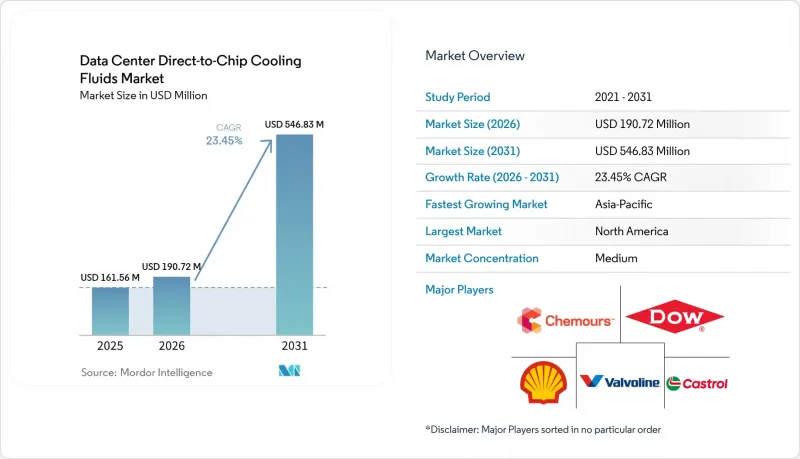
Mordor Intelligence에 의하면, 데이터센터용 D2C(Direct-to-Chip) 냉각액 시장 규모는 2025년에 1억 6,156만 달러로 평가되었습니다. 2026년 1억 9,072만 달러에서 2031년까지 5억 4,683만 달러로 예상되고 예측 기간(2026-2031년) CAGR은 23.45%를 나타낼 전망입니다.
본 보고서는 유체 유형(수성 냉각액 등), 냉각 기술(단상 D2C(Direct-to-Chip) 냉각 등), 냉각 대상 부품(CPU 냉각 등), 데이터센터 유형(하이퍼스케일 데이터센터 등) 및 지역(아시아태평양, 북미, 유럽 등)별로 세분화되어 있습니다. 시장 전망은 금액(달러) 기준으로 제시되어 있습니다.
세계의 데이터센터용 D2C(Direct-to-Chip) 냉각액 시장 동향 및 인사이트
AI 및 HPC 워크로드의 확대
AI 훈련 클러스터에서는 수천 대의 GPU가 밀접하게 연결되어 지속적인 열 부하가 발생합니다. NVIDIA의 B200 SXM6GPU는 1,000W의 열 설계 전력으로 작동하며, 8개의 GPU가 탑재된 서버의 경우 지속적인 부하 하에서 8kW 이상의 전력이 필요할 수 있습니다. NVIDIA의 지침에 따르면 B200 구성에서는 공랭식 냉각이 지원되지 않으며, 액체 냉각 인프라에 의존합니다. 이러한 요구 사항으로 인해 GPU 도입이 확대됨에 따라 데이터센터용 D2C(Direct-to-Chip) 냉각액 시장 수요가 증가하고 있습니다. AI를 활용하는 테넌트들의 D2C(Direct-to-Chip) 지원 공간에 대한 수요가 증가함에 따라, 코로케이션 사업자들은 시설 개조를 진행하고 있습니다. 사업자가 액체 냉각 지원 구역을 구축함에 따라, 주변의 레거시 장비에 대해서도 관련 냉각 시스템 업그레이드가 필요할 수 있습니다. 이 작업에는 배관 하드웨어, 모니터링 체계 및 냉각액 선정이 포함되며, 냉각액 수요는 초기 AI 서버 도입 단계를 넘어 확대되고 있습니다.
데이터센터 랙 전력 밀도의 상승
데이터센터 전문가 협회(AFCOM)의 『State of the Data Center Report 2026』에 따르면, 평균 랙 밀도는 2025년 16 kW에서 2026년에는 27 kW에 달했습니다. 20 kW를 초과하는 랙 밀도는 후면 도어 방식 열교환기나 냉각 통로 격리 방식의 실용적인 작동 범위를 초과할 가능성이 있습니다. D2C(Direct-to-Chip) 콜드 플레이트는 대규모 도입이 진행 중인 50-132 kW 랙 범위에 대응하는 경로를 제공합니다. NVIDIA GB200 NVL72 시스템은 랙 수준의 열 설계 전력(TDP)이 120 kW-132 kW에서 작동하지만, 후속 구성에서는 랙당 142 kW에 달할 것으로 예측됩니다. 이러한 작동 조건으로 인해 데이터센터용 직접 투 칩 냉각액 시장에서 냉각제 선정은 인프라 계획의 중요한 요소가 되었습니다. 또한, 이 솔루션은 처음부터 냉각수 분배를 고려하여 설계된 신규 시설에도 대응합니다. 이러한 부하를 고려한 계획에 따라 배관 경로, 냉각 분배 장치의 크기 선정 및 유지보수 프로세스가 변경됩니다. 게다가 일시적인 공랭식 업그레이드의 실용적 가치도 떨어집니다.
높은 개조 및 도입 비용
공랭식 열을 직접-투-칩(DTC) 수냉 방식으로 개조하려면 열당 5만-15만 달러의 비용이 듭니다. 냉각 분배 장치 설치, 배관 경로 설계, 매니폴드 통합 및 시운전으로 인해 프로젝트 기간이 연장됩니다. 이러한 비용은 많은 사업자가 채택하고 있는 3-4년의 갱신 주기를 초과할 가능성이 있습니다. 또한 기업용 시설에서는 직원 교육, 누출 감시 장치, 그리고 냉각액 폐기 절차도 필요합니다. 코로케이션 사업자는 AI 테넌트가 용량을 확정하기 전에 액체 냉각 지원 구역에 대한 투자를 진행해야 합니다. 이러한 시기적 문제로 인해 소규모 시설에서 데이터센터용 D2C(Direct-to-Chip) 냉각액에 대한 잠재적 수요 실현이 지연될 가능성이 있습니다. 통합에는 추가적인 계획이 필요하며, 그 기간 동안에도 공랭식 장비와 운영 절차는 그대로 유지됩니다. 또한 사업자는 전환 전에 검증된 누출 감지 및 냉각액의 호환성을 확보해야 합니다.
부문 분석
2025년, 수성 냉각액은 부문의 44.08%를 차지했습니다. 이는 글리콜-물 루프의 확고한 사용 실적과 검증된 부식 방지제의 화학 성분에 힘입은 결과입니다. OCP가 지정한 금속 및 엘라스토머와의 호환성이 조달 관행을 뒷받침했습니다. 쉘(Shell)은 2025년 6월 프로파일렌글리콜 기반의 ‘DLC Fluid S3’를 출시하며, 해당 제품이 OCP PG25의 모든 요건을 충족한다고 발표했습니다. 이 제품은 6년 이상의 유체 수명을 자랑하며, 공랭 방식에 비해 PUE를 최대 27%까지 개선할 수 있습니다. 이러한 도입 실적이 데이터센터용 D2C(Direct-to-Chip) 냉각유 시장에서 수계 배합액의 보급을 뒷받침하고 있습니다. 글리콜계 및 합성 탄화수소계 유체는 일부 설비에서 중복되는 열 요구 사항을 충족합니다. 바이오 및 특수 유체는 기업의 지속가능성 요구 사항에 좌우되지만, 여전히 제한된 선택지에 머물러 있습니다.
불소계 냉각액은 2031년까지 연평균 성장률(CAGR) 24.29%를 나타낼 것으로 예측됩니다. 이들은 잠열 전달을 통해 500 W/cm²를 초과하는 콜드 플레이트의 열유속을 가능하게 하는 2상 용도에 대응하고 있습니다. 케모어스(Chemours)의 ‘Opteon 2P50’은 2025년 Samsung Electronics에 의해 4세대 SSD(SSD)용으로 인증받았습니다. 이 인증은 다른 부품 및 시스템 개발자들에게 지침이 될 것입니다. 지구 온난화 지수(GWP)가 낮은 배합은 데이터센터용 D2C(Direct-to-Chip) 냉각액 시장에서 공급업체가 성능 요구 사항 및 규제 요건을 충족하는 데 도움이 될 수 있습니다. 그 가치는 서버 부품 및 유체 분배 장치에서의 인증 성패에 달려 있습니다. 이 과정은 공급업체가 차별화된 제품 포트폴리오를 구축하는 데 도움이 될 것입니다.
2025년 기준으로, 단상 D2C(Direct-to-Chip) 냉각은 해당 부문의 62.16%를 차지했으며, 현재도 운영 표준으로 자리 잡고 있습니다. 이 방식은 확립된 물-글리콜 혼합액의 운영 관행과 기존 냉각액 분배 시스템과의 폭넓은 호환성이라는 장점이 있습니다. 구글의 ‘프로젝트 데슈츠(Project Deschutes)’ 냉각 배액 유닛은 4세대에 걸친 텐서 처리 유닛(TPU)에 채택되어 있으며, 2020년 이후 전체 시스템 가동률이 99.99%라고 보고하고 있습니다. OCP공급수 온도 30°C 기준 또한 단상 물-글리콜계 냉각액의 운영 조건과 일치합니다. 이러한 조건은 데이터센터용 D2C(Direct-to-Chip) 냉각액에 대한 지속적인 수요를 뒷받침하고 있습니다. 사업자들은 열적 중단을 허용할 수 없는 시설을 계획할 때, 입증된 신뢰성을 중요시합니다. 또한 이 기술은 공통 냉각수 온도를 전제로 하는 신규 프로젝트에도 적합합니다.
2상식 D2C(Direct-to-Chip) 냉각은 2031년까지 연평균 성장률(CAGR) 28.08%를 나타낼 것으로 예측됩니다. 사업자들은 콜드 플레이트의 열유속이 500 W/cm²를 초과하는 플랫폼에서 이 방식의 도입을 검토하고 있습니다. 이 아키텍처는 높은 GPU 부하를 처리할 수 있지만, 증기 봉쇄, 호환 가능한 냉각 분배 장치, 그리고 안정적인 유체 성능이 필요합니다. Vertiv는 2026년 4월 Strategic Thermal Labs를 인수하며 첨단 액체 냉각 기술에 대한 지속적인 투자를 보여주었습니다. 도입은 강력한 엔지니어링 역량을 갖춘 하이퍼스케일 사이트에 계속 집중될 전망입니다. 이러한 동향은 데이터센터용 D2C(Direct-to-Chip) 냉각액 시장에 특화된 성장 경로를 창출하고 있습니다. 이 접근 방식은 단상 시스템으로는 필요한 열유속을 충족할 수 없는 경우에 가장 효과적입니다. 따라서 AI 도입 사례 중에서도 적용 범위는 좁아지겠지만, 성장세가 빠른 분야에 기여하게 될 것입니다.
지역별 분석
2025년, 북미는 데이터센터용 D2C(Direct-to-Chip) 냉각액 시장의 39.78%를 차지했습니다. 이 지역은 미국 내 하이퍼스케일 캠퍼스가 고도로 집중되어 있다는 이점이 있습니다. 또한, 북미의 하이퍼스케일 사업자들은 OCP의 냉각 사양에 크게 기여하고 있으며, 그 조달 요건은 전 세계 냉각액의 인증 기준에 영향을 미치고 있습니다. 특정 지구온난화지수(GWP)가 높은 냉매에 대한 미국 환경보호청(EPA)의 규제로 인해, 2027년 이후 글리콜계 및 지구온난화지수가 낮은 합성 유체의 재조성을 위한 투자가 촉진될 것으로 예측됩니다. 이러한 규제 환경은 장비가 가동을 시작하기 전의 유체 선정에 영향을 미치며, 배합에 관한 규정 준수 문서화의 필요성을 높일 가능성이 있습니다.
아시아태평양은 2031년까지 연평균 성장률(CAGR) 26.45%를 나타낼 것으로 예측됩니다. 중국에서는 많은 데이터센터에 전력 사용 효율(PUE)을 1.3 미만으로 유지하도록 의무화하고 있으며, 이로 인해 D2C(Direct-to-Chip) 방식 및 침지 냉각 시스템의 도입이 촉진되고 있습니다. 알리바바 클라우드, 텐센트 클라우드, 화웨이 클라우드는 국내 사업에서 이러한 효율 요건을 충족해야 합니다. Envicool과 Lingyi iTech를 비롯한 중국의 냉각 분배 장치 공급업체들은 국내 및 수출 수요에 대응하기 위해 생산량을 확대되고 있습니다. 로이터 통신은 2026년 3월, 구글이 Envicool 및 기타 중국 냉각 공급업체들과 구매에 관한 협의를 진행 중이라고 보도했습니다. 인도의 데이터센터용량은 5년 이내에 1.5GW에서 3GW, 나아가 3.5GW로 확대될 것으로 예측됩니다. 폐쇄형 루프 방식의 D2C(Direct-to-Chip) 시스템은 수자원이 제한된 도시 지역에서 증발 냉각에 따른 물 손실을 줄일 수 있습니다. 이 기능 덕분에 냉각 설계는 지역의 물 관리 우선순위와 부합하며, 랙 밀도를 넘어선 액체 루프에 대한 투자에 대한 독자적인 근거를 마련해 줍니다.
유럽 역시 데이터센터용 D2C(Direct-to-Chip) 냉각액 시장에 기여하고 있으며, 독일, 영국, 프랑스가 이 지역을 주도하고 있습니다. 독일에서는 2026년 7월 1일 이후 가동을 시작하는 데이터센터에 대해 에너지 재이용률(ERF) 10%를 의무화하고 있습니다. 이 요건은 2028년에 20%로 상향 조정될 예정이며, 온수를 이용한 D2C(Direct-to-Chip) 운영이 권장됩니다. 공급 온도 30°C-40°C 조건에서도 성능을 유지할 수 있는 공급업체는 이러한 프로젝트에서 유리한 입장에 있습니다. 남미, 중동 및 아프리카는 여전히 초기 단계에 있는 지역입니다. DataVolt사는 2025년 5월, Chemours사와 전략적 협약을 체결하고 Opteon 절연액을 활용한 액체 냉각 솔루션 개발을 추진했습니다. 이 협정은 걸프 지역 국가들의 국가 주도 AI 프로그램이 처음부터 칩 직접 냉각을 전제로 설계되었음을 시사합니다. 이러한 프로젝트는 구형 시설에서 볼 수 있는 통합상의 장벽 일부를 피할 수 있어, 설계 단계 초기에 협의에 참여하는 공급업체에게 비즈니스 기회가 될 것입니다.
기타 혜택 :
- 엑셀 형식 시장 예측(ME) 시트
- 3개월간의 애널리스트 지원
자주 묻는 질문
목차
제1장 서론
제2장 조사 방법
제3장 주요 요약
제4장 시장 구도
제5장 시장 규모 및 성장 예측
제6장 경쟁 구도
제7장 시장 기회 및 향후 전망
KTHAccording to Mordor Intelligence, the data center direct-to-chip cooling fluids market size is estimated at USD 161.56 million in 2025 and is estimated to grow from USD 190.72 million in 2026 to USD 546.83 million by 2031, at a CAGR of 23.45% during the forecast period (2026-2031).
This report is Segmented by Fluid Type (Water-Based Coolants and More), Cooling Technology (Single-Phase Direct-To-Chip Cooling and More), Component Cooled (CPU Cooling and More), Data Center Type (Hyperscale Data Centers and More), and Geography (Asia-Pacific, North America, Europe and More). The Market Forecasts are Provided in Terms of Value (USD).
Global Data Center Direct-to-Chip Cooling Fluids Market Trends and Insights
AI and HPC Workload Expansion
AI training clusters use thousands of tightly connected GPUs and generate sustained thermal loads. NVIDIA's B200 SXM6 GPU operates at a 1,000 W thermal design power, and an 8-GPU server can require more than 8 kW under sustained load. NVIDIA guidance does not support air cooling for B200 configurations, which rely on liquid-cooling infrastructure. This requirement increases demand in the data center direct-to-chip cooling fluids market as GPU installations expand. Colocation operators are adapting their facilities because AI tenants increasingly require direct-to-chip-compatible space. As operators create liquid-ready zones, surrounding legacy equipment may also require related cooling upgrades. This work includes distribution hardware, monitoring practices, and coolant selection, extending fluid demand beyond the initial AI server installation.
Rising Data Center Rack Power Density
According to the Association for Data Center Professionals (AFCOM)'s State of the Data Center Report 2026, average rack density reached 27 kW in 2026, up from 16 kW in 2025. Rack densities above 20 kW can exceed the practical operating range of rear-door heat exchangers and chilled-aisle containment. Direct-to-chip cold plates provide a pathway for the 50-132 kW rack range, which is entering large-scale deployments. NVIDIA GB200 NVL72 systems operate at 120 kW to 132 kW rack-level thermal design power, while successor configurations are projected to reach 142 kW per rack. These operating conditions make coolant selection a key part of infrastructure planning in the data center direct-to-chip cooling fluids market. They also support new facilities designed from the outset with liquid distribution in mind. Planning for these loads changes pipe routing, cooling distribution unit sizing, and maintenance processes. It also reduces the practical value of temporary air-cooling upgrades.
High Retrofit and Deployment Costs
Retrofitting an air-cooled row for direct-to-chip liquid cooling costs USD 50,000 to USD 150,000 per row. Cooling distribution unit installation, pipe routing, manifold integration, and commissioning extend project timelines. These costs can exceed the 3- to 4-year refresh cycle that many operators use. Enterprise facilities also need staff training, leak-monitoring equipment, and fluid disposal processes. Colocation operators must fund liquid-ready zones before AI tenants commit to capacity. This timing issue can delay addressable demand for data center direct-to-chip cooling fluids at smaller facilities. Integration requires additional planning, with air-cooled equipment and operating procedures remaining in place. Operators also need validated leak detection and fluid compatibility before conversion.
Other drivers and restraints analyzed in the detailed report include:
- Sustainability and Energy-Efficiency Mandates
- OCP-Compatible Coolant Standardization
- Per- and Polyfluoroalkyl Substances (PFAS) Restrictions and Two-Phase Fluid Replacement Uncertainty
For complete list of drivers and restraints, kindly check the Table Of Contents.
Segment Analysis
Water-based coolants accounted for 44.08% of the segment in 2025, supported by the established use of glycol-water loops and proven corrosion-inhibitor chemistry. Their compatibility with OCP-specified metals and elastomers supported procurement practices. Shell launched its propylene glycol-based DLC Fluid S3 in June 2025 and stated that it met all OCP PG25 requirements. The product offers a fluid life of more than six years and can improve PUE by up to 27% compared with air cooling. This installed base supports water-based formulas in the data center direct-to-chip cooling fluids market. Glycol-based and synthetic hydrocarbon fluids address overlapping thermal requirements in some installations. Bio-based and specialty fluids remain smaller options, shaped by enterprise sustainability requirements.
Fluorinated fluids are projected to record a CAGR of 24.29% through 2031. They support two-phase applications where latent heat transfer enables cold-plate heat flux above 500 W/cm2. Chemours' Opteon 2P50 was qualified by Samsung Electronics for a fourth-generation Solid-State Drive (SSD) in 2025. The qualification provides a reference point for other component and system developers. Low-global-warming-potential formulas may help suppliers address performance needs and regulatory requirements in the data center direct-to-chip cooling fluids market. Their value depends on successful qualifications across server components and fluid distribution equipment. This process can help suppliers build a differentiated product portfolio.
Single-phase direct-to-chip cooling held 62.16% of the segment in 2025 and remains the operating standard. It benefits from established water-glycol practices and broad compatibility with existing cooling distribution systems. Google's Project Deschutes cooling distribution unit has been used across four Tensor Processing Unit (TPU) generations and has reported fleet-wide availability of 99.99% since 2020. OCP's 30°C supply-temperature standard also aligns with single-phase water-glycol operating conditions. These conditions support continued demand for data center direct-to-chip cooling fluids. Operators value established reliability when planning facilities that cannot tolerate thermal interruptions. The technology also fits greenfield projects built around a common coolant temperature.
Two-phase direct-to-chip cooling is expected to grow at a CAGR of 28.08% through 2031. Operators are considering it for platforms where cold-plate heat flux exceeds 500 W/cm2. The architecture can manage high GPU loads but requires vapor containment, compatible cooling distribution units, and stable fluid performance. Vertiv acquired Strategic Thermal Labs in April 2026, indicating continued investment in advanced liquid-cooling capabilities. Deployment is likely to remain concentrated at hyperscale sites with strong engineering capacity. This trend creates a specialized growth path for the data center direct-to-chip cooling fluids market. The approach is most relevant when single-phase systems cannot meet the required heat flux. It therefore serves a narrower but faster-moving group of AI deployments.
Complete Report Scope:
- By Fluid Type
- Water-Based Fluids
- Glycol-Based Fluids
- Synthetic Hydrocarbon Fluids
- Fluorinated Fluids
- Others (Bio-Based Cooling Fluids, Specialty Fluids)
- By Cooling Technology
- Single-Phase Direct-to-Chip Cooling
- Two-Phase Direct-to-Chip Cooling
- By Component Cooled
- CPU Cooling
- GPU and AI Accelerator Cooling
- Memory and Storage Cooling
- Others (ASICs, FPGAs, Power Electronics)
- By Data Center Type
- Hyperscale Data Centers
- Colocation Data Centers
- Enterprise Data Centers
- Others (Edge Data Centers, High-Performance Computing Facilities)
- By Geography
- Asia-Pacific
- China
- India
- Japan
- South Korea
- Rest of Asia-Pacific
- North America
- United States
- Canada
- Mexico
- Europe
- Germany
- United Kingdom
- France
- Italy
- Rest of Europe
- South America
- Brazil
- Argentina
- Rest of South America
- Middle-East and Africa
- Saudi Arabia
- South Africa
- Rest of Middle-East and Africa
- Asia-Pacific
Geography Analysis
North America held 39.78% of the data center direct-to-chip cooling fluids market in 2025. The region benefits from a high concentration of U.S. hyperscale campuses. North American hyperscalers also contribute significantly to OCP cooling specifications, and their procurement requirements influence coolant qualifications worldwide. The Environmental Protection Agency (EPA) rule on certain high-global-warming-potential refrigerants is expected to spur investments in the reformulation of glycol and low-global-warming-potential synthetic fluids starting in 2027. This regulatory environment may influence fluid selection before equipment enters service and strengthen the need for documented compliance with formulations.
Asia-Pacific is forecast to expand at a CAGR of 26.45% through 2031. China requires many data centers to maintain a Power Usage Effectiveness (PUE) below 1.3, supporting the adoption of direct-to-chip and immersion systems. Alibaba Cloud, Tencent Cloud, and Huawei Cloud must meet these efficiency requirements in their domestic operations. Chinese cooling distribution unit suppliers, including Envicool and Lingyi iTech, have increased production to meet domestic and export demand. Reuters reported in March 2026 that Google was in discussions with Envicool and other Chinese cooling suppliers regarding purchases. India's capacity is projected to grow from 1.5 GW to 3 GW to 3.5 GW within five years. Closed-loop direct-to-chip systems can reduce water losses associated with evaporative cooling in water-constrained urban areas. This capability makes cooling design relevant to local water-management priorities and creates a separate rationale for liquid-loop investment beyond rack density.
Europe contributes to the data center direct-to-chip cooling fluids market, with Germany, the United Kingdom, and France leading the region. Germany's Energy Reuse Factor requirement is 10% for data centers commissioned on or after July 1, 2026. The requirement will rise to 20% in 2028, favoring warm-water direct-to-chip operation. Suppliers that maintain performance at supply temperatures of 30°C to 40°C are well positioned for these projects. South America, the Middle-East, and Africa remain early-stage regions. DataVolt signed a strategic agreement with Chemours in May 2025 to develop liquid-cooling solutions using Opteon dielectric fluids. The agreement indicates that Gulf sovereign AI programs are being designed with direct-to-chip cooling from the outset. These projects can avoid some integration barriers found in older facilities and create opportunities for suppliers that enter design discussions early.
- Arteco
- Castrol Limited
- CLARIANT
- Dober
- Dow
- Dynalene, Inc.
- Engineered Fluids
- Hydratech
- Inventec Performance Chemicals
- Kilfrost Ltd.
- LANXESS
- Lubrizol
- Recochem Corporation
- Shell plc
- The Chemours Company
- Valvoline Global Operations
Additional Benefits:
- The market estimate (ME) sheet in Excel format
- 3 months of analyst support
TABLE OF CONTENTS
1 Introduction
- 1.1 Study Assumptions and Market Definition
- 1.2 Scope of the Study
2 Research Methodology
3 Executive Summary
4 Market Landscape
- 4.1 Market Overview
- 4.2 Market Drivers
- 4.2.1 AI and HPC Workload Expansion
- 4.2.2 Rising Data Center Rack Power Density
- 4.2.3 Sustainability and Energy-Efficiency Mandates
- 4.2.4 OCP-Compatible Coolant Standardization
- 4.2.5 Warm-Water Cooling Adoption in Existing Facilities
- 4.2.6 Chip-Level Thermal Bottlenecks from Advanced Packaging
- 4.3 Market Restraints
- 4.3.1 High Retrofit and Deployment Costs
- 4.3.2 Integration Complexity in Air-Cooled Facilities
- 4.3.3 Fluid Compatibility and Leakage Risk
- 4.3.4 PFAS Restrictions and Two-Phase Fluid Replacement Uncertainty
- 4.4 Value Chain Analysis
- 4.5 Porter's Five Forces Analysis
- 4.5.1 Threat of New Entrants
- 4.5.2 Bargaining Power of Suppliers
- 4.5.3 Bargaining Power of Buyers
- 4.5.4 Threat of Substitutes
- 4.5.5 Competitive Rivalry
5 Market Size and Growth Forecasts (Value)
- 5.1 By Fluid Type
- 5.1.1 Water-Based Fluids
- 5.1.2 Glycol-Based Fluids
- 5.1.3 Synthetic Hydrocarbon Fluids
- 5.1.4 Fluorinated Fluids
- 5.1.5 Others (Bio-Based Cooling Fluids, Specialty Fluids)
- 5.2 By Cooling Technology
- 5.2.1 Single-Phase Direct-to-Chip Cooling
- 5.2.2 Two-Phase Direct-to-Chip Cooling
- 5.3 By Component Cooled
- 5.3.1 CPU Cooling
- 5.3.2 GPU and AI Accelerator Cooling
- 5.3.3 Memory and Storage Cooling
- 5.3.4 Others (ASICs, FPGAs, Power Electronics)
- 5.4 By Data Center Type
- 5.4.1 Hyperscale Data Centers
- 5.4.2 Colocation Data Centers
- 5.4.3 Enterprise Data Centers
- 5.4.4 Others (Edge Data Centers, High-Performance Computing Facilities)
- 5.5 By Geography
- 5.5.1 Asia-Pacific
- 5.5.1.1 China
- 5.5.1.2 India
- 5.5.1.3 Japan
- 5.5.1.4 South Korea
- 5.5.1.5 Rest of Asia-Pacific
- 5.5.2 North America
- 5.5.2.1 United States
- 5.5.2.2 Canada
- 5.5.2.3 Mexico
- 5.5.3 Europe
- 5.5.3.1 Germany
- 5.5.3.2 United Kingdom
- 5.5.3.3 France
- 5.5.3.4 Italy
- 5.5.3.5 Rest of Europe
- 5.5.4 South America
- 5.5.4.1 Brazil
- 5.5.4.2 Argentina
- 5.5.4.3 Rest of South America
- 5.5.5 Middle-East and Africa
- 5.5.5.1 Saudi Arabia
- 5.5.5.2 South Africa
- 5.5.5.3 Rest of Middle-East and Africa
- 5.5.1 Asia-Pacific
6 Competitive Landscape
- 6.1 Market Concentration
- 6.2 Strategic Moves
- 6.3 Market Share (%)/Ranking Analysis
- 6.4 Company Profiles (includes Global Overview, Market Overview, Core Segments, Financials as available, Strategic Information, Products and Services, and Recent Developments)
- 6.4.1 Arteco
- 6.4.2 Castrol Limited
- 6.4.3 CLARIANT
- 6.4.4 Dober
- 6.4.5 Dow
- 6.4.6 Dynalene, Inc.
- 6.4.7 Engineered Fluids
- 6.4.8 Hydratech
- 6.4.9 Inventec Performance Chemicals
- 6.4.10 Kilfrost Ltd.
- 6.4.11 LANXESS
- 6.4.12 Lubrizol
- 6.4.13 Recochem Corporation
- 6.4.14 Shell plc
- 6.4.15 The Chemours Company
- 6.4.16 Valvoline Global Operations
7 Market Opportunities and Future Outlook
- 7.1 White-Space and Unmet-Need Assessment