

|
시장보고서
상품코드
2099971
GPU 냉각 솔루션 시장 : 시장 점유율 분석, 업계 동향 및 통계, 성장 예측(2026-2031년)GPU Cooling Solutions - Market Share Analysis, Industry Trends & Statistics, Growth Forecasts (2026 - 2031) |
||||||
 Mordor Intelligence
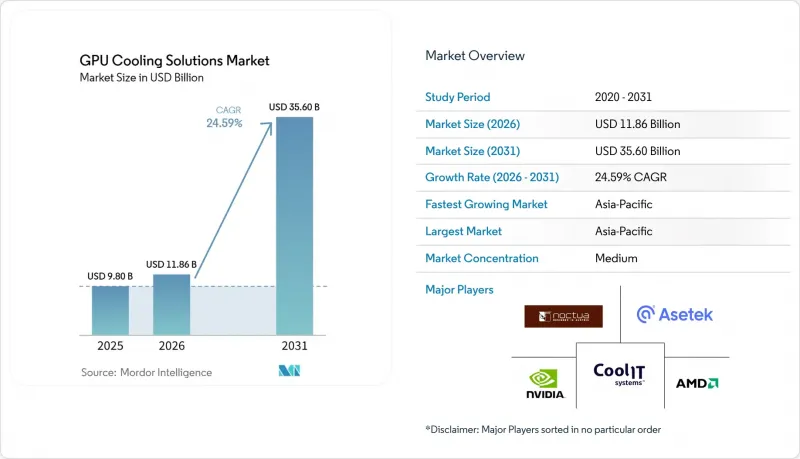
Mordor Intelligence에 의하면, GPU 냉각 솔루션 시장 규모는 2025년 98억 달러로 평가되었고, 2026년 118억 6,000만 달러에서 2031년까지 356억 달러로 확대될 것으로 예측되며, 2026-2031년 연평균 복합 성장률(CAGR)은 24.59%를 나타낼 전망입니다.
본 보고서는 냉각 기술별(공랭식, 수랭식, 침지 냉각, 하이브리드 냉각), 냉각 수준별(컴포넌트 수준 냉각, 서버 및 랙 수준 냉각), 도입 형태별(하이퍼스케일 및 클라우드, 엔터프라이즈, 정부·연구기관용 HPC, 기타), GPU 전력 밀도별(300W 미만, 300W-700W, 기타), 지역별로 분류되어 있습니다. 시장 전망은 금액(달러) 기준으로 제시되어 있습니다.
세계의 GPU 냉각 솔루션 시장 동향 및 인사이트
GPU의 전력 밀도 향상에 따라, 고도화된 열 관리가 요구되고 있습니다.
NVIDIA의 ‘Blackwell Ultra’는 디바이스당 1,400W의 TDP를 실현하며, 향후 출시될 ‘Rubin’ 시리즈는 1,950W를 목표로 하고 있어, 공랭식 방열판에서 오랫동안 가정되어 온 400W라는 상한선을 크게 상회합니다. 랙 수준의 전력 밀도는 2024년 15 kW에서 2028년까지 240 kW를 넘어설 것으로 예측되며, 기존 설비의 개조 여지는 극히 좁아지고 있어 액체 냉각은 단순한 선택지에서 필수 요건으로 변화하고 있습니다. 마이크로소프트의 750 W ‘Maia 200’ 가속기는 이미 85°C 이하를 유지하기 위해 폐쇄 루프 플레이트를 채택하고 있으며, 이러한 기술적 전환점으로 인해 금세기 말까지 공랭식은 CPU 전용이나 스토리지 분야로만 제한될 것으로 보입니다.
GPU 가속을 활용한 워크로드를 갖춘 하이퍼스케일 데이터센터의 확대
루이지애나주에 위치한 메타(Meta)의 400만 ft² 규모 ‘Hyperion’ 캠퍼스와 애틀랜타에 있는 마이크로소프트의 1 GW 규모 ‘Azure AI’ 슈퍼팩토리는 액체 냉각 랙 전용으로 설계되었으며, 2028년까지 총 1.3 GW의 GPU 용량을 제공할 예정입니다. 공공 프로그램도 이러한 추세를 반영하고 있는데, 예를 들어 캐나다의 ‘Sovereign Compute Initiative’는 2025년에 20억 캐나다 달러(14억 8,000만 달러)를 배정하고, 액체 냉각 도입을 의무화하고 있습니다. 또한, 영국의 ‘DAWN’ 업그레이드에서는 침지 냉각을 통해 PUE 1.12를 달성했습니다. 이러한 건설 프로젝트를 통해 냉각제 분배 장치, 맞춤형 플레이트 및 유전성 유체에 대한 향후 수년간 수요가 보장됩니다.
액체 냉각 및 침지 냉각 인프라에 대한 고액의 설비 투자
턴키 방식의 침지 냉각 시스템 비용은 일반적으로 1kW당 800-1,200 달러로, 이는 공랭식 시스템 비용의 약 2배에 달할 전망입니다. 또한, 직접 투 칩(Direct-to-Chip) 냉각 키트를 도입하면 서버 가격이 20%에서 40%까지 상승합니다. 이러한 높은 초기 비용에도 불구하고, 5년간의 총 소유 비용(TCO) 절감 효과는 대부분의 경우 15%를 초과합니다. 그러나 많은 중견 기업들은 합리적인 자금 조달 수단을 확보하는 데 어려움을 겪고 있습니다. 이러한 자금 조달상의 장벽으로 인해, 보다 신뢰할 수 있는 투자 회수 모델이 확립될 때까지 이러한 첨단 냉각 솔루션의 도입이 지연되고 있습니다. 그 결과, 시장 전체의 성장은 광범위한 합리적인 가격 책정 및 자금 조달 메커니즘의 부재로 인해 저해되고 있습니다.
부문 분석
2025년, 공랭식은 기존 설비를 활용할 수 있고 초기 투자 비용이 낮다는 점 때문에 그래픽 처리 장치(GPU) 냉각 솔루션 시장에서 45.50%의 점유율을 차지했습니다. 이 방법은 기존 인프라를 활용하면서 비용을 최적화하고자 하는 기업들에게 여전히 선호되는 선택지입니다. 그러나 침지 냉각 솔루션이 보급됨에 따라, 이 부문의 성장은 GPU 냉각 솔루션 시장 전체에 비해 뒤처지고 있습니다. 액침 냉각 솔루션은 핫 아일(hot aisle)을 제거하고 데이터센터의 설치 면적을 최대 60%까지 줄일 수 있다는 장점에 힘입어, 2031년까지 연평균 성장률(CAGR) 25.50%를 나타낼 것으로 예측됩니다. Submer사가 2025년 인도에서 선보인 ‘SmartPod’는 이러한 이점을 효과적으로 입증했습니다. 이러한 장점에도 불구하고, 유체 폐기에 관한 규제나 통일된 유전체 기준의 부재와 같은 과제가 여전히 보급을 저해하고 있지만, 이러한 문제를 해결하기 위한 연구 개발이 지속적으로 진행되고 있습니다.
랙 레벨 콜드 플레이트는 Open Compute Project(OCP) 랙과 원활하게 통합되며, 배관을 소수의 호스 어셈블리로 통합함으로써 설치 시간을 30% 단축할 수 있어 가장 빠르게 보급되고 있습니다. 이러한 시스템은 효율성과 최신 데이터센터 설계와의 호환성 덕분에 점점 더 많은 지지를 얻고 있습니다. CPU에는 공랭식, GPU에는 수냉식을 채택한 하이브리드 설계도 주목을 받고 있습니다. 이러한 접근 방식은 워크로드의 단계적 전환을 선호하고, 혁신과 리스크 관리의 균형을 중시하는 기업에게 매력적입니다. 이러한 하이브리드 시스템의 도입은 기업들의 신중하면서도 진보적인 전략을 반영하고 있습니다. 시장이 진화함에 따라, 이러한 솔루션들은 효율적인 GPU 냉각 기술에 대한 증가하는 수요에 대응하는 데 있어 매우 중요한 역할을 할 것으로 기대됩니다.
2025년에는 서버 및 랙 수준의 냉각이 그래픽 처리 장치(GPU) 냉각 솔루션 시장의 60.10%를 차지하며, 연평균 성장률(CAGR) 26.10%로 성장할 전망입니다. 이는 운영자들이 Open Compute Project(OCP) 랙을 준수하는 모듈식 냉각액 분배 장치를 점점 더 선호하고 있기 때문입니다. 이러한 시스템은 랙 수준의 도입을 지원하며, 데이터센터 운영자가 더 높은 열 부하를 효율적으로 관리하는 데 도움이 됩니다. 냉각수 분배 장치 1대당 최대 40대의 서버를 지원할 수 있어 비용 절감으로 이어지고, 대규모 배관 인프라의 필요성이 줄어들며, 지속적인 유지보수 부담도 경감됩니다.
서브밀리초 단위의 지연 시간이 최우선이며, 디바이스 수준에서 정밀한 열 제어가 요구되는 도입 환경에서는 여전히 컴포넌트 수준의 콜드 플레이트가 필수적입니다. Frore Systems사가 1,950W GPU용으로 설계한 플레이트와 같은 기술은 국소적인 열 최적화를 가능하게 하고, 고성능 GPU의 작동을 지원하면서 하드웨어 수명을 연장하는 데 도움이 되지만, 노드당 복잡성은 높아집니다. 장기적인 성장은 2026년 후반에 제정될 예정인 IEEE 상호운용성 표준에 달려 있습니다. 이 표준을 통해 콜드 플레이트 인터페이스에서 다중 벤더 간의 호환성이 지원되어, 이기종 혼합 인프라 환경 전반에 걸친 도입이 촉진될 가능성이 있습니다.
지역별 분석
아시아태평양은 2025년 전 세계 매출의 66.90%를 차지한 것으로 평가되었으며, 2031년까지 연평균 성장률(CAGR) 28.20%로 다른 어떤 지역보다 높은 성장세를 보일 것으로 전망되어, 이 지역이 GPU 냉각 솔루션 수요에서 주도적인 역할을 하고 있음을 입증하고 있습니다. 일본, 한국, 싱가포르의 국가 차원 AI 추진 정책에 따라, 엄격한 에너지 효율 목표를 충족해야 하는 국내 GPU 클러스터에 대한 자금 지원이 지속되고 있으며, 이로 인해 대규모 AI 인프라에서 액체 냉각이 사실상 모범 사례로 자리 잡고 있습니다. 일본의 NTT는 침지 냉각 기술을 활용해 시나가와에서 1 GW의 GPU 용량을 확보하겠다고 약속했습니다. 한편, 싱가포르의 58 MW 규모 Nxera 도입 사례에서는 습도가 높은 열대 기후 하에서 PUE 1.25의 운영이 입증되었으며, 첨단 냉각 시스템이 가혹한 기상 조건에서도 고밀도 컴퓨팅 환경을 지원할 수 있음을 보여주었습니다.
북미는 매출액 기준 2위를 차지하고 있으며, Meta Hyperion이나 마이크로소프트의 애틀랜타 슈퍼팩토리와 같은 하이퍼스케일 프로젝트에 힘입고 있습니다. 이 두 프로젝트를 합치면 2028년까지 1.5GW를 넘는 GPU 용량이 추가될 것으로 예측됩니다. 이러한 프로젝트들은 고밀도 AI 및 가속 컴퓨팅 워크로드를 지원할 수 있는 고성능 냉각 아키텍처에 대한 지역적 수요를 지속적으로 강화하고 있습니다. 캐나다의 ‘Sovereign Compute Initiative’를 비롯한 정부 주도의 노력도 수요를 더욱 끌어올리고 있지만, 콜드 플레이트와 펌프의 리드타임이 24주에 달하는 것이 공급 측면의 제약 요인으로 작용하고 있어, 이로 인해 수익 인식이 2027년 하반기로 이월될 가능성이 있습니다.
유럽은 아시아태평양이나 북미에 비해 뒤처져 있지만, 2030년까지 PUE 상한선을 1.5로 설정하고 사업자에게 보다 효율적인 열 관리를 촉진하는 ‘위임 규정 2024/1364’에 따라 계속해서 탄력을 받고 있습니다. EuroHPC의 ‘HammerHAI’와 같은 엑사스케일 프로그램은 차세대 고성능 컴퓨팅 인프라에서 액체 냉각의 역할을 강화하고 있습니다. 한편, 독일의 지역 난방에 대한 우대 조치 덕분에 사업자들은 폐열을 수익화하여 투자 수익률(ROI)을 높일 수 있게 되었습니다. 중동 및 아프리카은 여전히 발전 단계에 있지만, 아랍에미리트(UAE)와 사우디아라비아의 국가 주도 AI 프로젝트에서는 2027년 이후를 목표로 전용 시설 건설이 계획되어 있으며, 해당 지역의 AI 인프라 투자가 확대됨에 따라 추가적인 성장 가능성이 시사되고 있습니다.
기타 혜택 :
- 엑셀 형식 시장 예측(ME) 시트
- 3개월간의 애널리스트 지원
자주 묻는 질문
목차
제1장 서론
제2장 조사 방법
제3장 주요 요약
제4장 시장 구도
제5장 시장 규모 및 성장 예측
제6장 경쟁 구도
제7장 시장 기회 및 향후 전망
AJY 26.08.07According to Mordor Intelligence, the GPU cooling solutions market size is projected to expand from USD 9.80 billion in 2025 and USD 11.86 billion in 2026 to USD 35.60 billion by 2031, registering a CAGR of 24.59% between 2026 and 2031.
This report is Segmented by Cooling Technology (Air Cooling, Liquid Cooling, Immersion Cooling, and Hybrid Cooling), Cooling Level (Component-Level Cooling, and Server and Rack-Level Cooling), Deployment (Hyperscale and Cloud, Enterprise, Government and Research HPC, and More), GPU Power Density (Below 300W, 300W-700W, and More), and Geography. The Market Forecasts are Provided in Terms of Value (USD).
Global GPU Cooling Solutions Market Trends and Insights
Growing GPU Power Densities Requiring Advanced Thermal Management
NVIDIA's Blackwell Ultra pushes 1,400 W TDP per device, and the forthcoming Rubin series targets 1,950 W, eclipsing the 400 W ceiling long assumed for air-cooled heat sinks. Rack-level densities climbed from 15 kW in 2024 to projections above 240 kW by 2028, leaving retrofit windows razor-thin and turning liquid cooling from an option to a mandate. Microsoft's 750 W Maia 200 accelerator already relies on closed-loop plates to stay below 85 °C, a technical inflection likely to push air cooling into CPU-only or storage lanes by the decade's close.
Expansion of Hyperscale Data Centers with GPU-Accelerated Workloads
Meta's 4 million ft2 Hyperion campus in Louisiana and Microsoft's 1 GW Azure AI superfactory in Atlanta are purpose-built for liquid racks and will deliver a combined 1.3 GW of GPU capacity by 2028. Public programs mirror the trend, for instance, Canada's Sovereign Compute Initiative set aside CAD 2 billion (USD 1.48 billion) in 2025 with a mandate for liquid cooling, and the UK's DAWN upgrade achieved a 1.12 PUE through immersion cooling. These builds guarantee multi-year demand for coolant-distribution units, custom plates, and dielectric fluids.
High Capital Expenditure of Liquid and Immersion Cooling Infrastructure
Turnkey immersion systems typically cost between USD 800 and 1,200 per kW, which is approximately double the cost of air-cooled systems. Additionally, direct-to-chip cooling kits increase server pricing by 20% to 40%. Despite these higher upfront costs, the five-year total cost of ownership savings often exceed 15%. However, many mid-tier operators face challenges in accessing affordable financing options. This financial barrier delays the adoption of these advanced cooling solutions until more reliable payback models are established. As a result, the market's growth is hindered by the lack of widespread affordability and financing mechanisms.
Other drivers and restraints analyzed in the detailed report include:
- Increasing Adoption of Liquid Cooling in HPC and AI Clusters
- Government Energy Efficiency Regulations for Data Centers
- Compatibility Issues with Legacy Server Racks and Facility Layouts
For complete list of drivers and restraints, kindly check the Table Of Contents.
Segment Analysis
Air cooling held 45.50% of the Graphics Processing Unit (GPU) cooling solutions market share in 2025 because it leverages existing facilities and carries lower upfront capital. This method remains a preferred choice for enterprises looking to optimize costs while utilizing existing infrastructure. However, the segment's growth lags behind the overall GPU cooling solutions market as immersion solutions gain traction. Immersion solutions are projected to grow at a 25.50% CAGR through 2031, driven by their ability to eliminate hot aisles and reduce the data center footprint by up to 60%. Submer's 2025 SmartPod rollout in India demonstrated these advantages effectively. Despite these benefits, challenges such as fluid-disposal regulations and the absence of unified dielectric standards continue to hinder widespread adoption, though ongoing R&D efforts aim to address these issues.
Rack-level cold plates are expanding fastest because they integrate neatly with Open Compute Project racks and consolidate plumbing into fewer hose assemblies, slashing installation time by 30%. These systems are increasingly favored for their efficiency and compatibility with modern data center designs. Hybrid designs, which use air cooling for CPUs and liquid cooling for GPUs, are also gaining traction. This approach appeals to enterprises that prefer a phased migration of workloads, balancing innovation with risk management. The adoption of such hybrid systems reflects a cautious yet progressive strategy among enterprises. As the market evolves, these solutions are expected to play a critical role in addressing the growing demand for efficient GPU cooling technologies.
Server and rack-level cooling accounted for 60.10% of the graphics processing unit (GPU) cooling solutions market in 2025 and is poised for a 26.10% CAGR, as operators increasingly favor modular coolant distribution units that align with Open Compute Project racks. These systems support rack-level deployment and help data center operators manage higher thermal loads more efficiently. Cost savings result from serving up to 40 servers per coolant distribution unit, reducing the need for extensive plumbing infrastructure and lowering ongoing maintenance overhead.
Component-level cold plates remain vital in deployments where sub-millisecond latency is paramount and precise device-level thermal control is required. Technologies such as Frore Systems' generatively designed plates for 1,950 W GPUs enable localized thermal optimization, helping extend hardware lifespan while supporting high-performance GPU operation, although they introduce higher per-node complexity. Long-term growth depends on IEEE interoperability standards scheduled for late 2026, which may support multi-vendor interchangeability for cold-plate interfaces and improve adoption across heterogeneous infrastructure environments.
Complete Report Scope:
- By Cooling Technology
- Air Cooling
- Liquid Cooling (Direct-to-Chip)
- Immersion Cooling
- Hybrid Cooling
- By Cooling Level
- Component-Level Cooling
- Server and Rack-Level Cooling
- By Deployment
- Hyperscale and Cloud
- Enterprise
- Government and Research (HPC)
- Edge
- By GPU Power Density
- Below 300W
- 300W - 700W
- Above 700W
- By Geography
- North America
- United States
- Canada
- Mexico
- Europe
- Germany
- United Kingdom
- France
- Italy
- Rest of Europe
- Asia-Pacific
- China
- Japan
- South Korea
- India
- Southeast Asia
- Rest of Asia-Pacific
- Middle East and Africa
- North America
Geography Analysis
Asia-Pacific retained 66.90% of global revenue in 2025, and its 28.20% CAGR through 2031 outstrips every other region, underscoring the region's leading role in GPU cooling solutions demand. National AI mandates in Japan, South Korea, and Singapore continue to fund domestic GPU clusters that must satisfy strict energy-efficiency targets, effectively making liquid cooling a preferred best practice for large-scale AI infrastructure. Japan's NTT pledged 1 GW of GPU capacity at Shinagawa using immersion cooling, while Singapore's 58 MW Nxera deployment validated PUE 1.25 operation in a humid tropical climate, demonstrating that advanced cooling systems can support high-density compute environments under challenging weather conditions.
North America ranks second by revenue, supported by hyperscale projects such as Meta Hyperion and Microsoft's Atlanta superfactory, which together are expected to add over 1.5 GW of GPU capacity before 2028. These projects continue to strengthen regional demand for high-performance cooling architectures capable of supporting dense AI and accelerated computing workloads. Government initiatives, including Canada's Sovereign Compute Initiative, add another layer of demand, but 24-week lead times for cold plates and pumps remain a supply-side constraint and may defer revenue recognition into late 2027.
Europe trails Asia-Pacific and North America but continues to gain momentum under Delegated Regulation 2024/1364, which sets a PUE ceiling of 1.5 by 2030 and pushes operators toward more efficient thermal management. Exascale programs such as EuroHPC's HammerHAI reinforce liquid cooling's role in next-generation high-performance computing infrastructure, while district-heating incentives in Germany allow operators to monetize waste heat and improve return on investment. The Middle East and Africa remain nascent, though sovereign AI projects in the United Arab Emirates and Saudi Arabia are planning purpose-built facilities for 2027 and beyond, indicating potential upside as regional AI infrastructure investment scales.
- CoolIT Systems Inc.
- Asetek A/S
- Noctua GmbH
- EKWB d.o.o.
- Nvidia Corporation
- Advanced Micro Devices, Inc.
- Dell Technologies Inc.
- Hewlett Packard Enterprise Company
- Lenovo Group Limited
- Super Micro Computer, Inc.
- Corsair Gaming, Inc.
- Arctic GmbH
- ASUStek Computer Inc.
- Giga-Byte Technology Co., Ltd.
- Alphacool International GmbH
- Phanteks Company B.V.
- Thermaltake Technology Co., Ltd.
- Fujitsu Limited
- Inspur Systems Inc.
- LiquidStack Inc.
- Submer Technologies S.L.
Additional Benefits:
- The market estimate (ME) sheet in Excel format
- 3 months of analyst support
TABLE OF CONTENTS
1 INTRODUCTION
- 1.1 Study Assumptions and Market Definition
- 1.2 Scope of the Study
2 RESEARCH METHODOLOGY
3 EXECUTIVE SUMMARY
4 MARKET LANDSCAPE
- 4.1 Market Overview
- 4.2 Market Drivers
- 4.2.1 Growing GPU Power Densities Requiring Advanced Thermal Management
- 4.2.2 Expansion of Hyperscale Data Centers with GPU-Accelerated Workloads
- 4.2.3 Increasing Adoption of Liquid Cooling in HPC and AI Clusters
- 4.2.4 Government Energy Efficiency Regulations for Data Centers
- 4.2.5 Emergence of Modular Immersion Cooling Pods for Edge Micro-DCs
- 4.2.6 Integration of AI-Based Thermal Telemetry Driving Predictive Cooling Optimization
- 4.3 Market Restraints
- 4.3.1 High Capital Expenditure of Liquid and Immersion Cooling Infrastructure
- 4.3.2 Compatibility Issues with Legacy Server Racks and Facility Layouts
- 4.3.3 Limited Industry Standards for Coolant Fluids
- 4.3.4 Supply Chain Constraints for Advanced Cold Plates and Pump Components
- 4.4 Industry Value Chain Analysis
- 4.5 Regulatory Landscape
- 4.6 Technological Outlook
- 4.7 Impact of Macroeconomic Factors on the Market
- 4.8 Porter's Five Forces Analysis
- 4.8.1 Bargaining Power of Suppliers
- 4.8.2 Bargaining Power of Buyers
- 4.8.3 Threat of New Entrants
- 4.8.4 Threat of Substitutes
- 4.8.5 Competitive Rivalry
5 MARKET SIZE AND GROWTH FORECASTS (VALUE)
- 5.1 By Cooling Technology
- 5.1.1 Air Cooling
- 5.1.2 Liquid Cooling (Direct-to-Chip)
- 5.1.3 Immersion Cooling
- 5.1.4 Hybrid Cooling
- 5.2 By Cooling Level
- 5.2.1 Component-Level Cooling
- 5.2.2 Server and Rack-Level Cooling
- 5.3 By Deployment
- 5.3.1 Hyperscale and Cloud
- 5.3.2 Enterprise
- 5.3.3 Government and Research (HPC)
- 5.3.4 Edge
- 5.4 By GPU Power Density
- 5.4.1 Below 300W
- 5.4.2 300W - 700W
- 5.4.3 Above 700W
- 5.5 By Geography
- 5.5.1 North America
- 5.5.1.1 United States
- 5.5.1.2 Canada
- 5.5.1.3 Mexico
- 5.5.2 Europe
- 5.5.2.1 Germany
- 5.5.2.2 United Kingdom
- 5.5.2.3 France
- 5.5.2.4 Italy
- 5.5.2.5 Rest of Europe
- 5.5.3 Asia-Pacific
- 5.5.3.1 China
- 5.5.3.2 Japan
- 5.5.3.3 South Korea
- 5.5.3.4 India
- 5.5.3.5 Southeast Asia
- 5.5.3.6 Rest of Asia-Pacific
- 5.5.4 Middle East and Africa
- 5.5.1 North America
6 COMPETITIVE LANDSCAPE
- 6.1 Market Concentration
- 6.2 Strategic Moves
- 6.3 Market Share Analysis
- 6.4 Company Profiles (includes Global Level Overview, Market Level Overview, Core Segments, Financials as available, Strategic Information, Market Rank/Share, Products and Services, Recent Developments)
- 6.4.1 CoolIT Systems Inc.
- 6.4.2 Asetek A/S
- 6.4.3 Noctua GmbH
- 6.4.4 EKWB d.o.o.
- 6.4.5 Nvidia Corporation
- 6.4.6 Advanced Micro Devices, Inc.
- 6.4.7 Dell Technologies Inc.
- 6.4.8 Hewlett Packard Enterprise Company
- 6.4.9 Lenovo Group Limited
- 6.4.10 Super Micro Computer, Inc.
- 6.4.11 Corsair Gaming, Inc.
- 6.4.12 Arctic GmbH
- 6.4.13 ASUStek Computer Inc.
- 6.4.14 Giga-Byte Technology Co., Ltd.
- 6.4.15 Alphacool International GmbH
- 6.4.16 Phanteks Company B.V.
- 6.4.17 Thermaltake Technology Co., Ltd.
- 6.4.18 Fujitsu Limited
- 6.4.19 Inspur Systems Inc.
- 6.4.20 LiquidStack Inc.
- 6.4.21 Submer Technologies S.L.
7 MARKET OPPORTUNITIES AND FUTURE OUTLOOK
- 7.1 White-Space and Unmet-Need Assessment


