

|
시장보고서
상품코드
2099973
중국의 GPU 냉각 솔루션 시장 : 시장 점유율 분석, 업계 동향 및 통계, 성장 예측(2026-2031년)China GPU Cooling Solutions - Market Share Analysis, Industry Trends & Statistics, Growth Forecasts (2026 - 2031) |
||||||
 Mordor Intelligence
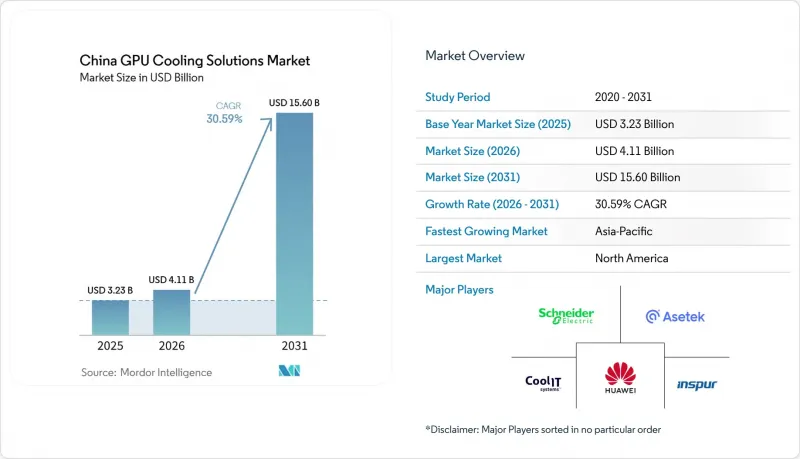
Mordor Intelligence에 의하면, 중국의 GPU 냉각 솔루션 시장 규모는 2025년에 32억 3,000만 달러로 평가되었고, 2026년 41억 1,000만 달러에서 2031년까지 156억 달러에 이를 것으로 예측되며, 2026-2031년 CAGR 30.59%로 성장할 전망입니다.
본 보고서는 냉각 기술별(공랭식, 수랭식, 직접 투 칩, 침지 냉각 등), 냉각 수준별(컴포넌트 수준 냉각, 서버 및 랙 수준 냉각), 도입 형태별(하이퍼스케일 및 클라우드, 엔터프라이즈, 정부·연구기관용 HPC, 엣지), GPU 전력 밀도별(300W 미만, 300W-700W, 700W 이상)로 분류되어 있습니다. 시장 전망은 금액(달러) 기준으로 제시되어 있습니다.
중국의 GPU 냉각 솔루션 시장 동향 및 인사이트
중국 하이퍼스케일 데이터센터 내 AI 클러스터의 급속한 확대
바이트댄스(ByteDance)와 VNET 간의 500메가와트 규모 코로케이션 계약 및 딥시크(DeepSeek)의 내몽골 건설 사례는 랙당 전력 소비량이 50kW를 초과하는 현 상황을 여실히 보여주고 있습니다. 이 수준에서는 열역학적으로 공기 냉각을 통한 열전달 경로를 유지하는 것이 불가능해집니다. 알리바바 클라우드의 장베이 캠퍼스에서는 침지 탱크와 풍력 발전을 결합하여 PUE를 1.09까지 낮추었으며, 액체 냉각 시스템이 에너지 목표와 ESG 목표를 모두 충족할 수 있음을 입증했습니다. 제15차 5개년 계획에서는 사업자에게 컴퓨팅 설비와 재생에너지를 병설하도록 지시하고 있으며, 이로 인해 건설 주기가 1년 미만으로 단축되었습니다. 조립식 매니폴드, 밀폐형 냉각 루프, 원격 시운전 서비스를 갖춘 공급업체들은 현재 몇 주 만에 수주를 확정하고 있으며, 중국 GPU 냉각 솔루션 시장에서 전략적 우위를 확립하고 있습니다.
국내 GPU 제조 및 생태계 현지화에 대한 정부의 우대 조치
공업정보화부는 콜드플레이트, 펌프, 열교환기에 국산 부품 사용을 인증받은 서버 제조업체에 대해 세금 환급 조치를 제공합니다. 화웨이가 2026년 3월에 발표한 'Xinghe AI Fabric 2.0' 스위치는 액체 냉각 채널을 내장하고 있어 랙의 설치 면적을 30% 줄이는 동시에 중국 내 조달을 정착시키고 있습니다. 상하이와 선전에서는 연구 기관과 부품 공급업체를 한데 모은 액체 냉각 시험 연구소가 개설되어, 프로토타입 개발 주기가 6개월에서 8주로 단축되었습니다. 이러한 조치로 인해 공급 탄력성이 확보되었으며, 2027년에 시행될 중국의 RoHS 불소 화합물 규제를 준수하기까지의 기간이 단축됩니다.
액체 냉각 및 침지 냉각 인프라에 수반되는 고액의 초기 설비 투자
터너 앤 타운젠드(Turner & Townsend)의 데이터센터 비용 지수에 따르면, 직접 투 칩(DTC) 루프의 경우 설비 투자가 15-25% 증가하고, 침지 탱크의 경우 40-60% 증가하여, 10MW 규모의 건설에는 300만-600만 달러의 추가 비용이 소요됩니다. 하이퍼스케일러 기업들은 장기 계약을 통해 이 비용을 상각하고 있지만, 시안이나 청두의 중소기업들은 업그레이드를 미루는 경우가 많습니다. 산업용 전기 요금이 0.06달러/kWh 미만인 지역에서는 침지 냉각의 투자 회수 기간이 4년 이상 걸리기 때문에 많은 사업자가 공랭식에 얽매여 있어 중국 GPU 냉각 솔루션 시장의 일부가 둔화되고 있습니다.
부문 분석
액침 냉각은 전력 사용 효율(PUE)을 1.10 미만으로 낮추려는 하이퍼스케일 데이터센터 사업자들 수요 증가에 힘입어, 냉각 기술 중 가장 높은 성장률(CAGR 25.50%)을 기록할 것으로 예측됩니다. 2025년에는 공랭식이 47.04%라는 큰 점유율을 차지할 것으로 예상되며, 이는 전력 밀도가 500와트 미만인 랙에서 공랭식이 정착된 현실을 반영합니다. 그러나 AI 워크로드 증가에 따라 랙 수준의 열 부하가 높아지고 있어, 운영 사업자들은 열 효율을 개선하고 더 높은 연산 밀도에 대응하기 위해 액체 냉각 기반의 대안을 채택하고 있습니다. 바닥 하중 제한이나 천장 높이 제약으로 인해 완전 침지 탱크의 도입이 현실적이지 않은 기존 시설(브라운필드)에서는 직접 투 칩(Direct-to-Chip) 냉각 루프에 대한 사후 도입이 점점 더 진행되고 있습니다. 베이징에서 진행된 시범 도입에서 Inspur사의 콜드 플레이트 캐비닛은 PUE 1.15를 달성하며, 기존 데이터센터 환경에서 액체 냉각의 실용성을 입증했습니다. 또한, 기업들이 시설을 전면적으로 재설계하지 않고 AI 서버를 기존 IT 인프라와 병행하여 운영하려는 방안을 모색하는 가운데, 팬월과 후면 도어형 열교환기를 결합한 하이브리드 냉각 시스템도 주목받고 있습니다.
알리바바 클라우드의 장베이(張北) 시설에서는 침지 냉각과 잉여 풍력 발전을 결합하여, 중국의 GPU 냉각 솔루션 시장에서 재생에너지가 풍부한 지역의 경쟁력을 높이고 있습니다. Sugon사의 C8000 메가와트급 침지 탱크는 국내 기업들이 고성능 컴퓨팅 및 AI 워크로드를 위해 설계된 초고밀도 냉각 아키텍처로 직접 도약할 수 있는 능력을 다시 한번 입증하고 있습니다. 공랭식은 공장 홀이나 이와 유사한 분산 환경에서의 엣지 추론 도입, 특히 GPU 전력 소비량이 300와트 미만인 경우 계속해서 유용할 것으로 예측됩니다. 그 결과, 시장 세분화는 도입 유형별로 지속될 가능성이 높습니다. 액체 냉각 기술은 고밀도 컴퓨팅과 정교한 열 관리가 필요한 새로운 AI 클러스터 도입에서 주류가 될 전망이지만, 기존 데이터센터의 대부분은 효율의 점진적인 향상에 힘입은 최적화된 공랭식 시스템에 계속 의존하게 될 것입니다.
2025년에는 서버 및 랙 레벨 루프가 59.02%의 시장 점유율을 차지한 것으로 평가되었으며, 도입의 간소화와 OEM 보증과의 호환성 덕분에 연평균 성장률(CAGR) 26.10%라는 견실한 성장이 전망됩니다. 이러한 솔루션은 운영을 효율화하고 데이터센터 냉각 시스템의 복잡성을 줄일 수 있어 주목받고 있습니다. 슈나이더 일렉트릭의 'EcoStruxure 스키드'는 매니폴드를 랙 후면에 배치하는 혁신적인 설계를 채택하여, 운영 담당자가 열(row)별로 단계적으로 액체 냉각을 도입할 수 있게 합니다. 이러한 단계적 접근 방식은 운영 유연성을 높일 뿐만 아니라, 도입 시 다운타임도 최소화합니다. 한편, 화웨이의 액체 냉각식 51.2 Tbps 스위치는 피크 밀도 성능이 뛰어나 고성능 환경에서 선호되는 선택지가 되고 있습니다. 그러나 단일 하드웨어 로드맵에 의존하고 있기 때문에 다양한 하드웨어 옵션을 원하는 운영 사업자에게는 유연성이 부족하다는 과제가 있습니다.
통신 사업자들은 향후 실리콘 전환에 따른 위험을 완화하기 위한 전략적 조치로 랙 루프를 점점 더 선호하고 있으며, 이는 중국 GPU 냉각 솔루션 시장의 중요한 요소가 되고 있습니다. 이러한 추세는 CDCC가 2025년에 실시한 조사에서 특히 두드러졌으며, 관리직의 68%가 새로운 데이터 홀에는 랙 루프를 선택할 것이라고 응답했습니다. 랙 루프는 확장성과 적응성을 갖추고 있어, 진화하는 기술적 요구에 대응할 수 있는 신뢰할 수 있는 선택지가 되고 있습니다. 그러나 AMD의 1,400와트 MI355X 출시가 임박함에 따라, 특히 최상위급 AI 훈련 시설에서 컴포넌트 수준의 콜드 플레이트로의 전환이 가속화될 것으로 예측됩니다. 이러한 콜드 플레이트는 고성능 GPU의 높은 열 출력을 관리하는 데 필수적일 가능성이 높으며, 2028년 이후 시장 역학을 서서히 변화시킬 것입니다. 이러한 예상되는 변화는 미래의 기술 발전에 대응하기 위해 사업자들이 냉각 전략의 균형을 맞출 필요가 있음을 여실히 보여줍니다.
기타 혜택 :
- 엑셀 형식 시장 예측(ME) 시트
- 3개월간의 애널리스트 지원
자주 묻는 질문
목차
제1장 서론
제2장 조사 방법
제3장 주요 요약
제4장 시장 구도
제5장 시장 규모 및 성장 예측
제6장 경쟁 구도
제7장 시장 기회 및 향후 전망
AJY 26.08.07According to Mordor Intelligence, the China GPU cooling solutions market size is expected to be USD 3.23 billion in 2025, USD 4.11 billion in 2026, and reach USD 15.60 billion by 2031, growing at a CAGR of 30.59% from 2026 to 2031.
This report is Segmented by Cooling Technology (Air Cooling, Liquid Cooling, Direct-To-Chip, Immersion Cooling, and More), Cooling Level (Component-Level Cooling, and Server and Rack-Level Cooling), Deployment (Hyperscale and Cloud, Enterprise, Government and Research HPC, and Edge), and GPU Power Density (Below 300W, 300W-700W, and Above 700W). The Market Forecasts are Provided in Terms of Value (USD).
China GPU Cooling Solutions Market Trends and Insights
Rapid Expansion of AI Clusters in Chinese Hyperscale Data Centers
ByteDance's 500 megawatt colocation deal with VNET and DeepSeek's Inner Mongolia build highlight how racks now exceed 50 kilowatts, a level that renders air paths thermodynamically untenable. Alibaba Cloud's Zhangbei campus combined immersion tanks and wind power to cut PUE to 1.09, proving liquid systems can meet both energy and ESG targets. The Fifteenth Five-Year Plan instructs operators to colocate compute with renewables, collapsing build cycles to under a year. Vendors with prefabricated manifolds, sealed coolant loops, and remote-commissioning services now close orders in weeks, giving them a strategic edge in the China GPU cooling solutions market.
Government Incentives for Domestic GPU Manufacturing and Ecosystem Localization
The Ministry of Industry and Information Technology offers tax rebates to server makers that certify local content across cold plates, pumps, and heat exchangers. Huawei's March 2026 Xinghe AI Fabric 2.0 switch features integrated liquid channels, cutting the rack footprint 30% while anchoring procurement inside China. Shanghai and Shenzhen have opened liquid-cooling test labs that pool research bodies with component suppliers, shrinking prototype loops from six months to eight weeks. These measures secure supply resilience and accelerate time-to-compliance with the 2027 China RoHS fluorocarbon cap.
High Upfront Capital Expenditure for Liquid and Immersion Cooling Infrastructure
Turner and Townsend's Data Center Cost Index shows a 15-25% capex premium for direct-to-chip loops and 40-60% for immersion tanks, adding USD 3-6 million to a 10 MW build. Hyperscalers amortize this over long contracts, but smaller firms in Xi'an or Chengdu often defer upgrades. Where industrial power falls below USD 0.06 /kWh, payback on immersion stretches past four years, locking many operators into air cooling and slowing part of the China GPU cooling solutions market.
Other drivers and restraints analyzed in the detailed report include:
- Rising GPU Thermal Design Power Exceeding 700 W in Next-Generation Accelerators
- Growing Adoption of Immersion Cooling in Cryptocurrency Mining Farms
- Limited Availability of Fluorocarbon-Free Dielectric Fluids Meeting China RoHS
For complete list of drivers and restraints, kindly check the Table Of Contents.
Segment Analysis
Immersion cooling is expected to record the fastest growth among cooling technologies, with a CAGR of 25.50%, supported by rising demand from hyperscale data center operators seeking to reduce power usage effectiveness (PUE) to below 1.10. Air cooling accounted for a substantial 47.04% share in 2025, reflecting its established deployment in racks with power densities below 500 watts. However, as AI workloads increase, rack-level heat loads are rising, prompting operators to adopt liquid-based alternatives to improve thermal efficiency and support higher computing density. Direct-to-chip cooling loops are increasingly being retrofitted in brownfield facilities where floor-loading limitations and ceiling-height constraints make full immersion tank deployment impractical. In Beijing pilot deployments, Inspur's cold-plate cabinets achieved a PUE of 1.15, demonstrating the operational viability of liquid cooling in existing data center environments. Hybrid cooling systems, which combine fan walls with rear-door heat exchangers, are also gaining traction as enterprises seek to operate AI servers alongside legacy IT infrastructure without fully redesigning their facilities.
Alibaba Cloud's Zhangbei facility combines immersion cooling with surplus wind power, strengthening the competitiveness of renewable energy-rich regions in the Chinese GPU cooling solutions market. Sugon's C8000 megawatt-scale immersion tank further demonstrates the capability of domestic players to advance directly toward ultra-dense cooling architectures designed for high-performance computing and AI workloads. Air cooling is expected to remain relevant for edge inference deployments in factory halls and similar distributed environments, particularly where GPU power consumption remains below 300 watts. As a result, the market is likely to remain segmented by deployment type. Liquid cooling technologies are expected to dominate new AI cluster installations that require high-density computing and advanced thermal management, while a large base of legacy data centers will continue to rely on optimized air cooling systems supported by incremental efficiency upgrades.
In 2025, server and rack-level loops commanded a 59.02% market share and are projected to grow at a robust 26.10% CAGR, thanks to their simplified deployment and alignment with OEM warranties. These solutions are gaining traction due to their ability to streamline operations and reduce complexities in data center cooling systems. Schneider Electric's EcoStruxure skid introduces an innovative design by positioning manifolds at the rear of the rack, allowing operators to phase in liquid cooling row by row. This phased approach not only enhances operational flexibility but also minimizes downtime during implementation. On the other hand, Huawei's liquid-cooled 51.2 Tbps switch excels in delivering peak density performance, making it a preferred choice for high-performance environments. However, its reliance on a single hardware roadmap limits flexibility for operators seeking diverse hardware options.
Operators are increasingly favoring rack loops as a strategic measure to mitigate risks associated with future silicon transitions, a critical factor in the Chinese GPU cooling solutions market. This preference is particularly evident in a 2025 survey conducted by CDCC, where 68% of managers indicated their choice of rack loops for new data halls. Rack loops offer scalability and adaptability, making them a reliable option for evolving technological demands. However, the impending release of AMD's 1,400-watt MI355X is expected to drive a shift towards component-level cold plates, especially for top-tier AI training facilities. These cold plates are likely to become essential for managing the high thermal output of advanced GPUs, gradually altering the market dynamics after 2028. This anticipated shift underscores the need for operators to balance their cooling strategies to accommodate future advancements.
Complete Report Scope:
- By Cooling Technology
- Air Cooling
- Liquid Cooling (Direct-to-Chip)
- Immersion Cooling
- Hybrid Cooling
- By Cooling Level
- Component-Level Cooling
- Server and Rack-Level Cooling
- By Deployment
- Hyperscale and Cloud
- Enterprise
- Government and Research (HPC)
- Edge
- By GPU Power Density
- Below 300W
- 300W - 700W
- Above 700W
List of Companies Covered in this Report:
- Asetek A/S
- CoolIT Systems Inc.
- Schneider Electric SE
- Inspur Electronic Information Industry Co., Ltd.
- Lenovo Group Limited
- Huawei Technologies Co., Ltd.
- Alibaba Cloud (Alibaba Group Holding Limited)
- Tencent Cloud Computing (Beijing) Co., Ltd.
- Sugon Information Industry Co., Ltd.
- GRC (Green Revolution Cooling, Inc.)
- Submer Technologies SL
- Nautilus Data Technologies, Inc.
- Iceotope Technologies Ltd.
- Haier Smart Home Co., Ltd.
- Chilldyne Inc.
- Asperitas BV
- Midea Group Co., Ltd.
- Vertiv Holdings Co.
- Delta Electronics, Inc.
- Fujitsu Limited
Additional Benefits:
- The market estimate (ME) sheet in Excel format
- 3 months of analyst support
TABLE OF CONTENTS
1 INTRODUCTION
- 1.1 Study Assumptions and Market Definition
- 1.2 Scope of the Study
2 RESEARCH METHODOLOGY
3 EXECUTIVE SUMMARY
4 MARKET LANDSCAPE
- 4.1 Market Overview
- 4.2 Market Drivers
- 4.2.1 Rapid Expansion of AI Clusters in Chinese Hyperscale Data Centers
- 4.2.2 Government Incentives for Domestic GPU Manufacturing and Ecosystem Localization
- 4.2.3 Rising GPU Thermal Design Power Exceeding 700W in Next-Gen Accelerators
- 4.2.4 Growing Adoption of Immersion Cooling in Cryptocurrency Mining Farms
- 4.2.5 Deployment of Edge Inference Nodes in Smart Manufacturing Zones
- 4.2.6 Integration of Waste-Heat Recovery for District Heating in Northern China
- 4.3 Market Restraints
- 4.3.1 High Upfront Capital Expenditure for Liquid and Immersion Cooling Infrastructure
- 4.3.2 Limited Availability of Fluorocarbon-Free Dielectric Fluids Meeting China RoHS
- 4.3.3 Talent Shortage in Liquid Cooling System Design and Maintenance
- 4.3.4 Grid Water Usage Regulations in Water-Stressed Northern Provinces
- 4.4 Industry Value Chain Analysis
- 4.5 Regulatory Landscape
- 4.6 Technological Outlook
- 4.7 Impact of Macroeconomic Factors on the Market
- 4.8 Porter's Five Forces Analysis
- 4.8.1 Threat of New Entrants
- 4.8.2 Bargaining Power of Suppliers
- 4.8.3 Bargaining Power of Buyers
- 4.8.4 Threat of Substitutes
- 4.8.5 Competitive Rivalry
5 MARKET SIZE AND GROWTH FORECASTS (VALUE)
- 5.1 By Cooling Technology
- 5.1.1 Air Cooling
- 5.1.2 Liquid Cooling (Direct-to-Chip)
- 5.1.3 Immersion Cooling
- 5.1.4 Hybrid Cooling
- 5.2 By Cooling Level
- 5.2.1 Component-Level Cooling
- 5.2.2 Server and Rack-Level Cooling
- 5.3 By Deployment
- 5.3.1 Hyperscale and Cloud
- 5.3.2 Enterprise
- 5.3.3 Government and Research (HPC)
- 5.3.4 Edge
- 5.4 By GPU Power Density
- 5.4.1 Below 300W
- 5.4.2 300W - 700W
- 5.4.3 Above 700W
6 COMPETITIVE LANDSCAPE
- 6.1 Market Concentration
- 6.2 Strategic Moves
- 6.3 Market Share Analysis
- 6.4 Company Profiles (includes Global Level Overview, Market Level Overview, Core Segments, Financials as available, Strategic Information, Market Rank/Share, Products and Services, Recent Developments)
- 6.4.1 Asetek A/S
- 6.4.2 CoolIT Systems Inc.
- 6.4.3 Schneider Electric SE
- 6.4.4 Inspur Electronic Information Industry Co., Ltd.
- 6.4.5 Lenovo Group Limited
- 6.4.6 Huawei Technologies Co., Ltd.
- 6.4.7 Alibaba Cloud (Alibaba Group Holding Limited)
- 6.4.8 Tencent Cloud Computing (Beijing) Co., Ltd.
- 6.4.9 Sugon Information Industry Co., Ltd.
- 6.4.10 GRC (Green Revolution Cooling, Inc.)
- 6.4.11 Submer Technologies SL
- 6.4.12 Nautilus Data Technologies, Inc.
- 6.4.13 Iceotope Technologies Ltd.
- 6.4.14 Haier Smart Home Co., Ltd.
- 6.4.15 Chilldyne Inc.
- 6.4.16 Asperitas BV
- 6.4.17 Midea Group Co., Ltd.
- 6.4.18 Vertiv Holdings Co.
- 6.4.19 Delta Electronics, Inc.
- 6.4.20 Fujitsu Limited
7 MARKET OPPORTUNITIES AND FUTURE OUTLOOK
- 7.1 White-Space and Unmet-Need Assessment


