

|
시장보고서
상품코드
2121688
고성능 컴퓨팅 : 시장 점유율 분석, 업계 동향과 통계, 성장 예측(2026-2031년)High Performance Computing - Market Share Analysis, Industry Trends & Statistics, Growth Forecasts (2026 - 2031) |
||||||
 Mordor Intelligence
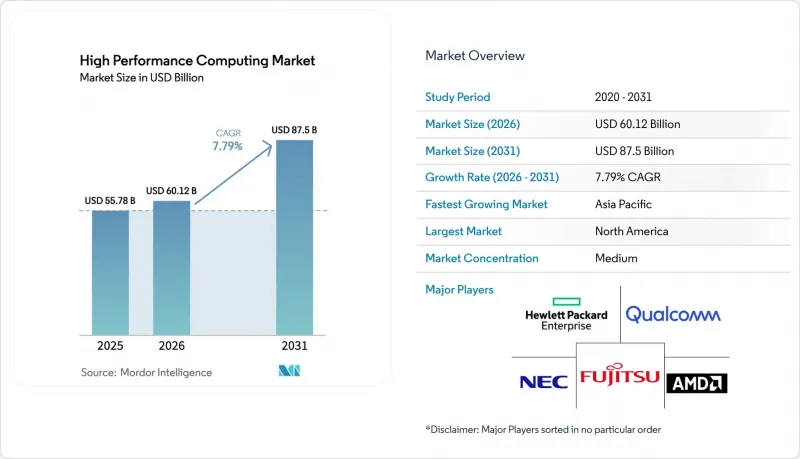
Mordor Intelligence에 따르면 고성능 컴퓨팅(HPC) 시장 규모는 2025년 557억 8,000만 달러, 2026년 601억 2,000만 달러에서 2031년까지 875억 달러로 확대될 것으로 예측되며, 2026년부터 2031년까지 연평균 성장률(CAGR)은 7.79%가 될 전망입니다.
본 보고서는 구성요소(하드웨어, 소프트웨어, 서비스), 배포 방식(온프레미스,클라우드, 하이브리드), 산업 분야(정부·국방, 학술·연구 기관, BFSI, 제조·자동차 엔지니어링 등), 칩 종류(CPU, GPU, FPGA, ASIC/AI 가속기), 그리고 지역별로 분류되어 있습니다. 시장 예측은 금액(달러) 기준으로 제시되어 있습니다.
세계 고성능 컴퓨팅 시장의 동향 및 인사이트
미국 연방 연구소 및 Tier 1 클라우드 제공업체에서 AI 및 ML 훈련 워크로드의 폭발적인 증가
연방 정부 기관은 현재 고립된 연구용 샌드박스가 아닌, 운영 중인 AI 파이프라인에 페타플롭스급 인프라를 통합하고 있습니다. 오크리지 국립연구소의 1.2 엑사플롭스급 ‘프론티어’는 배터리 화학제품 발견 주기를 18개월에서 6주로 단축하는 기반 모델을 학습시키고 있으며, 탐색적 벤치마크에서 실제 성과물로 전환되는 과정을 입증하고 있습니다. 미국 국립과학재단(NSF)의 ‘2025 제네시스 미션(2025 Genesis Mission)’은 20개 대학에 걸친 분산형 AI 클러스터에 8억 달러를 배정하여, 지역 내 고성능 컴퓨팅 시장 자원에 대한 접근성을 획기적으로 확대하고 있습니다. Microsoft Azure의 ND H100 v5 인스턴스는 초당 3.2테라비트의 InfiniBand 패브릭을 제공하여, 제약 기업이 리전 간 샤딩을 수행하지 않고도 1,000억 파라미터 규모의 트랜스포머를 구축할 수 있게 합니다. 연방 정부와 민간 부문의 이러한 공동 인센티브 조치로 인해 GPU 교체 주기가 가속화되면서, 1조 파라미터 규모의 워크로드에서 기존의 A100 노드는 경제적으로 구식이 되어, 희소한 HBM3e 기반 가속기에 대한 수요가 더욱 높아지고 있습니다.
아시아 제약 아웃소싱 거점에서의 GPU 가속 분자 동역학 시뮬레이션 수요 급증
중국과 인도의 계약 연구 기관(CRO)은 수천 대의 GPU를 도입하여 저분자 결합 시뮬레이션 소요 시간을 몇 주에서 몇 시간으로 단축함으로써, 유럽 및 미국의 기존 제약 기업들과의 경쟁 조건을 균등화하고 있습니다. WuXi AppTec의 5,000대의 GPU를 보유한 상하이 클러스터는 분기당 1,000만 종류의 화합물을 스크리닝하고 있으며, 그 처리량은 CPU의 40배에 달합니다. 또한, 전기 요금 보조 및 세제 혜택 덕분에 GPU 1시간당 비용은 북미 연구소에 비해 약 60% 저렴합니다. 인도의 PARAM Rudra사는 2025년 연산 예산의 3분의 1을 인도 과학산업연구위원회(CSIR) 산하 연구소에 배정하고, AlphaFold가 생성한 단백질 구조와 GPU 기반 도킹 엔진을 융합함으로써 결핵 치료제 개발을 가속화하고 있습니다. 이러한 지리적 차익 거래를 통해 제약 업계의 전임상 파이프라인은 동쪽으로 이동하고 있으며, 아시아태평양의 고성능 컴퓨팅 시장에서 장기적인 점유율이 더욱 공고해지고 있습니다.
가뭄에 취약한 미국 각 주에서 데이터센터의 물 사용 제한이 강화되고 있습니다.
현재 물 부족이 입지 선정의 결정적 요인이 되고 있습니다. 캘리포니아주의 산업용수 사용량 20% 감축 명령에 따라 Tier-3 시설은 건식 냉각으로의 개조를 강요받고 있으며, 이로 인해 전력 소비량이 15% 증가하고, 2025년에는 시설 1곳당 5,000만 달러의 추가 개조 비용이 발생할 것으로 예상됩니다. 애리조나주는 피닉스에서 새로운 지하수 이용 허가를 중단하고, 건설업체에 폐쇄형 루프 방식의 액체 냉각 도입 또는 프로젝트 중단을 요구하고 있습니다. 구글은 물 이용권 부족을 이유로 네바다주의 200메가와트 규모 HPC 사이트 건설을 연기하고, 비용이 더 많이 드는 공랭식 방식으로 전환했습니다. 용량은 오리건주나 워싱턴주와 같은 북부 지역으로 이동하고 있지만, 이러한 재배치로 인해 이전에는 단일 지역 내 왕복 시간이 10밀리초 미만이었던 캘리포니아주 기반 AI 스타트업의 경우 지연 시간이 증가하게 됩니다.
부문 분석
서비스 부문은 가장 빠른 성장 궤적을 기록했으며, 기업들이 수백만 달러 규모의 설비 투자에서 ‘코어 시간 단위 종량제 계약’으로 전환함에 따라 2026년부터 2031년까지 연평균 성장률(CAGR) 9.42%로 확대되었습니다. 2025년 매출에서 하드웨어가 차지하는 비중은 여전히 51.54%였지만, 서비스 분야의 고성능 컴퓨팅(HPC) 시장 규모는 2031년까지 300억 달러를 넘어설 것으로 예측되어, 지금까지의 격차가 해소될 전망입니다. 매니지드 HPC나 HPC-as-a-Service와 같은 서비스를 통해 항공우주 및 은행 업계의 고객은 5년 감가상각 주기에 자금을 묶어두지 않고도 2일간의 버스트 기간 동안 10만 코어 규모의 클러스터를 구축할 수 있게 되어, 수요가 간헐적인 경우에도 예산의 유연성을 높일 수 있습니다. 시스템 통합 프로젝트에서는 현재 애플리케이션 이식, 코드 리팩토링, 성능 튜닝이 세트로 제공되고 있으며, 특히 병렬 처리를 활용하기 위해 GPU 최적화를 통한 재작성이 필요한 레거시 Fortran이나 C 언어 커널에서 이러한 경향이 두드러집니다. 그러나 하드웨어 분야에서는 GPU 가속 지원 노드의 공급이 여전히 부족하며, 700와트짜리 장치가 랙 밀도를 120킬로와트 이상으로 끌어올리는 가운데, 칩 직결형 액체 냉각이 필수적입니다.
전문 서비스 공급업체들은 가동률 비율이 아닌, 실시간(월클럭 시간)으로 측정되는 성능 목표를 보장하는 사례가 늘어나고 있으며, 인센티브를 고객의 성과와 연계하고 있습니다. 지연 시간에 민감한 워크로드에서는 플래시 어레이가 주류를 이루는 반면, 오브젝트 리포지토리는 엑사바이트 규모의 유전체학 아카이브를 저장하고 있습니다. 상호연결 장비 판매는 비용을 중시하는 구매자의 경우 400기가비트 이더넷으로, 10일 이내에 1,000억 개의 매개변수를 가진 모델을 학습시켜야 하는 최상위급 도입의 경우 인피니밴드 NDR로 전환되고 있습니다. 소프트웨어 매출은 규모는 작지만, 작업 스케줄링, 데이터 오케스트레이션, 하이브리드 버스트 자동화를 뒷받침하고 있으며, 고성능 컴퓨팅 시장에서 클라우드 스팟 가격 및 데이터 상주 규정을 고려한 정책 주도형 배치를 가능하게 하고 있습니다. 이러한 변화들이 맞물리면서 벤더의 이익률 구조가 재편되고, 장기적인 가치 창출은 지속적인 서비스로 전환되고 있습니다.
2025년 매출에서 클라우드가 차지하는 비중은 48.88%였으나, 보안 및 비용 측면에서 하이브리드 접근 방식이 요구됨에 따라 하이브리드 배포 방식의 고성능 컴퓨팅 시장 규모가 가장 빠르게 확대되어 2031년까지 연평균 성장률(CAGR) 8.22%로 성장할 것으로 예측됩니다. 기업들은 18개월을 초과하는 지속적인 워크로드의 경우 자사 인프라에서 운영하는 것이 총 소유 비용(TCO)이 더 낮지만, 계절적 계산이나 탐색적 계산의 경우 여전히 클라우드 버스트가 유리하다는 점을 인식하고 있습니다. 밀리초 미만의 지연 시간이나 에어 갭 방식의 보안 요구 사항에 제약을 받는 국방 기관이나 고빈도 트레이더는 컨트롤 플레인을 온프레미스에 유지하면서, 업무 시간 외에는 파라미터 스윕을 퍼블릭 클라우드로 아웃소싱하고 있습니다. 슈륀베르제(Schlumberger)가 2025년에 실시한 ‘휴스턴+OCI’ 모델로의 전환은 하이브리드 환경을 통한 비용 절감 가능성을 부각시켰으며, 3년간의 예상 자본 지출에서 1억 2,000만 달러를 절감했습니다.
워크로드의 이식성이 높아짐에 따라 운영상의 복잡성이 증가하고, 1기가바이트당 0.12달러의 데이터 전송 비용으로 인해 페타바이트 규모의 데이터 이동은 경제적으로 비효율적이기 때문에 기업들은 실행 장소를 선정할 때 컴퓨팅과 데이터의 비율을 우선시하고 있습니다. IBM Spectrum LSF나 HPE Slingshot과 같은 쿠버네티스 네이티브 스케줄러는 배치를 자동화하지만, 규정 준수 담당자는 여전히 GDPR 및 업계별 규제 요건을 충족하기 위해 국경을 넘는 데이터 흐름을 면밀히 검토하고 있습니다. 이에 대응하여 클라우드 제공업체는 데이터 상주 보장이 포함된 지역 제한 HPC 구역을 제공하지만, 이러한 서비스에는 비싼 요금이 책정되어 있습니다. 하이브리드화의 급속한 확대는 궁극적으로 멀티사이트 토폴로지에 최적화된 네트워크 장비, 스토리지 게이트웨이 및 가시성 스택을 위한 고성능 컴퓨팅 시장의 틀을 완전히 새롭게 바꿀 것입니다.
지역별 분석
북미는 2025년 매출의 40.48%를 차지하고 있으며, 그 원동력은 미국 연방 정부의 35억 달러 규모의 엑사스케일 자금 지원과 AI 최적화 데이터센터에 연간 2,000억 달러 이상을 투자하는 하이퍼스케일 클라우드 사업자입니다. 캐나다의 고성능 컴퓨팅 시장 규모는 양자 어닐링 벤더인 D-Wave가 포트폴리오 최적화를 위한 10,000큐비트 시스템을 출하하고, 금융 기관을 위한 고전적 및 양자 워크플로우를 연결함으로써 확대되고 있습니다. 멕시코 시장 진출은 여전히 소규모에 그치고 있으며, 톨카에 설치된 5페타플롭스 규모의 제너럴 모터스(GM) 클러스터를 통해 근해 아웃소싱된 자동차 충돌 시뮬레이션을 처리하고 있습니다. 지리적으로는 캘리포니아주의 물 사용 제한 및 버지니아주의 데이터센터 건설 일시 중단 조치로 인해 신규 건설이 오리건주, 워싱턴주, 텍사스주로 이동하고 있으며, 그동안 실리콘밸리에 유리했던 지역 내 지연 시간 프로필이 미묘하게 재편되고 있습니다.
아시아태평양은 자국에서 개발한 엑사스케일 시스템의 도입과 국가 주도의 반도체 개발 프로그램에 힘입어 연평균 성장률(CAGR) 7.98%로 가장 빠른 성장이 예상됩니다. 중국의 ‘Sunway Oceanlight’ 및 후속 시스템은 외국 수출 규제를 회피하고, 서유럽 칩에 의존하지 않으면서도 기후 모델링 및 항공우주 설계를 가능하게 하고 있습니다. 인도의 12억 달러 규모의 ‘내셔널 슈퍼컴퓨팅 미션 2.0’은 2027년까지 각 대학 캠퍼스에 총 25페타플롭스의 연산 능력을 도입하여, 생명공학 및 기상 예보 스타트업 기업들의 접근성을 민주화할 것입니다. 일본의 ARM 기반 ‘후가쿠’는 여전히 에너지 효율의 벤치마크로 자리 잡고 있으며, 전 세계 CPU 로드맵에 영향을 미치고 있습니다. 한편, 한국에서는 반도체 공정 시뮬레이션 클러스터를 삼성의 연구개발과 연계하여 HBM 패키징을 가속화하고 있습니다. 싱가포르는 15페타플롭스 규모의 확장을 통해 자국의 국립 슈퍼컴퓨팅 센터를 제약 및 금융 분야 워크로드의 아세안(ASEAN) 허브로 자리매김하고 있습니다. 데이터 상주 요건 및 사이버 주권에 관한 법률로 인해 다국적 기업들은 국내에 클러스터를 유지해야만 하며, 그 결과 분절되어 가면서도 급속히 성장하는 지역 공급망이 형성되고 있습니다.
유럽은 2025년 전 세계 매출의 22%를 차지했습니다. EuroHPC 컨소시엄은 재료 과학 및 기후 연구를 위해 핀란드의 309 페타플롭스급 ‘LUMI’와 이탈리아의 304 페타플롭스급 ‘Leonardo’와 같은 엑사스케일급 시스템에 자금을 지원하고 있습니다. 독일의 엑사스케일 시스템 ‘JUPITER’는 NVIDIA H100 GPU와 에벤디의 BullSequana 캐비닛을 활용하여 폭스바겐의 충돌 시뮬레이션과 BASF의 촉매 설계를 지원하고 있습니다. EURO-NCAP 2030 요건은 독일, 프랑스, 이탈리아 전역에서 GPU 클러스터에 대한 구조적 수요를 지속적으로 견인하고 있습니다. 한편, 북유럽 국가들에서는 풍부한 수력발전과 무료 자연 냉각 환경 덕분에 프라이빗 클라우드 구축이 촉진되고 있습니다. GDPR(일반 데이터 보호 규정)에 따른 데이터 거주 요건은, 특히 기밀성이 높은 기록을 국경 너머로 반출할 수 없는 의료 및 금융 분야에서 온프레미스 및 하이브리드 환경의 성장을 뒷받침하고 있습니다.
남미, 중동 및 아프리카는 여전히 개발 도상 단계에 있지만, 큰 잠재력을 지니고 있습니다. 브라질의 페트로브라스는 해양 저류층 모델용으로 10페타플롭스 규모의 시스템을 운영하고 있으며, 사우디아라비아의 KAUST는 재생에너지 및 해수 담수화 연구를 위해 2024년에 15페타플롭스를 추가했습니다. 아랍에미리트는 아랍어 대규모 언어 모델 훈련 및 스마트 시티 트윈(가상 도시) 구축을 위해 8 페타플롭스 규모의 클러스터를 가동했습니다. 이스라엘의 테크니온은 사이버 보안 분석을 위해 5페타플롭스까지 확장한 반면, 남아프리카공화국의 CHPC는 광업 및 역학 연구를 위해 4페타플롭스 시스템을 유지하고 있습니다. 나이지리아의 불안정한 전력 공급이나 걸프 국가들의 심각한 물 부족과 같은 인프라 문제는 도입 비용을 상승시키고 있어, 에너지 효율에 최적화된 컨테이너형 및 모듈형 설계가 촉진되고 있습니다.
기타 혜택:
- 엑셀 형식의 시장 예측(ME) 시트
- 3개월간의 애널리스트 지원
자주 묻는 질문
목차
제1장 소개
제2장 조사 방법
제3장 주요 요약
제4장 시장 구도
제5장 시장 규모와 성장 예측(금액 기준)
제6장 경쟁 구도
제7장 시장 기회와 향후 전망
KSM 26.09.07According to Mordor Intelligence, the high performance computing market size is projected to expand from USD 55.78 billion in 2025 and USD 60.12 billion in 2026 to USD 87.5 billion by 2031, registering a CAGR of 7.79% between 2026 to 2031.
This report is Segmented by Component (Hardware, Software, and Services), Deployment Mode (On-Premise, Cloud, and Hybrid), Industrial Application (Government and Defense, Academic and Research Institutions, BFSI, Manufacturing and Automotive Engineering, and More), Chip Type (CPU, GPU, FPGA, and ASIC / AI Accelerators) and Geography. The Market Forecasts are Provided in Terms of Value (USD).
Global High Performance Computing Market Trends and Insights
The Explosion of AI and ML Training Workloads in U.S. Federal Labs and Tier-1 Cloud Providers
Federal agencies now embed petaflop-scale infrastructure into operational AI pipelines rather than isolated research sandboxes. Oak Ridge National Laboratory's 1.2-exaflop Frontier trains foundation models that compress battery-chemistry discovery cycles from 18 months to 6 weeks, validating the transition from exploratory benchmarks to real-world deliverables. The National Science Foundation's 2025 Genesis Mission earmarks USD 800 million for distributed AI clusters across 20 universities, multiplying regional access to high performance computing market resources. Microsoft Azure's ND H100 v5 instances provide 3.2-terabit-per-second InfiniBand fabrics that let pharmaceutical firms build 100-billion-parameter transformers without cross-region sharding. The combined federal-private stimulus advances GPU refresh cycles, rendering legacy A100 nodes economically obsolete for trillion-parameter workloads and tightening demand for scarce HBM3e-based accelerators.
Surging Demand for GPU-Accelerated Molecular Dynamics in Asian Pharma Outsourcing Hubs
Contract research organizations in China and India deploy thousands of GPUs to compress small-molecule binding simulations from weeks to hours, leveling the playing field against Western pharmaceutical incumbents. WuXi AppTec's 5,000-GPU Shanghai cluster screens 10 million compounds per quarter at 40-times CPU throughput, delivering cost per GPU-hour roughly 60% lower than North American labs thanks to subsidized electricity and tax holidays. India's PARAM Rudra allocates one-third of its 2025 compute budget to Council of Scientific and Industrial Research laboratories, accelerating tuberculosis drug discovery by fusing AlphaFold-generated protein structures with GPU-driven docking engines. This geographic arbitrage shifts pharmaceutical preclinical pipelines eastward, reinforcing Asia Pacific's long-run share of the high performance computing market.
Escalating Datacenter Water-Usage Restrictions in Drought-Prone U.S. States
Water scarcity now dictates site selection. California's 20% industrial-use reduction order forced Tier-3 facilities to retrofit with dry cooling that raises power draw by 15%, adding USD 50 million per site in 2025 retrofit capital. Arizona halted new groundwater permits in Phoenix, compelling builders to incorporate closed-loop liquid cooling or cancel projects. Google postponed a 200-megawatt Nevada HPC site for lack of water rights, substituting a costlier air-cooled design. Capacity shifts north toward Oregon and Washington, but that realignment increases latency for California-based AI startups that previously enjoyed single-region round-trip times below 10 milliseconds.
Other drivers and restraints analyzed in the detailed report include:
- Mandatory Automotive ADAS Simulation Compliance in EU EURO-NCAP 2030 Roadmap
- National Exascale Initiatives Driving Indigenous Processor Adoption in China and India
- Global Shortage of HBM3e Memory Constraining GPU Server Shipments 2024-26
For complete list of drivers and restraints, kindly check the Table Of Contents.
Segment Analysis
Services recorded the fastest trajectory, expanding at a 9.42% CAGR from 2026 to 2031 as enterprises transition away from multimillion-dollar capital purchases toward pay-per-core-hour contracts. Hardware still accounted for 51.54% of 2025 revenue, but the high performance computing market size for services is projected to surpass USD 30 billion by 2031, closing the historical gap. Managed HPC and HPC-as-a-Service offerings allow aerospace and banking clients to spin up 100,000-core clusters for two-day burst windows instead of locking funds into five-year depreciation cycles, improving budget agility when demand is episodic. System-integration engagements now bundle application porting, code refactoring and performance tuning, particularly for legacy Fortran or C kernels that require GPU-optimized rewrites to exploit concurrency. Within hardware, however, GPU-accelerated nodes remain supply-constrained, and direct-to-chip liquid cooling becomes mandatory as 700-watt devices push rack densities beyond 120 kilowatts.
Professional-services vendors increasingly guarantee performance targets measured in wall-clock hours, not utilization percentages, aligning incentives with customer outcomes. Flash arrays dominate latency-sensitive workloads, while object repositories store exabyte-scale genomics archives. Interconnect sales migrate to 400-gigabit Ethernet for cost-conscious buyers and to InfiniBand NDR for top-end deployments that must train 100-billion-parameter models within 10 days. Software revenue, though smaller, underpins job-scheduling, data-orchestration and hybrid-burst automation, enabling policy-driven placement that factors cloud spot pricing and data-residency rules in the HPC market. Altogether these shifts re-rank vendor margin structures and tilt long-term value capture toward recurring services.
Cloud held 48.88% of 2025 revenue, but the high performance computing market size for hybrid deployments is projected to expand fastest, growing at an 8.22% CAGR through 2031 as security and cost considerations dictate a blended approach. Enterprises discover that sustained workloads exceeding 18 months achieve lower total cost of ownership on owned infrastructure, whereas seasonal or exploratory computations still favor cloud burst. Defense agencies and high-frequency traders, constrained by sub-millisecond latency and air-gapped security mandates, keep control planes on-premise yet outsource parameter sweeps to public clouds during off-hours. Schlumberger's 2025 migration to a Houston-plus-OCI model underscores the savings potential of hybrid, trimming USD 120 million from projected three-year capital spend.
Operational complexity rises with workload portability, egress fees at USD 0.12 per gigabyte make petabyte shuffling uneconomical, so firms prioritize compute-to-data ratios when selecting execution venues. Kubernetes-native schedulers such as IBM Spectrum LSF and HPE Slingshot automate placement, but compliance officers still vet cross-border data flows to meet GDPR and sector-specific mandates. Cloud providers counter by promising region-locked HPC zones with residency guarantees, but such offerings carry premium pricing. The hybrid surge ultimately reframes the high performance computing market for networking gear, storage gateways and observability stacks tuned for multi-site topologies.
Complete Report Scope:
- By Component
- Hardware
- Servers
- General-Purpose CPU Servers
- GPU-Accelerated Servers
- ARM-Based Servers
- Storage Systems
- HDD Arrays
- Flash-Based Arrays
- Object Storage
- Interconnect and Networking
- InfiniBand
- Ethernet (25/40/100/400 GbE)
- Custom or Optical Interconnects
- Servers
- Software
- System Software (OS, Cluster Management)
- Middleware and RAS Tools
- Parallel File Systems
- Services
- Professional Services
- Managed and HPC-as-a-Service (HPCaaS)
- Hardware
- By Deployment Mode
- On-premise
- Cloud
- Hybrid
- By Chip Type (Cross-Cut with Component)
- CPU
- GPU
- FPGA
- ASIC or AI Accelerators
- By Industrial Application
- Government and Defense
- Academic and Research Institutions
- BFSI
- Manufacturing and Automotive Engineering
- Life Sciences and Healthcare
- Energy, Oil and Gas
- Other Industry Applications
- By Geography
- North America
- United States
- Canada
- Mexico
- Europe
- Germany
- United Kingdom
- France
- Italy
- Nordics (Sweden, Norway, Finland)
- Rest of Europe
- Asia Pacific
- China
- Japan
- India
- South Korea
- Singapore
- Rest of Asia Pacific
- South America
- Brazil
- Argentina
- Rest of South America
- Middle East
- Israel
- United Arab Emirates
- Saudi Arabia
- Turkey
- Rest of Middle East
- Africa
- South Africa
- Nigeria
- Rest of Africa
- North America
Geography Analysis
North America accounted for 40.48% of 2025 revenue, anchored by USD 3.5 billion in U.S. federal exascale funding and hyperscale cloud operators that annually invest more than USD 200 billion in AI-optimized datacenters. The high performance computing market size in Canada rises as quantum-annealing vendor D-Wave ships 10,000-qubit systems for portfolio optimization, bridging classical-quantum workflows for financial institutions. Mexico's entrance remains modest, serving nearshored automotive crash simulation through a 5-petaflop General Motors cluster installed in Toluca. Geographically, water-usage curbs in California and datacenter moratoriums in Virginia divert new builds to Oregon, Washington and Texas, subtly re-mapping intra-region latency profiles that historically favored Silicon Valley.
Asia Pacific is projected to grow fastest at 7.98% CAGR, powered by indigenous exascale deployments and sovereign silicon programs. China's Sunway Oceanlight and follow-on systems circumvent foreign export regimes and enable climate modeling and aerospace design without dependency on Western chips. India's USD 1.2 billion National Supercomputing Mission 2.0 will install 25 petaflops across academic campuses by 2027, democratizing access for biotech and weather-forecast startups. Japan's ARM-based Fugaku remains the energy-efficiency benchmark, influencing global CPU roadmaps, while South Korea aligns semiconductor-process simulation clusters with Samsung R&D to accelerate HBM packaging. Singapore's 15-petaflop expansion positions its national supercomputing center as an ASEAN hub for pharmaceutical and finance workloads. Data residency and cyber-sovereignty laws force multinational enterprises to maintain in-country clusters, giving rise to a fragmented yet fast-growing regional supply chain.
Europe captured 22% of 2025 global revenue. The EuroHPC Joint Undertaking funds exascale-class systems such as Finland's 309-petaflop LUMI and Italy's 304-petaflop Leonardo for materials science and climate research. Germany's JUPITER exascale machine leverages NVIDIA H100 GPUs and eviden BullSequana cabinets to support Volkswagen crash simulations and BASF catalyst design. The EURO-NCAP 2030 mandate remains a structural demand driver for GPU clusters across Germany, France and Italy, while Nordic nations attract private cloud builds thanks to abundant hydroelectric power and free ambient cooling. GDPR-induced residency obligations sustain on-premise and hybrid growth, particularly in healthcare and finance where sensitive records cannot leave national borders.
South America, the Middle East and Africa remain nascent but opportunity-rich. Brazil's Petrobras operates 10 petaflops for offshore reservoir models, and Saudi Arabia's KAUST added 15 petaflops in 2024 for renewable-energy and desalination research. The United Arab Emirates commissioned an 8-petaflop cluster for Arabic large-language-model training and smart-city twins. Israel's Technion expanded to 5 petaflops for cybersecurity analytics, whereas South Africa's CHPC maintains 4 petaflops for mining and epidemiology. Infrastructure gaps such as intermittent power in Nigeria and severe water scarcity in Gulf states elevate deployment cost, encouraging containerized or modular designs optimized for energy efficiency.
- Advanced Micro Devices
- NEC Corporation
- Fujitsu Limited
- Qualcomm Incorporated
- Hewlett Packard Enterprise
- Dell Technologies
- Lenovo Group
- IBM Corporation
- Eviden (Atos SE)
- NVIDIA Corporation
- Intel Corporation
- Penguin Computing (SMART Global)
- Inspur Group
- Huawei Technologies
- Amazon Web Services
- Microsoft Azure
- Google Cloud Platform
- Oracle Cloud Infrastructure
- Alibaba Cloud
Additional Benefits:
- The market estimate (ME) sheet in Excel format
- 3 months of analyst support
TABLE OF CONTENTS
1 INTRODUCTION
- 1.1 Study Assumptions and Market Definition
- 1.2 Scope of the Study
2 RESEARCH METHODOLOGY
3 EXECUTIVE SUMMARY
4 MARKET LANDSCAPE
- 4.1 Market Overview
- 4.2 Market Drivers
- 4.2.1 The Explosion of AI and ML Training Workloads in U.S. Federal Labs and Tier-1 Cloud Providers
- 4.2.2 Surging Demand for GPU-Accelerated Molecular Dynamics in Asian Pharma Outsourcing Hubs
- 4.2.3 Mandatory Automotive ADAS Simulation Compliance in EU EURO-NCAP 2030 Roadmap
- 4.2.4 National Exascale Initiatives Driving Indigenous Processor Adoption in China and India
- 4.2.5 Rapid Adoption of Digital Twins for Grid-Scale Battery Storage Optimization
- 4.2.6 Emergence of Quantum-Inspired Annealing Accelerators for Portfolio Optimization
- 4.3 Market Restraints
- 4.3.1 Escalating Datacenter Water-Usage Restrictions in Drought-Prone U.S. States
- 4.3.2 Ultra-Low-Latency Edge Requirements Undermining Centralized Cloud Economics
- 4.3.3 Global Shortage of HBM3e Memory Constraining GPU Server Shipments 2024-26
- 4.3.4 Cyber-Sovereignty Regulations Limiting Cross-Border HPCaaS Workloads
- 4.4 Industry Value Chain Analysis
- 4.5 Regulatory Outlook
- 4.6 Technological Outlook (Chiplets, Optical Interconnects)
- 4.7 Impact of Macroeconomic Factors on the Market
- 4.8 Porter's Five Forces Analysis
- 4.8.1 Bargaining Power of Suppliers
- 4.8.2 Bargaining Power of Buyers
- 4.8.3 Threat of New Entrants
- 4.8.4 Threat of Substitutes
- 4.8.5 Intensity of Competitive Rivalry
5 MARKET SIZE AND GROWTH FORECASTS (VALUE )
- 5.1 By Component
- 5.1.1 Hardware
- 5.1.1.1 Servers
- 5.1.1.1.1 General-Purpose CPU Servers
- 5.1.1.1.2 GPU-Accelerated Servers
- 5.1.1.1.3 ARM-Based Servers
- 5.1.1.2 Storage Systems
- 5.1.1.2.1 HDD Arrays
- 5.1.1.2.2 Flash-Based Arrays
- 5.1.1.2.3 Object Storage
- 5.1.1.3 Interconnect and Networking
- 5.1.1.3.1 InfiniBand
- 5.1.1.3.2 Ethernet (25/40/100/400 GbE)
- 5.1.1.3.3 Custom or Optical Interconnects
- 5.1.1.1 Servers
- 5.1.2 Software
- 5.1.2.1 System Software (OS, Cluster Management)
- 5.1.2.2 Middleware and RAS Tools
- 5.1.2.3 Parallel File Systems
- 5.1.3 Services
- 5.1.3.1 Professional Services
- 5.1.3.2 Managed and HPC-as-a-Service (HPCaaS)
- 5.1.1 Hardware
- 5.2 By Deployment Mode
- 5.2.1 On-premise
- 5.2.2 Cloud
- 5.2.3 Hybrid
- 5.3 By Chip Type (Cross-Cut with Component)
- 5.3.1 CPU
- 5.3.2 GPU
- 5.3.3 FPGA
- 5.3.4 ASIC or AI Accelerators
- 5.4 By Industrial Application
- 5.4.1 Government and Defense
- 5.4.2 Academic and Research Institutions
- 5.4.3 BFSI
- 5.4.4 Manufacturing and Automotive Engineering
- 5.4.5 Life Sciences and Healthcare
- 5.4.6 Energy, Oil and Gas
- 5.4.7 Other Industry Applications
- 5.5 By Geography
- 5.5.1 North America
- 5.5.1.1 United States
- 5.5.1.2 Canada
- 5.5.1.3 Mexico
- 5.5.2 Europe
- 5.5.2.1 Germany
- 5.5.2.2 United Kingdom
- 5.5.2.3 France
- 5.5.2.4 Italy
- 5.5.2.5 Nordics (Sweden, Norway, Finland)
- 5.5.2.6 Rest of Europe
- 5.5.3 Asia Pacific
- 5.5.3.1 China
- 5.5.3.2 Japan
- 5.5.3.3 India
- 5.5.3.4 South Korea
- 5.5.3.5 Singapore
- 5.5.3.6 Rest of Asia Pacific
- 5.5.4 South America
- 5.5.4.1 Brazil
- 5.5.4.2 Argentina
- 5.5.4.3 Rest of South America
- 5.5.5 Middle East
- 5.5.5.1 Israel
- 5.5.5.2 United Arab Emirates
- 5.5.5.3 Saudi Arabia
- 5.5.5.4 Turkey
- 5.5.5.5 Rest of Middle East
- 5.5.6 Africa
- 5.5.6.1 South Africa
- 5.5.6.2 Nigeria
- 5.5.6.3 Rest of Africa
- 5.5.1 North America
6 COMPETITIVE LANDSCAPE
- 6.1 Market Concentration
- 6.2 Strategic Moves
- 6.3 Market Share Analysis
- 6.4 Company Profiles (includes Global level Overview, Market level overview, Core Segments, Financials as available, Strategic Information, Market Rank or Share for key companies, Products and Services, and Recent Developments)
- 6.4.1 Advanced Micro Devices
- 6.4.2 NEC Corporation
- 6.4.3 Fujitsu Limited
- 6.4.4 Qualcomm Incorporated
- 6.4.5 Hewlett Packard Enterprise
- 6.4.6 Dell Technologies
- 6.4.7 Lenovo Group
- 6.4.8 IBM Corporation
- 6.4.9 Eviden (Atos SE)
- 6.4.10 NVIDIA Corporation
- 6.4.11 Intel Corporation
- 6.4.12 Penguin Computing (SMART Global)
- 6.4.13 Inspur Group
- 6.4.14 Huawei Technologies
- 6.4.15 Amazon Web Services
- 6.4.16 Microsoft Azure
- 6.4.17 Google Cloud Platform
- 6.4.18 Oracle Cloud Infrastructure
- 6.4.19 Alibaba Cloud
7 MARKET OPPORTUNITIES AND FUTURE OUTLOOK
- 7.1 White-space and Unmet-need Assessment


