|
시장보고서
상품코드
1683923
유럽의 국내 택배 시장 : 시장 점유율 분석, 산업 동향 및 통계, 성장 예측(2025-2030년)Europe Domestic Courier - Market Share Analysis, Industry Trends & Statistics, Growth Forecasts (2025 - 2030) |
||||||
 Mordor Intelligence
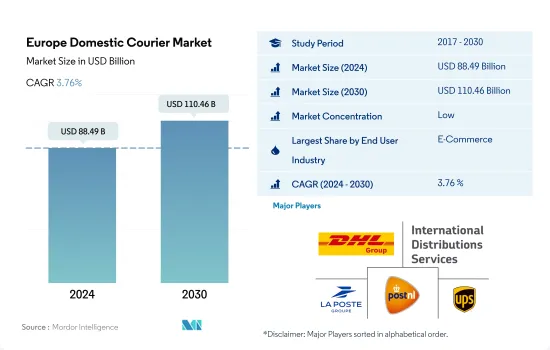
유럽의 국내 택배 시장 규모는 2024년에 884억 9,000만 달러로 평가되었고, 2030년에는 1,104억 6,000만 달러에 이를 것으로 예측되며, 예측 기간 중 2024년부터 2030년까지 CAGR 3.76%로 성장할 전망입니다.
전자상거래 회사는 고객에게 더 나은 서비스를 제공하기 위해 유럽에서 네트워크를 확장하고 있습니다.
- 소비자가 주문품의 빠르고 편리한 도착을 기대하기 때문에 국내 택배 서비스는 전자상거래 업계에서 점점 더 중요해지고 있습니다. 팬데믹은 지난 몇 년동안 쇼핑 행동에 극적인 변화를 가져왔으며 쇼핑 과정을 온라인 쇼핑으로 전환시켰습니다. 또한 전자상거래 회사는 고객에게 더 나은 서비스를 제공하기 위해 유럽에서 네트워크를 확장하고 있습니다. 예를 들어, 스페인 소매업체 DIA는 지로나에서 우엘바까지 스페인 해안선을 따라 모든 마을로 배송 서비스를 확장하여 500만 명 이상의 신규 고객을 확보하고 있습니다.
- 2022년에는 포르투갈, 터키, 폴란드가 각각 13.3%, 10.2%, 10.1%로 유럽에서 가장 매출이 증가했습니다. 2021년에는 모든 유럽 국가에서 소매 지출은 개인 소비에 차지하는 비율이 컸고, 일반적으로 30%에서 50%였습니다. 유럽에서는 독일 시장이 매출에서 가장 크고 가장 중요한 소매 시장이었습니다. 독일에 이어 유럽에서 경제 규모가 큰 것은 프랑스, 영국, 이탈리아로, 이들은 국내 택배 서비스의 주요 수요 창출국입니다.
- 의료용품 수요 증가, 의료비 증가, 보다 신속하고 효율적인 배송 서비스의 필요성 등 여러 요인들로부터 헬스케어 제품의 택배 서비스는 이 지역에서 향후 수년간 성장할 것으로 예상됩니다. 또한 2023년 이후 유럽 5개국(독일, 영국, 프랑스, 이탈리아, 스페인)의 소매 총 매출액은 유통 이전 수준에서 성장하여 시장 성장을 이끌 것으로 예상됩니다. 그 결과 유럽 국내 택배 시장은 예측 기간 동안 플러스 성장이 예상됩니다.
이탈리아의 국내 택배 수요가 CEP 성장을 가속, 매출은 22% 증가로 116억 달러를 달성
- 독일 택배업체는 2022년 크리스마스 기간에 7억 2,500만 개의 소포를 운송했습니다. B2C의 소포 운송이 가장 큰 부문으로, 3억 9,500만 개의 소포가 개인 수취인에게 배달되었습니다. 평균적으로, 피크 시에 하루에 2,000만 개, 개인 집에 800만 개를 포함하여 하루에 1,450만 개의 소포가 배달되었습니다. 독일 시장의 국내 CEP 수요는 2023년부터 2027년까지 9.36%의 비율로 예측되는 전자상거래 성장으로 증가할 것으로 예상됩니다.
- 전자상거래 분야는 프랑스 국내 택배 시장 성장의 주요 원동력이 될 것으로 예상됩니다. 2022년 프랑스 국내 택배 시장은 약 830억 달러로 평가되었고, 2027년에는 1,520억 달러에 이를 것으로 예측됩니다. 전자상거래에 대한 수요 증가는 상당한 소포 배달로 이어졌으며 프랑스 국영 우편 서비스인 La Poste 그룹에서도 2022년에는 26억 개의 소포를 배달했습니다. DHL Global Forwarding France SAS, General Logistics Systems France SA, United Parcel Services France SAS 등 프랑스 CEP 시장의 다른 주요 기업들도 크게 기여하고 있습니다.
- 이탈리아에서는 국내 배송 수요가 CEP 배송 추진에 큰 역할을 하고 있습니다. CEP의 수입도 크게 증가했으며 2020년 96억 달러에서 2021년에는 116억 달러로 22% 증가했습니다. 1인당 소포 배달도 증가했으며 2020년 21개에서 2021년 24개로 17% 증가했습니다. 그 결과 가구는 평균 55개의 소포를 받게 됩니다.
유럽의 국내 택배 시장 동향
유럽 연합(EU), 경기 회복을 뒷받침하는 135개 운송 프로젝트에 57억 6,000만 달러를 할당
- 유럽에서는 무역 및 여행 증가로 인해 운송 및 보관 부문의 GDP가 2021년 10.48% 증가했습니다. 2022년에는 약 135개의 운송 인프라 프로젝트가 총 60억 달러의 EU 보조금으로 선정되었습니다. 운송 및 보관 부문은 다양한 산업의 업무를 지원하는데 중요한 역할을 담당하고 있으며, 독일이 프랑스와 영국을 제치고 압도적인 존재로 선도하고 있습니다. 세계적으로 봐도 독일은 상품의 수출입 모두 3위입니다. 독일 연방 정부는 교통 인프라에 대한 투자를 확대할 의향을 표명했으며, 2022년에는 연방 고속도로에 120억 유로(128억 달러) 이상, 수로에 약 17억 유로(18억 1,000만 달러)를 할당, 교통망 개선에 대한 헌신을 나타냈습니다.
- 독일 정부는 도로보다 철도에 투자하려는 의향입니다. 2022년 독일 철도, 연방 정부 및 지방 정부는 철도 인프라 프로젝트에 약 136억 유로(145억 1,000만 달러)를 투자했습니다. 니더작센, 함부르크, 브레멘, 머크렌부르크-서 포메라니아, 슈레이스비히-홀슈타인은 DB와 제휴하여 2030년까지 철도망의 현대화에 투자할 전망입니다.
- 2022년 유럽 연합(EU)은 약 135개의 교통 인프라 프로젝트에 대한 보조금 54억 유로를 승인했습니다. 이 프로젝트는 EU 회원국의 대홍수 후 경제 회복을 지원하고, 교통망을 강화하며, 지속 가능한 수송을 촉진하고, 안전성을 높여, 고용 기회를 창출하는 것을 목표로 합니다. 지원되는 모든 프로젝트는 EU 회원국을 연결하는 유럽 횡단 교통 네트워크의 일부이며 2030년까지 TEN-T 코어 네트워크를 완성하고 2050년까지 종합 네트워크를 완성하는 EU의 목표에 부합합니다.
2023년 2월 이후 러시아에서 수입 금지로 중동, 아시아, 북미에서 디젤 수입이 증가하고 있습니다.
- 가솔린 가격은 2022년 1분기에 유로존 19개국 대부분의 리터당 2유로(2.13달러)를 초과했습니다. 가격 상승의 주된 이유는 러시아와 우크라이나의 분쟁으로 인한 공급 문제였으며, 러시아는 EU 석유 수요의 1/4 이상을 공급했습니다. 2021년 유로존 가솔린 1리터의 평균 가격은 1.30유로(1.38달러)였지만, 2022년 연초에는 리터당 약 1.55유로(1.65달러)였습니다.
- 러시아는 유럽에서 가장 큰 디젤 공급국입니다. 2023년 유럽에서는 디젤 가격이 하락했습니다. EU가 러시아에서 석유제품 수입 금지를 실시한 2023년 2월 이후 러시아에서 유럽으로의 디젤 수출은 평균 24,000배럴/일로, 2022년 러시아가 유럽으로 보낸 630,000배럴/일에서 96% 감소했습니다. 2월부터 5월까지 유럽용 디젤 수출은 중동에서 51%(16만b/d), 아시아에서 97%(14만 7,000b/d), 북미에서 65%(4만 7,000b/d) 증가했습니다.
- 덴마크는 가솔린 가격이 가장 높고 핀란드는 디젤 가격이 가장 높습니다. 오스트리아는 가솔린이 가장 저렴하고 스페인은 디젤이 가장 저렴합니다. 영국의 연료 가격은 2022년 과거 최고를 기록했으며, 7월 가솔린 평균 가격은 리터당 245.55달러, 디젤은 251.79달러에 달했습니다. 2023년에 들어가고 영국 주유소의 평균 가격은 리터 150페소(1.88.02달러)를 돌파했고 디젤은 리터 152.41페소(191.04달러)로 상승했습니다. 2023년 1월 스페인의 연료 가격은 영국보다 휘발유에서 리터당 약 20센트, 디젤에서 40센트 낮아졌습니다.
유럽의 국내 택배 산업 개요
유럽의 국내 택배 시장은 세분화되어 상위 5개사에서 36.18%를 차지하고 있습니다. 이 시장 주요 기업은 다음과 같습니다. DHL Group, International Distributions Services(including GLS), La Poste Group, Post NL 및 United Parcel Service of America, Inc.(UPS).
기타 혜택
- 엑셀 형식 시장 예측(ME) 시트
- 3개월의 애널리스트 서포트
목차
제1장 주요 요약 및 주요 조사 결과
제2장 보고서 제안
제3장 서문
- 조사 전제조건 및 시장 정의
- 조사 범위
- 조사 방법
제4장 주요 산업 동향
- 인구동태
- 경제 활동별 GDP 분포
- 경제 활동별 GDP 성장률
- 인플레이션율
- 경제성과 및 프로파일
- 전자상거래 산업의 동향
- 제조업의 동향
- 운수 및 보관업의 GDP
- 수출 동향
- 수입 동향
- 연료 가격
- 물류 실적
- 인프라
- 규제 프레임워크
- 중동유럽(CEE)
- 프랑스
- 독일
- 이탈리아
- 네덜란드
- 북유럽
- 러시아
- 스페인
- 스위스
- 영국
- 밸류체인 및 유통채널 분석
제5장 시장 세분화
- 배송 속도별
- 특급
- 비특급
- 출하 중량별
- 중량물 출하
- 경량물 출하
- 중중량 출하
- 최종 사용자 산업별
- 전자상거래
- 금융 서비스(BFSI)
- 헬스케어
- 제조업
- 제1차 산업
- 도매 및 소매업(오프라인)
- 기타
- 모델별
- 기업간 거래(B2B)
- 기업 대 소비자(B2C)
- 소비자간 거래(C2C)
- 국가별
- 알바니아
- 불가리아
- 크로아티아
- 체코 공화국
- 덴마크
- 에스토니아
- 핀란드
- 프랑스
- 독일
- 헝가리
- 아이슬란드
- 이탈리아
- 라트비아
- 리투아니아
- 네덜란드
- 노르웨이
- 폴란드
- 루마니아
- 러시아
- 슬로바키아 공화국
- 슬로베니아
- 스페인
- 스웨덴
- 스위스
- 영국
- 기타 유럽
제6장 경쟁 구도
- 주요 전략 동향
- 시장 점유율 분석
- 기업 상황
- 기업 프로파일
- DHL Group
- FedEx
- GEODIS
- International Distributions Services(including GLS)
- La Poste Group
- Logista
- Otto GmbH & Co. KG
- Post NL
- Poste Italiane
- United Parcel Service of America, Inc.(UPS)
제7장 CEO에 대한 주요 전략적 질문
제8장 부록
- 세계 개요
- 개요
- Porter's Five Forces 분석 프레임워크
- 세계 밸류체인 분석
- 시장 역학(DROs)
- 기술의 진보
- 정보원 및 참고문헌
- 도표 목록
- 주요 인사이트
- 데이터 팩
- 용어집
The Europe Domestic Courier Market size is estimated at 88.49 billion USD in 2024, and is expected to reach 110.46 billion USD by 2030, growing at a CAGR of 3.76% during the forecast period (2024-2030).
E-commerce companies are expanding their networks in Europe to provide better services to customers
- Domestic courier services are becoming increasingly important in the e-commerce industry as consumers expect their orders to arrive quickly and conveniently. The pandemic brought a drastic change in shopping behavior over the past years, shifting the shopping process toward online shopping. Moreover, e-commerce companies are expanding their networks in Europe to provide better services to customers. For instance, the Spanish retailer DIA is expanding its delivery services to all towns along the Spanish coastline, from Girona to Huelva, reaching more than 5 million new customers.
- In 2022, Portugal, Turkey, and Poland had the highest rise in sales in terms of volume in Europe at 13.3%, 10.2%, and 10.1%, respectively. In 2021, retail spending constituted a large proportion of private consumption in all European countries, i.e., typically between 30% and 50%. The German market in Europe was the largest and most important retail market in terms of turnover. After Germany, the largest economies in Europe were France, the United Kingdom, and Italy, the major demand generators for domestic courier services.
- Courier services for healthcare products are expected to grow in the coming years in the region due to several factors, including the increasing demand for medical supplies, rising healthcare spending, and the need for faster and more efficient delivery services. Also, From 2023 onward, it is expected that the total retail sales in Europe-5 countries (Germany, the United Kingdom, France, Italy, and Spain) will grow at pre-pandemic levels and drive the growth of the market. As a result, the European domestic courier market is expected to grow positively during the forecast period.
Italy's domestic delivery demand fuels CEP growth, revenue hits USD 11.6 billion with 22% increase
- Germany's parcel service providers moved a volume of 725 million parcels during the Christmas period in 2022. B2C parcel shipments were the largest segment, with 395 million parcels delivered to private recipients. On average, deliveries included 20 million shipments per day during peak times and 14.5 million parcels daily, including 8 million to private residences. The demand for domestic CEP in the German market is expected to increase due to the projected growth of e-commerce at a rate of 9.36% from 2023 to 2027.
- The e-commerce segment is expected to be the primary driver of growth in the French domestic courier market. In 2022, the French domestic courier market was valued at approximately USD 83 billion, and it is projected to reach USD 152 billion by 2027. The increased demand in e-commerce has led to significant parcel deliveries, with France's national postal service, La Poste Group, alone delivering 2.6 billion parcels in 2022. Other significant players in the French CEP market, such as DHL Global Forwarding France SAS, General Logistics Systems France SA, and United Parcel Services France SAS, also make substantial contributions.
- Domestic delivery demand plays a major role in driving CEP deliveries in Italy. Revenue from CEP also experienced a significant increase, rising by 22% to USD 11.6 billion in 2021 from USD 9.6 billion in 2020. The number of parcels delivered per person also grew, rising from 21 in 2020 to 24 in 2021, representing a 17% increase. This resulted in households receiving 55 parcels on average.
Europe Domestic Courier Market Trends
European Union allocated USD 5.76 billion to 135 transportation projects to boost economic recovery
- In Europe, the GDP of the transport and storage sector rise by 10.48% in 2021 due to rise in trade and travel. In 2022, around 135 transport infrastructure projects were selected for EU grants totaling USD 6 billion.The transportation and warehouse sector plays a crucial role in supporting operations across various industries, with Germany leading as the dominant player, surpassing France and the United Kingdom. Globally, Germany ranks third in both imports and exports of goods. The German federal government expressed its intention to increase investments in transportation infrastructure, allocating over EUR 12 billion (USD 12.80 billion) for federal highways and around EUR 1.7 billion (USD 1.81 billion) for waterways in 2022, thereby demonstrating its commitment to improving transportation networks.
- The German government intends to invest more in rail than roads. In 2022, Deutsche Bahn, the federal government, and the local and regional governments invested roughly EUR 13.6 billion (USD 14.51 billion) in rail infrastructure projects. Lower Saxony, Hamburg, Bremen, Mecklenburg-Western Pomerania, and Schleswig-Holstein are partnering with DB to invest in modernizing their rail network by 2030.
- In 2022, the European Union approved EUR 5.4 billion through grants for approximately 135 transport infrastructural projects. These projects aim to aid post-pandemic economic recovery in the EU Member States, enhance transport links, promote sustainable transportation, boost safety, and create job opportunities. All supported projects are part of the Trans-European Transport Network, which connects EU Member States and aligns with the European Union's goal of completing the TEN-T core network by 2030 and the comprehensive network by 2050.
Since February 2023, diesel imports from the Middle East, Asia, and North America have increased due to the ban on imports from Russia
- Gasoline prices surpassed EUR 2 (USD 2.13) per liter in most of the 19 eurozone countries in Q1 2022. The main reason behind the increased prices was supply issues due to the conflict between Russia and Ukraine, as Russia supplied more than a quarter of the EU's petroleum needs. In 2021, the average price for a liter of gasoline in the eurozone was EUR 1.30 (USD 1.38); at the start of 2022, the price was about EUR 1.55 (USD 1.65) per liter.
- Russia has been Europe's largest supplier of diesel. In 2023, diesel prices declined in Europe. Since February 2023, when the European Union implemented the ban on petroleum product imports from Russia, diesel exports from Russia to Europe have averaged 24,000 barrels per day (b/d), down by 96% from the 630,000 b/d Russia sent to Europe in 2022. From February through May, diesel exports to Europe increased by 51% (160,000 b/d) from the Middle East, by 97% (147,000 b/d) from Asia, and by 65% (47,000 b/d) from North America.
- Denmark is the most expensive country for petrol, and Finland is the most expensive for diesel. Austria has the cheapest petrol, and Spain is the cheapest for diesel. Fuel prices in the United Kingdom reached record highs in 2022, with the average price of petrol hitting USD 245.55 per liter and diesel reaching USD 251.79 per liter in July. The average cost of petrol at UK forecourts has risen to break 150 p a liter (USD 1.88.02) since the start of 2023, and diesel has risen to 152.41p a liter (USD 191.04). Spanish fuel prices were lower than in the United Kingdom by about 20 cents per liter for petrol and 40 cents per liter for diesel in January 2023.
Europe Domestic Courier Industry Overview
The Europe Domestic Courier Market is fragmented, with the top five companies occupying 36.18%. The major players in this market are DHL Group, International Distributions Services (including GLS), La Poste Group, Post NL and United Parcel Service of America, Inc. (UPS) (sorted alphabetically).
Additional Benefits:
- The market estimate (ME) sheet in Excel format
- 3 months of analyst support
TABLE OF CONTENTS
1 EXECUTIVE SUMMARY & KEY FINDINGS
2 REPORT OFFERS
3 INTRODUCTION
- 3.1 Study Assumptions & Market Definition
- 3.2 Scope of the Study
- 3.3 Research Methodology
4 KEY INDUSTRY TRENDS
- 4.1 Demographics
- 4.2 GDP Distribution By Economic Activity
- 4.3 GDP Growth By Economic Activity
- 4.4 Inflation
- 4.5 Economic Performance And Profile
- 4.5.1 Trends in E-Commerce Industry
- 4.5.2 Trends in Manufacturing Industry
- 4.6 Transport And Storage Sector GDP
- 4.7 Export Trends
- 4.8 Import Trends
- 4.9 Fuel Price
- 4.10 Logistics Performance
- 4.11 Infrastructure
- 4.12 Regulatory Framework
- 4.12.1 Central and Eastern Europe (CEE)
- 4.12.2 France
- 4.12.3 Germany
- 4.12.4 Italy
- 4.12.5 Netherlands
- 4.12.6 Nordics
- 4.12.7 Russia
- 4.12.8 Spain
- 4.12.9 Switzerland
- 4.12.10 United Kingdom
- 4.13 Value Chain & Distribution Channel Analysis
5 MARKET SEGMENTATION (includes Market Value in USD, Forecasts up to 2030 and analysis of growth prospects)
- 5.1 Speed Of Delivery
- 5.1.1 Express
- 5.1.2 Non-Express
- 5.2 Shipment Weight
- 5.2.1 Heavy Weight Shipments
- 5.2.2 Light Weight Shipments
- 5.2.3 Medium Weight Shipments
- 5.3 End User Industry
- 5.3.1 E-Commerce
- 5.3.2 Financial Services (BFSI)
- 5.3.3 Healthcare
- 5.3.4 Manufacturing
- 5.3.5 Primary Industry
- 5.3.6 Wholesale and Retail Trade (Offline)
- 5.3.7 Others
- 5.4 Model
- 5.4.1 Business-to-Business (B2B)
- 5.4.2 Business-to-Consumer (B2C)
- 5.4.3 Consumer-to-Consumer (C2C)
- 5.5 Country
- 5.5.1 Albania
- 5.5.2 Bulgaria
- 5.5.3 Croatia
- 5.5.4 Czech Republic
- 5.5.5 Denmark
- 5.5.6 Estonia
- 5.5.7 Finland
- 5.5.8 France
- 5.5.9 Germany
- 5.5.10 Hungary
- 5.5.11 Iceland
- 5.5.12 Italy
- 5.5.13 Latvia
- 5.5.14 Lithuania
- 5.5.15 Netherlands
- 5.5.16 Norway
- 5.5.17 Poland
- 5.5.18 Romania
- 5.5.19 Russia
- 5.5.20 Slovak Republic
- 5.5.21 Slovenia
- 5.5.22 Spain
- 5.5.23 Sweden
- 5.5.24 Switzerland
- 5.5.25 United Kingdom
- 5.5.26 Rest of Europe
6 COMPETITIVE LANDSCAPE
- 6.1 Key Strategic Moves
- 6.2 Market Share Analysis
- 6.3 Company Landscape
- 6.4 Company Profiles
- 6.4.1 DHL Group
- 6.4.2 FedEx
- 6.4.3 GEODIS
- 6.4.4 International Distributions Services (including GLS)
- 6.4.5 La Poste Group
- 6.4.6 Logista
- 6.4.7 Otto GmbH & Co. KG
- 6.4.8 Post NL
- 6.4.9 Poste Italiane
- 6.4.10 United Parcel Service of America, Inc. (UPS)
7 KEY STRATEGIC QUESTIONS FOR CEP CEOS
8 APPENDIX
- 8.1 Global Overview
- 8.1.1 Overview
- 8.1.2 Porter's Five Forces Framework
- 8.1.3 Global Value Chain Analysis
- 8.1.4 Market Dynamics (DROs)
- 8.1.5 Technological Advancements
- 8.2 Sources & References
- 8.3 List of Tables & Figures
- 8.4 Primary Insights
- 8.5 Data Pack
- 8.6 Glossary of Terms