
|
시장보고서
상품코드
1851817
인도의 시설 관리 : 시장 점유율 분석, 산업 동향, 통계, 성장 예측(2025-2030년)India Facility Management - Market Share Analysis, Industry Trends & Statistics, Growth Forecasts (2025 - 2030) |
||||||
 Mordor Intelligence
인도의 시설 관리 시장 규모는 2025년에 1,596억 1,000만 달러에 이르고, 예측 기간 중의 CAGR은 7.37%로, 2030년에는 2,277억 5,000만 달러에 달할 것으로 예상됩니다.
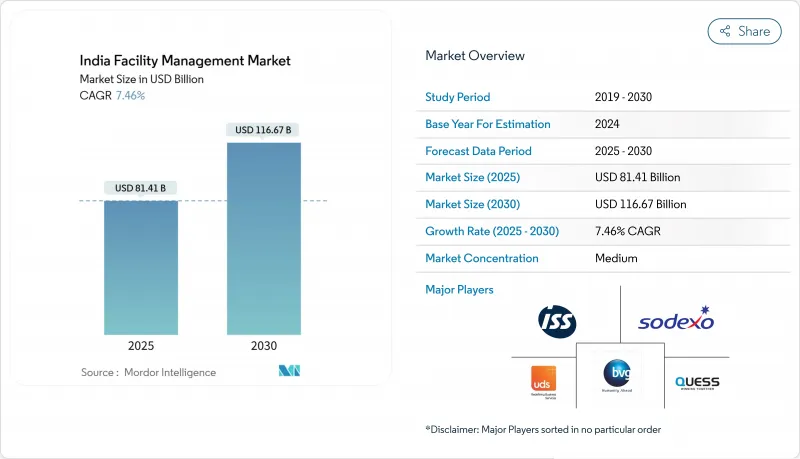
이 상승 궤도는 급속한 상업용 부동산 개발, 기술 도입 확대, 자사 서비스에서 아웃소싱 서비스 모델로의 가속적인 전환으로 뒷받침됩니다. 하드 서비스는 인도의 시설 관리 시장을 계속 지원하지만, 고용주가 직장 경험과 웰빙을 강조함에 따라 소프트 서비스에 대한 수요가 증가하고 있습니다. 기술 통합, 특히 IoT 센서, AI 주도 분석, 자동화 플랫폼은 비용 구조를 재구성하고 운영 비용을 최대 20%까지 절감하는 예지 보전을 가능하게 합니다. 아웃소싱은 여전히 선호되는 딜리버리 방식이지만, 일부 주요 입주자들은 데이터 관리를 유지하기 위해 내부 팀을 선택적으로 재구성하고 있으며, 공급업체는 측정 가능한 성능 성과에 근거한 가치 제안을 보다 선명하게 할 필요가 있습니다. 세계 메이저가 지역 전문가를 통합하고 고가치 번들 계약을 수용할 수 있는 통합 포트폴리오를 구축함에 따라 경쟁의 치열성이 커지고 있습니다.
인도의 시설 관리 시장 동향과 인사이트
상업용 부동산의 급속한 확대
방갈로르, 하이데라바드, 푸네, 아흐메다바드에 신설된 그레이드 A의 사무실과 창고에서는 입주 첫날부터 하드와 소프트의 통합 서비스가 요구되어 벤더에게는 롱테일의 수익원이 되고 있습니다. 시설 팀은 나중에 유지 보수 시스템, 에너지 대시 보드, 공간 계획 분석 등을 개조하는 대신 건설 중에 설계해야했습니다. 개발자는 자동화된 화재 안전 테스트 및 클라우드 기반 자산 목록과 같은 스마트 빌딩 사양을 점차 의무화하고 기술 대응 능력을 서비스 계약의 사전 자격 기준으로 삼고 있습니다. 세계 케이파빌리티 센터의 2급 도시로의 유입이 증가하고 지리적 수요가 다양화되는 한편, 공인기술자의 부족이 심각해지고 있기 때문에 대기업은 지역 트레이닝 아카데미의 설립을 촉구하고 있습니다. 각 새로운 상업 프로젝트는 일반적으로 다년간 서비스 계약을 체결하기 때문에 인도의 시설 관리 시장은 HVAC, 전기, 보안 및 위생의 각 범주에서 경상 이익을 보장합니다.
기술 통합(IoT, AI, 자동화)
냉동기, 펌프, 조명, 엘리베이터에 내장된 IoT 장치는 이상을 감지하고, 저스트 인 타임의 개입을 예약하며, 자산의 수명을 연장하는 AI 엔진에 실시간으로 데이터를 제공합니다. 초기 도입 사례에서는 에너지가 15-20% 절약되어 긴급 고장이 최대 30% 감소하고 투자 회수 기간이 24개월 미만으로 단축되었습니다. 애널리틱스 대시보드를 기존의 맨파워 서비스와 번들로 제공하는 공급업체는 가격 결정력을 높이고 고객과의 관계를 더욱 견고하게 만듭니다. 건물 데이터가 클라우드 플랫폼으로 이동함에 따라 사이버 보안 및 데이터 관리 전문 지식이 차별화 요인이 되고 있습니다. 또한 기술 도입으로 노동 시간만 청구하지 않고 에너지 강도 임계값 및 실내 공기 품질 지표를 공급업체가 보장하는 성과 기반 가격을 설정할 수 있습니다. 결과적으로 인도의 시설 관리 시장에서 대규모 통합 계약을 획득하기 위해서는 디지털 역량이 중요한 요소가 됩니다.
노동력 부족과 기술 격차
스마트 빌딩의 도입이 급증함에 따라 HVAC 자동화, 화재 안전 시스템, BMS 분석 자격을 갖춘 기술자 부족이 심각해지고 있습니다. Tier-2와 Tier-3의 도시에서는 인적 부족이 심각해지고 임금 프리미엄이 대도시 수준보다 15-20% 상승하여 벤더 마진이 악화되고 있습니다. 선도적인 공급자는 교실에서의 지도와 현장에서의 로테이션을 조합한 견습 프로그램을 시작하고 있지만, 파이프라인의 효과는 당분간 시장 요구에 미치지 못합니다. 지속적인 격차는 시간외 노동에 대한 의존도를 높이고, 서비스 수준 위반을 증가시키고, 신속한 계약의 동원을 방해하며, 결국 인도 시설 관리 시장의 성장 가능성을 제한합니다.
부문 분석
하드 서비스는 2024년 인도 시설 관리 시장의 58.37%를 차지하며 규정 준수 및 자산 신뢰성에 필수적인 역할을 반영했습니다. 전기 유지보수, HVAC 최적화, 화재 안전 검사 등과 같은 우선순위가 높은 범주는 특히 다운타임 비용이 까다로운 데이터센터 부문에서 시설 예산의 대부분을 흡수합니다. 부드러운 서비스는 절대적인 점유율로 후진을 숭배하고 있지만, 2030년까지 연평균 복합 성장률(CAGR)은 7.89%를 나타낼 전망입니다. 웰니스 관련 프로그램이 계약상 필수품이 됨에 따라 소프트 서비스 시장 규모가 꾸준히 확대될 것으로 예측됩니다. 기술은 두 범주의 경계를 모호하게 하고 있으며, 로봇이 바닥을 청소하는 한편, 냉동기의 성능을 추적하는 것과 같은 분석 플랫폼에 업무 데이터를 공급하게 되어, 벤더는 번들된 솔루션을 크로스셀 할 수 있게 되었습니다.
그린빌딩 인증에 대한 수요 증가는 하드 서비스 팀에게 에너지 벤치마킹 소프트웨어와 IoT 대응 고장 검출의 채용을 촉구하여 기술 요건을 높이고 있습니다. 동시에 유연한 작업 공간 사업자는 벤더의 보상을 테넌트의 만족도 지수에 연동시키는 성과 기반의 조건으로 팬토리와 프론트 오브 하우스 서비스를 아웃소싱하고 있습니다. 보안 서비스는 AI를 활용한 CCTV 애널리틱스의 통합이 진행되고 있으며, 경비원의 인원수를 삭감하는 동시에, 사고 대응의 정밀도를 높이고 있습니다. 이러한 변화로 인해 하드와 소프트 카테고리는 상품화된 라인 아이템에서 보다 광범위한 인도의 시설 관리 시장에서 입주자를 차별화하기 위한 전략적 레버로 자리매김을 바꾸고 있습니다.
기타 혜택 :
- 엑셀 형식 시장 예측(ME) 시트
- 3개월의 애널리스트 지원
목차
제1장 서론
- 조사 전제조건과 시장 정의
- 조사 범위
제2장 조사 방법
제3장 주요 요약
제4장 시장 상황
- 시장 개요
- 현재 가동률
- 주요 FM 사업자의 수익률
- 노동력 지표-노동 참가
- 시설 관리 시장 서비스 유형별 점유율(%)
- 시설 관리 시장 하드 서비스별 점유율(%)
- 시설 관리 시장 소프트 서비스별 점유율(%)
- 대도시권에 있어서 도시화와 인구 증가
- 국가 인프라 파이프라인에서 섹터 투자 우선순위
- 노동안전기준에 관한 규제요인
- 시장 성장 촉진요인
- 상업용 부동산의 급속한 확대
- 기술 통합(IoT, AI, 자동화)
- 아웃소싱 동향 증가
- 업무환경 경험과 직원 복지 대한 주목 증가
- 코워킹 스페이스와 플렉서블 오피스 모델의 성장
- 팬데믹 후의 위생 및 보건 컴플라이언스 의무화
- 시장 성장 억제요인
- 노동력 부족과 스킬 갭
- 오퍼레이션 코스트 상승에 의한 마진 압박
- 높은 가격 감도와 단편적인 조달 관행
- 공공 부문 계약에 있어서 규제 복잡성과 지불의 지연
- 밸류체인 분석
- PESTEL 분석
- 시장 진입을 위한 규제 및 법적 틀
- 거시경제지표가 FM 수요에 미치는 영향
- Porter's Five Forces 분석
- 공급기업의 협상력
- 구매자의 협상력
- 신규 참가업체의 위협
- 대체품의 위협
- 경쟁 기업 간 경쟁 관계
- 투자 및 자금조달 분석
제5장 시장 규모와 성장 예측
- 서비스 유형별
- 하드 서비스
- 자산 관리
- MEP 및 HVAC 서비스
- 소방 시스템 및 안전
- 기타 하드 FM 서비스
- 소프트 서비스
- 사무 지원 및 보안
- 청소 서비스
- 케이터링 서비스
- 기타 소프트 FM 서비스
- 하드 서비스
- 제공 유형별
- 인하우스
- 아웃소싱
- 단일 FM
- 번들 FM
- 통합 FM
- 최종 사용자 업계별
- 상업(IT 및 통신, 소매, 창고)
- 접객(호텔, 음식점, 레스토랑)
- 기관 및 공공 인프라(정부, 교육, 교통)
- 헬스케어(공공 및 민간 시설)
- 산업 및 공정(제조, 에너지, 광업)
- 기타 최종 사용자 산업(집합 주택, 엔터테인먼트, 스포츠, 레저)
제6장 경쟁 구도
- 시장 집중도
- 전략적 동향
- 시장 점유율 분석
- 기업 프로파일
- ISS Facility Management
- Sodexo Facilities Management Services India Pvt. Ltd.
- Quess Corporation
- Updater Services Pvt. Ltd.
- BVG India Ltd.
- Dusters Total Solutions Ltd.
- EFS Facilities Services
- G4S India
- Mortice Group PLC(TenonFM)
- ServiceMax Facility Management Pvt. Ltd.
- Knight Frank India
- Avon Facility Management Services Pvt. Ltd.
- Kleen Tek Solutions
- DTSS Facility Services
- Tenon Facility Management Pvt. Ltd.
- CBRE South Asia Pvt. Ltd.
- JLL Integrated Facilities Management
- Cushman & Wakefield Facilities Services India
- Colliers India
- Johnson Controls India
- Bharat Vikas Group(BVG) Soft Services
제7장 시장 기회와 향후 전망
KTH 25.11.17The India facility management market size reached USD 159.61 billion in 2025 and is projected to rise to USD 227.75 billion by 2030, reflecting a 7.37% CAGR during the forecast period.
The upward trajectory is underpinned by rapid commercial real-estate development, widening technology adoption, and the accelerating shift from in-house to outsourced service models. Hard services continue to anchor the India facility management market, yet soft-service demand is climbing as employers emphasise workplace experience and wellness. Technology integration-particularly IoT sensors, AI-driven analytics, and automation platforms-is reshaping cost structures and enabling predictive maintenance that trims operating costs by up to 20%. Outsourcing remains the preferred delivery approach, but several large occupiers are selectively rebuilding internal teams to retain data control, forcing vendors to sharpen value propositions rooted in measurable performance outcomes. Competitive intensity is increasing as global majors consolidate regional specialists to assemble integrated portfolios capable of serving high-value bundled contracts.
India Facility Management Market Trends and Insights
Rapid Commercial Real-Estate Expansion
New Grade-A offices and warehouses in Bangalore, Hyderabad, Pune, and Ahmedabad demand integrated hard and soft services from the first day of occupancy, creating long-tail revenue streams for vendors. Facility teams must now design maintenance regimes, energy dashboards, and space-planning analytics during construction rather than retrofitting later. Developers increasingly mandate smart-building specifications such as automated fire-safety testing and cloud-based asset inventories, making technology-ready capability a pre-qualification criterion for service contracts. The rising influx of Global Capability Centers into tier-2 cities diversifies geographic demand but intensifies the shortage of certified technicians, prompting large vendors to establish regional training academies. As each fresh commercial project typically locks in multi-year service agreements, the India facility management market secures recurring income across HVAC, electrical, security, and hygiene categories.
Technology Integration (IoT, AI, Automation)
IoT devices embedded in chillers, pumps, lighting, and elevators feed real-time data to AI engines that detect anomalies, schedule just-in-time interventions, and prolong asset life. Early deployments show energy savings of 15-20% and up to 30% fewer emergency breakdowns, translating into tangible payback periods of fewer than 24 months. Vendors that bundle analytics dashboards with conventional manpower services gain pricing power and stickier client relationships. Cyber-security and data-governance expertise have become differentiators as building data shifts to cloud platforms. Technology adoption also unlocks outcome-based pricing in which suppliers guarantee energy-intensity thresholds or indoor-air-quality indices instead of billing only labour hours. Consequently, digital competence is now table-stakes for winning large integrated contracts within the India facility management market.
Labour Shortages and Skill Gaps
The surge of smart-building deployments magnifies the scarcity of technicians certified in HVAC automation, fire-safety systems, and BMS analytics. Tier-2 and tier-3 cities suffer deeper shortages, inflating wage premiums by 15-20% over metropolitan levels and eroding vendor margins. Leading providers have launched apprenticeship programmes that pair classroom instruction with on-site rotations, but the pipeline effect trails immediate market needs. Persistent gaps elevate overtime reliance, increase service-level breaches, and impede rapid contract mobilisation, ultimately limiting the growth potential of the India facility management market.
Other drivers and restraints analyzed in the detailed report include:
- Increasing Outsourcing Trend
- Rising Focus on Workplace Experience and Employee Wellbeing
- Margin Pressure from Rising Operational Costs
For complete list of drivers and restraints, kindly check the Table Of Contents.
Segment Analysis
Hard services commanded 58.37% of the India facility management market in 2024, reflecting their indispensable role in compliance and asset reliability. High-priority categories such as electrical maintenance, HVAC optimisation, and fire-safety inspections absorb the bulk of facility budgets, particularly in data-centric sectors where downtime costs are punitive. Soft services trail in absolute share yet register a 7.89% CAGR through 2030 as occupants prioritise cleanliness, security, and hospitality to support hybrid workforces. The India facility management market size attributed to soft services is forecast to widen steadily as wellness-linked programs become contractual must-haves. Technology is blurring the line between the two categories-robots now scrub floors while feeding operational data into the same analytics platforms that track chiller performance-allowing vendors to cross-sell bundled solutions.
Growing demand for green-building certifications pushes hard-service teams to adopt energy-benchmarking software and IoT-enabled fault detection, elevating skill requirements. Simultaneously, flexible workspace operators are outsourcing pantry and front-of-house services on outcome-based terms that tie vendor rewards to tenant-satisfaction indices. Security services increasingly integrate AI-enabled CCTV analytics that cut guard headcount while boosting incident response precision. Together, these shifts reposition both hard and soft categories from commoditised line items into strategic levers for occupier differentiation within the broader India facility management market.
The India Facility Management Market Report is Segmented by Service Type (Hard Services, Soft Services), Offering Type (In-House, Outsourced), and End-User Industry (Commercial, Hospitality, Institutional and Public Infrastructure, Healthcare, Industrial and Process, Other End-User Industries). The Market Forecasts are Provided in Terms of Value (USD).
List of Companies Covered in this Report:
- ISS Facility Management
- Sodexo Facilities Management Services India Pvt. Ltd.
- Quess Corporation
- Updater Services Pvt. Ltd.
- BVG India Ltd.
- Dusters Total Solutions Ltd.
- EFS Facilities Services
- G4S India
- Mortice Group PLC (TenonFM)
- ServiceMax Facility Management Pvt. Ltd.
- Knight Frank India
- Avon Facility Management Services Pvt. Ltd.
- Kleen Tek Solutions
- DTSS Facility Services
- Tenon Facility Management Pvt. Ltd.
- CBRE South Asia Pvt. Ltd.
- JLL Integrated Facilities Management
- Cushman & Wakefield Facilities Services India
- Colliers India
- Johnson Controls India
- Bharat Vikas Group (BVG) Soft Services
Additional Benefits:
- The market estimate (ME) sheet in Excel format
- 3 months of analyst support
TABLE OF CONTENTS
1 INTRODUCTION
- 1.1 Study Assumptions and Market Definition
- 1.2 Scope of the Study
2 RESEARCH METHODOLOGY
3 EXECUTIVE SUMMARY
4 MARKET LANDSCAPE
- 4.1 Market Overview
- 4.1.1 Current Occupancy Rates
- 4.1.2 Profitability Rates of Major FM Players
- 4.1.3 Workforce Indicators - Labour Participation
- 4.1.4 Facility Management Market Share (%) by Service Type
- 4.1.5 Facility Management Market Share (%) by Hard Services
- 4.1.6 Facility Management Market Share (%) by Soft Services
- 4.1.7 Urbanisation and Population Growth in Major Metros
- 4.1.8 Sector Investment Priorities in National Infrastructure Pipeline
- 4.1.9 Regulatory Drivers Specific to Labour and Safety Standards
- 4.2 Market Drivers
- 4.2.1 Rapid Commercial Real Estate Expansion
- 4.2.2 Technology Integration (IoT, AI, Automation)
- 4.2.3 Increasing Outsourcing Trend
- 4.2.4 Rising Focus on Workplace Experience and Employee Wellbeing
- 4.2.5 Growth of Co-working Spaces and Flexible Office Models
- 4.2.6 Post-Pandemic Hygiene and Health Compliance Mandates
- 4.3 Market Restraints
- 4.3.1 Labor Shortages and Skill Gaps
- 4.3.2 Margin Pressure from Rising Operational Costs
- 4.3.3 High Client Price Sensitivity and Fragmented Procurement Practices
- 4.3.4 Regulatory Complexity and Delayed Payments in Public Sector Contracts
- 4.4 Value Chain Analysis
- 4.5 PESTEL Analysis
- 4.6 Regulatory and Legislative Framework for Market Entrants
- 4.7 Impact of Macroeconomic Indicators on FM Demand
- 4.8 Porter's Five Forces Analysis
- 4.8.1 Bargaining Power of Suppliers
- 4.8.2 Bargaining Power of Buyers
- 4.8.3 Threat of New Entrants
- 4.8.4 Threat of Substitute Services
- 4.8.5 Intensity of Competitive Rivalry
- 4.9 Investment and Funding Analysis
5 MARKET SIZE AND GROWTH FORECASTS (VALUE)
- 5.1 By Service Type
- 5.1.1 Hard Services
- 5.1.1.1 Asset Management
- 5.1.1.2 MEP and HVAC Services
- 5.1.1.3 Fire Systems and Safety
- 5.1.1.4 Other Hard FM Services
- 5.1.2 Soft Services
- 5.1.2.1 Office Support and Security
- 5.1.2.2 Cleaning Services
- 5.1.2.3 Catering Services
- 5.1.2.4 Other Soft FM Services
- 5.1.1 Hard Services
- 5.2 By Offering Type
- 5.2.1 In-house
- 5.2.2 Outsourced
- 5.2.2.1 Single FM
- 5.2.2.2 Bundled FM
- 5.2.2.3 Integrated FM
- 5.3 By End-user Industry
- 5.3.1 Commercial (IT and Telecom, Retail and Warehouses)
- 5.3.2 Hospitality (Hotels, Eateries, Restaurants)
- 5.3.3 Institutional and Public Infrastructure (Govt, Education, Transport)
- 5.3.4 Healthcare (Public and Private Facilities)
- 5.3.5 Industrial and Process (Manufacturing, Energy, Mining)
- 5.3.6 Other End-user Industries (Multi-housing, Entertainment, Sports and Leisure)
6 COMPETITIVE LANDSCAPE
- 6.1 Market Concentration
- 6.2 Strategic Moves
- 6.3 Market Share Analysis
- 6.4 Company Profiles
- 6.4.1 ISS Facility Management
- 6.4.2 Sodexo Facilities Management Services India Pvt. Ltd.
- 6.4.3 Quess Corporation
- 6.4.4 Updater Services Pvt. Ltd.
- 6.4.5 BVG India Ltd.
- 6.4.6 Dusters Total Solutions Ltd.
- 6.4.7 EFS Facilities Services
- 6.4.8 G4S India
- 6.4.9 Mortice Group PLC (TenonFM)
- 6.4.10 ServiceMax Facility Management Pvt. Ltd.
- 6.4.11 Knight Frank India
- 6.4.12 Avon Facility Management Services Pvt. Ltd.
- 6.4.13 Kleen Tek Solutions
- 6.4.14 DTSS Facility Services
- 6.4.15 Tenon Facility Management Pvt. Ltd.
- 6.4.16 CBRE South Asia Pvt. Ltd.
- 6.4.17 JLL Integrated Facilities Management
- 6.4.18 Cushman & Wakefield Facilities Services India
- 6.4.19 Colliers India
- 6.4.20 Johnson Controls India
- 6.4.21 Bharat Vikas Group (BVG) Soft Services
7 MARKET OPPORTUNITIES AND FUTURE OUTLOOK
- 7.1 White-space and Unmet-Need Assessment
- 7.2 Technology-led Integrated FM (IoT, BMS, AI-based Predictive Maintenance)
- 7.3 ESG-compliant FM Solutions Demand
- 7.4 Future Service-Model Shifts (Outcome-based Contracts)
- 7.5 Data-driven Energy Optimisation and Carbon Reporting Services