|
시장보고서
상품코드
2044275
싱가포르의 화학제품 물류 시장 : 점유율 분석, 산업 동향 및 통계, 성장 예측(2026-2031년)Singapore Chemical Logistics - Market Share Analysis, Industry Trends & Statistics, Growth Forecasts (2026 - 2031) |
||||||
 Mordor Intelligence
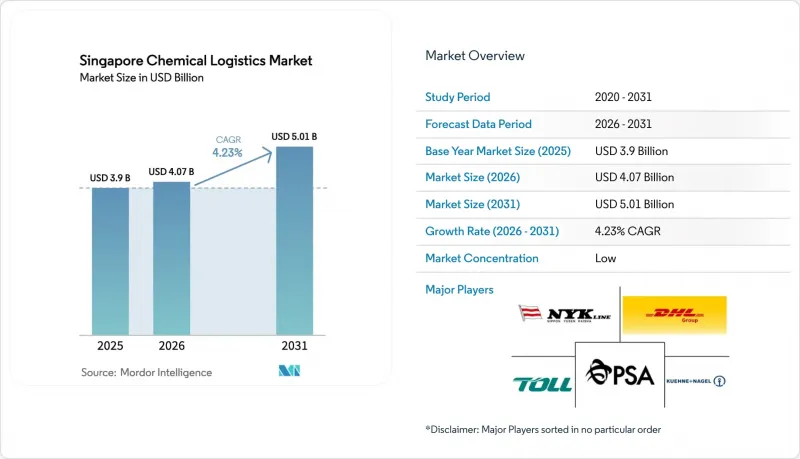
싱가포르의 화학제품 물류 시장 규모는 2025년에 39억 달러로 평가되었고 2026년 40억 7,000만 달러에서 2031년까지 50억 1,000만 달러에 이를 것으로 예측되며, 예측 기간(2026-2031년) CAGR은 4.23%를 나타낼 전망입니다.
아프리카와 남아시아로의 화학제품 재수출 흐름은 이 지역의 수입업체들이 품질 검증과 서류의 중앙집중식 관리를 싱가포르에 의존하고 있기 때문에 높은 수익률을 창출하고 있습니다. SS 667: 2020 표준 개정으로 인해 위험물 창고 공급이 타이트한 상황이며, 규정을 준수하는 시설을 갖춘 자본력이 있는 사업자에게 유리한 상황입니다. 투아스 항만의 자율주행 야드 트럭 도입은 이미 체류 시간을 20-30% 단축하여 실시간 데이터 연결 환경을 갖춘 사업자에게 자산 활용도를 향상시키고 있습니다. 싱가포르에 본사를 둔 사모펀드가 지원하는 ISO Tank Leasing Pool은 특수 장비 공급을 확대하고 있으며, 통합 제공업체가 운송, 탱크 임대 및 TradeNet 신고를 단일 소스 서비스로 패키징할 수 있도록 돕고 있습니다. 저탄소 암모니아 벙커링 검사 및 TradeNet의 전자 위험물 허가(e-DG) 시스템 검토는 정부 주도의 디지털화 및 탈탄소화 노력이 어떻게 업무 효율성의 기준을 지속적으로 높이고 있는지를 보여줍니다.
싱가포르 화학제품 물류 시장 동향과 인사이트
싱가포르에서 아프리카와 남아시아로 특수화학제품 재수출 급증 추세
엔터프라이즈 싱가포르에 따르면, 2024년 화학제품 수출액은 915억 싱가포르 달러(686억 달러)에 달했으며, 계면활성제 및 촉매와 같은 특수 화학제품 부문은 신흥 시장용 두 자릿수 성장률을 나타낼 것으로 예상했습니다. 수입업체는 소량 재포장, 현지어로 된 SDS(안전 데이터 시트) 작성, 정품 보증을 싱가포르에 의존하고 있으며, 이로 인해 물류 제공업체는 표준 환적 요금의 2-3배의 요금을 청구할 수 있습니다. 아프리카 유통업체와의 제휴를 통해 재고 관리 및 가치사슬 금융 서비스를 추가하는 한편, 남아시아의 제약 바이어들은 단일 국가에 대한 의존도를 탈피하고 조달처를 다양화하기 위해 싱가포르를 기반으로 한 조달을 채택하고 있습니다. 이러한 추세에 따라 부가가치 활동의 수익 비중이 확대되고, 특수화학제품의 리스크 완화를 위한 게이트웨이로서 싱가포르의 기능이 강화될 것으로 예측됩니다.
투아스 항구의 자율 주행 야드 트럭 검사 운영으로 처리 시간 단축 가속화
PSA 싱가포르는 24시간 365일 가동이 가능하고 센티미터 단위의 정확도를 가진 자율주행 전기 야드 트럭 200여 대를 도입해 화학물질 컨테이너의 체류 시간을 최대 30% 단축했습니다. 자동화를 통해 운전자의 피로로 인한 제약이 해소되고, 위험물에 대한 인적 접촉이 줄어들어 안전성과 생산성이 모두 향상됩니다. 이벤트 기반 항만 소프트웨어가 각 차량에 채널 정보를 실시간으로 제공하고, 야드 내 이동을 선박 스케줄 및 창고 가용 상황과 연동하여 선박의 이동을 관리하고 있습니다. 자사의 운송 관리 시스템을 PSA의 데이터 계층에 직접 연결하는 통합형 3PL(제3자 물류) 기업은 실시간 진행 정보를 얻을 수 있어 정시 달성률을 98% 이상으로 끌어올리고 있습니다.
전 세계 사고 후 위험물 창고 보험료 상승
베이루트와 톈진에서 발생한 폭발사고 이후 보험사들은 고도의 감지 및 소화설비를 갖추지 않은 시설에 대해 보험료를 30-50% 인상했습니다. 이로 인해 사업자는 보험 적용을 유지하기 위해 실시간 모니터링과 제3자 안전 감사를 도입할 수밖에 없는 상황입니다. 자금력이 있는 기업들은 이에 대응하고 있지만, 소규모 사업자들은 철수하는 경우가 많아 공급이 부족해지면서 공인된 공간의 임대료가 치솟고 있습니다.
부문 분석
2025년 싱가포르 화학제품 물류 시장에서 운송 부문은 66.47%의 점유율을 유지했지만, 수출업체들이 CBAM(탄소국경조정조치) 신고, 위험물 포장, 통관 업무에 어려움을 겪으면서 기타 서비스가 CAGR 6.11%로 더 빠르게 성장하고 있습니다. 싱가포르 화학제품 물류 시장의 부가가치 서비스 시장 규모는 탄소보고 의무화에 따른 수출업체 당 5,000-2만 5,000달러의 컨설팅 비용의 혜택을 받고 있습니다. 한편, 자율 주행형 야드 트럭의 도입으로 트럭의 사이클 타임은 개선되지만, 연료 할증료의 변동을 완전히 상쇄할 수는 없습니다. 창고 수익은 SS 667: 2020 표준의 프리미엄 효과로 인해 표준 산업용 공간보다 40-60% 높은 임대료로 인해 인증된 보관 서비스를 제공하는 사업자가 싱가포르 전체 화학제품 물류 시장에서 차지하는 점유율이 확대되고 있습니다.
통합 솔루션에 대한 수요로 인해 통합 3PL은 ISO 탱크 리스와 TradeNet의 자동화를 결합하여 계약 유지율과 가격 결정력을 높일 수 있게 되었습니다. 틈새 컨설턴트는 아프리카로 소량 재수출을 위한 위험물 서류 작성 및 포장 업무로 번창하고 있습니다. 디지털 허가증 통합 기능이 없는 사업자는 화주가 당일 통관이 가능한 업체를 채택함에 따라 중개 기능을 배제할 위험에 직면하고 있습니다.
싱가포르의 석유 및 가스 부문은 주롱섬의 정유공장 단지로 인해 싱가포르 화학제품 물류 시장 점유율의 27.08%를 차지하고 있으며, 전력 공급이 불안정한 아세안 인근 국가로 바이오 의약품이 유입되면서 의약품 물류는 CAGR 5.28%로 성장하고 있습니다. 비연속 전원 공급 장치와 검증된 냉장실을 갖춘 GDP 준수 시설은 표준 취급 요금의 2-3배에 달하는 요금을 책정하여 의료 관련 화물로 인한 싱가포르의 화학제품 물류 시장 규모를 키우고 있습니다. 또한, 반도체 팹과 뷰티 브랜드의 지역 집적화 거점으로서 싱가포르의 역할로 인해 화장품과 특수 전자 화학제품도 혜택을 받고 있습니다.
보건과학청(HSA)의 엄격한 감독으로 면허를 받은 GDP 제공업체만 경쟁에 참여할 수 있기 때문에 공급이 제한되어 수익률이 유지되고 있습니다. 한편, 에너지 전환 정책으로 원유 거래량이 줄어들면서 석유-가스 물류는 수익성 유지를 위해 ISO 탱크의 최적화와 자동화에 박차를 가하고 있습니다.
기타 혜택
- 엑셀 형태 시장 예측(ME) 시트
- 3개월간 애널리스트 지원
자주 묻는 질문
목차
제1장 서론
제2장 조사 방법
제3장 주요 요약
제4장 시장 구도
제5장 시장 규모와 성장 예측
제6장 경쟁 구도
제7장 시장 기회와 향후 전망
JHS 26.06.02The Singapore chemical logistics market size was valued at USD 3.9 billion in 2025 and estimated to grow from USD 4.07 billion in 2026 to reach USD 5.01 billion by 2031, at a CAGR of 4.23% during the forecast period (2026-2031).
Chemical re-export flows to Africa and South Asia generate premium margins because importers in those regions rely on Singapore for quality verification and consolidated documentation. SS 667:2020 upgrades are tightening dangerous-goods warehouse supply, favoring capital-rich operators with compliant facilities. Tuas Port's autonomous yard-truck deployments are already showing 20-30% dwell-time savings that raise asset utilization for operators with real-time data connectivity. Private-equity backed ISO-tank leasing pools domiciled in Singapore are expanding specialized equipment availability and helping integrated providers bundle transport, tank rental, and TradeNet filing into single-source offerings. Low-carbon ammonia bunkering trials, together with the TradeNet e-DG permit revamp, illustrate how government-led digitalization and decarbonization initiatives are continually raising the baseline for operational efficiency.
Singapore Chemical Logistics Market Trends and Insights
Surge in Singapore's Specialty-Chemical Re-Exports to Africa and South Asia
Enterprise Singapore recorded SGD 91.5 billion (USD 68.6 billion) of chemical exports in 2024, and specialty segments such as surfactants and catalysts posted double-digit growth toward emerging markets. Importers rely on Singapore for smaller lot repackaging, local-language SDS preparation, and authenticity assurance, allowing logistics providers to charge 2-3 times standard transshipment rates. Partnerships with African distributors add inventory management and supply-chain financing services, while South Asian pharmaceutical buyers adopt Singapore-based sourcing to diversify away from single-country dependencies. The dynamic is expected to widen the revenue share of value-added activities, reinforcing Singapore's function as a risk-buffering gateway for specialty chemicals.
Autonomous Yard-Truck Pilots at Tuas Port Accelerating Turnaround Times
PSA Singapore has deployed more than 200 autonomous electric yard trucks capable of 24/7 operation with centimeter-level precision, cutting chemical container dwell time by up to 30%. Automation removes driver fatigue limitations and reduces human exposure to hazardous cargo, enhancing both safety and productivity. Event-driven port software feeds routing updates to each vehicle, synchronizing yard moves with vessel schedules and warehouse slot availability. Integrated 3PLs that plug their transport-management systems directly into PSA's data layer gain real-time milestones, pushing on-time performance above 98%.
Rising Insurance Premiums for DG Warehousing Post-Global Incidents
After the Beirut and Tianjin explosions, underwriters raised premiums 30-50% for facilities without advanced detection and suppression, compelling operators to adopt real-time monitoring and third-party safety audits to maintain cover. Capital-rich firms comply; smaller players often exit, tightening supply and supporting higher rents for certified space.
Other drivers and restraints analyzed in the detailed report include:
- Mandatory SS 667:2020 Certification Driving Compliant Storage Demand
- PE-Backed Growth of ISO-Tank Leasing Pools Domiciled in Singapore
- EU CBAM Compliance Burden Inflating Export Documentation Cycles
For complete list of drivers and restraints, kindly check the Table Of Contents.
Segment Analysis
Transportation maintained 66.47% share of the Singapore chemical logistics market in 2025, yet other services are growing faster at 6.11% CAGR as exporters grapple with CBAM filings, dangerous-goods packaging, and customs brokerage. The Singapore chemical logistics market size for value-added services benefits from advisory fees of USD 5,000-25,000 per exporter on carbon reporting mandates. Meanwhile, autonomous yard-truck rollouts improve truck cycle times but cannot fully offset fuel-surcharge volatility. Warehousing revenue is buoyed by SS 667:2020 premiums that lift rents 40-60% above standard industrial space and enhance the overall Singapore chemical logistics market share captured by operators offering certified storage.
Demand for bundled solutions lets integrated 3PLs pair ISO-tank leasing with TradeNet automation, creating stickier contracts and pricing power. Niche consultants thrive on dangerous-goods documentation and packaging for small-lot re-exports to Africa. Those without digital permit integration risk disintermediation as shippers embrace providers capable of same-day clearance.
Oil and Gas controls 27.08% Singapore chemical logistics market share owing to Jurong Island's refinery complex, yet pharmaceutical logistics expands at 5.28% CAGR on biologics flows to power-unstable ASEAN neighbors. GDP-compliant facilities with backup power and validated cold rooms command 2-3-times standard handling rates, boosting the Singapore chemical logistics market size attributable to healthcare shipments. Cosmetics and specialty electronic chemicals also gain from Singapore's role as a regional consolidation hub for semiconductor fabs and beauty brands.
Stringent Health Sciences Authority oversight ensures only licensed GDP providers compete, limiting supply and supporting margins. Conversely, energy-transition measures compress crude trading volumes, forcing Oil & Gas logistics to pursue ISO-tank optimization and automation to preserve profitability.
The Singapore Chemical Logistics Market Report is Segmented by Service (Transportation, Warehousing/Distribution/Inventory Management, Other Services), End-User Industry (Pharmaceutical, Cosmetic, Oil and Gas, Specialty Chemicals, and More), Hazard Class (Hazardous Chemicals, Non-Hazardous Chemicals), Temperature Control (Temperature-Controlled, Non-Temperature-Controlled). The Market Forecasts are Provided in Terms of Value (USD).
List of Companies Covered in this Report:
- ALPS Global Logistics
- Bertschi Singapore Pte Ltd.
- DHL Group
- Kuehne+Nagel
- PSA Chemical Logistics (PSA Corp)
- NYK Line
- CMA CGM Group (Including CEVA Logistics)
- "K" Line
- Mitsubishi Chemical Logistics
- Noatum Holdings
- CWT Pte Ltd.
- YCH Group
- DSV A/S
- Rohlig Logistics
- Poh Tiong Choon Logistics Ltd.
- Yang Kee Logistics Pte Ltd.
- Suttons International
- Den Hartogh Logistics
- TranceGlobal Logistics Pte Ltd.
- Toll Group
- ACW Logistics Pte Ltd.
Additional Benefits:
- The market estimate (ME) sheet in Excel format
- 3 months of analyst support
TABLE OF CONTENTS
1 Introduction
- 1.1 Study Assumptions and Market Definition
- 1.2 Scope of the Study
2 Research Methodology
3 Executive Summary
4 Market Landscape
- 4.1 Market Overview
- 4.2 Market Drivers
- 4.2.1 Surge in SG's Specialty-Chemical Re-Exports to Africa and South Asia
- 4.2.2 Autonomous Yard-Truck Pilots at Tuas Port Accelerating Turnaround Times
- 4.2.3 Mandatory SS 667:2020 Certification Driving Compliant Storage Demand
- 4.2.4 PE-Backed Growth of ISO-Tank Leasing Pools Domiciled in Singapore
- 4.2.5 Low-Carbon Ammonia Bunkering Trials Creating New Logistics Flows
- 4.2.6 Tradenet E-DG Permit Revamp Reducing Customs Clearance Times
- 4.3 Market Restraints
- 4.3.1 Rising Insurance Premiums for DG Warehousing Post-Global Incidents
- 4.3.2 EU CBAM Compliance Burden Inflating Export Documentation Cycles
- 4.3.3 Limited Domestic Rail Connectivity Hindering Multimodal Cost Savings
- 4.3.4 Volatile Bunker Fuel Surcharges Eroding 3PL Margin Stability
- 4.4 Value / Supply-Chain Analysis
- 4.5 Regulatory Landscape
- 4.6 Technological Outlook
- 4.7 Porter's Five Forces Analysis
- 4.7.1 Bargaining Power of Suppliers
- 4.7.2 Bargaining Power of Buyers
- 4.7.3 Threat of New Entrants
- 4.7.4 Threat of Substitute Products
- 4.7.5 Intensity of Competitive Rivalry
- 4.8 Impact of Geo-Political Events on Supply Chain Shifts
5 Market Size and Growth Forecasts
- 5.1 By Service
- 5.1.1 Transportation
- 5.1.1.1 Road
- 5.1.1.2 Rail
- 5.1.1.3 Air
- 5.1.1.4 Sea
- 5.1.2 Warehousing, Distribution and Inventory Management
- 5.1.3 Other Services
- 5.1.1 Transportation
- 5.2 By End-User Industry
- 5.2.1 Pharmaceutical
- 5.2.2 Cosmetic
- 5.2.3 Oil and Gas
- 5.2.4 Specialty Chemicals
- 5.2.5 Other End-Users
- 5.3 By Hazard Class
- 5.3.1 Hazardous Chemicals
- 5.3.2 Non-hazardous Chemicals
- 5.4 By Temperature Control
- 5.4.1 Temperature-Controlled (Refrigerated/Heated)
- 5.4.2 Non-Temperature-Controlled
6 Competitive Landscape
- 6.1 Market Concentration
- 6.2 Strategic Moves
- 6.3 Market Share Analysis
- 6.4 Company Profiles (Includes Global Level Overview, Market Level Overview, Core Segments, Financials as Available, Strategic Information, Market Rank/Share for Key Companies, Products and Services, and Recent Developments)
- 6.4.1 ALPS Global Logistics
- 6.4.2 Bertschi Singapore Pte Ltd.
- 6.4.3 DHL Group
- 6.4.4 Kuehne+Nagel
- 6.4.5 PSA Chemical Logistics (PSA Corp)
- 6.4.6 NYK Line
- 6.4.7 CMA CGM Group (Including CEVA Logistics)
- 6.4.8 "K" Line
- 6.4.9 Mitsubishi Chemical Logistics
- 6.4.10 Noatum Holdings
- 6.4.11 CWT Pte Ltd.
- 6.4.12 YCH Group
- 6.4.13 DSV A/S
- 6.4.14 Rohlig Logistics
- 6.4.15 Poh Tiong Choon Logistics Ltd.
- 6.4.16 Yang Kee Logistics Pte Ltd.
- 6.4.17 Suttons International
- 6.4.18 Den Hartogh Logistics
- 6.4.19 TranceGlobal Logistics Pte Ltd.
- 6.4.20 Toll Group
- 6.4.21 ACW Logistics Pte Ltd.
7 Market Opportunities and Future Outlook
- 7.1 White-space and Unmet-need Assessment