

|
시장보고서
상품코드
2063302
화물 중개 서비스 : 시장 점유율 분석, 업계 동향 및 통계, 성장 예측(2026-2031년)Freight Brokerage Services - Market Share Analysis, Industry Trends & Statistics, Growth Forecasts (2026 - 2031) |
||||||
 Mordor Intelligence
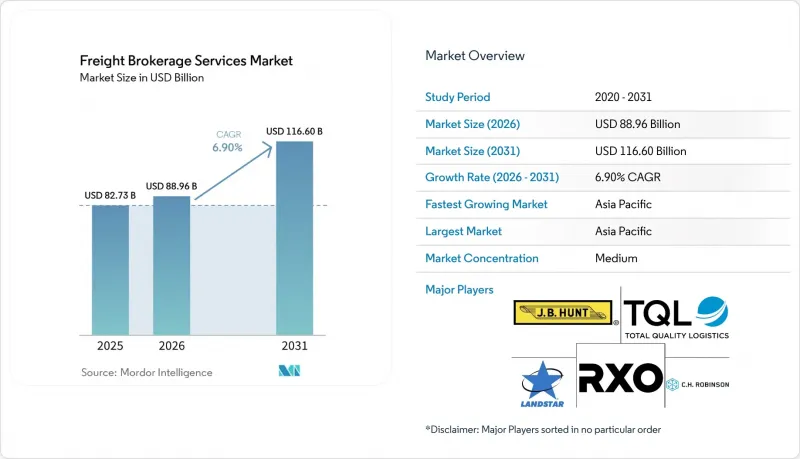
Mordor Intelligence에 의하면, 화물 중개 서비스 시장 규모는 2025년 827억 3,000만 달러로 평가되었습니다. 2026년 889억 6,000만 달러로 확대되어 2031년까지 1,166억 달러에 이를 것으로 예측되며, 2026-2031년에 걸쳐 CAGR은 6.90%를 나타낼 전망입니다.
니어쇼어링을 통해 평균 운송 거리가 단축되고, 옴니채널 소매로 인해 출하 물량이 세분화되며, 브로커와 전 세계 3PL 업체 간의 대규모 합병으로 인해 경쟁의 경계가 재정의되고 있습니다. 본 보고서는 서비스별(전체 트럭 적재, 기타), 설비/트레일러 유형별(드라이 밴, 냉장 밴, 기타), 운송 거리(장거리, 지역 내, 단거리), 비즈니스 모델(기존, 자산 보유형, 기타), 최종 사용자 산업(제조·자동차, 기타), 고객 규모(대기업, 기타), 지역별로 분류되어 있습니다. 시장 전망은 금액(달러) 기준으로 제시되어 있습니다.
세계의 화물 중개 서비스 시장 동향 및 인사이트
니어쇼어링과 리쇼어링으로 인해 운송 물량은 국경을 넘는 단거리 운송 경로로 전환되고 있습니다.
니어쇼어링과 리쇼어링의 추세에 따라 장거리 대륙 간 노선에 대한 의존도가 낮아지고, 국경을 넘는 단거리 회랑의 중요성이 커지고 있습니다. 멕시코나 동유럽 등지로 생산 거점을 이전함에 따라 운송 거리는 단축되는 반면, 운송 빈도와 국경을 넘는 화물량은 증가하고 있습니다. 이로 인해 통관, 서류 작성, 규정 준수 측면에서 문제가 발생하고 있어, 브로커의 역할이 중요해지고 있습니다. 이중 언어 능력, 규정 준수 관련 전문 지식, CARM 대응 플랫폼 등 통합형 통관 솔루션을 갖춘 브로커는 더 높은 수익률을 달성할 수 있는 입장에 있습니다. 이중 인증을 받은 운송업체 네트워크와 비용 최소화보다 회복탄력성을 중시하는 자세는 브로커의 경쟁 우위를 한층 더 높여, 지역 무역 회랑에서 지속적인 수요를 견인하고 있습니다.
옴니채널 소매의 급속한 성장이 미들마일 중개업체 수요를 가속화
옴니채널 소매의 성장은 속도, 유연성, 재고 대응 능력을 중시함으로써 물류 네트워크를 재구축하고 있습니다. 소매업체들이 내세우는 당일 또는 익일 배송 약속은 엄격한 시간 범위 내에서 매장과 물류 센터에 빈번한 재고 보충을 필요로 하여 미들마일 물류의 중요성을 높이고 있습니다. 화물 중개업체는 공차 주행 거리와 운송 비용을 절감하는 첨단 경로 설정 알고리즘의 지원을 받아, 경로 최적화 및 화물 집약에 있어 중요한 역할을 수행하고 있습니다. 빈번한 출하를 관리하기 위해서는 디지털 플랫폼과 실시간 가시화 도구가 필수적이며, 수요와 운송 능력의 동적 매칭을 통해 수요가 급증할 때의 대응력이 향상됩니다. 재고 분산이 진행되는 가운데, 효율적인 미들마일 운영을 가능하게 하는 브로커 서비스는 지속적인 성장과 전략적 중요성이 커질 것으로 예측됩니다.
컨테이너 운임의 급격한 변동이 현물 거래의 이익 마진을 압박하고 있습니다.
컨테이너 운임의 극심한 변동은 특히 단기 주기의 현물 시장에서 화물 중개업체에 상당한 이익률의 불확실성을 초래하고 있습니다. 40피트 컨테이너 운임이 몇 주 만에 최대 5,000달러까지 변동하기 때문에 중개업체들은 수송 견적을 빈번하게 재산출해야만 하며, 이로 인해 가격 책정의 일관성이 훼손되고 업무 부담이 증가하고 있습니다. 원래 마진이 좁은 항만에서 물류센터(DC)로 이어지는 드레이지 노선의 경우, 이러한 변동으로 인해 매출총이익률이 100베이시스포인트 이상 하락할 가능성이 있습니다. 또한, 계약 운임이 시장 가격과 차이를 보일 경우, 브로커는 거래 상대방 리스크 증가에 직면하게 되지만, 헤지나 정확한 예측을 할 수 있는 선택지는 제한적입니다. 그 결과, 브로커들은 동적 가격 책정 도구를 도입하고 계약 주기를 단축하는 등 조치를 취하고 있지만, 이러한 대책만으로는 지속적인 변동의 영향을 완전히 상쇄하지 못할 가능성이 있습니다.
부문별 분석
소량 화물(LTL) 운송은 연평균 성장률(CAGR) 10.05%로 확대되고 있으며, 소매업체들이 SKU 단위의 재고 보충 방식으로 전환하고, 공동 트럭 운송 프로그램을 통해 트레일러 적재율(적재 공간 활용률)이 92%에 달함에 따라 화물 중개 서비스 시장을 주도하고 있습니다. 다중 정차 알고리즘을 통해 통합 경로에서 브로커의 매출 총이익률은 16%를 나타낼 전망입니다. 한편, 풀 트럭 로드(FTL)는 여전히 67.15%의 시장 점유율을 유지하고 있지만, 화주들이 운송 수단을 다각화하고 유연한 운송 능력 옵션을 요구함에 따라 화물 중개 서비스 시장에서의 점유율은 2포인트 하락했습니다.
각 브로커사는 운송 관리 시스템(TMS)에 동적인 운송 수단 전환 규칙을 적용함으로써 기존 FTL 계약을 유지하고 있습니다. 이를 통해 기업 고객은 재입찰 절차 없이 FTL과 LTL 간에 주문을 전환할 수 있어, 고객 유지율을 높이고 수익을 안정화할 수 있습니다. LTL에 대한 구조적인 호재, 소포 요금에 대한 추가 요금 회피, 옴니채널을 통한 유통 속도 향상, 니어쇼어링을 통한 운송 경로 통합 등으로 인해 LTL은 증가하는 수요의 과반수를 확실하게 확보하고 있습니다.
드라이 밴은 2025년 화물 중개 서비스 시장의 46.04%를 차지했으나, 의약품 GDP 규정 및 신선식품 전자상거래가 노선 단위의 온도 원격 측정 기술을 필요로 함에 따라 냉장 밴 시장은 연평균 성장률(CAGR) 11.15%로 확대되고 있습니다. 브로커는 5분 간격으로 온도를 기록하고 규정 준수 여부를 입증하는 디지털 증빙 자료를 보관하는 IoT 프로브를 도입함으로써 클레임을 줄이고, 백신 제조업체로부터 우선 운송업체로서의 지위를 확보하고 있습니다.
높은 수익률을 바탕으로, 이 물류업체는 드라이밴 차량의 약 7%를 단열 또는 하이브리드 냉각 시스템으로 개조하는 데 투자하며, 자산 리스크의 균형을 유지하면서도 수익성이 높은 콜드체인 노선을 추구하고 있습니다. 냉동 화물 중개 서비스 시장은 확대될 것으로 예상되며, 화주들이 봉인 상태, 규제 서류, 비상 시 우회 경로 관리에 정통한 파트너를 중요하게 여기기 때문에 설비의 전문화가 경쟁 우위를 강화하고 있습니다.
지역별 분석
아시아태평양은 매출 점유율 44.13%를 유지하고 있으며, 이 지역의 화물 중개 서비스 시장 규모는 2031년까지 연평균 성장률(CAGR) 9.03%로 확대될 것으로 전망됩니다. 아세안(ASEAN)의 관세 조화로 국경 통과 절차가 30분으로 단축됨에 따라, 태국과 베트남의 중소 화주들이 디지털 중개 앱 도입을 서두르고 있습니다. 인도의 GST 전자 운송장(e-way bill) 자동화는 투명성을 높여, 규정 준수를 철저히 하는 미들마일 파트너를 찾는 해외 소매업체들의 관심을 끌고 있습니다.
북미에서는 니어쇼어링으로의 재편이 진행되고 있으며, 미국과 멕시코를 연결하는 육상 노선에서는 국경을 넘는 LTL 화물이 전년 대비 18% 증가했습니다. 이중언어 콜센터와 FAST 인증 운송업체를 활용하는 중개업체는 국경에서의 체류 시간을 42% 단축하여 자동차 제조업체로부터 모드 시프트 상을 수상했습니다. 캐나다에서 CARM이 도입됨에 따라, 브로커들은 관세 계산 도구를 통합할 수밖에 없게 되었으며, 2026년 한 해 동안만으로도 규정 준수 관련 서비스 매출이 1억 2,000만 달러 증가할 것으로 전망됩니다.
유럽에서는 ETS 4단계에 대응하는 데 어려움을 겪고 있습니다. 철도 및 트럭 구간을 결합한 복합 운송 서비스를 제공하는 중개업체는 트럭 단독 운송에 비해 탄소 집약도를 42% 줄여, 소매업체의 입찰 목록에서 우선적인 위치를 차지하고 있습니다. eIDAS 기반 인증에 대한 투자가 급증하고 있는 가운데, 감사 가능한 보관 이력 로그를 필요로 하는 제약 업계의 화주들 사이에서 이를 조기에 도입한 기업들은 브랜드 가치 향상의 혜택을 누리고 있습니다.
남미와 중동 및 아프리카는 전 세계 매출의 10% 미만에 그치지만, 신흥 시장으로서 성장 잠재력을 지니고 있습니다. 브라질의 BR-163번 국도 포장 공사로 인해 대두 수출 경로가 확보되는 한편, GCC(걸프협력회의)의 철도 연결 프로젝트는 석유에서 화학제품으로의 다각화에 따른 복합운송 중개 업무의 기회를 약속하고 있습니다.
기타 혜택
- 엑셀 형식 시장 예측(ME) 시트
- 3개월간의 애널리스트 지원
자주 묻는 질문
목차
제1장 서론
제2장 조사 방법
제3장 주요 요약
제4장 시장 구도
제5장 시장 규모 및 성장 예측
제6장 경쟁 구도
제7장 시장 기회 및 향후 전망
KTH 26.06.22According to Mordor Intelligence, the freight brokerage services market size is expected to increase from USD 82.73 billion in 2025 to USD 88.96 billion in 2026 and reach USD 116.60 billion by 2031, growing at a CAGR of 6.90% over 2026-2031.
Nearshoring is shortening average haul lengths, omni-channel retail is fragmenting shipment lots, and mega-mergers between brokers and global 3PLs are redefining competitive boundaries. This report is Segmented by Service (Full-Truckload, and More), by Equipment/Trailer Type (Dry Van, Refrigerated Van, and More), by Haul Length (Long-Haul, Regional, Local), by Business Model (Traditional, Asset-Based, and More), by End-User Industry (Manufacturing & Auto, and More), by Customer Size (Large Enterprise, and More), and by Geography. The Market Forecasts are in Terms of Value (USD).
Global Freight Brokerage Services Market Trends and Insights
Nearshoring and Reshoring Shift Volumes Toward Cross-Border Short-Haul Corridors
Nearshoring and reshoring trends are reducing reliance on long-haul intercontinental routes and increasing the importance of cross-border short-haul corridors. Manufacturing shifts to regions like Mexico and Eastern Europe are shortening shipment distances while increasing shipment frequency and border-crossing volumes. This creates challenges in customs clearance, documentation, and compliance, elevating brokers' roles. Brokers with bilingual skills, compliance expertise, and integrated customs solutions, such as CARM-ready platforms, are better positioned to capture higher margins. Dual-qualified carrier networks and a focus on resilience over cost minimization further enhance brokers' competitive advantage, driving sustained demand in regional trade corridors .
Omni-Channel Retail Boom Intensifies Middle-Mile Brokerage Demand
The growth of omni-channel retail is reshaping logistics networks by emphasizing speed, flexibility, and inventory responsiveness. Retailers' commitments to same-day or next-day delivery require frequent replenishment of stores and fulfillment centers within tight timeframes, increasing the importance of middle-mile logistics. Freight brokers play a key role in optimizing routes and consolidating loads, aided by advanced routing algorithms that reduce empty miles and transportation costs. Digital platforms and real-time visibility tools are essential for managing high-frequency shipments, while dynamic demand-capacity matching enhances responsiveness during demand spikes. As inventory decentralization continues, brokerage services enabling efficient middle-mile operations are expected to see sustained growth and strategic importance .
Container-Rate Whiplash Compresses Spot-Margin Windows
Extreme volatility in container freight rates is causing significant margin uncertainty for freight brokers, particularly in short-cycle spot markets. Fluctuations of up to USD 5,000 in 40-foot container rates within weeks force brokers to frequently re-quote shipments, disrupting pricing consistency and increasing operational workload. In port-to-distribution center (DC) drayage lanes, where margins are already narrow, such changes can reduce gross margins by over 100 basis points. Brokers also face heightened counterparty risk when contracted rates diverge from market prices, with limited options for hedging or accurate forecasting. As a result, brokers are adopting dynamic pricing tools and shorter contract cycles, though these measures may not fully offset the impact of sustained volatility..
Other drivers and restraints analyzed in the detailed report include:
- SME Self-Service Portals Expand Long-Tail Customer Penetration
- Mega-Mergers Between Brokers and Global 3PLs Unlock One-Stop Capacity Networks
- Inventory Destocking Post-Pandemic Dampens Shipment Volumes 2024-2026
For complete list of drivers and restraints, kindly check the Table Of Contents.
Segment Analysis
Less-than-Truckload shipments are expanding at a 10.05% CAGR, lifting the freight brokerage services market as retailers shift to SKU-level replenishment and shared-truckload programs push trailer cube utilization to 92%. Multi-stop algorithms widen broker gross margin to 16% on consolidated routes, while Full-Truckload continues to anchor 67.15% market share but sees its freight brokerage services market share decline two percentage points as shippers diversify modes and demand flexible capacity options.
Brokers protect legacy FTL contracts by integrating dynamic mode-shifting rules in Transportation Management Systems that let enterprise clients flip orders between FTL and LTL without re-tendering, deepening account stickiness, and smoothing revenue. LTL's structural tailwinds, parcel surcharge avoidance, omni-channel velocity, and nearshoring-driven lane compression ensure it captures an outsized portion of incremental demand.
Dry Vans held 46.04% of the 2025 freight brokerage services market, but Refrigerated Van is compounding at an 11.15% CAGR as pharma GDP mandates and fresh-food e-commerce require lane-level temperature telemetry. Brokers embed IoT probes that record five-minute temperature intervals and archive digital proof of compliance, reducing claims and securing preferred-shipper status with vaccine producers.
Capitalizing on premium yields, providers are reallocating roughly 7% of dry-van inventory to insulated or hybrid-cooling retrofits, balancing asset risk while pursuing higher-margin cold-chain lanes. The freight brokerage services market for Reefer loads is slated to rise, and equipment specialization strengthens competitive moats because shippers prize partners who master seal integrity, regulatory paperwork, and contingency routing.
Geography Analysis
Asia-Pacific sustains 44.13% revenue share, with the freight brokerage services market size in the region and forecasts to rise with 9.03% CAGR by 2031. ASEAN customs harmonization trims border clearance to 30 minutes, encouraging small Thai and Vietnamese shippers to adopt digital brokerage apps. Indian GST e-way bill automation injects transparency, attracting foreign retailers who demand compliant middle-mile partners.
North America re-orients around nearshoring; US-Mexico surface lanes see cross-border LTL loads jump 18% YoY. Brokers employing bilingual call centers and certified FAST carriers reduce border dwell by 42%, winning Mode Shift awards from automotive OEMs. Canada's CARM rollout compels brokers to embed tariff calculators, lifting compliance service revenue by USD 120 million in 2026 alone.
Europe grapples with ETS Phase 4. Brokers bundling intermodal rail with truck legs cut carbon intensity 42% versus truck-only, earning premium placement on retailer bid boards. eIDAS-driven authentication investment spikes, but early movers enjoy brand lift among pharma shippers who require auditable chain-of-custody logs.
South America and MEA, although sub-10% of global turnover, present frontier upside. Brazilian BR-163 highway paving unlocks soy export corridors, while GCC rail link projects promise multi-modal brokerage opportunities tied to oil-to-chemicals diversification.
- C.H. Robinson Worldwide Inc
- Total Quality Logistics LLC
- RXO Inc.
- Landstar System Inc.
- J.B. Hunt Transport Services Inc.
- Echo Global Logistics Inc.
- Schneider National Inc.
- Hub Group Inc.
- Mode Transportation LLC
- ArcBest Corporation
- Kuehne+Nagel
- Arrive Logistics LLC
- Worldwide Express LLC (WWEX Group)
- DSV A/S
- Sinotrans Limited
- NYK (Yusen Logistics Ltd)
- GEODIS
- Hellmann Worldwide Logistics
- Rohlig Logistics GmbH & Co. KG
- PLS Logistics Services Inc.
Additional Benefits:
- The market estimate (ME) sheet in Excel format
- 3 months of analyst support
TABLE OF CONTENTS
1 Introduction
- 1.1 Study Assumptions and Market Definition
- 1.2 Scope of the Study
2 Research Methodology
3 Executive Summary
4 Market Landscape
- 4.1 Market Overview
- 4.2 Market Drivers
- 4.2.1 Nearshoring and Reshoring Shift Volumes Toward Cross-Border Short-Haul Corridors
- 4.2.2 Omni-Channel Retail Boom Intensifies Middle-Mile Brokerage Demand
- 4.2.3 SME Self-Service Portals Expand Long-Tail Customer Penetration
- 4.2.4 Mega-Mergers Between Brokers and Global 3PLs Unlock One-Stop Capacity Networks
- 4.2.5 Real-Time Cargo-Insurance APIs Create New high-Margin Ancillary Revenue
- 4.2.6 Carbon-Linked Freight Derivatives Attract ESG-Focused Shippers to Broker Platforms
- 4.3 Market Restraints
- 4.3.1 Container-Rate Whiplash Compresses Spot-Margin Windows
- 4.3.2 Inventory Destocking Post-Pandemic Dampens Shipment Volumes 2024-2026
- 4.3.3 Algorithmic Capacity Hoarding by Digital Giants Sidelines Mid-Tier Brokers
- 4.3.4 Stricter Digital-identity & Cybersecurity Mandates (eIDAS 2.0, NIST 800-63) Spike Compliance Spend
- 4.4 Value / Supply-Chain Analysis
- 4.5 Regulatory Landscape
- 4.6 Technological Outlook
- 4.7 Porter's Five Forces
- 4.7.1 Threat of New Entrants
- 4.7.2 Bargaining Power of Suppliers
- 4.7.3 Bargaining Power of Buyers
- 4.7.4 Threat of Substitutes
- 4.7.5 Industry Rivalry
5 Market Size and Growth Forecasts (Value)
- 5.1 By Service
- 5.1.1 Full-Truckload (FTL)
- 5.1.2 Less-than-Truckload (LTL)
- 5.1.3 Others
- 5.2 By Equipment / Trailer Type
- 5.2.1 Dry Van
- 5.2.2 Refrigerated Van
- 5.2.3 Flatbed / Step-Deck
- 5.2.4 Tanker (Bulk Liquid and Chemical)
- 5.2.5 Others
- 5.3 By Haul Length
- 5.3.1 Long-Haul (More than 500 miles)
- 5.3.2 Regional (100-500 miles)
- 5.3.3 Local (Less than 100 miles)
- 5.4 By Business Model
- 5.4.1 Traditional Freight Brokerage
- 5.4.2 Asset-Based Freight Brokerage
- 5.4.3 Agent Model Freight Brokerage
- 5.4.4 Digital Freight Brokerage
- 5.5 By End-User Industry
- 5.5.1 Manufacturing and Automotive
- 5.5.2 Construction and Infrastructure Projects
- 5.5.3 Oil, Gas, Mining and Chemicals
- 5.5.4 Agriculture and Food / Beverage
- 5.5.5 Retail, FMCG and Wholesale Distribution
- 5.5.6 Healthcare and Pharmaceuticals
- 5.5.7 E-commerce and 3PL Fulfilment
- 5.5.8 Other End-User Industry
- 5.6 By Customer Size
- 5.6.1 Large Enterprise Shippers (More than USD 100 M)
- 5.6.2 Mid-Market Shippers (USD 10-100 M)
- 5.6.3 Small Businesses (Less than USD 10 M)
- 5.7 By Geography
- 5.7.1 North America
- 5.7.1.1 United States
- 5.7.1.2 Canada
- 5.7.1.3 Mexico
- 5.7.2 South America
- 5.7.2.1 Brazil
- 5.7.2.2 Peru
- 5.7.2.3 Chile
- 5.7.2.4 Argentina
- 5.7.2.5 Rest of South America
- 5.7.3 Asia-Pacific
- 5.7.3.1 India
- 5.7.3.2 China
- 5.7.3.3 Japan
- 5.7.3.4 Australia
- 5.7.3.5 South Korea
- 5.7.3.6 South East Asia (Singapore, Malaysia, Thailand, Indonesia, Vietnam, and Philippines)
- 5.7.3.7 Rest of Asia-Pacific
- 5.7.4 Europe
- 5.7.4.1 United Kingdom
- 5.7.4.2 Germany
- 5.7.4.3 France
- 5.7.4.4 Spain
- 5.7.4.5 Italy
- 5.7.4.6 BENELUX (Belgium, Netherlands, and Luxembourg)
- 5.7.4.7 NORDICS (Denmark, Finland, Iceland, Norway, and Sweden)
- 5.7.4.8 Rest of Europe
- 5.7.5 Middle East and Africa
- 5.7.5.1 United Arab of Emirates
- 5.7.5.2 Saudi Arabia
- 5.7.5.3 South Africa
- 5.7.5.4 Nigeria
- 5.7.5.5 Rest of Middle East And Africa
- 5.7.1 North America
6 Competitive Landscape
- 6.1 Market Concentration
- 6.2 Strategic Moves
- 6.3 Market Share Analysis
- 6.4 Company Profiles {(includes Global Level Overview, Market Level overview, Core Segments, Financials as available, Strategic Information, Market Rank/Share for key companies, Products and Services, and Recent Developments)}
- 6.4.1 C.H. Robinson Worldwide Inc
- 6.4.2 Total Quality Logistics LLC
- 6.4.3 RXO Inc.
- 6.4.4 Landstar System Inc.
- 6.4.5 J.B. Hunt Transport Services Inc.
- 6.4.6 Echo Global Logistics Inc.
- 6.4.7 Schneider National Inc.
- 6.4.8 Hub Group Inc.
- 6.4.9 Mode Transportation LLC
- 6.4.10 ArcBest Corporation
- 6.4.11 Kuehne+Nagel
- 6.4.12 Arrive Logistics LLC
- 6.4.13 Worldwide Express LLC (WWEX Group)
- 6.4.14 DSV A/S
- 6.4.15 Sinotrans Limited
- 6.4.16 NYK (Yusen Logistics Ltd)
- 6.4.17 GEODIS
- 6.4.18 Hellmann Worldwide Logistics
- 6.4.19 Rohlig Logistics GmbH & Co. KG
- 6.4.20 PLS Logistics Services Inc.
7 Market Opportunities and Future Outlook
- 7.1 White-Space and Unmet-Need Assessment


