

|
시장보고서
상품코드
2063883
독일의 컨테이너보드 시장 : 점유율 분석, 업계 동향과 통계, 성장 예측(2026-2031년)Germany Containerboard - Market Share Analysis, Industry Trends & Statistics, Growth Forecasts (2026 - 2031) |
||||||
 Mordor Intelligence
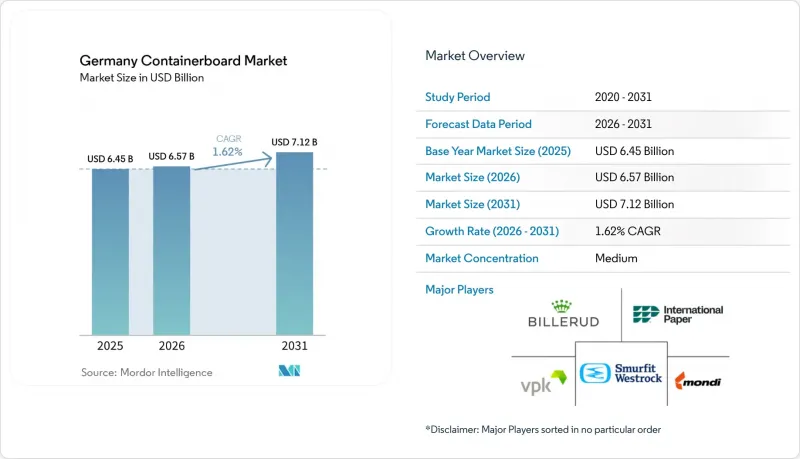
Mordor Intelligence에 의하면, 독일 컨테이너보드 시장 규모는 2025년 64억 5,000만 달러에서 2026년에는 65억 7,000만 달러로 확대되어 2031년까지 71억 2,000만 달러에 이를 것으로 예상되고 있어 2026년부터 2031년까지 CAGR 1.62%로 성장할 전망입니다.
본 보고서는 원료(버진 섬유 및 재생 섬유), 제품 유형(크래프트 라이너, 테스트 라이너, 플루팅), 그리고 최종 사용자(식품 및 음료, 소비재, 산업용 등)별로 분류되어 있습니다. 시장 전망은 금액(달러) 기준으로 제시되어 있습니다.
독일 컨테이너보드 시장 동향과 인사이트
전자상거래 및 옴니채널 주문 처리 수요 증가
독일의 온라인 소매 시장은 2025년에 924억 유로(1,000억 달러)에 달했으며, 2024년 대비 4% 증가했습니다. 마켓플레이스 플랫폼이 성장을 주도한 반면, 마켓플레이스 외 채널은 평균 5.4% 감소했습니다. 이러한 추세로 인해 컨테이너보드 수요는 소수의 대형 물류 업체에 집중되고 있으며, 독일의 컨테이너보드 시장에서 빠른 납기 및 정밀하게 구성된 경량 포맷의 가치가 높아지고 있습니다. 컨테이너보드는 보호성, 재활용성, 자동화 적합성 면에서 여전히 뛰어난 장점을 보였기 때문에 2024년 독일 전자상거래 포장 시장에서 90%의 점유율을 차지했습니다. 2024년, 독일의 전자상거래 보급률은 87%에 달했으며, 주민 1인당 평균 소포 배송 건수는 54건이었습니다. 또한, 택배·특급·소포 부문은 2031년까지 연평균 성장률(CAGR) 3.4%로 확대될 것으로 전망됩니다. 그 결과, 독일의 컨테이너보드 시장에서는 기존의 배송 모델에서 사용되던 중량급 소포용 등급보다 적정 크기의 재생 미디엄 및 테스트 라이너 포맷에 대한 수요가 증가하고 있습니다.
2차 포장 및 운송용 포장에서 플라스틱을 종이로 대체
독일에서는 상업 바이어와 규제 당국 모두가 재활용의 용이화와 규정 준수 비용 절감을 추진하고 있어, 플라스틱 운송 용기에서 종이 대체품으로의 전환이 진행되고 있습니다. 유럽 전체를 보면, 2023년 종이 및 컨테이너보드의 재활용률이 87%에 달한 반면, 플라스틱은 42.1%에 그쳤으며, EPR(확대 생산자 책임) 제도 하에서 섬유계 포장재의 경제적 이점이 더욱 커지고 있습니다. 하이델베르거 드루크마시네른 AG와 DHBW 하일브론이 공동으로 실시한 2030년까지의 포장 관련 조사에 따르면, 유연한 종이 포장재는 향후 10년간 연평균 4.5% 이상의 성장률을 보일 것으로 예측됩니다. Hugo Beck사와 Mondi사는 Interpack 2026에서 2차 포장에 플라스틱 수축 필름 대신 70 gsm 크라프트지를 사용한 ‘Paper S’ 슬리브 래퍼를 전시하고, 그 실제 적용 사례를 소개했습니다. 독일의 컨테이너보드 시장에서 이러한 변화는 운송 용도로 사용되는 두꺼운 라이너보드보다 중간 두께의 크라프트지 및 특수 플루트 등급에 대한 수요 증가를 촉진하고 있습니다.
에너지, 가스 및 OCC 비용의 변동
에너지 비용의 변동은 여전히 독일 컨테이너보드 시장에서 가장 뚜렷한 구조적 제약 요인으로 남아 있습니다. 이는 독일의 재생지 등급이 천연가스 가격의 영향을 계속해서 크게 받고 있기 때문입니다. 패스트마켓츠의 보고서에 따르면, 테스트 라이너 생산에 소요되는 에너지 소비의 68%가 천연가스에 의존하고 있으며, 화이트 라이너가 코팅된 칩보드의 경우 이 비율이 92%에 달할 수도 있습니다. 독일의 천연가스 가격은 2025년 2분기에 2024년 2분기 대비 18% 상승했으며, 에너지 가격 급등이 지속되는 가운데 2026년 초에도 생산자들은 추가적인 가격 인상을 모색하고 있었습니다. 독일의 컨테이너보드 시장에서 이러한 영향이 가장 크게 미치고 있는 곳은 비통합형 가공업체와 재생지 등급 제지업체입니다. 이러한 기업들은 비용 헤지를 할 여지가 적고, 에너지 가격과 섬유 원료 가격의 동시 급등을 흡수할 여지도 제한적이기 때문입니다.
부문별 분석
2025년 기준, 독일 컨테이너보드 시장에서 버진 섬유의 점유율은 62.5%를 차지했으나, 재생 등급은 2031년까지 연평균 성장률(CAGR) 2.1%로 성장할 것으로 전망됩니다. 재활용 원료의 성장이 가장 두드러지는 분야는 소비재, 소매 물류 및 FMCG(일용소비재) 분야이며, 이러한 분야에서는 조달 부서가 고품질 재활용 섬유를 적극적으로 도입하고 있습니다. 독일의 폐쇄형 회수 체계가 이러한 전환을 뒷받침하고 있습니다. 이는 종이 및 판지·컨테이너보드로 회수되는 상업용 운송 포장재의 무게 중 88%를 컨테이너보드가 차지하기 때문입니다. 이러한 경향은 특히 소포 및 매장 진열용 포맷에서 두드러지며, 자동 컨테이너보드 제조기에서는 더 우수한 원지 준비와 더 깨끗한 폐지(OCC) 공급을 통해 치수 일관성을 높이는 것이 중요시되고 있습니다.
한편, 의약품 2차 포장, 신선 식품, 두꺼운 두께의 산업용 컨테이너보드의 경우, 파열 강도, 인쇄 적합성, 내습성이 여전히 중요하게 여겨지고 있기 때문에 버진 펄프로 만든 판지가 구조적인 역할을 계속 수행하고 있습니다. 2024년 독일 실무자 설문조사에 따르면, 응답자의 80%가 투입되는 포장재에 포함된 버진 펄프를 재생 펄프의 품질 향상에 기여하는 요소로 보고 있습니다. 따라서 독일의 컨테이너보드 시장은 100% 재생 펄프로의 완전한 전환이 아닌, 보다 균형 잡힌 원료 구성으로 전환되고 있습니다.
기타 혜택:
- 엑셀 형식 시장 예측(ME) 시트
- 3개월간의 애널리스트 지원
자주 묻는 질문
목차
제1장 서론
제2장 조사 방법
제3장 주요 요약
제4장 시장 구도
제5장 시장 규모와 성장 예측
제6장 경쟁 구도
제7장 시장 기회와 향후 전망
JHS 26.06.23According to Mordor Intelligence, the germany containerboard market size is expected to increase from USD 6.45 billion in 2025 to USD 6.57 billion in 2026 and reach USD 7.12 billion by 2031, growing at a CAGR of 1.62% over 2026-2031.
This report is Segmented by Material (Virgin Fibers, and Recycled Fibers), Product Type (Kraftliners, Testliners, and Flutings), and End User (Food and Beverage, Consumer Goods, Industrial, and More). The Market Forecasts are Provided in Terms of Value (USD).
Germany Containerboard Market Trends and Insights
Rising E-Commerce and Omnichannel Fulfillment Demand
Germany's online retail sector rose to EUR 92.4 billion (USD 100 billion) in 2025, up 4% from 2024, with marketplace platforms driving growth while non-marketplace channels declined on average by 5.4%. This pattern is concentrating corrugated demand around a smaller set of large logistics operators, which raises the value of short lead times and tightly configured lightweight formats in the German containerboard market. Corrugated board held a 90% share of German e-commerce packaging in 2024 because it remained strong in protection, recyclability, and automation compatibility. Germany's e-commerce penetration reached 87% in 2024, average parcel deliveries were 54 per resident, and the courier, express, and parcel segment is projected to expand at a 3.4% CAGR through 2031. The German containerboard market is therefore seeing a stronger pull for right-size recycled medium and testliner formats than for heavier parcel grades used in earlier shipping models.
Plastic-to-Paper Substitution in Secondary and Transit Packaging
The move from plastic transport formats to paper-based alternatives is advancing in Germany as commercial buyers and regulators both push for easier recycling and lower compliance costs. Across Europe, paper and cardboard reached a 87% recycling rate in 2023, while plastics stood at 42.1%, strengthening the economic case for fiber-based packaging under EPR systems. The Heidelberger Druckmaschinen AG and DHBW Heilbronn study on packaging to 2030 projected that flexible paper packaging will grow by more than 4.5% annually through the decade. Hugo Beck and Mondi showcased a commercial example at Interpack 2026 featuring the Paper S sleeve wrapper, which uses 70 gsm kraft paper instead of plastic shrink film for secondary packaging. In the German containerboard market, this shift supports greater demand for medium-weight kraft and specialty fluting grades than for heavyweight linerboard in transit applications.
Volatile Energy, Gas, and OCC Costs
Energy cost volatility is still the clearest structural restraint on the Germany containerboard market because German recycled grades remain highly exposed to natural gas costs. Fastmarkets reported that testliner production draws 68% of its energy from natural gas, while white-lined chipboard can reach 92%. German natural gas prices rose 18% in Q2 2025 versus Q2 2024, and producers were still pursuing further hikes in early 2026 as energy pressure persisted. The German containerboard market feels this most sharply at non-integrated converters and recycled-grade mills, as they have less room to hedge costs or absorb concurrent spikes in energy and fiber input prices.
Other drivers and restraints analyzed in the detailed report include:
- Food and Beverage Shipment Hygiene and Shelf-Ready Needs
- High Recycled-Fiber Acceptance in German Packaging Procurement
- Weak Industrial Production and Cautious Ordering
For complete list of drivers and restraints, kindly check the Table Of Contents.
Segment Analysis
Virgin fibers held 62.5% of the Germany containerboard market share in 2025, while recycled grades are projected to grow at a 2.1% CAGR through 2031. Recycled-furnish growth is strongest in consumer goods, retail logistics, and FMCG applications where procurement teams are comfortable with high-quality recovered fiber. Germany's closed-loop collection structure supports this shift because corrugated board makes up 88% by mass of commercial transport packaging collected as paper, paperboard, and cardboard. The move is especially visible in parcel and shelf-ready formats where automated corrugators favor improved dimensional consistency from better stock preparation and cleaner OCC streams.
Virgin-fiber board still keeps a structural role in pharmaceutical secondary packaging, fresh produce, and heavy-wall industrial corrugated because those uses still value burst strength, print surface, and moisture resistance. The 2024 German practitioner survey showed that 80% of respondents see virgin fiber in incoming packaging as a positive input to recycled pulp quality. That is why the German containerboard market is moving toward a more balanced raw-material mix rather than a full shift to mono-recycled fiber.
List of Companies Covered in this Report:
- Progroup AG
- Papierfabrik Palm GmbH & Co. KG
- Hamburger Rieger GmbH
- LEIPA Georg Leinfelder GmbH
- Klingele Paper & Packaging SE & Co. KG
- Papierfabrik Adolf Jass GmbH & Co. KG
- THIMM Group GmbH + Co. KG
- Dunapack Spremberg GmbH & Co. KG
- Mondi plc
- Smurfit Westrock plc
- Saica, S.A.
- VPK Group NV
- Model GmbH
- Rondo Ganahl AG
- Billerud AB
- Metsa Board Corporation
- Schumacher Packaging GmbH
Additional Benefits:
- The market estimate (ME) sheet in Excel format
- 3 months of analyst support
TABLE OF CONTENTS
1 INTRODUCTION
- 1.1 Study Assumptions and Market Definition
- 1.2 Scope of the Study
2 RESEARCH METHODOLOGY
3 EXECUTIVE SUMMARY
4 MARKET LANDSCAPE
- 4.1 Market Overview
- 4.2 Market Drivers
- 4.2.1 Rising E-Commerce and Omnichannel Fulfillment Demand
- 4.2.2 Plastic-to-Paper Substitution in Secondary and Transit Packaging
- 4.2.3 Food and Beverage Shipment Hygiene and Shelf-Ready Needs
- 4.2.4 High Recycled-Fiber Acceptance in German Packaging Procurement
- 4.2.5 Lightweight Sub-100 gsm Grade Adoption on Automated Corrugators
- 4.2.6 Alternative-Fiber Blending for White-Top and Specialty Liner Innovation
- 4.3 Market Restraints
- 4.3.1 Volatile Energy, Gas, and OCC Costs
- 4.3.2 Weak Industrial Production and Cautious Ordering
- 4.3.3 Recovered-Fiber Export Disruptions Distorting Domestic Supply Economics
- 4.3.4 PPWR Compliance and Documentation Costs Ahead of Full Monetization
- 4.4 Industry Value Chain Analysis
- 4.5 Regulatory Landscape
- 4.6 Technological Outlook
- 4.7 Porter's Five Forces Analysis
- 4.7.1 Threat of New Entrants
- 4.7.2 Bargaining Power of Suppliers
- 4.7.3 Bargaining Power of Buyers
- 4.7.4 Threat of Substitutes
- 4.7.5 Competitive Rivalry
5 MARKET SIZE AND GROWTH FORECASTS (VALUE)
- 5.1 By Material
- 5.1.1 Virgin Fibers
- 5.1.2 Recycled Fibers
- 5.2 By Product Type
- 5.2.1 Kraftliners
- 5.2.2 Testliners
- 5.2.3 Flutings
- 5.3 By End User
- 5.3.1 Food and Beverage
- 5.3.2 Consumer Goods
- 5.3.3 Industrial
- 5.3.4 Other End Users
6 COMPETITIVE LANDSCAPE
- 6.1 Market Concentration
- 6.2 Strategic Moves
- 6.3 Market Share Analysis
- 6.4 Company Profiles (includes Global level Overview, Market level overview, Core Segments, Financials as available, Strategic Information, Market Rank/Share for key companies, Products and Services, and Recent Developments)
- 6.4.1 Progroup AG
- 6.4.2 Papierfabrik Palm GmbH & Co. KG
- 6.4.3 Hamburger Rieger GmbH
- 6.4.4 LEIPA Georg Leinfelder GmbH
- 6.4.5 Klingele Paper & Packaging SE & Co. KG
- 6.4.6 Papierfabrik Adolf Jass GmbH & Co. KG
- 6.4.7 THIMM Group GmbH + Co. KG
- 6.4.8 Dunapack Spremberg GmbH & Co. KG
- 6.4.9 Mondi plc
- 6.4.10 Smurfit Westrock plc
- 6.4.11 Saica, S.A.
- 6.4.12 VPK Group NV
- 6.4.13 Model GmbH
- 6.4.14 Rondo Ganahl AG
- 6.4.15 Billerud AB
- 6.4.16 Metsa Board Corporation
- 6.4.17 Schumacher Packaging GmbH
7 MARKET OPPORTUNITIES AND FUTURE OUTLOOK
- 7.1 White-Space and Unmet-Need Assessment


