

|
시장보고서
상품코드
2065458
베트남의 컨테이너보드 시장 : 시장 점유율 분석, 업계 동향 및 통계, 성장 예측(2026-2031년)Vietnam Containerboard - Market Share Analysis, Industry Trends & Statistics, Growth Forecasts (2026 - 2031) |
||||||
 Mordor Intelligence
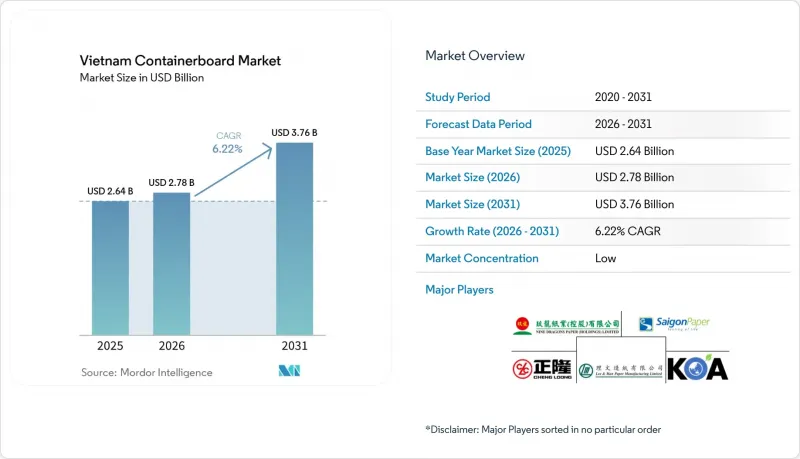
베트남의 컨테이너보드 시장 규모는 2025년에 26억 4,000만 달러로 평가되었고, 2026년 27억 8,000만 달러로 추정되고, 2031년까지 37억 6,000만 달러에 이를 것으로 예측되며, 예측 기간(2026-2031년) CAGR은 6.22%를 나타낼 전망입니다.
본 보고서는 원료별(버진 섬유 및 재생 섬유), 제품 유형별(크래프트 라이너, 테스트 라이너, 플루팅), 그리고 최종 사용자 산업별(식품 및 음료, 소비재, 산업용 등)로 분류되어 있습니다. 시장 전망은 금액(달러) 기준으로 제시되어 있습니다.
베트남의 컨테이너보드 시장 동향 및 인사이트
전자상거래 소포 증가와 라스트 마일 배송에서 골판지 상자의 사용 밀도
베트남의 주요 전자상거래 플랫폼은 2026년 1분기에 총 상품 가치(GMV) 148조 6,000억 VND(57억 달러)를 기록했으며, 판매량은 11억 4,000만 건에 달했습니다. 이는 전년 동기 대비 각각 47%, 20% 증가한 수치입니다. 베트남의 국내 전자상거래 시장은 2025년에 310억 달러에 달했으며, 베트남은 세계 온라인 소매 시장 상위 10위권, 아세안(ASEAN)에서는 상위 3위권에 진입했습니다. 베트남 골판지 시장의 중요한 변화는 풀필먼트가 보다 개별화된 포장을 통해 보호성이 높은 배송 방식으로 전환되고 있다는 점에 있습니다. 이로 인해 상품 수 증가율은 매출액 증가율보다 완만함에도 불구하고, 주문당 골판지 사용량이 증가하고 있습니다. 이러한 경향은 소포 처리량, 창고, 라스트 마일 활동이 가장 집중되어 있는 호치민시, 하노이, 빈즈엉에서 특히 두드러집니다. ‘2026-2030년 국가 전자상거래 개발 마스터플랜’에서는 온라인 소매의 연간 성장률을 15%-20%로 목표로 하고 있으며, 베트남의 골판지 시장은 향후 몇 년간 출하량에 힘입어 수요가 꾸준히 증가할 것으로 전망됩니다.
수출용 제조업의 이전이 산업용 골판지 수요를 끌어올렸습니다.
2025년, 베트남의 제조업은 10.6% 성장하며 7년 만에 가장 높은 산업 생산 증가율을 기록했습니다. 한편, 전자기기·컴퓨터의 수출액은 1,000억 달러를 넘어섰고, 섬유제품의 수출액은 460억 달러에 달했습니다. 일본계 기업을 대상으로 실시한 조사에 따르면, 베트남에서 사업을 영위하는 응답 기업의 56.9%가 향후 1-2년 이내에 생산 능력 확대를 계획하고 있으며, 이는 아세안(ASEAN) 국가 중 가장 높은 확대 의향률입니다. 베트남의 골판지 원지 시장에 있어 이는 중요한 의미를 지닙니다. 왜냐하면 새로운 공장이 하나 늘어날 때마다 부품 포장, 중간재 포장, 수출용 마스터 카톤 등 여러 단계에 걸친 포장 수요가 발생하기 때문입니다. 또한, 전자기기 조립 공정에서는 더욱 견고한 골판지 형태가 요구되며, 대부분의 경우 3층 또는 5층 상자 구조가 채택되기 때문에 고성능 크라프트 라이너 및 플루팅 등급 수요가 증가하고 있습니다. 수출 지향형 생산이 북부 및 남부의 산업 지역으로 이동함에 따라, 베트남의 컨테이너보드 시장은 더욱 산업적이고 사양 중심 수요 기반으로 계속 전환되고 있습니다.
OCC 및 펄프 가격 변동이 가공업체의 이익률을 압박하고 있습니다.
2024년 하반기, 베트남에 제품을 공급하는 제지 업체들은 미국의 더블 소트 OCC에 대해 톤당 195-200달러를 지불하고 있었으나, 이후 가격 하락으로 인해 동남아시아 전역의 조달 경제성이 변화했습니다. 2025년 10월에 도입된 중국의 재생 펄프 수입 제한 조치는 지역 내 OCC에서 펄프로 이어지는 공급망을 혼란에 빠뜨렸으며, 수입 재생 섬유의 구매 패턴을 변화시켰습니다. 대규모 통합 제지 업체는 소규모 제지 업체나 가공업체에 비해 규모가 크고 재고도 풍부하며 가격 결정력이 높기 때문에 이러한 압박에 효과적으로 대처할 수 있습니다. 베트남 제지 및 펄프 협회에 따르면, 2025년 국내 회수량은 OCC 수요의 불과 56%만을 충족하고 있으며, 나머지 44%는 세계 폐지 가격 및 운임 변동의 영향을 받기 쉬운 상황입니다. 비용 변동은 판매 가격 재조정보다 더 빨리 공급망 전반에 파급되기 때문에 이러한 영향은 여전히 베트남 골판지 시장에 있어 단기적으로 가장 큰 걸림돌이 되고 있습니다.
부문별 분석
2025년, 베트남 골판지 시장에서 재생 섬유는 68.11%의 점유율을 차지했으며, 여전히 확고한 1위 자리를 지켰습니다. 이는 OCC를 원료로 한 판지가 표준 골판지 등급에 있어 여전히 가장 경제적인 선택지였기 때문입니다. 그동안 현지 생산량의 80% 이상이 폐지 원료에 의존해 왔기 때문에 재생 원료는 제지 공장의 수익성 및 가공업체의 조달 패턴에서 여전히 핵심적인 위치를 차지하고 있습니다. 베트남의 국내 OCC 회수율은 2021년 46%에서 2024년에는 58%로 향상되었으며, 재생 섬유 공급에 대한 수입 의존도는 낮아졌지만 완전히 해소된 것은 아닙니다. 아시아 전체의 OCC 처리 능력은 2028년까지 450만 톤 증가할 것으로 예상되며, 그 증가분의 거의 절반을 베트남이 차지할 전망입니다. 이로써 해당국은 지역 내 2차 섬유 가공국으로서의 역할을 한층 더 강화하게 될 것입니다.
2025년에는 버진 섬유가 31.89%를 차지한 것으로 평가되었으며, 베트남 골판지 시장에서 이 부문은 2031년까지 연평균 성장률(CAGR) 6.74%로 성장할 것으로 전망됩니다. 타이꽝성이나 박닌성 등의 지역에서 전자기기 및 반도체 조립 공정에서는 보다 안정적인 압축 강도와 낮은 습기 민감성을 갖춘 포장재가 요구되고 있으며, 이것이 프리미엄 라이너보드 등급에 대한 수요를 뒷받침하고 있습니다. 다국적 기업의 바이어들도 스코프 3 보고 요건에 따라 현지 공급업체에 재생재 함유율 제고를 요구하고 있지만, 해당 포장 사양에서는 여전히 버진 펄프를 주원료로 하는 보드를 선호하는 성능 기준이 요구되는 경우가 많습니다. 이러한 모순으로 인해 프리미엄 등급공급 부족이 지속되고 있으며, 이는 버진 펄프 관련 자산에 대한 추가 투자 의지를 뒷받침하고 있습니다. 따라서 베트남의 컨테이너보드 업계는 재생 보드가 여전히 가장 큰 비중을 차지하고 있지만, 점차 더 다양한 원료 구성으로 전환되고 있습니다.
기타 혜택 :
- 엑셀 형식 시장 예측(ME) 시트
- 3개월간의 애널리스트 지원
자주 묻는 질문
목차
제1장 서론
제2장 조사 방법
제3장 주요 요약
제4장 시장 구도
제5장 시장 규모 및 성장 예측
제6장 경쟁 구도
제7장 시장 기회 및 향후 전망
AJY 26.06.26According to Mordor Intelligence, the vietnam containerboard market size was valued at USD 2.64 billion in 2025 and estimated to grow from USD 2.78 billion in 2026 to reach USD 3.76 billion by 2031, at a CAGR of 6.22% during the forecast period (2026-2031).
This report is Segmented by Material (Virgin Fibers and Recycled Fibers), Product Type (Kraftliners, Testliners, and Flutings), and End-User Industry (Food and Beverage, Consumer Goods, Industrial, and More). The Market Forecasts are Provided in Terms of Value (USD).
Vietnam Containerboard Market Trends and Insights
E-Commerce Parcel Expansion And Last-Mile Box Intensity
Vietnam's leading e-commerce platforms generated VND 148.6 trillion (USD 5.7 billion) in gross merchandise value in Q1 2026, while sales volume reached 1.14 billion items, up 47% and 20% year over year, respectively. Vietnam's domestic e-commerce market reached USD 31 billion in 2025, placing the country among the world's top 10 and ASEAN's top 3 online retail markets. The important shift in the Vietnam containerboard market is that fulfillment is moving toward more individually boxed, better-protected shipments, which increases corrugated board usage per order even as item counts grow more slowly than sales value. This pattern is strongest in Ho Chi Minh City, Hanoi, and Binh Duong, where parcel density, warehousing, and last-mile activity are most concentrated. With the National E-commerce Development Master Plan for 2026-2030 targeting annual online retail growth of 15%-20%, the Vietnam containerboard market is set to receive a steady flow of shipment-driven demand over the next several years.
Export Manufacturing Relocation Boosting Industrial Carton Demand
Vietnam's manufacturing sector grew 10.6% in 2025, the strongest industrial output growth in 7 years, while electronics and computers exceeded USD 100 billion in exports, and textiles reached USD 46 billion in exports. A survey of Japanese firms showed that 56.9% of respondents in Vietnam planned capacity expansion over the next 1-2 years, the highest expansion intent rate in ASEAN. For the Vietnam containerboard market, this matters because each new factory adds several layers of packaging demand, including packaging for components, intermediate goods, and export master cartons. Electronics assembly also requires stronger corrugated formats, often using 3-layer and 5-layer box structures, which increases demand for higher-performance kraftliner and fluting grades. As more export-oriented production shifts to northern and southern industrial provinces, the Vietnam containerboard market continues to move toward a more industrial, specification-driven demand base.
OCC And Pulp Cost Volatility Squeezing Converter Margins
Vietnam-bound mills were paying USD 195-200 per ton for US double-sorted OCC in late 2024 before later price declines changed procurement economics across Southeast Asia. China's recycled pulp import restrictions, introduced in October 2025, disrupted the regional OCC-to-pulp chain and altered buying patterns for imported recovered fiber. Large integrated mills can handle this pressure better because they have scale, broader inventories, and stronger pricing leverage than smaller mills and converters. Vietnam's Pulp and Paper Association said domestic collection met only 56% of OCC demand in 2025, leaving the remaining 44% exposed to global recovered paper and freight swings. That exposure remains the biggest near-term brake on the Vietnam containerboard market because cost movements can pass through the supply chain faster than selling prices can be reset.
Other drivers and restraints analyzed in the detailed report include:
- Food And Beverage Cold-Chain And Modern Retail Expansion
- Plastic Substitution And EPR Compliance Favoring Fiber Packaging
- Import Dependence For Virgin Fiber And Premium Kraftliner Grades
For complete list of drivers and restraints, kindly check the Table Of Contents.
Segment Analysis
Recycled fibers accounted for 68.11% of the Vietnam containerboard market share in 2025, keeping them firmly in the leading position, as OCC-based board remained the most economical option for standard corrugated grades. Over 80% of local production historically relied on recovered paper feedstock, so recycled furnish stayed central to mill economics and converter sourcing patterns. Vietnam's domestic OCC recovery rate improved from 46% in 2021 to 58% in 2024, reducing but not eliminating import dependence for recycled fiber supply. Asia's total OCC capacity is expected to grow by 4.5 million tons by 2028, with Vietnam contributing close to half of that expansion, strengthening the country's role as a regional secondary fiber processor.
Virgin fibers accounted for 31.89% in 2025, and this segment of the Vietnam containerboard market is projected to grow at a 6.74% CAGR through 2031. Electronics and semiconductor assembly in provinces such as Thai Nguyen and Bac Ninh require packaging with more stable compression strength and lower moisture sensitivity, which supports demand for premium linerboard grades. Multinational buyers are also pushing local suppliers to increase recycled content because of Scope 3 reporting, but their packaging specifications still require performance standards that often favor virgin-furnish board. That conflict keeps a premium-grade supply gap in place and supports further investment interest in virgin-capable assets. The Vietnam containerboard industry is therefore moving toward a more mixed furnish structure, even though recycled board remains the largest base.
List of Companies Covered in this Report:
- Vina Kraft Paper Co., Ltd.
- Cheng Loong Binh Duong Paper Co., Ltd.
- Vietnam Lee & Man Paper Manufacturing Limited
- Nine Dragons Paper (Holdings) Limited
- Kraft of Asia Paperboard & Packaging Co., Ltd.
- Saigon Paper Corporation
- Dong Hai Ben Tre Joint Stock Company
- Miza Corporation
- HHP Global Joint Stock Company
- Minhan Paper Joint Stock Company
- Dong Tien-Long An Paper Joint Stock Company
- Vina Corrugated Packaging Co., Ltd.
- Bien Hoa Packaging Joint Stock Company
- Settsu Carton Vietnam Corporation
- Ojitex (Vietnam) Company Limited
- Song Lam Trading & Packaging Production Co., Ltd.
- Khang Thanh Manufacturing Co., Ltd.
- HC Packaging Vietnam Company Limited
- Starprint Vietnam Joint Stock Company
- United Packaging Co., Ltd.
Additional Benefits:
- The market estimate (ME) sheet in Excel format
- 3 months of analyst support
TABLE OF CONTENTS
1 INTRODUCTION
- 1.1 Study Assumptions and Market Definition
- 1.2 Scope of the Study
2 RESEARCH METHODOLOGY
3 EXECUTIVE SUMMARY
4 MARKET LANDSCAPE
- 4.1 Market Overview
- 4.2 Market Drivers
- 4.2.1 E-commerce Parcel Expansion and Last-Mile Box Intensity
- 4.2.2 Export Manufacturing Relocation Boosting Industrial Carton Demand
- 4.2.3 Food and Beverage Cold-Chain and Modern Retail Expansion
- 4.2.4 Plastic Substitution and EPR Compliance Favoring Fiber Packaging
- 4.2.5 Scope 3 Procurement Rules Favoring Lightweight Local Recycled Board
- 4.2.6 AI-Led Box Optimization Improving Yield for Short-Run Orders
- 4.3 Market Restraints
- 4.3.1 OCC and Pulp Cost Volatility Squeezing Converter Margins
- 4.3.2 Import Dependence for Virgin Fiber and Premium Kraftliner Grades
- 4.3.3 Monsoon Humidity Weakening Compression Strength in Storage and Transit
- 4.3.4 Export-Market ESG Traceability and Carbon Disclosure Burden
- 4.4 Industry Value Chain Analysis
- 4.5 Impact of Macroeconomic Factors on the Market
- 4.6 Regulatory Landscape
- 4.7 Technological Outlook
- 4.8 Porter's Five Forces Analysis
- 4.8.1 Threat of New Entrants
- 4.8.2 Bargaining Power of Suppliers
- 4.8.3 Bargaining Power of Buyers
- 4.8.4 Threat of Substitutes
- 4.8.5 Competitive Rivalry
5 MARKET SIZE AND GROWTH FORECASTS (VALUE)
- 5.1 By Material
- 5.1.1 Virgin Fibers
- 5.1.2 Recycled Fibers
- 5.2 By Product Type
- 5.2.1 Kraftliners
- 5.2.2 Testliners
- 5.2.3 Flutings
- 5.3 By End-User Industry
- 5.3.1 Food and Beverage
- 5.3.2 Consumer Goods
- 5.3.3 Industrial
- 5.3.4 Other End-User Industries
6 COMPETITIVE LANDSCAPE
- 6.1 Market Concentration
- 6.2 Strategic Moves
- 6.3 Market Share Analysis
- 6.4 Company Profiles (includes Global Level Overview, Market Level Overview, Core Segments, Financials as available, Strategic Information, Market Rank/Share, Products and Services, Recent Developments)
- 6.4.1 Vina Kraft Paper Co., Ltd.
- 6.4.2 Cheng Loong Binh Duong Paper Co., Ltd.
- 6.4.3 Vietnam Lee & Man Paper Manufacturing Limited
- 6.4.4 Nine Dragons Paper (Holdings) Limited
- 6.4.5 Kraft of Asia Paperboard & Packaging Co., Ltd.
- 6.4.6 Saigon Paper Corporation
- 6.4.7 Dong Hai Ben Tre Joint Stock Company
- 6.4.8 Miza Corporation
- 6.4.9 HHP Global Joint Stock Company
- 6.4.10 Minhan Paper Joint Stock Company
- 6.4.11 Dong Tien-Long An Paper Joint Stock Company
- 6.4.12 Vina Corrugated Packaging Co., Ltd.
- 6.4.13 Bien Hoa Packaging Joint Stock Company
- 6.4.14 Settsu Carton Vietnam Corporation
- 6.4.15 Ojitex (Vietnam) Company Limited
- 6.4.16 Song Lam Trading & Packaging Production Co., Ltd.
- 6.4.17 Khang Thanh Manufacturing Co., Ltd.
- 6.4.18 HC Packaging Vietnam Company Limited
- 6.4.19 Starprint Vietnam Joint Stock Company
- 6.4.20 United Packaging Co., Ltd.
7 MARKET OPPORTUNITIES AND FUTURE OUTLOOK
- 7.1 White-Space and Unmet-Need Assessment


