

|
시장보고서
상품코드
2063944
중국의 LED 포장 시장 : 시장 점유율 분석, 업계 동향 및 통계, 성장 예측(2026-2031년)China LED Packaging - Market Share Analysis, Industry Trends & Statistics, Growth Forecasts (2026 - 2031) |
||||||
 Mordor Intelligence
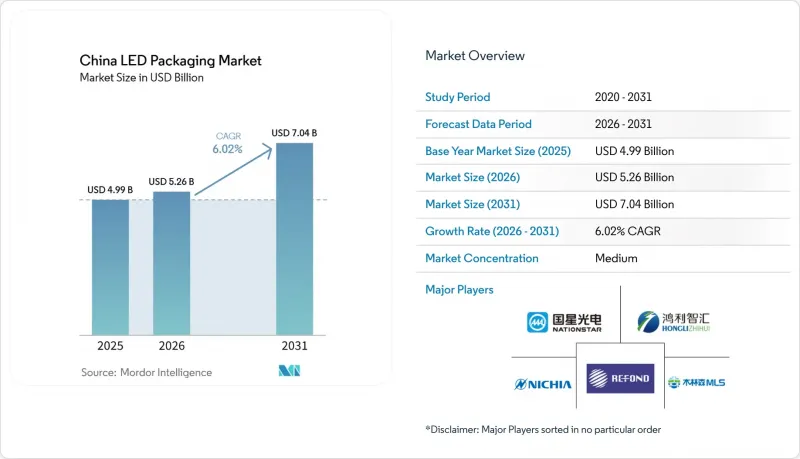
Mordor Intelligence에 의하면, 중국의 LED 포장 시장 규모는 2025년에 49억 9,000만 달러로 평가되었고, 2026년에 52억 6,000만 달러로 추정되고, 2031년까지 70억 4,000만 달러에 이를 것으로 예측되며, 2026-2031년 CAGR 6.02%로 성장할 전망입니다.
본 보고서는 포장 아키텍처별(칩 온 보드(COB), 기타), 출력 등급별(중출력(0.5-1W), 고출력(1-3W), 기타), 발광 유형별(가시광선 LED 포장, 적외선(IR) LED 포장, 기타), 재료 화학별(캡슐화, 기타), 용도별(일반 조명, 자동차용 조명, 기타), 지역별로 분류되어 있습니다. 시장 전망은 금액(달러) 기준으로 제공됩니다.
중국의 LED 포장 시장 동향 및 분석
정부 주도의 스마트시티용 LED 교체 사업
지자체 조달 프로그램에 따라 기존 가로등이 조광 기능, 센서, 원격 진단 기능을 통합한 네트워크 지원 LED 조명 기기로 교체되고 있습니다. 2024년 톈진시 빈하이 신구에서 완료된 79,000기 규모의 개보수 프로젝트를 통해 에너지 사용량을 40% 절감함으로써, 중-고출력 칩 온 보드(COB) 모듈의 효과를 입증했습니다. 입찰 서류에서는 GB 7000.1-2024 안전 기준 및 국내 조달 비율 요건에 대한 준수가 점점 더 요구되고 있으며, 국가 IoT 규격과의 상호 운용성을 입증할 수 있는 중국 포장 제조업체에 계약이 수여되는 추세입니다. 스마트 가로등 컨트롤러가 텔레메트리 데이터를 수집하기 때문에 견고한 분석 플랫폼을 갖춘 공급업체는 지속적인 서비스 수익을 창출할 수 있습니다. 이러한 성과 기반 계약으로의 전환에 따라, 사내에서 운전사용 전자 기기 및 현장 고장 진단을 직접 관리하는 수직 통합형 진출기업의 경쟁력이 강화되고 있습니다.
미니 및 마이크로 LED 백라이트 도입 가속화
중국에서는 2025년에 800만 대 이상의 미니 LED TV가 출하될 전망이며, 100인치 패널의 소매 가격이 1만 위안(1,385달러) 아래로 떨어짐에 따라 2026년에는 출하 대수가 1,000만 대를 넘어설 것으로 예측됩니다. 하이센스의 116인치 RGB 미니 LED 등 플래그십 모델은 패널당 다이 수를 3배로 늘려 BT.2020 커버리지 97%와 피크 밝기 1만 닛을 달성함으로써, 칩 스케일 포장(CSP)에 대한 수요를 대폭 확대되고 있습니다. 50마이크로미터 이하의 엄격한 실장 공차와 99.9%를 초과하는 수율 목표는 시장 진입 장벽을 높이고 있으며, BOE, 중국 싱광전자, 국내 포장 제조업체 간의 장기적인 공급 제휴를 촉진하고 있습니다. 한국과 일본의 경쟁사들은 현재 동등한 사양에서 50%의 가격 경쟁력 부족에 직면해 있어, 자사의 RGB 마이크로 LED 로드맵을 앞당길 수밖에 없는 상황입니다.
중출력 제품의 과잉 생산 능력으로 인한 가격 하락
주요 포장 제조업체들이 2026년 3월에 발표한 3%-25%의 정가 인상은 저장성에서는 곧 그 수준보다 낮아졌습니다. 해당 지역에서는 저가 제품군의 불량률이 여전히 15% 전후를 유지하고 있으며, 설비 가동률은 손익분기점인 85%를 밑돌고 있습니다. 2024년 산업 전체의 매출액은 8.9% 증가했으나, 이익 증가는 자동차용 및 미니 LED에 주력하는 기업들로 한정되어 있어, 원자재 가격의 취약성이 여실히 드러났습니다. 2025년 상반기, MLS와 NationStar의 매출은 감소한 반면, 틈새 시장에 진출한 기업인 Refond와 Jufei는 두 자릿수 성장을 기록하며, 중출력 부문의 구조적 공급 과잉이 입증되었습니다. 공장 폐쇄나 수요 증가로 인해 이러한 공급 과잉이 해소될 때까지 이익률 압박은 지속될 것이며, 이는 SMD 라인에 대한 신규 투자를 저해할 것으로 보입니다.
부문별 분석
TV 제조업체들이 백색 백라이트에서 더 높은 다이 밀도와 엄격한 배치 공차가 요구되는 RGB 미니 LED 엔진으로 전환함에 따라, 칩 스케일 포장 시장은 2031년까지 연평균 성장률(CAGR) 6.78%로 확대될 것으로 전망됩니다. 2025년에도 표면 실장 소자(SMD) 형태는 중국 LED 포장 시장 점유율의 42.78%를 차지했습니다. 이는 수십 년에 걸친 자동화로 인해 불량률이 2% 이하로 낮아졌고, 1만 개 단위의 주문 시 단가가 0.10달러 미만으로 떨어졌기 때문입니다.
대량 생산되는 2835, 3030, 5050 규격의 포장은 여전히 주거용 조명 분야에서 필수적이지만, 우수한 방열 성능이 요구되는 대전류 자동차용 모듈의 경우, 와이어 본딩이 필요 없는 플립칩 소자가 주류를 이루고 있습니다. 톈먼시에서 건설 중인 유리 기판용 양산 라인은 99.995%의 전사 수율을 목표로 하고 있으며, 이 수준을 달성하면 비용 효율이 뛰어난 마이크로 LED가 탑재된 웨어러블 기기나 자동차용 디스플레이의 실현이 가능해질 것으로 보입니다.
2025년, 정격 0.5-1W의 중출력 LED는 총 매출의 35.49%를 차지했습니다. 그러나 공급 과잉이 지속되고 있어, 이러한 LED 제품들은 한 자릿수 대의 매출 총이익률로 어려움을 겪고 있습니다. 한편, 정격 출력 1-3W의 고출력 포장 시장은 연평균 성장률(CAGR) 6.94%로 성장을 지속하고, 있습니다. 이러한 급속한 성장은 주로 적응형 주행 빔 헤드라이트와 산업용 하이베이 조명 기구에 적용된 데 기인하며, 이 두 가지 모두 조명 기구의 수를 줄이고 유지보수 작업을 경감시키는 데 기여하는 것으로 알려져 있습니다.
0.5W 이하의 출력 레벨을 가진 표시기급 발광 소자는 웨어러블 기기 및 간판 시장에서 주도적인 역할을 하고 있습니다. 그러나 이러한 부문의 이익률이 극히 낮기 때문에 재투자나 추가 개발의 기회가 크게 제한되고 있습니다. 한편, 하이엔드 시장에서는 3W를 초과하는 구리 기판 발광 소자가 원예용 재배 조명 및 경기장용 투광등을 대상으로 하고 있습니다. 이러한 용도에서는 높은 루멘 밀도와 긴 L70 수명을 얻기 위해 30%-50%의 가격 프리미엄을 감수하고 있습니다.
기타 혜택
- 엑셀 형식 시장 예측(ME) 시트
- 3개월간의 애널리스트 지원
자주 묻는 질문
목차
제1장 서론
제2장 조사 방법
제3장 주요 요약
제4장 시장 구도
제5장 시장 규모 및 성장 예측
제6장 경쟁 구도
제7장 시장 기회 및 향후 전망
AJY 26.06.24According to Mordor Intelligence, the china lED packaging market size is projected to be USD 4.99 billion in 2025, USD 5.26 billion in 2026, and reach USD 7.04 billion by 2031, growing at a CAGR of 6.02% from 2026 to 2031.
This report is Segmented by Packaging Architecture (Chip-On-Board (COB), and More), Power Class (Mid Power (0. 5-1 W), High Power (1-3 W), and More), Emission Type (Visible LED Packages, Infrared (IR) LED Packages, and More), Material Chemistry (Encapsulation, and More), Application (General Lighting, Automotive Lighting, and More), and Geography. The Market Forecasts are Provided in Terms of Value (USD).
China LED Packaging Market Trends and Insights
Government-Backed Smart-City LED Retrofits
Municipal procurement programs are replacing legacy streetlights with networked LED luminaires that integrate dimming, sensors, and remote diagnostics. Projects such as the 79 000-unit retrofit completed in Tianjin's Binhai New Area in 2024 cut energy use by 40%, proving the case for mid- to high-power chip-on-board modules. Tender documents increasingly require compliance with GB 7000.1-2024 safety rules and domestic-content thresholds, directing contract awards to Chinese packagers that can certify interoperability with national IoT standards. Because smart-streetlight controllers collect telemetry, suppliers with robust analytics platforms gain recurring service revenue. This shift toward performance-based contracts strengthens the grip of vertically integrated players that maintain in-house driver electronics and field-failure diagnostics.
Accelerating Mini/Micro-LED Backlighting Adoption
China shipped more than 8 million mini-LED televisions in 2025, and volumes are forecast to top 10 million units in 2026 as retail prices for 100-inch panels fall below CNY 10 000 (USD 1 385). Flagship sets such as Hisense's 116-inch RGB mini-LED achieve 97% BT.2020 coverage and 10 000-nit peaks by tripling die counts per panel, massively expanding demand for chip-scale packages. Placement tolerances tighter than 50 µm and yield targets above 99.9% elevate the barrier to entry, prompting long-term supply tie-ups between BOE, China Star Optoelectronics, and domestic packagers. Korean and Japanese competitors now face a 50% price disadvantage on comparable specifications, spurring them to accelerate their own RGB micro-LED roadmaps.
Price Erosion from Excess Mid-Power Capacity
March 2026 list-price hikes of 3%-25% announced by leading packagers were quickly undercut in Zhejiang, where defect rates in budget lines still hover near 15% and equipment utilization lags the 85% break-even threshold. Combined industry revenue grew 8.9% in 2024, yet profit expansion was confined to firms with automotive or mini-LED focus, highlighting the fragility of commodity pricing. Revenue at MLS and NationStar declined in the first half of 2025, even as niche players Refond and Jufei posted double-digit growth, confirming the structural oversupply in mid-power formats. Until plant closures or demand growth absorb this overhang, margin compression will persist, discouraging fresh investment in SMD lines.
Other drivers and restraints analyzed in the detailed report include:
- Automotive LED Penetration in NEVs
- Export-Oriented EMS Demand for SMD Packages
- Dependence on Imported High-Performance Phosphors
For complete list of drivers and restraints, kindly check the Table Of Contents.
Segment Analysis
Chip-scale packages are projected to expand at a 6.78% CAGR through 2031 as television makers move from white backlights to RGB mini-LED engines that need higher die density and tighter placement tolerances. Surface-mount device formats still held 42.78% of the China LED packaging market share in 2025, as decades of automation have driven defect rates below 2% and pushed unit pricing to under USD 0.10 for 10 000-piece orders.
High-volume 2835, 3030, and 5050 footprints remain indispensable in residential lamps, yet flip-chip devices without wire bonds now dominate high-current automotive modules that need superior heat dissipation. Glass-substrate mass-transfer lines under construction in Tianmen aim for 99.995% transfer yields, a threshold that could unlock cost-effective micro-LED wearables and automotive displays.
In 2025, mid-power LEDs, rated between 0.5-1 W, accounted for 35.49% of total revenue. However, due to a persistent oversupply, these LEDs are grappling with single-digit gross margins. On the other hand, high-power packages, rated between 1-3 W, are witnessing a growth rate of 6.94% CAGR. This surge is largely attributed to their adoption in adaptive driving-beam headlights and industrial high-bay luminaires, both of which are known to reduce fixture counts and maintenance labor.
Indicator-class emitters with power levels below 0.5 W play a dominant role in the wearables and signage markets. However, the extremely narrow profit margins in these segments significantly constrain opportunities for reinvestment and further development. At the top end, copper-substrate emitters above 3 W now target horticultural grow lights and stadium floodlamps that absorb the 30%-50% price premium in exchange for higher lumen density and long L70 life.
List of Companies Covered in this Report:
- MLS Co. Ltd.
- NationStar Optoelectronics Co. Ltd.
- Hongli Zhihui Group Co. Ltd.
- Refond Optoelectronics Co. Ltd.
- Jufei Optoelectronics Co. Ltd.
- San'an Optoelectronics Co. Ltd.
- Nichia Corporation
- ams OSRAM AG
- Samsung Electronics Co. Ltd. (Samsung LED)
- Seoul Semiconductor Co. Ltd.
- Lumileds Holding B.V.
- Everlight Electronics Co. Ltd.
- Bridgelux Inc.
- Citizen Electronics Co. Ltd.
- Cree LED
- Epistar Corporation
- Foshan NationStar Optoelectronics
- Lite-On Technology Corporation
- TongYiFang Optoelectronics
- Ledteen Lighting Co. Ltd.
Additional Benefits:
- The market estimate (ME) sheet in Excel format
- 3 months of analyst support
TABLE OF CONTENTS
1 INTRODUCTION
- 1.1 Study Assumptions and Market Definition
- 1.2 Scope of the Study
2 RESEARCH METHODOLOGY
3 EXECUTIVE SUMMARY
4 MARKET LANDSCAPE
- 4.1 Market Overview
- 4.2 Market Drivers
- 4.2.1 Government-Backed Smart-City LED Retrofits
- 4.2.2 Accelerating Mini / Micro-LED Backlighting Adoption
- 4.2.3 Automotive LED Penetration in NEVs
- 4.2.4 Export-Oriented EMS Demand for SMD Packages
- 4.2.5 Vertical Integration by Chinese LED Champions
- 4.2.6 Mass-Transfer Glass Substrate Packaging Breakthroughs
- 4.3 Market Restraints
- 4.3.1 Price Erosion from Excess Mid-Power Capacity
- 4.3.2 Dependence on Imported High-Performance Phosphors
- 4.3.3 Labor-Cost Inflation in Coastal Clusters
- 4.3.4 Recycling And E-Waste Compliance Costs
- 4.4 Industry Value-Chain Analysis
- 4.5 Technology Analysis
- 4.6 Regulatory Landscape
- 4.7 Impact of Macroeconomic Factors
- 4.8 Porter's Five Forces Analysis
- 4.8.1 Bargaining Power of Suppliers
- 4.8.2 Bargaining Power of Buyers
- 4.8.3 Threat of New Entrants
- 4.8.4 Threat of Substitutes
- 4.8.5 Intensity of Competitive Rivalry
5 MARKET SIZE AND GROWTH FORECASTS (VALUE)
- 5.1 By Packaging Architecture
- 5.1.1 Surface Mount Device (SMD)
- 5.1.2 Chip-on-Board (COB)
- 5.1.3 Chip Scale Package (CSP)
- 5.1.4 Flip-Chip LED Packages
- 5.1.5 Dual In-line Package (DIP / Through-hole)
- 5.1.6 Other Packaging Architectures (IMD, GOB, Mini-LED Display Packaging)
- 5.2 By Power Class
- 5.2.1 Low Power (Below 0.5 W)
- 5.2.2 Mid Power (0.5-1 W)
- 5.2.3 High Power (1-3 W)
- 5.2.4 Ultra-High Power (Above 3 W)
- 5.3 By Emission Type
- 5.3.1 Visible LED Packages
- 5.3.2 Infrared (IR) LED Packages
- 5.3.3 Ultraviolet (UV) LED Packages
- 5.4 By Material Chemistry
- 5.4.1 Substrates
- 5.4.2 Encapsulation
- 5.4.3 Bonding / Die-Attach
- 5.4.4 Phosphors / Coatings
- 5.5 By Application
- 5.5.1 General Lighting
- 5.5.2 Automotive Lighting
- 5.5.3 Display And Backlighting
- 5.5.4 Consumer Electronics
- 5.5.5 Industrial and Specialty
6 COMPETITIVE LANDSCAPE
- 6.1 Market Concentration
- 6.2 Strategic Moves
- 6.3 Market Share Analysis
- 6.4 Company Profiles (includes Global Level Overview, Market Level Overview, Core Segments, Financials as available, Strategic Information, Market Rank / Share, Products and Services, Recent Developments)
- 6.4.1 MLS Co. Ltd.
- 6.4.2 NationStar Optoelectronics Co. Ltd.
- 6.4.3 Hongli Zhihui Group Co. Ltd.
- 6.4.4 Refond Optoelectronics Co. Ltd.
- 6.4.5 Jufei Optoelectronics Co. Ltd.
- 6.4.6 San'an Optoelectronics Co. Ltd.
- 6.4.7 Nichia Corporation
- 6.4.8 ams OSRAM AG
- 6.4.9 Samsung Electronics Co. Ltd. (Samsung LED)
- 6.4.10 Seoul Semiconductor Co. Ltd.
- 6.4.11 Lumileds Holding B.V.
- 6.4.12 Everlight Electronics Co. Ltd.
- 6.4.13 Bridgelux Inc.
- 6.4.14 Citizen Electronics Co. Ltd.
- 6.4.15 Cree LED
- 6.4.16 Epistar Corporation
- 6.4.17 Foshan NationStar Optoelectronics
- 6.4.18 Lite-On Technology Corporation
- 6.4.19 TongYiFang Optoelectronics
- 6.4.20 Ledteen Lighting Co. Ltd.
7 MARKET OPPORTUNITIES AND FUTURE OUTLOOK
- 7.1 White-Space and Unmet-Need Assessment


