|
시장보고서
상품코드
2064538
아시아태평양의 GPU(그래픽 처리 유닛) 액체 냉각 시장 : 시장 점유율 분석, 산업 동향 및 통계 데이터, 성장 예측(2026-2031년)Asia-Pacific Graphics Processing Unit (GPU) Liquid Cooling - Market Share Analysis, Industry Trends & Statistics, Growth Forecasts (2026 - 2031) |
||||||
 Mordor Intelligence
Mordor Intelligence에 의하면, 아시아태평양 GPU(그래픽 처리 유닛) 액체 냉각 시장 규모는 2025년 37억 9,000만 달러로 평가되었고, 2026년에는 47억 1,000만 달러로 추정되고, 2026-2031년 CAGR 29.37%로 성장을 지속할 전망이며, 2031년에는 170억 6,000만 달러에 이를 것으로 예측됩니다.
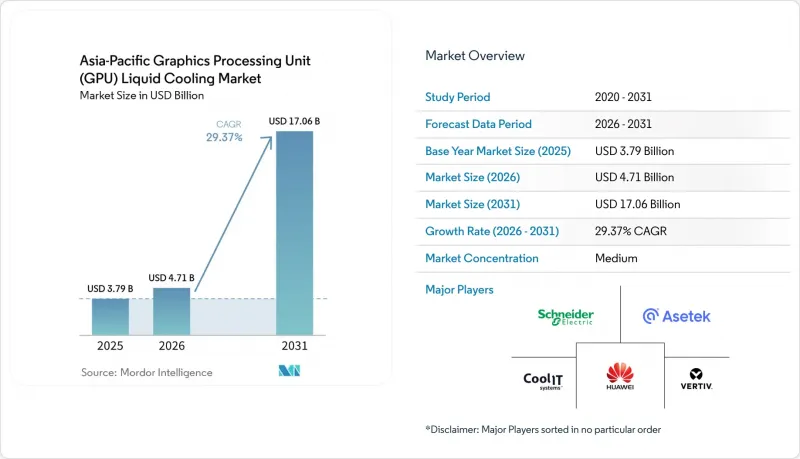
본 보고서는 냉각 방식별(단상 액체 냉각, 2상 액체 냉각), 냉각 수준별(컴포넌트 수준 냉각, 서버/랙 수준 냉각), 배포 방식별(하이퍼스케일/클라우드, 기업, 엣지 AI, 기타), GPU 전력 밀도별(300W 미만, 300W-700W, 700W 이상) 및 지역별로 분류되어 있습니다. 시장 전망은 금액(달러) 기준으로 제시되어 있습니다.
아시아태평양의 GPU 액체 냉각 시장 동향 및 인사이트
AI 주도형 하이퍼스케일 확장이 액체 냉각식 기술의 도입을 주도하고 있습니다.
알리바바, 삼성SDS, OpenAI 및 Global Switch는 랙당 전력 소비량이 100kW를 초과하고, GPU의 전력 소비량이 최대 1,200와트에 달하는 시설을 운영하고 있습니다. 이러한 환경에서는 공랭식으로는 경제성을 확보할 수 없습니다. 알리바바의 Feitian 플랫폼은 이미 10만 대 이상의 GPU를 침지 탱크 내에서 PUE 1.09로 가동하고 있으며, 이를 통해 시설의 에너지 비용을 약 절반으로 절감하고 있습니다. 삼성SDS는 2026년 3월, 구미에 60메가와트 규모의 AI 캠퍼스 건설에 착공했습니다. 이 프로젝트에서는 4,273억 원(3억 2,000만 달러)을 하이브리드 액체 냉각식 인프라에 투자하며, DTC(Direct to Chip) 시스템에 대한 장기적인 신뢰성을 강조하고 있습니다. Global Switch Hong Kong은 30메가와트의 액체 냉각 용량을 증설한 반면, 싱가포르의 Nxera사 DC Tuas는 정부 주도의 AI 워크로드를 위해 58메가와트의 온수 루프를 설치했습니다. 따라서 아시아태평양의 GPU 액체 냉각 시장은 하이퍼스케일러의 동향을 따르고 있습니다. 모델 크기가 커짐에 따라, 냉각 예산은 최적화에서 공기 냉각 시스템의 완전한 대체로 전환되고 있습니다.
동아시아 및 동남아시아 전역의 에너지 효율 관련 규제
일본 경제산업성은 2030년까지 PUE 1.4, 2029년 이후의 신규 건설에 대해서는 PUE 1.3을 의무화하고 있으며, 이에 따라 습도가 높은 기후 조건에서 기존의 칠러 사용은 사실상 금지됩니다. 중국의 칠러용 에너지 라벨 제도와 각 성의 전력 할당 제도 역시 마찬가지로, 실 수준이 아닌 칩 수준에서 열을 제거하는 시설을 우대하고 있습니다. 레노버의 ‘Neptune’은 45℃의 흡기 온도에서 작동하기 때문에 운영자는 폐열을 재활용할 수 있으며, 시설 전력 소비량의 최대 40%를 차지하는 칠러를 우회함으로써 새로운 탄소 예산 요건을 충족할 수 있습니다. 싱가포르의 ‘그린 데이터센터 로드맵’은 신규 전력 할당을 검증된 PUE 개선과 연계함으로써 추가적인 압박을 가하고 있습니다. 그 결과, 아시아태평양의 GPU 액체 냉각 시장은 전력 및 부지 확보를 위한 전제조건으로서 효율성을 추구하는 정책의 혜택을 받고 있습니다.
기존 시설에 대한 막대한 초기 설비 투자와 개보수의 복잡성
DTC 방식으로의 개조 비용은 1kW당 500-800달러로, 공랭식 방식에서 업그레이드하는 비용의 2배 이상에 달하므로, 가동 시간을 유지하면서 단계적으로 전환해야 합니다. 운영자는 배관을 위한 구조 보강, 펌프를 위한 전기 설비 업그레이드, 소화 설비의 재검토가 필요한 경우가 많으며, 이로 인해 투자 회수 기간이 3-5년으로 늘어남에 따라 랙 밀도가 50kW 미만인사이트에서는 도입을 주저하게 만드는 요인이 되고 있습니다. 맞춤형 설계는 규모의 경제성을 저해하기 때문에 많은 기존 시설 소유주들은 단계적인 개보수를 실시하기보다는 열적 한계에 의해 전면적인 이전을 할 수밖에 없게 될 때까지 기다리는 경향이 있습니다.
부문별 분석
2025년 기준으로, 아시아태평양의 GPU 액체 냉각식 시장 점유율의 74.51%를 단일 상 솔루션이 차지했으며, 이러한 입지는 표준 시설 인프라와 통합된 성숙한 물 순환 시스템을 기반으로 합니다. Lenovo Neptune 및 HPE ProLiant XD685는 45°C의 흡입 온도에서 작동하며, PUE를 1.1 수준으로 유지하고, 냉수 플랜트에 정통한 직원들에게 익숙한 유지보수 모델을 제공합니다. 2상 시스템은 2025년에는 25.49%에 그칠 것으로 예상되지만, ZutaCore와 미쓰비시 중공업이 랙 수준에서 부분 PUE를 1.01 수준으로 억제하고, 화이트 스페이스에서 시설용수를 제거하는 데 성공함에 따라 연평균 성장률(CAGR) 32.17%라는 놀라운 속도로 확대되고 있습니다.
NVIDIA GB200이나 AMD MI300X와 같은 칩은 1,000와트의 벽을 돌파하고 있습니다. 이 임계값에 도달하면 물의 열적 여유가 제한되고, 필요한 유량으로 인해 펌프에 막대한 전력이 필요해지기 때문에 기존의 냉각 방식으로는 효율이 떨어집니다. 이에 따라 대체 냉각 솔루션, 특히 2상 냉각 시스템에 대한 관심이 높아지고 있습니다. 통신사들의 ZutaCore에 대한 투자와 Train의 LiquidStack 인수는 업계에서 결정적인 전환점을 여실히 보여주고 있습니다. HVAC 업계의 거대 기업들이 보여준 이러한 전략적 움직임은 효율성과 확장성을 높이는 2상 냉각 로드맵에 대한 그들의 확신을 강조하고 있습니다. 그 결과, 아시아태평양의 GPU 액체 냉각 시장은 2028년까지 유전성 유체로 전환될 것으로 예상되며, 이는 냉각 기술 분야의 큰 변화를 상징하게 될 것입니다.
2025년, 아시아태평양의 GPU 액체 냉각 시장에서 부품 수준의 콜드플레이트가 55.72%를 차지했습니다. 이는 하이퍼스케일러 각사가 개별 칩의 최적화에 주력하고 있는 경향과 일치합니다. 이러한 콜드 플레이트는 칩 단위의 냉각을 제공하도록 설계되어 있으며, 하이퍼스케일 환경에서 GPU의 높은 발열을 관리하는 데 필수적입니다. 이 분야의 유력한 솔루션인 Supermicro의 DLC-2는 서버 발열량의 92%를 배출할 수 있는 능력을 자랑합니다. 이 기능을 통해 사업자는 대규모 랙 개조 없이도 GPU 노드와 CPU 노드를 원활하게 통합할 수 있게 됩니다. 한편, 콜로케이션 사업자들은 열 제거 공정의 효율성을 높이기 위해 랙 단위의 냉각수 분배 장치(CDU) 도입을 확대되고 있습니다. 이러한 유닛들은 열 제거를 공유 서비스로 취급하여, 운영을 간소화하고 효율을 높이는 집중형 냉각 방식을 제공합니다.
ZutaCore사의 2메가와트 엔드-오브-로우 CDU나 CoolIT사의 CHx500 스택과 같은 랙 레벨 솔루션은 Equinix나 STT GDC와 같은 주요 사업자들의 개보수 작업에서 필수적인 요소로 자리 잡고 있습니다. 이러한 솔루션을 통해 시설 소유주는 계측, 유지보수, 서비스 수준 계약(SLA)과 같은 중요한 측면을 지속적으로 관리할 수 있게 됩니다. 랙 수준의 서비스 제공이 연평균 성장률(CAGR) 31.60%로 확대되는 가운데, 시장에서는 냉각 전략에 큰 변화가 나타나고 있습니다. 임차인들은 랙별로 개별적으로 배관을 설치하는 방식에서 벗어나, 대신 CaaS(Cooling as a Service)를 이용하고 있습니다. 이 모델은 고성능 컴퓨팅 수요를 뒷받침하기 위해 확장 가능하고 효율적인 냉각 솔루션이 필요한 멀티테넌트 AI 클러스터로 시장 전환 추세와 부합합니다.
기타 혜택 :
- Excel 형식 시장 예측(ME) 시트
- 3개월간의 애널리스트 지원
자주 묻는 질문
목차
제1장 서론
제2장 분석 방법
제3장 주요 요약
제4장 시장 구도
제5장 시장 규모 및 성장률 예측
제6장 경쟁 구도
제7장 시장 기회 및 향후 전망
AJYAccording to Mordor Intelligence, the asia-Pacific graphics processing unit (GPU) liquid cooling market size is expected to grow from USD 3.79 billion in 2025 to USD 4.71 billion in 2026 and is forecast to reach USD 17.06 billion by 2031 at 29.37% CAGR over 2026-2031.
This report is Segmented by Cooling Type (Single-Phase Liquid Cooling, and Two-Phase Liquid Cooling), Cooling Level (Component-Level Cooling, and Server/Rack-Level Cooling), Deployment (Hyperscale/Cloud, Enterprise, Edge AI, and More), GPU Power Density (Below 300W, 300W-700W, and Above 700W), and Geography. The Market Forecasts are Provided in Terms of Value (USD).
Asia-Pacific Graphics Processing Unit (GPU) Liquid Cooling Market Trends and Insights
Mainstream AI-Led Hyperscale Expansions Drive Liquid-Cooling Adoption
Alibaba, Samsung SDS, OpenAI, and Global Switch are commissioning facilities where racks surpass 100 kilowatts, and GPUs draw up to 1,200 watts, a regime that renders air cooling uneconomic. Alibaba's Feitian platform already operates more than 100,000 GPUs in immersion tanks at PUE 1.09, cutting facility energy bills by roughly one-half. Samsung SDS broke ground on a 60 megawatt AI campus in Gumi in March 2026 that allocates KRW 427.3 billion (USD 320 million) to hybrid liquid infrastructure, underscoring long-term confidence in direct-to-chip systems. Global Switch Hong Kong added 30 megawatts of liquid-cooled capacity, while Nxera's DC Tuas in Singapore installed 58 megawatts of warm-water loops for sovereign AI workloads. The Asia-Pacific GPU liquid cooling market, therefore, follows hyperscalers' cadence: as model sizes inflate, cooling budgets shift from optimization to outright replacement of air systems.
Mandatory Energy-Efficiency Regulations Across East and South-East Asia
Japan's Ministry of Economy, Trade, and Industry requires PUE 1.4 by 2030 and PUE 1.3 for new builds from 2029, effectively outlawing traditional chillers in humid climates. China's energy labeling for chillers and its provincial power-quota regime likewise favor facilities that remove heat at the chip rather than at the room level. Lenovo's Neptune operates at 45 °C inlets, letting operators reuse waste heat, bypass chillers that consume up to 40% of facility power, and meet emerging carbon budgets. Singapore's Green Data Center Roadmap adds further pressure by tying new electricity allotments to demonstrated PUE improvements. Consequently, the Asia-Pacific GPU liquid cooling market benefits from a policy that makes efficiency a prerequisite for power and land access.
High Up-Front Capex and Retrofit Complexity for Brownfield Facilities
Direct-to-chip retrofits cost USD 500-USD 800 per kilowatt, more than double air-cooling upgrades, and demand phased cutovers that must preserve uptime. Operators often need structural reinforcement for pipes, electrical upgrades for pumps, and revised fire suppression, stretching payback to three to five years and deterring sites with rack densities below 50 kilowatts. Custom engineering erodes economies of scale, so many legacy owners wait until thermal ceilings force a wholesale move rather than incremental retrofits.
Other drivers and restraints analyzed in the detailed report include:
- Rapid Growth of Edge-AI Inference Nodes in 5G Networks
- Data-Center Land Constraints in Tier-1 Cities Boost Rack-Level Density
- Limited Skilled Workforce for Liquid-Cooling O&M Across Emerging Markets
For complete list of drivers and restraints, kindly check the Table Of Contents.
Segment Analysis
Single-phase solutions accounted for 74.51% of the Asia-Pacific GPU liquid cooling market share in 2025, a position built on mature water loops that integrate with standard facility infrastructure. Lenovo Neptune and HPE ProLiant XD685 operate at 45 °C inlets, achieve a PUE of near 1.1, and provide a familiar maintenance model for staff already versed in chilled-water plants. Two-phase systems, although only 25.49% in 2025, are racing ahead at 32.17% CAGR as ZutaCore and Mitsubishi Heavy Industries prove rack-level partial PUE near 1.01 and remove facility water from the white space.
Chips such as the NVIDIA GB200 and AMD MI300X are pushing past the 1,000-watt mark. At this threshold, water's thermal headroom becomes limited, and the required flow rates demand significant pump power, making traditional cooling methods less efficient. This has led to increased interest in alternative cooling solutions, particularly two-phase cooling systems. Carrier's investment in ZutaCore, coupled with Trane's acquisition of LiquidStack, underscores a pivotal shift in the industry. These strategic moves by HVAC behemoths highlight their confidence in two-phase cooling roadmaps, which offer enhanced efficiency and scalability. As a result, the Asia-Pacific GPU liquid cooling market is expected to pivot towards dielectric fluids by 2028, marking a significant transformation in cooling technologies.
In 2025, component-level cold plates accounted for 55.72% of the Asia-Pacific GPU liquid cooling market, aligning with hyperscalers' focus on optimizing individual chips. These cold plates are designed to provide per-chip cooling, which is critical for managing the high heat output of GPUs in hyperscale environments. Supermicro's DLC-2, a prominent solution in this space, boasts the ability to extract 92% of server heat. This capability allows operators to seamlessly integrate GPU and CPU nodes without requiring extensive rack modifications. On the other hand, colocation operators are increasingly adopting rack-level coolant distribution units (CDUs) to streamline heat removal processes. These units treat heat removal as a shared service, offering a centralized approach to cooling that simplifies operations and enhances efficiency.
Rack-level solutions, such as ZutaCore's 2 megawatt end-of-row CDU and CoolIT's CHx500 stack, are becoming integral to retrofits by major players like Equinix and STT GDC. These solutions enable landlords to maintain control over critical aspects such as metering, maintenance, and service level agreements (SLAs). With rack-level offerings growing at a 31.60% CAGR, the market is witnessing a significant shift in cooling strategies. Tenants are moving away from individually plumbing racks and are instead subscribing to cooling as a service. This model aligns with the market's transition toward multi-tenant AI clusters, which demand scalable and efficient cooling solutions to support their high-performance computing needs.
List of Companies Covered in this Report:
- CoolIT Systems Inc.
- Asetek A/S
- Vertiv Holdings Co.
- Schneider Electric SE
- Huawei Technologies Co., Ltd.
- Iceotope Technologies Limited
- Submer Technologies Sl.
- LiquidStack Holdings, Inc.
- ZutaCore Ltd.
- JetCool Technologies Inc.
- Boyd Corporation
- Fujitsu Limited
- Inspur Electronic Information Industry Co., Ltd.
- Mitsubishi Electric Corporation
- Sugon Information Industry Co., Ltd.
- Rittal GmbH & Co. KG
- Green Revolution Cooling Inc.
- Lenovo Group Limited
- Hewlett Packard Enterprise Company
- Alibaba Cloud (Alibaba Group Holding Limited)
Additional Benefits:
- The market estimate (ME) sheet in Excel format
- 3 months of analyst support
TABLE OF CONTENTS
1 INTRODUCTION
- 1.1 Study Assumptions and Market Definition
- 1.2 Scope of the Study
2 RESEARCH METHODOLOGY
3 EXECUTIVE SUMMARY
4 MARKET LANDSCAPE
- 4.1 Market Overview
- 4.2 Market Drivers
- 4.2.1 Mainstream AI-led Hyperscale Expansions Drive Liquid-Cooling Adoption
- 4.2.2 Mandatory Energy-Efficiency Regulations Across East and South-East Asia
- 4.2.3 Rapid Growth of Edge-AI Inference Nodes in 5G Networks
- 4.2.4 Data-Center Land Constraints in Tier-1 Cities Boost Rack-Level Density
- 4.2.5 Availability of Turn-key Liquid-Ready Colocation Capacity
- 4.2.6 Advancements in Coolant Chemistry Enabling Non-Conductive Two-Phase Designs
- 4.3 Market Restraints
- 4.3.1 High Up-Front Capex and Retrofit Complexity for Brownfield Facilities
- 4.3.2 Limited Skilled Workforce for Liquid-Cooling O&M Across Emerging Markets
- 4.3.3 Supply-Chain Bottlenecks in Precision Cold Plates and Quick Disconnects
- 4.3.4 PFAS Regulatory Uncertainty for Two-Phase Dielectric Fluids
- 4.4 Industry Value / Supply-Chain Analysis
- 4.5 Impact of Macroeconomic Factors on the Market
- 4.6 Regulatory Landscape
- 4.7 Technological Outlook
- 4.8 Porter's Five Forces Analysis
- 4.8.1 Bargaining Power of Suppliers
- 4.8.2 Bargaining Power of Buyers
- 4.8.3 Threat of New Entrants
- 4.8.4 Threat of Substitutes
- 4.8.5 Competitive Rivalry
5 MARKET SIZE AND GROWTH FORECASTS (VALUE)
- 5.1 By Cooling Type
- 5.1.1 Single-Phase Liquid Cooling
- 5.1.2 Two-Phase Liquid Cooling
- 5.2 By Cooling Level
- 5.2.1 Component-Level Cooling
- 5.2.2 Server / Rack-Level Cooling
- 5.3 By Deployment
- 5.3.1 Hyperscale / Cloud
- 5.3.2 Enterprise
- 5.3.3 Government and Research (HPC)
- 5.3.4 Edge AI
- 5.4 By GPU Power Density
- 5.4.1 Below 300W
- 5.4.2 300W - 700W
- 5.4.3 Above 700W
- 5.5 By Geography
- 5.5.1 China
- 5.5.2 Japan
- 5.5.3 South Korea
- 5.5.4 India
- 5.5.5 Southeast Asia
- 5.5.6 Rest of Asia-Pacific
6 COMPETITIVE LANDSCAPE
- 6.1 Market Concentration
- 6.2 Strategic Moves
- 6.3 Market Share Analysis
- 6.4 Company Profiles (includes Global Level Overview, Market Level Overview, Core Segments, Financials as available, Strategic Information, Market Rank/Share, Products and Services, Recent Developments)
- 6.4.1 CoolIT Systems Inc.
- 6.4.2 Asetek A/S
- 6.4.3 Vertiv Holdings Co.
- 6.4.4 Schneider Electric SE
- 6.4.5 Huawei Technologies Co., Ltd.
- 6.4.6 Iceotope Technologies Limited
- 6.4.7 Submer Technologies Sl.
- 6.4.8 LiquidStack Holdings, Inc.
- 6.4.9 ZutaCore Ltd.
- 6.4.10 JetCool Technologies Inc.
- 6.4.11 Boyd Corporation
- 6.4.12 Fujitsu Limited
- 6.4.13 Inspur Electronic Information Industry Co., Ltd.
- 6.4.14 Mitsubishi Electric Corporation
- 6.4.15 Sugon Information Industry Co., Ltd.
- 6.4.16 Rittal GmbH & Co. KG
- 6.4.17 Green Revolution Cooling Inc.
- 6.4.18 Lenovo Group Limited
- 6.4.19 Hewlett Packard Enterprise Company
- 6.4.20 Alibaba Cloud (Alibaba Group Holding Limited)
7 MARKET OPPORTUNITIES AND FUTURE OUTLOOK
- 7.1 White-Space and Unmet-Need Assessment