

|
시장보고서
상품코드
2065610
컴포저블 HCM 플랫폼 시장 : 시장 점유율 분석, 업계 동향 및 통계, 성장 예측(2026-2031년)Composable HCM Platform - Market Share Analysis, Industry Trends & Statistics, Growth Forecasts (2026 - 2031) |
||||||
 Mordor Intelligence
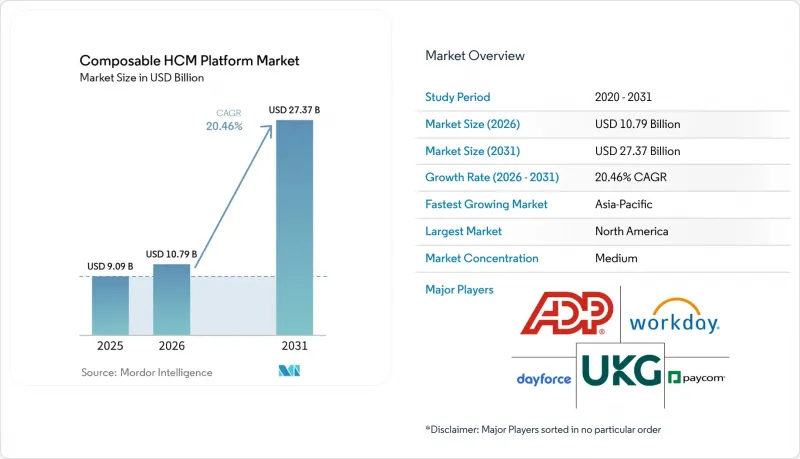
Mordor Intelligence에 의하면, 컴포저블 HCM 플랫폼 시장 규모는 2025년에 90억 9,000만 달러로 평가되었고, 2026년에 107억 9,000만 달러로 추정되고, 2031년까지 273억 7,000만 달러에 이를 것으로 예측되며, 2026-2031년 CAGR 20.46%로 성장할 전망입니다.
본 보고서는 구성 요소별(플랫폼 소프트웨어, 서비스 등), 도입 모델별(클라우드 기반 등), 기업 규모별(대기업, 중소기업), 기능 모듈별(핵심 HR 및 직원 기록 관리 등), 최종 사용자 산업별(헬스케어 및 생명과학 등), 지역별로 분류되어 있습니다. 시장 전망치는 금액(달러)으로 표시되어 있습니다.
세계의 컴포저블 HCM 플랫폼 시장 동향 및 인사이트
클라우드 네이티브 모듈형 HR 아키텍처로의 전환
컴포저블 HCM 플랫폼 시장이 성장세를 보이고 있는 이유는 많은 기업들이 하나의 프로세스가 변경될 때마다 플랫폼 전체를 업그레이드해야 하는 인사 시스템을 더 이상 원하지 않기 때문입니다. 기존의 HR 스택에서는 변경이 있을 때마다 밀접하게 연동된 여러 시스템에 영향을 미치기 때문에 정책 개정, 규정 준수 업데이트 또는 분석 요청이 있을 때마다 비용이 증가하는 경우가 많습니다. 컴포저블 HCM 플랫폼 시장은 마이크로서비스, API 우선 설계, 클라우드 네이티브 배포 및 헤드리스 용도 아키텍처의 보급에 힘입어, 조직은 인접한 워크플로우를 중단시키지 않고도 단일 모듈을 교체할 수 있게 되었습니다. 워크데이는 2025년 9월, 이러한 방향으로 방향을 전환하며 ‘Workday Build’를 출시했습니다. 이를 통해 해당 기업의 애플리케이션, 데이터, AI 인프라가 개방되어 고객과 파트너가 개발한 확장 기능을 플랫폼에서 직접 활용할 수 있게 되었습니다. SAP SuccessFactors는 2026년 상반기 릴리스를 통해, 보다 느슨하게 결합된 서비스 모델을 바탕으로 채용, 급여 계산, 교육, 노무 관리 등 각 분야에 걸친 AI 에이전트를 연동함으로써 이러한 방향성을 한층 더 강화했습니다. 점점 더 많은 기업이 모듈을 하나씩 현대화해 나감에 따라, 이후 인사 관련 변경에 수반되는 비용과 업무에 미치는 영향은 감소하는 추세를 보이고 있으며, 이로 인해 장기적인 도입 주기에서 컴포저블 HCM 플랫폼 시장의 우위가 더욱 강화되고 있습니다.
AI를 활용한 인재 계획 및 인재 분석에 대한 수요 증가
컴포저블 HCM 플랫폼 시장은 정적인 인사 보고서에서 능동적인 인력 의사결정 지원으로의 명확한 전환에 힘입어 성장하고 있습니다. 조직은 현재, 서로 연계되지 않은 시스템 간이 아닌, 단일한 거버넌스가 확립된 환경 내에서 인건비, 직원 수, 역량 및 경영 성과를 연계할 수 있는 계획 도구를 필요로 하고 있습니다. 2026년 3월 Workday가 Sana의 일반 제공을 시작한 것은 주요 벤더들이 단일 인터페이스를 통해 다단계 인사 및 재무 업무를 처리할 수 있는 정책에 부합하는 AI 에이전트를 어떻게 구축하고 있는지를 보여줍니다. SAP는 2026년 5월, 경영진(C-suite)의 62%가 인재 데이터와 실적 간의 연계 방식에 불만을 가지고 있다고 보고했으며, 이는 현재의 기업 운영 모델에 실질적인 격차가 존재함을 보여줍니다. 수요가 가장 빠르게 증가하고 있는 분야는 시나리오 기획과 인건비 모델링 분야이며, 기업들은 인력 배치 결정을 내리기 전에 다양한 인력 구성 방안을 검토하고자 합니다. 이 계획 레이어가 도입되면 통합된 직원 데이터의 가치가 급속히 높아질 것이며, 그 결과 구성 가능한 HCM 플랫폼 시장은 인력 인텔리전스의 발전과 밀접하게 연계된 상태를 유지하게 될 것입니다.
데이터 개인정보 보호, AI 거버넌스 및 알고리즘 감사의 부담
컴포저블 HCM 플랫폼 시장은 AI를 활용한 채용, 성과 평가 및 계획 수립 도구에 수반되는 거버넌스상의 부담으로 인해 실질적인 제약에 직면해 있습니다. 현재, 기업은 자동화된 시스템이 고용 결정에 영향을 미치는 경우, 모델의 논리를 문서화하고, 감사 추적을 보관하며, 명확한 인적 감독을 유지해야 합니다. 이러한 부담은 특히 유럽에서 두드러지는데, EU AI법에서는 고용 관련 AI 도구가 고위험 애플리케이션으로 분류되어, 시장에 출시하기 전에 문서화 및 적합성 요건을 충족해야 합니다. 따라서, 컴포저블 HCM 플랫폼 시장에서는 규정 준수 관리 체제가 성숙한 벤더가 조달 및 법무 심사를 원활하게 진행할 수 있기 때문에 시장을 더욱 신속하게 확대되고 있습니다. 신규 진출기업 중에서도 강력한 AI 기능을 제공하는 곳이 있지만, 구매자가 보안, 거버넌스, 설명 가능성 요건을 검증하는 과정에서 많은 기업이 더 긴 심사 주기에 직면하고 있습니다. 규제가 엄격한 업계에서는 거버넌스 체계의 구축 현황이 초기 선별 요인으로 작용하고 있어, 상세한 기능 평가 단계까지 진출하는 벤더의 수가 줄어들고 있습니다.
부문별 분석
2025년에는 플랫폼 소프트웨어가 매출의 67.42%를 차지했으며, 컴포저블 HCM 플랫폼 시장에서 이 분야는 여전히 구매자들의 지출 중심을 이루었습니다. 기업은 우선 핵심 고객층을 우선시했습니다. 이는 API 오케스트레이션, 로우코드 기반 설정, 워크플로우 제어 및 인력 데이터 관리가 시스템의 다른 부분들이 얼마나 원활하게 연동될 수 있는지를 결정하기 때문입니다. 이 분야에 대한 지출에는 단순히 인터페이스를 늘리는 데 그치는 독립형 포인트 도구보다 통합 기능을 갖춘 HR 인프라가 확실히 선호되고 있다는 점도 반영되어 있었습니다. 소프트웨어 계층 내에서 핵심을 이루는 구성 가능한 HCM 플랫폼과 API·통합 오케스트레이션 플랫폼은 아키텍처 전체의 상호 운용성 한계를 결정짓기 때문에 여전히 가장 가치가 높은 하위 계층으로 남아 있습니다. 또한, 대기업들이 특정 HR 활용 사례에서 가치를 실현하는 데 걸리는 시간을 단축할 수 있는 미리 구축된 비즈니스 기능을 요구함에 따라 마켓플레이스와 확장성 플랫폼도 주목을 받게 되었습니다.
서비스 분야는 2025년 시점에서는 비교적 소규모였으나, 2031년까지 연평균 성장률(CAGR) 20.66%를 나타낼 것으로 예측되어, 컴포저블 HCM 플랫폼 업계가 라이선스 수익에만 그치지 않고 확대되고 있음을 보여줍니다. 컴포저블 HCM 플랫폼 시장에서는 도입 범위가 더 광범위한 워크플로로 확대되고, 사내 인사팀만으로는 감당하기 어려울 정도의 설정 지원이 필요해짐에 따라 서비스 수요가 증가하는 추세입니다. 이러한 경향이 중요한 이유는 도입, 자문, 관리형 서비스가 대부분의 경우 초기 소프트웨어 도입 후에도 장기간에 걸쳐 지속되기 때문입니다. 워크플로우 자동화 및 프로세스 오케스트레이션으로 인해 이러한 수요는 더욱 확대되고 있습니다. 이는 조직이 승인 절차, 규정 준수 대응, 데이터 흐름 설정을 개발자의 지속적인 개입 없이 수행할 수 있기를 점점 더 요구하고 있기 때문입니다. 장기적으로는 수익 구조가 여전히 플랫폼 소프트웨어에 치우칠 가능성이 있지만, 서비스 수익은 벤더와 파트너들이 컴포저블 HCM 플랫폼 시장에서 사업을 전개하는 데 있어 계속해서 중요한 요소가 될 것입니다.
2025년에는 클라우드 기반 도입이 매출의 72.18%를 차지했으며, 컴포저블 HCM 플랫폼 시장의 주요 모델로 자리매김했습니다. 구매자들은 설비 투자를 줄이고, 업그레이드 주기를 공급업체의 출시 일정에 맞출 수 있기 때문에 구독형 인프라를 선호했습니다. 또한, 벤더가 보다 일관된 업데이트 주기를 유지함으로써 새로운 구성 요소를 연결하기가 쉬워졌기 때문에 클라우드 도입은 시장의 모듈식 설계 논리와도 잘 부합했습니다. 반면, 직원 데이터나 급여 처리가 엄격하게 관리되는 정부 기관, 국방 기관, 중요 인프라 환경에서는 온프레미스 구축이 여전히 중요하게 여겨지고 있습니다. 이러한 예외로 인해 도입 방식의 선택은 아키텍처에 대한 선호도뿐만 아니라 규제 상황에도 좌우되게 되었습니다.
하이브리드 방식은 2031년까지 연평균 성장률(CAGR) 21.47%로 확대될 것으로 예상되며, 컴포저블 HCM 플랫폼 시장에서 가장 빠르게 성장하는 모델로 자리매김하고 있습니다. 많은 기업들은 규제 대상 데이터를 On-Premise에 남겨둔 채, 분석, 협업, 확장성 계층을 우선 클라우드 환경으로 이전하는 단계적 접근 방식을 선호합니다. 이러한 패턴은 국가별 데이터 상주 규정에 따라 퍼블릭 클라우드로의 완전한 전환이 지연될 가능성이 있는 유럽 및 아시아태평양에서 특히 중요합니다. 따라서, 컴포저블 HCM 플랫폼 시장은 온프레미스에서 클라우드로 일직선으로 나아가고 있는 것은 아닙니다. 하이브리드 구조는 전환 위험이나 규정 준수상의 제약에 직면한 조직에게 실용적인 가교 역할을 하기 때문입니다. 지역 클라우드 인프라가 구축됨에 따라 일부 하이브리드 사용자들은 클라우드 전용 서비스로 더욱 전환해 나갈 것이지만, 예측 기간 동안 하이브리드는 여전히 견고한 선택지로 남을 것입니다.
지역별 분석
2025년, 북미는 컴포저블 HCM 플랫폼 시장의 39.86%를 차지했으며, 최대 지역 부문이 되었습니다. 그 수요의 대부분은 미국이 차지하고 있는데, 이는 미국 기업들이 API 우선형 HR 아키텍처의 초기 도입자였으며, 다중 모듈 배포를 지원하는 탄탄한 벤더 생태계를 갖추고 있었기 때문입니다. 기술, 금융 서비스, 헬스케어 분야의 주요 기업들은 핵심 HR, 급여 계산, 분석, 인재 관리를 통합된 데이터 구조 내에서 지속적으로 연계하고 있으며, 이를 통해 구성 가능한 HCM 플랫폼 시장은 해당 지역에서 확고한 기반을 계속 다지고 있습니다. 캐나다에서는 여러 주에 걸쳐 규정 준수 자동화에 대한 관심이 점점 더 높아지고 있으며, 멕시코에서는 제조 및 유통 분야의 인력 디지털화가 수요를 견인했습니다. 이러한 지역적 우위는 클라우드 인프라의 높은 보급률과, 기업들이 기존 HR 핵심 시스템에서 전환하는 데 적극적인 태도를 보이고 있다는 점도 반영하고 있습니다.
아시아태평양은 2031년까지 연평균 성장률(CAGR) 24.89%를 나타낼 것으로 예측되며, 컴포저블 HCM 플랫폼 시장에서 가장 빠르게 성장하는 지역이 될 것입니다. 이러한 성장은 인도 및 동남아시아 지역의 중소기업들의 급속한 디지털화, 일본, 한국, 호주 등 여러 국가에 걸친 급여 계산 시스템의 현대화, 그리고 해당 지역 전반에 걸친 헬스케어 플랫폼에 대한 투자 확대에 기인합니다. 중국은 여전히 중요한 시장이지만, 그 동향은 지역별 클라우드 도입 옵션을 갖춘 아키텍처를 우선시하는 현지화 규제에 의해 형성되고 있습니다. 인도에서도 분산된 직원을 관리하는 기술 서비스 수출 기업이나 세계 역량 센터에서 수요가 나타나고 있는 반면, 노동 집약적 부문에서는 보다 유기적으로 연계된 인사 운영으로의 전환이 진행되고 있습니다. 2026년 5월 테크 마힌드라가 UKG와 체결한 제휴는 아시아태평양을 거점으로 하는 서비스 및 기술 역량이 해당 지역을 훨씬 넘어선 도입 양상에 점점 더 큰 영향을 미치고 있음을 보여줍니다.
유럽에서는 컴포저블 HCM 플랫폼 시장에서 규정 준수 중심의 성장이 진행되고 있습니다. 2026년 6월 7일, EU 임금 투명성 지침에 따른 국내법 반영 기한을 앞두고, 고용주들은 보다 적절한 직무 체계와 임금 데이터 인프라를 구축해야 할 압박을 받고 있습니다. 독일, 영국, 프랑스, 네덜란드 및 북유럽 국가들은 기업 규모가 크고, 관리된 노동력 데이터에 대한 기대치가 더 엄격한 점이 맞물려 여전히 주요 수요 거점으로 자리 잡고 있습니다. 남미는 여전히 신흥 지역이지만, 브라질은 대규모 기업 기반과 복잡한 급여 계산 의무로 인해 규정 준수와 관련된 급여 계산 자동화에 대한 수요가 크게 증가하고 있다는 점에서 두드러집니다. 중동도 계속해서 성장세를 보이고 있으며, 사우디아라비아와 아랍에미리트가 이를 주도하고 있습니다. 이들 국가에서는 노동력 현지화 프로그램에 따라, 노동력 구성에 관한 상세한 보고의 필요성이 높아지고 있습니다. 아프리카는 여전히 초기 단계에 있지만, 남아프리카공화국과 나이지리아는 급여 계산의 복잡성과 여러 관할권에 걸친 규정 준수 요건으로 인해 모듈식 인사 인프라의 명확한 활용 사례가 나타나고 있어, 더 빠르게 발전하고 있습니다.
기타 혜택 :
- 엑셀 형식 시장 예측(ME) 시트
- 3개월간의 애널리스트 지원
자주 묻는 질문
목차
제1장 서론
제2장 조사 방법
제3장 주요 요약
제4장 시장 구도
제5장 시장 규모 및 성장 예측
제6장 경쟁 구도
제7장 시장 기회 및 향후 전망
LSH 26.06.24According to Mordor Intelligence, the composable HCM platform market size is projected to be USD 9.09 billion in 2025, USD 10.79 billion in 2026, and reach USD 27.37 billion by 2031, growing at a CAGR of 20.46% from 2026 to 2031.
This report is Segmented by Component (Platform Software, and Services), Deployment Model (Cloud-Based, and More), Enterprise Size (Large Enterprises, and Small and Medium Enterprises), Functional Module (Core HR & Employee Record Management, and More), End-User Industry Vertical (Healthcare and Life Sciences, and More), and Geography. The Market Forecasts are Provided in Terms of Value (USD).
Global Composable HCM Platform Market Trends and Insights
Shift Toward Cloud-Native Modular HR Architecture
The composable HCM platform market is gaining traction because many enterprises no longer want HR systems that require full platform upgrades whenever one process changes. Older HR stacks often make each policy revision, compliance update, or analytics request more costly because every change touches multiple tightly linked systems. The composable HCM platform market benefits from the spread of microservices, API-first design, cloud-native delivery, and headless application architectures, enabling organizations to replace a single module without disrupting adjacent workflows. Workday moved in this direction in September 2025, when it launched Workday Build, which opened the company's applications, data, and AI infrastructure to customer- and partner-built extensions directly on the platform. SAP SuccessFactors reinforced this direction in its 1H 2026 release by linking AI agents across recruiting, payroll, learning, and workforce administration through a more loosely coupled service model. As more enterprises modernize one module at a time, the cost and disruption of later HR changes tend to decline, strengthening the case for the composable HCM platform market over a longer adoption cycle.
Rising Demand for AI-Driven Workforce Planning And People Analytics
The composable HCM platform market is also being driven by a clear shift from static HR reporting to active workforce decision support. Organizations now want planning tools that can connect labor costs, headcount, skills, and operating outcomes in a single, governed environment rather than across disconnected systems. Workday's general availability launch of Sana in March 2026 showed how leading vendors are building policy-aware AI agents that can complete multi-step HR and finance tasks from a single interface. SAP reported in May 2026 that 62% of C-suite executives were dissatisfied with how people data connects to business performance, indicating a real gap in current enterprise operating models. Demand is rising fastest in scenario planning and labor cost modeling, where companies want to test workforce options before making staffing decisions. Once this planning layer is adopted, the value of unified employee data rises quickly, which keeps the composable HCM platform market closely tied to advances in workforce intelligence.
Data Privacy, AI Governance, and Algorithm Audit Burdens
The composable HCM platform market faces a real constraint due to the governance burden associated with AI-based hiring, performance, and planning tools. Companies now have to document model logic, preserve audit trails, and maintain clear human oversight when automated systems influence employment decisions. This burden is especially strong in Europe, where the EU AI Act classified employment-related AI tools as high-risk applications and set documentation and conformity obligations before market placement. The composable HCM platform market, therefore, moves faster for vendors with mature compliance controls, as they can progress through procurement and legal review with less friction. Newer entrants may still offer strong AI functionality, but many face longer review cycles when buyers test security, governance, and explainability requirements. In regulated industries, governance readiness is becoming an early screening factor, which reduces the number of vendors that reach a detailed functional evaluation.
Other drivers and restraints analyzed in the detailed report include:
- Expansion of Multi-Country Payroll and Compliance Automation Needs
- Frontline and Distributed Workforce Digitization
- Legacy HR and Payroll Migration Complexity
For complete list of drivers and restraints, kindly check the Table Of Contents.
Segment Analysis
Platform software accounted for 67.42% of revenue in 2025, keeping this part of the composable HCM platform market at the center of buyer spending. Enterprises prioritized the core layer first because API orchestration, low-code configuration, workflow control, and workforce data management determine how well the rest of the system can connect. Spending in this area also reflected a clear preference for integration-capable HR foundations rather than stand-alone point tools that add more interfaces. Within the software layer, core composable HCM platforms and API and integration orchestration platforms remained the most valuable sub-tiers because they set the interoperability ceiling for the full architecture. Marketplace and extensibility platforms also gained more attention as large employers sought pre-built business capabilities that shortened time-to-value across specific HR use cases.
Services remained smaller in 2025, but they are projected to grow at a 20.66% CAGR through 2031, indicating that the composable HCM platform industry is expanding beyond license revenue alone. The composable HCM platform market tends to drive greater service demand as implementations expand into a broader set of workflows and require more configuration support than internal HR teams can sustain. This pattern matters because implementation, advisory, and managed services often continue long after the initial software deployment. Workflow automation and process orchestration are helping expand this need since organizations increasingly want approval chains, compliance actions, and data flows configured without constant developer involvement. Over time, the revenue balance may still favor platform software, but service income should remain an important part of how vendors and partners participate in the composable HCM platform market.
Cloud-based deployment accounted for 72.18% of revenue in 2025, making it the leading model in the composable HCM platform market. Buyers favored subscription-based infrastructure because it reduces capital spending and aligns upgrade cycles with vendor release schedules. Cloud adoption also aligned well with the market's modular design logic, since new components are easier to connect when vendors maintain a more consistent update rhythm. At the same time, on-premises deployment still has relevance in government, defense, and critical infrastructure environments where employee data and payroll processing are tightly controlled. These exceptions kept deployment choice tied to regulatory context rather than to architecture preference alone.
Hybrid deployment is projected to expand at a 21.47% CAGR through 2031, which makes it the fastest-growing model in the composable HCM platform market. Many enterprises prefer a phased approach in which regulated data remains on-premises while analytics, collaboration, and extensibility layers move to the cloud first. This pattern is especially relevant in Europe and the Asia-Pacific region, where country-specific residency rules can slow a full shift to public cloud. The composable HCM platform market is therefore not moving in a straight line from on-premises to the cloud, because hybrid structures offer a practical bridge for organizations dealing with migration risk and compliance constraints. As regional cloud infrastructure deepens, some hybrid users will move further toward cloud-only delivery, but hybrid should remain a durable choice through the forecast period.
Geography Analysis
North America accounted for 39.86% of the composable HCM platform market in 2025, making it the largest regional segment. The United States accounted for most of that demand because enterprises there were early adopters of API-first HR architecture and had a dense vendor ecosystem to support multi-module deployment. Large organizations in technology, financial services, and healthcare continued to connect core HR, payroll, analytics, and talent management within unified data structures, keeping the composable HCM platform market firmly anchored in the region. Canada gained momentum from growing interest in multi-provincial compliance automation, while Mexico saw demand driven by workforce digitization in manufacturing and distribution environments. This regional lead also reflected stronger cloud infrastructure penetration and greater willingness among enterprises to move away from legacy HR cores.
Asia-Pacific is projected to expand at a 24.89% CAGR through 2031, which makes it the fastest-growing geography in the composable HCM platform market. Growth is coming from rapid SME digitization in India and Southeast Asia, multi-country payroll modernization in Japan, South Korea, and Australia, and rising healthcare platform investment across the region. China remains important, but its path is shaped by localization rules that favor architectures with regional cloud deployment options. India is also seeing demand from technology services exporters and global capability centers that manage distributed workforces, while labor-intensive sectors are moving toward more connected HR operations. Tech Mahindra's May 2026 partnership with UKG showed how APAC-based service and technology capabilities are increasingly influencing deployment patterns well beyond the region.
Europe is moving through a more compliance-driven expansion in the composable HCM platform market, with the June 7, 2026, transposition deadline under the EU Pay Transparency Directive pushing employers toward better job architecture and pay data infrastructure. Germany, the United Kingdom, France, the Netherlands, and the Nordic countries remain the main demand centers because they combine enterprise scale with stricter expectations around governed workforce data. South America is still an emerging geography, but Brazil stands out because its large enterprise base and complex payroll obligations create strong demand for compliance-linked payroll automation. The Middle East is also expanding, led by Saudi Arabia and the United Arab Emirates, where workforce nationalization programs are increasing the need for detailed workforce composition reporting. Africa remains at an earlier stage, but South Africa and Nigeria are moving faster as payroll complexity and multi-jurisdiction compliance needs create clearer use cases for modular HR infrastructure.
- Automatic Data Processing, Inc.
- Bamboo HR LLC
- Cegid Group
- Cornerstone OnDemand, Inc.
- Darwinbox Digital Solutions Private Limited
- Dayforce, Inc.
- Deel Inc.
- Sage People
- Lattice
- Hi Bob, Inc.
- isolved, inc.
- Paychex, Inc.
- Paycom Software, Inc.
- Paycor HCM, Inc.
- Paylocity Holding Corporation
- Personio SE and Co. KG
- Remote Technology, Inc.
- Rippling People Center Inc.
- UKG Inc.
- Workday, Inc.
- Zellis UK Limited
Additional Benefits:
- The market estimate (ME) sheet in Excel format
- 3 months of analyst support
TABLE OF CONTENTS
1 INTRODUCTION
- 1.1 Study Assumptions and Market Definition
- 1.2 Scope of the Study
2 RESEARCH METHODOLOGY
3 EXECUTIVE SUMMARY
4 MARKET LANDSCAPE
- 4.1 Market Overview
- 4.2 Impact of Macroeconomic Factors on the Market
- 4.3 Market Drivers
- 4.3.1 Shift Toward Cloud-Native Modular HR Architecture
- 4.3.2 Rising Demand for AI-Driven Workforce Planning and People Analytics
- 4.3.3 Expansion of Multi-Country Payroll and Compliance Automation Needs
- 4.3.4 Frontline and Distributed Workforce Digitization
- 4.3.5 EU Pay Transparency Readiness and Pay Equity Reporting
- 4.3.6 Low-Code Marketplace Extensions and Packaged HR Capabilities
- 4.4 Market Restraints
- 4.4.1 Data Privacy, AI Governance, and Algorithm Audit Burdens
- 4.4.2 Legacy HR and Payroll Migration Complexity
- 4.4.3 Suite Vendor Marketplace Lock-In Risk
- 4.4.4 Country-Level Payroll and Benefits Rule Fragmentation
- 4.5 Industry Value-Chain Analysis
- 4.6 Regulatory Landscape
- 4.7 Technological Outlook
- 4.8 Porter's Five Forces Analysis
- 4.8.1 Bargaining Power of Buyers
- 4.8.2 Bargaining Power of Suppliers
- 4.8.3 Threat of New Entrants
- 4.8.4 Threat of Substitutes
- 4.8.5 Intensity of Competitive Rivalry
5 MARKET SIZE AND GROWTH FORECASTS (VALUE)
- 5.1 By Component
- 5.1.1 Platform Software
- 5.1.1.1 Core Composable HCM Platforms
- 5.1.1.2 API and Integration Orchestration Platforms
- 5.1.1.3 Workflow Automation and Process Orchestration Engines
- 5.1.1.4 Low-code/No-code HR Configuration Platforms
- 5.1.1.5 Workforce Data Fabric and Intelligence Platforms
- 5.1.1.6 Marketplace and Extensibility Platforms
- 5.1.2 Services
- 5.1.1 Platform Software
- 5.2 By Deployment Model
- 5.2.1 Cloud-based
- 5.2.2 On-premise
- 5.2.3 Hybrid
- 5.3 By End User Enterprise Size
- 5.3.1 Large Enterprises
- 5.3.2 Small and Medium Enterprises
- 5.4 By Functional Module
- 5.4.1 Core HR and Employee Record Management
- 5.4.2 Payroll, Compensation and Benefits
- 5.4.3 Talent Acquisition and Recruiting
- 5.4.4 Talent Management and Internal Mobility
- 5.4.5 Workforce Management and Labor Optimization
- 5.4.6 Learning and Workforce Development
- 5.4.7 Workforce Intelligence, Analytics and Planning
- 5.4.8 Employee Experience, HR Service Delivery and Workflow Automation
- 5.4.9 Integration and Workflow Orchestration
- 5.4.10 Workforce Data Fabric and Employee Identity Management
- 5.5 By End user Industry Vertical
- 5.5.1 BFSI
- 5.5.2 Healthcare and Life Sciences
- 5.5.3 Information Technology and Telecom
- 5.5.4 Retail and E-commerce
- 5.5.5 Industrial Manufacturing
- 5.5.6 Government and Public Sector
- 5.5.7 Other End-user Industries
- 5.6 By Geography
- 5.6.1 North America
- 5.6.1.1 United States
- 5.6.1.2 Canada
- 5.6.1.3 Mexico
- 5.6.2 South America
- 5.6.2.1 Brazil
- 5.6.2.2 Argentina
- 5.6.2.3 Rest of South America
- 5.6.3 Europe
- 5.6.3.1 Germany
- 5.6.3.2 United Kingdom
- 5.6.3.3 France
- 5.6.3.4 Italy
- 5.6.3.5 Spain
- 5.6.3.6 Russia
- 5.6.3.7 Netherlands
- 5.6.3.8 Rest of Europe
- 5.6.4 Asia-Pacific
- 5.6.4.1 China
- 5.6.4.2 Japan
- 5.6.4.3 India
- 5.6.4.4 South Korea
- 5.6.4.5 Australia and New Zealand
- 5.6.4.6 Rest of Asia-Pacific
- 5.6.5 Middle East
- 5.6.5.1 Saudi Arabia
- 5.6.5.2 United Arab Emirates
- 5.6.5.3 Rest of Middle East
- 5.6.6 Africa
- 5.6.6.1 South Africa
- 5.6.6.2 Nigeria
- 5.6.6.3 Rest of Africa
- 5.6.1 North America
6 COMPETITIVE LANDSCAPE
- 6.1 Market Concentration
- 6.2 Strategic Moves
- 6.3 Market Share Analysis
- 6.4 Company Profiles (includes Global Level Overview, Market Level Overview, Core Segments, Financials as available, Strategic Information, Market Rank/Share, Products and Services, Recent Developments).
- 6.4.1 Automatic Data Processing, Inc.
- 6.4.2 Bamboo HR LLC
- 6.4.3 Cegid Group
- 6.4.4 Cornerstone OnDemand, Inc.
- 6.4.5 Darwinbox Digital Solutions Private Limited
- 6.4.6 Dayforce, Inc.
- 6.4.7 Deel Inc.
- 6.4.8 Sage People
- 6.4.9 Lattice
- 6.4.10 Hi Bob, Inc.
- 6.4.11 isolved, inc.
- 6.4.12 Paychex, Inc.
- 6.4.13 Paycom Software, Inc.
- 6.4.14 Paycor HCM, Inc.
- 6.4.15 Paylocity Holding Corporation
- 6.4.16 Personio SE and Co. KG
- 6.4.17 Remote Technology, Inc.
- 6.4.18 Rippling People Center Inc.
- 6.4.19 UKG Inc.
- 6.4.20 Workday, Inc.
- 6.4.21 Zellis UK Limited
7 MARKET OPPORTUNITIES AND FUTURE OUTLOOK
- 7.1 White-space and Unmet-Need Assessment


